
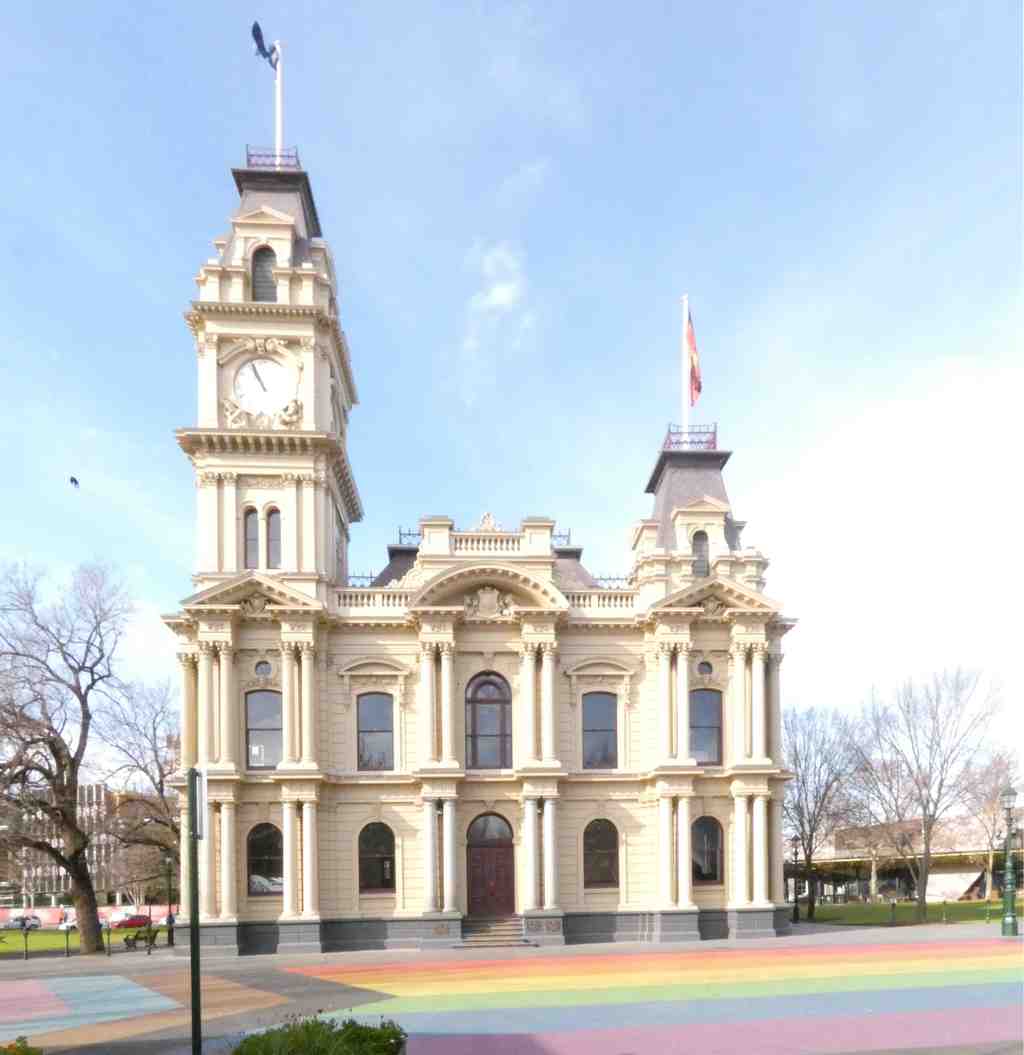
As you walk along Bull Street, keep an eye to your left. You’ll easily spot the imposing structure of the Bendigo Town Hall. Its creamy façade and grandiose architecture dominate the scene. The most prominent feature is the tall clock tower on the left side of the building, which immediately draws your attention. The building is adorned with intricate details and classical decorative elements, giving it a grandiose and historic appearance. The mansard roofs and the flag flying high add to its distinctive character.
Now, let’s dive into its fascinating history. The Bendigo Town Hall, prominently located at the intersection of Bull Street and Hargreaves Street, is considered one of the finest Victorian-era Second Empire buildings in Australia. Originally designed in 1859 by Bendigo's town clerk, George Avery Fletcher, it initially included a council chamber added in 1866 and a hall for trading grain, known as the Corn Exchange, added in 1871-72. Despite its majestic architecture, the completed building wasn't a hit with the locals.
Enter William Vahland, the architect extraordinaire tasked with transforming this hall to reflect Bendigo’s status as the "City of Gold". Between 1878 to 1902, Vahland gave the Town Hall a spectacular makeover, adding extensive new offices, enlarging the main hall and council chambers, and introducing an elaborate interior decorative scheme. A clock tower and mansard roofs were added to the mix.
The cherry on top? The hall’s interior, designed by Otto Waschatz, featured decorative plaster adorned with 22-carat gold leaf - quite fitting for a gold-rich city! This dazzling transformation was completed in 1885, making it one of Vahland’s most significant works.
After an extensive restoration and renovation program in 2003, it was returned to its 19th-century splendor, complete with restored plaster works, murals, and gold leaf. Today, the Bendigo Town Hall houses the council chambers and administrative activities of the City of Greater Bendigo. Quite the glow-up, right?




