
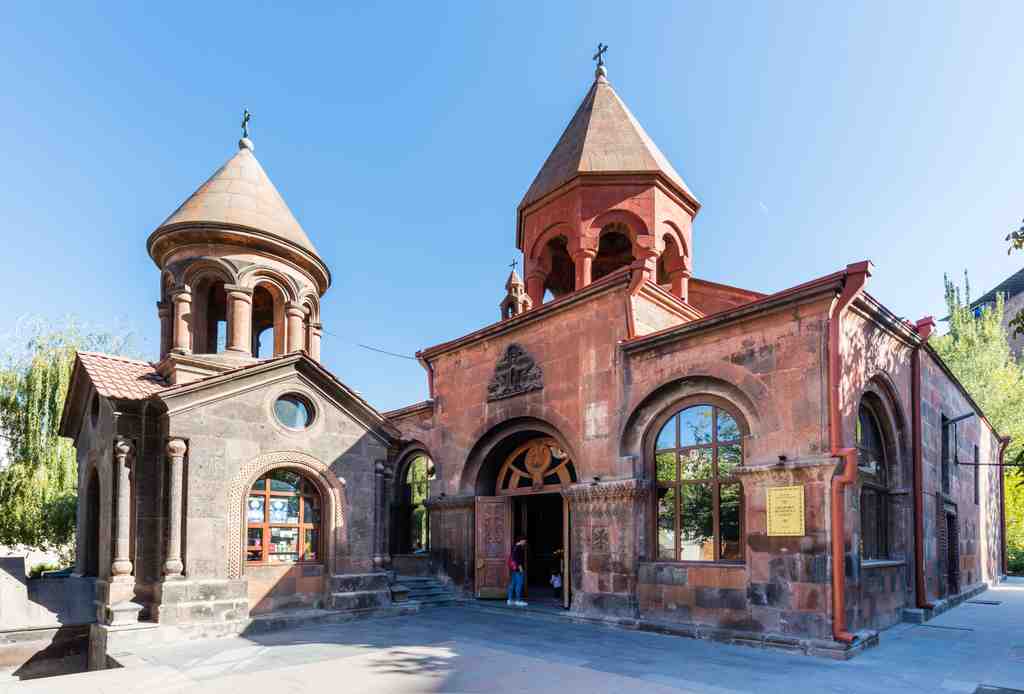
If you’re looking for the Zoravor Surp Astvatsatsin Church, glance ahead for a building proudly displaying Armenia’s iconic rose tufa stone. Its warm, reddish-brown walls stand out, topped by two pointed, conical roofs-one larger and centered, the other off to the left. Broad arches frame the windows and the entrance, and you’ll spot a carved cross above the main door. Its calm and sturdy presence sits just where the trees start to part, as if inviting you in.
Now, imagine yourself a few centuries back, standing right in this busy district of Old Yerevan. Horses would clop past, dust swirling in the hot air. In front of you rises the Zoravor Surp Astvatsatsin Church, second oldest in the whole city-older than some of your favorite action movie quotes! But don't let the plain stone fool you; this church has more stories tucked in its walls than a library with a leaky roof.
Originally called Surp Astvatsatsin, or Holy Mother of God, it earned the nickname "Zoravor"-which means "Powerful"-because it once protected a special 13th-century Bible. Just picture it: priests and monks, whispering prayers, worried that invaders-or an earthquake-might snatch away their precious book.
This site has always been a sanctuary. Long ago, there was a chapel holding the tomb of Ananias the Apostle, and people truly believed it was a safe haven. The entire complex, built in the 1600s thanks to generous locals, was like a fortress of faith, with thick walls and a lively community. Imagine the laughter from the monastic school as children scurried to lessons, their voices echoing against the stone.
Don’t get too comfortable, though. In 1679, an earthquake hit, shaking this whole area, and the monastery collapsed. It must have felt like the world was ending-can you feel the ground tremble beneath your feet? But just like in a good comeback story, the people of Yerevan rolled up their sleeves and rebuilt this church in 1693. They even added the beautiful khachkars-look along the outer walls for these old cross-stones, each one with its own secret patterns and legends.
For years, the church changed roles-a bit like an actor playing many parts. During Soviet times, it paused its religious duties, but eventually, in the 1970s, the church was returned to its original purpose and got a full makeover. The walls and roof were patched up, a choir space was added, and Saint Ananias Chapel was brought back to life.
If you listen closely, maybe through the doorway you’ll hear the quiet murmur of prayers or the faint, solemn ring of a church bell-echoing down through centuries right to this moment. Welcome to Zoravor Surp Astvatsatsin, where the stones themselves seem to hum with faith, courage, and a little bit of mystery. And yes, the walls really have seen it all-even earthquakes! Ready to walk further into Yerevan’s secrets?


