
Wycieczka audio po Maladze: Historie i pomniki w sercu portu
W blasku słońca Malagi starożytne sekrety pulsują wzdłuż szerokich bulwarów i lśniących nabrzeży – jeśli wiesz, gdzie patrzeć. Ta wycieczka audio z przewodnikiem zmienia zwykły spacer z Puerto de Málaga na Plaza de la Marina w podróż przez skandaliczne historie, morskie legendy i ukryte zakątki. Odkryj opowieści, które umykają nawet rodowitym mieszkańcom. Kto zorganizował śmiały spisek w cieniu Latarni w Maladze? Jaki tajemniczy relikt spoczywa w Muzeum Alborania, czekając na odczytanie? I dlaczego tutejsza fontanna wywołała gorący bunt wieki temu? Przemierzaj Malagę śladami dawnych spiskowców, podążając za echem politycznych intryg i morskich przygód. Od tętniących życiem placów po zapomniane zaułki – każdy krok odsłania dramat, tajemnicę i duszę miasta. Czy jesteś gotów podążyć za ukrytym pulsem Malagi i spojrzeć na nią nowymi oczami? Twoja podróż zaczyna się teraz.
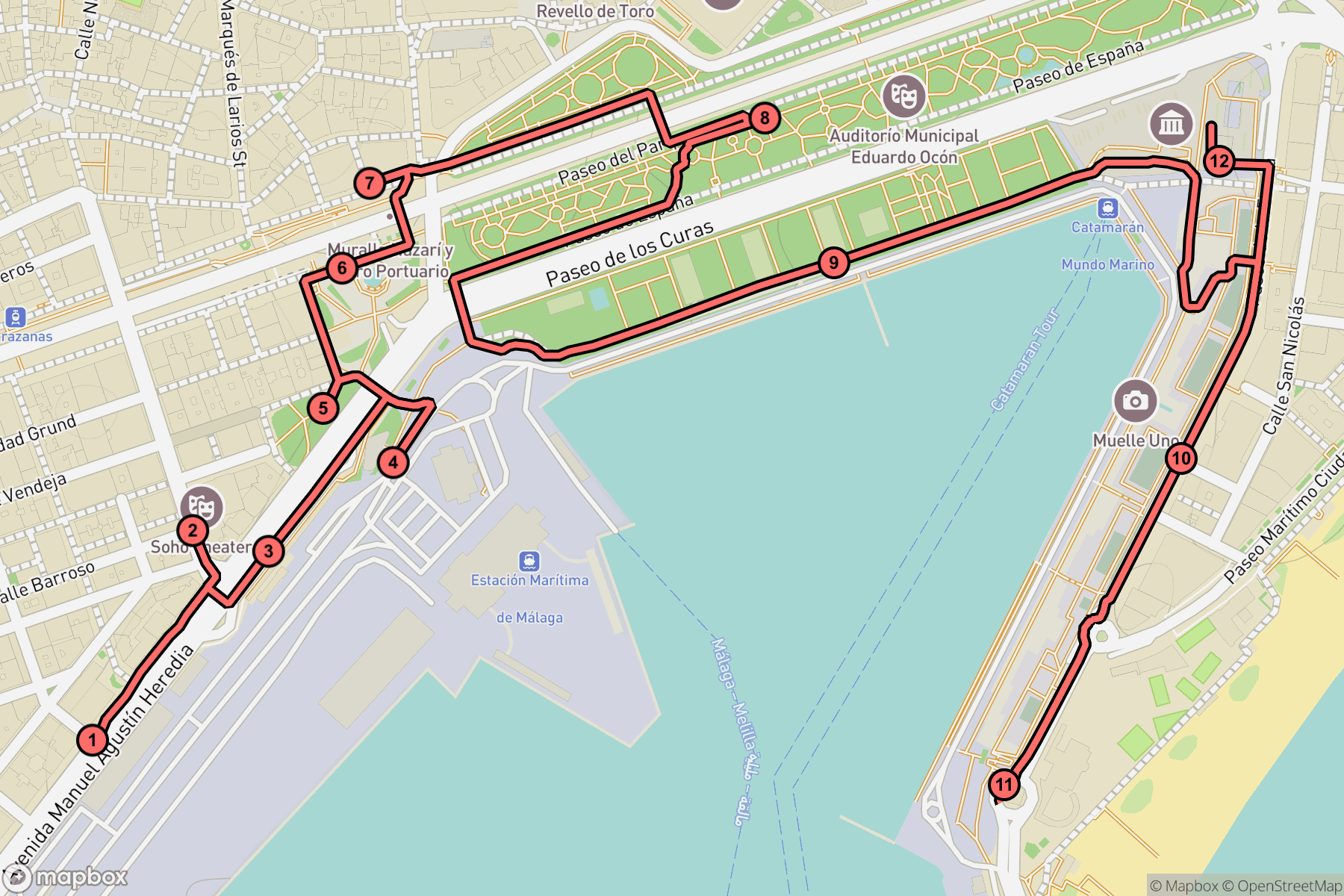
Podgląd trasy
O tej trasie
- scheduleCzas trwania 40–60 minsIdź we własnym tempie
- straighten3.7 km trasy pieszejPodążaj wyznaczoną trasą
- location_on
- wifi_offDziała offlinePobierz raz, korzystaj gdziekolwiek
- all_inclusiveDożywotni dostępOdtwarzaj ponownie w dowolnym momencie
- location_onStart przy Aleja Manuela Agustína Heredii
Przystanki na tej trasie
To spot Manuel Agustin Heredia Avenue, look out for the wide boulevard stretching ahead with rows of tall, elegant columns, palm trees, and a grand avenue where cars glide beneath…Czytaj więcejPokaż mniej
To spot Manuel Agustin Heredia Avenue, look out for the wide boulevard stretching ahead with rows of tall, elegant columns, palm trees, and a grand avenue where cars glide beneath the warm glow of early evening lights. Welcome to Manuel Agustin Heredia Avenue, one of Malaga's grand gateways and a true lifeline of the city. Take a moment to soak in your surroundings: imagine the wide, bustling avenue beneath your feet, the gentle shadows of the tall columns stretching across the pavement, and the swaying palm trees offering a bit of shade from the Mediterranean sun. It feels alive, doesn't it? Like the city's very own heartbeat. But believe it or not, if you were standing here just a couple hundred years ago, you’d have had to watch your step-not for traffic, but for loose sand. That’s right, this grand avenue was once nothing but a sandy stretch, with waves lapping at the edge and hardly a building in sight! The original vision for this place was born thanks to the Sociedad Propagandística del Clima de Málaga-a fancy-sounding club of people who decided, “You know what this city needs? Benches. And trees. Lots and lots of trees.” So they planted and they built, following the fashion of 19th-century boulevards-big, broad, and lined with leafy greenery to keep the summer heat at bay. Now, as the avenue grew and Malaga flourished, so did its importance. It came to separate two vital parts of the city: the commercial buzz of Ensanche Centro-built in the Jazz Age of 1929-and the mighty Puerto de Málaga, where ships from far-off lands still dock to unload their cargo. This is one of Malaga’s most travelled routes, running right alongside the Carretera N-340, which is pretty much the "main artery" of the city! If you ever feel lost in Malaga, just follow the sound of honking horns and distant bus brakes, and you’ll probably end up here. But the real heart of this avenue is in its name: Manuel Agustín Heredia. Picture a 19th-century industrial tycoon with an iron will and a taste for progress. Heredia was a hometown hero who helped turbocharge Malaga into the age of industry-with smelters blazing and factories roaring like dragons. His family must have thought, “This guy deserves more than just a pat on the back,” because they commissioned a monument in his honor. The monument’s quite a sight-just up ahead at the junction with Alameda de Colón. There stands Heredia, cast from iron in his own factory. He holds a scroll that says Constantia et labore-which means "With work and perseverance, anything is possible." Words to live by, especially next Monday morning, am I right? His statue’s base is covered with symbolic carvings, lovingly highlighting all the domains Heredia mastered: industry, commerce, navigation, and the arts. There’s even a nod to Thanatos, the Greek god of death-perhaps to remind us that time waits for no one, not even industrial giants. The statue’s journey was a saga in itself. First it stood at Heredia’s factory door; then it moved to Málaga’s lush city park; then, in a final twist (after a few centuries of city debate), it returned here to the avenue named for him, keeping a stoic watch as traffic flows endlessly by. Back in the day, this avenue came alive with even more excitement-at the start of the 20th century, it was the very spot where Malaga celebrated its famous Feria. You’d have found music, laughter, market stalls, dancers, and fireworks lighting up the night. These days, while the party might have moved, you’ll still catch the occasional street performer or festival breezing through-adding a festive touch to the hum of daily life. Look across the street, and you can spot some fantastic buildings with stories of their own: from a 1950s union headquarters to the center of maritime authority-all witnesses to the avenue’s changing face. And rumor has it, with new plans for port expansions buzzing in the air, who knows how this avenue will evolve next? So as you stand here, take in the rustling palm leaves, the echo of distant laughter, and the endless parade of city life. You’re not just looking at a road-you’re standing on Malaga’s living timeline, marching forward thanks to generations of dreamers, doers, and, apparently, really enthusiastic tree-planters. Onward to our next stop!
Otwórz dedykowaną stronę →To spot Teatro del Soho, look for a modern building with a tall, rusty-red metallic facade full of tiny holes and bold white columns just under the trees on your right. Now, as…Czytaj więcejPokaż mniej
To spot Teatro del Soho, look for a modern building with a tall, rusty-red metallic facade full of tiny holes and bold white columns just under the trees on your right. Now, as you stand in front of this striking theatre, let’s take a little journey through time together! Imagine the street a century ago-back in 1907, when a wave of excitement washed over Málaga because a little place called Cine Pascualini had just opened here. People flocked from all over, eager to see Hollywood’s latest movies flickering on a silver screen. But peace didn’t last long; during the Spanish Civil War, bombs rained down, and everything was lost in a rumble of chaos. But like a good plot twist, this spot wasn’t done yet. By the 1940s, laughter and joyful screams filled the air as the site transformed into a buzzing amusement park called the Crystal Palace. Then, in the '50s, you could enjoy balmy summer nights at Terraza Alameda, an open-air cinema where dreams were projected under the stars. Sometimes even the circus rolled into town, so if you hear an elephant trumpet in your imagination, you’re not far off. On December 22, 1961, the Alameda Theatre made its dazzling debut with the opera “La serva padrona.” For nearly sixty years, it became Málaga’s stage for comedy, drama, ballet, jazz, and more-it was a cultural chameleon, even hosting the lively Carnival and film festivals with audiences cheering, laughing, sometimes even crying. But every great act must pause. The curtains closed for the last time as Teatro Alameda in May 2018. Enter Málaga’s own superstar-Antonio Banderas-who transformed the space into Teatro del Soho. He poured his heart (and a hefty two million euros) into remaking it for a grand modern era. With 896 seats, a tailor’s studio for costumes, and even a chic bar, the theatre sparkled to life once more in November 2019 with the glitzy musical “A Chorus Line.” It even hosted the glamorous Goya Awards in 2021, when cameras flashed and Málaga felt just a bit like Hollywood once again. Life here has always been dramatic. Well, what do you expect from a place owned by Zorro?
Otwórz dedykowaną stronę →To spot the Jardines de Alfonso Canales, look for a lush, sun-dappled garden framed by palm trees and benches, and right in front, you can’t miss the big “drunken” tree with its…Czytaj więcejPokaż mniej
To spot the Jardines de Alfonso Canales, look for a lush, sun-dappled garden framed by palm trees and benches, and right in front, you can’t miss the big “drunken” tree with its barrel-shaped trunk! Welcome to the Jardines de Alfonso Canales, a little oasis with just the right mix of poetry, mystery, and, well, chubby trees. Legend says that the star of this garden, the Chorisia insignis-sometimes called the “Palo Borracho” or “Drunken Stick”-sailed all the way from South America, probably hitching a ride with a mariner who couldn’t resist showing it off at the entrance to Málaga’s port. With neighbors like the bitter orange, palm trees swaying above, vibrant pink oleanders, and those bright red Christmas stars (the pascuero), it’s almost as if you’re standing in a living, breathing botanical postcard. Pause for a second-the gentle splash you hear is from the elegant fountain presiding over the garden, and nearby, the proud bust of Malaga’s poet Alfonso Canales, carved by sculptor Jaime Fernández Pimentel, gives the space its thoughtful spirit. Breathe in the perfume of citrus and the sea breeze as you sit on a bench-just watch out for one of those falling spiky pods from the Palo Borracho! There’s a quiet magic here, where poems once whispered under the branches drift on the breeze, joining the exotic history of ships, sailors, and seeds from places far away. If gardens could write postcards, this one’s would say, “Wish you were here!”
Otwórz dedykowaną stronę →
Pokaż jeszcze 9 przystankówPokaż mniej przystankówexpand_moreexpand_less
To spot Plaza de la Marina, just look ahead for a wide, open square lined with palm trees, large bright columns, and modern features like a circular fountain and a sheltered…Czytaj więcejPokaż mniej
To spot Plaza de la Marina, just look ahead for a wide, open square lined with palm trees, large bright columns, and modern features like a circular fountain and a sheltered walkway-right in front of you at the heart of Málaga, with the port and sea as its backdrop. Welcome to Plaza de la Marina! Stand still a moment and take in the buzz of Málaga’s very heart-if this place feels busy, that’s because it’s always been the city’s crossroads, where the ocean breeze meets the energy of downtown. Picture this: it all began centuries ago, when the ground beneath your feet was the end of the old Muslim city walls and not so much a grand plaza but a messy patchwork of warehouses, humble market stalls, and barrels of Málaga wine stacked sky-high. You’re standing where, for hundreds of years, merchants from Genoa set up a bustling little fortress-the Castil de Ginoveses-to keep trade secure and profits even safer! Imagine sailors unloading crates of juicy oranges, sweet raisins, and all kinds of salted fish, with the cries of dealers echoing through the salty air. As the centuries ticked by, the walls crumbled-sometimes helped along by people eager for progress and sometimes simply by old age. By the 19th century, Málaga decided it was time to look a little more civilized and started snatching land back from the sea, expanding outward, and crowning this very spot as the Plaza de la Marina. The vibe changed from chaos to a pinch of elegance, with wealthy merchants snapping up land for their grand new houses, while steam-powered trams, horse-drawn at first, clanged bells as they trundled by. If you had stood here then, you’d have smelled fresh-baked bread and oranges mingling with the sea air-a little less organized chaos, a little more style. For a long while, the plaza was connected directly to the port, and imagine the wildness: fishmongers hawking their wares side by side with smartly dressed coffee drinkers watching ships glide in. Over there, where shiny hotels and the famous Equitativa building stand, there were once only rows of wine vats and olive oil drums waiting to be shipped. And right where you are standing today, Málaga’s first ever traffic lights blinked into life in the 1950s-no more donkey carts barreling through without stopping! The locals, by the way, are stubbornly attached to the old name "Plaza de la Marina," ignoring any official attempts to rename it for politicians or generals. Take a good look around now: see the tall columns facing the port? They were meant to hold grand vases or even statues, but-surprise!-the city ran out of money. So there they stand, a monument to unfinished dreams and frugal city planning. Further along, you can spot the statue of the Cenachero, a fish seller with baskets forever frozen in motion, and the statue of Hans Christian Andersen, the famous writer who claimed Málaga cheered him up more than any other Spanish city. But this isn’t just a plaza, it’s the beating heart of Málaga’s big events. Come Christmas, this whole square turns into a sparkling celebration, with a giant lit-up tree, bustling markets selling turrón and hand-carved nativity scenes, and, if you listen closely, the gleeful sounds of children as the annual parade passes. During Easter, every cofradía in the city has to parade through here, and stands are set up so locals can get the best seat for processions that slip past, followed by incense smoke and slow drumbeats. Beneath your feet, deep underneath the square, lies an underground car park that was built in the 1980s-yep, you’re literally standing a few meters above centuries of secrets, including pieces of the city’s original medieval wall that were discovered during construction. Think of all the layers beneath you: pirate raids, royal parades, stubborn fishmongers, and now, hundreds of cars snoozing soundly out of the Andalusian sun. So, whether you’re imagining 18th-century merchants, 1950s protesters climbing buildings to raise Andalusian flags, or just wondering where to catch the next bus-Plaza de la Marina is nothing short of the giant, beating heart of Málaga. And don’t worry about getting lost; all roads, and probably most of Málaga’s pigeons, eventually find their way here! To expand your understanding of the etymology, buildings or the public art, feel free to engage with me in the chat section below.
Otwórz dedykowaną stronę →To spot the Estatua de Hans Christian Andersen, just look for a bronze statue of a man in a top hat and bow tie, sitting comfortably on a bench right under the palm trees. Here…Czytaj więcejPokaż mniej
To spot the Estatua de Hans Christian Andersen, just look for a bronze statue of a man in a top hat and bow tie, sitting comfortably on a bench right under the palm trees. Here you are, standing face-to-face with Hans Christian Andersen himself-well, almost! Imagine it’s 1862. Málaga is alive with lively conversations and the scent of the sea drifting in from the port. There’s a gentle murmur of footsteps along the promenade. Into this scene strolls a tall, thin man with a twinkle in his eye and stories to spare, pausing to rest on a sun-warmed bench, marveling at the city around him. This statue, crafted in 2005 by José María Córdoba, captures the famous fairy tale writer just as he might have been-relaxed, inspired, and ready for a new adventure. The Danes commissioned it to celebrate Andersen’s memorable visit to Málaga, a place he described as nowhere else he’d felt happier in Spain. So if you want to hear the secret behind ‘The Little Mermaid’ or maybe just what inspired him here, try sitting beside the statue-just don’t be surprised if you find yourself humming an old fairy tale tune
Otwórz dedykowaną stronę →To spot the Ninfa de la Caracola, look straight ahead for a petite, elegant statue of a maiden sitting atop a fountain, holding a seashell from which water is gently…Czytaj więcejPokaż mniej
To spot the Ninfa de la Caracola, look straight ahead for a petite, elegant statue of a maiden sitting atop a fountain, holding a seashell from which water is gently streaming-she’s perched on a rocky pedestal and surrounded by lush greenery. Now, let’s dive into her story. Imagine yourself here over a century ago, the air filled with the scent of blooming flowers and the distant laughter from Málaga’s lively corralones. The “Ninfa de la Caracola”-or as she was once lovingly called, “La Muñeca”-stands quietly in a sun-dappled glade. She was crafted in France back in the late 1870s, ordered by the visionary engineer José María de Sancha. Picture hardworking blacksmiths at A. Durenne’s foundry in Sommevoire pouring iron into molds, knowing their creation was heading to sunny Spain, not realizing she’d become famous on countless postcards! But this nymph wasn’t always here. She enjoyed her spotlight in Plaza de la Victoria until, in 1922, she was moved to this very park to watch generations of children marvel at the water spilling from her seashell. Life wasn’t always a fairytale, though-by 1970, she’d taken a few knocks and had to leave the stage for some serious repairs. There she waited, gathering dust in storage, as if under a long enchantment. But good things come to those who wait; in 2007, a skilled restorer carefully healed her cracks, and now, she sparkles once more, inviting you to make your own splashy memory in her leafy world. And who knows? Maybe she’ll grant you a drop of good luck!
Otwórz dedykowaną stronę →In front of you, you'll spot a curved building dressed in red and white brick, with strong stone arches and tall windows-just look for a proud semicircular façade with classic…Czytaj więcejPokaż mniej
In front of you, you'll spot a curved building dressed in red and white brick, with strong stone arches and tall windows-just look for a proud semicircular façade with classic columns and a clock above the door! Welcome to the former station of the Malaga suburban railway-imagine yourself standing at the very entrance to Malaga’s port, where more than a hundred years ago, the city was abuzz with excitement. The building in front of you wears its history, with bold Doric columns on pedestals, a grand fronton with a stately clock ticking away the comings and goings of travelers-if you listen close, you might almost hear the. It all began on a winter’s day in 1911; a crowd gathered here, anxious and hopeful, as the foundation stone was laid by the Minister of Public Works, watched by the city’s bigwigs and blessed by Bishop Muñoz de Herrera. There was a whiff of fresh cement and the promise of movement filling the air. The building soon buzzed with life-people running for the train, porters hollering, tickets being clipped, and carriages waiting outside to whisk passengers away. Inside, the architecture blended strength and elegance. White and red walls both echoed the look of nearby buildings, creating a sort of stylish family photo on the Plaza de la Marina. For decades, this was the station where the adventure began: ticket in hand, you might catch a train to Coín, race toward Vélez-Málaga, or daydream your way towards Fuengirola as the tracks clicked away beneath you. Yet by the swinging sixties, the party was over for most of these lines-the world was changing, cars and buses were taking over, and trains fell silent. Only the line to Fuengirola stayed alive, stubbornly rattling on. In 1995, the station got a facelift, swapping whistles and coal smoke for books and meetings as the Institute of Port Studies took up residence. So, as you stand here, think about those old journeys beginning with a rush and a whistle. Maybe, just maybe, the building remembers-and if you ever feel like running for a train, well, you’re in the right place for nostalgia!
Otwórz dedykowaną stronę →To spot the Heredia Pier Station, look just ahead for a long metal canopy above the street with big blue letters spelling out “muelle heredia” and some striking bright orange…Czytaj więcejPokaż mniej
To spot the Heredia Pier Station, look just ahead for a long metal canopy above the street with big blue letters spelling out “muelle heredia” and some striking bright orange columns-you’ll find buses lined up beneath it and plenty of travelers bustling about. Now that you’re standing right in front of the Heredia Pier Station, I want you to imagine the sound of engines idling, the swoosh of doors opening, and the hum of travelers swapping stories about plans, work, or maybe the best spot to get churros in Málaga. This isn’t just any bus stop; it’s the beating heart of the city’s suburban transport-a place where journeys begin and end, 24/7. Back in 1987, when crowds wore bigger hair and songs had even bigger choruses, the city of Málaga and its public transport company decided to build this station, right here on the edge of Muelle 4, borrowing the land straight from the port authorities. This patch of ground would soon see thousands of footsteps-locals heading to nearby towns, kids gossiping on benches, and tourists puzzling over where to catch the seaside bus. The main platform stretches an impressive 120 meters, with a modern roof that keeps you dry even on Málaga’s rare rainy days. Want a quick snack while you wait? You’re in luck-there’s been a bar here for as long as anyone can remember, ready to provide your daily caffeine fix. But here’s the twist: this station might not be here forever. There are secret plans afoot-well, okay, city plans-to eventually move everything, making all the current features easy to pack up and ship to a new home. So, as you stand here today, you’re part of a living movement, perched between Málaga’s historic center and the wide, sunlit port. Wondering where everyone’s off to? Buses go everywhere across the metropolitan area-and nearly every urban line stops nearby, so hopping from old town sights to the port or the park is a breeze. Beneath all the noise and chatter, this stop tells the story of a city always on the move-one foot in the past, one racing eagerly toward tomorrow!
Otwórz dedykowaną stronę →Straight ahead, you’ll spot a sleek, modern glass building with tall windows, nestled among quirky trees-just walk toward the sunlit courtyard and you can’t miss it. Welcome to…Czytaj więcejPokaż mniej
Straight ahead, you’ll spot a sleek, modern glass building with tall windows, nestled among quirky trees-just walk toward the sunlit courtyard and you can’t miss it. Welcome to the Alborania Museum! Imagine you’re a little fish swimming right into the heart of the Mar de Alborán-no need for goggles, just your curiosity. This fascinating place began as the Aula del Mar back in 1989, born out of a big dream: to teach everyone, especially students, why the sea matters so much. The real adventure started when it moved here, to this shining building on the Palmeral de las Sorpresas, right at the port of Málaga, in 2012. Picture yourself stepping inside, greeted by twelve bubbling aquariums brimming with underwater life. Each tank offers a window into a different world, showing the habitats that make the Mar de Alborán such a wild underwater playground. There are creatures with spiky shells, twisting tentacles, and ancient bones-over 1,000 species showing off their weird and wonderful features. Want a little mystery? Don’t miss the teeth of a Megalodon, a shark as big as a city bus-imagine the dentist bills! Or stand beneath a giant whale skull-you’ll feel tiny, let me tell you. For a twist of drama, there are also two giant squid here, immortalized in their “I-swear-it-was-this-big!” glory. There’s even a life-sized ship’s bridge, complete with a radio you can use to “call” fishing boats sailing in the bay. It’s the closest you’ll get to being Captain for a day without risking a sea monster encounter! All this tells a story not just about curious sea life, but of Málaga’s age-old relationship with the deep blue sea-full of danger, discovery, and the never-ending call to protect these waters. Dive in, and let your imagination swim wild!
Otwórz dedykowaną stronę →Ahead of you, look straight down the palm-lined avenue toward the sea-you’ll spot The Lighthouse Walk by following the road until your eyes settle on the bright, white lighthouse…Czytaj więcejPokaż mniej
Ahead of you, look straight down the palm-lined avenue toward the sea-you’ll spot The Lighthouse Walk by following the road until your eyes settle on the bright, white lighthouse at its far end, standing tall and proud against the blue sky. Now, as you stand here, take a deep breath and let the salty breeze drift in from the harbor-this is the famous Paseo de la Farola, a beloved promenade where Málaga’s maritime spirit truly comes to life. Picture this spot nearly two centuries ago: instead of the busy cafés and laughter-filled strolls you hear now, there was the eager clatter of shipbuilders, merchants haggling over fresh catches, and the distant clanging of a chapel bell guiding sailors safely to shore. This avenue gets its name from “La Farola,” the elegant lighthouse you can see gleaming at the end of the walk, which has stood like a steadfast guardian over Málaga since 1817. And here’s a fun fact: it’s one of only two lighthouses in Spain referred to with a feminine name! No wonder she’s a local icon-La Farola doesn’t just shine her light for sailors, she’s also a bit of a diva in lighthouse circles. But there’s more to this walk than shining lights and palm trees. Imagine April 28th, 1929: church bells ring out as the Bishop of Málaga blesses the very first stone of the grand Laboratory of Oceanography, right here at number 47 Paseo de la Farola. Scientists and sea-lovers bustled about with microscopes and measuring jars, ready to unlock the mysteries of the deep. For forty years, this spot was a beacon of marine research, attracting experts from far and wide. It even became an aquarium and museum, bubbling over with curious minds. Picture children pressing their noses to glass tanks, wide-eyed at glowing fish and swirling seaweed. It makes you wonder-if any of those fish heard the bishop’s blessing, maybe that’s why they swam with extra enthusiasm? There’s a hint of drama, too. Later, the building housed the Navy Command and was never officially opened as a full laboratory… talk about an identity crisis! By the way, part of the building was still used by marine scientists, so the spirit of discovery stuck around. For local families, this was a place of curiosity and wonder, while parents swapped stories of research breakthroughs, fishy escapades, and dramatic lab coat mix-ups. Just steps from here stands the Capilla del Puerto-a small, baroque chapel that’s moved more times than a determined game of hide-and-seek. Back in 1593, sailors and dockworkers would stop to pray in the original oratory halfway down the pier, longing for safe journeys and a quick return. By the early 1700s, it was falling apart, so when Málaga’s port was being rebuilt in 1717, they decided to construct a new chapel. The first design had it nearly open on all sides, so even those bobbing on the bay could watch Mass! But, like all great plans, it received tweaks and flourishes over decades-engineers and scholars each adding their own flair until the chapel we see today opened in 1732. Jump ahead to the 1970s-a push for modernization nearly wiped out the chapel altogether, but the people of Málaga wouldn’t let it go. In a remarkable feat of devotion (and patience), the entire building was dismantled stone by stone and reassembled just a short stroll from its original site. That’s dedication! Not to mention that its patron saint has even changed over the years-from the Virgin of Puerto Salvo to the Virgen del Carmen, the protector of mariners. Look up at the windows, and you might even spot the emblems that mark each of these sea-blessed guardians. And did you know the Mediterranean Club, founded in 1873 by a bunch of rowing-obsessed locals, got to build its clubhouse right by La Farola? These sporty folks didn’t just spark Málaga’s love for the sea-they rowed their way into royal favor, earning a special title from King Alfonso XIII in 1893. All along this walk, stories have drifted ashore, swirling together like sea foam. From scientific discoveries and tenacious chapels to the shimmering light of La Farola herself, Paseo de la Farola is where Málaga’s history, heart, and humor meet the open sea-and if you’re very quiet, you might just hear those old sailors, scientists, and sport lovers cheering you on in the breeze.
Otwórz dedykowaną stronę →To spot the Streetlight of Malaga-La Farola-look out for a tall, sturdy white lighthouse standing at the edge of the port, its cylindrical body topped with a lantern, rising…Czytaj więcejPokaż mniej
To spot the Streetlight of Malaga-La Farola-look out for a tall, sturdy white lighthouse standing at the edge of the port, its cylindrical body topped with a lantern, rising proudly above its surroundings. As you stand beneath La Farola, take a moment to breathe in that salty sea breeze; this isn’t just any lighthouse, it’s a star in Malaga’s history, shining here since 1817. Picture the year 1717, when a wooden lantern-a much humbler structure-gave the first flickers of guidance to ships braving the unpredictable coast. The engineer Bartolomé Thurus designed that original beacon, but it was replaced a century later by the engineer Joaquín María Pery y Guzmán, whose creation still stands before you. Imagine the scene in 1884, when a mighty earthquake thundered across Andalusia, causing the lighthouse’s bright eye to go dark. Repairs in 1885 brought back its guiding glow, and even added a home at the base for the brave keeper whose job was never just nine to five-unless you count 31 flashes an hour as overtime! Actually, those 31 flashes are still one of La Farola’s signature moves, thanks to some German engineering flair and Spanish craftsmanship. But this elegant tower has faced real danger. Picture August 1936, the days of the Spanish Civil War-the command came down: “Turn off the light!” The silhouette of La Farola was such a precise landmark, it could guide enemy ships and planes. As if darkness wasn’t enough, it got a makeshift camouflage makeover, painted with blotchy brown patches so even the boldest pilot would have a hard time spotting it in the chaos of war. After battle scars and brave repairs, La Farola stood tall again in 1939. Through the 20th century, the port around it got busier and busier, enclosing the lighthouse in a hive of city activity. Now, beneath your feet, plans are already underway for a new parking garage, and inside, the future Museum of the Port of Malaga is just waiting to welcome its first visitors. In 2023, La Farola was officially declared a monument of cultural interest-finally, a true star on Malaga’s walk of fame. So the next time you see its lantern beam sweep out over the sea, think about all those centuries of storms, wars, repairs, and stories. La Farola isn’t just shining for the ships-it’s shining for you, too.
Otwórz dedykowaną stronę →To spot the Pompidou Centre in Malaga, just look ahead for the striking, glass cube made of colorful panels perched on top of a sleek, modern white building, almost like a giant…Czytaj więcejPokaż mniej
To spot the Pompidou Centre in Malaga, just look ahead for the striking, glass cube made of colorful panels perched on top of a sleek, modern white building, almost like a giant Rubik’s Cube for art lovers. Ah, you've made it to the vibrant heart of Málaga’s port - and there it is, the famous Pompidou Cube, shimmering in the sun like a jewel box filled with creativity! Stand right here, take a deep breath, and soak in the energy, because you’re about to hear a story where French flair, Spanish sun, and modern art all meet for coffee every morning. It all started back in November 2013, with a daring announcement that Málaga would host a new outpost of France’s legendary Centre Pompidou-a first outside of Paris, mind you! Now, you might think the French would be too protective of their art to let it travel, but apparently Paris couldn’t resist the call of the Mediterranean. The deal was simple but bold: for five years, art from the Beaubourg in Paris would take up residence here in Málaga, with exhibitions rotating every couple of years, and thrilling temporary shows sprinkled throughout the year. The gamble? Would Málaga’s people embrace French art like a long-lost aunt at a family fiesta? The answer echoed through the city: over half a million visitors in the first three years! That went so well, the agreement was swiftly renewed in 2018, giving art lovers at least until 2025 to keep wandering its halls. The building itself is another story-El Cubo, as it’s known, emerges where the Paseo de la Farola and Paseo de los Curas meet, a crossroads of sun, sea, and city. Designed by local architects Javier Pérez de la Fuente and Juan Antonio Marín Malavé, its vast, 7,600 square meters are hidden mostly underground. Imagine entering a light-filled, open plaza, then descending into a sanctuary for creativity-like a reverse rabbit hole where you don’t find Wonderland, but instead the wonders of modern and contemporary art. Above you gleams the icon: that enormous, glass-and-steel cube, each face splashed with colored panes as if someone threw a modernist paint party and forgot to stop. This isn’t just a fancy sunroof! In 2015, French artist Daniel Buren installed his piece "Incubé" here, transforming the cube into a beacon for art and a symbol for Málaga itself. When sunlight pours through, the interior fills with radiant color-a reminder that here, light and imagination blend in unpredictable ways. The experience begins on level 0 with its open-access spaces-a shop, lockers for your beach hat, and an area for young adventurers called the Espacio Público Joven. Head downstairs, and you’ll hit the magic: galleries bursting with works collected from masters and rebels of the twentieth and twenty-first centuries. The first semi-permanent exhibition, lovingly called "The Collection," invited visitors to lose themselves among works by Frida Kahlo, Picasso, Magritte, Giacometti, and more. Each room became its own world, drifting from metamorphosis, to self-portraits, to fragmented bodies and faceless men-maybe even a nightmare or two, just to keep things spicy. Then came "Modern Utopias," the show that turned the museum into a train racing through the twentieth century, gathering up dreams, disasters, radical ideas, and off-the-wall sculptures along the way. It’s as if every piece has a secret to whisper: "Remember the joy of living," says Delaunay’s swirling color. "Don’t forget the chaos," grumbles a Picasso canvas. And Chagall’s leap of Icarus? Well, he just wants you to fly… but not too close to the sun. Now, don’t forget the grand staircase leading down to the collection. Each year, local artists are invited to transform it for the Málaga Film Festival, turning what could be an ordinary descent into a parade of wild color and audacious experiments. One year, you’ll step across "Our Future is in the Air"; the next, you might be serenaded by rhythmic melodies rippling along every step. Families with curious kids-take note! There’s always something interactive brewing inside the Espacio Público Joven, from building cities out of moonlight to tracing collages with your fingertips. Admission is free, and if you listen closely, you’ll hear giggles bouncing off the walls. With each temporary exhibition, from Matisse to Miró, from cinema to inflatable architecture, the building pulses with new rhythms-never the same twice, except perhaps for the daily chorus of awed gasps from visitors. So next time you see that colorful cube shining on Málaga’s skyline, you’ll know: behind those panes, a world of imagination is waiting for you to step inside, lose track of time-and maybe, just maybe, come out seeing a shade or two brighter. Yearning to grasp further insights on the building, access staircase or the semi-permanent collection? Dive into the chat section below and ask away.
Otwórz dedykowaną stronę →
Najczęściej zadawane pytania
Jak rozpocząć trasę?
Po zakupie pobierz aplikację AudaTours i wpisz kod realizacji. Trasa będzie gotowa do natychmiastowego rozpoczęcia – po prostu dotknij \"Play\" i podążaj trasą z nawigacją GPS.
Czy potrzebuję internetu podczas trasy?
Nie! Pobierz trasę przed rozpoczęciem i korzystaj z niej w pełni offline. Jedynie funkcja czatu wymaga internetu. Zalecamy pobieranie przez WiFi, aby oszczędzać dane mobilne.
Czy to wycieczka grupowa z przewodnikiem?
Nie – to samodzielny audioprzewodnik. Zwiedzasz niezależnie, we własnym tempie, z narracją audio odtwarzaną przez telefon. Bez przewodnika, bez grupy, bez harmonogramu.
Ile trwa trasa?
Większość tras zajmuje 60–90 minut, ale to Ty kontrolujesz tempo. Wstrzymuj, pomijaj przystanki lub rób przerwy, kiedy chcesz.
Co jeśli nie zdążę ukończyć trasy dzisiaj?
Żaden problem! Trasy mają dożywotni dostęp. Wstrzymaj i wznów, kiedy chcesz – jutro, za tydzień lub za rok. Twój postęp jest zapisywany.
W jakich językach są dostępne trasy?
Wszystkie trasy są dostępne w ponad 50 językach. Wybierz preferowany język podczas realizacji kodu. Uwaga: języka nie można zmienić po wygenerowaniu trasy.
Gdzie znajdę trasę po zakupie?
Pobierz darmową aplikację AudaTours z App Store lub Google Play. Wpisz kod realizacji (wysłany e-mailem), a trasa pojawi się w Twojej bibliotece, gotowa do pobrania i rozpoczęcia.
Jeśli trasa Ci się nie spodoba, zwrócimy Ci pieniądze. Skontaktuj się z nami pod adresem [email protected]
Bezpieczna płatność przez 


