
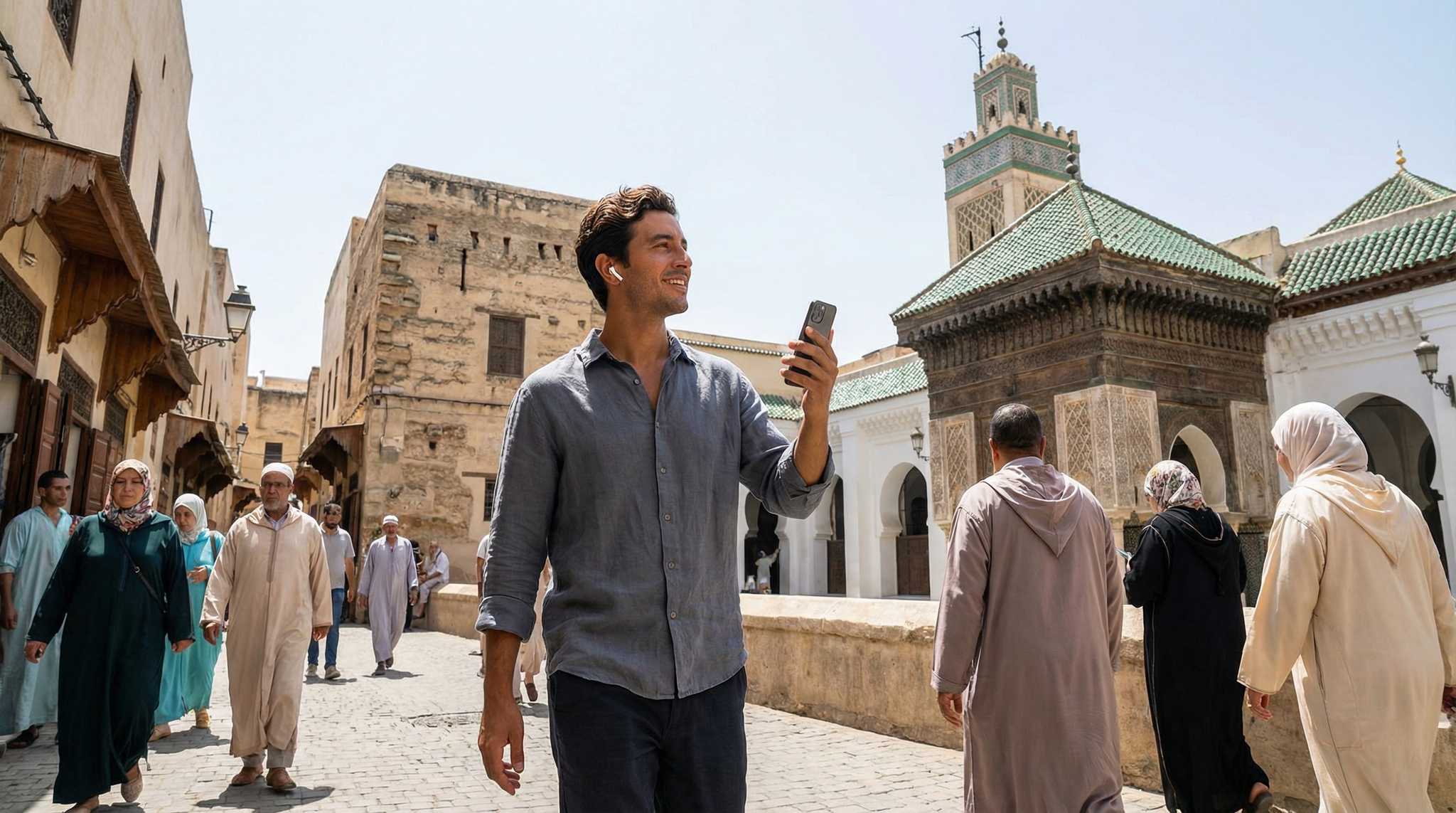
Wycieczka audio po Fezie: Echa uczonych, sułtanów i starożytnych suków
Odkryj serce Fezu podczas fascynującej wycieczki po medynie, gdzie historia ożywa! Wędruj starożytnymi uliczkami, aby odkryć Uniwersytet Al-Karawijjin, jeden z najstarszych ośrodków nauki na świecie. Podziwiaj oszałamiającą architekturę medresy Al-Attarine z jej misternymi mozaikami i spokojnymi dziedzińcami. Zanurz się w tętniącej życiem atmosferze Fes el Bali, starego miasta pełnego gwarnych suków, tradycyjnego rzemiosła i ponadczasowej kultury. Ta podróż oferuje idealne połączenie edukacji, sztuki i autentycznego marokańskiego uroku.
Podgląd trasy
O tej trasie
- scheduleCzas trwania 40–60 minsIdź we własnym tempie
- straighten4.8 km trasy pieszejPodążaj wyznaczoną trasą
- location_on
- wifi_offDziała offlinePobierz raz, korzystaj gdziekolwiek
- all_inclusiveDożywotni dostępOdtwarzaj ponownie w dowolnym momencie
- location_onStart przy Medresa Cherratine
Przystanki na tej trasie
To spot the Cherratine Madrasa, look for a large, cream-colored building with a bold rectangular shape, wooden balcony details, and a grand arched doorway surrounded by intricate…Czytaj więcejPokaż mniej
To spot the Cherratine Madrasa, look for a large, cream-colored building with a bold rectangular shape, wooden balcony details, and a grand arched doorway surrounded by intricate stucco carvings, just off a bustling street in the heart of the medina. Welcome, traveler, to the Cherratine Madrasa! Right here, just steps away from the buzz of Fes Medina, stands a school with almost as many secrets as students, and a name that ties right into the strings of the city-literally. “Cherratine” means “rope makers,” hinting at a time when the nearby market was tangled with merchants spinning ropes and trading stories. So, if you think you hear a distant “twang” of a rope snapping, don’t worry-it’s just the echoes of history tightening the plot! Imagine, it’s December 1670. The Alawi sultan Moulay al-Rashid stands at the head of a construction crew, dreaming up this madrasa to replace an older one that, according to local legends, was brought down by a group of particularly rowdy students. Apparently, the previous residents thought the madrasa was a perfect spot for high-volume fun, not quiet study! Moulay al-Rashid swept in, cleared the slate, and commissioned a brand-new campus, determined that order-and maybe a little wisdom-would hang in the air. Even the building’s footprint is special. Here in the densely-packed medina, most landmarks twist and turn with the alleys, but not Cherratine Madrasa. Thanks to its predecessor’s footprint, the madrasa confidently flaunts its big, neat rectangular courtyard-like a perfectly folded piece of rope among a pile of knots. Walk around the outside and you’ll notice the building’s size; this was, and still is, one of the largest madrasas in the neighborhood. Step closer, and you’ll spot the subtle elegance in its brick and cedar wood walls. Unlike its louder, flashier cousins in town-the jewel-box of Al-Attarine, or the palatial Bou Inania-this madrasa keeps its cool. Decoration here is delicate, a lesson in restraint: gentle arabesques carved in wood and stucco, blind arches framing windows, and a few horse-shoe shaped arches leading your eyes to a whispering prayer hall. Above your head, the cedar beams and latticework glow with the warmth of centuries. Picture the bustling life of the madrasa: Two upper floors, more than a hundred tiny dorm rooms, and voices from every corner of the Islamic world. Students from Algeria, the high mountains of the Rif, the Tafilalt oases, and lands stretching eastward-all found shelter and camaraderie here. Some would have entered shy and nervous, clutching their dreams beneath humble robes. Others swaggered in, sure as scholars, ready to debate all night or, in true student fashion, maybe sneak out for a snack! Every evening, as the city’s lanterns flickered and settled, the marble fountain in the courtyard sent up gentle tunes of running water, and the smell of cedar mingled with crisp night air. The walls, a little plain on purpose-perhaps so the students’ imaginations would flourish!-held back the chaos of the marketplace and wrapped the students in a calm embrace. Since 1917, Cherratine Madrasa has been a protected historic monument, its stories thick as the ropes that once lined its nearby markets. Who knows-maybe some old students come back as ghosts, checking that no new generation gets too raucous for their own good! But for now, soak in the calm and let the centuries-old wisdom of this place whisper in your ear. Ready for our next stop?
Otwórz dedykowaną stronę →To spot Hammam Saffarin, look for the rounded, pierced domes rising above the old rooftops-they almost look like giant, friendly turtles peeking out from the clay! Now, let me…Czytaj więcejPokaż mniej
To spot Hammam Saffarin, look for the rounded, pierced domes rising above the old rooftops-they almost look like giant, friendly turtles peeking out from the clay! Now, let me take you back in time as you stand here… Imagine yourself centuries ago, the sound of coppersmiths echoing across Place Seffarine, hammers clinking on metal as hardworking hands shaped brilliant pots and pans. Right here, across from the Saffarin Madrasa, stands our ancient bathhouse-a place that’s seen more steam than a Moroccan tea kettle on market day! Welcome to Hammam Saffarin, born in the lively 14th century, under the rule of the Marinids, who sure knew how to keep both their cities and themselves squeaky clean. Now, picture the scent of wood smoke and olive pits drifting through the narrow streets as fuel for the fires, carried straight here by donkeys loaded with goods. Can you sense the heat? Step back in history and feel the bustle as neighbors tumbled in, wiping sweat from their brows, eager for a good scrub. This place wasn’t just for the wealthy-everyone from busy coppersmiths, who would sparkle by the time they left, to new mothers, brides, and even kids celebrating big life moments, would come here. The hammam became a heart of the neighborhood, where traditions were passed on as smoothly as soap between hands. And let me tell you a secret: locals still whisper about the baraka, or blessings, that float invisibly through these dome-topped rooms. Legends tie Hammam Saffarin to two Sufi Muslim saints-Sidi Tallouk and Sidi Ahmad Skalli. While nobody ever found their tombs, people say the blessings of these saints help wash away not just dirt, but troubles and worries, too. Maybe you’ll walk away today feeling a little lighter yourself… though perhaps that’s just the magic of a good bath! From outside, it’s easy to miss-the entrance is just a simple horseshoe arch, no grand signs, leading you along a bent little passage. But step inside and suddenly you’re greeted by a wide, square room, four sturdy columns holding a huge high dome overhead. The echoes of laughter and friendly chatter bounce off the carved stucco archways and colorful zellij tiles. There's a fountain built into the wall, decorated with lively geometric mosaics, where water splashes into a basin-imagine the glimmering, cool stream in the otherwise steamy air. Around the edges, benches and storage lockers line the walls, and just by the door is a little reception desk-the ancient version of a spa check-in! Patrons would hand over coins and get their fair share of water buckets-no endless showers here, unless you wanted to splash out a bit more money. Once undressed, visitors moved through three chambers: first, the cool room where you’d brace yourself, then on to the warm room to start melting away troubles, and finally, the hot room where steam swirled around you. Those domed ceilings with their small skylights must have made the steam glow as the afternoon sunlight filtered in. Special private alcoves let you share secrets with your friends (or maybe just shiver and giggle together as you acclimated to the heat). But here’s a fun historical twist: While most hammams only let in men and women at different hours, Saffarin had entirely separate facilities, men on one side, women on the other! That meant it was always in action, sunup to sundown. For the women, especially, this was a rare space outside the home for connection, shared stories, and a little pampering. No wonder so many generations of Fassi women guarded the rituals and secrets of the hammam. Keeping all these rooms toasty warm required constant attention. At the back, at a lower level, laborers fed two roaring furnaces, one for each side, tossing in wood, olive pits, and even wood shavings recycled from carpenters nearby. Over these fires, massive brass cauldrons-crafted right outside in Place Seffarine-would bubble away, ready to pour buckets of hot water for customers. The air was always a little humid, a little smoky, but full of anticipation for the transformation waiting inside. And of course, the bathhouse played stage to life’s milestones: newlyweds lighting candles for luck, women who’d just given birth getting a soothing massage, even little ones facing their first ceremonial wash. The streets outside might have bustled with trade and talk, but inside these domes, time seemed to slow down, as warmth, voices, and the odd burst of laughter echoed through the ages. So whether you believe in blessings or just love a clean pair of feet, Hammam Saffarin is more than a bathhouse. It’s where memories are scrubbed fresh and stories bubble up like water in the steamy air. If only these ancient stones could talk-just imagine the tales they’d tell!
Otwórz dedykowaną stronę →If you’re looking for the University of al-Qarawiyyin, just glance ahead-spot the white, rectangular minaret towering above lush green tile roofs and ornate arches decorated with…Czytaj więcejPokaż mniej
If you’re looking for the University of al-Qarawiyyin, just glance ahead-spot the white, rectangular minaret towering above lush green tile roofs and ornate arches decorated with mesmerizing patterns; it’s an architectural gem that practically calls out, “Knowledge lives here!” Welcome to the legendary University of al-Qarawiyyin, a place where the air is thick with stories and the scent of old parchment and fresh mint tea seems to swirl through the centuries. Imagine yourself here nearly 1,200 years ago. The city is bustling, craftsmen are clanging hammers on copper, and somewhere in the medina a donkey is probably arguing with a rooster. Once upon a time, a woman named Fatima al-Fihri-wise, ambitious, and blessed with a hefty inheritance-picked this exact spot to build a mosque for her community of Kairouan migrants. The year was 857, or maybe 859 (who’s really counting when you’re about to make history?). Some say Fatima’s sister built the rival mosque across the river. Now, whether this powerful tale of the two sisters is pure legend or historical fact, no one’s completely sure. What we do know is that an ancient cedar-wood inscription was found here, hidden beneath layers of plaster, declaring that this mosque-yes, this one-was founded by Dawud ibn Idris, long before Instagram was even a twinkle in the internet’s eye! The building grew as dynasties rose and fell like the tides. By the 10th century, al-Qarawiyyin’s halls echoed with animated debates, soul-stirring sermons, and the busy shuffle of slippers on zellij tile. Can you hear that? It was a place not just for prayer, but for curious minds. Over centuries, it blossomed into a magnet for scholars from Morocco, West Africa, and beyond. Rumor has it some European popes and mapmakers snuck in for a bit of learning too-though their attendance sheets have mysteriously disappeared. As you gaze at the majestic courtyard, picture it during the Golden Age around the 13th century. Students sat in circles, hunched with anticipation, learning not only the Quran and Islamic law, but also astronomy, mathematics, medicine, and even the finer points of grammar (because a misused comma can spark a scholarly riot). The university’s famed library was legendary: its treasures included parchments from Al-Andalus, commentaries by Ibn Khaldun, manuscripts on gazelle skin, and even one of the world’s oldest diplomas in medicine. Fancy a medical degree? They issued those on deer parchment-finally, paper that could run away from you! Political drama was never far away; the mosque’s status soared when the khutba-Friday’s all-important sermon-was moved here from another mosque by the Fatimids, underlining its spiritual importance. Sultans, caliphs, and dynasties outdid each other in donations and renovations, installing everything from marble fountains to dazzling bronze chandeliers. That giant hanging bronze lantern you might glimpse inside? It’s older than some countries, and frankly, it’s so heavy with history it nearly needs its own passport. Of course, al-Qarawiyyin’s fortunes waxed and waned. Sometimes the syllabus shrunk to the basics; sometimes the libraries were neglected and books disappeared faster than pastries at a Moroccan wedding. As the modern era approached, reforms swept through the university. French colonizers poked and prodded at the curriculum, but couldn’t quite dim its ancient glow. The big moment came after Morocco’s independence: al-Qarawiyyin officially became a state university in 1963. Women finally joined the classrooms and a new chapter of learning began. Throughout its epic life, the university has weathered war, colonialism, famine, and political intrigue-yet students still arrive hungry for knowledge, and teachers still debate in sunlit courtyards. If you listen closely, you might almost hear the recitation of ancient texts and the distant laughter of scholars trying to untangle a tricky bit of classical Arabic. So as you stand outside these grand arches, know that you’re brushing shoulders with nearly twelve centuries of seekers, dreamers, and the occasional sly prankster hoping for a longer lunch break. The University of al-Qarawiyyin isn’t just the world’s oldest existing university. It’s a living testament to the power of curiosity, the beauty of tradition, and the one universal truth-never forget where you put your library card! Intrigued by the name, education and curriculum or the architecture of the mosque? Make your way to the chat section and I'll be happy to provide further details.
Otwórz dedykowaną stronę →
Pokaż jeszcze 12 przystankówPokaż mniej przystankówexpand_moreexpand_less
To spot the Al-Attarine Madrasa, look for a rather modest entrance on Tala’a Kebira Street, but don’t be fooled-step closer and gaze through the ornate archway to see a dazzling…Czytaj więcejPokaż mniej
To spot the Al-Attarine Madrasa, look for a rather modest entrance on Tala’a Kebira Street, but don’t be fooled-step closer and gaze through the ornate archway to see a dazzling courtyard decorated with colorful mosaic tiles, carved cedar wood, and intricate plasterwork above a central marble fountain. Welcome! You’re about to cross the threshold into one of the crown jewels of Marinid architecture, the Al-Attarine Madrasa. Imagine the air in the early 1300s, bustling with the scent of spices drifting from the nearby souk-it’s no accident that this place is named after the perfumers’ market. As you take in the dizzying patterns of zellij at your feet and the filigreed arches above you, let’s wind the clock back to 1323. Sultan Uthman II Abu Said was feeling generous-and maybe hoping to make a few religious scholars happy-so he called for the construction of this elegant school right next to the famous al-Qarawiyyin Mosque. Picture the sultan himself, with pomp and ceremony, observing the laying of these very foundations, maybe brushing a bit of dust off his robe and hoping nobody would notice if he tripped over a brick. Now, don’t get distracted by the plain exterior. The real magic happens inside-a bit like a cake that looks boring but turns out to be filled with chocolate mousse and sprinkles. Step through and you’ll see why the Al-Attarine Madrasa is considered a masterstroke of harmony and design: two stories surrounding a bright courtyard, layers upon layers of creativity. On the ground you’ll spy tiny geometric tiles forming intricate star patterns, while eye-level bands of calligraphy wrap around the walls with sgraffito-style flair. If you could touch them, you’d feel the cool smoothness of glazed tiles beneath your fingertips, and above you, stucco blossoms like a stone garden along the upper walls. This building was more than just a pretty face-it had a job to do. At any given time, between 50 and 60 young men lived and studied here, many of them poor but burning with ambition, having journeyed from the far-off towns of Tangier or Ksar el-Kebir. The madrasa gave them shelter, bread, and knowledge, right next door to the immense al-Qarawiyyin, where the greatest minds of Morocco gathered. I imagine you’d hear the shuffle of slippers on mosaic floors, the low and melodic chant of students reciting by candlelight, maybe some hopeful sighs as they worked through yet another endless legal text. But let’s not forget, it was also a place of political importance. The Marinid sultans wanted to keep the city’s religious scholars happy-no easy feat in a city where the ulema liked to think for themselves. By building institutions like this, they could present themselves as stalwart defenders of Sunni Islam, and maybe, just maybe, keep those independent thinkers on their side. There’s a bit of mystery here too: behind the beautiful bronze-plated doors-plated in interlocking geometric stars, each piece carefully chiseled with vegetal motifs-there are secrets of centuries, lives passed in quiet scholarship. The prayer hall is a marvel all its own. Oddly, the space didn’t allow the architects to align it with Mecca as usual, so the mihrab is set at a sideways angle-a clever bit of improvisation that shows the flexibility and inventiveness of Marinid artisans. The prayer hall ceiling is a wooden cupola-step inside on a sunny day, and colored glass windows set in lead grilles send fractured light across the walls, almost like little rainbows sent to encourage weary students. Decorations here reach a dazzling peak: carved cedar wood at the top, vivid zellij tiles at the base, and stucco everywhere in between, with every inch bursting with stars, flowers, foliage, and repeating patterns-the very best of Moroccan art. On your way out, have a look at the bronze chandelier above, which glimmers with an inscription praising Sultan Uthman II. Maybe he hoped a little flattery would keep the oil lamps burning and the students hard at work! The Al-Attarine Madrasa has seen centuries roll by, and since 1915, it’s been protected as a historic site. Today, it stands not just as a school but as a living memory-a mosaic of faith, hope, fragrance, and knowledge, echoing with the footsteps of those who dared to dream big within these sparkling walls.
Otwórz dedykowaną stronę →Just ahead, you’ll see the Chouara Tannery popping out from the golden-yellow buildings-spot the maze of giant stone vats filled with milky and rainbow-colored liquids, almost…Czytaj więcejPokaż mniej
Just ahead, you’ll see the Chouara Tannery popping out from the golden-yellow buildings-spot the maze of giant stone vats filled with milky and rainbow-colored liquids, almost like a surreal patchwork quilt, right in the open air below the rooftops. Welcome to the Chouara Tannery, the beating, sloshing, and sometimes nostril-flaring heart of Fez! As you stand here, imagine the soundtrack of splashing water, the sun shining on a patchwork of round stone vats, each brimming with colors so bright, you’d think someone dropped paint bombs from above. Now, about that smell-trust me, it's famous. If your nose wrinkles a bit, you’re experiencing history with all your senses! This tannery has been hard at work for more than a thousand years, or so the locals say-dating back to the time of Idris II at the very birth of Fez in the 9th century. While the true age is a bit of a mystery-like a medieval whodunit with no clear answer-it’s certain that tanneries like this quickly became a mainstay when Fez sprang to life. Even early on, the leather from these vats was shipped off to faraway cities like Baghdad. That’s a lot of shoes and bags with more stamps in their passports than most of us! Picture this: the city’s rulers counting nearly a hundred tanning workshops in the bustling medina, echoing with the shouts of workers and the slap of leather being worked. By the Marinid era, the number swelled even more. It wasn’t just a place to make things; it was industry, artistry, and the livelihood of entire families, stitched right into the city’s DNA. Glance down at the vats and you’ll see a wild mosaic of colors: poppy-red, indigo-blue, henna-orange. Here, craftsmen still use natural dyes, keeping tradition alive in every hue. But before those colors come out to play, the raw hides go for an adventure of their own. First, a “spa day” in white liquid-though perhaps you wouldn’t sign up for this treatment yourself! Think cow urine, pigeon droppings, quicklime, salt, and water, all swirling into a potent potion. The smell is legendary; local guides sometimes hand visitors mint sprigs just to help mask it. (A little fun fact for next time you want to freshen up a room: maybe not this recipe.) After their softer’s bath, the hides are thoroughly drenched in those technicolor dyes, laid under the Moroccan sun, and dried until they’re ready to become Fez’s famous slippers, bags, and coats. You can practically see the story of the city in these goods: every item crafted hands-on, fashion that’s truly medieval chic. No modern machines have muscled into this backbreaking craft-every slap of leather, every stir of dye, is pure human grit and skill. But, this beauty comes at a cost. For centuries, tanneries have been shooed to the outskirts for their smell and waste, and the Chouara Tannery is no exception. In the 19th century, things got even murkier with the introduction of chromium-a chemical that boosted output, but poisoned rivers and soil downstream. Health concerns loomed large for workers, and sometimes, sadly, tragedy followed in the wake of such pollution. In recent years, a river-saving superhero named Aziza Chaouni led a big rescue project, trying to clean up the Fez River, turn back the pollution, and even imagined moving the tanneries out for good. But the people of Fez pushed back-after all, this isn’t just industry, it’s their living heritage. So instead, the tannery was restored and the centuries-old, almost magical sight and smell remain for all to see…and yes, to sniff. So as you look over this wild, colorful sea of vats, close your eyes for a moment. Listen for the voices of a thousand years: workers at dawn, merchants haggling, and leather leaving for all corners of the globe. It’s living history-messy, smelly, dazzling, and utterly unforgettable!
Otwórz dedykowaną stronę →To spot the Zawiya of Moulay Idris II, just look up for the striking green-tiled pyramidal roof and the tallest minaret in the old city - both rising above the dense medina like a…Czytaj więcejPokaż mniej
To spot the Zawiya of Moulay Idris II, just look up for the striking green-tiled pyramidal roof and the tallest minaret in the old city - both rising above the dense medina like a pair of emerald beacons. Now, as you stand right outside, close your eyes and imagine yourself a thousand years in the past. You’re not just on a city street, but in the very heart of Fez’s spiritual life. The air is thick with the scent of spices and distant perfumes drifting from the bazaar, and the walls seem to hum with centuries of secrets. This is the Zawiya, the shrine of Moulay Idris II-considered Fez’s founding father and Morocco’s first true Islamic king. Born in 791, Idris II was more than just a ruler; he was the son of Idris I, a descendant of the Prophet Muhammad, who fled his dangerous rivals and ended up forging a powerful new alliance with the local Berbers. Idris II grew up fast-his father died just after he was born, and by the time he took power, he was ready to claim Fez as his own. He moved the capital here from nearby Volubilis in 809, doubling the city’s size by merging his father’s settlement on one bank of the river with his own on the other, and making it the beating heart of Morocco. Over the centuries, this building has seen some wild ups and downs. In the early days, Idris II was buried right where he’d built his mosque-his shrine soon filled with people hoping for blessings and protection. But power in Morocco was a game of musical chairs, and when the ruthless Zenata Berber rulers arrived, they tried to wipe out Idris II’s legacy. They even spread rumors that his body wasn’t here at all! For a while, the glorious Qarawiyyin Mosque grabbed the spotlight as Fez’s main mosque, and the Zawiya slipped into neglect, its roof finally collapsing in the 1300s. But Fez isn’t a city that lets legends fade. Fast forward to the 15th century: the Marinid dynasty is in charge, and suddenly, there are whispers of a miracle. During a renovation, workers discover a mysterious body, and the scholars solemnly declare-it’s Idris II! Delighted, the Marinids host a grand reburial and install a marble plaque above the tomb, which you can still see today. Ever since, the Zawiya has gone from strength to strength. Every new dynasty-Marinids, Saadis, and especially the Alaouites-sought to outdo each other by contributing to its beauty and fame. Sultan Moulay Ismail in the early 18th century rebuilt nearly everything you see, including the soaring minaret and the splendid pyramidal roof, both covered with glossy green tiles that flash in the sunlight. It’s like Fez’s way of making sure nobody gets lost-even if you’re stuck in the maze of the medina, just follow the rooftops! Inside, it only gets grander: imagine white marble courtyards with fountains-some over three centuries old-ornate black and white columns recycled from vanished Saadian palaces, and walls adorned with swirling stucco and zellij mosaics. And if you were to peek into the mausoleum, you’d see the tomb of Idris II cloaked in an elaborate wood and gold canopy, watched over by the echoing calligraphy of Muhammad al-Qandusi and topped by a star-patterned wooden dome. Sadly, if you’re not Muslim, you’ll have to admire this from the outside-but don’t worry, the cedarwood doors and grilled window offer you a glimpse, and who knows, some say you can still feel the baraka-the blessing-creeping through the ancient stone. And get this: for hundreds of years, certain streets outside the shrine were marked with wooden beams, creating a “protective bubble”-the horm. If you passed under one, congratulations! You just stepped into a sanctuary where even the law couldn’t touch you. Need to dodge troublemakers or a grumpy sultan? Find the Zawiya! Pilgrims still flock here every day, traveling across Morocco, seeking miracles and adding to the ever-thickening layers of faith and tradition. The highlight is the yearly moussem festival for Moulay Idris II-imagine the whole city erupting in music, drumming, dancing, and a procession of artisans, each guild parading gifts and wrapping the tomb in a magnificent cloak. So as you stand at the gates, you’re not just in front of a building. You’re at the crossroads of Morocco’s history-the place where holiness, ambition, mystery, and the city’s very soul have converged for over a thousand years. Not bad for a pit stop in the medina, right? Curious about the background: moulay idris ii, geography or the architecture? Don't hesitate to reach out in the chat section for additional details.
Otwórz dedykowaną stronę →To spot Funduq al-Najjarin, just look for a grand, ornately carved wooden entrance right on Nejjarine Square, topped with an impressive cedar canopy and standing beside a…Czytaj więcejPokaż mniej
To spot Funduq al-Najjarin, just look for a grand, ornately carved wooden entrance right on Nejjarine Square, topped with an impressive cedar canopy and standing beside a beautifully decorated public fountain-trust me, you can’t miss it! Welcome to the Funduq al-Najjarin, which literally means "Inn of the Carpenters!" Right now, you’re standing before one of Fez’s architectural treasures-if buildings could talk, I’m sure this one would have some amazing stories (and probably ask you to wipe your feet before entering). Imagine yourself back in the early 1700s: merchants, camels, and traders from all corners, bustling through Nejjarine Square. They’d come here from long dusty journeys over mountain passes, searching for a place to rest, store their goods, and swap stories with other travelers. The imposing entrance in front of you isn’t just an ordinary door. At five meters tall and three meters wide, topped with stunning floral and geometric designs-think of it as the red carpet for traders. And above you, that glorious carved cedar wood canopy stands guard, a real show-off in the sunlight! As you walk inside, there’s a central courtyard with three stories of galleries, all looking inward. The ground floor, where you might now hear the faint echoes of footsteps and voices, once held precious merchandise: spices, cloth, maybe even the odd secret stash of dates-because who travels without snacks, right? All around, the intricately latticed windows and painted woodwork hint at how important the building was to the city-it was a place to keep goods safe from thieves, to strike deals, and to get some much-needed shut-eye after a long day at the souq. Originally, the upper floors were for sleeping; rumor has it the snores of traveling merchants could shake the cedar rafters at night! Funduq al-Najjarin’s name also comes from the surrounding neighborhood: Najjarin means “carpenters.” Right outside, this whole square once buzzed with hammering and sawing as craftsmen shaped wood into everything from furniture to musical instruments. If you listen closely, you might still imagine the tap-tap-tap of busy hands at work, the smell of sawdust mixing with the wind, and merchants bragging about their newest finds. As centuries rolled on, this place kept up with the times. By the 19th century, it even had a post office tucked between the funduq and the public fountain-so along with gossip and trading goods, you’d have people sending letters home, possibly complaining about missing shoes or the city pigeons’ singing skills. In fact, a group of Jewish merchants owned a handful of the funduq’s rooms, trading side-by-side with everyone else-this was a place where deals were struck across religious and cultural lines. The attached public fountain-the Nejjarine Fountain-is more than just eye candy! It’s a lifeline for anyone parched after exploring the busy Medina. Carved with zellij tilework and stucco, this fountain wasn’t just for show; it provided free, cool water to anyone passing by, a symbol of charity that made even the stingiest trader a little more generous. Over time, Funduq al-Najjarin has worn many hats-it became a police station under French rule in the 1940s (imagine the surprise of a merchant from the old days seeing that!), and later, after a careful restoration, it transformed into a museum: Le Musée Nejjarine des Arts et Métiers du Bois. Step in today, and you’ll find displays of Morocco’s wooden wonders-carved doors, musical instruments, religious treasures, even wooden boards once used by young Quranic students. There’s humor in imagining a modern visitor, stunned by ancient craftsmanship, while a merchant ghost mutters, “That’s nothing! You should’ve seen Tuesday’s shipment!” Standing here, you’re surrounded by echoes of centuries-the voices of traders, the slap of camels’ hooves, the laughter of craftsmen, even the click of ink pens in the old post office. Each layer adds up to a place that’s not just a building, but a living, breathing piece of Fez itself. So soak it in-you’re standing on ground where the spirit of trade, hospitality, and woodwork still lingers in the air!
Otwórz dedykowaną stronę →To spot the Chrabliyine Mosque, look up and you’ll see a beautifully decorated square minaret rising above the rooftops, covered in enchanting green and white tiles with intricate…Czytaj więcejPokaż mniej
To spot the Chrabliyine Mosque, look up and you’ll see a beautifully decorated square minaret rising above the rooftops, covered in enchanting green and white tiles with intricate patterns-like a giant, colorful lantern standing guard over Tala'a Kebira street. Now, as you stand in front of this splendid mosque, let your imagination whisk you away to the 14th century, when the very air buzzed with the energy of the Marinid dynasty, spices wafted from nearby souks, and the click-clack of handmade cherbil shoes echoed all around. This mosque you see before you, established during the reign of Sultan Abu al-Hasan, is a living piece of Fez’s grand puzzle. Abu al-Hasan wasn’t just an average sultan-oh no, he was a building enthusiast who left his architectural fingerprints all over the city. If he had a frequent builder’s card, he’d have gotten a lot of free minarets! Back in those days, the site you’re looking at would have been fresh and lively, with stone masons chipping away and tile artists climbing scaffolds, placing each bit of mosaic with loving care. Feel the history beneath your feet-it’s said only the elaborate minaret and the grand entrance have stuck around from the Marinid glory days, while the rest of the mosque took on a stylish new wardrobe in the early 1800s, thanks to Sultan Moulay Slimane, who clearly had a flair for home renovation. Now glance up at that minaret. Notice the dazzling tilework and the sebka pattern, which might make you think of palmettes or maybe even the fanciest birthday cake icing you’ve ever seen. Those tiles shimmer in the Moroccan sun, and if you caught a glimpse in the right light, you’d see the bold kufic inscription, a kind of medieval graffiti that’s far more stylish than anything you’ll find sprayed on the street. The top, crowned with a wide band of zellij, still holds the original Marinid magic-just think, these very tiles have watched centuries swirl past, from the days of camel caravans to modern motorbikes buzzing below. The mosque isn’t all show on the outside-enter the courtyard (if you could, just for a moment, imagine yourself sneaking through the carved wooden canopy above the entrance) and you’d find a space filled with the babble of water in a marble fountain. This courtyard, framed by elegant horseshoe arches, would have seen the passage of prayers, community gossip, and the serious business of daily life. If you followed the sound of whispered prayers, you’d discover the prayer hall, where soft light filters through small windows, and find the mihrab-a stunning octagonal alcove topped by a muqarnas dome that looks like a honeycomb spun by angels. But the secrets don’t stop there. One side door leads to the “mosque of the dead,” a special room set aside for funerary rites. Here, the whole community would gather before a burial, giving their loved ones a respectful sendoff in a space kept purposely separate from the main hall, because, as everyone knows, cleanliness is next to godliness (and nobody wants muddy shoes in the prayer room). Directly across the street stands the mida’a, a spot where, for centuries, the faithful have paused to perform their ablutions before entering the mosque. Picture the tiled courtyard, the gurgle of running water, and people ducking in and out of little latrines around the edge-it’s as lively now as it was then, a heartbeat of the neighborhood. And let’s not forget that the very name “Chrabliyine” comes from those famous cherbil shoes-the kind of footwear local women once bought from nearby shops. So as you gaze at this minaret and listen to the music of the street, imagine centuries of shoppers, shoemakers, and storytellers passing through, all beneath the watchful gaze of these timeless tiles. The Chrabliyine Mosque isn’t just a landmark-it’s the soul of Tala’a Kebira, and now, you’re part of its story too!
Otwórz dedykowaną stronę →To spot Fes el Bali, look ahead for a monumental gate clad in brilliant blue and white mosaic tiles with three grand horseshoe arches-this is Bab Bou Jeloud, and through it,…Czytaj więcejPokaż mniej
To spot Fes el Bali, look ahead for a monumental gate clad in brilliant blue and white mosaic tiles with three grand horseshoe arches-this is Bab Bou Jeloud, and through it, you’ll see the bustling heart of the old medina stretching out before you. Welcome to Fes el Bali, the oldest heartbeat of the city, where even your footsteps feel like they’re echoing back a thousand years. Imagine yourself not just as a tourist, but as a time traveler, taking your first step through the great gate and into a living maze where every twist and turn tells a story. Back in 789, the ambitious Idris ibn Abdallah gazed across this very river, dreaming up a new capital. Here’s the funny thing-not long after, his son Idris II must have thought, “Great idea, Dad! But let’s make my own city... just across the river.” So, two towns grew side by side, divided only by water but filled with rival refugees-one batch straight from Córdoba in Spain, the other from Kairouan in Tunisia. Talk about a Mediterranean mix-up! Imagine the commotion as new families rolled in, speaking all sorts of dialects and trying to outdo the neighbors with their bread recipes. Over time, those rival towns merged, woven together by the clever Almoravids into one enormous, buzzing labyrinth. It became a city where religion and trade lived side by side-sometimes arguing over who got the best spot near the river! Even after Marrakesh snatched the title of political capital, Fes el Bali wouldn’t stop growing. In fact, imagine at one point in the 12th century, as you squeeze through these alleys, you’d be just one person among 200,000 others making it the biggest city in the world! But, of course, any city this old has faced more drama than a soap opera. For centuries, dynasties rose, fell, and sometimes rolled their eyes at the medina’s stubborn spirit. The Marinids swooped in, crowned Fez as their capital, and got busy building palaces and madrasas that dazzle even today. You’ll see their touch if you peek up at the intricately tiled mosques or wander into cool, shaded courtyards. Still, not every ruler was quite so fond of this place. Fast-forward to the Saadians in the 16th century: they built mighty forts and bastions surrounding the city, supposedly for protection, but you could say they kept one eye on Fez and the other on their cannons! If you ever get lost, just look for one of these old fortifications-they’re great orientation points... and reminders of the “watchful” relationship between the rulers and the rebellious folks of Fes el Bali. It wasn’t all about sultans and soldiers though. Did you know the world’s oldest university that’s still running today-al-Qarawiyyin-was started right here in 859, by a woman named Fatima al-Fihri who used her inheritance to share education with the whole city? That means every crazy alley and sunlit courtyard was once part of the world’s brightest campus. And across the river, the Andalusiyyin Mosque stands, believed to have been founded by Fatima’s sister. Sisterly rivalry, but in the name of learning! Now, you might notice as you walk the medina that the streets twist like a plate of spaghetti. That’s no accident. The main souks lead you straight to the city’s cherished mosques, inns, and markets. If you wander off, you’ll find quiet, narrow derbs-local lanes ending in peaceful residential secrets or maybe a stray cat lounging, ready to quiz you on history. And if you ever feel lost, don’t worry. Nearly everyone wandering these streets-whether merchant, tourist, or local-sticks close to the main thoroughfares, dodging donkeys and following the scent of fresh bread or leather from the tanneries. Fes el Bali is a UNESCO World Heritage site, carefully protected so future generations can feel the thrill, confusion, and charm you do now. Teams work tirelessly to restore its monuments and even clean up the Fez River (because, let’s face it, a city this beautiful deserves a clean reflection). Remember, while modern Fez stretches out beyond the medina-thanks to a certain group of French city planners who chose to keep history alive here-the old streets of Fes el Bali are still car-free. Well, except for the occasional cat, clattering cart, and, of course, your own curious footsteps. So, step boldly in, listen for the echoes of the past, and let this great, tangled treasure chest of stories work its magic on you every time you turn a corner.
Otwórz dedykowaną stronę →To spot Dar Moqri, look ahead for a grand, white-walled mansion with graceful arches wrapping around a tiled courtyard and a long green-tiled roof, often bustling with…Czytaj więcejPokaż mniej
To spot Dar Moqri, look ahead for a grand, white-walled mansion with graceful arches wrapping around a tiled courtyard and a long green-tiled roof, often bustling with visitors-it's hard to miss its peaceful elegance amid the medina. Now, take a moment to soak up the air of intrigue and luxury swirling around Dar Moqri. Close your eyes and picture it: in the late 1800s, this stretch of Fez wasn’t crammed with homes, but dotted with lush gardens, as open and inviting as a story just waiting to be written. Imagine the gentle rustle of wind through cypress trees as the Moqri family, newly arrived from Tlemcen, Algeria, began carving their mark into the heart of Morocco. The patriarch, Abdelsalam al-Moqri, chose this very spot to build his palace-though ‘palace’ might sound too stiff! This was a house meant to dazzle and entertain, with halls as wide as ambition and rooms as plentiful as hopes. He was no ordinary man; Abdelsalam had climbed the ranks from a merchant’s son to the trusted right hand of Sultan Moulay Hassan, a master of construction, a fixer of finance-and, for a time, even the city’s personal “water guy.” (Who knew that sorting out a city’s plumbing made you a legend?) As you stand here, picture all the footsteps that wandered these halls, the laughter echoing off the mosaics, the secret deals whispered behind doors. And here’s a fun twist: the house isn’t exactly a single palace, but a duo of lavish homes built by the same family, right next to each other-like a spot-the-difference puzzle brought to life. The older palace, crafted by Abdelsalam, featured a smaller, star-shaped courtyard and a fountain where the gentle gurgling of water must have soothed many a tired guest. Its main cluster of rooms was built for grand feasts, shady afternoon conversations, even roaring debates about how best to tile the floors. The second, newer palace-stitched right onto the first-was built by Si Tayb, Abdelsalam’s grandson, who clearly fancied a dash of European flair. He stretched out a glamorous rectangular patio, ringed by gleaming columns and arches, splashing in Italian marble and even a few unexpected classical flourishes that might make you swear you’d taken a wrong turn into Florence. Even the garden here is extraordinary. Dar Moqri’s three terraced levels spill down toward the medina, studded with towering cypress, aromatic plants, and playful fountains. Each terrace acts like a green carpet stretching out toward the horizon-giving the residents grandstand seats for both the sunset and the city that sprawls below. Life in this palace was anything but boring. The Moqris, after all, were VIPs in the makhzen-the royal administration. Abdelsalam’s son, Muhammad al-Moqri, helped expand the family portfolio, eventually rising to become Morocco’s grand vizier. Now, imagine him: a power broker striding past these pillars, perhaps practicing his best “I’m in charge” face in the fountain’s reflection. Muhammad wasn’t just a footnote-he held office for nearly half a century, even outmaneuvering the French during the Protectorate! All the while, only the top Moqri of each generation got to call the main palace home... talk about exclusive real estate. But the fun didn’t stop there. Each sibling spun out their own legacy; Si Dris, Muhammad’s brother, would wander off to build “Riad Driss Moqri” in another part of the city-kind of like wanting a little more legroom on your family tree. Everyone here seemed to have a knack for grand gestures, beautiful libraries, and throwing parties that could make even the fountains want to dance. The buildings themselves tell a thousand stories, their intricate zellij mosaics glimmering in the sun, their carved wooden ceilings hanging overhead like a suspended puzzle. In one corner, you’d find the palace’s private hammam-steamy, echoing, a retreat for gossip or a bit of plotting about next week’s feast. So, as you look into the buzzing courtyard and up to the elegant facade, remember you’re not just seeing a house, but centuries of big dreams, wild ambition, and just a dash of sibling rivalry. That’s the magic of Dar Moqri-where every echo, every sunbeam, every distant melody from the garden pavilions carries a secret from Morocco’s grandest days.
Otwórz dedykowaną stronę →To spot the Bou Inania Madrasa, look for a large, elegant building with ornate geometric tilework, horseshoe arches, and a tall, square minaret covered in green-and-blue mosaics…Czytaj więcejPokaż mniej
To spot the Bou Inania Madrasa, look for a large, elegant building with ornate geometric tilework, horseshoe arches, and a tall, square minaret covered in green-and-blue mosaics rising above the corner-just ahead of you. Welcome to the splendid Bou Inania Madrasa, where the stonework whispers stories and the minaret stands tall like a proud, ancient lighthouse! You’re about to enter one of Fez’s grandest masterpieces, crafted over 650 years ago by the ambitious Sultan Abu Inan Faris. Imagine the year is 1350. Fez is bustling, camels jingle their bells in the nearby souk, and Sultan Abu Inan, after a tumultuous rise to power-even rebelling against his own father, by the way-decides he needs a little bit of spiritual redemption and, perhaps, a shiny building to leave his mark on history. Legend has it, Abu Inan, feeling a little guilty after ousting his dear dad, asked the city’s wise scholars how he might clear his conscience. “Clean up the garbage dump,” they said (really, it was the top of the town’s trash heap right here), “and turn it into a place of learning and worship.” So, he did-swapping rags for riches, filth for finery, and suddenly, those banana peels and chicken bones were replaced with marble courtyards and dazzling tilework! Take in the architecture around you: the madrasa is an irregular rectangle packed into the old city between two main streets. If you hear a faint splashing… that’s the central fountain in the marble courtyard, once used for washing before prayer-and a handy spot for students to daydream, I imagine, if lectures got dull. Unlike other madrasas in Morocco, Bou Inania is special-for starters, it’s the only one that doubles as a Friday mosque, which means, yes, you could hit the books and catch a powerful Friday sermon all under the same decorated roof. Look up: that minaret, trimmed with geometric zellij tiles and crowned with an elegant metal finial, was a landmark for worshippers and bookworms alike, guiding them toward knowledge, faith, and-perhaps-a good spot to gossip between classes. You’ll see two grand doorways. One leads straight from Tala’a Kebira, the city’s main artery, with carved stucco so ornate you could spend an entire tea break counting the tiny motifs. Pass through, and you’ll discover a vestibule ceiling carved in cedar wood-the scent must have been glorious after the old garbage dump era! To the side, a ‘door for the barefoot’ let students scurry in and out to their living quarters, eager not to miss the lunch queue. Step inside, and the courtyard opens up-marble underfoot, horseshoe arches overhead, and galleries wrapped in spectacular woodwork. If you blink, you might imagine scholars bustling past, balancing scrolls, or pausing under the shade of intricately carved cedar screens. On the east and west sides, large chambers once buzzed with classroom debate as light dappled through colored glass set into stucco grilles. Some doors are so delicately carved with interlocking stars, you’d swear they might unlock a secret chamber if you whispered the right poetic phrase. And there’s more-cross the marble canal at the courtyard’s edge (careful, it gets slippery!), and you’d find yourself staring into the prayer hall. The mihrab glows with stucco carvings, and when sunlight hits, the colored glass windows sparkle like hidden jewels. If you listen in your imagination, you might even catch the low murmur of prayer or a poetic Arabic recitation floating up to the wooden canopy. The sultan didn’t skimp-when his nervous accountants showed him how much gold he’d spent, he famously tossed their account book straight into the river. “What is beautiful is not expensive,” he declared. No joke-the result is an architectural gem, tough enough to survive earthquakes and centuries of use, yet so pretty you’ll find your eyes tracing every curve and star-shaped motif. Across the street, don’t miss the mysterious Dar al-Magana, once home to a legendary water clock. At every hour, a ball would drop into a bronze bowl--ringing out time for prayers and lessons. The exact workings are lost to history, but the magic remains, a puzzle still waiting for its timekeeper. Even today, Bou Inania Madrasa is not just a place of stone and stories, but a living echo of Fez’s golden age, where devotion, learning, and a touch of sultan-sized drama still fill the air. And hey, if you manage to find your way through without getting lost in the geometry, you might just leave here a tiny bit wiser-Sultan Abu Inan would be proud! Intrigued by the architecture, adjacent structures or the the minbar? Explore further by joining me in the chat section below.
Otwórz dedykowaną stronę →Look ahead for a grand, sand-colored city gate with three horseshoe arches and striking blue tilework-if you spot shimmering blue patterns and a line of notched merlons along the…Czytaj więcejPokaż mniej
Look ahead for a grand, sand-colored city gate with three horseshoe arches and striking blue tilework-if you spot shimmering blue patterns and a line of notched merlons along the top, you’re staring right at the famous Bab Bou Jeloud! Imagine yourself standing before this mighty gateway-a place where past and present shake hands every day, and where the city’s secrets seem to linger in the colorful tiles and in the warm desert air. The Bab Bou Jeloud, with its deep blue facade and triple arches, wasn’t always here to welcome visitors like a grand host at the front door of the medina. In fact, this exquisite entrance only dates back to 1913-a relatively young gate in a city that measures its history in centuries, not decades. Once upon a time, the only thing at this site was a much smaller, more modest gate-a shy, utilitarian door to the mysteries of Fes el Bali. That earlier gate may have first guarded these walls in the 1100s, standing firm while soldiers and traders bustled past, probably wishing they could get a coffee to go. It opened directly onto Tala'a Kebira, a street so important it’s practically the city’s main artery, running straight toward the mighty Qarawiyyin Mosque. But defending a mighty city calls for clever tricks-so the old gate had a sneaky move: it was set at an angle, its passage turning visitors sideways as they entered, just to keep everyone on their toes and make defending the city a bit easier. When gunpowder and cannons crashed onto the scene, these old walls-once formidable defenses-could barely keep a determined goat away, let alone an army. City gates began to serve less as military barriers and more as proud decorations, like jewels on the city’s crown. Fast-forward to 1912, and French colonial rule sweeps into Fez. Like all new bosses, they want to start with a grand entrance. Captain Mellier, a man in charge of municipal matters (and apparently a lover of dramatic architecture), looks at the modest old gate and thinks, “Let’s make this the front door everyone remembers.” So they buy up a stables and three shops and-with a lot of negotiating with local charities-make space for a gleaming new entrance, finished in 1913. Today that entrance stands before you: a masterpiece of Moorish style! The outer facade dazzles with cool blue tiles, intricate with Moroccan patterns and swirling arabesques, while the inside surprises you with rich green where the blue gives way-each color with special meaning in Moroccan tradition. Above, the crenellated top line makes the gate look ready for a medieval pageant… or, perhaps, a very fancy game of chess. If you look to your left while facing the gate from the outside, you can still glimpse the blocked-off old Bab Bou Jeloud-like a shy relative at a family reunion, almost hidden but not forgotten. And through these arches, the city pulses with life: beyond the gate is a small, lively square encircled with cafes and shops, and beyond that, the main streets of the medina wind into the heart of old Fez. As you gaze under the arch, you might spot the minarets of Bou Inania Madrasa and Sidi Lazzaz Mosque peeping above the rooftops in the distance, as if they too are peeking out to welcome you. So step through the blue gate, and let the rhythm of Fez sweep you into its spell-just try not to trip over your own sense of wonder along the way!
Otwórz dedykowaną stronę →To spot the Bou Jeloud Mosque, look for a sturdy light-yellow building with green-tiled rooftops and a tall, square minaret rising up above the street-it stands right along the…Czytaj więcejPokaż mniej
To spot the Bou Jeloud Mosque, look for a sturdy light-yellow building with green-tiled rooftops and a tall, square minaret rising up above the street-it stands right along the roadside and is hard to miss! Alright, traveler, while you stand here outside the Bou Jeloud Mosque, let’s take a little journey back-over 800 years, in fact! Picture this spot not as a busy street with cars, but as a windswept plateau on the very edge of a restless city. The year is somewhere between 1184 and 1199, and the powerful Almohad caliph al-Mansur is calling the shots. Now, I bet you never thought your day in Fes would turn into an adventure with medieval rulers, crumbling citadels, and the threat of complete destruction! The story of Bou Jeloud Mosque begins when Fes’s mighty fortifications had just been battered and broken by the previous caliph, Abd al-Mu’min. The city’s defenses lay in ruins, and life on these outskirts was anything but peaceful. Enter caliph al-Mansur-a man who believed in big plans and sturdy walls! He aimed to rebuild the city’s fortifications and create a new heart for this western edge of Fes. He chose this very hilltop to found a kasbah-a fortress community-and right at its center, he built the Bou Jeloud Mosque. The mosque wasn’t just any place of worship; in those early days, it would have been a shining new landmark for soldiers, officials, and city dwellers who lived too far from the grand al-Qarawiyyin and al-Andalus mosques in town. Coming here for Friday prayers must have felt like finding an oasis in the desert: finally, a place close to home where you could hear the powerful khutba sermon and see the community gathered! But don’t get too comfy just yet-the neighborhood didn’t stay still for long. The baton passed to a new caliph, Muhammad al-Nasir, who finished the job al-Mansur started, expanding the kasbah and solidifying the mosque’s position as the spiritual anchor of these western neighborhoods. Imagine this mosque gleaming, its simple Almohad design standing tall over an ever-growing city, the sound of footsteps echoing through its whitewashed brick halls, men lining up between the horseshoe-shaped arches, and sunlight streaming through the courtyard, sparkling off the fountain at the center. Then came the Marinids in 1248, riding into town and ready to stamp their mark on Fes. Their leader, Abu Yahya, captured the city and quickly built the square minaret you see looming over you now. That minaret isn’t just a landmark; it’s the oldest Marinid monument with a founder’s inscription, proudly announcing its arrival. But just to spice up the real estate-like a builder who simply couldn’t resist a renovation-the Wattasid dynasty came next. They made the mosque even bigger, stretching its western walls into a quirky, asymmetrical shape-proof that even sacred buildings aren't immune to a little creative remodeling! By the 19th century, under the Alaouite sultans, the minaret needed some modern TLC, so up it went, growing a little taller, and the doors got their current fancy decorations. Step a little closer and you’ll see the mosque has a personality both grand and humble. The outer walls are simple, but step inside (if you get the chance!) and you’re transported into a forest of arches and whitewashed columns. The mihrab, which points the way to Mecca, shows off delicate carvings and a sprinkle of muqarnas-a kind of stone honeycomb that’s a real architectural treat. But don’t expect too much glitz; the Almohads liked their design sturdy and spiritual, not showy. So, as you stand here, remember: you’re standing before one of Fes’s oldest mosques-the third ever built for Friday prayers in this ever-expanding city. Its walls have seen centuries of sultans, sermons, rebuildings, and repairs, each layer a reminder that Fes, like all great cities, is always a work in progress-one minaret at a time! And hey, isn't that the secret to both good cities and good stories? Always room for another twist.
Otwórz dedykowaną stronę →To spot the Kasbah An-Nouar, look ahead for tall, sandy-yellow walls topped with pointy battlements and two sturdy octagonal towers flanking a grand arched gateway decorated with…Czytaj więcejPokaż mniej
To spot the Kasbah An-Nouar, look ahead for tall, sandy-yellow walls topped with pointy battlements and two sturdy octagonal towers flanking a grand arched gateway decorated with geometric patterns; the bustling market outside will let you know you’re in the right place. Alright, let’s take you on a little journey through time as you stand in front of the mighty Kasbah An-Nouar-one of Fez’s true guardians and, quite frankly, one of the coolest citadels whose name means “Citadel of the Flowers.” Now, don’t let that gentle name fool you! For centuries, these formidable walls-rising before you, sharply crenellated like the notches on a giant’s crown-marked both safety and secrecy for those on the inside, and a clear “keep out” signal for, well, just about everyone else. Let’s travel back nearly 900 years. Imagine Fez in the 12th century: smoky, bustling, with traders arguing over spices and royals plotting in shadowy corners. One day, the city faced the iron hand of the Almohad conquerors. After a particularly fierce siege, where Fez’s defenders had really made the invaders sweat, the new ruler Abd al-Mu’min decided to make a dramatic statement-not Hollywood blockbuster style, but by knocking down every wall and fortification in sight! No walls, no troublemakers, he thought. But soon enough, the tables turned. The city was simply far too important-too busy, too rich, too tasty for the empire to leave vulnerable. So, a few decades later, Caliph Muhammad al-Nasir, perhaps with a sigh, rebuilt the city walls… and added two big citadels where the army could keep an eye on things and, you know, actually defend the city. Kasbah An-Nouar, right here where you stand, was one of them. Picture craftsmen sweating under the Moroccan sun as they stacked stone upon stone, shaping the labyrinth you see now. Fez’s rulers came and went, and each left their mark. The Marinids-who fancied themselves the new kings of the block-decided they needed their own fancy palace district (because sharing was obviously out of the question). Not to be outdone, the tough folks from Marrakesh, the Saadians, added their own fortresses when they worried Fez might be a rebellious thorn in their side. But let’s fast-forward to the 17th century and the arrival of the ‘Alawi dynasty. Now, this is where the Kasbah gets a family twist. Imagine: Sultan Moulay Rachid sweeps in from Tafilalt, bringing with him not just a crown but also a whole crew of homesick settlers from his native land. He gives them this kasbah, which people soon begin calling Kasbah Filala-sort of like renaming your castle after your old neighborhood! And just to make it interesting, he gives them a touch of independence: their own council of twelve elders (I bet meetings were rowdy), choosing their leaders, running their affairs, collecting rent from the rooms inside these very towers to pay for new roofs and festivals. A real self-governing community, centuries before local democracy was trendy. Inside, past the thick gateway, life has always been different from the rest of Fez. The only entrance-Bab Chorfa, the gateway in front of you, topped with eye-catching patterns and octagonal towers-was like a filter. Unless you came from the right family, born of Tafilalt roots or blessed with a royal connection, the gates were firmly closed. Oddly enough, even other Muslims weren’t exactly welcomed, and non-Muslims? Let’s just say their chances of getting in were about as good as a camel passing through the eye of a needle. The kasbah’s secretive nature became local legend. Attilio Gaudio, writing in the 1980s, remarked that this little world behind the walls still kept outsiders at bay. Inside, the twisting streets were and are full of laughter, neighborly gossip, and the distinct aromas wafting from kitchens-couscous and mint, maybe a bit of saffron-while the Friday mosque offers a simple square for reflection and quiet. And outside? The modern market at your feet tells its own story, with tarps and stalls creating a rainbow patchwork where people chase bargains, haggle over cloth or fruit, and spin tales of their own. If these walls could talk, imagine the stories they’d tell: of sieges endured, rulers crowned, and a lively, stubborn neighborhood that outlasted them all. So as you take it all in, remember: the Citadel of Flowers isn’t just stone and mystery, but a living piece of Fez’s beating heart-still standing strong, still watching, and still home to more stories than the square outside could ever hold.
Otwórz dedykowaną stronę →To spot the Ibn al-Khatib landmark, look for a wall decorated with beautiful, intricate Arabic calligraphy deeply carved into creamy stone, highlighted with geometric and floral…Czytaj więcejPokaż mniej
To spot the Ibn al-Khatib landmark, look for a wall decorated with beautiful, intricate Arabic calligraphy deeply carved into creamy stone, highlighted with geometric and floral patterns just above a line of green-and-white tiles. Now, step a little closer and let your imagination transport you-back to the golden days of Granada, when Ibn al-Khatib, the man behind this name, was changing the course of history with both his pen and his wits. Picture the court halls echoing with poetry, laughter, and maybe the occasional political plot-yes, back then, the vizier’s job came with a dose of drama! Ibn al-Khatib was born in Granada in 1313, into a world thriving with color, language, and ambition. He grew up amid the hum of scholars and politicians, his father working for the ruling emir. But his life changed suddenly after the devastating Battle of Río Salado, when both his father and older brother were lost-a sharp twist of fate that launched young Ibn al-Khatib right into politics. Suddenly, he wasn’t just a scholar’s son; he became secretary to his own teacher, Ibn al-Jayyab, and, when tragedy struck again and his mentor succumbed to the plague, the responsibility of guiding Granada fell to Ibn al-Khatib himself. He soon became vizier-the king’s right-hand man, juggling diplomacy, poetry, and peril. At the shimmering palace, amid fountains and gardens, he wrote verses that still decorate the walls of the Alhambra, catching sunlight in the finest script. Imagine the vizier strolling these corridors, a scroll of rhymed prose in one hand and a stack of secret messages in the other-leading Granada, wrangling rivals, and pausing only to dash off a line of poetry. He even composed “Jadaka al-Ghaithu” and quite possibly “Lamma Bada Yatathanna,” songs of longing and rain that you just can’t get out of your head if you hear them at dusk in a palace courtyard. But let’s not forget the dark clouds overhead. Ibn al-Khatib’s life was a rollercoaster of banishments, feuds, and suspicion. When plague hit the land with the roar of destiny, he did something remarkable-he started investigating, observing how disease traveled, writing a treatise so ahead of its time that Louis Pasteur would have taken notes, if he’d been around! Ibn al-Khatib recorded how “contagion was proven by experience,” describing germs hitching rides on fabrics, trinkets, and even ships crossing the sea. If only he’d invented hand sanitizer as well! And while his ideas about infection seemed revolutionary, he humbled himself before Islamic wisdom, quoting the Prophet’s warning: stay put during plague, don’t run-because fate, and germs, have ways of finding us. He wasn’t just a scientist or a poet. Ibn al-Khatib wove his life between Andalusia and Morocco. Twice exiled from home, he found sanctuary in Fes and other cities, continuing to write, debate, and sometimes poke fun at his enemies. Political intrigue clung to his footsteps; one minute he was head of both Granada’s army and its government; the next, his rivals swarmed in. Jealousies simmered, alliances shifted, and friends like Ibn Khaldun would one day write down the story of his rise and tragic fall. In Morocco, after earning both respect and envy, Ibn al-Khatib was accused-unjustly, many say-of heresy. The scholars couldn’t decide what to do with him; his old student twisted the knife, and late at night, in a cell dark with shadows, he was strangled, his fate sealed by those who feared his genius more than his supposed crimes. Even in death, he found little peace: his body was burned before being buried near Fes’ Bab al-Mahruq gate. Yet his words have never been silenced. His books spanned history, science, politics, medicine, and personal adventure-all filled with the color and music of Andalusia, and the sharp edge of a mind that could see centuries ahead. His rhymed prose, or saj’, still dazzles readers, especially those who love the thrill of a clever turn of phrase or a playful insult, Andalusian style. So as you stand here, in front of these ancient walls, listen for a faint whisper of poetry among the patterns and script. Imagine the echoes of Ibn al-Khatib’s footsteps and laughter, the clink of ink pots, and perhaps-just for a moment-the heartbeat of a legend who outlived his age through the stories he left behind. Interested in a deeper dive into the biography, on the plague or the death? Join me in the chat section for an insightful conversation.
Otwórz dedykowaną stronę →
Najczęściej zadawane pytania
Jak rozpocząć trasę?
Po zakupie pobierz aplikację AudaTours i wpisz kod realizacji. Trasa będzie gotowa do natychmiastowego rozpoczęcia – po prostu dotknij \"Play\" i podążaj trasą z nawigacją GPS.
Czy potrzebuję internetu podczas trasy?
Nie! Pobierz trasę przed rozpoczęciem i korzystaj z niej w pełni offline. Jedynie funkcja czatu wymaga internetu. Zalecamy pobieranie przez WiFi, aby oszczędzać dane mobilne.
Czy to wycieczka grupowa z przewodnikiem?
Nie – to samodzielny audioprzewodnik. Zwiedzasz niezależnie, we własnym tempie, z narracją audio odtwarzaną przez telefon. Bez przewodnika, bez grupy, bez harmonogramu.
Ile trwa trasa?
Większość tras zajmuje 60–90 minut, ale to Ty kontrolujesz tempo. Wstrzymuj, pomijaj przystanki lub rób przerwy, kiedy chcesz.
Co jeśli nie zdążę ukończyć trasy dzisiaj?
Żaden problem! Trasy mają dożywotni dostęp. Wstrzymaj i wznów, kiedy chcesz – jutro, za tydzień lub za rok. Twój postęp jest zapisywany.
W jakich językach są dostępne trasy?
Wszystkie trasy są dostępne w ponad 50 językach. Wybierz preferowany język podczas realizacji kodu. Uwaga: języka nie można zmienić po wygenerowaniu trasy.
Gdzie znajdę trasę po zakupie?
Pobierz darmową aplikację AudaTours z App Store lub Google Play. Wpisz kod realizacji (wysłany e-mailem), a trasa pojawi się w Twojej bibliotece, gotowa do pobrania i rozpoczęcia.
Jeśli trasa Ci się nie spodoba, zwrócimy Ci pieniądze. Skontaktuj się z nami pod adresem [email protected]
Bezpieczna płatność przez 


