Audioprzewodnik po Zagrzebiu: Głosy i artefakty kulturalnego serca Zagrzebia
Zapomniany płomień przedarł się niegdyś przez serce Zagrzebia, lecz jego żar wciąż tli się pod wielkimi fasadami i złoconymi scenami. Pod wypolerowanym pięknem miasta historie szepczą z zacienionych korytarzy i skąpanych w słońcu placów. Ta wycieczka z audioprzewodnikiem zaprasza do odkrywania kolejnych warstw Zagrzebia we własnym tempie. Śledź ukryte powiązania między majestatycznymi muzeami, dostojnymi teatrami i nieoczekiwanymi placówkami – odkrywając sekrety, które większość turystów pomija. Które arcydzieło w salach Mimary niemal przepadło w wyniku skandalu? Jaki tajny pakt prześladował Chorwacki Teatr Narodowy w noc otwarcia? Dlaczego dzwony straży pożarnej biły po północy, gdy obywatele szeptali o buncie? Przejdź przez złote foyer i historyczne wieże strażnicze, gdzie wrzała rywalizacja i płonęły namiętności. Każdy krok obiecuje objawienie – miasto odrodzone przez dramat, sztukę i odporność. Twoja podróż przekształci znane zabytki w żywe echa buntu i intrygi. Zacznij już teraz i pozwól, by ukryte ognie Zagrzebia poprowadziły Cię ku historiom, które nie chcą zgasnąć.
Podgląd trasy
O tej trasie
- scheduleCzas trwania 30–50 minsIdź we własnym tempie
- straighten1.8 km trasy pieszejPodążaj wyznaczoną trasą
- location_on
- wifi_offDziała offlinePobierz raz, korzystaj gdziekolwiek
- all_inclusiveDożywotni dostępOdtwarzaj ponownie w dowolnym momencie
- location_onStart przy Chorwackie Archiwum Państwowe
Przystanki na tej trasie
To spot the Croatian State Archives, look for a grand, light stone building with a domed green roof and two statues perched on either corner above a series of tall windows, right…Czytaj więcejPokaż mniej
To spot the Croatian State Archives, look for a grand, light stone building with a domed green roof and two statues perched on either corner above a series of tall windows, right at the end of a peaceful tree-lined path. Welcome, traveler! Right in front of you stands the Croatian State Archives - but don’t let this dignified building fool you; behind those tall glass windows lies the entire memory of Croatia, stacked up like the world’s most official game of Tetris. Imagine the goosebumps as you step closer, on the very ground where, for nearly a thousand years, Croatia’s most treasured secrets have been guarded. Hundreds of years ago, important documents were stashed away not in fancy vaults like today, but in good old-fashioned chests-yes, actual wooden treasure chests, guarded by medieval lords, bishops, and even the odd knight or two. You might even hear echoes of dusty parchment being rolled and sealed in candlelight, as if Croatia’s past is whispering right into your ear. Picture the year 1643, the Croatian Parliament sits in heated debate, finally deciding that all royal privileges, laws, and musty papers need a safer, more dignified home-so, they pay the treasurer, Ivan Zakmardi, to build a special “privilege chest.” The first Croatian national archive was literally a fancy box! And where does this legendary chest go? Not in some grand hall, but in the sacristy of Zagreb Cathedral, next to the monks’ robes and church relics. It was, perhaps, the holiest filing cabinet in Europe. But soon enough, the Parliament demands, "Move that chest to the chamber in Markov Square!" - which, after 100 years, finally happens. Well, you know how bureaucracy can be. Over many centuries, the Archives grew, gathering everything from royal scrolls to county records, noble family secrets, even the paperwork of monks whose monasteries vanished long ago. Try to imagine the slow creak of carriage wheels in 1849, as precious documents returned from Budapest-letters from the Zrinski counts, the powerful Fraknapan princes, and ancient Jesuits, all coming home like travelers at the end of a very long holiday. Of course, what one hand gives, the other sometimes takes-ban Khuen-Héderváry, famous for having the trickiest surname in Croatian politics, packed them off to Budapest again in 1885... only for them to shuffle back a few decades later, a game of international document ping-pong! This proud building was finished in 1913, built specially to house both the Archives and the University Library. If these walls could talk, they’d share stories of scholars hunched over yellowed folios, of passionate historians discovering lost chapters of Croatia’s story, and maybe even of anxious staff, nervously fetching coffee before an important inspection. Today, the Croatian State Archives is the heart and soul of the nation’s memory, carefully preserving everything from medieval scrolls to modern government files, all the way up to movie reels and photographs. So as you stand here, take a deep breath-this is where Croatia keeps its secrets, and where every page, every faded letter, still shapes the country’s tomorrow. Not bad for a place that started out as just a really important wooden box, wouldn’t you agree?
Otwórz dedykowaną stronę →To spot the Ministry of Culture and Media, look for a building displaying a bold design with Croatia’s red and blue state colors and a striking modern logo on its signage, usually…Czytaj więcejPokaż mniej
To spot the Ministry of Culture and Media, look for a building displaying a bold design with Croatia’s red and blue state colors and a striking modern logo on its signage, usually accompanied by the official Croatian title. Welcome to the Ministry of Culture and Media-and don’t worry, you don’t need to recite Shakespeare or sing an opera to enter! Imagine standing here in 1994, with the city buzzing and Croatia busily reimagining itself after years of change. Until then, culture had to share office space with education and sports-imagine the confusion: little ballet slippers squeezed next to soccer balls and stacks of history books! But as Zagreb grew, so did its vibrant arts scene, and it was clear that the country’s treasures-ancient manuscripts, folklore festivals, and even those charming old city stones-needed champions. So, under the Cabinet of Nikica Valentić, the Ministry got its own official keys, ready to guard, nurture, and show off Croatia’s unique heritage. Step back and picture all the passionate artists, historians, and dreamers who have walked through these doors, each determined to make sure that Croatia’s culture isn’t just preserved in dusty rooms, but alive in every story and song. And whether they’re battling for a crumbling castle or launching a new film, you can bet there are plenty of heated debates-and just as many laughs. After all, where else could one heated argument mean saving a 500-year-old book?
Otwórz dedykowaną stronę →To spot the Zagreb Fire Brigade, look ahead for a striking shield-shaped emblem with a sky-blue background, yellow and red accents, and a bold golden helmet surrounded by…Czytaj więcejPokaż mniej
To spot the Zagreb Fire Brigade, look ahead for a striking shield-shaped emblem with a sky-blue background, yellow and red accents, and a bold golden helmet surrounded by firefighting tools-like a medieval superhero team logo waiting just for you! Now, take a moment right here and imagine: the air is filled with the solid scent of engine oil and smoke. You’re standing before a place that’s never truly asleep-a command center of unsung heroes, always ready to leap into action at the signal of a ringing phone. This is the Zagreb Fire Brigade! Not only Croatia’s busiest, but one of the true legends of European firefighting. Let me take you back in time. Picture 1869, Zagreb’s streets echo with the calls of hardworking stonemasons, chimney sweeps, blacksmiths, and carpenters. Suddenly, they start coming together, not just for beer or gossip, but to form the city’s very first volunteer fire society. About a hundred brave souls sign up that first year, proudly marching out to defend the town against the ever-looming threat of fire. For forty years, these volunteers faced their fears together, sometimes with nothing more than buckets and courage, building a proud legacy of service and sacrifice. By the early 1900s, fires were everyone’s business, and the city was divided into ten districts so help could reach every corner fast. Signal towers-yes, like real-life watchmen in fairy tales-watched for smoke and flame. Imagine being the lucky soul stationed on Lotrščak Tower, your job to keep one eye on the city’s rooftops and the other on your signaling gear. When flames rose, beacons flashed and messages darted across town, summoning firefighters from their ready stations. Everything changed on a day in September 1909. The firemen, their boots heavy but hearts light, marched into a brand new firehouse on Savska Street. It wasn’t long before the city made their job official, creating the first professional fire brigade in Zagreb in October 1910. Their schedule? Forget nine-to-five-these heroes worked non-stop for a week at a time before finally enjoying a full day off. That’s a lot of coffee, and probably more than a few burnt breakfasts. Over the decades, the brigade rolled with the tides of history-through wars, political shifts, and even a shuffle in who signed their paychecks. After World War II, they technically reported to the Ministry of the Interior-the same folks you’d call for a traffic jam or a missing cat. Finally, in 2000, they came under direct city command, with a “classic” badge design that you can see right in front of you. Ironically, the logo you see here was inspired by an idea from the firefighters themselves, though the city chose a more traditional approach. But hey, they didn’t let rejection dampen their spirits! Today, the Zagreb Fire Brigade is a high-tech powerhouse with five stations spread across the city: VP Centar, VP Žitnjak, VP Jankomir, VP Novi Zagreb, and VP Dubrava. With 391 staff-most of them tough, young firefighters averaging just 30 years old-they rush to over 5,000 emergencies a year. That’s fires, floods, earthquakes, car crashes, daring rescues from rooftops, deep wells, and anything else the city throws their way. They've got a fleet of 52 vehicles, ready for action, with less gray hair than most family cars! But being a firefighter here isn’t just about fighting flames. Oh no-these folks also have motorcycle and bicycle clubs, speleology and mountaineering teams, and even a bunch of paragliders among their ranks. When the day’s work is done (and sometimes before it even starts), you might see them training hard-to climb, to crawl, to carry, and to leap to the rescue whenever duty calls. And duty calls often-sometimes in the dead of night, sometimes on holidays, but always with the rush of adrenaline. Picture it: dispatchers shout a call; boots hit the floor; gear straps on in seconds; engines roar to life, and the brigade rumbles out into the real world-every time striving to beat the clock, save lives, and protect Zagreb’s people and places. Their work is dangerous-think smoke, toxic fumes, falling beams, rain, snow, even the scorching summer sun. So they train hard, test their strength, and keep their wits razor-sharp. Not just anyone can join: you need the muscles, the lungs, the balance, and the nerves to handle the pressure-and trust me, you probably have to love a good team breakfast! So next time you spot this colorful badge, take a second to tip your hat, or maybe just whisper a quiet “thanks” under your breath. Because behind these doors, and that shield full of history, beats the brave, bold, and often very busy heart of Zagreb. Ready to delve deeper into the introduction, the unit today or the training? Join me in the chat section for an enriching discussion.
Otwórz dedykowaną stronę →
Pokaż jeszcze 8 przystankówPokaż mniej przystankówexpand_moreexpand_less
To spot the Croatian Journalists' Association, look for the grand rounded corner building with the words "Novinarski Dom" above its curved rows of windows-right at the start of…Czytaj więcejPokaż mniej
To spot the Croatian Journalists' Association, look for the grand rounded corner building with the words "Novinarski Dom" above its curved rows of windows-right at the start of the next crosswalk. Now, as you stand in front of this impressive building, imagine the bustling chatter that echoed through its halls more than a hundred years ago, when journalists first gathered here in December 1910. The world was very different then-news traveled by train and telegram, and a single thrilling scoop could set the whole city whispering. This is the heart of the Croatian Journalists' Association, the place where over 3,000 passionate truth-seekers unite to keep the voice of free speech alive. Inside, you’d find lively debates, the occasional friendly argument, and plenty of caffeine-fueled midnight writing marathons. Every year, the grand old building hosts awards for journalistic courage and skill-think of it as the Oscars, but with more coffee stains and dramatic deadlines. But it’s not all smooth sailing; in 2015, a burst of tension swept through Zagreb’s media world, sparking a rival association. Picture concerned whispers, heated debates, and determined efforts to protect democracy’s favorite sidekick-the free press. Through world wars, political shakeups, and the tidal wave of the internet, this building has stood as a beacon for reporters hungry for a good story-and brave enough to tell it. So if you hear a whisper on the wind, maybe it’s just a journalist chasing the next big scoop!
Otwórz dedykowaną stronę →To spot the Croatian Chamber of Economy, keep an eye out for a building marked by a striking black-and-white checkerboard shield logo-just look for the bold “HGK 1852” and the…Czytaj więcejPokaż mniej
To spot the Croatian Chamber of Economy, keep an eye out for a building marked by a striking black-and-white checkerboard shield logo-just look for the bold “HGK 1852” and the words “Hrvatska Gospodarska Komora” right above the entrance. Now, step closer and imagine yourself back in 1852, when Zagreb was buzzing with change and the city’s business world desperately needed more order than a cat-herding contest! That’s when the Croatian Chamber of Economy was born-an organization designed to bring together everyone in Croatia running a business, whether it’s a bakery on the corner or a tech company with dreams of Silicon Valley. With the current president, Luka Burilović, steering the ship, the Chamber takes care of everything from defending its members’ interests with the government, to making sure businesses stick to the straight-and-narrow when it comes to good practices and business morals. Picture the clatter of typewriters and rustle of papers as the Chamber’s offices got to work, judging who was playing fairly and who needed a gentle nudge towards honesty. They built up a network not just in Croatia, but across the world-rubbing shoulders in Paris with the International Chamber of Commerce, and shaking hands in Brussels with European industry big-shots. The place has witnessed passionate debates, secretive negotiations, and even the odd office prank (that time someone swapped all the sugar for salt is still legendary). Inside, you’d find experts helping new businesses get started, arbiters calming commercial disputes, and a team dedicated to making Croatian business more innovative than a chef inventing new pizza toppings. They even help protect the environment and encourage technology so cutting-edge, you might hear the hum of servers and computers deep inside. So, as you stand here, imagine the high stakes and tense meetings-though, don’t worry, the odd business lunch softens things up! The Chamber is where Croatian business finds its voice, its order, and maybe even its sense of humor.
Otwórz dedykowaną stronę →To spot the Mimara Museum, look for the enormous, elegant neo-Renaissance palace-like building with wide stone steps and grand arched windows, right across from Roosevelt…Czytaj więcejPokaż mniej
To spot the Mimara Museum, look for the enormous, elegant neo-Renaissance palace-like building with wide stone steps and grand arched windows, right across from Roosevelt Square-it easily stands out with its stately presence among Zagreb’s city blocks. Welcome to the Mimara Museum! Picture yourself standing at the entrance to what looks almost like a palace from an old European fairy tale-towering walls and ornate windows, all hinting at secrets inside. Now, close your eyes for a moment. Imagine the echoes of children’s laughter in the late 1800s, when this was actually a school buzzing with young students. But this building’s real adventure started much later, all thanks to one man: Ante Topić Mimara. He was a Croatian-born collector with a taste for drama-think of him as the Indiana Jones of the art world, racing between cities, ducking into antique shops, and swooping up treasures from auctions all over Europe. His quest started almost a century ago, zipping from Rome to Paris to Berlin. He didn’t just collect paintings and statues, either-he scooped up glassware from ancient Alexandria, jade from the Chinese Qing dynasty, and bejeweled, centuries-old crosses worthy of kings and emperors. Despite all his globe-trotting, Mimara felt a tug at his heartstrings for his homeland, Croatia. Through years abroad, he never stopped dreaming of bringing his collection home-almost as if there was a secret trunk in his attic with “For Croatia” scrawled on it in chalk. Now imagine the museum in its heyday. The entrance hall echoes with footsteps as art lovers file past marble pillars, each eyeing over 3,750 objects-some sparkling, some mysterious, some so grand you’d swear they belong in a royal castle. The ground floor glimmers with ancient glass-delicate vials and cups that survived the ages, whispering stories from ancient Venice and Murano. Upstairs, you’ll find treasures from ancient Greece, Rome, even a Paleolithic Venus sculpted before there were written words. Every floor offers another journey-rooms bursting with painting masters like Rembrandt, Goya, Manet, Renoir, Degas. It’s been called Zagreb’s “small Louvre,” and once you wander through its huge galleries, you’ll know why. This building was once a grand old school, crafted in 1896 by German architects Ludwig and Hülssner-the kind of place with massive wings, ornate rooftops, and a gym modeled after an ancient Greek temple. It was transformed into a museum in 1987, and its grand halls soon hosted not only art, but all manner of events: book launches echoing through the marble atrium, musicians tuning up for concerts, and the clinking of glasses at elegant dinners. But not all tales here are bright and shiny. In 2020, as the city shook during the Zagreb earthquake, the museum suffered too-cracks in the roof, halls closed and quiet, some artworks in peril. But like a true hero’s comeback story, restoration teams arrived, determined to breathe life back into the damaged palace. Now, the city buzzes with excitement as the Mimara Museum prepares for a remarkable reopening, almost like a phoenix rising with brush, hammer, and heart. Yet, here’s a twist worthy of a gallery heist movie: for years, rumors swirled around Ante Topić Mimara’s mysterious collection. A few skeptics claimed that much of it might not be quite what it seems-perhaps a “fake” or two snuck in with the masterpieces, or maybe even lots of them. Some called it an incredible collection; others, the “greatest collection of fakes in the world.” But however you see it, each artifact, painting, and sculpture comes with a story-real or imagined-that makes wandering these halls an adventure. So as you stand before this grand neo-Renaissance facade, imagine the building bustling with curiosity, debates, and laughter-a three-storey time capsule, echoing centuries of art and the soul of a collector who simply couldn’t resist sharing a lifetime’s treasures with his city. Whether you come here for the beauty, the history, or just a good bit of old-fashioned mystery, the Mimara Museum is waiting to sweep you off your feet. Want to explore the museum mimara - reconstruction, artworks or the gallery in more depth? Join me in the chat section for a detailed discussion.
Otwórz dedykowaną stronę →Right in front of you, you’ll see a grand and stately grey building with tall windows, decorative stonework, and a central arched doorway-just look for the impressive steps and…Czytaj więcejPokaż mniej
Right in front of you, you’ll see a grand and stately grey building with tall windows, decorative stonework, and a central arched doorway-just look for the impressive steps and the big, welcoming entrance directly across the street. Now, step closer and let’s soak in the atmosphere together. Imagine it's a crisp morning in 1938. Young men in neat coats are bustling up these steps, some clutching their satchels and others just clutching their nerves-they’re about to begin their first day at what would become Zagreb’s famous Fifth Gymnasium. The building already feels like a castle of knowledge, sturdy and proud, its walls keeping centuries of secrets and laughter inside. Back then, this was the Fifth Male Gymnasium of Zagreb-boys only, and it didn’t take long for those echoing hallways to fill with a whopping 762 students that first year. The teachers were strict, lessons were sharp, and if you forgot your homework, well, let's just say you’d prefer to disappear behind one of those giant pine trees outside! In 1946, after the world had changed so dramatically with the end of WWII and the birth of Yugoslavia, the name changed too. It honored Bogdan Ogrizović, a legendary local physics and maths teacher who was so good at numbers, rumor has it he could recite Pi backward! (Okay, maybe not, but he was famously brilliant.) By the 1960s, change was in the air. The school became one of Zagreb’s first to welcome both boys and girls, swapping out the old single-sex model for a place where everyone could argue over who was better at solving equations-or, more importantly, who could sneak a snack between classes without getting caught. Together with the former women’s gymnasium, they created something even closer to today’s V Gymnasium: a school absolutely buzzing with curiosity, laughter, and the drama of budding friendships. And let’s talk about brains! Students here are major science whizzes-they’ve bagged medals at international Olympiads in maths, chemistry, and physics. You can almost imagine someone running out the doors yelling excitedly, “We did it! Gold medal!” If walls could talk, these ones would recite chemical formulas and probably a bit of Latin for good measure. And when it’s time to graduate? More than 90% of these bright minds head off to top Croatian universities-many to Zagreb’s famous faculties, diving into medicine, engineering, or the mysteries of the universe. Not to mention some have become actors, basketball stars, or inventors. Honestly, the only thing this school doesn’t teach is how to avoid bumping into your teacher at the supermarket! So, as you stand here, maybe you’ll catch a whiff of chalk dust and excitement in the air-V Gymnasium is a true Zagreb legend, where the next great minds could be daydreaming inside right now.
Otwórz dedykowaną stronę →To spot the Museum of Arts and Crafts, look for a grand, yellow historicist palace with a stately central entrance and a reddish-brown tiled roof, standing proudly across the…Czytaj więcejPokaż mniej
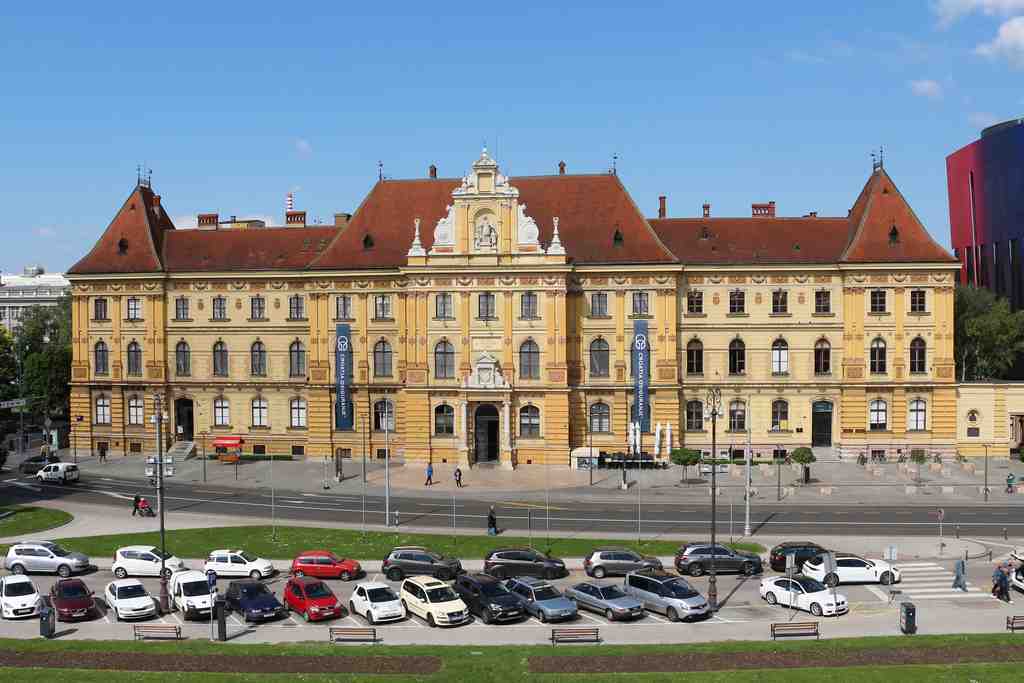
To spot the Museum of Arts and Crafts, look for a grand, yellow historicist palace with a stately central entrance and a reddish-brown tiled roof, standing proudly across the street with ornate architectural details and blue banners by its doors. Ah, you’ve made it to one of Zagreb’s most enchanting grand dames! Imagine yourself standing here in the late 1800s-the streets bustling with horse-drawn carriages, craftsmen hauling mysterious bundles under their arms, and a gentle clatter of tools, as the scent of fresh paint and sawdust drifts in the air. The Museum of Arts and Crafts before you was born from an ambitious dream that started in 1880, spearheaded by Izidor Kršnjavi, a man with a remarkable moustache and even more remarkable ideas. He and the Arts Society decided it was time for Zagreb to embrace beauty in everyday life-picture that for a moment! They wanted to inspire craftspeople and artists to create objects not just for use, but for joy, and maybe a little bit of showing off to their neighbors. Their inspiration? The English Arts and Crafts movement, which championed handmade artistry over soulless factory goods. Kršnjavi read the works of Gottfried Semper and thought, “Let’s not only preserve our crafts-let’s make everyday objects into masterpieces!” So, with the support of Bishop Josip Juraj Strossmayer-a name that pops up in Croatian history like a well-loved old friend-they began hunting for treasures. The first pieces were snatched up at an inheritance auction in Paris from the famed Catalan painter Mariano Fortuny. It sounds rather glamorous, doesn’t it? Fancy hats, elegant gestures, and the anxious bidding of collectors-one can almost hear the auctioneer’s rapid-fire French. By 1888, architect Hermann Bollé (who must have had a flair for drama) unveiled this palatial building just for the museum and a crafts school-one of the first of its kind designed to merge education, creativity, and display. If walls could talk, these would whisper stories of apprentice woodcarvers and nervous students racing to sketch an ornate piece before lunchtime. The building’s style nods to German Renaissance, with all the turrets, flourishes, and bravado of a cake decorated by an enthusiastic pastry chef. The museum had humble beginnings, debuting its first collection in a cramped space on Gajeva Street in 1882. But by 1909, every shiny new acquisition and cherished relic was finally home under this red-tiled roof. Fast forward to 1995, and the museum underwent a magical transformation, orchestrated by director Vladimir Maleković and architect Marijan Hržić-who made sure you could travel through history as you wandered from floor to floor, as breezily as taking three steps into three different centuries. Now, the museum is a treasure chest, with three sprawling floors-more than 2,000 square meters-stuffed with about 3,000 splendid exhibits. But that’s only a small taste: the full trove is a mind-boggling 160,000 objects stretching from the 4th to the 20th century! You’ll find Gothic to Art Deco wonders, dazzling glass, intricate textiles, clocks stubbornly stuck at tea time, musical instruments that once serenaded ballroom dancers, and even quirky product designs that might make you scratch your head and smile. Behind the scenes, the Collections Department keeps everything in tip-top shape-100,000 objects in 19 distinct collections, everything from architecture to painted leather, ivories, and even a famed collection belonging to Anka Gvozdanović. There are restoration workshops busting with experts: picture a “doctor” for every kind of art, patching up cracked ceramics or mending battered old books with a surgeon’s precision. Speaking of books, the museum’s library is a hidden world unto itself, still housed in its original 19th-century interior (designed by Bollé, naturally). Its 65,000 volumes include art history, rare print portfolios, antique catalogs, and more. Trade secrets and beautiful patterns wait on every shelf, the perfect resource for anyone hoping to bring a little extra magic into the world. So, as you gaze up at this magnificent yellow palace, picture the generations of artisans, thinkers, and dreamers who passed through its doors-all united by a simple idea: to make the ordinary extraordinary. Now, that’s a little bit of magic, don’t you think?
Otwórz dedykowaną stronę →To spot Republic of Croatia Square, look for a grand, yellow, historic theatre building-the Croatian National Theatre-standing proudly at the square’s heart, surrounded by green…Czytaj więcejPokaż mniej
To spot Republic of Croatia Square, look for a grand, yellow, historic theatre building-the Croatian National Theatre-standing proudly at the square’s heart, surrounded by green lawns, stone paths, and impressive, elegant architecture on all sides. Ah, here we are at Republic of Croatia Square, one of Zagreb’s most magnificent open spaces! Take in the scene-the grand golden-yellow National Theatre commands the center stage, while the whole square is wrapped in a patchwork of stately 19th-century buildings. It’s almost as if the entire square is a well-rehearsed play, and you’ve just arrived for opening night! But this wasn’t always the glamorous hotspot you see today. Picture the year 1855: instead of the hum of traffic and students chatting on benches, you’d hear cows mooing on southern meadows and see a few hospital buildings going up-the beginnings of a transformation! The north side saw the first construction, intended as a hospital but soon finding itself home to a tobacco factory, then a university, and today, the Rectorate and Law Faculty. Every building seemed to audition for new roles over the years. Fast forward to the late 1800s, and it’s all action! The east welcomes the city’s publishing house and the multi-use building of the Croatian Economic Society-architects furiously sketching two floors, and then, wait, let’s add a third in 1922! Not dramatic enough? 1884 brings the gymnasts of Hrvatski Sokol and the singers of Kolo society, their shouts and songs echoing off freshly built walls. The left wing of this building even becomes a rehearsal hall for the Academy of Dramatic Art. Yes, this is truly a stage for all of Zagreb's talents. Then, the west side claims the beautiful building for the School of Crafts and the Museum of Arts and Crafts, designed by Hermann Bollé-imagine the first tinkering students rushing through its new halls. For even more variety, add in a teacher’s home, a Renaissance-inspired palace by Viktor Kovačić, and that very unique business building, Željpoh, raised in 1964. Each addition a new scene, a new act in the story of the square. Of course, every good drama requires a showstopper, and in 1895, it arrives: the Croatian National Theatre, opened with all the fanfare and presence of Emperor Franz Joseph himself! Imagine the crowd, the swirling music, the sharp click of boots on stone as dignitaries paraded in. Not to be outdone, Ivan Meštrović’s famous sculpture, the Well of Life, is placed nearby in 1905-a symbol of hope and creativity gurgling away in front of the theatre’s grand entrance, surrounded by people pondering both water and art. Through decades, the square’s name changes as often as a chameleon in a paint factory. It’s known as Fairground Square, University Square, Wilson Square, King Alexander I Square, Square I, Theatre Square, Marshal Tito Square, and finally, Republic of Croatia Square in 2017. Each new name, a spark of tension-debates clattering through coffee houses, politicians squabbling, and in the background, Zagreb’s citizens rolling their eyes and simply calling it the big square by the theatre. Today, as you stand here, you’re not just in a square but in a living time machine. Turn slowly and you’ll see historicist buildings watching over you, theaters echoing with the past’s laughter, and more stories beneath your feet than anyone could ever count. So breathe in-there’s always something dramatic going on at Republic of Croatia Square… but don’t worry, the cows are long gone!
Otwórz dedykowaną stronę →To spot the Croatian National Theatre in Zagreb, look for a grand, bright yellow building with a green dome and two towers topped by Croatian flags, standing proudly at the edge…Czytaj więcejPokaż mniej
To spot the Croatian National Theatre in Zagreb, look for a grand, bright yellow building with a green dome and two towers topped by Croatian flags, standing proudly at the edge of the square ahead of you. Welcome to one of the most dazzling jewels in Zagreb-home to drama, opera, ballet, and, let's admit, the best concentration of velvet seats per square meter in the city! The Croatian National Theatre, or HNK as locals call it, isn’t just an ordinary building-it’s a stage where history, dreams, and music have danced together for over a century. Imagine the year is 1895. The city’s old theater-sadly battered by the infamous 1880 earthquake-just couldn’t keep up with all the creative minds bursting to perform. But wait! The city buzzes with excitement as hundreds of workers clatter and hammer, racing the clock to finish the finest theater in Croatia for Emperor Franz Joseph’s big visit. The result? This neobaroque masterpiece, designed by architectural dream team Fellner and Helmer, whose buildings still dazzle across Europe! On the grand opening day, a sea of top hats and elegant dresses gathers outside. Suddenly-drumroll, please-a hush falls as Emperor Franz Joseph steps onto the front balcony. He lifts a shiny silver hammer, crafted just for this event, and with one final whack, officially opens the theater. The crowd cheers! That night, the very first performance, a poetic spectacle called “Glory to Art,” fills the theater with music and song. Legends say the emperor’s mustache twitched in approval. Now, that’s show business! But this site’s drama doesn’t begin with the neobaroque sparkle. For centuries, Zagreb’s actors performed in cathedrals, palace dining rooms, and even old school halls. In the buzzing days of the 1700s and 1800s, German theater groups livened up city taverns and grand mansions, sometimes even acting in the local dialect, thrilling curious citizens who yearned for world-class culture. By the 1830s, with the help of a lucky lottery winner, a brand new theater was built in the Upper Town-imagine hitting the jackpot and then building a stage instead of buying a sports car! Soon, this theater became the beating heart of the city, and by 1840 the Croatian National Theatre company was born, staging its very first play right there. Even the Croatian parliament danced-well, debated-in its side ballroom! But progress waits for no one, and as the city grew, so did its ambitions: Zagreb wanted a theater to rival Vienna, and boy, did it get one. The new HNK became a magnet for legends. Composer Ivan Zajc took up the conductor’s baton, and opera maestro Jakov Gotovac held the post for an astounding 35 years! Famed Croatian directors, prima ballerinas, and star actors-some whose names sparkle to this day-started their journeys right here, beneath the theater’s glittering painted ceilings. Look up at those mighty statues and busts outside; you’ll see Croatian literary and musical greats, forever keeping watch over the city’s artistic future. Step closer to the entrance, and you’ll spot the Well of Life fountain by Ivan Meštrović, where many a lover has made a wish (and probably a few actors have cooled down after a particularly dramatic monologue). The stories don’t stop at drama, opera, and ballet. In 1941, a living chess game was staged here, inspired by a match played by future world champion Alexander Alekhine. Imagine actors becoming pawns and queens, gliding across the stage with every move - talk about putting yourself in the game! Through wars, renovations, and wild applause, this building has survived and thrived-its golden walls soaking up tears, laughter, and maybe even the odd ghostly encore. Today, the Croatian National Theatre remains the beating heart of Zagreb’s arts scene, drawing in stars from Laurence Olivier to José Carreras, and filling its seats with dreamers young and old. So, as you stand before these grand doors, take a deep breath. You’re not just in front of a building-you’re in the front row of history’s greatest show.
Otwórz dedykowaną stronę →Directly ahead of you, look for a low, round bronze fountain surrounded by life-sized figures-men, women, and children-crouching and leaning over the well, their shimmering dark…Czytaj więcejPokaż mniej
Directly ahead of you, look for a low, round bronze fountain surrounded by life-sized figures-men, women, and children-crouching and leaning over the well, their shimmering dark shapes in striking contrast to the pale stone beneath them. Alright, take a deep breath and step a little closer-you’ve made it to the Well of Life! Now, before you worry you’ve gatecrashed a naked swim party, let me reassure you: you’re gazing at one of Zagreb’s most iconic sculptures, created by the famous Croatian artist Ivan Meštrović in 1905. From a distance, it might seem like a curious huddle of bronze figures, but get closer, and you’ll find an extraordinary snapshot of life itself, frozen in a moment around a deep, mysterious well. Imagine yourself in early 20th-century Zagreb. The streets are busy with horse-drawn carriages, and the Croatian National Theatre nearby has just let out a crowd in their finest hats. Suddenly, word spreads-a new sculpture is being unveiled on Republic of Croatia Square. People gather, some excited, others a little scandalized by the sight of ten naked figures, each showing every curve and emotion, twisting and bending around a circular well. There’s a child, a young couple practically glued together in love, and an old man at the far edge whose gaze carries the weight of an entire lifetime. These figures, with their smooth, almost dreamlike forms, draw the eyes-and possibly a few shocked gasps-from early Zagreb citizens. Listen closely: the well is more than just a pool of water. It’s a symbol of hope, change, the ups and downs of life. Each figure seems caught in a dance between joy and sadness-after all, doesn’t life sometimes make us want to jump in headfirst, and at other times just dip a cautious toe? The young couple, full of love and energy, reminds you of the springtime of life, while the old man’s quiet sadness hints at its twilight. Now, here’s a twist worthy of a good drama! Ivan Meštrović actually wished for this fountain to be placed in Split, but it was bought and installed here instead, tucked partly out of sight to avoid offending the city’s more conservative folks. No Instagram back then, but you can bet this was the talk of the town. As you take in the gentle shimmer of bronze, the way the light glides over the figures-think of it as Meštrović bringing a splash of Rodin’s Impressionist touch right into Zagreb. This is not just a sculpture; it’s a celebration of everything we go through as humans. Birth, love, longing, and eventually, goodbye... all gathered together, side by side by the Well of Life. So, my fellow explorer, as you stand here for your final stop, try to spot your own reflection among these figures. And remember-even the old man was young once, and the circle goes on!
Otwórz dedykowaną stronę →
Najczęściej zadawane pytania
Jak rozpocząć trasę?
Po zakupie pobierz aplikację AudaTours i wpisz kod realizacji. Trasa będzie gotowa do natychmiastowego rozpoczęcia – po prostu dotknij \"Play\" i podążaj trasą z nawigacją GPS.
Czy potrzebuję internetu podczas trasy?
Nie! Pobierz trasę przed rozpoczęciem i korzystaj z niej w pełni offline. Jedynie funkcja czatu wymaga internetu. Zalecamy pobieranie przez WiFi, aby oszczędzać dane mobilne.
Czy to wycieczka grupowa z przewodnikiem?
Nie – to samodzielny audioprzewodnik. Zwiedzasz niezależnie, we własnym tempie, z narracją audio odtwarzaną przez telefon. Bez przewodnika, bez grupy, bez harmonogramu.
Ile trwa trasa?
Większość tras zajmuje 60–90 minut, ale to Ty kontrolujesz tempo. Wstrzymuj, pomijaj przystanki lub rób przerwy, kiedy chcesz.
Co jeśli nie zdążę ukończyć trasy dzisiaj?
Żaden problem! Trasy mają dożywotni dostęp. Wstrzymaj i wznów, kiedy chcesz – jutro, za tydzień lub za rok. Twój postęp jest zapisywany.
W jakich językach są dostępne trasy?
Wszystkie trasy są dostępne w ponad 50 językach. Wybierz preferowany język podczas realizacji kodu. Uwaga: języka nie można zmienić po wygenerowaniu trasy.
Gdzie znajdę trasę po zakupie?
Pobierz darmową aplikację AudaTours z App Store lub Google Play. Wpisz kod realizacji (wysłany e-mailem), a trasa pojawi się w Twojej bibliotece, gotowa do pobrania i rozpoczęcia.
Jeśli trasa Ci się nie spodoba, zwrócimy Ci pieniądze. Skontaktuj się z nami pod adresem [email protected]
Bezpieczna płatność przez