Milwaukee Audiotour: Sporen, Schatten & Verhalen van Downtown
Ooit zwierf een leeuw door het centrum van Milwaukee – het eerste ontsnapte dier uit de dierentuin van de stad, dat paniek zaaide op slechts enkele straten afstand van waar legendes nu brullen in de UW–Milwaukee Panther Arena. Deze zelfgeleide audiotour neemt je mee diep in de levende verhalen van de stad, en leidt je van historische tentoonstellingen in het Milwaukee Public Museum naar de glimmende zalen van het Baird Center en verder. Ontdek het drama en de eigenaardigheden waar de meeste bezoekers zonder het te merken voorbijlopen. Welke politieke opstand verscheurde de stad bijna onder deze arenastoelen? Wiens gefluisterde geheimen blijven hangen in de schaduwrijke hoeken van het museum na sluitingstijd? En welke schandalige culinaire uitvinding verraste de gemeenteraad in het Baird Center? Bewegen door het hart van Milwaukee terwijl de verborgen geschiedenis onder je voeten pulseert. Volg rebellie, schandalen en verrassingen in het ritme van de stad – zie elke bekende hoek met frisse ogen en nieuwe vragen. Begin nu en jaag op de leeuw in het verhaal van Milwaukee – avontuur wacht waar het verleden nooit helemaal rust.
Tourvoorbeeld
Over deze tour
- scheduleDuur 30–50 minsGa op je eigen tempo
- straighten4.4 km wandelrouteVolg het geleide pad
- location_onLocatieWauwatosa, Verenigde Staten
- wifi_offWerkt offlineEén keer downloaden, overal gebruiken
- all_inclusiveLevenslange toegangOp elk moment opnieuw afspelen, voor altijd
- location_onStart bij The Hop
Stops op deze tour
Look for the sleek metal transit shelter displaying a bold yellow logo with block letters and a circular, geometric emblem right in the center. Milwaukee has this wild habit of…Meer lezenToon minder
Open eigen pagina →Look for the sleek metal transit shelter displaying a bold yellow logo with block letters and a circular, geometric emblem right in the center.
Milwaukee has this wild habit of erasing its own blueprints just to draw them all over again. When this modern streetcar system opened up to the public in 2018, it was really just the newest chapter in a long history of tearing down and building back up. A whole new set of tracks for a city that refuses to stand still.
Back in 1860, the city's very first transit system used horse drawn cars, which eventually grew into a massive, electric streetcar network. But after World War II, the federal government started pouring money into the new interstate highway system while simultaneously raising taxes on private railway operators. Those heavy financial burdens on the operators, combined with the push for sprawling highways, essentially crushed the original public transit network. The final nail in the coffin came on March 2, 1958, when the last electric line on Wells Street was shut down.
Check out your phone for a second to see what the modern version looks like cruising down the street.

The Hop streetcar (Car 02) westbound on E. Ogden Avenue, part of the 2.1-mile M-Line that connects major Milwaukee neighborhoods.Photo: Michael Barera, Wikimedia Commons, CC BY-SA 4.0. Cropped & resized. For exactly 60 years, the city streets were entirely free of rails. Then, in March of 2018, an 83,000 pound Liberty model streetcar, built by Brookville, finally rolled into town. Local leader Robert Bauman actually pointed out the crazy irony of that timing. Sixty years to the month after the old system was killed off, the new one arrived to take its place.
If you want a peek inside, take a glance at your app to see the spacious interior that can comfortably fit up to 150 passengers.

The accessible and modern interior of a Hop streetcar, designed to comfortably carry 120 to 150 passengers.Photo: Michael Barera, Wikimedia Commons, CC BY-SA 4.0. Cropped & resized. This system is actually pretty clever. Because almost a third of the 2.1 mile original route does not have overhead wires, these cars are designed to run purely on battery power for those stretches. They just charge right back up once they reconnect to the grid. The whole thing is operated by Transdev and remains completely free to ride, thanks in large part to an initial 10 million dollar sponsorship from the local Potawatomi Native American community. Getting this project off the ground was a massive political battle, with critics calling it a 1900s style trolley just for yuppie entertainment. But the city pushed through anyway, tearing up the pavement to lay down the future.
It is funny how we always seem to circle back to where we started, just with shinier wheels. Speaking of things that keep moving forward, let us shift our focus from the rails of transit to the historic hub of commerce. We are going to head toward the old merchant center, which is about a 9 minute walk away, down at The Avenue.
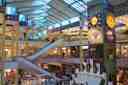
Take a look inside The Avenue, a sprawling multi-level complex defined by its soaring glass skylight roof, sturdy yellow cylindrical pillars, and a towering square column…Meer lezenToon minder
Open eigen pagina →
The AvenuePhoto: Sulfur, Wikimedia Commons, CC BY-SA 3.0. Cropped & resized. Take a look inside The Avenue, a sprawling multi-level complex defined by its soaring glass skylight roof, sturdy yellow cylindrical pillars, and a towering square column featuring a large clock face. You are standing in front of a space that spans three entire city blocks, a place that has been tearing itself down and building itself back up for over a century.
Back in 1982, this opened as the Grand Avenue Mall, trying to save downtown retail by combining local flavor with a massive food court. It actually swallowed up the old Plankinton Arcade, which had itself replaced the historic Plankinton House Hotel. If you look closely at the older stonework and railings, you will find a hidden architectural detail called a quatrefoil, which is basically a fancy four-leaf clover design. The original developers loved this detail so much they made it the mall's logo, and today, the new apartment complex inside pays homage to it with the name Plankinton Clover Apartments.
But let me tell you, even shopping centers have their fair share of hidden drama. Right in the center of the arcade's circular atrium sits a life-size bronze statue of meat-packing titan John Plankinton, and the story behind it is pure soap opera. The sculptor, a guy named Richard Henry Park, had actually betrayed Plankinton's daughter, Elizabeth, abandoning her to marry another woman and leaving her completely heartbroken. Despite this devastating personal insult to the family, Plankinton's son William actually hired Park to create this memorial honoring their father. It is wild to think they handed a massive commission to the man who ruined their sister's life, but that is exactly what happened.
This space has seen its share of darker, heavier moments too. In September of 1990, the notorious serial killer Jeffrey Dahmer was walking through this very mall when he encountered a twenty-two-year-old father named David Thomas. Dahmer used false pretenses to lure Thomas away from the bustling crowds to his apartment, where Thomas was tragically murdered. It is a chilling footnote, showing how true darkness can slip right through a crowded public space.
Decades later, the mall faced totally different challenges. During the holiday season in 2014, protests over a fatal police shooting spilled right into the corridors, prompting panicked staff to shut down stores and causing significant financial hits for a space that was already struggling.
But true to form, this block is morphing once again. The Avenue is currently under renovation, swapping out vacant retail spaces for a new food hall, office spaces, and apartments. It is the ultimate cycle of reinvention, tearing up the script to write a brand new one. Speaking of scripts, we are heading toward the theater district next, where the behind-the-scenes stories are just as dramatic as the ones on stage. The Milwaukee Repertory Theater is just a seven minute walk away. By the way, the public areas here are generally open from eleven in the morning to seven in the evening most days, with slightly shorter hours on the weekend.
Standing before you is a grand symmetrical brown brick building defined by its large recessed arches and a striking black wrought-iron canopy stretching over the sidewalk below…Meer lezenToon minder
Open eigen pagina →
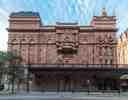
Pabst TheaterPhoto: Kenneth C. Zirkel, Wikimedia Commons, CC BY-SA 3.0. Cropped & resized. Standing before you is a grand symmetrical brown brick building defined by its large recessed arches and a striking black wrought-iron canopy stretching over the sidewalk below ornate gold-leaf balconies. Back in 1890 the famous brewing magnate Captain Frederick Pabst bought an existing opera house on this spot and renamed it The New German City Theater. It was a beautiful monument to the city's wealthy brewing elite serving as a proud symbol of Milwaukee's deep German roots. In those days the city was so steeped in German culture it was actually nicknamed the German Athens.
Take a moment to really look up at the theater's exterior and see if you can spot those intricate gold details and classical figures perched along the roofline.
But this place did not just survive on good looks alone. It was forged in disaster and conflict constantly adapting its shape and purpose to match the restless energy of the city. In January 1895 a massive fire completely leveled the original building. Captain Pabst was vacationing in Europe at the time but he supposedly fired off a frantic telegram to his architect Otto Strack demanding he rebuild at once. Strack got his bold second chance and designed this masterpiece in an amazing eleven months building it in the ornate German Renaissance Revival style.
To make sure his work never burned again Strack demanded the skeleton be built of cast iron and concrete meaning a sturdy metal framework surrounded by poured stone. The only wood allowed in the entire building was the stage floor and the window frames. He even banned open flames making this Milwaukee's first all-electric venue.
Take a peek at your screen to see a neat before and after shot showing how this elegant 1895 Victorian facade has stayed beautifully preserved despite the changing decades. You can also see an image of how proudly the theater sits right next to the towering City Hall anchoring the urban landscape.

The Pabst Theater stands proudly alongside Milwaukee City Hall, emphasizing its status as a significant City of Milwaukee Landmark in its urban setting.Photo: Michael Barera, Wikimedia Commons, CC BY-SA 4.0. Cropped & resized. Inside the theater is shaped like a drum and drips with luxury featuring a two-ton Austrian crystal chandelier and staircases crafted from white Italian Carrara marble. It originally hosted exclusively German language performances. But when World War I broke out intense national scrutiny hit the local community hard. Anti-German vigilantes threatened the theater with local legends claiming a mob actually dragged a machine gun out front to force the cancellation of a play. It was a fierce cultural standoff and by 1918 the theater was forced to pivot to English acts to survive the hostility.
Known affectionately as the Grande Olde Lady the theater eventually faced a bitter union dispute and the very real threat of the wrecking ball in the late 1960s. But a passionate coalition of architectural advocates and the city stepped in to save it from destruction. That public fight sparked a massive restoration in 1976 that brought back the architect's opulent original vision. Decades later philanthropist Michael Cudahy bought it for just one dollar to set up the Pabst Theater Foundation securing its future.
Soak in the grand architecture of this incredible survivor one last time. When you are ready we will leave this monument to the brewing kings and walk a couple minutes over to the political heart of the city Milwaukee City Hall.
Toon 8 stops meerToon minder stopsexpand_moreexpand_less
On your left is Milwaukee City Hall, a massive brick and stone fortress anchored by a soaring clock tower topped with a green copper spire and rows of elegant arched windows. This…Meer lezenToon minder
Open eigen pagina →
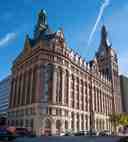
Milwaukee City HallPhoto: Gillfoto, Wikimedia Commons, CC BY-SA 4.0. Cropped & resized. On your left is Milwaukee City Hall, a massive brick and stone fortress anchored by a soaring clock tower topped with a green copper spire and rows of elegant arched windows. This towering Flemish Renaissance Revival building, an architectural style known for its ornate gables and intricate European brickwork, was finished in 1895 and stood as the tallest building in the city until the 1970s.
This place is the absolute epicenter of Milwaukee's constant cycle of bold visions and messy public battles. During the first half of the twentieth century, this very building was the headquarters for a totally unique American political movement known as Sewer Socialism. I know, it is an amazing name. Instead of preaching radical revolution, Milwaukee's socialist mayors focused completely on pragmatic things like municipal water systems, sanitation, public parks, and running a brutally honest, penny-pinching government. They just wanted things to work.
Which makes the modern history of this building deeply ironic. Those frugal early mayors would have probably lost their minds over the taxpayer burden that happened here recently. From 2006 to 2008, the city launched a massive 76 million dollar restoration project to save the aging exterior. They installed fully grouted terra cotta, which is a type of baked clay used for decorative architectural details. But they clearly did not factor in the brutal freeze and thaw cycles of a Wisconsin winter. The solid clay cracked under the pressure.
The situation hit a breaking point on a February night in 2011. A massive piece of a decorative terra cotta urn broke clean off the facade and plummeted directly onto Market Street. That near-disaster forced the city to wrap this beautiful historic landmark in ugly metal scaffolding and plywood just to protect the pedestrians below from falling debris. It sparked an absolute nightmare of a lawsuit, eventually clawing back about 16 million dollars from the contractors in settlements.
And the drama did not stop at the roof. The building is literally resting on a swamp. The foundation is supported by over two thousand wooden piles made of white pine driven deep into the marshy ground. By 2014, those ancient wooden supports started to rot, and the northeast side of the building actually sank nearly two inches. The city had to pump in even more millions just to stop the whole thing from sinking into the mud.
It is wild how much effort goes into keeping a structure like this standing. Even back in 1929, the top of that 350 foot bell tower caught fire, and the flames were so high that the fire department did not even own ladders tall enough to reach it. They just had to stand on the street and watch the roof burn until it could be rebuilt later.
Consider the irony here. A 76 million dollar restoration meant to preserve history ended up cracking under pressure and raining debris onto the sidewalks. When does preservation become more costly than simply starting over?
Think about that as we head toward our next stop, which offers a very different kind of architectural statement. Oh, and if you want to peek at the soaring eight-story atrium inside, the doors are open Monday through Friday from eight in the morning until four forty five in the afternoon. Let's keep moving and make the short three minute walk over to the Marcus Center.
Look to your left for the large, blocky towers made of light stone flanking a massive glass-walled lobby with a sweeping metal canopy stretching over the main entrance. That is…Meer lezenToon minder
Open eigen pagina →
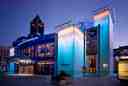
Marcus CenterPhoto: Bginptotao23, Wikimedia Commons, CC BY-SA 4.0. Cropped & resized. Look to your left for the large, blocky towers made of light stone flanking a massive glass-walled lobby with a sweeping metal canopy stretching over the main entrance. That is the Marcus Performing Arts Center. Though the story of this place is a lot heavier than the ballets and Broadway shows they put on inside.
Back in September 1969, the opening night of this venue was an absolute blowout, with balcony tickets going for a hundred dollars, which is about seven hundred bucks today. But while the wealthy sipped champagne inside, protesters marched right outside these doors, demanding basic rights and arguing this lavish complex was just a playground for the rich that completely ignored the needs of the city's poor and minority communities. These protests add another layer to the city's history of hidden turmoil, highlighting a deep tension between the shiny, expensive new Milwaukee and the people left out of the frame.
The original building was designed by a famous Chicago architect named Harry Weese in a style called Brutalism. Now, Brutalism usually involves massive, heavy, raw concrete forms that look almost like fortresses. But Weese wanted something more elegant, so he originally wrapped this entire building in luminous white Italian travertine marble. It was supposed to be clean and muscular.
But cities rarely sit still. Over the years, the building's identity was totally altered. In 1994, that pristine white marble was stripped off and replaced with the limestone and huge glass additions you see now. You can check your screen to see a clearer view of this altered exterior. Architecture critics absolutely hated the change. One critic famously complained that the renovation turned a fresh mint into a milk dud. Later on, they added bright LED lighting arrays to the building. Some critics dismissed those lights as cheap costume jewelry meant to distract from the lost original design.

This view of the Marcus Center's exterior from 2022 shows the building after its 1994 renovation, which replaced the original white travertine marble with limestone and brick, a change criticized by architectural purists.Photo: Michael Barera, Wikimedia Commons, CC BY-SA 4.0. Cropped & resized. The fights over this space did not stop at the walls, either. Surrounding the center used to be a meticulously organized grove of thirty six horse chestnut trees, designed by a renowned landscape architect named Dan Kiley. In 2018, the center decided to tear the grove down to make way for an open public lawn. Preservationists fought a bitter, incredibly tense battle to save the modernist grove, even winning a temporary historic designation. But the victory did not last. The center quickly cut down four trees, the city ultimately overturned the historic status, and the whole grove was quietly demolished. You can take a look at the historic before and after image in your app to see how the plaza transformed from that dense tree grove into the open stone gathering area there today.
It is a venue constantly shaped by clashing visions and fierce public debates. By the way, if you need to hit the box office, it is open Monday through Friday from noon to four in the afternoon.
Now, let us transition from the performing arts to the arena where sports and public art collided. We are heading over to the UW-Milwaukee Panther Arena, which is about an eight minute walk away.
You are looking at a massive red brick building crowned by a sweeping arched roof, easily identified by the large black and yellow panther head mounted right on its facade. For…Meer lezenToon minder
Open eigen pagina →
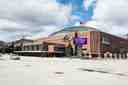
UW–Milwaukee Panther ArenaPhoto: Pepsiwithcoke, Wikimedia Commons, CC BY-SA 4.0. Cropped & resized. You are looking at a massive red brick building crowned by a sweeping arched roof, easily identified by the large black and yellow panther head mounted right on its facade.
For a long time, locals just knew this place as the MECCA Arena, a building that became the unlikely canvas for a chaotic forty thousand pound basketball floor painted in blazing orange. Back in 1978, the city hired famous pop artist Robert Indiana to design a new basketball court for the Milwaukee Bucks. The result was absolutely wild. He painted massive, vibrant orange letter M's covering both half courts.
The initial public reaction was completely hostile. The city spent twenty seven thousand five hundred dollars in public funds on the project, which is roughly a hundred and thirty grand in today's money. Locals felt it was a ridiculous waste of their hard earned taxes. But that community outrage shifted pretty quickly when the Bucks actually started playing on it.
The court was so intensely bright and visually jarring that opposing players would completely lose their bearings. They would accidentally step out of bounds or wander blindly into the three second lane, which is the restricted painted area near the basket where offensive players are legally only allowed to stand for a few moments at a time. Even the Bucks head coach, Don Nelson, joked that he thought his team had to wear sunglasses because the floor was so blinding. It was pure pop art weaponized for a home court advantage.
But nothing lasts forever. After the Bucks moved out in 1988, this massive wooden masterpiece was unceremoniously abandoned. Fast forward to the early two thousand tens, and the legendary floor mysteriously ended up listed on a random architectural salvage website. If you check out your screen you can see the arena's very tidy modern exterior, a sharp contrast to the messy, colorful drama of its history.
A local fan named Andy Gorzalski spotted that internet listing and panicked. Refusing to let the iconic court be chopped into scrap wood, he threw a twenty thousand dollar hold straight onto his personal credit card. He frantically tracked down a local flooring company owner named Greg Koller, who officially stepped in to buy it.
But tragically, Greg died unexpectedly in July of twenty eleven, right after acquiring the wood. Just before his passing, he urged his son Ben to come back home from Los Angeles to preserve the artwork. Greg told his son that the MECCA was not just a basketball floor, but an idea that represented going after your dreams.
Honoring his father's final wish, Ben partnered with Andy to restore the floor, eventually transforming that crazy orange puzzle into a celebrated public art installation. It is a fantastic story of how this city constantly tears down and rebuilds its identity, taking huge artistic risks that spark fierce community arguments, only for passionate locals to step up and rescue the pieces.
And speaking of places where bold modern ambition meets deep local roots, we are moving on. Make your way toward our next stop at the Baird Center, which is about a six minute walk away.
Right in front of you sits a massive convention space recognizable by its expansive red brick exterior, a sloping green roofline, and a prominent corner tower topped with a…Meer lezenToon minder
Open eigen pagina →
Baird CenterPhoto: Michael Barera, Wikimedia Commons, CC BY-SA 4.0. Cropped & resized. Right in front of you sits a massive convention space recognizable by its expansive red brick exterior, a sloping green roofline, and a prominent corner tower topped with a skeletal metal spire. This is the Baird Center, a place that perfectly captures how this city is constantly tearing up the script to write something entirely new, sometimes with a fair bit of friction along the way.
If you look closely at that brickwork and the sharply angled roofs, you will notice a deliberate callback to the historic German architecture that shaped much of downtown. It is a massive modern facility putting on the clothes of the nineteenth century.
But its history is totally modern, and full of wild pivots. Take a look at your screen to see the building as it stood in 2022, back when it was called the Wisconsin Center. In 2020, this venue was meant to host a massive showcase for the Democratic National Convention, but the pandemic forced everything to be radically downsized into a mostly virtual broadcast. Instead of addressing a roaring crowd, political delegates delivered their speeches to a nearly empty conference room right here, turning the expected economic boom into a political ghost town.

This image shows the building in 2022 when it was known as the Wisconsin Center, before it was officially renamed the Baird Center in July 2023.Photo: Michael Barera, Wikimedia Commons, CC BY-SA 4.0. Cropped & resized. And the friction here is not just on the national stage. For decades, the inside of this building hosted one of the most uniquely Milwaukee pieces of public art you could ever imagine. It was an interactive escalator officially named Polka Time, though everyone just called it the Polkalator. The installation featured twenty two photographs of people dancing at a 1976 party, and riders could press a button to blast one of two hundred random polka songs on their way up.
It was quirky, it was fun, and it eventually became the center of a local cultural battle. A few years ago, the venue executive decided one of the photos, which featured a man sticking his tongue out, was inappropriate and demanded it be altered. The artist absolutely refused, arguing the work was an unchangeable historical record. In the end, during the recent massive expansion of the center, the entire Polkalator was dismantled. You can look at your app to see the glassy, hyper modern 2024 expansion that took its place. But the people did not let the Polkalator go quietly. On its final day, fans showed up in full traditional polka gear, high fiving each other as they rode it one last time. Attendees of the local anime convention even started treating the empty elevator bay like a shrine, leaving battery operated candles and Pokemon cards to mourn its loss.
It just goes to show how passionate folks around here get about their local flavor, even inside a corporate convention center. We are going to step away from modern politics and polka drama now, and head toward the institutions that preserve the deeper, ancient roots of the region. Next up is the Milwaukee Public Museum, just an easy five minute walk from here.
Look for the massive, boxy beige stone structure featuring a striking sculpture of five metal birds in flight mounted directly on the flat facade, right above the lower glass and…Meer lezenToon minder
Open eigen pagina →
Milwaukee Public MuseumPhoto: Sulfur, Wikimedia Commons, CC BY-SA 3.0. Cropped & resized. Look for the massive, boxy beige stone structure featuring a striking sculpture of five metal birds in flight mounted directly on the flat facade, right above the lower glass and steel entryway. You can see a great shot of this mid-century exterior on your screen.

The current Milwaukee Public Museum building at 800 W. Wells Street, which has housed the museum's extensive collections since its completion in 1962.Photo: Michael Barera, Wikimedia Commons, CC BY-SA 4.0. Cropped & resized. This place is a perfect monument to how this city is always pushing forward, dreaming up massive new visions, and occasionally getting into a serious brawl over what comes next.
It all started back in 1851 with the German-English Academy. Milwaukee had this incredible influx of German immigrants who brought along a deep intellectual curiosity and a reverence for the natural world. The academy's principal, Peter Engelmann, was all about hands-on learning. He sent his students out on field trips to collect botanical, geological, and archaeological specimens. Before long, these kids brought back so many rocks, bugs, and bones that the collection completely overran the school. Engelmann had to form a natural history society just to manage it all, transforming a quirky private school collection into a true public treasure. By 1882, the city officially accepted the collection to create a free public museum.
As the collection grew to over four million artifacts, the museum needed bigger homes, eventually moving into this current building in 1962. Here, art directors scavenged real cobblestones, gas lamps, and ornate doors from historic buildings being demolished for freeways. They used them to build the Streets of Old Milwaukee. It was one of the world's first walk-through immersive dioramas, meaning a life-sized historical scene you can physically step inside. It is incredibly beloved, right down to hidden Easter eggs like an animatronic Granny and a preserved alley cat that meows at passing visitors.
The museum also revolutionized how we see the natural world. Back in 1890, a taxidermist here named Carl Akeley, a scientist who prepares and mounts animal skins, sculpted anatomically accurate clay models instead of just stuffing them. Akeley was an absolute legend... he literally once survived an attack in Africa by choking an eighty-pound leopard with his bare hands.
But progress here usually comes with a fight. This mid-century building is now failing. We are talking severe temperature swings, mold, and water leaks threatening irreplaceable artifacts, like the bones of a woolly mammoth butchered by humans over fourteen thousand years ago. The museum's leadership launched a bold campaign to abandon this building and construct a brand new facility.
But remember those intricate 1965 historic streets? They were built straight into the structure of this building with heavy wood and glue. They cannot be physically moved to a new site without being destroyed. That realization sparked huge public petitions and outcries from folks who mourn the loss of that hand-built magic. It is a classic clash between preserving the past and saving the entire collection for the future.
The museum's story is still unfolding as they prepare for their next big move, and you can step inside to see the artifacts any day of the week except Tuesday between ten in the morning and five in the evening. For now, let us take a five-minute walk over to the Central Library, the very building where this museum used to share a roof before they moved here.
You will spot the Central Library right away by its massive light-colored stone facade, the long row of tall pillars stretching across the front, and the prominent rounded dome…Meer lezenToon minder
Open eigen pagina →
Central LibraryPhoto: Freekee, Wikimedia Commons, Public domain. Cropped & resized. You will spot the Central Library right away by its massive light-colored stone facade, the long row of tall pillars stretching across the front, and the prominent rounded dome crowning the center of the roof.
Milwaukee is not a city that just settles for the status quo. It is a place that constantly tears up the blueprint to build something bolder, often fighting tooth and nail to make those big dreams happen. Back in 1893, the city held a massive national competition to design a monumental structure that would originally house both the public library and the public museum under one roof. Seventy-four different plans were submitted, including one by a young Frank Lloyd Wright.
But the local architectural firm of Ferry and Clas beat them all out. Ferry and Clas pitched a sprawling, block-long masterpiece blending French and Italian renaissance styles, pulling inspiration straight from the Louvre in Paris.
It cost 780,000 dollars to build, which is roughly 26 million dollars today. Not a bad price tag for a building that won national medals and anchored an ambitious new plan for the western edge of downtown.
Inside, the dedication to pushing architectural boundaries continued. Master Italian craftsmen who had immigrated to Milwaukee were brought in to create something truly spectacular.
If the doors are open, go ahead and peek into the main entrance to check out those intricate mosaic tile floors. Try to imagine the sheer patience of these artisans placing each tiny piece by hand.
They used specially cut pieces called tessera, which are small squarish blocks of colored marble or tile. The builders intentionally used tessera that were smaller than usual just to achieve incredibly detailed patterns in the entryway. The whole interior is a masterclass in grand illusions and meticulous detail. For instance, the beautiful bay leaf garlands above the corridor doors look exactly like carved wood, but they are actually molded out of painted plaster. They also used scagliola, a brilliant technique where plaster is painted and polished to imitate expensive marble, to coat the towering pillars.
The library has always been a space of high-stakes negotiations and creative maneuvers to benefit the public. They even used one of their prized possessions, an ironic 19th-century painting called The Bookworm, as leverage in a modern deal. The library board negotiated a bold trade to loan the painting to a local college museum. In return, they scored free museum admission for all library cardholders and a cool one million dollar donation.
Whether it is pushing architectural limits or striking million-dollar art deals, this place proves that the pursuit of knowledge here is anything but quiet. And speaking of keeping the peace, our next stop shifts from the pursuit of knowledge to the pursuit of order as we head over to the Milwaukee Police Department, which is about an eight-minute walk away. Oh, and if you want to explore the library collections yourself, it is generally open daily with hours ranging from mid-morning to early evening depending on the day.
Look straight ahead at the sturdy masonry building, marked by a bold shield-shaped emblem with a bright blue and yellow border and a prominent central gear. It looks pretty…Meer lezenToon minder
Open eigen pagina →
Milwaukee Police DepartmentPhoto: Rcsprinter123, Wikimedia Commons, CC BY-SA 3.0. Cropped & resized. Look straight ahead at the sturdy masonry building, marked by a bold shield-shaped emblem with a bright blue and yellow border and a prominent central gear. It looks pretty orderly now, but this department was born out of absolute chaos. Back in the mid nineteenth century, Milwaukee was overrun by local gangs, mobs, and thieves. The county sheriff was completely overwhelmed. So, the city decided to completely overhaul its approach to law enforcement, establishing a dedicated police force in eighteen fifty five to wrestle back control of the streets. They brought in a guy named William Beck, a tough former New York City detective, to be the first chief.
Beck started with just six policemen. As the force grew, they introduced roundsmen. A roundsman was essentially an early shift supervisor who led the patrolmen out to their specific neighborhood beats. For that extra responsibility, a roundsman earned an extra five dollars a month, which is roughly a hundred and seventy dollars today.
That all sounds very structured, but grabbing control of the city wasn't just about fighting street crime. It was a vicious political tug of war. For decades, the department was at the mercy of the spoils system, a practice where winning politicians handed out government jobs as rewards to their loyal supporters. Take eighteen seventy eight, for example. A new Democratic mayor appointed a fellow Democrat as police chief, and that chief immediately fired twenty five Republican patrolmen just for being on the wrong side of the ballot.
The real test of the department's grit, though, happened in nineteen seventeen. A social worker named Maude Richter noticed a strange package wrapped up next to an evangelical church. She dragged it into the basement, and the church janitor eventually brought it right to the central police station. The station keeper was showing this suspicious package to the shift commander right before a scheduled inspection. Then, it detonated. It was a massive black powder bomb. The explosion ripped through the station, killing nine officers and a civilian.
Check out your phone to see a historical newspaper clipping covering the devastating aftermath of that blast. Investigators suspected the bomb was planted by the Galleanists, a faction of radical Italian anarchists who advocated for the violent overthrow of the government. For decades, that tragedy stood as the most fatal single event in national law enforcement history.
You can also glance at your screen to see the wider administration building where the modern force operates. It is a stark reminder that this town is always reshaping its identity, tearing down old paradigms and fighting tooth and nail to build something new from the rubble.

The Milwaukee Police Department administration building, from which the department, founded in 1855, manages its seven districts and approximately 1,800 sworn officers.Photo: Michael Barera, Wikimedia Commons, CC BY-SA 4.0. Cropped & resized. Speaking of massive civic transformations, let us head to our final destination. We are walking eleven minutes down the street to a spot where huge public investments and modern entertainment collide. Follow your map, and I will catch up with you at Fiserv Forum.
Look to your right and you will spot a massive glass-fronted arena capped with a sweeping, bronze-colored curved roof and supported by bold white V-shaped structural pillars along…Meer lezenToon minder
Open eigen pagina →
Fiserv ForumPhoto: Michael Barera, Wikimedia Commons, CC BY-SA 4.0. Cropped & resized. Look to your right and you will spot a massive glass-fronted arena capped with a sweeping, bronze-colored curved roof and supported by bold white V-shaped structural pillars along the side. This is Fiserv Forum.
To really understand this building, you have to look at the lineage of arenas in this town. We passed the Panther Arena earlier, which used to be the famous MECCA arena. That was replaced in 1988 by the Bradley Center. And by 2018, the Bradley Center was deemed too old, so it was demolished to make way for this. Fiserv Forum is the ultimate modern symbol of this city tearing down the old to build the new.
The push for this place started when former Bucks owner and United States Senator Herb Kohl proposed building a replacement for the Bradley Center. The NBA had flat out threatened to move the team to Las Vegas or Seattle if Milwaukee did not build a state-of-the-art facility. So, the city scrambled.
Of course, building a world-class arena takes serious cash. The total construction cost was 524 million dollars, and the taxpayers were handed a 250 million dollar burden to make it happen. The city even sold the downtown land to the team for exactly one dollar. You might remember the fierce protests we talked about earlier at the Marcus Center, where citizens demanded public money be spent on housing instead of civic monuments. That exact same debate echoed here. People argued endlessly over who really benefits from these monumental projects.
But whether you supported the funding or not, the result is undeniable. The architects designed that sweeping roof to evoke the waves of Lake Michigan. And that massive glass facade is actually a pioneer in conservation. It is the world's first bird-friendly sports arena. The glass is embedded with microscopic ceramic patterns, a process known as fritting, which makes the transparent glass look like a solid barrier to migrating birds so they do not fly into it.
This venue was designed to be the glittering crown jewel for the 2020 Democratic National Convention. But as we discussed earlier, the pandemic hit, and those plans were drastically downsized and moved.
Instead, that same year, the plaza right in front of you became the epicenter of a very different kind of civic action. Following a police shooting in nearby Kenosha, the plaza transformed into a gathering space for racial justice protests. Inside the NBA bubble in Florida, the Bucks players launched a wildcat strike, which is an unplanned, sudden work stoppage, refusing to play a playoff game until they could demand systemic changes from Wisconsin politicians.
A year later, this exact same space hosted one of the largest outdoor watch parties in American sports history. Sixty-five thousand people jammed into the surrounding streets to watch the Bucks win their first championship in fifty years.
That is the true story of Milwaukee. It is a city of constant transformation, built on intense public debate, heavy investments, and a relentless drive to reinvent itself. Thank you for walking these streets with me.
Veelgestelde vragen
Hoe begin ik de tour?
Download na aankoop de AudaTours-app en voer je inwisselcode in. De tour is direct klaar om te starten – tik gewoon op afspelen en volg de GPS-geleide route.
Heb ik internet nodig tijdens de tour?
Nee! Download de tour voordat je begint en geniet er volledig offline van. Alleen de chatfunctie vereist internet. We raden aan om te downloaden via wifi om mobiele data te besparen.
Is dit een groepsrondleiding met gids?
Nee - dit is een audiotour met eigen gids. Je verkent zelfstandig op je eigen tempo, met audiovertelling via je telefoon. Geen tourguide, geen groep, geen schema.
Hoe lang duurt de tour?
De meeste tours duren 60-90 minuten, maar jij bepaalt het tempo volledig. Pauzeer, sla stops over of neem pauzes wanneer je wilt.
Wat als ik de tour vandaag niet kan afmaken?
Geen probleem! Tours hebben levenslange toegang. Pauzeer en hervat wanneer je wilt – morgen, volgende week of volgend jaar. Je voortgang wordt opgeslagen.
Welke talen zijn beschikbaar?
Alle tours zijn beschikbaar in meer dan 50 talen. Selecteer je voorkeurstaal bij het inwisselen van je code. Let op: de taal kan niet worden gewijzigd na het genereren van de tour.
Waar vind ik de tour na aankoop?
Download de gratis AudaTours-app uit de App Store of Google Play. Voer je inwisselcode in (verzonden per e-mail) en de tour verschijnt in je bibliotheek, klaar om te downloaden en te starten.
Als je niet tevreden bent met de tour, betalen we je aankoop terug. Neem contact met ons op via [email protected]
Veilig afrekenen met