
Valletta Audiotour: Verborgen Paleizen, Heilige Heiligdommen & Tijdloze Verhalen
Onder de oogverblindende gouden steen van Valletta sluimeren geheimen – bloedvlekken van staatsgrepen, gefluister van verboden schatten, schaduwen geworpen door verdwenen keizers. Dwaal op eigen tempo door deze honingkleurige straten met een audiotour die is ontworpen om te onthullen wat de reisgidsen overslaan. Luister hoe stille paleizen spreken en kerken eeuwen van strijd, kunstzinnigheid en intriges onthullen die voor het oog verborgen zijn. Welke Grootmeester durfde de Paus te trotseren binnen zijn eigen sierlijke paleiszalen? Welke vloek echoot onder de skeletmozaïeken van de Sint-Janscokathedraal? Waarom bewaakt de Jezuïetenkerk een deur die op een stormachtige nacht werd verzegeld, om nooit meer geopend te worden? Volg de voetsporen van rebellen, spionnen en visionairs door gangen die echoën van verloren macht en vervlogen glorie. Elke bocht brengt een nieuw verhaal dat zich een weg baant uit het glorieuze en getroebleerde hart van de stad. Ontgrendel de verborgen geschiedenis van Valletta. Druk op play en laat de stad haar geheimen opbiechten.
Tourvoorbeeld
Over deze tour
- scheduleDuur 40–60 minsGa op je eigen tempo
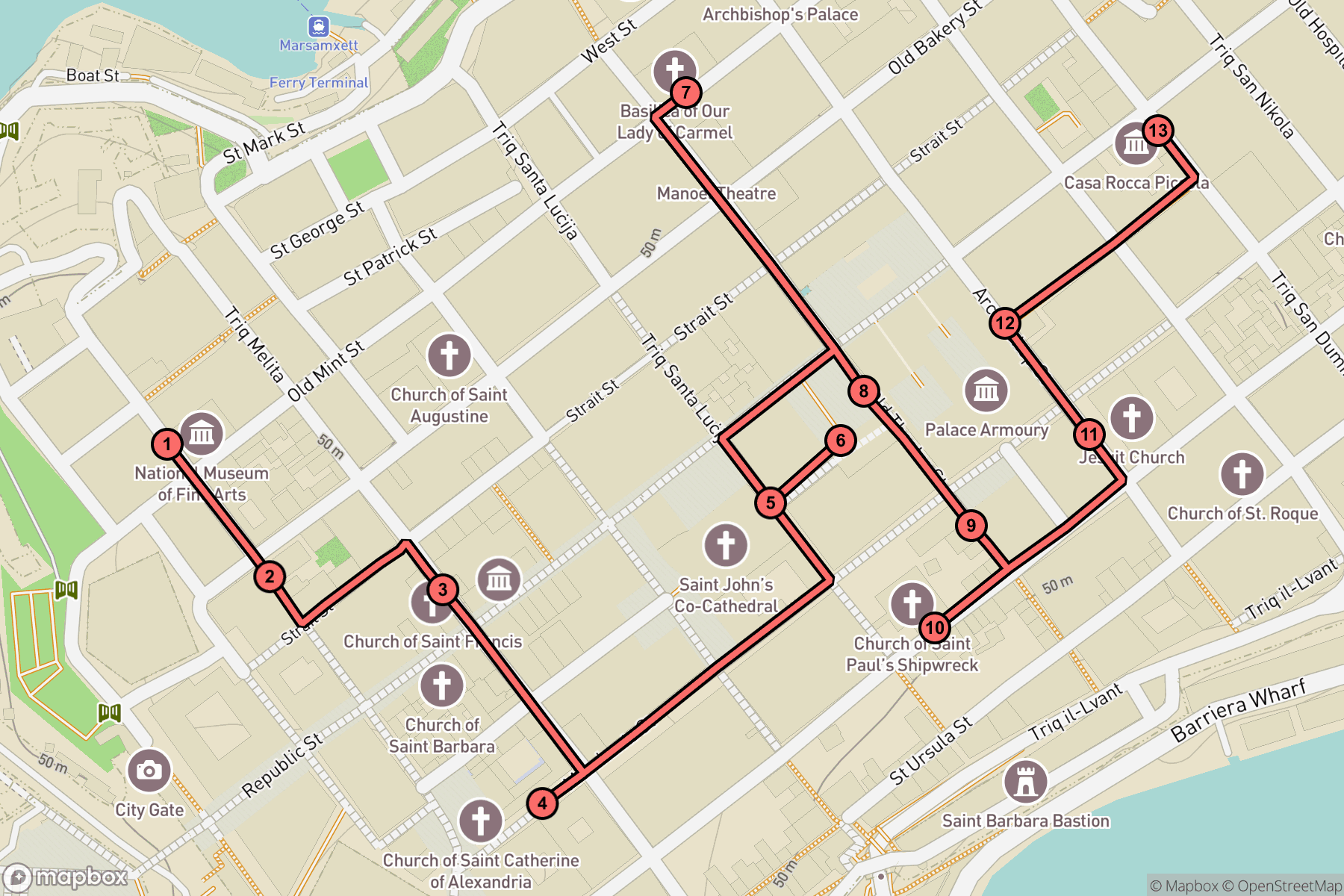
- straighten2.2 km wandelrouteVolg het geleide pad
- location_on
- wifi_offWerkt offlineEén keer downloaden, overal gebruiken
- all_inclusiveLevenslange toegangOp elk moment opnieuw afspelen, voor altijd
- location_onStart bij MUŻA
Stops op deze tour
To spot MUŻA, look for a grand ochre stone building with an ornately carved portal topped by a dramatic Baroque crest, turquoise shutters, and iron-grilled windows-it stands out…Meer lezenToon minder
To spot MUŻA, look for a grand ochre stone building with an ornately carved portal topped by a dramatic Baroque crest, turquoise shutters, and iron-grilled windows-it stands out just ahead with banners advertising its art treasures. Welcome to MUŻA! As you stand before this beautiful sunlit building, take a moment to soak in the warm honey-colored stone-the hallmark of Valletta’s streets. Here at Auberge d’Italie, history echoes in every carved detail above the entrance, and you might just catch your reflection in the windowpanes as artists and grand masters once did centuries ago. But don’t worry, you don’t need a frilly collar or a powdered wig to get inside! This place has stories to tell from pretty much every century Valletta has seen. Long before Maltese schoolchildren dreaded art class, the very collection now inside was born from a wild dream. Back in the 1920s, the curator Vincenzo Bonello was on a mission-a bit like Indiana Jones, but with paintings instead of ancient skulls. He traveled all over Europe, bartering, haggling, and bringing back masterpieces to Malta when prices were still just a few coins and maybe a smile. Over the decades, what started as a little collection soon blossomed into Malta’s most dazzling array of art. For years, this national treasure lived nearby in a palace called Admiralty House-a real estate shuffle that would make any Monopoly player proud. That building, with its own tales of knights, naval commanders, and no doubt some spectacular dinner parties, was built for Fra Jean de Soubiran dit Arafat, and then redesigned in the 18th century for a Portuguese knight who clearly loved a bit of drama. From there, Admiralty House rolled out the red carpet for the Commander-in-Chief of the British Mediterranean Fleet-a.k.a. “the guy in the fanciest hat”-for almost a century and a half. But collections, like people, sometimes need a fresh start. In 2016, the old museum shut its doors for good. Cue a dramatic move-pardon the pun-back to Auberge d’Italie, this very building you’re standing in front of. In 2018, as Valletta proudly wore the crown of European Capital of Culture, the museum was reborn as MUŻA. And what does “MUŻA” mean? It’s not just short for “museum”-in Maltese, it’s music to any artist’s ear: the acronym for Mużew Nazzjonali tal-Arti (National Museum of Art). Now, close your eyes and imagine the Maltese knights bustling into this palazzo, carrying gossip, secrets, and maybe a loaf of crusty bread from the market. Smell the paint and turpentine-yes, real masterpieces hung here, some straight from the hands of Mattia Preti, the Baroque genius knight who made even the walls of St. John’s Co-Cathedral blush with color. There are treasures here by Guido Reni, by British and Dutch artists who peeked at Malta with foreign eyes, and by Maltese sculptors like Melchiorre Gafà, who could coax the soul from a block of stone. But it wasn’t all grand oil paintings and dramatic busts! Inside, you’ll discover antique maps-imagine navigating Malta’s winding harbors before Google Maps, armed with nothing but ink and guesswork. There’s a watercolour of Grand Harbour by Joseph Mallord William Turner, no less, and jars from the Sacra Infermeria, where the Order’s knights patched up wounded soldiers-hopefully with more success than my attempts at putting together IKEA furniture. There’s an emotional side too. Bequests from generous locals gave Malta pieces even the cleverest curator could never buy-a chalice from 15th-century Paris, delicate silverware, and landscapes where the island practically breathes beneath the brushstrokes. That’s not all-MUŻA is alive with temporary exhibitions! Here, postage stamps become masterpieces, ukiyo-e prints conjure floating worlds from Japan, and bequests of local paintings tell heartfelt stories of Maltese families. Every visit promises a twist-a new artist, a rediscovered canvas, the kind of surprise that makes you want to shout, “Mamma mia!” in the best possible way. So, while you’re standing here, surrounded by the scents, sounds, and sunlight of Valletta, remember: MUŻA isn’t just a museum. It’s Malta’s beating, creative heart-a place where old palazzos and new ideas mingle, and everyone, from knights to curious wanderers like you, is part of the story. Ready for another masterpiece? Follow me! The tour is just beginning.
Open eigen pagina →Look for a grand cream-colored corner palace with tall shuttered windows, thick limestone walls, and elegant green wooden balconies poking out above your head-if you're standing…Meer lezenToon minder
Look for a grand cream-colored corner palace with tall shuttered windows, thick limestone walls, and elegant green wooden balconies poking out above your head-if you're standing near the crossroads, you can’t miss its majestic, slightly weathered presence! Welcome to Admiralty House, a place with as many lives as a cat-and just as many stories to tell! Imagine yourself standing here in 1569, when this mighty structure was just two separate houses built for a French knight named Fra Jean de Soubiran dit Arafat. Now, close your eyes for a second and picture the sound of chisels and hammers echoing through these narrow streets as limestone blocks from nearby Floriana arrive, ready to become part of an enduring palace. Back in the seventeenth and eighteenth centuries, this spot was really the social network hub of its day-knights from the Order of St. John would lease and occupy these fine homes, bringing with them intrigue and perhaps the occasional competitive sword-fighting accident. Flash forward to the 1760s, and you’d see a major glow-up: the two old houses were totally rebuilt for Fra Raimondo de Sousa y Silva, a wealthy Portuguese knight whose name is almost as long as his list of titles. They called it 'Palazzo Don Raimondo', and the new design was by Andrea Belli, the same architect responsible for the impressive Auberge de Castille up the road. The palace was built in the late Baroque style, with Italianate and Rococo touches-and if you peek through the windows, you might imagine grand halls around a central courtyard, and a sweeping staircase so magnificent that it could probably give modern escalators a complex. As you stand here now, imagine the chaotic days of the French occupation of Malta at the turn of the nineteenth century. Napoleon’s troops stormed in and, not keen on the former rulers, defaced the pretty coats of arms on the façade. They even planned, for a hot minute, to turn the place into a seminary, but the Maltese uprising and siege made sure that was as short-lived as a Maltese summer rainstorm. Then came the days of the British. Malta became a protectorate, and this palace welcomed a parade of British officials, including Alexander Ball, who quite possibly had the best commute in Valletta. In 1808, the palace became a scene of both royal glamour and tragedy when Louis Charles, Count of Beaujolais, stayed here but sadly died of tuberculosis-so if these walls could cough, they probably would. Not long after that, Admiralty House earned the role that gave it its current name: from 1821 to 1961, it served as the glitzy official residence of the Commander-in-Chief of the Mediterranean Fleet. Imagine royal banquets in candlelit halls-Lord Mountbatten brushing shoulders with Winston Churchill, King George V, and Queen Elizabeth making stately entrances. In those naval days, the palace must have thrummed with the sound of boot heels, clipped naval orders, and the laughter of officers telling stories of distant seas. With the dawn of an independent Malta, Admiralty House gained a new lease on life. It swapped naval brass for fine brush strokes, opening in 1974 as the National Museum of Fine Arts, displaying works that could make even the ghosts of knights pause in admiration. The sounds here now became those of footsteps echoing on marble floors, schoolchildren’s whispers, and the soft hush of museum-goers. Recently, the museum has moved out-so no more jostling for the best spot to admire a painting, but there are grand plans afoot! This Grade 1 monument is set for restoration, transforming into the office of the Attorney General. Who knows, perhaps it will become a place where history continues to be made-except, this time, with far more paperwork and far fewer swords. So, as you gaze at its grand yet weathered façade, imagine all the drama, celebration, and change witnessed by these old stones. And next time you pass by, give a secret salute-you never know which historical figure’s footsteps you’re following. Alright, onward to our next stop-but don’t trip on your own shoelaces while dreaming of ballrooms and bygone duels!
Open eigen pagina →To spot St. Andrew's Scots Church, look for a tall cream-colored building with a square tower, neo-Gothic windows, and battlements along the roof, standing behind a black iron…Meer lezenToon minder
To spot St. Andrew's Scots Church, look for a tall cream-colored building with a square tower, neo-Gothic windows, and battlements along the roof, standing behind a black iron fence right in front of you. Welcome to St. Andrew’s Scots Church, where the architecture seems to have stepped right out of a Sherlock Holmes novel-so if you hear bagpipes or the faint sound of a Scottish accent, don’t worry, you’re not imagining things! Picture yourself back in the 19th century, walking these narrow Valletta streets. The church you see here stands on a spot that was once home to Casa Torrensi, a grand house built centuries earlier by the knights of the Order of St. John. You wouldn’t have needed a treasure map to find it-just look for the number 60. Fast forward to 1824. Imagine the determined Reverend John Keeling, perhaps with a twinkle of rebellion in his eye, buying this land to build Malta’s very first non-Catholic church. Back then, choosing a new religion was as bold as wearing a woolen kilt in the Mediterranean sun! When the church doors opened in 1857, Reverend Dr. George Wisely welcomed a tiny Methodist flock-but don’t let their numbers fool you. If faith really could move mountains, he might’ve rearranged a few of Valletta’s hills! St. Andrew’s was the very first neo-Gothic building in all Malta, designed by local architect Giuseppe Bonavia. Malta had never seen such a sharp tower or those pointed window arches before. And although St. Andrew’s started out Methodist, the Church of Scotland eventually moved in-clearly, the Scots were drawn by dreams of sunshine and less rain. Inside, the air still holds the quiet energy of prayers offered in many languages and denominations: Presbyterians, Methodists, reformists, and even some curious Catholics have all found a seat here. For years, its ministers even served as chaplains to British forces stationed on the island-a church as welcoming to questions as it is to wandering souls. So as you stand here, let the echo of history and hymns fill your imagination, and remember: even stone walls can have a sense of humor-and a story worth retelling!
Open eigen pagina →
Toon 10 stops meerToon minder stopsexpand_moreexpand_less
Straight ahead, you'll spot the St Francis of Assisi Church by its grand, sandy-colored stone façade, crowned with a sturdy triangular pediment and a coat of arms just above the…Meer lezenToon minder
Straight ahead, you'll spot the St Francis of Assisi Church by its grand, sandy-colored stone façade, crowned with a sturdy triangular pediment and a coat of arms just above the main door-look up to catch the ornate details. Here you are, right in front of the St Francis of Assisi Church-Valletta’s very own architectural time traveler! Imagine the year is 1598: street merchants chatter, and stonemasons chip away at pale Maltese stone, laying the very blocks before you. The church grew quickly, completed by 1607, but like a tower of cards in a Mediterranean breeze, it started wobbling with structural defects a few decades later. Enter Grand Master Gregorio Carafa, who arrived like a knight in shining armor, generously rebuilding the church in 1681. His coat of arms, you’ll notice, still boasts above the entrance, as if reminding you, “Yes, I saved the day!” But this church didn’t just stop at a rescue-centuries later in the 1920s, it was given a makeover with a brand-new dome and some fresh artwork. Some old frescos by Giuseppe Calì moved out, but new ones by Gianni Vella moved in, brushing more color into its history. Step inside, if you wish, and you’ll discover dazzling treasures: paintings by Mattia Preti, Pietro Gagliardi, and Filippo Paladini, plus the admired statue of St Francis himself. But whether you’re here for art or adventure, just remember: this church has survived time, trouble, and a few makeovers-proof that even in Malta, a little drama keeps things standing strong!
Open eigen pagina →To spot Saint John’s Co-Cathedral, look for the grand, fortress-like limestone building ahead of you, flanked by two tall square bell towers-one of them with a striking clock and…Meer lezenToon minder
To spot Saint John’s Co-Cathedral, look for the grand, fortress-like limestone building ahead of you, flanked by two tall square bell towers-one of them with a striking clock and the Maltese sun shining off its pale stone. Welcome to the doorstep of Saint John’s Co-Cathedral, a place that’s witnessed centuries of history and is almost bursting at the seams with stories. If you listen close enough, you might even hear the whispers of knights and the faint ring of church bells that have echoed through these streets for hundreds of years. Let’s travel back for a moment to the year 1573. Valletta was still new, dust still swirling in the streets after the city rose like a phoenix from the ashes of the Great Siege of 1565. The Order of St. John, battered but unbeaten, needed a church that was more than just a place to pray-a church that would reflect their might and their faith. The Grand Master, Jean de la Cassière, took up the challenge. He called on Malta’s own star architect, Girolamo Cassar, to design a masterpiece for the ages. And so it was built, brick by brick, with sunlight dancing off pale limestone and two mighty bell towers standing like loyal guards. The church began with simple walls, almost stern-some say its fortress-like face was inspired by the Order’s military roots and the tense mood after surviving the Ottoman siege. Look up to the balcony between those two towers: Grand Masters once addressed their people from there, their voices carrying across the city. Pretty grand, right? Honestly, the only thing missing was a little trumpet fanfare! But step inside (at least in your imagination), and get ready for a feast of color, gold, and wonder. The interior is a full-on Baroque extravaganza, thanks to the magic brush and chisel of Mattia Preti, called in during the 1660s by another ambitious Grand Master. Preti transformed every surface into a sparkling celebration-walls carved with intricate patterns, a ceiling swirling with the dramatic life story of Saint John the Baptist, and the floors paved with an entire marble storybook: here, under your feet, rest about 400 knights and dignitaries, wrapped forever in boldly colored stone mosaics. Grand Masters from across Europe are here, buried beneath your feet or watching from their grand marble tombs in side chapels. Each chapel has its own tale-one even once held an icon of Our Lady of Philermos, rescued (or spirited away, depending whom you ask) from the Crusades, now far away in Montenegro. Chapels dedicated to France, Aragon, Germany, and other corners of Europe are here too, each adorned with their own great paintings and memorials. Now, here’s a showstopper: the Oratory houses a painting called “The Beheading of Saint John the Baptist,” the only canvas signed by the legendary Caravaggio, painted right here in 1608. This riveting scene captures the last dramatic moments of Saint John’s life-lit by Caravaggio’s famous flare for shadow and light. It’s so intense, I promise you’ll want to step closer and hold your breath. But the cathedral’s life hasn’t always been peaceful. Bombs fell on Valletta during World War II, and the cathedral’s thick walls trembled-but somehow, it survived. Even the priceless treasures within were carefully tucked away in advance; not a single masterpiece lost. Over the centuries, the cathedral shifted from a humble conventual chapel for knights, to a Baroque jewel meant to outshine even those mighty churches in Rome, to a co-cathedral that shares the seat of Malta’s bishop. Sir Walter Scott, famed author, once stepped inside and declared it the “most striking interior” he’d ever seen. I like to think he was so dazzled, he nearly forgot how to write for a moment. Today, as you stand outside surrounded by the hum of people and the warm Maltese sun, remember: every stone, every carving, every twinkle of sunlight off that limestone holds the echo of centuries of hope, ambition, and artistry. And if you close your eyes, maybe-just maybe-you’ll hear the last footsteps of a knight hurrying in for Mass, his cloak swirling and boots thudding on ancient stone. For further insights on the exterior, interior or the visiting, feel free to navigate to the chat section below and inquire.
Open eigen pagina →To spot the National Library of Malta, keep your eyes peeled for a grand neoclassical building standing proudly in Republic Square, its symmetrical stone façade graced with…Meer lezenToon minder
To spot the National Library of Malta, keep your eyes peeled for a grand neoclassical building standing proudly in Republic Square, its symmetrical stone façade graced with elegant columns and a stately balustraded balcony right above the main entrance. Alright, book lovers-or maybe just lovers of a good story-take a deep breath and step up to the impressive National Library of Malta, one of Valletta’s crown jewels. Imagine the crisp scent of old paper and leather-bound volumes waiting just inside these doors. Now, let’s travel back in time, all the way to the 16th century, when knights in shining armor weren’t just for fairy tales, but walked these streets for real! It was Grand Master Claude de la Sengle, who in 1555 had the bright idea: let’s not let good books go to waste! He ordered all the books of deceased knights to be saved for the Order’s treasury. Over 200 years later, enter the hero of our story: Louis Guérin de Tencin, the legendary book collector who seriously knew how to throw a literary party. In 1760, he bought 9,700 books from a Spanish marquis-such a large haul his friends probably thought he’d need a new house just to shelve them! And just a year later, De Tencin opened the library’s doors to the public in Valletta, filling it with treasures from his own stash, the marquis’s, and even gifts donated by book-loving knights. Talk about teamwork! The library was at first squeezed into a building called Il Forfantone, which must’ve felt like stuffing an elephant into a phone booth. But De Tencin had bigger dreams. Sadly, he died in 1766, before he could secure funds to expand the library. Still, his legacy lived on. In 1776, Grand Master Emmanuel de Rohan-Polduc took up the torch and officially founded the Bibliotheca Publica, honoring De Tencin by calling it the Bibliotheca Tanseana. As the old Forfantone was bursting at the seams, the Order decided to give the books a home they deserved. Enter architect Stefano Ittar-you can almost hear the clanking of chisels and the rattle of horse-drawn carts as construction began in 1786 on the site of the Conservatoria. The final building, finished in 1796, dazzled with its neoclassical style-symmetrical, stately, with columns marching across its loggia and a grand monumental staircase that looks worthy of a red carpet. But, plot twist! The books didn’t move in straight away because, as fate would have it, there was the small matter of the French invading Malta in 1798. If you could peek inside back then, you would've just seen empty shelves gathering dust, waiting for the world to calm down. It was only in 1812, long after the drama, that the library finally opened its doors as the Malta Public Library. Over the centuries, the library collected more than just books-its shelves hold the archives of the proud Order of St. John, the ledgers of the Università of Mdina and Valletta, and even a prized papal bull from 1113 that confirmed founding the Order! Imagine parchment so old, you’d feel like Indiana Jones just laying eyes on it. Fast forward to 1925: the library becomes a legal deposit library. Every book published in Malta finds its forever home here. In the 1930s, the archives of the Order of St. John were finally brought here from elsewhere, making this place a treasure trove for history buffs. And, for the grand finale, in 1936, King George V made it official-this was now the Royal Malta Library! Now, standing in front of this Grade 1 national monument, you’re at the gateway to more than half a millennium of history, adventure, and knowledge. The rarest of manuscripts, medieval maps, newspapers from Malta’s earliest presses, and even volumes once owned by King Louis XV himself are tucked safely inside. And let’s not forget the staircase-picture scholars through the ages climbing it, eager to find a scrap of wisdom hiding in the archives. So next time you hear the gentle hum of footsteps echoing on stone behind you……maybe it’s a long-lost knight, still searching for a good story!
Open eigen pagina →To spot the Collegiate Parish Church of St Paul’s Shipwreck, just look up ahead for a grand, sandstone façade with columns and twin bell towers rising above the narrow street-it’s…Meer lezenToon minder
To spot the Collegiate Parish Church of St Paul’s Shipwreck, just look up ahead for a grand, sandstone façade with columns and twin bell towers rising above the narrow street-it’s hard to miss those ornate details and impressive arches! Now, let me sweep you back nearly two thousand years, to a night when a terrible storm tossed a ship upon wild Mediterranean waves-aboard was none other than Saint Paul himself, Apostle and, according to legend, Malta’s spiritual father! Imagine the crash of wind and surf, the panic and prayers, until finally, that ship wrecked on the rocky shore of what the ancient world called Melita (but we know as Malta). And here you stand, where centuries later, the people built this magnificent church to honor that fateful landing. Picture the bustling Valletta of the 1570s, when this church first began as a humble place of worship, drawn into being by the talented hands of Girolamo Cassar. Over the years, the church grew and transformed-Jesuits took over, new designs appeared, facades were reimagined, and by 1885, Nicholas Zammit’s vision soared high above you. This isn’t just another church; standing here, you’re in the presence of one of Valletta’s very oldest, a keeper of secrets and miracles. Step inside, and you would see masterpieces: paintings glowing in candlelight, a grand altarpiece, and above all-a statue of St Paul from 1659, carved so lifelike you half expect him to wink! Once a year, the streets fill with excitement when this statue parades outside, celebrated by cheering crowds on February 10. There’s something a bit mysterious, too: you can actually glimpse a relic believed to be St Paul’s own right wrist-bone and even part of the column where he was martyred in Rome. Not every church gets to be on TV, but this one shined in Season 28 of The Bachelor (and yes, the building looked as dramatic as the romance). So take a moment, breathe deep, and let St Paul’s Shipwreck Church remind you that legend, beauty, and a little bit of drama are always close at hand here in Valletta!
Open eigen pagina →Right ahead, you’ll spot a tall, rectangular building with creamy, honey-colored stone arches and a shimmering glass-and-iron top level that stands out from the surrounding…Meer lezenToon minder
Right ahead, you’ll spot a tall, rectangular building with creamy, honey-colored stone arches and a shimmering glass-and-iron top level that stands out from the surrounding limestone facades-just look for the sunlit terrace bustling with visitors and the inviting open square. Now, take a comfy stand and let’s step straight into the wild and wonderful saga of Is-Suq tal-Belt-Valletta’s very own covered market, with a backstory tastier than anything you’ll find in the food stalls inside. Picture yourself here in the 16th century: this was actually the Piazza del Malcantone, where marketplaces and, believe it or not, some rather grim parades took place. If you feel a chill, it could be the ghosts of the “gallows parade,” as convicted souls were dragged through the streets in a noisy, raucous spectacle before their final stop in Floriana. Not exactly a carnival, unless you count the crowd’s dramatic gasps and whispers! But don’t worry-let’s sprinkle in something lighter. Imagine the air here thick with the smells of fresh bread, sun-warmed fruit, and spices, as farmers from the countryside bargained with townsfolk over noisy stalls. The first real market was a grand baroque beauty, two stories high with shops lining arcades and a courtyard fountain where all the gossip of Valletta bubbled up. People poured through entrances on Merchants Street and St. Paul’s Street, each with something to sell, a secret to swap, or perhaps a fish that had seen better days. Then the British swept in and-like a recipe gone wrong-declared the old structure unfit for modern stomachs. Demolished due to pesky sanitation problems, a clean slate soon beckoned for a bold new market. And in the 19th century, Is-Suq tal-Belt rose again, now as a marvel of its age-the first building in Malta made mostly of iron. While the market’s bones are Maltese limestone, its shiny iron roof and supporting columns would’ve made any Victorian engineer puff out his beard in pride. It even borrowed style tips from heavyweights like Covent Garden in London and Halles Centrales in Paris, which makes sense since Hector Zimelli, the Superintendent of Public Works, had quite the eye for trends. If you listen closely now, you might hear the clatter and shouts of 153 thrifty vendors and 65 cellars beneath your feet, selling Malta’s best produce to every walk of life from nobles to children snatching sneaky bites. It’s easy to see why it inspired grand markets across the British Empire, even as far away as Calcutta. Fast forward to the 1940s-war planes thunder over Valletta and, in 1942, disaster strikes. A bomb rips through one-third of the market, reducing part of this bustling food haven to rubble. The market survived but emerged a little crooked, its elegant symmetry forever altered. Over the years, layer upon layer was added to the market-new floors, shiny escalators, and, in the 1980s, a face-lift as “Ixtri Malti,” or “Buy Maltese.” Unfortunately, customers voted with their feet (and appetites), and the arcade idea failed. By the late 20th century, Is-Suq tal-Belt was fading, whispers of its past drowned out by the silence of empty stalls. But just when you think the story is over, this grand old market throws one last twist. In the run-up to Valletta’s 2018 stint as European Capital of Culture, a rescue mission was launched. With a cash injection that ballooned to €14 million (impressive, but probably a bit hard to fit in one of the cellars down below), restoration crews began peeling away decades of careless add-ons and dust, determined to let that ironwork, stone, and bustling energy shine again. Inspired by the lively food halls of Madrid and Barcelona, Is-Suq tal-Belt finally reopened in 2018-this time as a vibrant food market, brimming with laughter, sizzling pans, and the tap-tap of coffee cups. Now, whether you fancy a bite of Maltese cheese or just want to soak in the atmosphere, you’re standing in a marketplace where history, iron, and flavor all come together under one gleaming roof. Just remember, the next time you order lunch inside, you’re tucking in where generations before you squabbled, shopped, and survived-if these arches could whisper, oh, the tales they’d tell!
Open eigen pagina →Look for a grand, honey-colored stone façade with tall, slightly uneven Baroque columns and decorative details towering right above the street on your right-the Church of the…Meer lezenToon minder
Look for a grand, honey-colored stone façade with tall, slightly uneven Baroque columns and decorative details towering right above the street on your right-the Church of the Jesuits is hard to miss! Alright, take a deep breath and let your imagination whisk you back to Valletta in the late 1500s. Picture the bustling sounds of stonemasons chipping away, the sun beating down on freshly laid blocks, and the sharp scent of limestone in the air. You’re standing outside one of the city’s largest and oldest churches-a place that’s seen as much drama as a soap opera… but with better costumes! The foundations were laid here in 1593, as the Jesuit order dreamed up a complex so large it swallowed the whole city block. Not only were they building this impressive church, but right next door-the Collegium Melitense- was a university, alive with students’ chatter. Nearly finished by 1609, the church was ready to stand the test of time… or so they thought. Just when everyone was about to breathe easy, disaster struck-a gunpowder factory nearby exploded in 1634, sending shockwaves that shattered windows and tumbled the newly completed façade of the church. Picture bricks and dust flying, and for a moment, even the bravest builder’s knees knocking together like castanets! Stepping in to save the day (and the church), architect Francesco Buonamici arrived from Lucca, Italy. He decided, “If we’re rebuilding, let’s make it as grand as Rome!” That’s why the inside is full of Doric columns and chapels, echoing the famous Church of the Gesù. Although the façade looks unfinished, it’s a quirky reminder of the building’s dramatic past-like someone pausing halfway through tying their shoelaces. This church has seen it all: from the Jesuits’ sudden expulsion in 1768-imagine it, priests packing their bags in a hurry-to becoming the official home for university graduation ceremonies, a place that’s filled with every emotion from academic nerves to proud tears. In fact, even today, Masters and Doctoral students celebrate their big moment right here, surrounded by art from the likes of Filippo Paladini and Mattia Preti. Now, as you stand in the sunlight, take in the hum of modern Valletta and picture all those stories echoing through the stones-because history here isn’t just in books; it’s in the very walls around you.
Open eigen pagina →To spot the landmark, look for the long, pale stone building just ahead with two flagpoles flying Malta and the EU flags on the roof, black window shutters across its length, and…Meer lezenToon minder
To spot the landmark, look for the long, pale stone building just ahead with two flagpoles flying Malta and the EU flags on the roof, black window shutters across its length, and a central arched entrance flanked by ornate columns-this is the Grandmaster’s Palace, the stage for the dramatic events of 1749. Alright, stand right where you are, take in the grand façade, and imagine Valletta in summer 1749-a city alive with secrets, tension, and plots. The sun is blazing down on the pale stone of the palace, the square bustling with traders, slaves, knights and citizens who have no idea just how close Malta is to being turned upside down. Now, get ready for a tale of intrigue, espionage, and one seriously stressful dinner party. You see, at this very palace, the fate of Malta nearly changed forever. The Conspiracy of the Slaves was a carefully coordinated uprising, masterminded by Mustafa, the former Pasha of Rhodes-an Ottoman official who ended up here as a slave after a wild revolt on his own galley. Imagine Mustafa, once powerful and feared, now pacing his rather plush prison quarters in Floriana, plotting his return to glory. He wasn’t exactly scrubbing floors-he dined well, thanks to his high rank and some well-placed French friends. But make no mistake, beneath those silks, he was simmering with revenge. Picture the scene: over a thousand Muslim slaves lived in Malta at the time, many snatched from ships by Maltese corsairs. Most toiled away, some even selling goods on these very streets; at night, the city’s main “bagnios”-slave prisons-locked behind them with a grim metallic clang. But the island’s rulers, the Knights Hospitaller, were so confident in their power that Malta became a pressure cooker. Everyone got just enough comfort-and just enough audience with their own enemies-to make things interesting. In the run up to the feast of Saints Peter and Paul-traditionally a pretty quiet time in Valletta, as most folks celebrated inland-a handful of slaves plotted under Mustafa’s orders. The plan was detailed and daring: kill Grand Master Pinto at a lavish palace banquet. The assassin was to use a poisoned knife, and once Pinto was dead, they’d toss his head out into the courtyard as a signal for the others to rise. Imagine watching dinner take a deadly turn! That’s certainly one way to flip the script on “Guess Who’s Coming to Dinner.” Immediately, chaos was to erupt: the conspirators would seize the Palace Armoury, unleash their fellows from the nearby Gran Prigione, and storm Fort St. Elmo. At the same time, slaves in Birgu and Senglea would revolt, grabbing Fort St. Angelo and all the gunpowder. Meanwhile, the Barbary States and Ottoman fleet would sweep into the Grand Harbour, flags flapping in the sharp wind, ready for the final act. But as with all great plots, someone just couldn’t keep their mouth shut-or maybe, they weren’t good at choosing drinking buddies! At a tavern down Strada Fontana (now St Christopher’s Street), some of the plotters tried to recruit a certain Giacomo Cassar. But Cassar didn’t bite; instead, he told Giuseppe Cohen, the local barkeep and a former convert to Catholicism, who-after a night of restless foot stomping-dashed up to the Grand Master to spill the beans. From there, things went downhill faster than a knight in full armor on a banana peel. The Knights cracked down hard-arrests, interrogations, and, sadly, plenty of torture. Suspects faced the corda and cavalletto, named names, and by mid-July, over 80 people had been pulled in. Some got their “just deserts” (if you can call torture and execution ‘deserts’), others the galley oar-and four were dramatically quartered in the Grand Harbour, the only time that punishment was ever used here. The city was gripped by fear and rumor. Citizens pelted Mustafa’s carriage with stones, mobs nearly lynched him, and churches in Valletta thundered with prayers of thanksgiving when the plot was stopped. As a rather unique “thank you” to Giuseppe Cohen, he was awarded a tidy annual pension and even a new property with a shiny marble inscription for his loyalty and quick thinking. For years after, Malta remembered this near-miss with public processions and thanksgivings; and the government cracked down on the movements of slaves-no more strolls outside city limits, no keys, and definitely no parties in the bagnios. Was it tension? Was it terror? Or perhaps, just Malta’s way of saying, “Better luck next time!” So, as you stand here, imagine all the plots, whispers, and secret oaths echoing through these very stones-and know you’re standing where Malta almost became a legend of a different kind! On that note, shall we sneak off to our next adventure? Ready to delve deeper into the background and prelude, plot or the discovery and aftermath? Join me in the chat section for an enriching discussion.
Open eigen pagina →To spot the Basilica of Our Lady of Mount Carmel, just lift your eyes up and look for the enormous, cream-colored dome towering proudly above the rooftops, crowned by a cross and…Meer lezenToon minder
To spot the Basilica of Our Lady of Mount Carmel, just lift your eyes up and look for the enormous, cream-colored dome towering proudly above the rooftops, crowned by a cross and visible from all around Valletta-trust me, you’ll know it when you see it! Now, take a deep breath and imagine you’re stepping into Valletta hundreds of years ago. The sea breeze dances along Old Theatre Street, and the sound of church bells echoes through sunlit stone alleys. At this very spot, the Carmelite friars first arrived way back in the 16th century, boots dusty and hearts set on building something extraordinary. With the blessing-quite literally-of the Hospitaller Grand Master Pierre de Monte, the Carmelites were handed this plot of land. At first, they were supposed to pay 66 scudi for it... but who likes paperwork and debt? The Grand Master kindly declared they could have it for free. Must have been Malta’s best property deal ever! The first church here was nothing less than majestic, designed by the famous architect Girolamo Cassar, who was basically the “starchitect” of Valletta’s golden age. Mass began humbly in a tiny chapel-just picture candles flickering on stone and the whispers of prayers filling the air. That little chapel was the heart of the new city, serving as the very first parish church in Valletta. As time went on, the knights of St. John flocked to this church, especially those from the German tongue, who didn’t have their own place of worship and made this their spiritual home. Knights donated treasures, gold, and even entire chapels within these walls, their marble tombstones still surviving to this day, perched like silent witnesses of centuries gone by. Fast forward to the 1800s, and you’d find the church refreshed with a brand-new façade-think of it like an architectural facelift by Giuseppe Bonavia. The interior? A showcase of gorgeous frescoes, red marble columns, and precious artworks, including a mysterious altarpiece painting of the Virgin Mary and baby Jesus. No one really knows who painted it, but if you squint, you might imagine it being spirited across the sea from Sicily or even crafted by the elusive painter Filippo Paladini. It’s seen generations of believers and witnessed celebrations grand enough to attract papal attention! In 1881, the church's treasured painting was crowned after a decree by Pope Leo XIII, all shimmering gold and glory, and the church itself was made a minor basilica in the years that followed. But wait, there’s a dramatic plot twist! During World War II, the rumble of bombs filled the Valletta air. The basilica, proud and ancient, was struck and left in ruins. Imagine the devastation as centuries of history came crashing down-though, in true Maltese fashion, many precious artworks and tombstones were carefully saved from the rubble, as if the past just refused to let go. Instead of surrendering to despair, the Carmelite friars dreamed even bigger. They demolished the broken bones of the church and set about building a new one from scratch. The basilica you see now rose from the ashes with all the drama and determination of a phoenix, designed by Ġużè Damato-the head was filled with visions of a giant dome, soaring higher than anything else on this skyline. In fact, they deliberately built the dome just a smidge taller than the one on the nearby Anglican St. Paul’s Pro-Cathedral. Don’t tell the Anglicans, but it was a bit of holy one-upmanship! Construction began in 1958, each stone placed with hope and faith, and it wasn’t finished until 1981. Inside, the walls glow with the soft warmth of red marble, and in a niche outside, at the corner of Old Theatre and Old Mint streets, Our Lady of Mount Carmel stands watch, sculpted by Salvatore Dimech in 1855. Step closer and you’ll sense it-layer upon layer of human drama, ambition, generosity, and artistry. The basilica’s very stones are a monument not just to faith, but to Valletta’s resilience, its ability to start anew after every storm. So, look up at that dome. Imagine the stories it could tell-from knights and friars to wartime devastation and hopeful new beginnings. And you, right now, are part of its next chapter. Onward, explorer! And if you’re feeling inspired, maybe say a little thanks-preferably not in scudi. Intrigued by the architecture, artworks or the burials? Make your way to the chat section and I'll be happy to provide further details.
Open eigen pagina →To find Republic Square, look straight ahead for a broad open piazza, bustling with lively outdoor cafés and crowned by a grand statue of Queen Victoria sitting proudly in front…Meer lezenToon minder
To find Republic Square, look straight ahead for a broad open piazza, bustling with lively outdoor cafés and crowned by a grand statue of Queen Victoria sitting proudly in front of an elegant, columned library building flying the Maltese flag. Welcome to Republic Square - although, if you ask a local for directions, don’t be surprised if they call it Piazza Regina instead! Now, picture this: You’re standing in the very heart of Valletta, surrounded by layers of history that have seen everything from the clinking coins of knights in shining armor to British governors sipping tea under orange trees. Before the smell of coffee and the chatter of today’s café-goers, this place was called Piazza Tesoreria, home to the secretive treasury of the Order of Saint John. Just imagine hooded knights sneaking gold and ledgers through what is now a sun-soaked courtyard. But wait, what’s that at the center? Queen Victoria, in her bronze glory, surveys her empire of pastries and cappuccinos. She’s been there since 1891, thanks to her Golden Jubilee. And isn’t it ironic-when her statue first arrived, it stole the spotlight from Grand Master Manoel de Vilhena’s statue, which had to pack up and move not once, but twice! The square itself once became a British-governors-only orchard-a citrusy VIP lounge-complete with jealous locals peeping through the gates! If you imagine the laughter of high-ranking officers and the secrets rustling through the orange trees, you’ll start to feel the spirit of bygone centuries. On your right, the proud Casa del Commun Tesoro was the bank, post office, and even a secret cinema, now beautifully restored as the Casino Maltese. During the Second World War, bombs battered its walls, but like a true Maltese survivor, it dusted off the debris and got back to work, this time with a little more glamour. Turn your head across the square and you spot the magnificent National Library, built in 1796 but left waiting, locked and silent during the French occupation. Only when the British walked in did this place open its doors, offering a treasure trove of knowledge to everyone. Think of the ceremonies: crowds draped in dark clothes, mourning the death of Queen Victoria, gathering in this very piazza in August 1901. Royal history and people’s everyday moments share the space even now, with Queen Victoria’s lap often serving as the fanciest bench for the local pigeons! Every café, shop, and paving stone has its own tale. So take a seat in the shade, soak up the bustle, and let Piazza Regina-or Republic Square, if you prefer-show you how Malta celebrates its many lives.
Open eigen pagina →Look for a grand cream stone building on your right, with two large dark green wooden balconies jutting out above the street and a thick, dark doorway right below one of…Meer lezenToon minder
Look for a grand cream stone building on your right, with two large dark green wooden balconies jutting out above the street and a thick, dark doorway right below one of them. Welcome to Casa Rocca Piccola, the final stop on our adventure! Imagine yourself standing here in the late 1500s, brushing shoulders with knights, noblemen, and maybe-just maybe-a secret or two. Behind these thick stone walls, Admiral Don Pietro la Rocca decided that Valletta needed more than just sturdy defenses; it deserved elegance and surprise. So, he built this very palace, adding something hardly anyone else in the city had: a lush private garden! ("La casa con giardino," they called it, though honestly, watering your plants was probably trickier back then than defending against an invasion.) If you listen, you might almost hear the soft jingle of keys as servants hurried below, running through kitchens and stables where horses once stomped impatiently. On the first floor, there are over fifty rooms-drawing rooms echoing with laughter, a pair of libraries brimming with family secrets, and even a peaceful old chapel where candlelight would still flicker over stone walls. Here’s a twist worthy of a thriller: In the Second World War, Casa Rocca Piccola became a lifeline. The de Piro family, determined not to let history bury their story, dug a deep air-raid shelter below the palace where countless people huddled for safety as bombs fell overhead. But let’s not get too serious on our final stop-this place also celebrates Malta’s flair for style! There are cabinets stuffed with antique costumes fit for noble balls, and lace-so much delicate Maltese lace that every window ledge and collar must have looked like it was dressed up for a festival. In fact, if you’re here in time for the annual lace competition, you’ll see needlework as intricate as the palace’s own history. The archives? Oh, those are a treasure chest of stories: marriage contracts, bills, and letters going back centuries, all kept safely tucked away in The Archive Room, just waiting for some detective from Oxford or Malta to come hunting for juicy details. Even the architecture can’t quite make up its mind. There’s a touch of grand old Palladian design here-symmetrical, elegant, orderly-but as you follow the house back towards the garden, you’ll find 20th-century Art Deco where new walls were built over old roots. And don’t forget to peek at the BnB or maybe, after your journey, settle down for a victory meal at La Giara Restaurant. So whether you’ve come for knights and nobles or secret rooms and silk, Casa Rocca Piccola has always kept a little magic-and a few mysteries-just behind these timeworn walls.
Open eigen pagina →
Veelgestelde vragen
Hoe begin ik de tour?
Download na aankoop de AudaTours-app en voer je inwisselcode in. De tour is direct klaar om te starten – tik gewoon op afspelen en volg de GPS-geleide route.
Heb ik internet nodig tijdens de tour?
Nee! Download de tour voordat je begint en geniet er volledig offline van. Alleen de chatfunctie vereist internet. We raden aan om te downloaden via wifi om mobiele data te besparen.
Is dit een groepsrondleiding met gids?
Nee - dit is een audiotour met eigen gids. Je verkent zelfstandig op je eigen tempo, met audiovertelling via je telefoon. Geen tourguide, geen groep, geen schema.
Hoe lang duurt de tour?
De meeste tours duren 60-90 minuten, maar jij bepaalt het tempo volledig. Pauzeer, sla stops over of neem pauzes wanneer je wilt.
Wat als ik de tour vandaag niet kan afmaken?
Geen probleem! Tours hebben levenslange toegang. Pauzeer en hervat wanneer je wilt – morgen, volgende week of volgend jaar. Je voortgang wordt opgeslagen.
Welke talen zijn beschikbaar?
Alle tours zijn beschikbaar in meer dan 50 talen. Selecteer je voorkeurstaal bij het inwisselen van je code. Let op: de taal kan niet worden gewijzigd na het genereren van de tour.
Waar vind ik de tour na aankoop?
Download de gratis AudaTours-app uit de App Store of Google Play. Voer je inwisselcode in (verzonden per e-mail) en de tour verschijnt in je bibliotheek, klaar om te downloaden en te starten.
Als je niet tevreden bent met de tour, betalen we je aankoop terug. Neem contact met ons op via [email protected]
Veilig afrekenen met 


