
Turijn Audiotour: Paleizen, Piazzas en Legendes van Centro
Een koninklijk hart klopte ooit onder Piazza Castello, weerklinkend met paleisintriges en gefluisterde verraad terwijl het lot van de stad van de ene op de andere dag veranderde. Laat deze zelfgeleide audiotour de straten van Turijn veranderen in een levend, ademend podium waar geheimzinnige monarchen, rebellen en visionairs verborgen aanwijzingen achterlaten die de meeste voorbijgangers nooit opmerken. Ontgrendel met elke stap het drama en de eigenaardigheden die verweven zijn in de elegante façade van de stad. Welk schandaal in het Carignano Paleis bracht bijna een dynastie ten val? Waarom flikkerde een zee van kaarsen wanhopig op Piazza San Carlo op een onvergetelijke nacht? Wat is de betekenis achter het over het hoofd geziene standbeeld waar de lokale bevolking nauwelijks naar omkijkt? Ontrafel lagen van machtsspelletjes, mysteries en onvertelde verhalen terwijl je boulevards en binnenplaatsen doorkruist, elk boordevol onthullingen. Ga verder dan toeristische kiekjes en bekijk het centrum van Turijn met onverwachte ogen. De hartslag van Turijn wacht. Druk op afspelen en duik in de geheimen van zijn koninklijke hart.
Tourvoorbeeld
Over deze tour
- scheduleDuur 40–60 minsGa op je eigen tempo
- straighten3.4 km wandelrouteVolg het geleide pad
- location_on
- wifi_offWerkt offlineEén keer downloaden, overal gebruiken
- all_inclusiveLevenslange toegangOp elk moment opnieuw afspelen, voor altijd
- location_onStart bij Piazza Castello
Stops op deze tour
To spot Piazza Castello, look for a huge open square surrounded by elegant buildings and arched porticoes, with the grand white facade of Palazzo Madama standing right at its…Meer lezenToon minder
To spot Piazza Castello, look for a huge open square surrounded by elegant buildings and arched porticoes, with the grand white facade of Palazzo Madama standing right at its heart. Welcome to Piazza Castello-Turin’s living room and quite possibly the best place in the city to lose your sense of direction while admiring the view! Stand here, and you’re standing in the pulsing heart of Torino, where four major roads crisscross like spaghetti: Via Garibaldi, Via Po, Via Roma, and Via Pietro Micca. You might even hear the whirl of bicycle wheels or the happy chatter of fellow explorers all around you. But oh, the stories these stones could tell! Back in the 1st century AD, this square was nothing more than the eastern entrance to a Roman military camp-Julia Augusta Taurinorum. The Roman gate held steady against wild barbarian raids and the clang of swords during the rule of Lombard dukes, its two massive towers staring down danger like a pair of grumpy old men. By the Middle Ages, the gate got a glow-up, becoming a fortified home for the local bishop, and later, an ever stronger castle-giving the square its name, Castello. Fast-forward to the drama of the 1500s-when the Savoy Dukes shifted their entire capital here, you could almost feel the city’s chest puff up with pride. The square had everything: festive fairs under the porticoes, fancy palaces, secret ducal passages, and even space for solemn masses. When the Holy Shroud of Turin arrived in 1578, crowds squeezed in here, dazzled, and probably elbowing each other for a better view. The next few centuries? Architects came in with rulers and lanterns, laying down plans by candlelight. Some, like Ascanio Vitozzi, wanted an elegant square with perfect lines (probably the type who meticulously rearranged their pencils). Others, like Castellamonte and Juvarra, added porticoes for the snow-splattered nobles, a shiny new Royal Palace, and even a pinacoteca full of paintings-though fires and wars didn’t always cooperate. If you’d strolled here in the 1800s, you might trip on the cobbles-and then get distracted by Napoleonic soldiers, noble ladies, or a few tram horses jostling their way through. King Carlo Alberto added the grand gates you see now, complete with bronze statues of Castor and Pollux to “guard” the Royal Palace. Art lovers flocked to the sparkling Galleria Subalpina, movie buffs caught a flick in its cinema, and even today you can find shoppers and dreamers wandering through. Wander the square and look for the statues: boldly perched at corners you’ll find symbols of military glory, like the white marble Standard-Bearer dedicated to the Sardinian Army, or the heroic General Aosta, cast from enemy cannons-extra points for recycling, right? Spot the elegant porticoes lining the sides, each with its own stories of carnivals, royal ceremonies, and the wild celebrations of loyal Juventus football fans. It isn’t just about the past, though! Piazza Castello has a flair for the dramatic-hosting everything from giant bonfires (the Falò di San Giovanni) to wild concerts and glowing drone shows. For centuries, crowds have gathered around the burning wooden pole on the eve of June 24th, eyes fixed on the top where the city’s bull-Torino’s mascot-stands. If the pole falls toward Via Roma, it means good luck for the whole city; if not, well, there’s always next year’s party! So, whether you’re here to marvel at baroque facades or just pick a prime people-watching spot, Piazza Castello is Torino’s stage. Every era left its mark-ancient Roman gates, medieval fortresses, grand palaces, and modern celebrations. The only thing missing is your own story, drifting into this square’s timeless soundtrack. Interested in knowing more about the description, i will make of san giovanni or the places of interest
Open eigen pagina →To spot the Carignano Palace, look for a large reddish-brown brick building right in front of you, with an eye-catching wavy curved façade and bold decorations around the…Meer lezenToon minder
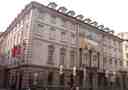
To spot the Carignano Palace, look for a large reddish-brown brick building right in front of you, with an eye-catching wavy curved façade and bold decorations around the windows-it’s the one that looks like it’s ready for a royal photoshoot! Alright, welcome to the fabulous Carignano Palace! Before you stands a building that isn’t just waving at you with its curved façade-it’s practically doing jazz hands. Built from 1679 amidst the grandeur, ambitions, and a little bit of family drama of the Savoy family, this palace is a Baroque masterpiece created by the genius Guarino Guarini, a man so clever, he designed everything from grand churches to the legendary chapel for the Shroud of Turin. Guarini broke the rules of the day: forget straight, uniform lines-this palace is all about curves and flourishes, as if it’s showing off a baroque mustache. Picture Turin in the late 1600s: fine carriages rattling on cobbles, elegant folks in powdered wigs; then, suddenly, the sound of construction fills the air. It was Emanuele Filiberto of Savoy-Carignano-nicknamed “the Mute”-who commissioned the palace, possibly proving that actions (and fabulous palaces) speak louder than words. The palace became the steady residence of the Carignano princes from 1694, and later Carlo Alberto and Maria Teresa lived here in the grand apartments facing the sun-hence the poetic "Appartamento dei Principi." Imagine the drama: elegant balls, diplomatic intrigue, and whispers in every gilded hallway. Outside, a decorative frieze honors the birth of Italy’s first King, Vittorio Emanuele II, right here within these walls-a royal birth announcement on a whole new level. Just above your head, if you squint, you can spot the name “Qui nacque Vittorio Emanuele II,” thanks to architect Carlo Ceppi, who gave the façade this claim to fame in 1884. Fun fact: the Carignanos were so ambitious that their building was intentionally different from the straight-edged palaces around-sort of like wearing a polka-dot suit to a black-tie event. Now, let’s fast-forward to the political fireworks of the 1800s. With the wind of revolution blowing in 1848, the palace became the headquarters of the Subalpine Parliament’s Chamber of Deputies. Imagine passionate debates, proud speeches, and the faint, constant shuffling of parchment. This was the scene of historic moments: here, Carlo Alberto granted the Statuto, the constitution that kickstarted Italy’s journey to unity. And in these halls, King Vittorio Emanuele II himself announced the birth of the Kingdom of Italy, in a scene fit for a blockbuster movie-capes, medals, stern faces, maybe even a teacup or two shaking from excitement. With so many schemes and meetings, they ran out of space, and the grand expansion was added, pushing the palace out toward Piazza Carlo Alberto. But here’s a twist for you: the parliament hall they built for the newly unified Italy was never actually used. Sometimes history leaves a dramatic room empty-like setting the table for a dinner party that never happened. Over centuries, Carignano Palace changed hats more than a quick-change magician. It was a residence, a home for the state council and postal services, a temporary lecture hall for the city’s university, and later, the seat of the National Museum of the Italian Risorgimento, which reopened triumphantly in 2011. For a touch of drama, in the 1930s and just before World War II, the palace played host to massive exhibitions, including the Baroque and Gothic-Renaissance art extravaganzas. Today, some areas are popular offices, others are filled with curiosity and echoes of the past, and a lucky few can sneak a peek into the plush “Mezzanotte” and “Mezzogiorno” apartments. From its swirling brickwork-almost rough in places, like it’s still shaking off the dust of a long adventure-to the shimmering gold interiors, Carignano Palace is a survivor and a star. Standing here, you’re literally in the spotlight of centuries of stories, intrigue, and some very stylish bricks. Now, onward to our next stop-let’s see what other stories the city has up its majestic sleeves!
Open eigen pagina →Straight ahead, you’ll spot a grand, symmetrical building with a row of tall windows and a striking green copper roof, its elaborate stone façade framed by two ornate towers and…Meer lezenToon minder
Straight ahead, you’ll spot a grand, symmetrical building with a row of tall windows and a striking green copper roof, its elaborate stone façade framed by two ornate towers and elegant street lamps nearby-this is the National University Library of Turin. Picture yourself here in the early 18th century: dusty volumes stacked high, the echoes of learned professors bouncing through newly built halls, and the city crackling with the excitement of a growing hub for knowledge. In 1720, Duke Vittorio Amedeo II decided Turin needed a true treasure house, merging the Savoy family’s 14,000 precious volumes with the university’s growing book collection. Thus, Turin’s first public library-actually the very first in the Kingdom of Italy-came to life here. Over the centuries, it’s swallowed up donations, collections, acquisitions, and a mountain of academic work, growing ever more labyrinthine. Can you imagine: over 1.3 million printed volumes and thousands of manuscripts, some of which are older than Turin itself! Now, this library’s story isn’t just dusty tomes and quiet reading rooms-it’s more dramatic than some people’s love lives. Picture the year 1904: on a cold January night, five of the library’s grand rooms are engulfed by fire. Rare manuscripts-some illuminated, dripping with golden ink-curl into ash among the falling timbers. About one-third of the library’s manuscript collection, and tens of thousands of books, vanish in a single, smoky disaster. But you know scholars: nothing stops them, not even when their workplace smells like burnt parchment. Rescue teams moved fast to save damp, scorched remains, and set up the nation’s very first book restoration lab. Imagine experts hunched over battered books, blackened pages, and crumbling spines, somehow transforming them back into readable history. There’s even a reconstruction of that original lab inside, complete with century-old tools and photo displays-sort of the “ER” of books. Rising from smoke and ruin, the library also became a magnet for generosity. Manuscripts and books poured in from across Europe and the world, universities and collectors eager to refill Turin’s bookshelves. It was a comeback worthy of a movie montage: by 1911, the library’s collection had leapt back to 400,000 volumes, with stacks of works still awaiting their turn for restoration. The library moved through endless growing pains. It wasn’t always in this splendid building; for years, books were packed into anywhere with decent humidity and not too many pigeons. Plans for new, fireproof halls-using the stables of Palazzo Carignano right across the square-were put on pause by wars and bureaucratic delays. By the late 1950s, this epic saga ended in success: a team of Italian architects finally created the building you see before you, preserving the original stable façade but hiding a modern, fire-resistant book lover’s paradise within. By 1976, the National University Library of Turin opened here, gleaming with new hope (and, crucially, improved fire safety). But let’s talk treasures! There’s the legendary collection of Vivaldi manuscripts-450 pieces, the notewise signature of the maestro himself, donated in a grand act of remembrance and civic generosity. There’s also the Corpus Juvarrianum, over a thousand drawings by the brilliant architect Filippo Juvarra, spanning not just buildings, but theatrical scenes and baroque decorations. And don’t forget the collection of Queen Margherita herself: 13,000 elegantly bound volumes that cover everything from poetry to pasta-making-okay, maybe not the pasta making, but you get the idea. Even today, if you step inside, you might encounter exhibitions of rare books or end up in the Auditorium Vivaldi-a spot where the music of history literally sits beside you. Not bad for a place that once weathered fire, war, and the occasional melodramatic librarian. Go on, look up at its statues and carvings and just imagine the stories each book inside could tell-hopefully without bursting into flames this time! If you're keen on discovering more about the patrimony, restoration workshop or the exhibition rooms and auditorium, head down to the chat section and engage with me.
Open eigen pagina →
Toon 10 stops meerToon minder stopsexpand_moreexpand_less
Fast forward to 1703, when the Prince bought this lively venue and asked Guarino Guarini-yes, the same architectural superstar behind Palazzo Carignano-to spice things up with a…Meer lezenToon minder
Fast forward to 1703, when the Prince bought this lively venue and asked Guarino Guarini-yes, the same architectural superstar behind Palazzo Carignano-to spice things up with a real theater layout. The result? A bold, wood-paneled box that, quite swiftly, became the place for court entertainment: comedies for the Carignano family, while serious opera was reserved for the nearby Teatro Regio. But word got out fast! By 1719, the public was flocking here. Just imagine the excitement when, with shining torches and the smell of fresh-lacquered wood, the first performance open to everyone took place: Il carceriero di se stesso, starring the famous "Parmigiana" soprano Francesca Cuzzoni. As the 18th century rolled along, the theater saw big upgrades, thanks to the ever-generous Savoy family. The renowned architect Benedetto Alfieri stepped in for a full makeover in 1752: more balconies, more seats, and a horseshoe-shaped hall that’s still the model of classic theaters today. The grand reopening starred Carlo Goldoni’s La calamita dei cuori-love, hijinks, and catchy tunes swirling into the night! Turin’s high society loved the upgraded Carignano-until disaster struck. In 1786, a fire ravaged the interior. Miraculously, it was rebuilt in just six months under Giovanni Battista Feroggio, recapturing Alfieri’s original vision yet with fresh 18th-century flair, rich with woodwork by the Pozzo brothers and painted ceilings from Bernardino Galliari. Through the 19th century, the Carignano took on legendary status. Even Niccolò Paganini played here-and gave Turin its most famous “no encore” when the king demanded another piece, but Paganini’s poor fingertips could take no more. Maybe after hours of playing, his violin strings were more stressed than an actor at a Shakespeare audition. But the drama wasn’t limited to the stage. The theater changed hands repeatedly, even falling into the city’s ownership in 1870. New safety codes, electric lighting, and savvy management kept Carignano lively, while famous figures-like Eleonora Duse and Sarah Bernhardt-took turns making their mark. In fact, it hosted the Italian premiere of La dame aux camélias, which became one of Duse’s signature roles. Even as cinema stole the spotlight, especially during the 20th-century world fairs, Carignano embraced change. It survived the Second World War with only minimal damage, thanks to quick-thinking staff who snuffed out incendiary bombs before they could set the theater ablaze. The spirit of the place seems as indestructible as its masonry. Upgrades continued-restorations in the 1930s, a period moonlighting as Turin’s leading lyric theater (when the Regio burned!), and finally, the birth of Torino’s own permanent theater company, the Teatro Stabile, under Nico Pepe. The stage welcomed the likes of Oscar Wilde’s plays and directors like Luca Ronconi. Movie buffs will spot it in Dario Argento’s “Deep Red”-though fortunately, any on-screen horror stayed in fiction. Step inside, and you enter a dream of red velvet, gold galleries, and 875 seats circling a frescoed ceiling-painted with the Trionfo di Bacco. There’s even an old beer hall in the basement, now part of the chic foyer. The royal box centers the room, waiting for someone of truly dramatic flair-or just a slightly overenthusiastic tourist. So, whether you're a lover of comedies, dramas, or you just want to imagine a night here on opening day-this place hums with artistry, resilience, and the kind of stories that keep you on the edge of your seat. And if someone insists you repeat yourself, just channel your inner Paganini and say, “Sorry, no encores!”
Open eigen pagina →Imagine the year is 1630. Turin bustles with saber-wearing dukes, and just arriving in the city is a rather peculiar artifact: the Mensa Isiaca-a bronze tablet teeming with…Meer lezenToon minder
Imagine the year is 1630. Turin bustles with saber-wearing dukes, and just arriving in the city is a rather peculiar artifact: the Mensa Isiaca-a bronze tablet teeming with ancient symbols that set every local scholar’s heart racing and mind spinning. Even back then, people liked a good mystery! Carlo Emanuele I of Savoy snapped it up, and, well, he wasn’t shy about showing it off. Curiosity grew, and soon a daring botanist-professor named Vitaliano Donati was sent off to Egypt. Picture him squinting under the desert sun, brush in hand, uncovering treasures like Ramses II carved from pink granite, a regal Sekhmet, and the goddess Isis herself. These discoveries were shipped triumphantly back to Turin-as easy as international shipping in the 1700s could be, which, let’s be honest, probably involved a lot of cursing at missing wagons. Then, around the early 1800s, Europe caught Egypt-mania. Everyone wanted a piece of the pharaohs, and Bernardino Drovetti, a Piedmontese working as France’s consul in Egypt, didn’t miss a beat. He collected more than 7,000 rare treasures-statues, sarcophagi, mummies, papyrus scrolls, amulets, you name it. After Paris said “non, merci,” Drovetti pitched the collection to King Carlo Felice of Savoy for the princely sum of 400,000 lire. Torino hit the jackpot, and in 1824, the world’s very first Egyptian museum outside of Egypt was born. The museum’s rooms, nestled in the stately Palazzo dell’Accademia delle Scienze-you’re actually standing right by it now-opened their creaky old doors. Even Jean-François Champollion, the man who cracked the hieroglyphic code, rushed here to try out his new skills on the real thing. I imagine him muttering under his breath, “So, *this* is what a pharaoh’s grocery list looks like!” By 1888, after years of dusty catalogs and glass cases, the collection held 7,400 objects. Along the way, more treasures arrived-including rare items from Jesuit scholar Athanasius Kircher. Then came Ernesto Schiaparelli, a man whose spirit for adventure rivaled Indiana Jones. In the early 1900s, he led fifteen massive expeditions to Egypt, sending even more artifacts back to Turin, including the breathtaking painted shroud of Gebelein and royal tombs that let us peek straight into the everyday lives (and afterlives) of ancient Egyptians. Now, here’s a riddle for you: How many mummies can you fit in one museum without them complaining about the neighbors? In Turin’s Egyptian Museum, the answer is at least forty-twenty-four humans and seventeen animals, to be exact, scattered over five sprawling floors. There are also 700 complete papyri, 17,000 fragments, an entire temple rescued from a rising lake in Nubia, and treasures from the tomb of Nefertari. Modern times brought big changes, too. In 2015, after three and a half years of renovations-thanks in part to the Italian lottery, proving that games of chance can support more than just your gelato habit-the museum reopened, doubled in size, glowing with state-of-the-art displays and high-tech conservation labs. Since then, more than a million visitors have wandered its halls each year, ogling the relics of one of humanity’s oldest civilizations. Oh, and you know you’ve made it as a museum when you get your own botanical garden devoted to the plants of ancient Egypt! In 2022, Turin’s Egyptian Museum did just that-more proof, perhaps, that you never know what might spring up in a city so rich in stories. So, step inside if you dare-just remember not to wake the mummies. They’ve been having a nap for a few millennia and get a little grumpy if you ask them for a selfie. For a more comprehensive understanding of the collection, management or the headquarters and activities, engage with me in the chat section below.
Open eigen pagina →To spot the Palazzo Cacherano di Bricherasio, look for a stately, light-gray building with a grand entrance flanked by neoclassical windows topped with triangular…Meer lezenToon minder
To spot the Palazzo Cacherano di Bricherasio, look for a stately, light-gray building with a grand entrance flanked by neoclassical windows topped with triangular pediments-standing right at the corner, its symmetric facade and rows of attic windows are hard to miss along via Lagrange. Now, take a deep breath and imagine the sound of carriage wheels rattling down cobbled streets, the faint aroma of roasting chestnuts from a nearby vendor, and the building in front of you standing as it has since 1636-a silent witness to nearly four centuries of Italian history. Palazzo Cacherano di Bricherasio isn’t just an elegant structure; it’s practically Turin’s own time-travel machine. If these walls could talk, they’d probably ask you for a coffee and then spill 400 years of gossip! Originally built as a noble home in the old Contrada dei Conciai, the palace became a hotspot for the city’s high society. Imagine the clatter of sabers and the rustle of silk dresses: the seventeenth-century halls were soon filled with the laughter and plotting of the counts Cacherano di Bricherasio. This family, now extinct, was quite something. Military heroes, patrons of the arts, philanthropists-they wore a lot of hats… probably very fancy ones. The building’s look isn’t just about classical charm; over the years it’s picked up details like its neoclassical windows and the robust, slightly stern gate added by architect Annibale Rigotti in 1937. Once upon a time, there was a lovely garden here too-now gone-but you can still imagine ladies and gentlemen strolling beneath the trees, planning the next spectacular soirée or plotting world domination à la Turin. Step into the 1800s for a second. If you had visited the palace around 1850 and knocked on the door, you might have met Giovanni Berchet-the famous Romantic poet and a man prone to exile, who took up residence here until his final breath in 1851. There’s even a plaque up there to remember him. Not your typical Airbnb guest: he brought big ideas and a lot of drama. In 1855, the Bricherasio family took over for good, and things got busy. Count Luigi Baldassarre Cacherano di Bricherasio set about sprucing up the place-inside and out-with a touch of Neoclassical pizzazz. When Luigi died young, his daughter Sofia and son Emanuele became the palace’s new stars. Sofia was a talented painter and made Palazzo Bricherasio the cultural living room of Turin. Think of it: the city’s best and brightest gathered here for concerts, exhibits, and heated debates, including legendary guests like artist Lorenzo Delleani, writer Edmondo De Amicis, and even the conductor Arturo Toscanini. (Rumor has it, if you hum opera near the windows late at night, you might just hear a faint encore!) But here’s where it gets wild: Emanuele, always the innovator, was so fascinated by the technological revolution that in 1899 he gathered Turin’s top minds right here at this palace and helped found the company that would become F.I.A.T.-yes, the famous automaker! The company’s founding document was even signed on the first floor. Picture it: silk cravats, the whiff of cigar smoke, and the birth of Italian motoring history. As the world changed, so did the palace. Sofia, left as the last of her line, kept the spirit of charity alive, hosting a school for embroidery and then a technical institute, keeping the building buzzing with young energy even when the grandeur faded. After a few decades of slumber and structural wrinkles, the palace was revived in the 1990s as a bustling art center, hosting world-class exhibitions before finally settling down as the dazzling headquarters of Banca Patrimoni Sella & C. Even today, it opens its doors for the curious - and hey, coffee fans rejoice, there’s now a café tucked into a steel-and-glass structure right out front. So as you stand outside, think of all those centuries: nobles and inventors, poets and pranksters, artists and bankers-all weaving their lives into this grand old building. Now, isn’t that a lot richer than just another bank?
Open eigen pagina →To spot Via Roma, just look straight ahead for a grand avenue stretching between rows of tall, elegant arcades-those impressive archways make the street look almost endless and…Meer lezenToon minder
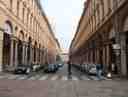
To spot Via Roma, just look straight ahead for a grand avenue stretching between rows of tall, elegant arcades-those impressive archways make the street look almost endless and frame a lively view full of shoppers and city verve. Now, take a breath and let’s stroll back through time. Picture Turin at the end of the 16th century: a city on the brink of transformation, with the duke himself, Carlo Emanuele I of Savoy, dreaming up what would soon be known as the “Via Nuova.” This street, designed by the clever architect Ascanio Vittozzi, wasn’t even 10 meters wide at first-hard to imagine given how broad and powerful it feels today! It quickly shot to fame, one of Turin’s most important arteries, and even caught the eye of city officials. At one point, they had to decree, very seriously: “No building taller than the cornice!” (I imagine that caused a lot of tall hats to go out of fashion.) For decades, Via Roma marked the very pulse of city life, though up until the 19th century, it didn’t stretch as far as it does now. It was only thanks to Carlo Felice of Savoy that Turin pressed onward, extending the street further to meet the needs of an ever-bustling capital. But don’t get too comfortable yet-the real shakeup came in the early 20th century. The street might have looked beautifully baroque from a distance, but it was a wild parade up close: rattling trams, wandering vendors, cinemas aglow, and so many food stalls that even the most disciplined shopper couldn’t resist a taste. The city soon realized chaos needed some order. Enter a new architectural vision! In the early 1930s, Via Roma underwent a transformation more dramatic than my haircut in the 80s. New buildings in an eclectic style appeared, with harmonious porticoes paved with dazzling, colorful marbles sourced from all over Italy. The street was so fancy, at one point the road itself was covered with wooden blocks-not just for the look, but for the gentle, almost springy step they offered. Sadly, the wood had to go after World War II, when bombings left their mark, replaced by today’s handsome stone. Oh, but the drama isn’t over! In the 1930s, an even bolder makeover swept the rest of the street. The architect Marcello Piacentini orchestrated the southern half, clearing old blocks to make way for something truly modern: imposing rationalist buildings, like the famous Hotel Principi di Piemonte, and rows of porticoes lined with mighty twin columns. Overhead, new lamps glowed-some modeled on antique gas lanterns, others with a trendy 'novecento' flair, depending on which section of Via Roma you strolled. You might notice that nearly all the doorways and car entrances are missing here. That’s on purpose-maximum space has always gone to the shops. Ever since its rebirth, Via Roma has been the heart of Turin’s shopping scene. Under these high, bright porticoes, the city’s best-dressed citizens still parade between elegant cafes, famous boutiques (don’t forget those historic pastry shops), and the irresistible shoe and clothing shops that lure you in with every window. If you’re wondering why you don’t hear the rumble of a subway beneath your feet, here’s a twist: there are vast underground spaces running the length of this street! The original plan was to build the city’s very first metro line here in the 1960s, but it never materialized. Instead, these spaces, after a few adventures, became Turin’s grandest underground parking garages. Today, most of Via Roma is pedestrian-only-a stage for all of Turin to see and be seen. Plans are underway to complete the pedestrian dream, bringing even more laughter, footsteps, and stories to these historic stones. So, as you stand here, take in the echo of centuries. Imagine the lively market stalls, the elegant barons keeping an eye on their hat heights, the melodies of trams and chatter, and the promise that Via Roma, no matter how times change, will always be the beating heart at the center of it all. And don’t worry, you don’t need a tall hat to fit in-just a sense of wonder!
Open eigen pagina →Directly ahead, you’ll see the vast open space of Piazza San Carlo, surrounded by elegant arcaded buildings and anchored in the center by a dramatic bronze equestrian…Meer lezenToon minder
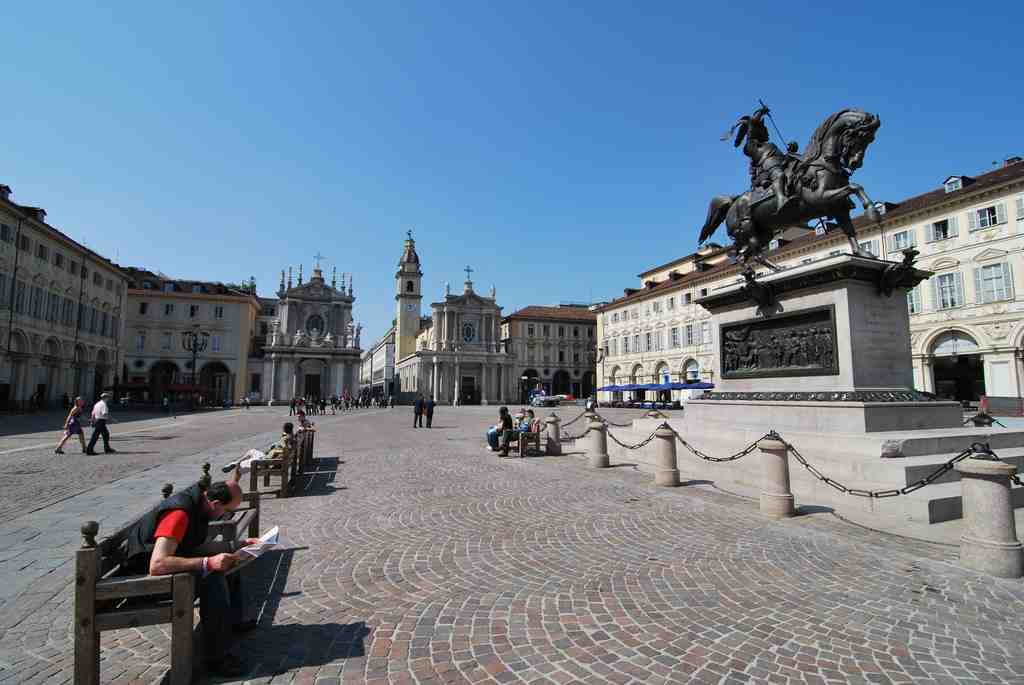
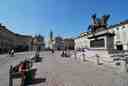
Directly ahead, you’ll see the vast open space of Piazza San Carlo, surrounded by elegant arcaded buildings and anchored in the center by a dramatic bronze equestrian statue-simply look for the two “twin” churches facing you at the far end and you’ll know you’ve arrived! Welcome to Piazza San Carlo, or as the people of Turin fondly call it, the city’s living room-though I assure you, you won’t find any slippers or remote controls lying around! Standing here, picture yourself in the heart of centuries of history, on a vast stone rectangle stretching 168 meters, framed by regal palaces and echoing with the memories of elegant footsteps and whispered secrets. Take a breath and listen-the silence is not empty, it’s full of stories. It all began when this spot lay just outside Turin’s original Roman walls, nothing but vegetable plots and country air. In 1617, the city’s expansion called for grandeur-so enter architect Carlo di Castellamonte with a mission: build a new, magnificent square, eventually named Piazza Reale. By 1638, thanks to the noble patronage of Madama Cristina di Francia, the square was ready for royal processions…and the occasional local market selling, let’s imagine, rather saucy cheeses. But things weren’t always so peaceful. The square became known as Piazza d’Armi-a parade ground for soldiers, echoing with the clatter of boots and, during the 1706 siege, shuddering with cannon fire that left actual cannonballs still wedged in nearby walls. Next time you spot a bar called Mokita, look up and see if you can find one!. As centuries rolled on, Piazza San Carlo emerged as the elegant jewel you see today: arcades lined with legendary cafés, palazzi reconstructed and refined by Benedetto Alfieri, and the stunning “twin” baroque churches-Santa Cristina on your left and San Carlo on your right. Not identical twins, mind you! One took inspiration from the other, and if you squint you might spot the differences. Santa Cristina’s façade, a creation of Filippo Juvarra, is as showy as a peacock in spring, while San Carlo’s more reserved look came nearly 120 years later, courtesy of Ferdinando Caronesi. And right in the middle, presiding over it all, is the Caval ëd Bronz-the Bronze Horse-an equestrian statue of Emanuele Filiberto of Savoy by Carlo Marochetti. Rumor has it that folks think the statue is all about military glory, when actually, the duke is shown sheathing his sword, not unsheathing it-a subtle sign of peace after victory. Just imagine how many fans have climbed that plinth to celebrate a Juventus victory!. Beneath the arcades, historic cafés like Caffè San Carlo and Caffè Torino once buzzed with politicians, poets, and thinkers. Cavour plotted politics over coffee, and it’s said you could bump into everyone from Cesare Pavese to Ingrid Bergman. Fancy a sprinkle of good luck? Find the little brass bull in front of Caffè Torino and stomp-carefully-on his, um, special attributes. Locals say it works wonders. Of course, not every chapter here has been joyful. In 1864, when Turin lost its status as Italy’s capital, peaceful protests in this square met tragic violence, a reminder that beauty and sorrow sometimes linger side by side. In more recent times, the square has shaken off the rumble of cars and reinvented itself as a peaceful pedestrian haven, resurfaced with porphyry stones and modern touches like smart lighting and Wi-Fi-because even the most historic piazzas need to check their emails these days. So, as you wander, keep your ears open and your eyes wide. Every stone, every column, every shaded portico is part of a centuries-old tapestry-somewhere between a grand stage for popes and generals, and the sun-dappled living room where Turin naps, dreams, and celebrates. Intrigued by the structure, cafes and clubs or the the home of alfieri? Explore further by joining me in the chat section below.
Open eigen pagina →Look straight ahead and a little up-you’ll spot the Torre Littoria by its bold, sleek red-and-white facade, rising directly above the street with a sharp modern edge and a flag…Meer lezenToon minder
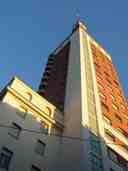
Look straight ahead and a little up-you’ll spot the Torre Littoria by its bold, sleek red-and-white facade, rising directly above the street with a sharp modern edge and a flag waving proudly at the very top. Now, let me take you back to the early 1930s. Picture Turin buzzing with excitement and industry, the air full of ambition, as workers hurried through the city streets while concrete mixers and iron hammers echoed through the city blocks. Here, right where you’re standing, they built what looked at the time like something out of a science fiction novel-a skyscraper! Not just any tower, but the first real residential skyscraper of Turin, and, for a glorious while, the tallest in all of Europe. Imagine the skyline in 1934 when Torre Littoria, as it was called then, shot up over its neighbors like an adventurous child on stilts, eager to see the world. You might think its location was pure chance, but there’s a bit of playful rebellion in its address. Original plans placed it far from here, in Piazza XVIII Dicembre, but the final spot, just steps from the baroque and royal Piazza Castello, was no accident. There was a bit of symbolic chest-thumping here! Some say the engineers wanted the modernist “finger” of the new era to poke the old royal order right in its stately ribs-a striking, vertical poke among Turin’s classic curves. And here comes the twist: it was designed to be the proud headquarters of the National Fascist Party. But in true Italian plot-twist fashion, the party never moved in! Instead, Reale Mutua, the insurance company that helped pay for it, took over-and you can still spot their giant sign shining from the top. Picture the construction: frantic, relentless work that didn’t stop even at night. The team behind it was Armando Melis de Villa and Giovanni Bernocco, already famous for their bold ideas. By 1934, the building was complete. It quickly became both a symbol of hope and a conversation starter-if buildings could talk, this one would definitely brag to its neighbors! On the ground floor, people would gather at the Bar Impera, famous across Turin, run by the Chazelettes-yes, the same family that gave the world their famous vermouth. During World War II, the rooftop of Torre Littoria had a dramatic job: one of Turin’s 58 air raid sirens was planted right up there, its wailing cry echoing over the rooftops whenever danger approached. The building itself got away with just a few scrapes during the air raids of July 1943, like a boxer dodging most of the punches. The style is unmistakable: check out the glass blocks, red brick bands, and those quirky round terraces. The materials were downright futuristic for the 1930s-glass cement, clinker, linoleum. It was Italy’s first high-rise built with a welded steel skeleton, more like a New York skyscraper than any Italian palazzo. Even its relationship with Turin’s other icon, the Mole Antonelliana, became something of a good-natured rivalry-the old brick-and-mortar champion versus the new metal upstart. The tower stretches 109 meters into the sky, 19 stories above the city-the apartments above were, and still are, the dream home for many. As you look up, notice the different layers: nine stories stretch almost lazily along Via Viotti, until the main tower suddenly shoots upward. The east side balconies show off gleaming glass curves, now rimmed at night by blue light, making the building glow like a beacon after dark. Let’s be honest, not everyone loved this modern marvel at first. Locals gave it nicknames: “the eyesore,” “the cellphone,” “the Duke’s finger,” or-my favorite-“the arrogant tower.” But love it or not, the Torre has always housed dreamers and doers: offices, studios, luxurious apartments, and, rumor has it, some of the most intriguing personalities in Turin. Today, after a major renovation in 2020-think new concierge, fancy gym, and sparkling blue lights-it’s looking sharper than ever. There's even been talk of epic rooftop bars and restaurants, though those plans remain tantalizingly out of reach. Perhaps, as you gaze up at the flag snapping in the breeze far above, you’ll sense the stories, arguments, jokes, and history sealed in every brick and pane of glass.
Open eigen pagina →Facing you right now, the Church of San Lorenzo blends seamlessly with the buildings around it-you’ll spot it by its plain, pale yellow wall, no grand front, and a truly…Meer lezenToon minder
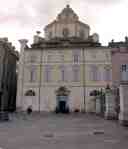
Facing you right now, the Church of San Lorenzo blends seamlessly with the buildings around it-you’ll spot it by its plain, pale yellow wall, no grand front, and a truly eye-catching baroque dome rising like a crown above the rooftops. So here you are, perhaps thinking, “Wait a second, is that really the church? It doesn’t even have a fancy front!” Don’t worry, you’re not seeing things; San Lorenzo is famous in Turin for pretending to be just another stately building until you look up at its remarkable dome. That’s all part of its mysterious charm! Now, picture this square bustling nearly five centuries ago-soldiers marching, nobles in velvet cloaks, and a duke with a mission. The story starts in 1557, on the bloody fields of Saint-Quentin in France, where Emanuele Filiberto of Savoy and his cousin, the Spanish king Philip II, won a decisive battle on Saint Lawrence’s feast day. Both promised to honor the saint; Philip built his monastery in Spain shaped like a gridiron-the instrument of Lawrence’s martyrdom-but Emanuele Filiberto, “Iron Head” as they called him, had to wait until peace was restored to refurbish this humble church, once a small chapel dedicated to the Virgin Mary. Imagine the old chapel-smaller, quieter, and yet, soon to be transformed into the heart of a ducal promise. In 1572, it became the seat of Turin’s knightly Order of Saints Maurice and Lazarus. Later, in 1578, the atmosphere lit up when the Holy Shroud first arrived in Turin, and crowds gathered for a grand mass led by Cardinal Borromeo himself. The poet Torquato Tasso was even here, inspired to pen a poem as bells rang out over the piazza. But the real transformation took nearly a century. As the years passed, Turin wanted something spectacular. The great Guarino Guarini was called in-imagine him, a priest and mathematician with wild architectural dreams. Starting in 1668, Guarini tore up the old building plans and designed a church with an octagonal main hall nestled inside a square, its space swirling upwards with energy, like a massive kaleidoscope in stone. He imagined a decorated facade, but that was abandoned to protect the symmetrical flow of Piazza Castello-so here stands a church that hides itself in plain sight! Now, the cupola: look up, and let your eyes wander skyward. Guarini’s dome is a spectacle-a dizzying lattice of arches drawing a star that seems to spin the light above. If you visit at the right hour, sunlight throws amazing patterns inside. The star shape and the repeated number eight in the architecture-eight petals in the dome’s flower, eight windows, octagonal shapes-aren’t just artistic, but loaded with symbolism: eight is the number of the perfect day, the infinite, the new beginning. Four levels of light symbolize the elements-earth, water, air, fire-as the space inside rises from darkness at the base to blinding illumination in the dome above. Some regulars even joke you can see the “face of the devil” in the windows from below, thanks to the dazzling arrangement! Despite the majestic dome, the bell tower is barely noticeable, peeking sheepishly from behind the roof. Inside, the church glows with colorful marbles, golden decorations, and side chapels filled with artwork. There’s a pulpit carved from a single giant piece of Indian walnut-intended for another Turin church, it ended up here by twist of fate! Every detail seems to whisper a new story. Don’t forget: every day at exactly 17:15, the bell chimes ten solemn times. This honors the Italian divisions lost on the Russian front in WWII, a daily echo of memory and resilience. And if you wander behind the scenes, the sacristy now shelters a little Shroud museum-a treasure for any curious soul. So, before you move on, take one more long look. The Church of San Lorenzo is a master of disguise: on the outside, it hides its beauty; inside, it dazzles with light, color, and a sense of eternity that’s touched the lives of poets, dukes, soldiers, and all who step inside.
Open eigen pagina →To spot the Church of the Holy Spirit, just look straight ahead for a pale yellow, neoclassical facade with a tall set of stairs, a distinct round window above a green door, and a…Meer lezenToon minder
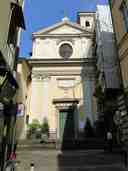
To spot the Church of the Holy Spirit, just look straight ahead for a pale yellow, neoclassical facade with a tall set of stairs, a distinct round window above a green door, and a cross topping the triangular pediment. Alright, time to dive into a story that stretches from ancient gods to Baroque columns! Picture yourself centuries ago as you stand in this very spot: back then, the air would have been filled not with music or prayer, but whispers of Roman gods. Legend has it, right here was once a temple dedicated to Diana, the goddess of the hunt. If you listen closely, maybe you’ll still hear the hidden rustle of ancient togas-or a startled deer or two! Was there truly a Temple of Diana beneath your feet? Turin’s historians have argued for ages, but the evidence hasn’t exactly leapt out of the crypt. Still, the floor of the church’s lowest crypt lies perfectly level with the old Roman streets, so the scent of mystery lingers under every stone. Move forward to the Middle Ages and a tiny church dedicated to Saint Sylvester stood here, perhaps made with recycled marble from Diana’s temple. This was a place so old, no one quite knew when it was built; it's almost as if the stones themselves have forgotten. Imagine a single short nave, an oddly shaped apse-perhaps the only survivor of a Roman temple, now cleverly repurposed and pointed east, exactly the opposite to the church you see now. By the time the 16th century rolled in, the population here was smaller than the queue outside a gelato shop in winter-just about 250 souls. The faithful formed the Confraternity of the Holy Spirit, devoted to good deeds, especially helping new converts to Christianity. That role brought some drama! This church hosted emotional ceremonies for spiritual conversions and public renunciations of other beliefs, sometimes capturing the gaze of all Turin. Here, a seventeen-year-old named Jean-Jacques Rousseau, yes, the soon-to-be-famous philosopher, stood trembling through his baptism into the Catholic faith, coaxed along by circumstance more than conviction. Years later, he’d swap faiths again-talk about indecisive! The church’s fortunes rose and fell with the times-a devastating fire in 1653 turned the old Saint Sylvester to ashes. Yet out of those ashes, in 1662, the new Church of the Holy Spirit began to rise by the hand of Bernardino Quadri. Of course, nothing in Turin ever goes smoothly, and a feud soon erupted over whether to connect this sacred space with the nearby Corpus Domini church. The result? A brick wall was thrown up to keep the peace-a classic Torinese showdown! Fast-forward to the 18th century. Cracks started to show, literally, and the church stood on wobbly legs. Architect Giovanni Battista Feroggio, whose name is nearly as long as his renovation to-do list, stepped in, filled the nave with fourteen mighty Corinthian columns (four a personal gift from Carlo Emanuele III), and polished up the interiors. By 1767, the church gleamed with marble, color, and a dash of royal generosity. The 20th century wasn’t kind either. In July 1943, the rumble of bombers overhead turned prayer into panic-the church was almost flattened by an air raid, its splendid organ reduced to splinters. But the Turinese are made of strong stuff. Repairs finished in 1951, and by 1985, this church was not just a place of worship but home to the Accademia Musicale del Santo Spirito. Now, music of the Renaissance and Baroque dances through its halls every autumn, and the building stands steady once more. Inside, treasures await: a miraculous wooden crucifix said to protect Turin against plague and cholera, the mausoleum of a noble Estonian baron who gave up Lutheranism for local honors, and a dazzling marble altar holding martyrs’ relics. And if you’re very quiet, you might even hear faint notes from a long-lost organ, or the echoes of debates between gods, saints, and philosophers-after all, this is the Church of the Holy Spirit, where history refuses to rest! Ready to delve deeper into the description, conversions and abjurations at the church of the holy spirit or the the academy of the holy spirit? Join me in the chat section for an enriching discussion.
Open eigen pagina →To spot Piazza Savoia, look straight ahead for a tall, pale granite obelisk rising proudly at the center of an open square, surrounded by elegant yellow buildings and trees-a…Meer lezenToon minder
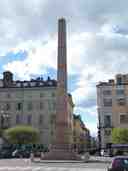
To spot Piazza Savoia, look straight ahead for a tall, pale granite obelisk rising proudly at the center of an open square, surrounded by elegant yellow buildings and trees-a sight that truly stands out as you approach. Let’s jump right into the curious, unpredictable, and sometimes dramatic history of Piazza Savoia-though, if we’re being honest, the locals often call this “Piazza Obelisco” for a reason! Right now, the 21-meter-tall granite obelisk is impossible to ignore, but centuries ago, you’d have found the busy western gateway to ancient Turin-and maybe, if you’d lingered too long, an impatient Roman urging you to get out of their way. This was once the end of the mighty decumano maximus, the original Roman road cutting straight through the city, which led travelers directly out to the Via delle Gallie and west towards France. As time wound through the centuries, the old Roman gate transformed and took on new names. In the 6th century, it became known as Porta Segusina, because here began the journey to Susa in the mountains. By the 10th century, even the noble Arduinici family felt this spot required a little medieval bling, so they set up a castle-fortress right where you’re standing-try to imagine armored counts and the famous Countess Adelaide of Susa glancing down from their windows! Of course, castles and city walls don’t last forever, and by 1250, Count Pietro II of Savoy decided he needed a new castle, so down came the old one. The area stayed bustling; for centuries, it was a critical turn-off on the pilgrimage route called via Francigena, leading devout Christians southward across Europe. Fast forward to the 18th century, and the square started getting its current, elegant look. Michelangelo Garove drew up the first plans for this cozy and sophisticated piazza, intended to be adorned by palaces for the city’s “who’s who.” To the north, you'll notice the stately Palazzo Martini di Cigala, crafted by the celebrated Juvarra, while on the south side stands the Palazzo Baldassarre Saluzzo di Paesana, whose underground tunnels sparked their fair share of whispered rumors about secret passageways. Yet nothing in Turin ever stays quietly dignified for long: when French troops arrived in 1798, out went the old names and in came “Place de France.” Then, after the monarchy returned, it became Piazza Paesana, and for a while, it even turned into a lively flea market known as mercà dij busiard-imagine stalls piled with treasures and trinkets, and plenty of haggling in Piedmontese dialect! Now, let's talk about the main attraction-the obelisk. Erected in 1853 and towering above your head, it celebrates the Siccardi Laws, major reforms in 1850 that lessened the church’s legal privileges and stirred up more than a few heated arguments in Turin. Support for the monument came from all over, with 800 communities' names carved on its sides. There’s even a time capsule in the base-containing newspapers, laws, coins, rice, breadsticks, and a bottle of Barbera wine. That’s right, even the obelisk was prepared for a party! And during WWII, when bullets flew and mortars threatened to topple the monument, it shook but stood strong-restored after the war and again in 1993. Today, it’s a symbol of the city’s spirit: a little bit rebellious, a little bit grand, and always ready for the next chapter. So, standing here in Piazza Savoia, the air filled with the echo of centuries of change, you are at the crossroads of pilgrims, palaces, protests, and pastries-Turin’s past and present all in one lively, sunlit place.
Open eigen pagina →To spot Piazza Statuto, look just ahead for a wide, elongated square framed by grand neoclassical buildings with elegant arcades, and right at its heart stands a dramatic stone…Meer lezenToon minder
To spot Piazza Statuto, look just ahead for a wide, elongated square framed by grand neoclassical buildings with elegant arcades, and right at its heart stands a dramatic stone monument topped with a winged figure and surrounded by statues. Well, you’ve made it to Piazza Statuto, and let me tell you, this spot has witnessed more drama than a soap opera marathon! Picture yourself, feet planted on these stones, at the final grand stage of Turin’s Risorgimento-a square designed to impress with its rows of fancy arcaded buildings, thanks to the ambitious plans of architect Giuseppe Bollati and a wealthy construction company from London. Back in those heady days after 1861, Turin was buzzing as Italy’s capital, and this area was built for the armies of politicians, soldiers, and administrators. Of course, as luck would have it, just when everyone got comfy, the capital packed its bags for Florence. The chaos in 1864? Oh, it spilled out right here-people yelling, stones flying, probably a tomato or two, as Turin protested its sudden demotion. Now, let’s take in the monument at the center, looming like a pile of boulders from a very ambitious garden gnome. That’s the Monument to the Fréjus Tunnel, built in 1879 to celebrate the construction of the railway tunnel through the Fréjus mountain. Imagine it: roaring trains, ringing bells, and the first thrilling journey underneath a whole mountain from France to Italy. The monument itself is a rough stone pyramid, stacked high with real rocks from the tunnel, and upon it sits a winged genius, star on his head, arms outstretched. Underneath, marble titans tumble in defeat. In theory, it’s all about humanity’s triumph over nature-science conquers the wild! But locals sometimes whisper it’s a tribute to the poor, battered miners who toiled and suffered to make the tunnel happen. For those who love a good ghost story: there are even legends saying the winged figure is Lucifer himself. Don’t worry, he’s not taking attendance. But this square’s strange energy runs deeper. Under your feet lies a web of tunnels-old sewers, metro lines, even a tangle of old railway tracks. Long ago, Romans built roads here leading far into Gaul, while the land outside these original walls was, rumor has it, used as a necropolis, a place of executions, and later near the city’s main gallows. This reputation for dark happenings is probably why fans of magical mysteries believe Piazza Statuto sits at the heart of Turin’s so-called “black magic triangle,” alongside London and San Francisco. Imagine, according to some, you’re at one of the planet’s top supernatural hotspots. Magician’s hat not included! Speaking of oddities, look for a tiny obelisk called “Guglia Beccaria.” It's a memorial to an 18th-century mathematician, who used it to measure the Earth's size. Yes, scientists literally stuck a stick in the ground here and changed our understanding of the planet. The buildings? Take a glance at the palazzo on the corner, once home to the Paravia publishing dynasty. Right across the way, there’s the post-war BBPR Tower, an eye-catching modernist block that stands apart from the older grandeur, its portico now marked by a memorial to partisans executed during the war’s grim days. Piazza Statuto also loves a good protest. From 19th-century riots over the loss of capital pride, to the thunderous worker’s strikes of 1962, crowds have filled these spaces, voices bouncing off the stone facades. Even in recent decades, the square owed its own rhythm to the mods-youths in sharp suits meeting outside number 18 every Saturday-and music, with the ska group Statuto taking the square’s name and spirit onto the stage. So as the trams rattle by and sunlight plays on the monument’s edge, you stand where Turin’s history twists and turns, a place full of stories both scientific and spooky. I’d say Piazza Statuto has seen it all-politics, protests, peril… and possibly the odd poltergeist! If you're curious about the the square as a place of protest, major infrastructure works 1990-2016 or the cultural influences, the chat section below is the perfect place to seek clarification.
Open eigen pagina →


Veelgestelde vragen
Hoe begin ik de tour?
Download na aankoop de AudaTours-app en voer je inwisselcode in. De tour is direct klaar om te starten – tik gewoon op afspelen en volg de GPS-geleide route.
Heb ik internet nodig tijdens de tour?
Nee! Download de tour voordat je begint en geniet er volledig offline van. Alleen de chatfunctie vereist internet. We raden aan om te downloaden via wifi om mobiele data te besparen.
Is dit een groepsrondleiding met gids?
Nee - dit is een audiotour met eigen gids. Je verkent zelfstandig op je eigen tempo, met audiovertelling via je telefoon. Geen tourguide, geen groep, geen schema.
Hoe lang duurt de tour?
De meeste tours duren 60-90 minuten, maar jij bepaalt het tempo volledig. Pauzeer, sla stops over of neem pauzes wanneer je wilt.
Wat als ik de tour vandaag niet kan afmaken?
Geen probleem! Tours hebben levenslange toegang. Pauzeer en hervat wanneer je wilt – morgen, volgende week of volgend jaar. Je voortgang wordt opgeslagen.
Welke talen zijn beschikbaar?
Alle tours zijn beschikbaar in meer dan 50 talen. Selecteer je voorkeurstaal bij het inwisselen van je code. Let op: de taal kan niet worden gewijzigd na het genereren van de tour.
Waar vind ik de tour na aankoop?
Download de gratis AudaTours-app uit de App Store of Google Play. Voer je inwisselcode in (verzonden per e-mail) en de tour verschijnt in je bibliotheek, klaar om te downloaden en te starten.
Als je niet tevreden bent met de tour, betalen we je aankoop terug. Neem contact met ons op via [email protected]
Veilig afrekenen met 


