
Dortmund Audiotour: Oriëntatiepunten van Erfgoed en Industrie
Verborgen in het hart van Dortmund, dwalen legendes en verloren stemmen onder de energieke polsslag van de stad. Volg deze zelfgeleide audiotour om geheimen te ontdekken die veel verder gaan dan voetbal en winkelen – plekken waar geschiedenis trilt achter alledaagse bezienswaardigheden. Waarom verdwenen verzetsstrijders binnen de verboden muren van de gevangenis van Dortmund in het holst van de nacht? Welk radioschandaal zorgde voor schokgolven aan ontbijttafels afgestemd op 91.2 MHz? Welke spoorwegarbeider beweerde ooit iets onverklaarbaars te hebben gezien bovenop de watertoren van het Zuidstation? Stap door tijdperken getekend door bezetting, herboren door kunstzinnigheid en geëlektrificeerd door onverwachte triomfen. Luister hoe echo's van guillotines, wilde ethergolven en middernachtelijke motoren je leiden door paden die weinigen durven te betreden. Verhalen ontstaan waar baksteen prikkeldraad ontmoet en muziek de stadslucht vult. Klaar om af te stemmen op de diepste frequenties van Dortmund? Druk op play en duik onder het oppervlak – je staat aan de rand waar het geheugen nooit echt slaapt.
Tourvoorbeeld
Over deze tour
- scheduleDuur 30–50 minsGa op je eigen tempo
- straighten4.5 km wandelrouteVolg het geleide pad
- location_on
- wifi_offWerkt offlineEén keer downloaden, overal gebruiken
- all_inclusiveLevenslange toegangOp elk moment opnieuw afspelen, voor altijd
- location_onStart bij Radio 91.2
Stops op deze tour
Look ahead and to your right for a tall brick-and-white building surrounded by high walls and rolls of barbed wire lining the rooftop-that’s the unmistakable silhouette of the…Meer lezenToon minder
Look ahead and to your right for a tall brick-and-white building surrounded by high walls and rolls of barbed wire lining the rooftop-that’s the unmistakable silhouette of the Dortmund correctional facility. Step a little closer-just don’t get too close to the wall, or you might set off more than curiosity! Now, take a deep breath and imagine it’s the year 1902. The air is thick and damp, and the new Dortmund prison, nicknamed “Lübecker Hof,” has just opened its doors-not for freedom, but for those waiting on the slow march of justice. For decades, this building has stood like a silent giant in the city’s heart, watching the world change around it. In the early days, it was just an investigation prison. But the story soon thickened: imagine, in 1923, French authorities, boots echoing on cobblestones, requisitioned the prison during the Ruhr occupation, cramming its cells with political prisoners and resistance fighters-men and women whose only crime was hope. The walls here have heard secret whispers and muffled sobs, the drama of human defiance playing out in shadowy corridors. Fast forward to World War II, and things take a haunting turn. In 1942, the prison became home to “Nacht-und-Nebel” prisoners-people snatched in the night and swallowed by darkness, mostly foreign resistance members. Imagine the anxiety in the corridors, the feeling of every heavy footstep possibly meaning your name was next. In 1943, a chilling sound joined the daily noises-a guillotine was set up here, becoming the center of regional executions. Over 300 people lost their lives within these walls: French priests like Jozef Raskin, brave members of the Résistance like Pierre Carpentier, and ordinary young citizens, including 19-year-old Ilse Mitze, who was executed for a petty theft during the chaos after an air raid. The year 1944 saw even more tragedy. In September, workers from Bielefeld-mostly union men-were executed one after another. Each name still lingers in the air: Appelfelder, Brockmann, Giesselmann, and so many others. Another life lost was 18-year-old Oskar Aschoff, a Wehrmacht deserter who tried to escape to the Netherlands, only to find his journey cut short here by the guillotine. The last execution happened on January 5th, 1945. Just a few months later, when American soldiers rolled in, the guillotine itself was made unusable, a final act of closure to its grim legacy. But the story doesn’t end with the Liberation. By the evening of April 30, 1945, operations resumed-life goes on, even in the most unlikely places! The British military government moved in, ordering yet another guillotine built, and about 50 more executions followed, most under British military justice. It’s a chilling thought, but one underscoring the long, difficult journey from war back to peace. By 1950, the justice minister himself ordered the dismantling and destruction of the execution device, hoping to leave that painful chapter firmly in the past. In the decades since, the prison saw physical changes too. Laundry rooms destroyed by bombs were rebuilt, cell blocks were expanded, an underground sports hall appeared-imagine prisoners in striped uniforms trading sullen looks for a quick game of football. Jump to more modern times, and you’ll notice something unexpected-art! In 2019, massive murals went up on the prison’s once-bleak facades: an Italian artist depicted the doubting Apostle Thomas, his painting echoing Caravaggio’s drama. Around the back, a Hopper-esque mural, by German artists Noah Kauertz and Oliver Hollatz, shows a young man reading a haunting letter-sadness painted as brightly as the sun. These artworks transform the prison’s cold face into a canvas of memory and hope. Believe it or not, this place is also famous for its library-it once won “Prison Library of the Year.” And, if you’re a fan of German TV, the JVA Dortmund took the star role in a “Tatort” crime episode-although they filmed it in Magdeburg for extra mystery! Today, this prison can house up to 404 inmates, divided between investigation and regular sentences, though sometimes it’s more crowded than a subway at rush hour. It’s still a place of strict routine, holding men on everything from short stints to sentences of several years. And yet, on anniversary walks, with scouts and city historians coming to remember, it’s also a place where the city’s memories gather-where laughter, sadness, defiance, and even hope echo against ancient, watchful walls. And now, as you stand outside, you’re a witness to a story more winding than these old city streets-a place where history, horror, art, and even a dash of humor live side by side. Be sure not to miss the small plaque on the wall-a sobering reminder of those lost lives, and of a city that never stops remembering.
Open eigen pagina →
Toon 5 stops meerToon minder stopsexpand_moreexpand_less
To spot the Dortmund Regional Court, just look for a grand, pale stone building with rows of tall windows and a flat roof lined with statues-it's right at the corner of…Meer lezenToon minder
To spot the Dortmund Regional Court, just look for a grand, pale stone building with rows of tall windows and a flat roof lined with statues-it's right at the corner of Kaiserstraße and quietly impresses everyone who walks by. Now, as you're standing right here in front of it, let me tell you a little secret-this building has seen more drama than a soap opera marathon! The Dortmund Regional Court is one of ten major courts in the region and it has played an important role in keeping law and order across Dortmund, Hamm, Castrop-Rauxel, and pretty much everywhere in between. You’re not just standing by any old courthouse-oh no! This monument is so special it’s been declared a historic landmark, and the stories within these walls could make even the most seasoned judge’s wig curl. Picture this: It’s the late 1920s, the golden era of jazz and wild ideas, but here in Dortmund, the court had its own revolution. They set up one of the first higher labor courts in the region, deciding tough cases and shaping how workers were treated in bustling, industrial Germany. People must have tiptoed in with sweaty palms, nervous to hear their fates. For a while, this very building bustled with heated arguments, the tapping of stern shoes echoing off these stone floors. Then, imagine after World War II, when all the courts in the country were closed down-the entire place would’ve fallen eerily silent, the sort of quiet that makes you feel the weight of history pressing down on your shoulders. But this story has a happy ending! The justice system was rebuilt, and soon enough, the hard questions of life and law echoed here once more. And just between you and me, I always imagine the statues on the roof secretly watching all the comings and goings, judging the judges! So, next time you stroll past, give the building a wink-you never know if it’s keeping score!
Open eigen pagina →Take a look right in front of you: you’ll spot a grand, elegant three-story building with tall white columns, sandstone accents, and a slate-roofed clock tower peeking above the…Meer lezenToon minder
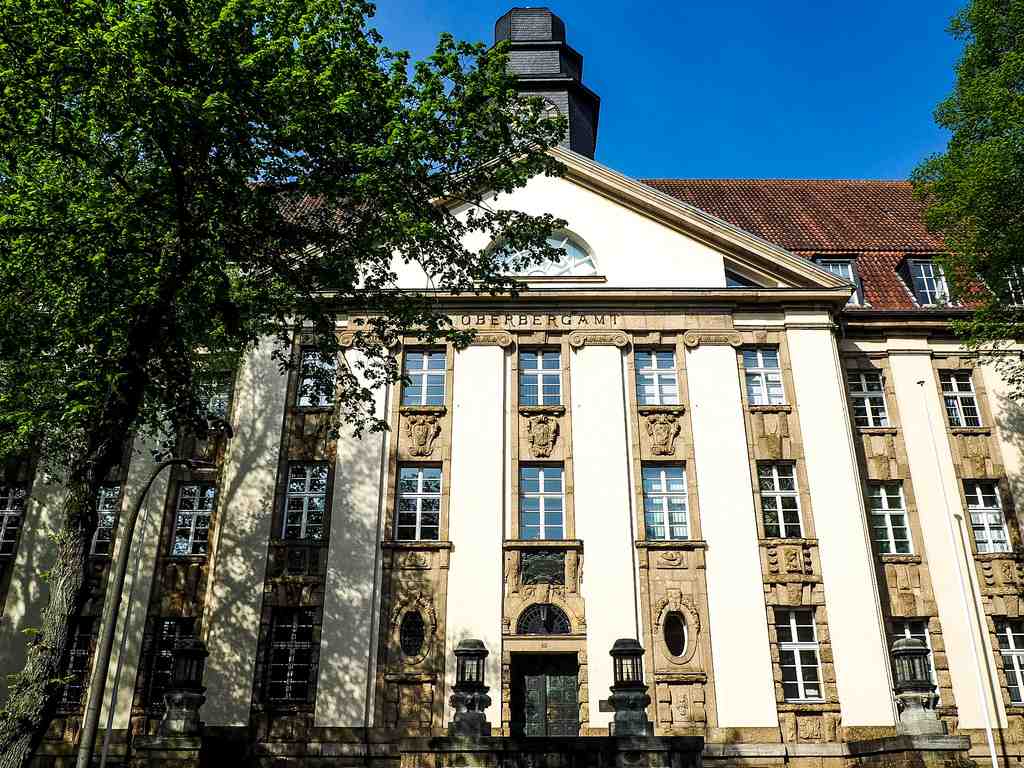
Take a look right in front of you: you’ll spot a grand, elegant three-story building with tall white columns, sandstone accents, and a slate-roofed clock tower peeking above the leafy trees-the words “Oberbergamt” proudly carved above its doors. Now, let’s step back in time. Imagine the Ruhr area buzzing with the sound of steam engines, coal carts rattling down tracks, and a thick haze of smoke drifting above newly built factories-this was the Ruhrgebiet, booming with industrialization. But all these mines and machinery needed someone to keep order, and that’s where the State Mining Authority’s story kicks off. Picture this: it’s the late 1700s. A clever, forward-thinking statesman named Freiherr vom Stein realizes the chaos of so many new mines could turn into a real disaster-like ordering a pizza with too many toppings, only with way more coal dust. He urges the Prussian government to put some officials in charge, and in 1792, the very first Oberbergamt opens in the little town of Wetter. Imagine miners, engineers, and mapmakers huddled around tables in an old castle-Burg Wetter-trying to make sense of maps and ledgers scribbled with the locations of every tunnel and shaft. These were the days of the legendary Niemeyer map-a kind of industrial treasure map created from 1787 to 1794, meant to capture the sprawling underground world. But it didn’t take long for things to grow. The seat of the mining authority shifted-first to Essen, then to Bochum, and eventually, in 1815, to the lively heart of Dortmund. That first office, tucked in at the Alte Markt, quickly became too cramped as the industrial boom roared ahead and more mines popped up than mushrooms after a rainstorm. So in 1875, a new home was built on Ostwall, designed by Gustav Knoblauch. But progress waits for no one! By 1910, another move was needed, and that brought us the majestic building in front of you. Picture government architect Fritz Behrendt and city official Rudolf Claren teaming up under the watchful eye of master planner Oskar Delius, sketching the plans for a building worthy of Dortmund’s mining empire. Look up at the elaborate stonework and the clock tower-imagine miners checking the time as they hurry to a meeting with a stern “Berghauptmann” (mining director) whose portrait might have glared at them from the walls inside. This place has seen its share of drama. In World War II, it was badly battered, but unlike a stubborn old miner, the building simply dusted itself off and stood tall after the war, nearly unchanged. In its golden age, this authority didn’t just oversee mines in Dortmund-they watched over mining districts as far south as Oberhausen, Hattingen, Werden, and Witten. If these walls could talk, they’d tell tales of strict laws, heated debates, and maybe a few secret snacks tucked away during meetings. And the parade of mighty “Berghauptleute”-with names like Toussaint von Charpentier and Guntram Polster-guided the region through wars, reforms, and wild times in the mines. By 1970, a merger with Bonn’s mining authority gave birth to the State Mining Authority of North Rhine-Westphalia, calling this building home. Fast-forward to 2001, and the mining authority as it was officially closed. But the building didn’t lose its spirit. Today, it stands proudly preserved as a heritage site, part of the Industrial Heritage Trail-witness to Dortmund’s rise from muddy coalfields to industrial metropolis
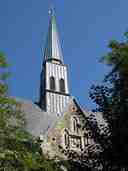
Open eigen pagina →Right in front of you, you should spot St. Franziskus by its tall, sharp steeple topped with a golden cross, rising above a sturdy facade of gray stone peeking out from behind the…Meer lezenToon minder
Right in front of you, you should spot St. Franziskus by its tall, sharp steeple topped with a golden cross, rising above a sturdy facade of gray stone peeking out from behind the leafy trees-just look up and you can't miss it! Now, take in the sight and let me spin the story of this special place! Imagine Dortmund way back in the Middle Ages, the city humming with the voices of monks and city folk, the smell of freshly baked bread drifting from little market stalls. It’s the 13th century, and here the first brothers of the Order of St. Francis set up their cloister right on this spot. They arrived between 1232 and 1244-back when a “talking clock” meant someone yelling the hour from a tower! Life wasn’t always peaceful for these early Franciscans. In 1297, their beloved monastery was nearly consumed by fire, forcing them to rebuild their home brick by brick. At the height of their influence, the convent even claimed one Johannes Schneider, who went from humble monk to being named an auxiliary bishop by the Pope himself. That’s a pretty impressive career change if you ask me! Even so, religious politics got heated-at one point, the Franciscans and their Dominican neighbors were locking theological horns with the local clergy, fighting for the right to preach and hear confessions. Gossip must have been even juicier than today’s social media! Fast-forward to the upheaval of 1805: the winds of secularization swept through, and the long-standing monastery was dissolved. Imagine the echoes of centuries of prayer suddenly falling silent-the cloister and its church were demolished, leaving only memories and scattered stones. Then, as Dortmund’s factories belched steam and the city boomed with industry in the late 1800s, waves of workers from far-off places, especially Poland, settled here. The city’s only surviving Catholic church was bursting at the seams. Enter, stage left, our Franciscan heroes making a dramatic comeback! In 1895, new brothers-a lively bunch with roots in Saxony and Silesia-set up shop in a modest house nearby. With space just for 150 people, their house chapel probably felt more crowded than a bus on match day! So, in 1896, they boldly secured this very plot of land to build something bigger and better. The church you see now is built in the neo-Gothic style, with its soaring spire and three-aisle basilica layout. Designed by the local architect Johannes Klomp, it’s got all the gravitas of a cathedral-if cathedrals ever had to compete with the sound of steam engines out back! The foundation stone was laid on St. Francis’ feast day, October 4, 1898, and by June 1902, the doors were open, welcoming streams of new parishioners. But Dortmund wasn’t always kind to its buildings. During WWII, bombs fell thick and fast, leaving deep scars-a major hit in May 1944 left much of the monastery in ruins, and later raids finished off the sacristy. Yet, in a Christmas miracle for 1949, the church reopened for worship, bringing warmth and hope when it was needed most. As years rolled by, St. Franziskus became more than just a parish church. It hosted a student residence, nourished local youth, helped traveling pilgrims, and even gave shelter to the city’s homeless with hot breakfasts-a bit like a spiritual and culinary lifeline. If you listen hard, you might still hear the echoes of “Jordan-Treff,” ringing with laughter and clinking breakfast mugs. One of the most beloved Franciscans here was Brother Jordan Mai, who served as doorkeeper from 1907 until his death in 1922. People say he lived such a saintly life that many still hope he’ll be made officially blessed someday. When his remains were moved from the cemetery next door to rest inside this church in 1950, nearly 100,000 people turned up. Imagine that crowd-a true Dortmund homecoming! Take a peek at the windows and altar next time you peer inside: you’ll find stained glass scenes telling the stories of saints and even a grand, wood-carved altarpiece brought all the way from Osnabrück. The organ, too, is a modern marvel-39 registers and a mind-boggling 10,000 programmable settings. Whoever said monks only sang Gregorian chants would be in for a real treat. Through centuries of fire, war, migration, and renewal, St. Franziskus has watched over Dortmund’s Catholic life-its steeple pointing to the sky like a signpost of hope, resilience, and a little Franciscan humor. After all, not every church comes with a breakfast bar! So, give a nod to old Brother Jordan, breathe in the history, and maybe listen for the bells-they’re cast in melodious e, f-sharp, and g-sharp, and they still ring out, calling everyone home.
Open eigen pagina →
Veelgestelde vragen
Hoe begin ik de tour?
Download na aankoop de AudaTours-app en voer je inwisselcode in. De tour is direct klaar om te starten – tik gewoon op afspelen en volg de GPS-geleide route.
Heb ik internet nodig tijdens de tour?
Nee! Download de tour voordat je begint en geniet er volledig offline van. Alleen de chatfunctie vereist internet. We raden aan om te downloaden via wifi om mobiele data te besparen.
Is dit een groepsrondleiding met gids?
Nee - dit is een audiotour met eigen gids. Je verkent zelfstandig op je eigen tempo, met audiovertelling via je telefoon. Geen tourguide, geen groep, geen schema.
Hoe lang duurt de tour?
De meeste tours duren 60-90 minuten, maar jij bepaalt het tempo volledig. Pauzeer, sla stops over of neem pauzes wanneer je wilt.
Wat als ik de tour vandaag niet kan afmaken?
Geen probleem! Tours hebben levenslange toegang. Pauzeer en hervat wanneer je wilt – morgen, volgende week of volgend jaar. Je voortgang wordt opgeslagen.
Welke talen zijn beschikbaar?
Alle tours zijn beschikbaar in meer dan 50 talen. Selecteer je voorkeurstaal bij het inwisselen van je code. Let op: de taal kan niet worden gewijzigd na het genereren van de tour.
Waar vind ik de tour na aankoop?
Download de gratis AudaTours-app uit de App Store of Google Play. Voer je inwisselcode in (verzonden per e-mail) en de tour verschijnt in je bibliotheek, klaar om te downloaden en te starten.
Als je niet tevreden bent met de tour, betalen we je aankoop terug. Neem contact met ons op via [email protected]
Veilig afrekenen met 


