
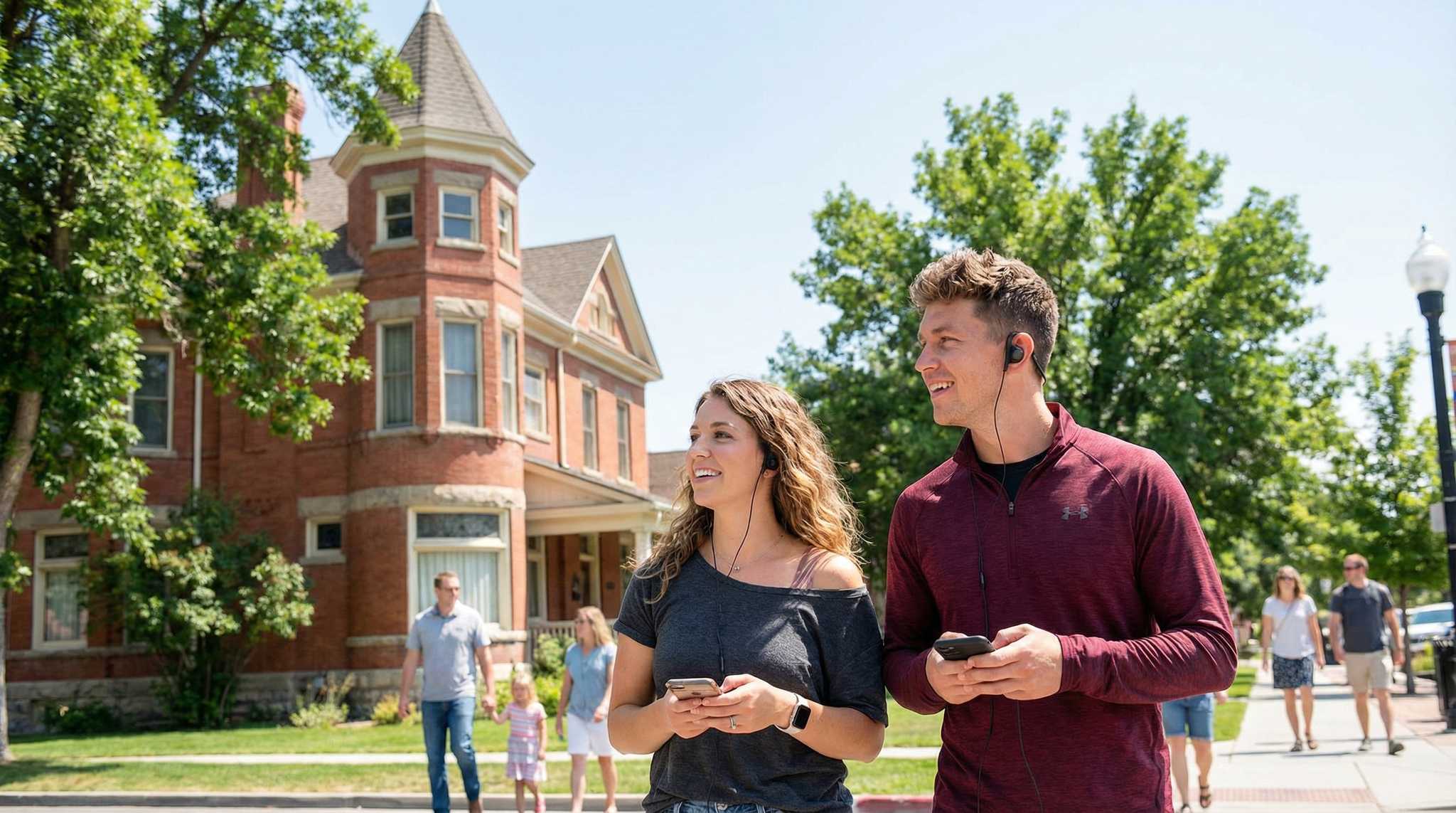
프로보 오디오 투어: 달콤한 이야기와 화려한 저택
프로보의 고요한 스카이라인 아래에는 선구자와 반역자, 행운을 좇는 자와 성인들의 비밀이 반짝입니다. 이 셀프 가이드 오디오 투어는 평범한 도시 거리를 대부분의 방문객이 그냥 지나치는 숨겨진 이야기와 보석을 위한 무대로 바꿉니다. 웅장한 사원, 유서 깊은 회사 타워, 과거에 그림자를 드리운 집들 사이를 거닐어 보세요. 각 정류장은 프로보를 새로운 시각으로 보게 할 것입니다. 프로보 시티 센터 사원에서의 방화 시도가 왜 도시를 혼란에 빠뜨렸을까요? 세상이 알기 전에 뉴스킨 엔터프라이즈 내부에서는 어떤 영업 비밀이 끓어올랐을까요? 그리고 한나 마리아 리비 스미스 하우스의 어떤 잊혀지지 않는 전통이 자정 이후에도 여전히 남아있을까요? 격변과 독창성, 스캔들과 영감을 따라 프로보의 심장을 가로질러 보세요. 모든 모퉁이는 또 다른 장을 드러내며, 도시를 향한 여러분의 감각을 변화시킬 드라마와 흥미로 여정을 채울 것입니다. 프로보의 가장 잘 보존된 이야기를 풀어보세요. 미지의 세계가 바로 앞에 있습니다. 걸어 들어가서 들어보세요.
투어 미리보기
이 투어에 대하여
- schedule소요 시간 40–60 mins나만의 속도로 이동
- straighten4.4 km 도보 경로안내 경로 따라가기
- location_on
- wifi_off오프라인 작동한 번 다운로드, 어디서든 사용
- all_inclusive평생 이용언제든지 다시 재생 가능
- location_on스타트업 캔디 공장에서 시작
이 투어의 정류장
To spot the Startup Candy Factory, look for a large, historic brick building with a tall white smokestack that says “STARTUP” on it, just above the line of parked cars. Alright,…더 보기간략히 보기
To spot the Startup Candy Factory, look for a large, historic brick building with a tall white smokestack that says “STARTUP” on it, just above the line of parked cars. Alright, sweet tooth or not, you’re standing in front of one of Utah’s most delicious chapters of history-the Startup Candy Factory! Picture it: the turn of the 20th century, the air thick with the smell of boiling sugar, the rhythmic clatter of candy-making machines, and maybe even a stray caramel rolling underfoot. This red-brick building isn’t just a treat for your eyes; it’s been filled with the sounds of industry, laughter, and the scent of candies that made folks’ mouths water from blocks away. Our story starts across the ocean in England, where William Daw Startup and his father first dabbled with sweets in their basement-call it an “underground candy club.” William dreamed big, set sail for America with his sweetheart Hagar Hick, and soon after marrying her, bought a home and set up shop in Provo in 1874. Imagine the excitement and nerves: he’s got candy molds, a few London tricks, and plenty of ambition. The Startup family didn’t just want to make candy for Provo; they wanted to make it for all of America-and with one of the nation’s very first candy bars, they really meant it. But life wasn’t always sweet. In 1878, William suffered a tragic accident when a heavy limestone slab meant for cooling candies fell and struck him. He lingered, his family hoping for a miracle, until he passed away 10 days later. It could have been the end for Startup Candy. But not for Hagar! She raised four children and ran the business on her own for ten long years. Imagine her-rolling up her sleeves, stoking the fire, molding sweets, all while little ones tugged at her skirt for a free sample. By the 1890s, the Startup children were grown and ready to turn their family’s name into a legend. George, Harry, and William J. Startup expanded the business across the western states. Their candies became so beloved that this very factory was built in 1900, humming with activity and employing up to 175 workers at its peak. And here’s a “sweet” historical twist-this was the first factory in Utah to hand out profit-sharing bonuses to employees. That means busy hands got rewarded for making the world’s best chocolate-covered honeycomb! Let’s pause and imagine what that might have sounded like inside-workers chatting, the snap of caramel being cracked, perhaps the delighted squeal from a taste test gone right. Sounds like a fun place to work, as long as you didn’t eat all the profits. But every sugar rush comes with a crash. In 1929, just before the Great Depression started, George sold his share, and Harry ended up owning it all-only to lose it to foreclosure when the economy soured. For years, the factory sat like a sleeping giant, echoing with memories of sweetness past. Eventually, Startup was able to buy back part of the building to restart the candy business, while the other half got, well, stuffed…with wool. (Not quite as delicious.) Later, lumber filled the empty spaces, almost replacing candy with cabinets, until the community rallied to save the historic heart of Provo. Over time, the building changed hands and purposes again and again-a bustling event venue, office spaces, and still, a shadowy hint of chocolate in its bones. So now, as you look up at the mismatched windows, the sturdy brick walls, and that bold smokestack, remember: you’re standing where generations of Provo’s dreamers mixed hope, sugar, and a dash of stubbornness to make something unforgettable. And if you listen closely, maybe-just maybe-you’ll hear the whisper of a candy wrapper being opened in the wind.
전용 페이지 열기 →To spot the Johnson-Hansen House, look for a classic, two-story brick home with a steep, shady roof and white trim, tucked behind leafy trees and greenery-it's the handsome house…더 보기간략히 보기
To spot the Johnson-Hansen House, look for a classic, two-story brick home with a steep, shady roof and white trim, tucked behind leafy trees and greenery-it's the handsome house with an inviting covered entryway right in front of you. Now, as you stand here in the cool shade, imagine the sound of wagon wheels crunching along a dirt road, and the scent of fresh brick and timber in the air-because you’re not just in front of an old house, you’re traveling back through 150 years of Provo history. This is no ordinary home; its walls have seen the grit, dreams, and daily life of Utah’s early settlers. The Johnson-Hansen House stands like a time traveler at 485 East 400 South. Cast your eye over its friendly brickwork, its neat white windows, and, if you peek around the corner, you just might glimpse the rough-hewn logs of the old cabin joined to the back. Those logs might look humble, but they’ve seen more action than a squirrel at a nut festival! They’re some of the last remaining proof of what Provo looked like when people were first daring enough to build their lives far from the fort in the 1870s. You see, after settlers moved out from the safety of the stockade, they followed a very specific plan-one dreamed up by a prophet named Joseph Smith, and set into motion by Brigham Young, the big boss of early Utah. The city was platted into perfectly measured squares, each just the right size for a home with a patch of garden out front, so every family could grow something to eat and show off a few flowers (just in case someone important strolled by). Picture those first homesteaders, heading out by foot or horse each morning to their fields beyond town, tending rows of wheat or corn. At night, they’d come home to tidy houses clustered together, safe among neighbors-a bit like those cozy villages you see in storybooks. This was for safety, but also to make sure nobody missed out on the latest gossip or a good laugh at church socials. Now, let’s meet Neils Johnson, the man whose name will forever be tied to these bricks and logs. Born in Denmark in 1848, Neils sailed across the sea and ended up right here in Provo, where he set to work both as a farmer and as the cemetery sexton, caring for the resting places of the town’s dearly departed. He and his wife, Josephine, who hailed from Norway, raised five children here-though heartbreakingly, only two survived into adulthood, a sober reminder of how tough life was back then. The Johnsons' home became the anchor for their family and for generations who followed, even as neighbors came and went. And then, one day, a fellow named Ray Hansen arrived on the scene. Born nearby in Benjamin, Utah, Ray was a pipeline man by day and, more interestingly, a gunsmith in his spare time. If you could look right through these walls, you’d spot the log cabin at the back, where Ray tinkered on his gun repairs for over fifty years! There’s a bit of a mystery here-nobody’s quite sure why Ray decided to haul that cabin to its spot by the brick house, connect it to the “modern” garage, and create this quirky trio of old and new. Maybe he wanted to show off the layers of Provo’s story, or maybe he just liked a good project. Either way, if walls could talk, these ones might be whispering, “You should’ve seen the things we’ve seen…” Today, carefully cared for by Dr. and Mrs. M. Gary Hadfield, the home stands as a testament to all those years-a single-family residence filled with warmth and the echoes of laughter and life gone by. They even spent hours scrubbing away old layers of paint on those old bricks and logs, so you could see them just as Neils Johnson did. The house was officially named a Provo City Historic Landmark in 1995, but if you ask me, it became historic the day its walls first went up and a family called it home. So go ahead, take a deep breath. Imagine farmers trotting past, the clang of tools in that old log shop. There’s real history in these walls. But remember-no peeking in the windows, or the ghosts of Provo’s past might mistake you for just another nosy neighbor!
전용 페이지 열기 →Directly in front of you, you’ll spot Maeser Elementary-a stunning, three-story building made of tan and red brick, with a grand arched entrance right in the middle and rows of…더 보기간략히 보기
Directly in front of you, you’ll spot Maeser Elementary-a stunning, three-story building made of tan and red brick, with a grand arched entrance right in the middle and rows of tall windows marching above. Let me take you back more than a hundred years-a time when Provo was still growing and schoolrooms were more likely to be neighbors’ parlors than anything fancy. Imagine kids in wooly trousers and pinafores rushing along this same path, their feet crunching on gravel as they darted toward the area’s very first big, beautiful school. Built in 1898, Maeser Elementary wasn’t just another brick in the wall-it was the oldest school building in Provo, the pride of the town, and a sign that education here was ready to move up in the world. If these walls could talk, I’m sure they’d complain about all the chalk dust and endless spelling bees! The man it’s named for-Karl G. Maeser-began his journey far from Utah, growing up in Germany. He probably never guessed he’d end up in the wilds of Utah, helping shape the future of a brand new community. Karl and his wife Anna were baptized into the LDS Church in 1855, but getting to Utah wasn’t exactly a hop, skip, and a jump-they ended up making pit stops, serving church missions all along the way. It took them five years to finally arrive in Utah in 1860! And what did Karl do when he arrived? He got to work, operating schools and, eventually, founding Brigham Young Academy, which later became-you guessed it-Brigham Young University. His influence in the community was so strong, some of Utah’s most famous leaders praised his character and leadership as life-changing. Now, let’s look around you for a second. The original schools in Provo were just humble, adobe buildings-basically, mud brick huts that were pretty drafty and certainly didn’t have Wi-Fi. But as Provo blossomed, the community decided kids needed something better. By 1898, the Board of Education gave the green light to build Maeser Elementary, and it was dedicated with none other than Karl Maeser himself in attendance. Designed by Richard C. Watkins-who must’ve been hard to keep up with, since he designed at least three other famous buildings in town-this school was the place where childhood memories were forged, and friendships began over sticky lunches and playground games. Maeser School kept teaching generation after generation until 2002, when its old classrooms finally fell silent. For a while, there was suspense about what would become of this grand old building-some locals called it “the second biggest building controversy in the history of Provo.” But the story didn’t end there! It was soon reborn as Maeser School Apartments, a place where senior citizens now live, laugh, and, quite possibly, regale each other with stories of their own school days. The transformation won awards, too, proving that even old schools can graduate to something greater! There’s something beautiful, isn’t there, about a place that once protected children now sheltering the elderly? Maybe some of those seniors walking the halls today once recited their ABCs right where you’re standing. If you listen closely, you might swear you can still hear the bell ring and the sound of giggling children echoing in these storied halls.
전용 페이지 열기 →
10개 정류장 더 보기정류장 적게 보기expand_moreexpand_less
To spot the Charles E. Loose House, look for a large, yellow-brick Victorian mansion with a swooping shingled roof, tall corner chimneys, and an inviting wraparound veranda…더 보기간략히 보기
To spot the Charles E. Loose House, look for a large, yellow-brick Victorian mansion with a swooping shingled roof, tall corner chimneys, and an inviting wraparound veranda accented by ornate white Eastlake-style woodwork-right across from the lush green lawn. Alright, imagine yourself right here in front of Provo’s own gem, the Charles E. Loose House, like you’ve stepped out of a time machine straight into 1893! Take a breath-maybe you can practically smell the fresh pine on that wraparound porch and feel the heat rising from the yellow bricks on a sunny afternoon. Now, picture the local buzz: a brand-new mansion has just gone up, built for none other than Charles E. Loose-a banker, senator, and, let’s be honest, a pretty fancy fellow who really knew how to make his mark! Just think, you’re standing where Provo’s elite once gathered for garden parties, and maybe even a little gossip on that veranda, while the glimmer of the mining boom was lighting up the whole city. The design here combines the Shingle Style’s cozy curves with Eastlake’s eye for jaw-dropping details. Check out the woodwork on those porch posts-each one’s practically an artwork! The pentagonal fanlight windows up in the gables? Now that’s a house that wants to make sure nobody misses it. But don’t let all this fine architecture fool you-behind these walls was the nerve center of some serious business. You see, Charles E. Loose wasn’t just any banker. He rode the wild wave of the mining rush, right as Provo was changing from a sleepy farming town to an industrial powerhouse. The mining world here, especially in the Tintic District about 30 miles away, was all about striking it rich underneath Utah’s dusty hills. Jesse Knight and his family, some of the other mansion owners nearby, were hauling up silver by the ton, but Charles E. Loose, though he wasn’t Mormon like most leaders here, quickly became the sharpest mind in Provo’s business scene. Loose managed the Grand Central Mining Company, where their silver stock shot up faster than a squirrel chased by a dog! By the turn of the century, his company had built a steel headframe over its mine-a first for the whole area. Just imagine the excitement and the noise of trains, horses, and hopeful miners around town while this new industrial age came to life. Provo’s economy was booming, the streets buzzing with new inventions, and houses like this one springing up like mushrooms after rain. The Loose House is part of a whole club of fancy mansions-each built by someone whose name belonged on the front page and whose wallet could probably have its own zip code. From the William H. Ray House to the Knight-Mangum House, these homes are pure brick-and-mortar proof that Provo was not just a farming town anymore. They mixed high architectural styles-Eastlake, Craftsman, Colonial, even a dash of Moorish flair-building mansions that still dazzle us more than a century later. But you might notice something mysterious about this house’s story. Though it was nominated for the National Register of Historic Places in 1982-like many of its prestigious neighbors-this house didn’t make the final cut at the time because the owner objected! A twist worthy of a soap opera. It took until 1995 for the city to officially make it a Provo landmark, ensuring its story would stick around for the next generation of curious wanderers… like you! So as you gaze up at those fan-shaped windows and ornate porch, think of Provo’s roaring transformation-of fortunes made, parties thrown, and perhaps a few secret hopes whispered beneath the shingle roof. And hey, if you listen closely, you might just hear the distant echo of clinking silver coins-or maybe that’s just the sound of your own adventurous spirit!
전용 페이지 열기 →To spot the Knight-Mangum House, look ahead for a grand, old English Tudor-style mansion with steep gable roofs, half-timbered upper stories in creamy stucco, large bay windows,…더 보기간략히 보기
To spot the Knight-Mangum House, look ahead for a grand, old English Tudor-style mansion with steep gable roofs, half-timbered upper stories in creamy stucco, large bay windows, and a porch that wraps around the corner, partially hidden behind leafy trees. Welcome to the legendary Knight-Mangum House, where Provo history is written right into the bricks and beams! Take a deep breath-the leafy shade here makes the air feel almost like turning the pages of a mysterious, charming old novel. Close your eyes for a second and picture 1908: the clang of hammers, the shouts of skilled builders-the Alexandis Brothers-pausing to wipe sweat from their brows as they erect what would become one of the city's grandest homes. This two-and-a-half-story mansion isn’t just a house; it’s a time capsule built from the victories of the Tintic mining era, with every steep roof, cozy nook, and decorative rafter whispering stories of ambition, luck, and the American West. The home’s heart beats with that classic English Tudor charm-picture those cross-gables, gable dormers, a flat-roofed porch perfect for a summertime lemonade, and all around you, chunky clinker bricks giving it a feeling of rooted strength. On the upper floors, the decorative stick work traces patterns like the edges of an elegant old lace collar, while the tall windows grouped in quirky arrangements once peered out on passing carriages and stylish townsfolk. Now, I hope you didn’t bring your horse and buggy, but imagine a time when Mr. W. Lester Mangum and his wife, Jennie Knight Mangum, sauntered up those very steps you see, perhaps in their Sunday best, no less proud than a pair of haberdashers showing off their finest hats. Jennie was the daughter of Jesse Knight, the mining legend himself-a man whose humbug mine in the wild-flung hills of Tintic turned silver dreams into dollar signs. The Mangums snagged the lot for $3,500, and thanks to selling their Tintic mining shares bought for twenty cents each (and selling them at eight dollars a pop!), they plunked down another $40,000 to raise this splendid home. Talk about ROI! If only my piggy bank would perform half as well. But these walls aren’t just about money and mansions-they’re about a boom that reshaped Provo. The Knighthood of Jesse Knight-let’s call it that-made Knightsville, a mining camp so upright that you’d be hard pressed to buy a beer or spot a saloon. Instead, the church steeples and Sunday picnics set the tone, while the Knight family spun their wealth into power plants, sugar companies, woolen mills, and even ranches sprawling into new parts of Utah and South America. Provo’s “mansion row” was their glittering playground, each Victorian home showing off a different architectural hat-Eastlake, Moorish, Colonial, Shingle, and here, the dignified Arts and Crafts elegance of the Knight-Mangum House. W. Lester Mangum, for his part, was not just a man with deep pockets-he taught English at Brigham Young University, married the mining magnate’s daughter, leapt into family businesses, and managed sprawling land deals that reached as far south as the equator. He and Jennie, besides filling these grand rooms with gatherings and laughter, dedicated themselves to their church and community. As decades rolled past, the house saw new dreams and dramas. After Mr. Mangum passed in 1949, the house was chopped up into eleven apartments by Paul Salisbury of Salt Lake City. Imagine it-children’s voices echoing down the halls, the ringing of dinner bells from kitchens shoehorned into drawing rooms. Then, in 1969, came Milo Baughman, a big deal in American furniture design, who snapped up the place and gave the old manor a dash of modern flair. Today, the old carriage house next door boasts new lives as apartments too. Yet, even now, the Massey of windows, sturdy brick, and woodwork hold the memory of a golden era-a time when Provo’s finest gathered under chandeliers, talk of silver fortunes hung in the air, and you might hear the click of a lady’s heel as she slips out onto the porch to watch the sunset. Take one last look up at that high, pointy roof-the same one that has faced more than a century of Utah storms and sunshine-and tip your imaginary hat to the Mangums, the Knights, and all the dreamers who turned ore and opportunity into something truly timeless. For further insights on the description, the victorian mansions of provo or the jesse knight and the tintic mining industry, feel free to navigate to the chat section below and inquire.
전용 페이지 열기 →To spot the Hannah Maria Libby Smith House, just look straight ahead for a charming one-story orange brick home with crisp white trim around its tall windows and a cozy porch…더 보기간략히 보기
To spot the Hannah Maria Libby Smith House, just look straight ahead for a charming one-story orange brick home with crisp white trim around its tall windows and a cozy porch right up front. Ready for a tale as sturdy as these old bricks? Imagine you’re standing here in 1878, the scent of wood smoke on the air and wagon wheels creaking down Center Street. This house was being built by Charles Warren Smith for his mother, Hannah Maria Libby Smith, a woman tough enough to herd cattle, cook, care for children, and cross the wild plains of America-sometimes all on the same day. Now, Hannah wasn’t just anybody-she was married to George A. Smith, an important LDS Church apostle, and she traveled west with pioneers, braving freezing winters and prairie storms in covered wagons. Her story reads like a frontier novel: in Winter Quarters, Iowa, Hannah’s sister Sarah Ann was sick with tuberculosis, so Hannah did what any heroic little sister would do-drove the cattle, tended kids, and cooked meals, all while sharing a packed wagon with her sister and her sister’s child. When Sarah passed away, Hannah took in her two-year-old nephew John Henry Smith, raising him as one of her own. When Hannah and her family settled here in Provo, this was a young, bustling city surrounded by towering mountains. She and her allies-her sister-wife Lucy-were master crafters, weaving carpets for the Provo Tabernacle so seamlessly that nobody could tell where one woman’s work stopped and the other’s began. Talk about teamwork. As you look at the house, notice the original orange brick walls, built on a solid rubble rock foundation, and those eye-catching windows-unusually big six-over-six panes. They’re topped with federal-style lintels and brackets, adding just a dash of East Coast flair. If you listen closely, you might almost hear the creak of those gorgeous, sanded hardwood floors inside, or the clink of china being set in a cupboard rediscovered during a 2006 restoration. In its earliest days, just four sturdy rooms formed the core of this house. Over time, two more rooms and a wooden corridor reached toward the Granary out back. Before harvest, the Glass-roofed Granary was a summer kitchen, bustling with the sounds of cooking and laughter-though a word to the wise: that back door is so high off the ground, it hasn’t seen a delivery in 75 years! Generations of strong women shaped the pulse of this home. Hannah raised five children and cared for her disabled nephew-one grandchild, President George Albert Smith, would eventually become the head of the entire LDS Church. After Hannah passed away in 1906, her youngest daughter Grace moved in, cared for her parents and her disabled sister Tirzah, ran the household, led church youth programs, and worked as an executive secretary-let’s just say she put the “grace” in her name. For almost 150 years, the house was handed down from mother to daughter, each woman adding her own chapter: from Grace and Tirzah (the dynamic duo of hospitality and resilience) to Arnel Milner, who loved this house so much he wanted it preserved as a creative haven for local women. Later, Beth Milner Raynes, and finally Marybeth-who restored every cornice and chandelier with painstaking care. Today, classes in needlework, crafts, and homemaking continue on these grounds, echoing back to Hannah’s days. The house is still a heartbeat in Provo’s story. So as you stand here, see if you can feel the energy of past generations-busy footsteps, voices laughing while weaving, children running around the porch, and maybe even a tired pioneer dropping into one of those famously high-ceilinged rooms after a hard day wrangling cattle or running the house. This isn’t just a place with pretty brickwork; it’s a living memory of the women of Provo, and every bit as tough, clever, and warm as the family that built it.
전용 페이지 열기 →To spot the John R. Twelves House, just look for the striking light-gray Victorian mansion with elegant arched windows and a large, white marble statue of Jesus standing on the…더 보기간략히 보기
To spot the John R. Twelves House, just look for the striking light-gray Victorian mansion with elegant arched windows and a large, white marble statue of Jesus standing on the front lawn, welcoming you right from the sidewalk. Now, take a deep breath and let your eyes wander around this magnificent mansion. Imagine it’s 1906, and Provo is filled with the scent of new construction and the quiet hum of horse-drawn carriages. Standing before you, the John R. Twelves House rises with all the pride, fashion, and fortune of Utah’s gilded age. This is no ordinary home-every brick and window here whispers about the dreams and ambitions of its owner and its era. John R. Twelves, the mastermind behind this place, was more than just a man with an almost comically perfect last name for Provo’s lucky number of Victorian mansions-he was a central character in the story of Utah’s mining boom. As secretary-treasurer of the Grand Central Mining Company, Twelves rode the silver rush all the way to the bank. Rumor has it, in his day, if he sneezed, you could probably hear the clink of coins, not just the rustle of handkerchiefs! This house is a living catalogue of late Victorian tastes: take in those ornate leaded and stained-glass windows glinting in the sunlight and the carefully crafted stone arches above the porch. Unlike the tall, vertical Victorian mansions up in Salt Lake City, Provo’s wealthy built these homes with a different philosophy. Instead of reaching for the sky, these mansions hug the earth, stylishly squat and solid, elegant but never ostentatious. The materials speak, too-look at all that brilliant, sturdy brickwork. If you think Provo’s architects weren’t flexing some creative muscle, just try counting the architectural styles blended here, from Colonial Revival touches to a playful splash of Romanesque and Shingle details. This isn’t just a beautiful building. Starting in 1911, the house got a new resident, and not just anyone-George H. Brimhall, then the president of Brigham Young University, called this place home. Imagine nervous students and professors visiting to talk grades or university gossip, the door creaking open, perhaps an owl-eyed portrait of John R. Twelves peering down approvingly from inside as they entered. Let’s fast forward a bit, roll out the red carpet, and you’ll find the next act as dramatic as any Hollywood story. Since 2005, the house became home to Richard Dutcher’s Main Street Movie Company, turning this stately old manor into a hive of film scripts, clapperboards, and movie magic. And if you’re wondering about the giant marble statue of Jesus out front-no, it’s not a heavenly delivery gone astray! It’s a film prop with a starring role in Dutcher’s movie “Falling.” That statue’s probably seen more action and drama in a decade than most front lawns will in a century. But when you stand here, you’re not just near one house-you’re among the “Seven Sisters” of Provo’s Victorian era. These grand homes, like the Jesse Knight House, the Knight-Mangum House, and this beauty before you, were built as fortunes from the Tintic Mining District and other booming enterprises poured into Provo. Jesse Knight himself made sure his mines followed strict rules: no saloons, no loose living, just plenty of wealth and good clean living-sort of like the world’s strictest Monopoly game. This group of homes became a symbol of rising fortunes as Utah shifted from farms to factories. In 1982, the John R. Twelves House got a fresh badge of honor, making it onto the National Register of Historic Places-meaning its stories aren’t going anywhere, and neither is that marble statue (sorry, squirrels). As you stand here and gaze at the arched windows, imagine echoes of laughter, the soft shuffle of silk dresses, murmurs of business deals, and the distant clatter of typewriters-an eternal reminder of the vibrant past holding hands with today. So the next time you pass by, maybe tip an imaginary hat to Mr. Twelves, President Brimhall, or the occasional movie hero-and remember, you’ve just stepped onto the set of a real-life, ever-unfolding drama in the heart of Provo.
전용 페이지 열기 →You’re standing right in front of a modern, gleaming building of glass and steel; to spot Nu Skin Enterprises, just look for the large reflective windows, sleek lines, and the…더 보기간략히 보기
You’re standing right in front of a modern, gleaming building of glass and steel; to spot Nu Skin Enterprises, just look for the large reflective windows, sleek lines, and the striking silver sculpture near the front steps. Alright, time for a little adventure! Imagine for a moment it’s 1984. The world isn’t exactly bustling with superfoods or fancy anti-aging gadgets-back then, skin care usually involved a washcloth and wishing for the best! But from this very place in Provo, three dreamers-Blake Roney, Sandie Tillotson, and Steven J. Lund-decided to turn the beauty industry on its head with a simple promise: “all of the good, none of the bad.” That meant natural ingredients, no weird fillers, and products people could actually trust on their faces! As you stand here, picture the journey these founders set in motion. In the beginning, their products served only the United States, but soon, their ambitions grew as fast as a sprouting cactus. Canada caught the vibe in 1990, and then, just one year later, the bright lights of Hong Kong marked Nu Skin’s first Asian home. Before long, the company hit the global stage. Now, more than 1.2 million independent distributors-from Anchorage to Auckland-share their glowing skin secrets in 54 markets! By 1996, Nu Skin scaled another summit-they went public on the New York Stock Exchange. Imagine the excitement: ringing that bell, the hum of traders beneath bright ticker screens-not your average day at the spa! Oh, but it hasn’t been all rose petals and cucumber slices. The company has weathered more than a few storms. In the early ‘90s, other states challenged Nu Skin over their advertiser’s creative claims and not-totally-accurate distributor earnings promises. Nu Skin settled those disputes, changed their tune on advertising, and paid a few hefty fines-nothing like a little courtroom drama to keep your brand in the headlines, right? And then, they kicked things up a notch, bringing Pharmanex-a vitamin and supplement company-into their family in 1998. This is when science took center stage. Nu Skin created a BioPhotonic Scanner, a zappy-sounding device that actually measures the carotenoids in your skin. (That’s code for, “Do you eat enough carrots?”) Some critics said it was more about selling supplements than measuring health, but for customers, it was like something out of Star Trek! Nu Skin even dabbled in the heady world of dot-com mania, launching Big Planet, a bold effort to sell internet technology the old-fashioned way-neighbor by neighbor. The catch? Some folks selling it didn’t even own a computer! Rumor has it, the best sales pitch was, “Trust me, it’s good-don’t ask me how it works!” Let’s turn the page to the 21st century, when Nu Skin doubled down on the science game. They collaborated with LifeGen Technologies to learn the secrets of human genetics for anti-aging goodness. Eventually, Nu Skin acquired this Wisconsin-based company, letting them flex their science muscles with ageLOC products-a line that promises to make time just a little less cruel. By the 2010s, Nu Skin drew global headlines again, settling legal claims about sales practices overseas and even landing on Forbes’ list of “100 Most Trustworthy Companies.” They’ve launched gadgets that sound like they belong in a sci-fi movie: the ageLOC LumiSpa for deep facial cleaning, and the RenuSpa iO, which could make your living room feel like a futuristic day spa. They’re constantly inventing: smart skincare devices, connected apps, and a supplement called MYND360 designed to keep your brain as sharp as your cheekbones. For all the glamour above ground, though, there’s been tension behind the scenes. Class action lawsuits, government fines, and even an appearance on Last Week Tonight with John Oliver-nothing like a little tough love from late-night TV! At one point, 93% of their distributors didn’t earn a commission check in a typical month-but Nu Skin still claims they pay over 40% of product revenue back in compensation. Today, as you stand within sight of that bold glass facade reflecting the Utah sky, Nu Skin has gone through controversies, comebacks, and clever comebacks (and yes, even some very shiny lawsuits). Still, it’s a place of invention, ambition, and let’s face it-a little bit of showbiz glitz. In 2025, they even scored a spot on USA Today’s “best customer service” list, proving that if nothing else, they know how to keep people talking-and glowing. So take a deep breath, admire the shimmering glass, and remember: in Provo, even a skincare company can have a story worth telling!
전용 페이지 열기 →Look straight ahead for a grand red-brick building with a tall white steeple, four blue-topped corner towers, and arched, stained-glass windows-if you see a golden statue way up…더 보기간략히 보기
Look straight ahead for a grand red-brick building with a tall white steeple, four blue-topped corner towers, and arched, stained-glass windows-if you see a golden statue way up high, you’ve found the Provo City Center Temple! Alright, fancy a story with fire, mystery, and a little bit of magic? Let’s dive in, right here where you’re standing on the very ground that has held Provo’s heart for over 150 years. This place wasn’t always so peaceful; picture a bustling 19th-century town with townsfolk hurrying to events at the old Provo Tabernacle, laughter floating out the doors, and the echo of music and sermons in the air. People gathered inside for everything you can imagine-graduations, concerts featuring world musicians, even a visit from President Taft! The tabernacle became a friend to the community, always welcoming, always full of life. But one winter night in 2010, disaster struck. The beautiful old tabernacle, a building loved by all, was swallowed by fire. You can almost hear the crack and roar of flames as smoke billowed up and onlookers gasped in disbelief. Yet, as the smoke cleared and sun rose, the charred shell stood tall, defiant, and for a time people feared Provo had lost a piece of its soul forever. But-here’s where the magic kicks in-sometimes, from ashes, something even greater is born. In 2011, hope returned as the president of the LDS Church, Thomas S. Monson, stood before the world and announced that where the Tabernacle once stood, a new temple would rise. The crowd erupted in joy! People from all over came to watch the transformation, even the folks at Brigham Young University got involved by digging up the old meetinghouse beneath your feet. They unearthed a hidden world: stone foundations, forgotten relics, pieces of days long gone-like Provo’s very own archaeological treasure hunt. When construction began, it wasn’t easy. Imagine the old brick walls carefully balanced up on stilts-yes, actual stilts!-while workers scooped out earth to create brand new basements below. It was a balancing act worthy of a circus (minus the clowns, unless you count nervous engineers!). Through it all, architects and designers studied every detail, bringing Victorian charm back to life. Every arch, every window told a story-they even managed to reuse stained glass from the first tabernacle, so if you look close, you might spot glass that witnessed Provo’s pioneers. The finished temple is a true showstopper. Look up: those striking blue spires and arched glass windows shimmer in the sunlight, and the golden angel Moroni on top catches your eye, shining like a beacon. Inside, the grandeur doesn’t stop-rich walnut and mahogany, floral designs inspired by the lotus flower (a worldwide symbol of purity and rebirth), and a stained-glass portrait of Christ from New York, all come together to remind everyone that this place is about new beginnings. But it’s not just stone and stained glass. The grounds are built for serenity and celebration, with peaceful gardens and a pavilion housing a replica of the Christus statue-a favorite spot for nervous wedding parties. Every detail, down to the flowerbeds, was chosen so people who visit feel both inspired and at home. When the temple was finished, over 800,000 visitors streamed through its doors during the open house. It was finally dedicated in 2016. You can almost imagine the excitement buzzing in the air as local kids danced and sang during a special cultural celebration, sharing tales of pioneers, patriotism, and Provo’s own journey through hardship to hope. Today, the Provo City Center Temple stands as a living symbol of spiritual and literal renewal-a place where the past and present blend, and where a community’s dreams rose from the ashes to touch the sky. And if you listen closely, maybe you’ll hear echoes of all those people who, for generations, gathered right here, drawn by the belief that something truly special could be built, even out of heartbreak. To expand your understanding of the design and architecture, cultural and community impact or the temple presidents, feel free to engage with me in the chat section below.
전용 페이지 열기 →To spot the Provo Downtown Historic District, look for the row of beautiful old brick buildings with charming storefronts and a mix of classic architectural styles, right along…더 보기간략히 보기
To spot the Provo Downtown Historic District, look for the row of beautiful old brick buildings with charming storefronts and a mix of classic architectural styles, right along the tree-lined Center Street - just follow the shade and you can’t miss it! Alright, picture this: it’s the late 1840s, and this spot was nothing but open land-and possibly a few confused cows wondering who ordered all these pioneers. In 1849, a determined group of about 150 settlers rolled in, sent by Brigham Young himself, tasked with building a new community. Can you imagine? There’s nothing here but sagebrush, mountain views, and the endless possibility of what could be. The early years were a whirlwind. The town plot was drawn up, one square mile neatly sectioned and ready for action. Now, Brigham Young was no slouch when it came to motivation: he told the settlers to gather their homes and businesses close, plant both their feet and their dreams on Center Street. And, just to prod things along, George Albert Smith, a church leader with a knack for city-building, set up shop in Provo, inspiring others to follow. At first, most business was personal-literally. Andrew J. Stewart, Provo’s first merchant, ran his store right out of his home, probably tripping over barrels of flour and customers alike. But by 1852, this little outpost was starting to hum: you’d smell bread from two grist mills, hear the rhythmic clatter from three cabinet shops, catch the buzz of the pottery, the clang of the blacksmith, the shuffle of two hotels, and-of course-the chaos of early shoe shops. By the looks of things, nobody had any excuse for walking barefoot! Things got tricky in the 1860s. Utah’s merchants were making a tidy profit, while farmers-well, they were still wondering if their cows would ever chip in for rent. That’s when Brigham Young, playing both town mayor and financial advisor, told everyone to stop paying those sky-high prices and start trading together. Enter the Provo West Co-op, the first cooperative store, set up in the very building where Stewart started his little operation. Talk about full-circle. Fast forward to the building boom. In the late 1860s, the place exploded with new construction-Center Street started filling up with wooden and adobe buildings. The town sprouted brickyards, a foundry, and even a kiln or two. And if you’ve ever wondered how Provo got so many sturdy walls, you can thank the Liddiard Brothers for their cement and E.J. Ward and Sons for lumber-not to mention the Taylor family for their furniture, which was likely as hard to assemble as today’s flat-pack desks. But here’s where things really get shiny: the Tintic Mining District. About thirty miles away, miners struck it rich with precious metals like they were unearthing chocolate coins. That wealth transformed Provo from a farming town to a lively commercial center. Jesse Knight became a local legend after discovering the Humbug mine, and he poured his fortune into making Provo a proper city. Knight’s success also attracted other entrepreneurs, leading to the rise of buildings like the Knight Block and the Loose Block-each as fancy as their names sound. Thanks to all this boom, Provo was soon buzzing nonstop. In 1883, locals started building a brand-new LDS Tabernacle. A chamber of commerce popped up in 1887. The infamous Rocky Mountain Bell was stringing up phone lines by 1889, and Provo Lake Resort invited families to splash around in Utah Lake. Today, as you stand right here, you’re in the heart of what those pioneers dreamed up-four blocks of Center Street, plus some of University Avenue, alive with history and the echoes of more than 40 historic buildings. Each brick and storefront isn’t just architecture-it’s the sound of hammers, laughter, and maybe a complaint or two about shoe prices. Listed on the National Register of Historic Places in 1980, Provo Downtown Historic District is a living memory, a storybook made of brick and mortar-where every stroll down the street is a stroll through time. So, take a good look and imagine the bustling, dusty, slightly chaotic center of a young city on the rise. Who knows? Maybe you’ll catch the echo of a miner’s laughter or the friendly shout of a shopkeeper, right where you stand.
전용 페이지 열기 →To spot Velour Live Music Gallery, look for the building with a green shingled awning, a wooden sign overhead that says "VELOUR," and a string of glowing lights above its cozy…더 보기간략히 보기
To spot Velour Live Music Gallery, look for the building with a green shingled awning, a wooden sign overhead that says "VELOUR," and a string of glowing lights above its cozy entrance with a bench out front. Now, straight ahead, you’re standing at the doorstep of one of Provo’s quirkiest hidden gems-Velour Live Music Gallery! From the outside, it almost feels like you’ve stumbled onto a moody little movie set: twinkling bulbs framing the doorway, heavy curtains in the window, and a sign above with vintage flair that hints at the magic hiding inside. Don’t let its pint-sized, unassuming façade fool you-Velour is the stage where legends are born and local dreams come to life! Take a deep breath and imagine what it’s like on a show night here. The buzz of excitement fills the air as a crowd of all ages gathers, waiting for the curtains to part and the first riff of music to shatter the quiet. This place is the heart of Provo’s live music scene-it’s intimate, inviting, and, thanks to its owner Corey Fox, always smoke and alcohol free. Nobody leaves with a hangover, unless you count a musical one. You know the bands Neon Trees and Imagine Dragons? Yep, they played right here before they rocked stadiums around the globe. In fact, Neon Trees call this their “home venue,” and Imagine Dragons won the legendary Velour Battle of the Bands. Think about that: before all the bright lights and Grammy speeches, their sound echoed off these old walls. Indie folk artist Joshua James, electropop star Lindsey Stirling, and even Sara Bareilles have performed under the warm glow of Velour’s spotlights too. And every year, the wild creative energy of the FilmQuest film festival spills through those doors, cranking up the thrill. Velour has racked up awards like “Best Live Music Venue” and “Best Musical Ambiance,” often described by locals (and Spin Magazine) as one of Utah’s greatest secrets. So while it looks like a charming little oddity from the street, you’re looking at the launchpad for musical legends-a place where the next big thing could be tuning up, just on the other side of that door.
전용 페이지 열기 →To spot the Harvey H. Cluff House, just look ahead for a handsome red-brick home with white, lacy trim and bay windows, standing slightly behind some tall, shady trees at the edge…더 보기간략히 보기
To spot the Harvey H. Cluff House, just look ahead for a handsome red-brick home with white, lacy trim and bay windows, standing slightly behind some tall, shady trees at the edge of a green yard-almost like it’s playing peekaboo from the 1800s. Welcome to the Harvey H. Cluff House! Imagine yourself standing here back in 1877, when Provo was mostly dirt roads, horse-drawn wagons, and everyone knew your name-especially if your name was Harvey Cluff. This house was built by a good friend of Harvey’s, architect John Watkins, and it was meant to impress. See those white wooden decorations along the roof line? They’re called bargeboards-think of them as Victorian house jewelry! And those steep roofs with the dormer windows almost make the house look ready to host a rooftop tea party or maybe shelter a family of roof-loving raccoons. This isn’t just any old architecture. The style is a blend of Greek Revival elegance-notice the “temple” shape-and Gothic Revival touches: the pointy bits, carved wooden details, and those big bay windows poking out like they’re eager to watch the world go by. Only about six homes in all of Utah were built in this fanciful style, so you’re looking at a pretty rare piece of the state’s puzzle! Now, if you listen closely (or just use your imagination), you might hear echoes from when Harvey Cluff lived here. Born in Ohio in 1836, young Harvey and his family crossed miles of wild country to settle in Provo. By the 1850s, the Cluffs had opened a furniture factory-Harvey could probably carve a chair leg with his eyes closed! He soon became a builder of landmarks, overseeing the creation of the Provo Tabernacle and BYU’s Academy Building. Quite the resume, right? But Harvey didn’t stop at bricks and mortar. He ran the city newspaper, guided a bank, managed a foundry, and served as basically every kind of community leader you could dream up: city councilman, bishop, even a mission president in the far-off Sandwich Islands. I bet he barely had time to mow the lawn. Even as life swirled with political debates, church meetings, and big city changes, the Cluff House stood steady. After Harvey moved to Salt Lake City, the house was sold to W. Ray Ashworth, who kept it neat and humming with family life for decades more. At one point, you might have seen neighbors gathered on the porch, gossiping quietly or waving as the mailman walked past. In 1982, the Harvey H. Cluff House earned its spot on the National Register of Historic Places, which means it’s officially recognized as a local treasure. So, while you stand under these shady branches outside its door, just imagine all the stories-of ambition, family, adventure, and daily life-that these walls have soaked up for over 140 years. If these bricks could talk, I have a feeling you’d never get them to hush!
전용 페이지 열기 →To spot the Dr. Samuel H. Allen House and Carriage House, look straight ahead for a massive, gray-blue Victorian mansion peeking out from behind thick greenery, with tall, pointed…더 보기간략히 보기
To spot the Dr. Samuel H. Allen House and Carriage House, look straight ahead for a massive, gray-blue Victorian mansion peeking out from behind thick greenery, with tall, pointed roofs and an inviting, classically detailed white porch. Now, stop for a second and imagine you’ve stepped back into Provo’s golden age of grand mansions and bigger-than-life stories. Right in front of you stands one of the city’s oldest “gentle giants”-the Dr. Samuel H. Allen House. Picture yourself here in the late 1800s, where the air might’ve buzzed with the clicking of horse hooves and the distant laughter of families heading to town. If these towering gables could talk, oh, the tales they’d spill! So, let’s open this house’s own storybook. It all started in 1892, when Dr. Samuel H. Allen decided to put down roots in Provo. He wanted a home as impressive as his career. Dr. Allen didn’t just heal the sick-he also made sure his house would heal the soul, too, with beautiful local stone, a sprawling porch with intricate brackets turning every sunset into a stage show, and classic columns worthy of a Greek hero. And just over there, behind heavy trees, hides a carriage house said to be one of the biggest in all of Provo-so if you hear ghostly hoofbeats at night, you know why! Now, the Allen house wasn’t just a place for family dinners and late-night cocoa. For a few years, patients crept nervously up those front steps, hoping Dr. Allen could work some medical magic. It wouldn’t have been out of place to see a neighbor hobbling in with a twisted ankle or children hiding behind their mothers’ skirts. Eventually, Dr. Allen moved his practice to the bustling Knight Block, passing along his home to a man who knew a thing or two about big decisions-Samuel R. Thurman. Thurman, by the way, is a name packed with political plot twists. He’d been the mayor over in Lehi before joining the Utah House of Representatives-at the youngest age ever. Around here, he was known as a man who never slept-maybe because his house was so big he kept getting lost! He played a role in the Utah Constitutional Convention, shaped local parties, and later even served on the Utah Supreme Court. The man could argue the finer points of law all morning, then sip tea on this porch by evening, surrounded by whispering trees. But wait-turn the page again, and you'll find yourself in the middle of a family soap opera! The next resident, John W. Taylor, had a complicated personal life. He set up his third wife, Nellie Eva Todd, right here; meanwhile, wife number two lived just down the street. Taylor ran four farms, probably to keep everyone happy and well-fed, but life in those days was anything but a fairy tale. In 1915, John W. Taylor suffered a heavy blow-he was excommunicated from the LDS Church. That shadow hung over him, and financial troubles forced him to sell the mansion. A new doctor, David Westwood, moved in next. With him, the house became a beacon for Provo’s health-he was vice-president of the city’s very first hospital, bringing both medical miracles and the occasional nervous patient up the steps. Later, his son, a dentist, made sure there was never a shortage of toothy smiles inside these walls. But then-imagine it silent. In the 1940s, the Westwoods left, and the house stood lonely and ghostly for years. No one knows if the wind or the memories howled louder during those nights... But have no fear! In 1952, the Paxman family, with seven kids, filled the old mansion with laughter, music, and midnight fridge raids. The home stayed in the family for decades-becoming, you could say, the heartbeat of a whole neighborhood. Today, with grandkids and a new generation of caretakers, this mansion is more than just Provo’s prettiest face. It's a living landmark-recognized since 1995, and along with its mighty carriage house, it keeps watch over the city’s secrets and proudest moments. So take a look around: you’re not just seeing history, you’re standing in it. And if you listen closely, you might just hear echoes of medicine bottles clinking, gavel knocks, love letters, and the kind of laughter that can only come from a truly extraordinary home.
전용 페이지 열기 →
자주 묻는 질문
투어는 어떻게 시작하나요?
구매 후 AudaTours 앱을 다운로드하고 교환 코드를 입력하세요. 투어를 바로 시작할 수 있습니다 - 재생을 탭하고 GPS 안내 경로를 따라가시면 됩니다.
투어 중 인터넷이 필요한가요?
아닙니다! 시작 전에 투어를 다운로드하면 완전히 오프라인으로 즐길 수 있습니다. 채팅 기능만 인터넷이 필요합니다. 모바일 데이터 절약을 위해 WiFi에서 다운로드하시는 것을 권장합니다.
이것은 가이드가 안내하는 단체 투어인가요?
아닙니다 - 이것은 셀프 가이드 오디오 투어입니다. 폰을 통해 오디오 나레이션을 들으며 나만의 속도로 독립적으로 탐험합니다. 투어 가이드도, 단체도, 일정도 없습니다.
투어는 얼마나 걸리나요?
대부분의 투어는 60-90분이 소요되지만, 속도는 전적으로 본인이 조절합니다. 원할 때 언제든지 일시정지하거나, 정류장을 건너뛰거나, 휴식을 취하세요.
오늘 투어를 끝낼 수 없으면 어떻게 하나요?
괜찮습니다! 투어는 평생 이용이 가능합니다. 원할 때 언제든지 일시정지하고 다시 시작하세요 - 내일, 다음 주, 또는 내년에도. 진행 상황이 저장됩니다.
어떤 언어를 이용할 수 있나요?
모든 투어는 50개 이상의 언어로 이용 가능합니다. 코드를 교환할 때 원하는 언어를 선택하세요. 참고: 투어 생성 후에는 언어를 변경할 수 없습니다.
구매 후 투어는 어디에서 이용하나요?
App Store 또는 Google Play에서 무료 AudaTours 앱을 다운로드하세요. 교환 코드(이메일로 전송됨)를 입력하면 라이브러리에 투어가 나타나며, 다운로드하여 시작할 수 있습니다.
투어가 마음에 들지 않으시면 환불해 드립니다. 문의: [email protected]
안전한 결제 


