
헐 오디오 투어: 선박, 거리, 그리고 해양 대도시의 이야기
헐 구시가지의 돔과 웅장한 외관 아래에는 반항적인 오르간 콘서트가 도시를 뒤흔들고, 미술품 컬렉션이 밤의 장막 아래 사라지며, 고래잡이들이 등불 아래 고래 뼈에 숨겨진 이야기를 새겨 넣었던 비밀스러운 세계가 숨겨져 있습니다. 셀프 가이드 오디오 투어를 통해 이 신성한 거리를 거닐며, 대부분의 방문객이 결코 들을 수 없는 예상치 못한 이야기와 간과된 순간들을 발견해 보세요. 제2차 세계 대전 중 어떤 비극이 연기 구름 속에서 왕족을 헐 시청으로 급히 달려가게 했을까요? 페렌스 미술관에서 방문객을 따라다니는 신비로운 여인은 누구이며, 감히 누구든 그녀의 정체를 밝히도록 도전하는 걸까요? 해양 박물관이 대대적인 개조를 하기 전에 수천 점의 유물들이 왜 귀중한 밀수품처럼 급히 옮겨졌을까요? 시간을 거닐며 음악, 스캔들, 회복력, 그리고 잃어버린 걸작들이 당신을 광장에서 광장으로 이끌게 하세요. 돌에 새겨진 드라마와 모든 벽에 엮인 속삭임을 풀어보세요. 헐의 겹겹이 쌓인 역사를 한 걸음 한 걸음 벗겨내며, 극소수만이 경험하는 헐을 발견하세요. 헐의 자랑스러운 돔 아래 숨겨진 비밀을 풀 준비가 되셨나요? 이야기는 여기서 시작됩니다.
투어 미리보기
이 투어에 대하여
- schedule소요 시간 40–60 mins나만의 속도로 이동
- straighten4.5 km 도보 경로안내 경로 따라가기
- location_on
- wifi_off오프라인 작동한 번 다운로드, 어디서든 사용
- all_inclusive평생 이용언제든지 다시 재생 가능
- location_on헐 시청에서 시작
이 투어의 정류장
To spot Hull City Hall, just look across Queen Victoria Square for a grand sandstone building with a huge green dome rising above its entrance and a set of tall white columns at…더 보기간략히 보기
To spot Hull City Hall, just look across Queen Victoria Square for a grand sandstone building with a huge green dome rising above its entrance and a set of tall white columns at the front. Now, take a moment right here in front of Hull City Hall, and let your imagination whisk you back to the early 1900s. The square hums with the sound of clattering horse carriages and laughter as crowds gather to admire the sparkling new building, designed by Joseph Hirst in a bold and cheerful Baroque Revival style. He must have loved his domes, because this one is impossible to miss-a giant green crown right in the heart of Hull, making sure no one ever gets lost in the city centre. But, believe it or not, City Hall never actually ran the city! Need to pay your council tax? That was always the job of the Guildhall down the road. This place was all about big events and good times-concerts and graduations, not paperwork and politics. Imagine yourself in 1911; you might hear the thunderous organ shaking the walls, as composer Edwin Lemare plays Hull's first notes on its mighty pipes. Of course, there’s a twist: City Hall once had its own art gallery, but all the paintings packed up and moved to Ferens Art Gallery in 1927, leaving space for a mysterious collection of ancient relics-Mortimer’s treasures! Archaeology fans flocked in, jaws dropping at the prehistoric wonders on display. But then came the dark days of 1941. Bombs whistled down over Hull during WWII’s Blitz. The City Hall roof shook, rubble tumbled, and everyone feared the worst for its grand organ. King George VI and Queen Elizabeth themselves hurried north, brushing soot off their coats, to comfort the city and take their seats for a concert inside-imagine the tension in the hushed hall as they listened, the air thick with the smell of smoke and hope. Restoration followed, and soon, the City Hall was humming with music once more. By the 1970s, if you listen closely, it’s the roar of rock fans you’ll hear-bands like The Who and Iron Maiden have all rattled the windows with their legendary shows here. Today, you might find everything from orchestras to pop stars on stage, or even folks queuing for their COVID vaccinations. City Hall is Hull’s timeless party host, a beacon reminding the city to gather, celebrate, and always keep the music playing.
전용 페이지 열기 →

12개 정류장 더 보기정류장 적게 보기expand_moreexpand_less
Look for a bold, white building ahead with striking pillars and blue trim-just glance slightly to your left, and you’ll see the word “THEATRE” standing large and proud on its…더 보기간략히 보기
Look for a bold, white building ahead with striking pillars and blue trim-just glance slightly to your left, and you’ll see the word “THEATRE” standing large and proud on its modern, glassy extension. Welcome to the Hull New Theatre! Imagine you’re standing here back in 1939. The doors have just swung open, letting out a whiff of new paint, fresh curtains, and the thrill of anticipation. Crowds in their finest are bustling past you, excited for a night of drama, romance, and a touch of cheeky comedy. It’s no ordinary place-this grand building, with its bright white walls and towering columns, rose as a replacement for the beloved Hull Repertory Theatre, promising Hull a fresh stage for all sorts of magic: dazzling musicals, elegant ballets, gripping dramas, operas, and of course, those classic kid’s shows that always get a cheer. Can you hear the distant echoes of actors warming up on stage? Every year, folks flock here for the Christmas pantomime-a Hull tradition! There’s always boos and hisses for the baddies and roars of laughter from the audience. But the real drama arrived in 2016, when the theatre closed its doors for a major glow-up. Hull was getting ready to show the world what it could do as UK City of Culture 2017, but just as the curtain was set to rise, a twist! Funding troubles, delays, the whole lot-but Hull’s got grit. The city pressed on, and the grand reopening was no less than a fairytale: the Royal Ballet, lights glittering, an audience of thousands spilling out into Queen’s Gardens next door to watch the performance live on a giant screen. Today, you stand before a Grade II listed gem that’s seen more drama in its walls than most soap operas! So, next time you come for a show, remember-you’re not just taking a seat, you’re stepping into the next act of this theatre’s own remarkable story.
전용 페이지 열기 →To spot Wilberforce House, look for a grand old brick house with tall white windows and a statue of a thoughtful man standing right out front in the green garden-if you see him,…더 보기간략히 보기
To spot Wilberforce House, look for a grand old brick house with tall white windows and a statue of a thoughtful man standing right out front in the green garden-if you see him, you’ve found it! Welcome, my friend, to Wilberforce House-where history isn’t just trapped in dusty books, it’s holding the door open and inviting you in! Imagine the smell of autumn leaves in the air as you step up to this grand merchant’s house-once bustling with sailors and traders from the nearby river. But listen closely: you might hear whispers from the past, telling tales of a baby born right here in 1759, someone destined to shake the very foundations of the world. That baby grew up to be William Wilberforce. But don’t let the garden fool you-he wasn’t just strolling around for fresh air! No, he spent his life in fierce debates, his voice ringing out in Parliament as he battled against one of the greatest evils of his time: slavery. He didn’t stop even when Britain banned the trade in 1807, and it’s as if you can still feel that determination echoing in the house’s sturdy old walls. Take a look at the statue outside-and give Wilberforce a cheeky nod, if you like. He helped spark a revolution for freedom, his words rippling right across the Empire. And see that quiet green space you’re standing on? It’s named after none other than Nelson Mandela-because ideas about freedom cross not just countries, but centuries. Step inside, and you’d find exhibits buzzing with the stories of Wilberforce’s fight, his friendships, and even the fascinating East Yorkshire regiment. This house has seen the world change, survived pandemics, and emerged ready to welcome you with creaky floorboards and a few secrets yet to tell. Oh, and here’s a fun fact: Netflix once used this house as the home of a villain! Now, that’s a plot twist Wilberforce would have laughed at. Let’s move on, but remember-the echoes of courage and change surround you right here.
전용 페이지 열기 →You’ll spot the William Crampton Library just ahead by looking for the rows of windows and the shelves inside festooned with colourful miniature flags from every corner of the…더 보기간략히 보기
You’ll spot the William Crampton Library just ahead by looking for the rows of windows and the shelves inside festooned with colourful miniature flags from every corner of the globe. Welcome, explorer, to the William Crampton Library - the most flag-tastic spot in all of Hull! If a sudden breeze swept through here right now, you’d be sure to see a hundred mini flags wave back at you from inside. It’s named after Dr William Crampton, the ultimate flag fanatic and founder of the Flag Institute, who dreamed of a place just like this. When it first opened its doors in 1999, the Lord Mayor and William’s own daughter Elanor were there, probably wondering if someone would ever try to smuggle out a flag under their coat. Imagine this: shelves stacked higher than a pirate’s treasure chest, filled with books, photos, and over 40,000 different flags. Some tell stories of victory, others of hope, mystery, or even rebellion. The library moved here to the Hull Business Centre in 2006, keeping its secret stash safe for Flag Institute members who make an appointment with the sly librarian. Just think - inside these walls, you could find the banner that once signalled a revolution, or the whacky flag of a country you never knew existed. Flags are so much more than cloth - they’re shouts of identity, moments in history, and guests of honour at every parade on Earth. So, if you ever fancied becoming a vexillologist - yes, that’s a real word for flag experts, and no, you don’t have to wave it around - this is where your adventure would begin!
전용 페이지 열기 →Hull Minster is a grand, towering church with a stony, castle-like tower and rows of tall stained-glass windows, so just look up and ahead for an impressive mix of medieval stone…더 보기간략히 보기
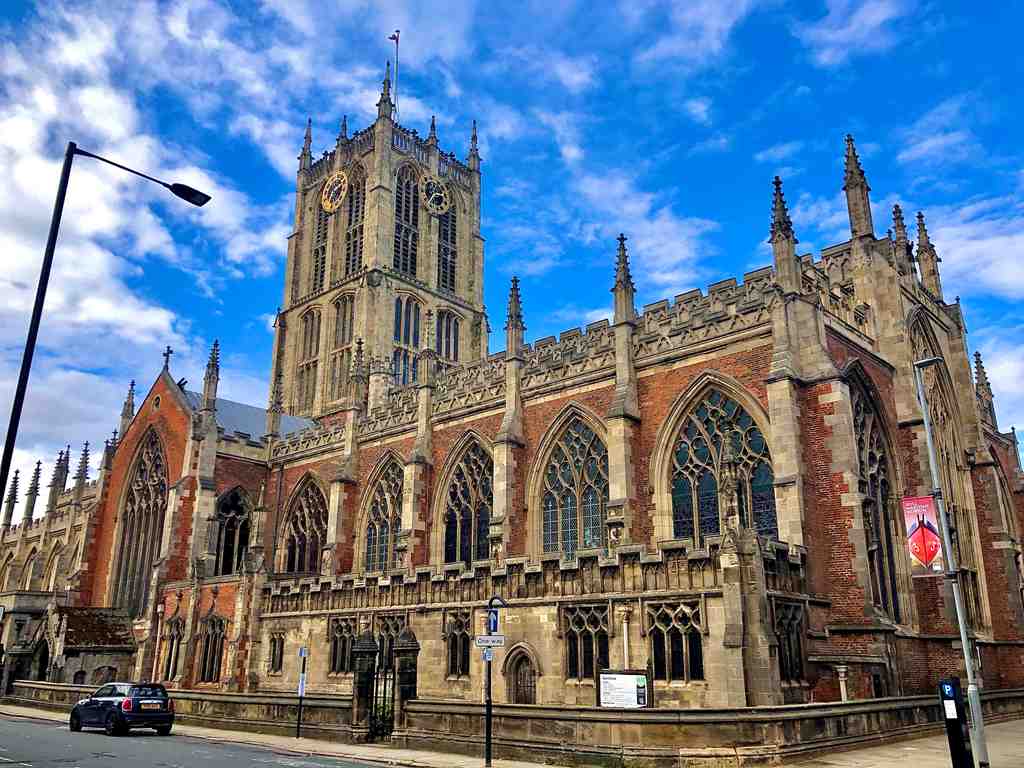
Hull Minster is a grand, towering church with a stony, castle-like tower and rows of tall stained-glass windows, so just look up and ahead for an impressive mix of medieval stone and deep-red brickwork! Now, as you stand right here in front of Hull Minster, take a deep breath and imagine this street bustling with people for over seven centuries. This giant beauty used to be called Holy Trinity Church, but in 2017, it stepped up its game and became Hull Minster. People say it’s the largest parish church in all of England by floor area-and looking at its mighty walls and soaring windows, I’d be hard-pressed to disagree! Its earliest parts-the transepts-date back to the days when knights in shining armour rode through Europe, about the year 1300. The choir was crafted a few decades later, and, bit by bit, medieval builders added the nave and the impressive tower that now stretches toward the sky. Back in the 18th century, somebody had the idea to cover the red brick with stucco-basically giving the church a questionable makeover-only for later Victorians to say “No, thank you!” and peel it all away. Now we see that stunning medieval brickwork, believed to be some of the finest in the country. During one enormous restoration in the 1840s, they ripped away old galleries and dusty pews, scrubbed paint from the ancient stone, and even hired a Hull carver by the name of George Peck to fill the nave with new oak stalls-each one topped by little poppy heads, some copied from models at Lincoln Cathedral. Central heating was the new rage, too! Just picture iron pipes winding through the nave, puffing warmth in winter, while workers painted the ceiling ultramarine blue, beaming with crimson and gold. It’s practically the Hogwarts of Hull, only with slightly less Quidditch. Did you know William Wilberforce, the famed anti-slavery campaigner, was baptised here in 1759? Imagine the gasps and whispers: “There’s Wilberforce!” right here where you’re standing. And when Hull suffered bombing raids in both world wars-those dreadful nights, with sirens wailing from the wharves-the Minster somehow dodged destruction. The city might have been easy for the Luftwaffe to find along the Humber, but the church survived, its sturdy stone a symbol of hope. Now, look up at the clock tower. In 1772, it first ticked to life with just one clock face, but in 1840, they added four enormous faces-each one bigger than a double bed-and hands as long as surfboards! That means you could never blame missing your meeting on "not seeing the time"-everyone in Hull could. The clock dials we see today were installed in 1913, and the chimes will make you feel like you’re stepping into a fairytale: the bells first played in the 18th century, with the mechanism being carefully wound and tuned almost daily, and now there’s a 25-bell digital carillon, but you might be lucky and hear someone play them by hand from a mighty keyboard. Fancy a climb to the bell tower? Though I wouldn’t recommend it after a big lunch, as the peal of 12 great bells-originals from the 1890s with a couple of 1950s’ recruits-wait to ring out on special days, filling the city with sound and shaking the medieval windows. There’s more mystery to uncover here. In the 1600s, letters from the Archbishop begged Hull’s leaders to bring music back to the church organ-can you imagine the musty silence before the first notes soared again? The organ has a story all its own, with pipes and puzzles stretching back through centuries of tuning and tinkering, from “Father” Smith’s work in 1712 all the way to the mighty 4-manual beast you’d find inside today. The Minster kept growing. In 2014, it wasn’t enough just to be a house of worship-it was set to become a hub for culture and community, hosting everything from banquets to exhibitions. There’s even a fresh new visitor centre and café now, thanks to a grant in 2019-so when you’ve finished your tour, don’t forget to pop in for a cuppa! Through wars, fires, noisy pipes, mighty organs, raucous chimes, and sugar-crazed restoration teams, Hull Minster has stood tall-a living, echoing memory bank for the city. So next time you hear the bells, think of all the generations who’ve stood where you are now, lost in wonder at the same incredible view. Seeking more information about the current status, tower or the list of vicars? Ask away in the chat section and I'll fill you in.
전용 페이지 열기 →Look ahead for a glassy, modern building with a sign that says “Princes Quay,” perched above the water on sturdy stilts-almost as if it’s floating over the old Prince’s…더 보기간략히 보기
Look ahead for a glassy, modern building with a sign that says “Princes Quay,” perched above the water on sturdy stilts-almost as if it’s floating over the old Prince’s Dock. Alright, let’s take a deep breath and imagine this spot not as a bustling shopping centre, but as the shimmering heart of Hull’s harbor life! If you stand quietly, and maybe squint just a little, you can practically hear the salty commotion of old steamers docking, sailors laughing, and gulls eyeing the freshest catch of the day-because Princes Quay isn’t your ordinary mall. It’s literally built above what used to be Prince’s Dock, floating on handsome stilts, a unique sight even among shopping centres. Back in 1991, when Princes Quay first opened its doors, it was like someone had dropped a glittering new spaceship right onto the water. Instead of regular floors, you’ll find “decks”-a nod to the nautical roots of this vibrant city. Locals and visitors alike have always enjoyed those panoramic windows, giving you spectacular views of both Hull Marina on one side and the lively dock on the other. You’ll notice how much light floods in; it almost feels like shopping aboard a grand ocean liner, with shops and delights scattered from bow to stern. When it first launched, the buzz was electric-three “decks” of more than eighty shops, all swirling around a bright central atrium. The Harbour Deck, right at the bottom, was bursting with the aromas of all sorts of street food tempting tired shoppers. And high above, what was once quiet space became, in 2007, home to a Vue cinema with ten screens and, get this, Europe’s very first digital screen. So, while you could pick up a new jacket, you could also catch the latest blockbuster without ever leaving the ship-er, the shopping centre. Pretty handy for Hull’s rainy days. Now, getting here has always been part of the adventure. There’s a whopping 1,000-space car park (I’d like to see someone try to parallel park a real ship in there!), easy bus access, and the city’s Paragon Interchange just a short stroll away. Princes Quay didn’t stand still, either-plans to expand westward were set to turn this place into a retail giant, looking to add a hotel, a leisure complex, and even more shopping. Though that pirate treasure chest of expansion was lost to budget storms and new owners, the centre pressed on. In recent years, the centre’s gotten a fresh coat of paint and sparkle-28 new outlet shops, a makeover for the food court, and beloved brands like Next moving in. And, if your belly’s rumbling, you might smell dough or see steam wisping from the window-it’s just Pizza Express and Nando’s firing up another round, while word on the street hints at Wagamama possibly joining the fleet. Oh, and here’s a splash of local color: every July, the waters around Princes Quay come alive with the wild spectacle of the Hull International Canoe Polo tournament! Bright kayaks, cheering crowds, and competitors zipping about-you’d almost believe the mall could set sail itself. So as you gaze up at those gleaming decks and bustling crowds, remember-this is where old Hull’s waterways meet new Hull’s rhythm. Now, onward, sailor-adventures in shopping (or snacking, or cinema-hopping) await!
전용 페이지 열기 →To spot the Spurn Lightship, look for a striking, black ship with a towering glass lantern on its deck, floating right in the marina beside the row of red-brick…더 보기간략히 보기
To spot the Spurn Lightship, look for a striking, black ship with a towering glass lantern on its deck, floating right in the marina beside the row of red-brick buildings. Welcome to the mighty Spurn Lightship, one of Hull’s most unusual and heroic guardians! Believe it or not, you’re standing in front of a ship with a giant lighthouse for a hat-no wonder it gets a lot of head turns! Picture this: it’s 1927, steam whistles are blowing and the smell of salt hangs in the air, when this ship first rolled off the yard, ready to keep sailors safe at the mouth of the wild Humber Estuary. For nearly half a century, the Spurn sat just over four miles off Spurn Point, shining its beam through fog and storm, guiding ships away from danger and into safer waters. Just imagine the clang of its bell and the steady sweep of its lantern, a true lifeline for wayward vessels. But all good things-and hardworking ships-must come to a pause. By 1975, the Spurn Lightship was retired. That could’ve been the end, but Hull City Council spotted a legend in need of rescue. After a bit of TLC and a shiny new paint job in 1983, the old lightship became a museum, inviting landlubbers and curious visitors aboard to relive its watery adventures. That was until work on a new footbridge meant it needed to set sail (well, more like a tug) for conservation once again. Can you hear the creak of old timbers and the excited chatter of shipyard workers? Now the Spurn shines brighter than ever, freshly restored as part of a huge city heritage project, and moored near Murdoch’s Connection for you to enjoy. Imagine her side-by-side with the Arctic Corsair, two legends swapping sea stories. Ready to wave back as you stroll past? Don’t get too close, or you might start flashing like a lighthouse yourself!
전용 페이지 열기 →To spot The Deep, just look ahead for the enormous, futuristic building shaped like a giant ship's prow, with shimmering blue glass and dark panels rising dramatically above the…더 보기간략히 보기
To spot The Deep, just look ahead for the enormous, futuristic building shaped like a giant ship's prow, with shimmering blue glass and dark panels rising dramatically above the water at the very tip of Sammy’s Point. Welcome to The Deep - the grand finale of our Hull adventure! Now, as you stand here, imagine the salty breeze swirling around you, and the gentle slosh of two mighty rivers meeting just below your feet. This striking building, looking like an enormous crystal iceberg or perhaps a spaceship that’s just touched down, is not only Hull’s most iconic landmark, but also one of the most spectacular aquariums in the world. But let’s roll back the clock a bit. You’re standing on a site that’s seen ships, soldiers, and even a fortress-Hull Castle, to be exact, way back in the 16th century. Then came The Citadel, built up with muddy earth dug out for the Victoria Dock in 1850. The land itself was shaped by centuries of industry-first Samuelson’s old shipyard, then bustling with the clang and rattle of the Humber Conservancy’s buoy depot, and finally-quiet for a time-until the Millennium Commission said, “Let’s build a submarium!” No, that’s not a typo: it really is called a “submarium.” I know, it sounds like a place where fish go to school! When The Deep opened its doors in 2002, Hull had truly reeled in the big one. Terry Farrell, the famous architect, designed this place to make a splash - and did he ever! The building looks ready to set sail at any moment, perched dramatically where the River Hull and the Humber sweep together. Inside, you’ll find 2,500,000 litres of swirling seawater (that’s enough to fill more bathtubs than you’ll see in a lifetime), and a vibrant community of more than seven shark species, rays, glowing fish, penguins, and even the odd sawfish - the only pair of green sawfish in Northern Europe, in fact. There’s a sting of mystery to the tanks here-some creatures even glow in the dark! Especially if you’ve ever tried to find your socks at night, you know how useful that would be. They didn’t call this place the best family attraction in Hull for nothing. Try to picture yourself gliding down in a glass lift, drifting through Europe’s deepest underwater tunnel while an army of fish and a few curious sharks watch you right back. The daily shark and ray feeding might just make you rethink lunch. And don’t miss the chance to grab the controls of the underwater diving vessel in the interactive area-just remember, no honking at the eels! But The Deep isn’t all fun and fin-tastic games. It’s a powerhouse of marine research too, with dedicated aquarists tirelessly caring for creatures great and small, and investigating the secrets of the deep blue. And talk about education-over 30,000 kids, from teachers to tiddlers, stream through every year, learning about everything from food chains to frog toes and coral reefs. Sometimes, the aquarium is filled with the excited whispers and giggles of sleepovers, turning the nighttime into a real-life “Finding Nemo” adventure. There used to be the Two Rivers Restaurant-where you could dine with fish floating past your table. Now, if you ever need a desk with a difference, the Deep Business Centre lets you work right above an ocean of aquatic wonders. Not a bad commute if you ask me! On a typical day, you’ll see regular visitors, tourists, schoolchildren, and even business folk in snazzy suits, all crossing paths right here at Hull’s edge. On special nights, The Deep dazzles as a stage for art and history too. During Hull’s City of Culture celebrations, the building’s shiny face became a massive screen, a canvas for breathtaking projections. And, believe it or not, the draw for the FA Cup’s third round happened right here, beamed live to football fans across the nation. So, as you gaze up at that remarkable wedge of glass and steel, think about all the stories swirling below-from medieval castles to marine research. The Deep is, quite simply, where Hull’s past and future flow together, and the wonders of the ocean are just a glass panel away. Well, that marks the end of our tour! I hope you’ve enjoyed our adventure as much as a penguin enjoys a good plunge. Safe travels, and may your days always have a bit of Hull’s magic. Fascinated by the exhibits, education or the two rivers restaurant? Let's chat about it
전용 페이지 열기 →





자주 묻는 질문
투어는 어떻게 시작하나요?
구매 후 AudaTours 앱을 다운로드하고 교환 코드를 입력하세요. 투어를 바로 시작할 수 있습니다 - 재생을 탭하고 GPS 안내 경로를 따라가시면 됩니다.
투어 중 인터넷이 필요한가요?
아닙니다! 시작 전에 투어를 다운로드하면 완전히 오프라인으로 즐길 수 있습니다. 채팅 기능만 인터넷이 필요합니다. 모바일 데이터 절약을 위해 WiFi에서 다운로드하시는 것을 권장합니다.
이것은 가이드가 안내하는 단체 투어인가요?
아닙니다 - 이것은 셀프 가이드 오디오 투어입니다. 폰을 통해 오디오 나레이션을 들으며 나만의 속도로 독립적으로 탐험합니다. 투어 가이드도, 단체도, 일정도 없습니다.
투어는 얼마나 걸리나요?
대부분의 투어는 60-90분이 소요되지만, 속도는 전적으로 본인이 조절합니다. 원할 때 언제든지 일시정지하거나, 정류장을 건너뛰거나, 휴식을 취하세요.
오늘 투어를 끝낼 수 없으면 어떻게 하나요?
괜찮습니다! 투어는 평생 이용이 가능합니다. 원할 때 언제든지 일시정지하고 다시 시작하세요 - 내일, 다음 주, 또는 내년에도. 진행 상황이 저장됩니다.
어떤 언어를 이용할 수 있나요?
모든 투어는 50개 이상의 언어로 이용 가능합니다. 코드를 교환할 때 원하는 언어를 선택하세요. 참고: 투어 생성 후에는 언어를 변경할 수 없습니다.
구매 후 투어는 어디에서 이용하나요?
App Store 또는 Google Play에서 무료 AudaTours 앱을 다운로드하세요. 교환 코드(이메일로 전송됨)를 입력하면 라이브러리에 투어가 나타나며, 다운로드하여 시작할 수 있습니다.
투어가 마음에 들지 않으시면 환불해 드립니다. 문의: [email protected]
안전한 결제 


