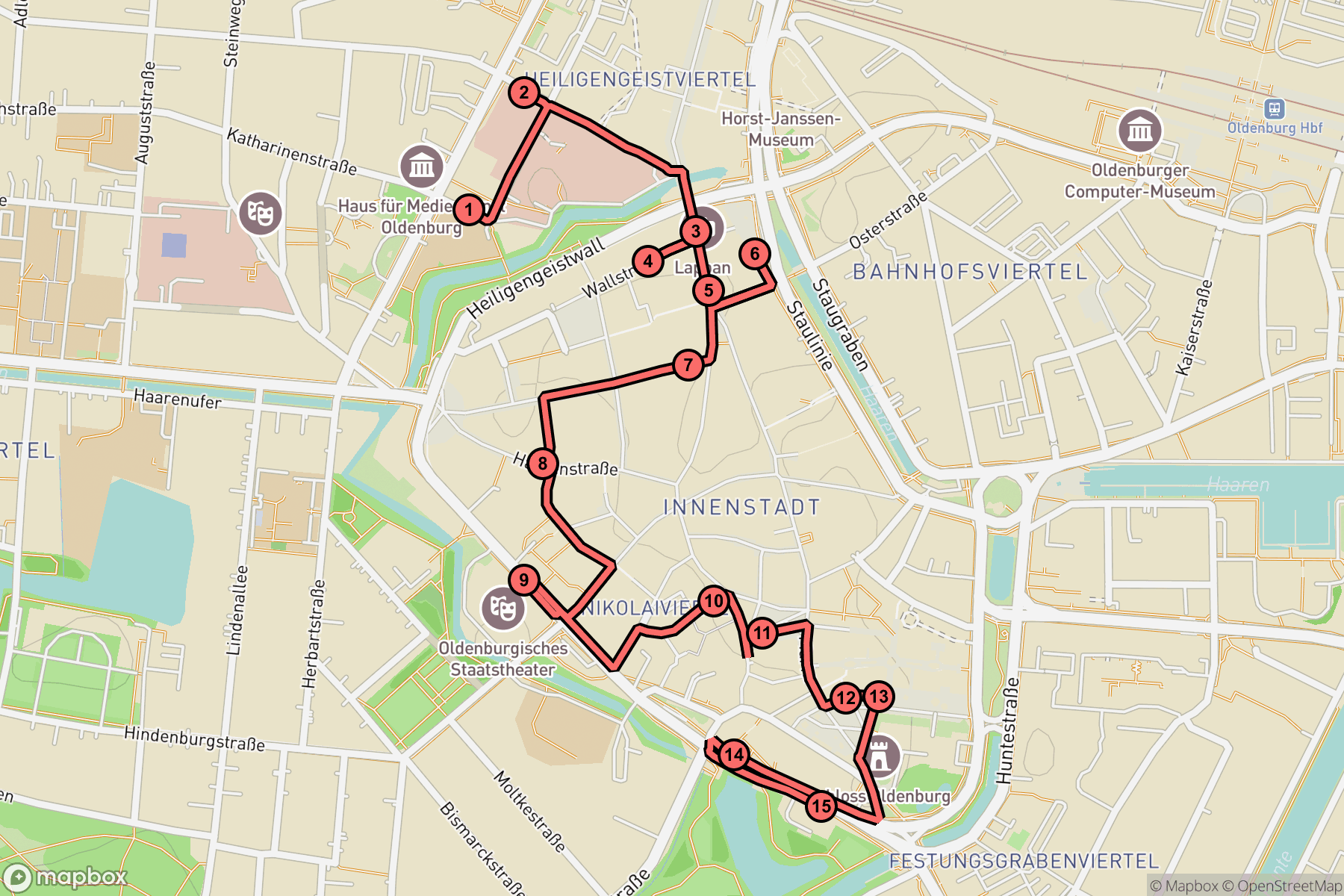
올덴부르크 오디오 투어: 궁전, 탑 & 이넨슈타트 이야기
올덴부르크의 정돈된 외관 아래에는 수세기 동안 숨겨진 비밀과 보이지 않는 권력 투쟁의 맥박이 뛰고 있습니다. 이 셀프 가이드 오디오 투어는 노르트베스트-차이퉁의 기둥에서 성 람베르트 교회의 그늘진 처마, 그리고 올덴부르크 주립 극장의 빛나는 홀까지 이동하며 숨겨진 역사를 풀어낼 수 있도록 초대합니다. 바쁜 방문객들이 놓치기 쉬운 이야기와 장소들을 만나보세요. 왜 긴급 헤드라인이 뉴스룸 바로 밖에서 도시 전체의 불안을 촉발했을까요? 한밤중의 반란 동안 성 람베르트의 돌에 새겨진 수수께끼 같은 메시지는 무엇이었을까요? 개막일 밤 주립 극장의 벨벳 커튼 뒤로 사라진 사람은 누구이며, 단 하나의 단서만을 남겼을까요? 구불구불한 거리와 솟아오른 첨탑을 따라 이 미스터리들을 추적하며, 한 걸음 한 걸음마다 드라마와 잊혀진 음모의 층을 벗겨내세요. 과거의 속삭임으로 시야가 선명해진 올덴부르크를 새롭게 경험해 보세요. 올덴부르크의 비밀이 기다리는 문턱을 넘을 용기를 내세요. 당신의 여정은 지금 시작됩니다.
투어 미리보기
이 투어에 대하여
- schedule소요 시간 40–60 mins나만의 속도로 이동
- straighten3.0 km 도보 경로안내 경로 따라가기
- location_on
- wifi_off오프라인 작동한 번 다운로드, 어디서든 사용
- all_inclusive평생 이용언제든지 다시 재생 가능
- location_on하우스 "그라프 안톤 귄터"에서 시작
이 투어의 정류장
To spot Haus "Graf Anton Günther", just look for the grand red-brick building with large, white-framed windows and, if you peek to your left, you’ll catch the impressive painting…더 보기간략히 보기
To spot Haus "Graf Anton Günther", just look for the grand red-brick building with large, white-framed windows and, if you peek to your left, you’ll catch the impressive painting of a man on horseback right on the facade. Welcome, traveler! You’re now standing where barrels once rolled and smoke filled the air, thanks to the busy life of merchants and tobacco makers from centuries ago. Imagine the year is 1682-a great fire has swept through Oldenburg, but on Lange Straße, hopeful hands are laying fresh bricks to rebuild the city. For 135 years, the Grovermann family watched the world change through these very windows. Then, in 1838, the air grew thick with the scent of tobacco leaves when Johann Karl Propping set up his factory right here. You can almost hear the clatter of wooden carts and maybe, if the wind’s right, catch a faint whiff of cigars! Later in the 1890s, this house shuffled owners faster than a deck of cards-until the Hoyer brewery rolled in and transformed it into the hotel and restaurant you see today. And what about the horseman above you? That’s none other than Count Anton Günther, astride his noble steed, Kranich, captured forever in a fresco by Professor August Oetken. Legend has it, if you wink at the Count as you walk by, he just might wink back-he’s been keeping an eye on Oldenburg for centuries! Shall we head to the next stop?
전용 페이지 열기 →Looking straight ahead, you’ll spot the Oldenburger Volksbank by its grand, sand-colored stone façade, with tall columns and bold “VOLKSBANK” letters gleaming right above the…더 보기간략히 보기
Looking straight ahead, you’ll spot the Oldenburger Volksbank by its grand, sand-colored stone façade, with tall columns and bold “VOLKSBANK” letters gleaming right above the entrance-just look for the row of intriguing stone figures at nearly eye level. Now, as you stand before this historic building, imagine Oldenburg over a century ago-a city bustling with craftsmanship, hope, and the constant clang of industry. Right where you are, the ground rumbled with ambition. On this very spot, the Volksbank’s journey began-though, just like my attempts at German tongue twisters, not without a few surprises. Picture this: In 1903, there was a sense of tension in the air. Local craftsmen were struggling to get fair credit-they could build half the city but couldn’t find a bank that would lend them a wheelbarrow, let alone any real money. So, an idea began to stir. In a meeting fueled by big dreams (and probably some strong coffee), 37 Oldenburg craftsmen agreed to create their own cooperative-a club with a very practical twist: a savings and loan fund that would help tradespeople borrow, save, and thrive. That first meeting must have sounded a bit like this:. From the start, this banks’ spirit was all about neighbors helping neighbors. Their first official home wasn’t even a grand building-just a simple room. But by the end of that year, they’d grown to 69 members, and-like a cake on a warm window sill-they kept on rising: by their tenth birthday, 387 members strong. It wasn’t long before they decided their ambitions needed a grander stage. Fast forward to 1906-1908, and you have this very building, designed by the well-known architects Abbehusen & Blendermann, rising on Lange Straße like a stone guardian over the heart of Oldenburg. Take a closer look at the façade-can you see the figures carved into the sand-colored stone? Each one tells a story. There’s a man with a pickaxe, checking a stone as carefully as a kid checking his ice cream cone on a hot day: “Prüfen”-to examine. Next, a bearded fellow with weighing scales, focused on finding balance: “Wägen”-to weigh. Then, the heat of the forge: “Schmelzen”-to melt. And finally, the ultimate reward, stamping out shiny coins: “Prägen”-to mint. Together, they form an ode to Oldenburg’s energy and discipline, a cycle of effort and reward. You don’t need a bank account to appreciate the sculptor’s skill-but hey, it wouldn’t hurt, right? Above it all, reigning over the columns, is a woman with outstretched arms, holding laurel wreaths above the emblems of industry and shipping-a reminder that the bank was always about more than just money: it was about the spirit of a thriving city. Look closely and you’ll see the coats of arms of Bremen and Oldenburg, symbols of unity and cooperation. But just as with all epic stories, there were twists and turns. The Volksbank changed names several times, like a secret agent trying to keep ahead of the plot. It expanded, merged with other banks, survived wars, economic crises, and celebrated milestones by opening new branches and welcoming more members into its fold. In 2022, it joined forces with the Raiffeisenbank Oldenburg eG, another community-minded bank with its own rich roots stretching back to the early 1900s. Suddenly, this wasn’t just a local tale-it was a saga spanning city and countryside, from Ammerland to Brake, and beyond. Inside, of course, you’ll find less gold bars and more paperwork, but the heartbeat of the bank-cooperation, trust, and old-fashioned neighborliness-still echoes in the halls. The façade you see was lovingly restored for its 100th birthday in 2003, so every detail is a living link to Oldenburg’s past. And while the Oldenburger Volksbank has become a financial powerhouse, supporting everything from youth sports to cultural events and local charities-even earning a few “Stars of Sport” along the way-you could argue its real treasure is right here: the stories, the community, and the sense of belonging, all written into the very stone around you. So, next time you pass, give a nod to the craftsmen-bankers with hammers and dreams-whose legacy still shapes Oldenburg today. If those stone figures could talk, I bet they’d have a few good investment tips-and maybe a couple of jokes about interest rates!
전용 페이지 열기 →Picture Wilhelm Christian Diedrich Fortmann-the man who sparked it all-stroking his mustache in deep thought. On May 1st, 1886, he and a group of clever business friends made it…더 보기간략히 보기
Picture Wilhelm Christian Diedrich Fortmann-the man who sparked it all-stroking his mustache in deep thought. On May 1st, 1886, he and a group of clever business friends made it official. They set up shop right here, and Oldenburg’s residents must have looked on with curiosity, wondering what big city financial wizardry was about to wash ashore. The partners were an interesting crew: an insurance director, a gas factory owner (who probably never let a meeting run out of steam), an authorized signatory, and a proper banker. Even the founding seems dramatic, with titles and authority bouncing around like coins on a banker’s desk. In those days, the bank specialized in private clients-people with big dreams and, let’s be honest, even bigger pockets. But fortune has a sense of humor. Over the years, W. Fortmann & Söhne changed its shape more often than a magician’s hat. In 1903, it turned into a “Kommanditgesellschaft” or limited partnership. Fast-forward through decades of world wars, shifting fortunes, and enough managers to fill a football team, and you’ve got a drama worthy of the silver screen. Oh, and the family drama! The Fortmann family passed the torch from generation to generation, sometimes for decades. But as the years rolled on, the bank became part of Oldenburgische Landesbank, then Dresdner Bank, then Allianz, and back and forth like the world’s most complicated game of Monopoly. By 2015, the name was just a branch of another, only to finally close its historic doors in 2016. Standing here, you can almost hear old Wilhelm Fortmann whispering financial advice-or maybe a gentle reminder not to spend all your Euros in one place. The legacy of W. Fortmann & Söhne is one of careful investment, shrewd partnerships, and, every now and then, a bit of good old-fashioned family squabble. Now, while you can't make a deposit anymore, you can certainly soak up a story or two and imagine Oldenburg’s wealthy citizens once gliding in and out, dreaming of fortunes made and lost. All right! Ready to trade in bankers for Shakespeareans? Onward to your next stop!
전용 페이지 열기 →
12개 정류장 더 보기정류장 적게 보기expand_moreexpand_less
To spot the Oldenburg Wallkino, look for a grand, cream-colored building with a rounded upper facade, tall columns, and a red-tiled roof directly in front of you on the…더 보기간략히 보기
To spot the Oldenburg Wallkino, look for a grand, cream-colored building with a rounded upper facade, tall columns, and a red-tiled roof directly in front of you on the street. Imagine you’re standing in front of this striking old building, its ornate columns and theater-like façade just oozing with stories of the past. Step back in time to 1914, when crowds eagerly flocked here on an autumn evening in their finest clothes to witness moving pictures as a brand-new art form. The Wallkino wasn’t just any cinema-it was the pride of Oldenburg, showing off its swirling stucco decorations and seating 750 people, which is a lot of popcorn crunching if you ask me. As you peer up, picture the glow of golden lamps, ticket sellers buzzing at the windows, and the deep hum of excitement as people hurried inside. This was a palace for movie lovers, with sloping rows of seats, balconies, and elegant boxes-almost like going to the opera, but with more cowboys and car chases on screen! Now, fast forward through two world wars. The old girl survived nearly unscathed, though for a while during the Second World War, the screens went dark and silence filled the halls. But in 1948, the show was back on! The 1960s became the Wallkino’s golden era: blockbuster crowds squeezed in for everything from love stories to alien adventures. But every good tale has its drama. The cinema was sold and split in two, turning into the Wall and the Cinema, each with hundreds of seats but losing a bit of its original sparkle behind a new aluminum façade. Yet, nostalgia won out in the ‘90s, and the Wallkino got a facelift-restored outside, sparkling inside, with cushier seats for modern film fans. Folks poured in for Oldenburg’s International Film Festival’s grand opening, and you could almost hear the applause echoing off the walls. Sadly, when the building changed hands again, the magic faded; in 2007, the lights flickered out for the last time and the doors closed. Since then, it’s stood in limbo: haunted by film memories and debate, a beauty in distress as city leaders and owners argue over its future. Sometimes, bits of plaster tumble from the cornices-watch your head! Still, underneath those layers and graffiti, you can almost see the ghosts of moviegoers waiting in line, eager for the next big premiere. Don’t be surprised if you feel a little movie magic in the air-it just can’t be helped in front of the Wallkino!
전용 페이지 열기 →To spot the Lappan, look for a tall, square, red-brick tower with a dark, pointy spire reaching into the sky, right at the start of the bustling Lange Straße and surrounded by…더 보기간략히 보기
To spot the Lappan, look for a tall, square, red-brick tower with a dark, pointy spire reaching into the sky, right at the start of the bustling Lange Straße and surrounded by bicycles. Welcome to one of Oldenburg’s absolute stars: the Lappan! Imagine you’re standing here in the middle of the 15th century - the year is 1468. The clanging sound of church bells would have echoed off these brick walls, calling people to the nearby Heilig-Geist-Kirche. This tower was once part of a busy hospital and almshouse, taking care of the city’s sick and poor. The name “Lappan” actually comes from the way the tower was “clapped on” to the side of the old church. When the Reformation swept through, things got shaken up - the church became secular, which is a fancy way of saying it wasn’t just for prayers anymore. Suddenly, this place transformed! The Lappan was turned into a watchtower where someone literally lived inside, always on-duty to ring the clock, sounding it out three times a day, plus every time church was about to begin somewhere in town. Not the best gig if you love sleeping in. The Lappan went through quite a bit - in 1676, a massive city fire tore through Oldenburg. Most buildings burned, but the Lappan endured, though it got pretty bruised. When they rebuilt, they topped it with the “welsche” (that means Italian-style) dome you see now, making it look like it’s wearing a fancy hat. In the 1890s, citizens actually had to fight to save the tower from demolition. Good thing they did, or we’d be staring at a very historic… parking lot. Since 2018, the Lappan has been home to the Oldenburg tourist info center, so it’s not just a historical survivor - it’s still welcoming visitors every day! Hop on a bus from here or just soak in the history. Oh, and fun fact: it even inspired a famous German comic publisher! So, if you hear a mysterious bell late at night while wandering Oldenburg, don’t worry - it’s just the spirit of the Lappan, keeping the city on time as always.
전용 페이지 열기 →Look for a bold blue sign in front of you, shaped almost like an open newspaper with the big white letters “NWZ” printed right in the middle-that’s your landmark, the headquarters…더 보기간략히 보기
Look for a bold blue sign in front of you, shaped almost like an open newspaper with the big white letters “NWZ” printed right in the middle-that’s your landmark, the headquarters of the Nordwest-Zeitung. Now, picture this: it’s April 1946. The city is still picking up the pieces after World War II, the air heavy with hope and a bit of lingering soot. Down the street, the smell of fresh ink spills from the presses as Fritz Bock, an ambitious publisher with ink-stained fingertips and a mind full of ideas, launches the very first issue of the Nordwest-Zeitung-under the watchful eye of the British military government. Back then, paper was so precious you’d think it was gold dust. The NWZ was printed only twice a week at first; people eagerly awaited every edition, often reading them until the pages grew thin and the headlines faded. Imagine the excitement in the NWZ’s small original office as the first copies came off the press. “Hot off the press!” someone might have shouted, holding up the next day’s news while others huddled around for any mention of their town or neighbors. By the 1950s, the NWZ was already reshaping Oldenburg-expanding partnerships with other regional newspapers and opening a dedicated publishing house right here. You’re standing in the footsteps of journalists who covered stories from the Cold War to moon landings and Oldenburg’s own everyday events. But don’t worry-they do much more than write about cows crossing the road or gnomes mysteriously vanishing from gardens. Well, except that one time... Now, picture the city buzzing in 1971: while bell-bottom pants were all the rage, NWZ’s tech wizards started using electronic data processing-giant computers that looked like they could launch rockets. By 1977, they tossed aside their heavy lead printing sets for fresh photo typesetting, keeping up with the times as fast as a breaking story. (Bet they never expected phone-sized newspapers we have today!) The NWZ didn’t just report the news, they helped shape it. Six days a week-except on Sundays, because even news takes a nap-it quietly became the voice of northwestern Lower Saxony. Through the decades, the NWZ expanded their reach, starting new editions, old-school print collaborations, and even jumping onto the digital wave. By 2016, they celebrated 70 years, and here’s a quirky celebration for you: on each of the next 70 days, they reprinted a front page from each year gone by, covering historic moments, both triumphant and tragic. But things weren’t always smooth. As with any good newspaper drama, there were challenges, conflicts, and-brace yourself-an epic paper shortage! And in the digital age, listeners, they had to face the cold reality that fewer people wanted a crinkly, inky edition on their breakfast table. The result? Circulations that dropped by almost half since 1998. Still, they didn’t give up. The NWZ adapted with digital editions for tablets and smartphones-no more smudged fingertips! By now, almost 15 percent of copies are digital, which must make those 1946 printers spin in their grave. The NWZ also dove into online startups, from matchmaking sites to 360° panorama services-an online dating headline is much more exciting than “Sunny with a Chance of Rain,” right? Their digital archive, launched in 2016, has more than three and a half million scanned pages now fully searchable. In the heart of Oldenburg, the NWZ has become both a chronicler and a connector. They even founded their own delivery service to ensure papers landed on doorsteps as reliably as sunrise. Of course, not every headline brings applause. Over the years, the NWZ has garnered prestigious awards-for investigative journalism, economic reporting, and even multimedia storytelling-plus a few finger-waggings from Germany’s press watchdog. Sometimes, their stories were too bold or not careful enough, and once, a pizza-factory scoop earned an editor a prize (though probably no free pizzas). Ethical debates, ruffled feathers, and a newsroom buzzing with arguments come with the business-it’s all part of keeping the fourth estate alive. Next time you see NWZ splashed across the blue masthead, remember its journey: from black-and-white afternoons in war-torn Germany to today’s rapid-fire news alerts and digital archives. News, after all, doesn’t just bring the world to Oldenburg-it helps Oldenburg speak to the world. Now, onward to our next stop-if history had a deadline, it would be now! Interested in knowing more about the distribution, edition or the organization
전용 페이지 열기 →Look ahead for a striking red-brick church with a towering, four-story spire and Gothic-style pointed arches-St. Peter is right in front of you, its impressive tower reaching…더 보기간략히 보기
Look ahead for a striking red-brick church with a towering, four-story spire and Gothic-style pointed arches-St. Peter is right in front of you, its impressive tower reaching powerfully into the sky above the leafy street corner. Welcome to St. Peter, the big red-brick guardian of Oldenburg’s city center! If this church looks proud and a bit defiant, well, it has good reason. Imagine standing here back in 1876, when the church first threw open its doors-freshly built from the designs of Franz Xaver Lütz, its walls still echoing with the ambitions of a tiny Catholic community in a city that had been mostly Lutheran since the Reformation. The air would be heavy with the scent of mortar and hope, as if something new and grand was about to take root. Its neo-Gothic architecture is pure drama, with tall pointed windows, multiple gables, and that tower-oh, the tower! It originally stood at a dizzying 75 meters high, crowned with a spire that pierced clouds. The church’s inside is like walking into a medieval fairytale: broad and open, with pale stone walls, splashes of gentle red and blue, and sunlight streaming through stained glass, casting glowing patches on the floor. If you hear a soft rustle, it might just be the spirits of old parishioners shuffling to their pews, elbowing for space, because this church was built to seat 500 souls-no small feat for a minority community at the time! But don’t let the serenity fool you. St. Peter has weathered more than just storms of prayer. In 1972, an actual hurricane-the notorious Quimburga-sent the church’s spire crashing down right onto the roof. You can imagine the gasps and the neighbors rushing out, nightgowns flapping, into the howling winds. For a year, the tower stood awkward and stubby-like a knight who’d lost his helmet-until a new octagonal spire was raised in 1973. If you think it looks a little shorter than expected, you’re right; about 14 meters shorter, to spare the budget! Inside, the music is another adventure. After the 1972 storm mangled the old organ, it was replaced by a modern masterpiece with forty-two registers. When the organist lets loose, the sound swirls through the nave like a flock of pigeons startled at dusk. St. Peter’s bells have their own story too. Four bronze bells once rang here, but only little St. Joseph has survived both world wars. The other three, cast in the 1950s, sing with her in harmonious tones-each dedicated to saints and the Virgin Mary, keeping the memory of older times alive. Today, St. Peter is a city church, offering not just masses but music, culture, and conversation to all. As you stand here, listen for echoes of faith, thunder, laughter, and the steady rhythm of time-right in the heart of Oldenburg. And remember: if those bells ring while you’re here, you’ve just heard a chorus that’s survived storms, wars, and centuries of change!
전용 페이지 열기 →To spot the Oldenburg State Theatre, look for a grand white building with tall columns, arched windows, and a big domed roof rising above the street corner right in front of…더 보기간략히 보기
To spot the Oldenburg State Theatre, look for a grand white building with tall columns, arched windows, and a big domed roof rising above the street corner right in front of you. Now, take in the scent of adventure and maybe a hint of old curtain dust! You’re standing where drama, laughter, and a bit of nail-biting suspense have filled the air for nearly two centuries. Picture back to 1833-a simple wooden theater stood here, the pride of Herman Wilhelm Muck, who not only built it but owned it. Imagine carriages clattering up, local crowds eagerly whispering about what stories would unfold inside, led by the clever Carl Christian Ludwig Starklof and the seasoned performer Johann Christian Gerber. Thanks to Grand Duchess Cecilia, even the upper crust supported this wooden wonder! By 1881, the old wooden theater made way for a brand new Renaissance-style palace of stories, stone replacing timber, columns shooting up, hats coming off in awe. But the drama wasn’t just on stage-one stormy November night in 1891, flames suddenly erupted, and the stunning building burned to the ground. Undeterred, the city’s love of theatre wouldn’t let the curtain fall for good. While a temporary stage sheltered shows, the architects Franz Noack and Paul Moritz Zimmer raced to rebuild. This time, they tucked a huge dome on top, not just for style, but to hold a water tank (firefighters everywhere cheered, I’m sure)! The inside glowed with baroque moldings, swirling frescoes, and for the first time, electric lights glittered over the eager crowds. Since reopening in 1893, the Oldenburg State Theatre has dazzled under the lead of colorful directors and wowed generations. Walking past today, imagine the stamp of actors’ feet, the heavy hush before the curtain rises-and maybe, just maybe, listen for the standing ovation echoing from the past!
전용 페이지 열기 →Wonderful, you’ve found your way to the legendary Isensee Verlag! Look around you-this isn’t just a book publisher; it’s a portal into the soul of Northwest Germany, wrapped up in…더 보기간략히 보기
Wonderful, you’ve found your way to the legendary Isensee Verlag! Look around you-this isn’t just a book publisher; it’s a portal into the soul of Northwest Germany, wrapped up in pages and ink. Imagine the scent of freshly printed paper and the soft rustle of manuscripts-this place has been a storyteller for the region for well over a century. Let’s jump back in time to 1892. The city is bustling, horses clop down the cobbled streets, and a young typesetter named Heinrich Karl Adolf Isensee arrives in Oldenburg. He’s got ink on his fingers and ambition in his eyes. Just a year after his move from Schöningen, he opens his very own publishing company-little does he know, it will one day become the heart of Oldenburg’s literary world. By 1902, Heinrich proves he’s got more than just novels up his sleeve; he cleverly buys up a bankrupt printing shop, Winter & Meschett. Some people see bankruptcy as bad luck-Heinrich saw it as a plot twist! The presses clank into the future. In 1907, the company adds a shop so people in Oldenburg can buy their pens and paper where the books come from-a full stationery adventure! The 1930s roar in, and suddenly there’s a shiny new rotation press and seven typesetting machines shaking the floors. By 1945, after a world turned upside down, the company settles here on Haarenstraße, right in the heart of Oldenburg’s old town. For a while, the press mostly focused on local matters-if it happened in Oldenburg or the Northwest, it ended up in print. But by the 1960s, with the rise of the Oldenburgische Landschaft group, the publisher became a fierce guardian of local stories and culture. Today, they keep spreading their wings: fiction in Low German, essays on art, culture, and even science! And every year, Florian Isensee keeps the presses rolling. So, if you ever get lost in Oldenburg, just follow the sound of stories being told. And remember: here at Isensee, there’s always room for one more chapter-are you ready to write your own?
전용 페이지 열기 →To spot the Degodehaus, look for a striking half-timbered house with yellow walls, dark wooden beams, and a steep triangle-shaped roof-right on the corner ahead of you. Now,…더 보기간략히 보기
To spot the Degodehaus, look for a striking half-timbered house with yellow walls, dark wooden beams, and a steep triangle-shaped roof-right on the corner ahead of you. Now, let’s step back in time… Imagine it’s the year 1502. Oldenburg is bustling, carts rolling over cobblestones, and right here stands the Degodehaus-impossibly sturdy and proud, even while a thick smell of woodsmoke drifts through the air. Not just any house, this was a patrician's residence, built to impress with fine oak beams and bright, decorative panels. The town eventually faced the great fire of 1676-a moment when flames threatened to turn everything to ash. Yet, somehow, this house survived! Today, it’s the last medieval patrician house standing in all of Oldenburg. Fast forward to 1645, and imagine painters climbing rickety ladders inside. Mylius Gnadenfeld, the proud owner, wanted the world-yes, all the continents-painted across his wooden ceiling. Picture rich blues for oceans and golden continents shining overhead. For centuries, though, this masterpiece was hidden, covered up by stucco until 1992, when it was rediscovered-as if the past itself whispered out: “I’m still here!” Since 1860, the Degode family has lent their name to this house. Hold still for a moment and you might even hear the faint laughter of merchants bartering or the footsteps of Georg Wilhelm Degode, a painter born right inside these walls. Isn’t it wonderful how every corner here holds a secret?
전용 페이지 열기 →Look for the cluster of tall, pointed towers with green copper roofs rising up from behind the trees-St. Lambert’s Church is straight ahead, dominating the skyline like a gothic…더 보기간략히 보기
Look for the cluster of tall, pointed towers with green copper roofs rising up from behind the trees-St. Lambert’s Church is straight ahead, dominating the skyline like a gothic crown floating above Oldenburg. Now, take a deep breath and imagine the sights and sounds of centuries past swirling around you. You’re standing before the central and oldest church of the town: St. Lambert’s-or, for those on a nickname basis, Lambertikirche. With its five dramatic spires (the tallest soaring up 86 meters-yes, that’s higher than anything else in Oldenburg, so it’s hard to miss), the church has been watching over this city longer than most of the surrounding buildings have been bricks! Built in the Middle Ages, right next to the original count’s castle, the very first version of this church was a simple one-nave Romanesque job, probably built somewhere between 1180 and 1200 by the powerful House of Oldenburg. The Oldenburg nobles weren’t just looking for a place to pray-they were making a statement, and they liked naming things after their personal favorite, Saint Lambert. By 1237, we know the locals had their own parish priest (that’s medieval VIP status!), and a golden chalice from 1265 still exists, likely shining on special occasions to this day. As Oldenburg grew from a little settlement to a full-fledged town, so did the church’s importance. When the city received its rights in 1345, Lambertikirche suddenly wasn’t just another village chapel; it was now a bona fide city church! Soon after, the church was packed with up to nine altars, one for each of its canon priests and their abbot. Imagine the hum of daily prayers, monks rustling robes, and the low voices echoing off gothic arches. By the 15th century, things got fancier. The choir was expanded eastward in 1436, and vibrant stained-glass windows were added-funded by local nobility and even some bigwigs from Bremen. I like to think the sunlight spilling through those windows must have made everything in the church glow like a rainbow. Then came the Reformation around 1527. The city switched over to Protestantism and, instead of Latin, the sermons were suddenly in good, old German. The church changed hands, altars vanished, and the gothic exterior stayed stubbornly in place-like an old dog refusing to learn new tricks. More drama: the ruling Oldenburg counts died out in the late 1600s, and the city passed through various royal hands-Danish, then Holstein-Gottorp. Honestly, this church saw more regime changes than a soap opera. By the late 1700s, the building was so run-down that they basically gutted everything but the walls and rebuilt the inside as a grand, neoclassical rotunda with a dome. During this makeover, they even twisted the orientation of the church! Instead of an altar at the east, the main door was plopped right where tradition said it shouldn’t go. Scandalous! And for a while, the church lost its tower entirely, leading the famous poet Heinrich Heine to compare it to a theater. Talk about a dramatic entrance. Finally, in the late 1800s, new life-and several thousand bricks-were breathed into the structure, giving it the red neo-Gothic suit of armor you see today. The four side towers were added, and the exterior was wrapped in striking red brick, crowned with green copper spires. The inside stayed a light-filled, classicist surprise-like biting into a chocolate and finding fruit. Inside, there’s a mighty organ: 52 registers, the largest in all of Oldenburg, built in 1972, with pipes that once filled the space and probably rattled a few nervous pigeons from the rafters. And if you hear the bells? There are five in total, including a gigantic bronze bell weighing nearly three tons and a historical one that made its way here all the way from Silesia, via Hamburg. As you stand here now, think of all the people who’ve gathered, mourned, cheered, and changed here across nearly a thousand years, from the first stone to the latest renovation. So next time you hear those bells or glimpse the spires over Oldenburg, smile and remember-you’ve just met the city’s oldest friend… and probably its most stylish hat. Yearning to grasp further insights on the preacher, bells or the administration? Dive into the chat section below and ask away.
전용 페이지 열기 →Just ahead, look for a wide cobblestone square framed by a cheerful yellow palace with a tall clock tower-that's Schlossplatz, the heart of Oldenburg! Picture yourself centuries…더 보기간략히 보기
Just ahead, look for a wide cobblestone square framed by a cheerful yellow palace with a tall clock tower-that's Schlossplatz, the heart of Oldenburg! Picture yourself centuries ago, right where you’re standing now, with the fresh scent of baked bread and flowers filling the air as busy market stalls pop up across the square. This is where Oldenburg really comes to life! People have gathered here for generations, chatting, bartering, and exchanging stories-sometimes even debating whether cheese or sausages belong on a good German sandwich. Legend has it that if you listen closely, you might catch the ghostly echoes of market traders, still haggling over apples and potatoes. With Schloss Oldenburg rising on one side, the royal family could sneak a peek at the townsfolk’s daily drama, while nearby, the beautiful Schlossgarten offered peaceful escapes for daydreamers and lovebirds. Take a breath and imagine carriages bouncing across the stones and children dodging geese. These days, the square is still bursting with life: open-air markets and festivals fill the area with laughter, music, and the delicious smell of pretzels. You’re now standing in a place where Oldenburg’s past and present dance together-whether you came for the architecture, the shopping, or just the adventure, there’s magic in this square if you pause and feel it. Ready to see what’s around the next corner? Let’s go!
전용 페이지 열기 →To spot Schloss Oldenburg, look for the grand, yellow-painted palace just ahead with a tall tower topped by a greenish copper spire and a clock on its face, standing prominently…더 보기간략히 보기
To spot Schloss Oldenburg, look for the grand, yellow-painted palace just ahead with a tall tower topped by a greenish copper spire and a clock on its face, standing prominently on the Schlossplatz. Imagine standing here over 900 years ago, when instead of the elegant palace you see today, there was a rugged old castle, huddled low on this very patch of ground. The first stones of this stronghold were set down by the Counts of Oldenburg way back around 1100, all to keep a watchful eye on travelers bobbing along the trade route that snaked from Westphalia to East Frisia. Picture it: the busy clatter of hooves, merchants calling out, and maybe even a watchman’s horn. The foundations of the original castle were so muddy and boggy that some buildings were actually sinking! By 1608, the keep-yes, the very heart of the fortress-had started leaning alarmingly, so much so it had to be torn down before it toppled over. That’s Oldenburg’s very own “Leaning Tower,” but nobody was making postcards of it! Fast-forward to the early 1600s, just as powdered wigs and ruffled collars were the height of fashion. Enter Count Anthony Günther, a man with a big vision: transforming the humble castle into a glorious, four-winged palace fit to rival the finest Italian city palaces. Anthony hired a master builder and even brought in a famous architect from Switzerland, Andrea Spezza-because when you want a palace, you want it done properly. Work buzzed along, and even a brilliant sculptor, Ludwig Münstermann, gave the palace its Renaissance flair. But, as in any good drama, along came the Thirty Years’ War and, with it, money troubles. The grand plans ground to a halt, and the palace-to-be sat unfinished, gathering gossip and the odd weed. When Anthony died without an heir, the keys were handed over to the Danish royal family. Suddenly, the new rulers had to commute all the way from Copenhagen just to sort out business in Oldenburg! For over a century, the Danes ran things, with their governors taking up residence right here, while the old moat gradually got filled in and the last medieval walls crumbled away. Don’t worry: by the 18th century, they also built a sensible, if plain, “chancellery wing” for the government officials-proof that even palaces have their paperwork. But that’s not the end of the palace makeover. By 1773, a new dynasty stepped in-the dukes from Holstein-Gottorf-who looked around, saw the party possibilities, and promptly decided they needed a proper ballroom. So, a shiny new extension went up. Peter I, the first Grand Duke, came in with a taste for the modern and added a towering library wing and some fancy coach houses. Sadly, the library wing went up in flames in 1913, and I’ll bet everyone could hear the crackling and shouting right out on the square. It was rebuilt immediately, because, as everyone knows, you can lose the kitchen but never the books! The last grand duke, Friedrich August, held on until 1918, when the winds of revolution swept across Germany and he had to pack up and move out, leaving this palace to the people. Not long after, workers arrived, hammers in hand, and the palace became a museum-no need for crowns, just a ticket! Today, it’s home to remarkable art, exquisite furniture, and tales from across the ages. As you stand in front of this sunny yellow building, just imagine all the characters who’ve walked its halls-counts, dukes, grand dukes, even Danish kings. The marketplace buzzes to the north, the peaceful Schlossgarten calls from the south, and the palace itself stands as a silent storyteller, waiting for curious visitors like you to step inside, wonder, and maybe, just maybe, start a story of your own.
전용 페이지 열기 →To find the Powder Tower, look to your left for a round, red-brick building with a big domed roof and a wooden staircase leading up to a doorway-it looks a bit like an ancient…더 보기간략히 보기
To find the Powder Tower, look to your left for a round, red-brick building with a big domed roof and a wooden staircase leading up to a doorway-it looks a bit like an ancient fortress right in the middle of the city. Welcome to the Powder Tower, Oldenburg’s last surviving piece of the town’s once-mighty old fortifications! Imagine yourself standing here almost 500 years ago-in 1529, this place was more than just a quirky round building. It was built as a defensive outpost, its thick walls protecting the town against anyone foolish enough to attempt an attack. Originally, it was a flat gun tower over a vaulted basement, and back then, Oldenburg was surrounded by walls and defenses to make any invader think twice. When the town beefed up its defenses around the 1600s, the distinctive conical roof was added, giving it the classic look you see today. Now, picture the hustle and bustle during the days when this tower was filled with gunpowder, not art! As part of the Eversten Gate, this tower was the city’s explosive secret. You probably wouldn’t want to light a candle in here unless you enjoyed sudden surprises! During the Danish occupation in the 1700s, it officially held its title as the “Powder Tower.” After the fortifications were torn down and the city grew more peaceful, the tower played a very different role, storing ice for the royal castle nearby-talk about a cool new job! By the 20th century, the Powder Tower had survived many close calls. In the 1960s, it became the property of Oldenburg, got a makeover for its dome, and was protected as a historic monument. Imagine artists and potters now displaying their creations in this very spot, where once only soldiers and ice blocks could enter. If you look closely, you might notice the tower leans a little toward the Schlosswall. That tilt has been there since it was built, but don’t worry-recent checks show it’s not going anywhere! So let the Powder Tower’s ancient walls remind you that even old soldiers-or towers-can reinvent themselves and stay standing strong.
전용 페이지 열기 →To spot the Elisabeth-Anna-Palais, look just past the thick trees and gardens for a large, brilliant red-brick building with a steep, tiled roof-its impressive outline pops…더 보기간략히 보기
To spot the Elisabeth-Anna-Palais, look just past the thick trees and gardens for a large, brilliant red-brick building with a steep, tiled roof-its impressive outline pops against the greenery and sky. Now, as you’re standing here with the Elisabeth-Anna-Palais right in front of you, let me take you back to the late 1800s. Picture it: elegant carriages rolling up, and the sharp scent of new brickwork mixing with the fresh garden air. Duke Frederick Augustus, tired of living in the big, old Schloss, wanted a new home for his family-somewhere modern yet grand, just close enough to the palace for convenience, but not too far from the lovely Schlossgarten. So, between 1894 and 1896, the Palais rose up under the watchful eye of the duke’s own architect, Ludwig Freese. It was meant to be a happy place, filled with laughter and royal parties. But then came a shadow over all those dreams. Tragically, Frederick Augustus’s wife, Princess Elisabeth Anna, died before she ever had the chance to enjoy her new home. In her memory, the red-brick palace was named after her-a grand gesture, but one tinged with sadness. Now, look to the corner-see that tower with its funny onion-shaped dome? That’s where the ducal family would glance out at their gardens, maybe dreaming of better days. But history wasn’t quite done stirring things up here! In 1918, the winds of revolution were howling through Germany. Imagine, on a chilly November day, angry revolutionaries storm the gates and demand the Grand Duke fly the red flag above both the palace and the old Schloss. Not exactly your average housewarming party! A few days later, Frederick Augustus gave up his throne and slipped away to quieter pastures-leaving this once-royal home to face its next chapter. Since then, the Elisabeth-Anna-Palais has seen everything from bustling officials to city plans gone wild. Part of its kitchen wing was even torn down in the 1960s to make space for a new road. Today, it houses the Sozialgericht Oldenburg, buzzing with everyday stories instead of royal secrets-unless, of course, a few ghosts of its grand past still linger, peering out from behind those big, old windows.
전용 페이지 열기 →
자주 묻는 질문
투어는 어떻게 시작하나요?
구매 후 AudaTours 앱을 다운로드하고 교환 코드를 입력하세요. 투어를 바로 시작할 수 있습니다 - 재생을 탭하고 GPS 안내 경로를 따라가시면 됩니다.
투어 중 인터넷이 필요한가요?
아닙니다! 시작 전에 투어를 다운로드하면 완전히 오프라인으로 즐길 수 있습니다. 채팅 기능만 인터넷이 필요합니다. 모바일 데이터 절약을 위해 WiFi에서 다운로드하시는 것을 권장합니다.
이것은 가이드가 안내하는 단체 투어인가요?
아닙니다 - 이것은 셀프 가이드 오디오 투어입니다. 폰을 통해 오디오 나레이션을 들으며 나만의 속도로 독립적으로 탐험합니다. 투어 가이드도, 단체도, 일정도 없습니다.
투어는 얼마나 걸리나요?
대부분의 투어는 60-90분이 소요되지만, 속도는 전적으로 본인이 조절합니다. 원할 때 언제든지 일시정지하거나, 정류장을 건너뛰거나, 휴식을 취하세요.
오늘 투어를 끝낼 수 없으면 어떻게 하나요?
괜찮습니다! 투어는 평생 이용이 가능합니다. 원할 때 언제든지 일시정지하고 다시 시작하세요 - 내일, 다음 주, 또는 내년에도. 진행 상황이 저장됩니다.
어떤 언어를 이용할 수 있나요?
모든 투어는 50개 이상의 언어로 이용 가능합니다. 코드를 교환할 때 원하는 언어를 선택하세요. 참고: 투어 생성 후에는 언어를 변경할 수 없습니다.
구매 후 투어는 어디에서 이용하나요?
App Store 또는 Google Play에서 무료 AudaTours 앱을 다운로드하세요. 교환 코드(이메일로 전송됨)를 입력하면 라이브러리에 투어가 나타나며, 다운로드하여 시작할 수 있습니다.
투어가 마음에 들지 않으시면 환불해 드립니다. 문의: [email protected]
안전한 결제 



