ハリスバーグ オーディオツアー:鉄道、大理石、そして議事堂の伝説
ハリスバーグの壮麗なドームと静かな像の下では、かつて雷鳴のような決定が響き渡り、国家の運命を完全に秘密裏に形作っていました。 このセルフガイドオーディオアドベンチャーは、ベルベットのロープと大理石のファサードの裏側に忍び込み、議事堂の隠された劇的な側面と、鉄道遺産の鉄の鼓動を明らかにします。地元の人々さえ見過ごしている物語を追跡し、街の真の顔を明らかにしましょう。 どの元老院の投票が政府のホールで真夜中の暴動を引き起こしたのでしょうか?議事堂の彫刻群の中に閉じ込められた秘密は何でしょうか—石に永遠に刻まれたメッセージとは?なぜ機関車4859は静かに、しかし崇拝され、忘れ去られた希望とスキャンダラスな妨害工作の遺物として立っているのでしょうか? ささやきが反乱に変わり、進歩が抗議と衝突した街区の回廊を通り抜けましょう。それぞれのランドマークは過去の陰謀で息づいており、大胆な足跡が再びそれを目覚めさせるのを待っています。 ハリスバーグの秘密の章に入り込み、歴史の鼓動に導かれてツアーを始めましょう。今すぐ始めましょう。
ツアーのプレビュー
このツアーについて
- schedule所要時間 40–60 mins自分のペースで進める
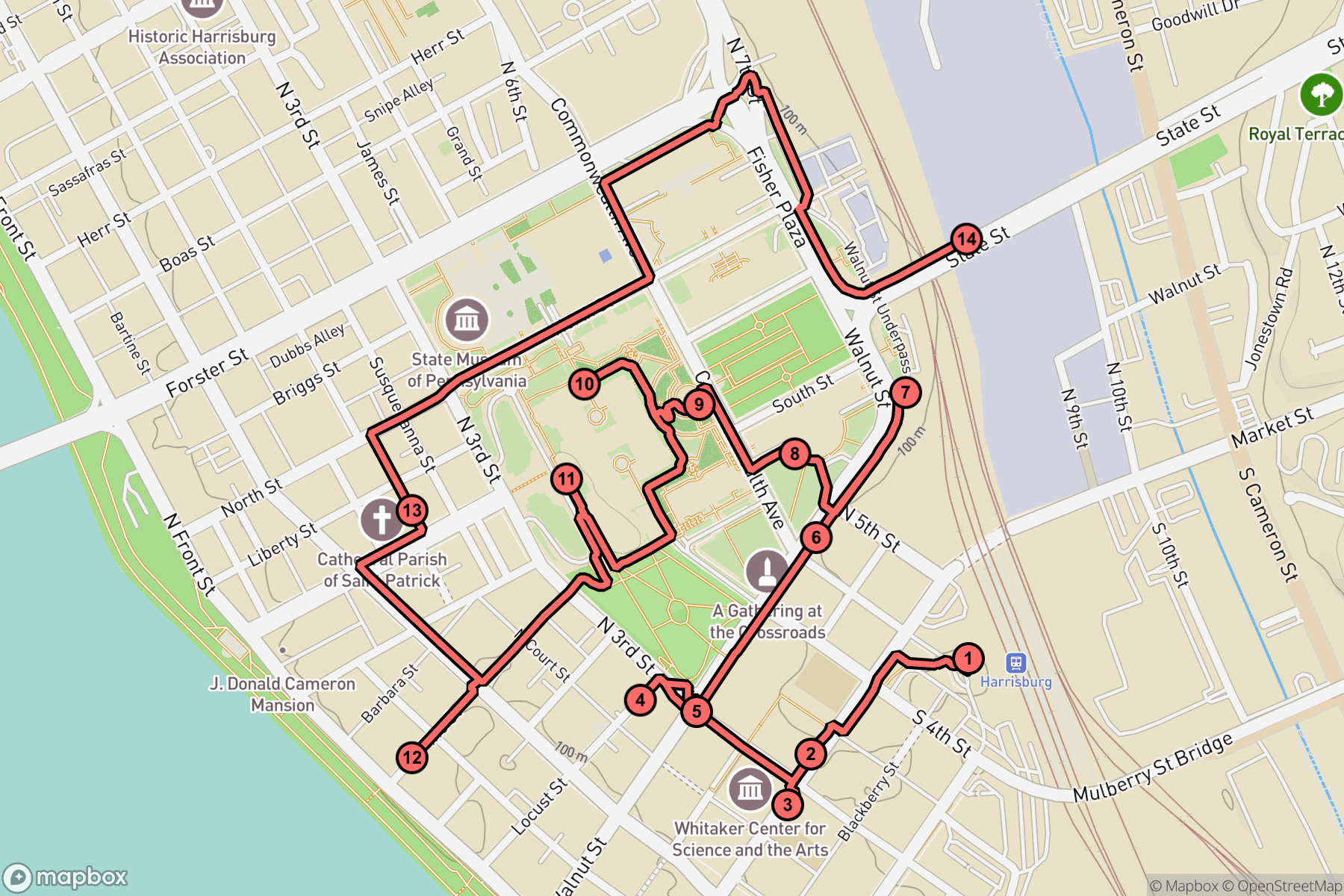
- straightenウォーキングルート 4.8kmガイド付きパスに沿って進む
- location_on
- wifi_offオフライン対応一度のダウンロードでどこでも使える
- all_inclusive無期限アクセスいつでも、ずっと再生可能
- location_onペンシルバニア鉄道4859号から開始
このツアーのスポット
You’re now standing next to a true titan of Pennsylvania railroading history: the Pennsylvania Railroad 4859. Imagine the year is 1938. The city is buzzing with excitement, hats…もっと読む折りたたむ
You’re now standing next to a true titan of Pennsylvania railroading history: the Pennsylvania Railroad 4859. Imagine the year is 1938. The city is buzzing with excitement, hats everywhere, and the hum of anticipation hangs in the air. Suddenly, the mighty GG1-class locomotive-fresh from the Pennsylvania Railroad’s Altoona Works-rolls into Harrisburg for the very first time, leading a sleek silver train directly from Philadelphia. Picture whistles shrieking and fire sirens blaring as it charges down the line, the whole city alive with sound-some folks even thought it was the start of an invasion! Now, the 4859 isn’t just any old engine. This beauty was developed in the 1930s by General Electric, meant to replace the aging P5a models. There was a locomotive “talent show” of sorts, as the Pennsylvania Railroad decided between the GG1 and Westinghouse’s R1. The GG1 won out, thanks in part to its uncanny flexibility-literally! Its articulated design let it slide around curves like a steel snake on rails. Of course, looks matter too-even for trains! Raymond Loewy, the famous industrial designer, was brought in to give the GG1 its flair. He insisted on welding, not riveting, so the sides were smooth as chocolate, and he dreamed up that rich Brunswick green coat with gold stripes cat whiskered across the nose. Yes, even trains can look fabulous. And this paint job became a signature look for Pennsylvania’s engines for decades. 4859 was at the heart of the action for over forty years: racing at speeds up to 90 miles per hour, it hauled both gleaming passenger trains and hulking lines of freight. If you squint, you can almost see commuters in their suits hurrying to make “Clockers” to New York, or laborers waving as the freight thundered by. Even after switching to mostly freight duty in 1964, 4859 had its moments of glory-pulling the very last GG1-powered freight out of Enola Yard in 1979. Retirement, though, wasn’t the end. Instead of the scrapyard, this iron legend got a new lease on life. Bought for $13,000-as much as some used cars but quite a bargain for a star-4859 was shipped off to Strasburg for a makeover. Out came the hazardous bits, on went the fresh paint, and she looked just as sharp as the day she debuted. After some time at the Pennsylvania Railroad Museum, her story came full circle and she was brought here, to be honored in Harrisburg’s heart. Not only did she make the National Register of Historic Places (twice, for good measure), she also earned the title of Pennsylvania’s official state electric locomotive in 1987. And even now, every so often, 4859 receives a touch-up to fight off the rust and keep her gleaming. So as you stand here, reflect for a moment: this engine isn’t just metal and wires. It’s decades of innovation, speed, and style-all rolled into one very photogenic locomotive. And if you ask me, she takes her job as Pennsylvania’s electric ambassador quite seriously
専用ページを開く →But let’s not skip ahead too quickly. Behind those gleaming glass doors sits a secret-a whole alleyway, Strawberry Alley, once cut straight through this spot from Front Street to…もっと読む折りたたむ
But let’s not skip ahead too quickly. Behind those gleaming glass doors sits a secret-a whole alleyway, Strawberry Alley, once cut straight through this spot from Front Street to Third Street. Today, part of that alley lives on beside the second floor escalators as a lively commons area. Picture the city’s rhythm folding into what became affectionately known as the ‘Key Block.’ By 1989, the Harristown Development Corporation wasn’t done. They poured $21 million into preserving ten of the oldest buildings downtown-places that could probably tell you a few stories about the city’s wild younger days. Now, the complex is home to over 40 shops and galleries, tempting you with everything from glimmering jewelry to mysterious international snacks (no one leaves the food court hungry!). Strawberry Square isn’t just for shopping or eating. With schools like Harrisburg University, Capital Area School for the Arts, Messiah College, and Temple University tucked inside, you never know if you’ll bump into future scientists or the next Picasso. Once, there was a legendary 41-foot tall sculpture-the Chockablock Clock-filling the atrium with whirrs and chimes. That’s one clock you could never blame for making you late-it was honestly hard to walk away from it. At the end of the day, this isn’t just a building-it’s Harrisburg’s gathering space. Don’t be surprised if you spot a poetry reading, a science demo, or even someone dropping their lunch in the midst of all the excitement. That’s the real Strawberry Square: a meeting point for stories old and new, all under one very busy roof.
専用ページを開く →This place is more than just a building. With 130,000 square feet of possibilities, it’s the ultimate playground for the curious. Back in the day, there was excitement in the air…もっと読む折りたたむ
This place is more than just a building. With 130,000 square feet of possibilities, it’s the ultimate playground for the curious. Back in the day, there was excitement in the air as workers hammered away, building Discovery Lab classrooms and the sparkly Stage Two, and hanging art in the elegant Kunkel Gallery. Imagine the National Science Foundation deciding, “Yes, Harrisburg deserves a permanent science exhibit!” and adding their own bit of magic. Take a peek at the two-story UPMC Science Center-over 240 hands-on exhibits will have you laughing, learning, and maybe launching a ping-pong ball across the room. And don’t miss the giant digital cinema screen. Used to be IMAX, but now it’s gone digital-no more arguing with enormous film reels, but you’ll still get that sense of whoa as the lights dim. And the Sunoco Performance Theater! Plush seats, twinkling chandeliers, seven theater boxes, and once, seven resident companies all eager to steal the show. These days, it’s home to local stars like the Central Pennsylvania Youth Ballet and Market Square Concerts. The energy in this building is contagious-science, stories, and a dash of showbiz all under one roof. In short, the Whitaker Center is what happens when a city dares to ask, “Why not?” and then actually builds the answer.
専用ページを開く →
さらに10件のスポットを表示表示するスポットを減らすexpand_moreexpand_less
Picture the unique energy here: mornings are filled with the sounds of musicians tuning, dancers warming up, and artists sketching away in studio-based classes. Afternoons switch…もっと読む折りたたむ
Picture the unique energy here: mornings are filled with the sounds of musicians tuning, dancers warming up, and artists sketching away in studio-based classes. Afternoons switch gears to a whirl of interdisciplinary collaboration-imagine a filmmaker working with a writer and a dancer, all prepping for a one-night-only show at the Whitaker Center. Getting in isn’t just a matter of filling out a form-prospective students have to audition and, if too many apply, there’s a little drama of a literal lottery draw! CASA draws its talented crew from all over Dauphin, Cumberland, and Perry counties, and since 2010, aspiring writers got their own creative writing program. Who needs a boring old classroom when you’ve got downtown Harrisburg as your canvas?
専用ページを開く →Back when it opened in 1966, this building was just called the Federal Building-simple and to the point. But in 2004, with a flourish of patriotism, it was renamed in honor of…もっと読む折りたたむ
Back when it opened in 1966, this building was just called the Federal Building-simple and to the point. But in 2004, with a flourish of patriotism, it was renamed in honor of President Ronald Reagan. If these walls could talk, they’d have some stories about federal justice. The United States District Court for the Middle District of Pennsylvania used to call this place home, overseeing court cases from about half the state-so you can bet there was always a bit of legal drama inside. But nothing stays the same for long! By 1993, folks realized this federal building was getting a bit cozy, and everyone started dreaming big about a brand new courthouse. There were debates, community protests, and more plot twists than a courtroom drama show, especially when proposed sites threatened local neighborhoods. Eventually, after years of back-and-forth and a few good mayoral speeches, a new spot at North 6th and Reily was chosen for the future courthouse. In recent years, the old Federal Building got ready for a new act-no more judges, but maybe the occasional pool party. Sold to new investors, it’s being transformed into “The Federal,” a swanky spot with luxury apartments, rooftop pools, bars, and even two restaurants. It’s proof that in Harrisburg, history doesn’t just stand still-it moves in, redecorates, and probably hosts brunch on Sundays.
専用ページを開く →Take a good look at this impressive building in front of you-Harrisburg Technical High School, or as it’s sometimes known, Old City Hall. This place has worn many hats over the…もっと読む折りたたむ
Take a good look at this impressive building in front of you-Harrisburg Technical High School, or as it’s sometimes known, Old City Hall. This place has worn many hats over the years, and probably a few mortarboards too! Imagine Harrisburg, over a hundred years ago-a city humming with industry, its factories churning out dreams as well as gears and gadgets. The city leaders were watching how schools in Philadelphia and D.C. were teaching kids to work with their hands-not just their heads. So, in 1905, Harrisburg decided it needed its own space for “manual training,” and expanded the old DeWitt School right here to house all sorts of heavy machinery. And yes, it was as noisy as you’d imagine-think machines thumping and kids learning trades that powered the city. The old front of the school got retired (knocked down, to be honest), and in 1910, this sturdy four-story building rose up-designed by Harrisburg’s own Charles Howard Lloyd, using plenty of local brownstone, some from Hummelstown. Whether students were practicing carpentry or figuring out engines, there was always something buzzing. But the story doesn’t end there! Sports fans, this place had a football team to be reckoned with. The Tech Maroons, under Coach Paul G. Smith, won 21 games in a row-undefeated seasons in 1918 and 1919! Johnny Kitzmiller was a star, racking up 21 points in a championship game. I guess you could say they really “schooled” the competition! Even when the city grew too big for one school and Harrisburg Technical shut its classroom doors in 1926, the building just shrugged and carried on. It became City Hall, and then, as the years marched on, got another makeover as apartments. Demand for chalkboards may change, but a beautiful brownstone building? Always in style.
専用ページを開く →Back in 1929, when the Pennsylvania Railroad built this place, railroads were the rock stars of transportation. All those tracks once merged right near here, meaning Harris…もっと読む折りたたむ
Back in 1929, when the Pennsylvania Railroad built this place, railroads were the rock stars of transportation. All those tracks once merged right near here, meaning Harris Tower’s operators had to keep an eagle eye on every signal and switch-or risk chaos on the rails. On the second floor, you’ll find a mechanical giant: the Union Switch & Signal Model 14 interlocking machine. It’s nearly 25 feet long, covered in steel levers, and used to prevent trains from playing bumper cars at high speed. Picture a stressed-out operator, hands flying over 113 levers, with a massive board glowing with more than 450 little lamps, each one showing where the trains were and which way the tracks pointed. Try not to picture them accidentally turning off the coffee machine instead of a signal light-railroads weren’t built for decaf emergencies. During its busiest days in the 1940s, Harris Tower was the portal for passenger and freight trains from all across the northeast heading west. It even marked the last stop for electric locomotives before they were swapped for steam or diesel for the climb past the mountains. Now here’s something wild: before Harris Tower replaced three older towers in 1930, it took 21 people to juggle the maze of tracks. With Harris Tower, that number dropped to 12-though I suspect lunchtime still meant a jam at the sandwich shop. But time brings change. In 1989, with the advent of computers and new signaling, Harris Tower found itself in semi-retirement, controlling just four Amtrak trains a day. By 1991, its last signalman packed up his lantern and the magic of steel bars and lamps gave way to digital control rooms elsewhere. Yet, the story doesn’t stop there! In 1992, the local National Railway Historical Society saved Harris Tower and turned it into a museum. Today, you can even play signal operator yourself, running simulated trains just like the old days-minus the possibility of an actual train pileup. So, while those levers no longer decide the fate of real locomotives, Harris Tower stands watch as a living memory for railfans and the simply curious. Just don’t try to pull any levers without permission-the last thing we need is a simulated traffic jam!
専用ページを開く →Back then, the library was for General Assembly folks to share books-though, let’s just say, the House and Senate weren’t always the best at sharing. For years, each group…もっと読む折りたたむ
Back then, the library was for General Assembly folks to share books-though, let’s just say, the House and Senate weren’t always the best at sharing. For years, each group collected books like rival baseball card collectors-no tradesies! Finally, in 1816, Governor Simon Snyder decided enough was enough. He signed an act to merge their stashes, fund the whole thing, and even appoint a librarian-cue the sound of eager footsteps as the two troves came together. When Harrisburg became the new capital in 1822, the collection moved here, perching proudly on the second floor of the old building. Sadly, for decades, the library was just a legislative warehouse, not a treasure trove for all. Cue William Henry Egle-think of him as the Indiana Jones of Pennsylvania books. He spotted fire hazards, shoddy electrical wires, and probably the ghost of lost paperwork. He campaigned for more space and, with some serious muscle (and help from the governor), relocated over 100,000 books before disaster struck. In 1897, fire ripped through the old capitol-flames licking at what history remained. Fortunately, most of the collection had been saved by Egle’s daring move! The 20th century brought new heroes. George E. Reed made a catalog so thorough he probably knew the library’s books better than his own family photos. Then came Thomas Lynch Montgomery, who expanded the reach, diversified collections, and even helped birth the State Archives and the State Museum. Talk about a multitasker! Since 1931, this grand location at Commonwealth Avenue and Walnut Street has welcomed everyone-from lawmakers to ordinary citizens hungry for knowledge. Its mission? To hold, preserve, and share our written heritage, making sure every Pennsylvanian’s story can find a page and a place
専用ページを開く →Let your eyes wander to the bridge’s west end - do you see those enormous pylons reaching up 145 feet into the sky, one perched with an eagle for the Army, one with an eagle for…もっと読む折りたたむ
Let your eyes wander to the bridge’s west end - do you see those enormous pylons reaching up 145 feet into the sky, one perched with an eagle for the Army, one with an eagle for the Navy? Lee Lawrie, a sculptor whose hands touched everything from New York skyscrapers to this very bridge, crafted these guardians. Each eagle stands 21 feet tall and weighs a whopping 300 short tons - that’s about as heavy as an entire herd of elephants. Talk about “watching over Harrisburg”! Now, let’s step back in time. After the state capitol burned to the ground in 1897 - yes, the whole thing! - Harrisburg was determined to rebuild bigger and bolder. Plans danced around for years, drawn up by the visionary Arnold Brunner. But then: World War I broke out, and everything slammed to a halt. Only when the dust settled in 1919 did Pennsylvania decide this new bridge should double as a grand memorial, honoring the brave souls from the state who served in the Great War. The legislature wrote up the plans, signed the checks, and, with a few design tweaks by William Gehron and Sidney Ross, construction finally got underway in 1925. It wasn’t just about architecture - it was about meaning. You’ll spot the years of eight different wars stamped on the pylons, and humming along the length of the bridge are carvings of World War I weaponry, nodding to the new and terrifying machines that changed the world. And here’s a little twist for fans of “what could have been”: the original plans even included a museum underneath the western end, meant to hold Pennsylvania’s battle flags and the names of everyone from the state who fought. Wouldn’t that have been amazing to explore? So while you’re standing here, feel the history that echoes under each step: from tragedy to triumph, memorial to modern-day masterpiece. And remember - if those eagle statues are ever missing, don’t worry, they’re just out for a flight over the Susquehanna!
専用ページを開く →You’re standing outside the Pennsylvania State Senate-home of some of the most serious lawmaking in the state, and probably a few legendary coffee runs. Imagine this: it’s 1791,…もっと読む折りたたむ
You’re standing outside the Pennsylvania State Senate-home of some of the most serious lawmaking in the state, and probably a few legendary coffee runs. Imagine this: it’s 1791, and the Senate first gathers in Harrisburg. The city is buzzing as citizens gather, voices rising with hope-and maybe a few debates about who makes the best shoofly pie. Fifty senators now serve here, each representing over 250,000 Pennsylvanians-so you could say it’s a pretty exclusive club, with only slightly more drama than your neighborhood association meeting. Senators are elected for four years, but not all at once; they stagger their elections to keep things fresh-half of them face the voters every two years. Odd and even districts take turns, so campaigning never really goes out of style here. The lieutenant governor oversees the Senate, but gets to vote only if there’s a tie-just like that one friend who only appears when pizza’s on the line. And if something happens to the lieutenant governor, the president pro tempore steps right in-double duty, and double the headaches! To be a senator, you need to be at least 25, a U.S. citizen, a Pennsylvania resident for four years, and live in your district for a year before the election. So, as you gaze up at these grand halls, just imagine centuries of passionate debate, close calls, and maybe even a little political mischief echoing through these walls. Now, isn’t democracy a noisy, lively thing?
専用ページを開く →Alright, here we are, standing before the Pennsylvania State Capitol’s famous sculpture groups-the marble masterpieces that have silently observed more drama than a soap opera…もっと読む折りたたむ
Alright, here we are, standing before the Pennsylvania State Capitol’s famous sculpture groups-the marble masterpieces that have silently observed more drama than a soap opera since their arrival in 1911. Take a second to marvel at the larger-than-life figures resting on each side of the grand entrance. These aren’t just ordinary statues. Nope! You’re about to meet the legacy-and a little bit of the scandal-behind these works, by George Grey Barnard. Let’s set the scene, Harrisburg-style. Picture it: It’s 1902. Architect Joseph Miller Huston taps Barnard, a sculptor with a big imagination, for the Capitol’s exterior art. The original plan? Eight grand groups of figures at every entrance and a colossal bronze scene up top so big, even the birds would stop to gawk. Too bad the budget for this epic vision was $700,000-just slightly more than what the state was willing to fork over. So, they settled on the two gigantic marble groups you see today. Let’s be honest, even politicians had to agree-less is more when sculpted in heavy marble! Barnard and family packed up and moved to France, setting up his studio in a barn that saw more clay models and artistic frustration than farm animals. Imagine Barnard and up to fifteen assistants, working away and waiting… waiting for money that wasn’t arriving. The Capitol project was entangled in financial chaos-so much so that people actually ended up in jail. Desperate to keep the chisels moving, Barnard started collecting and selling old Gothic sculptures he found dotting the French countryside. That’s commitment! After years of modeling figures in clay and plaster, the sculptures were finally carved out of dazzling Carrara marble in New York by the Piccirilli Brothers-yes, the same folks who cranked out the Lincoln Memorial. Once completed, the works made a star appearance at the Paris Salon, where critics couldn’t decide if Barnard was the next Rodin or just a marble maniac. Either way, he was a hit. When the statues shipped back across the Atlantic and landed in Harrisburg, they caused quite a stir-for a different reason. Here comes the juicy part. Barnard’s sculptures are, shall we say, uninhibited. Of the 30 figures in the two groups, 27 are definitely not hiding behind any marble curtains. The southern group, called "The Burden of Life: The Broken Law," depicts all the hardships mankind bears-grief, despair, toil, with Adam and Eve overseeing the whole drama. The north group, "Love and Labor: The Unbroken Law," celebrates the brighter side-family bonds, education, hope… and a very sturdy marble farmer with his wife. But some folks in Harrisburg weren’t exactly ready for so much anatomy on display. Even the Capitol’s birds may have blushed! Legislators wanted the nudity covered. At one point, someone slapped on plaster shorts-but that, let’s be honest, looked even sillier than socks with sandals. And get this: before marble modesty panels were added to the men’s statues, canvas tents went up to block the curious public while changes were made. But the art lovers of Harrisburg were having none of that, and on a Sunday, cut down the walls to get a peek! The real punchline? Even with the marble coverings, those statues still made quite the impression at the grand unveiling in October 1911. Barnard’s idea was this: only in the nude could he express life’s extremes-the suffering, the hope, the love, and the sense of future. Anything more covered up, he said, would just turn the statues into marble dummies. He won over most women in town-who, he claimed, had the better artistic sense anyway! So, next time you pass by these twin marble storytellers, know you’re seeing more than just stone. They stand as a testament to artistic vision, a crash course in Capitol politics, and just maybe, the boldness to bare it all for the sake of art. Now, let’s see what stories the rest of Harrisburg has in store!
専用ページを開く →Here we are at the Episcopal Diocese of Central Pennsylvania, where the spirit of history is as strong as a bishop’s handshake. Imagine the streets of Harrisburg back in…もっと読む折りたたむ
Here we are at the Episcopal Diocese of Central Pennsylvania, where the spirit of history is as strong as a bishop’s handshake. Imagine the streets of Harrisburg back in 1904-horse-drawn carriages rattling by, church bells ringing, and a lot of excitement. That was the year the Diocese of Harrisburg formally separated from the original Diocese of Central Pennsylvania. Talk about a spiritual split decision! The diocese’s heart beats right here at St. Stephen’s Episcopal Cathedral on North Front Street. Through the years, this community watched as the first boys’ choir broke into song in the 1880s-picture bright choir robes and slightly off-key notes drifting from a church window. Fast forward to the 1970s, and the diocese cleverly reclaimed its old name-just when everyone had finally updated their address books. And here’s a twist worthy of a family reunion: after decades apart, the Dioceses of Central Pennsylvania and Bethlehem voted in 2024 to reunify, soon to be called the Diocese of the Susquehanna. The story here isn’t just old buildings and bishops; it’s about adapting, splitting, reuniting, and a touch of divine comedy. If you spot a bishop hurrying by, don’t worry-they’re probably just late for choir practice!
専用ページを開く →Here we are, in front of the grand Cathedral of Saint Patrick-the heart and soul of Catholic Harrisburg. Picture this: it’s the early 1800s, there’s nothing here but wild land,…もっと読む折りたたむ
Here we are, in front of the grand Cathedral of Saint Patrick-the heart and soul of Catholic Harrisburg. Picture this: it’s the early 1800s, there’s nothing here but wild land, and the Catholics who gathered in Harrisburg could probably fit around a dinner table-no RSVP required! Their first little chapel appeared in 1813, and just a decade later, thanks to an influx of Irish immigrants, the Rev. Patrick Leary scooped up this very spot on State Street. By 1826, the community laid the cornerstone for their own St. Patrick’s Church-cost? A modest $6,500. Not bad, considering you can barely buy a used car for that nowadays! If you listen closely, you might just hear the faint echoes of early-day festivities and hymns as people gathered from near and far. Even St. John Neumann, Bishop of Philadelphia, visited this parish back in the booming 1850s, when horse-drawn wagons rattled up and down these streets. Now, fast-forward to 1902: Harrisburg’s Catholics are dreaming bigger-so Bishop John W. Shanahan rallies his flock to build a cathedral worthy of the growing city. Construction breaks ground in 1904. And, talk about dedication-bodies from the parish cemetery were respectfully moved to Mount Calvary Cemetery so the cathedral could rise in their place. In just three years, and for a whopping $250,000, the Cathedral of Saint Patrick was completed-a price tag that would send a fundraising committee’s hair standing on end! Take a look at those solid granite walls, shipped all the way from North Carolina, the Baroque Revival curves and Renaissance flourishes, and that glorious dome. Step inside, and you’d be greeted by a swirl of oriental and Connemara marble, forty-four brilliant stained glass windows from Munich, and a nave lined with mighty granite columns. The altar borrows inspiration from Bernini’s masterpiece in Rome, and up in the dome, frescoes gaze down with wisdom-St. Jerome, Augustine, Gregory, and Ambrose, just keeping an eye on things. With every renovation, from the frescoes added in 1950 to the chancel’s reworking in the 1970s, the cathedral has lived and breathed with the city. Shrines tucked throughout honor the bishops and saints who shaped the community-there’s even a shrine to Saint Katherine Drexel right in the portico. And don’t forget to read the inscription around the dome’s lower rim: “Behold, I am with you all days, even to the consummation of the world.” Powerful words, wouldn’t you agree? The Cathedral of Saint Patrick truly is a living story: part soaring architecture, part spiritual heartbeat, and part Harrisburg’s own family album-where every echo, every marble column, and every stained window has a tale to tell. Now, that’s a finale worth a hallelujah, if you ask me!
専用ページを開く →
よくある質問
ツアーはどうやって始めますか?
購入後、AudaToursアプリをダウンロードして引き換えコードを入力してください。ツアーはすぐに開始できます。再生ボタンをタップして、GPSガイド付きルートに従うだけです。
ツアー中にインターネットは必要ですか?
いいえ!開始前にツアーをダウンロードしておけば、完全にオフラインで楽しめます。チャット機能のみインターネットが必要です。モバイルデータを節約するため、WiFi環境でのダウンロードをお勧めします。
これは団体ツアーですか?
いいえ、これはセルフガイド式のオーディオツアーです。ガイドや団体、決まったスケジュールに縛られることなく、スマホから流れるナレーションを聴きながら自分のペースで自由に探索できます。
ツアーの所要時間は?
ほとんどのツアーは60〜90分で完了しますが、ペースは完全に自由です。好きな時に一時停止したり、スポットを飛ばしたり、休憩を取ったりできます。
今日中にツアーを終えられない場合は?
問題ありません!ツアーには無期限でアクセスできます。明日、来週、あるいは来年でも、好きな時に再開できます。進行状況は保存されます。
どの言語が利用可能ですか?
すべてのツアーが50以上の言語に対応しています。コードを引き換える際にお好みの言語を選択してください。注意:ツアー生成後に言語を変更することはできません。
購入後、どこからツアーにアクセスできますか?
App StoreまたはGoogle Playから無料のAudaToursアプリをダウンロードしてください。メールで届いた引き換えコードを入力すると、ライブラリにツアーが表示され、ダウンロードして開始できるようになります。
もしツアーを楽しめなかった場合は、返金いたします。お問い合わせ先: [email protected]
以下の決済で安全にチェックアウト 


