
エルジン・オーディオツアー:歴史の中心に響く革新のこだま
エルジンの静かなスカイラインの下、ビクトリア様式のレンガ造りやアールデコ様式のガラスを通して秘密がさざめき、野心、革命、スキャンダルのささやきがあらゆる街灯の下で脈打っています。 このセルフガイド・オーディオツアーで、街の忘れられた鼓動を見つけてください。歴史的なホールや薄暗い角を探索し、一般的なガイドブックには載っていない物語を解き明かしましょう。 かつてエルジン・タワー・ビルディングを揺るがし、一夜にして地方政治の流れをほぼ変えてしまった衝撃的な出来事とは何だったのでしょうか?エルジン・アカデミーのホールに何十年も生徒や職員を悩ませ続けている未解決の謎とは?なぜファースト・ユニバーサリスト教会の鐘は、町を二分しかけた奇妙な確執のこだまを響かせているのでしょうか? そびえ立つ尖塔の下や、時を経た回廊をさまよいながら、街の真の精神が明らかになるのを感じてください。人里離れた場所でしか見つけられない陰謀と驚きに満ちた歴史のドラマを、あらゆる角で感じてください。 エルジンの隠された遺産への扉がきしむ音を立てて開きます。中に足を踏み入れ、耳を傾ける準備はできていますか?
ツアーのプレビュー
このツアーについて
- schedule所要時間 30–50 mins自分のペースで進める
- straightenウォーキングルート 4.3kmガイド付きパスに沿って進む
- location_on
- wifi_offオフライン対応一度のダウンロードでどこでも使える
- all_inclusive無期限アクセスいつでも、ずっと再生可能
- location_onエルジン・タワー・ビルディングから開始
このツアーのスポット
Look for the tallest building in downtown Elgin with striking Art Deco details, soaring up fifteen stories and watched over by eagle statues and a copper clock jutting out over…もっと読む折りたたむ
Look for the tallest building in downtown Elgin with striking Art Deco details, soaring up fifteen stories and watched over by eagle statues and a copper clock jutting out over the corner of Chicago Street-believe me, you can’t miss it! Picture yourself standing here in the late 1920s, with the scent of fresh concrete mixing with hope as workers in coveralls put the finishing touches on Elgin’s brand new skyscraper. Back then, Elgin was buzzing with optimism-just look up, and imagine the clang of hammers and the low drone of construction. The building in front of you was finished in May 1929, at a staggering cost of $800,000, and people from all over the city craned their necks to marvel at it-some even joked they got neck cricks from admiring the new “Home Banks Building.” The Home National Bank had decided their old offices just wouldn’t cut it for the bustling city anymore, so they ordered this sparkling Art Deco tower. Imagine the grand opening: polished marble, fireproof and burglar-proof vaults gleaming, and shiny doors swinging open for businessmen in sharp suits and secretaries with arms full of paperwork. This was the hub of finance and optimism for Elgin’s bustling downtown, known as Fountain Square. But then, just months after those grand doors opened, the Great Depression hit. Picture the eerie quiet-where laughter and clinking coins once echoed on marble floors, now whispers of worry filled the air. By 1932, the Home National Bank had collapsed, and only a fraction of its plush new offices were filled. Yet, life didn’t give up on this building. First National Bank of Chicago took over, occupancy crept back up, and life carried on-even through those lean years. People still came to Walgreens on the ground floor to buy a pack of gum or a chocolate bar, clinging to tiny normalcies. After World War II, the city’s factories spun and clattered with the sound of progress, and Elgin’s industries brought new hope to the Tower. In the 1950s, you’d have found almost every office buzzing with business once again, the hum of typewriters and muffled phone calls drifting down the corridors. But, of course, life in Elgin, like the best sitcoms, had its ups and downs! The 1960s brought trouble-the legendary Elgin National Watch Company closed, new highways skirted around the city, and shoppers packed their cars for the shiny, air-conditioned malls in the suburbs. Sears and JC Penney left for greener pastures, and the once-crowded central tower sometimes felt like a forgotten castle. Yet, just when it seemed the Tower might fade into obscurity, a cast of local heroes stepped forward. Families like the Williams and, most dramatically, William Stickling, took ownership and poured their hearts (and quite a bit of money) into restoring the building’s Art Deco shimmer. In 1999, brilliant lights were installed outside to show off its lines and sculptures, so the tower could once again stand tall at night, like a jewel on Elgin’s skyline. After Stickling’s death, his charitable foundation took over and continues to care for the building-proof that sometimes, when a city loves one of its landmarks enough, there’s always another chapter. And here’s a twist worthy of a mystery novel: in 2014, the wooden interior of one of the elevators was destroyed by arson, filling this old tower with the scent of smoke and a rush of sirens. But the building couldn’t be kept down for long! In 2016, Capstone Development bought it, turning its storied halls into apartments, so the next generation could chase dreams right where history was made. Look at the eagles perched atop those columns, feel the weight of stories in every stone, and imagine the clock’s hands spinning through the decades. Elgin’s Tower Building is more than just architecture-it’s a survivor, a beacon, and a very fancy old friend who’s finally getting the attention it deserves. Would you trust a bank with a building this impressive? Well, at least you’d know you’d never be late-just check the clock on the corner!
専用ページを開く →To spot the Elgin Downtown Commercial District, just look ahead for the striking corner building with a pointed turret and red brick walls-it stands right where Spring Street…もっと読む折りたたむ
To spot the Elgin Downtown Commercial District, just look ahead for the striking corner building with a pointed turret and red brick walls-it stands right where Spring Street meets the bustling crossroads. Now, take a deep breath and let yourself travel back through time! You’re standing in the living heart of Elgin’s history, surrounded by walls that have seen more stories than a library after hours. Imagine the sound of horses’ hooves on cobblestone as we step into the 1870s, when the oldest buildings were new and shopkeepers hurried to open their doors. The air smells like fresh bread and sawdust, while children’s laughter dances with the clang of a distant bell from one of the churches or perhaps the whirr from the old power station. Shops built two or three stories high line the street, dressed in fanciful Italianate and Queen Anne styles-rounded bays, ornate trim, and the occasional mystery turret, perfect for spying on your neighbors (or at least, keeping an eye on the competition). As you stroll, peek at grander buildings from the 20th century, with bold Colonial and Renaissance Revival flair, showing off a little civic pride. With 94 buildings in total-76 original enough to make any history buff swoon-the district buzzes with stories old and new. It’s no wonder this entire scene got a spot on the National Register of Historic Places in 2014. Just don’t blink-who knows which century you might land in next!
専用ページを開く →
さらに7件のスポットを表示表示するスポットを減らすexpand_moreexpand_less
To spot Elgin Academy, look ahead for a sturdy three-story brick building with lots of tall windows and a white cupola perched on top-it's framed by bare trees and sits…もっと読む折りたたむ
To spot Elgin Academy, look ahead for a sturdy three-story brick building with lots of tall windows and a white cupola perched on top-it's framed by bare trees and sits prominently on a grassy corner. Alright, traveler, let’s spin the tale of Elgin Academy-the grand, yellow-brick building right in front of you, crowned by that stately white cupola, standing like a sentinel over the city for more than 160 years. Imagine it’s the 1850s. Horse hooves clatter down the street as students march up this very hill, books in hand, ready to unlock the secrets of Latin and science. This spot became the beacon for young minds when Elgin was just a wee town, barely older than a toddler, and the state decided it needed a serious place for learning. Old Main, the building you see here, opened its doors in 1856 and cost a whopping $19,000-a small fortune back then. Yet, for as grand as it looked, the very first diploma didn’t leave these halls until 1872. Laura Davidson, granddaughter of Elgin’s founder, was the trailblazer who set the bar. And she had quite the legacy: after marrying Nathaniel Sears, she and her new family became the Academy’s own set of fairy godparents, building gyms, halls, and even an art gallery in the decades to come. Wartime didn’t pass Elgin Academy quietly. Imagine the sound of boots on wood and patriotic cheers, as 153 students and associates-future generals, colonels, and privates-marched off to the Civil War. Their names are inscribed on the base of two real Union cannons that guarded the campus, a constant reminder of courage and sacrifice. By 1900, this place had everything: football and basketball teams, a lively student newspaper, and eager young minds chasing their dreams-some days, probably just chasing each other down these halls. For a twist worthy of a mystery novel, the Academy once teamed up briefly with the University of Chicago and later with Northwestern, trading in a bit of local flavor for the hustle and bustle of big university life. Now… imagine 274 students in wool uniforms heading to their College Prep or Business classes. Fast-forward, and Elgin Academy boomed with new halls, a gym, tennis courts, and even a dorm for girls starting in the 1940s (folks, that was a pretty big deal at the time). But every good story has its dramatic turn-and here, it came in the 1970s when Old Main was closed and student numbers dwindled to just 85. Yet, the Academy dusted itself off, added kindergartners, then preschoolers, and bounced back up to 425 students. The Hilltoppers, as they’re known (these buildings really are on a hill, so no one had to stretch their imagination for that one), cheered on their teams, the fearless Foxman mascot leading the way. All the while, students racked up state and national titles in science, academic bowls, and sports, showing everyone in Illinois that Elgin Academy was still a force to be reckoned with. But here’s the bittersweet ending: after welcoming generations of students, teachers, and champions, the Academy closed its doors in 2024. The building now stands as a museum, keeping those memories alive for curious explorers like you. So as you look at Old Main, imagine the echo of chalk on blackboards, the laughter of students plotting their next mischief, and maybe, just maybe, the proud gaze of all those who built this place brick by brick.
専用ページを開く →Right in front of you, you’ll see a unique, yellow-brick building with a tall conical tower on the left and a sixteen-sided, tent-like roof-look to the corner lot where Villa and…もっと読む折りたたむ
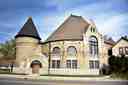
Right in front of you, you’ll see a unique, yellow-brick building with a tall conical tower on the left and a sixteen-sided, tent-like roof-look to the corner lot where Villa and Dupage Streets meet to spot its clockwork charm. Welcome to the First Universalist Church, where history ticks away as quietly as the pocket watches it was built to honor! Imagine you’re here in the year 1892: horse-drawn carts click-clack by on the cobblestone, and proud new bricks are being laid on this very corner. The architect George Hunter, a man with his head in the clouds and his heart shaped like a wristwatch, decided his church should look just like a giant pocket watch-now that’s what I call keeping the faith on time! The Universalists had been here since 1866, back when their first building, Unity Hall, stood right on this site. That same year, the National Watch Company factory opened nearby-both were new kids on the block, but quickly became the heartbeat of Elgin. Silvanus Wilcox, a church member, even gave some of the land for the factory. Thanks to the growing congregation, the Universalists needed a new space by 1890, and Hunter’s playful design came to life. Step back and take it in: those sixteen sides, the big arched stained-glass windows still catching the sun, and the tower rising like an old-fashioned watch snap. The pulpit inside? It sits right where the “12” would be on a watch’s face. The roof itself swoops down like the cover, as though you could flip it open to wind the gears of time. Inside, the church sang out with a $3,000 tracker pipe organ from John W. Steele & Sons-quite the extravagance for the time, and only one of ten of its kind! Wealthy factory donors helped make it possible. This building buzzed with community life: new churches got started here, and townsfolk came for events and gatherings. You might catch a whiff of pipe smoke, hear a hymn echo off the arches, or spot a parade of hats and bonnets as the crowd rushed in on Sunday mornings. After the famous Elgin factory vanished in 1966, this whimsical church stood as a time capsule-one of Elgin’s last reminders of its watchmaking heyday. Even today, it’s a loving echo of a city where every second counted. And hey, if you ever wonder what time it is, just look at the church-Elgin’s most stylish timepiece!
専用ページを開く →To spot the Elgin Historic District, look ahead for a cluster of charming old houses and grand churches surrounding a leafy park-you’ll see a bronze World War I soldier statue,…もっと読む折りたたむ
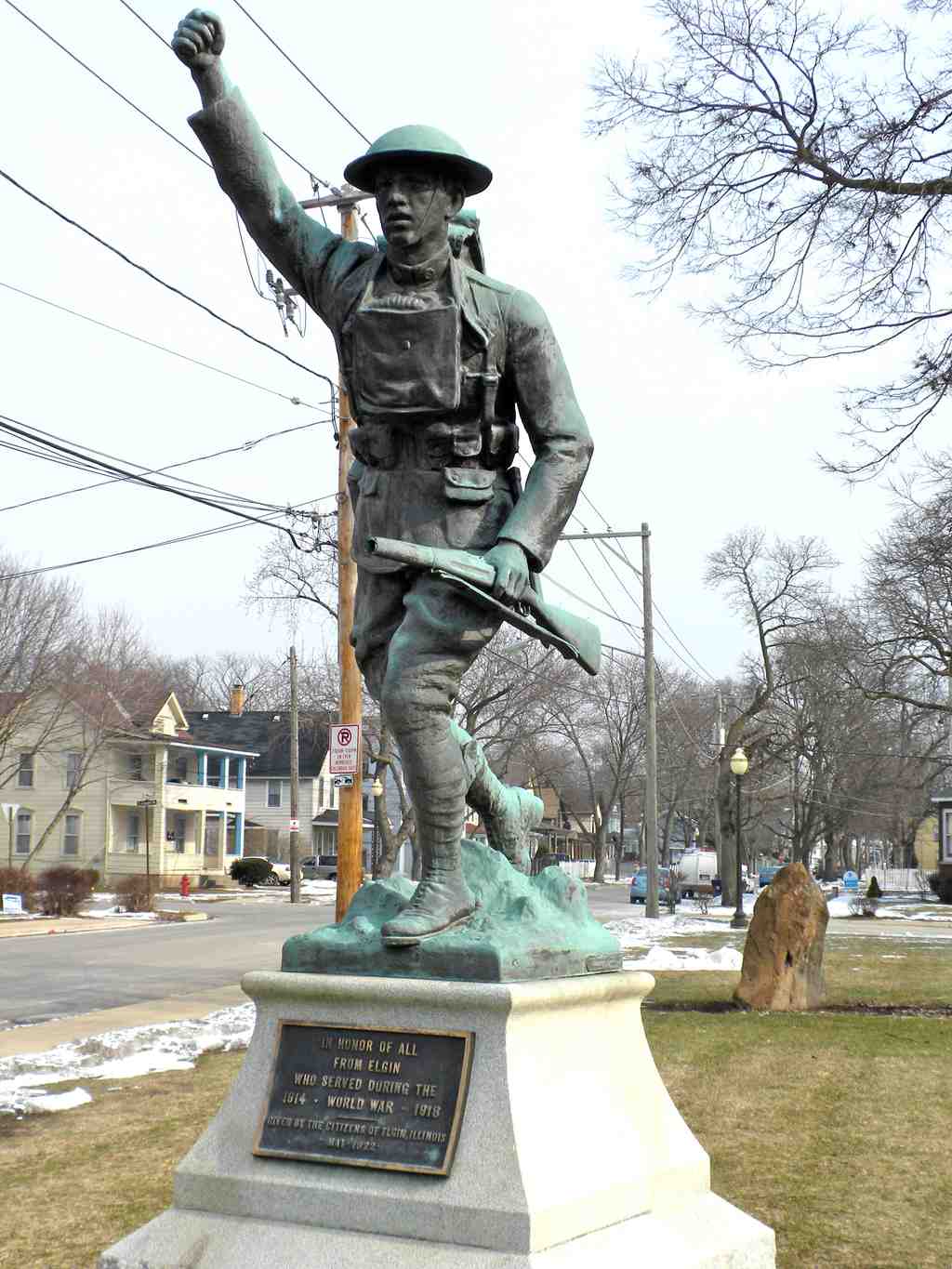
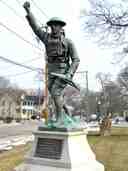
To spot the Elgin Historic District, look ahead for a cluster of charming old houses and grand churches surrounding a leafy park-you’ll see a bronze World War I soldier statue, hand raised in salute, standing proudly at the intersection. Now that you’re right here at the heart of Elgin’s oldest neighborhood, travel back with me to 1835. Imagine this spot as a patchwork of wild prairie, tall grass, and the hopeful echo of wagon wheels-James Talcott Gifford, Elgin’s restless founder, built a tiny cabin just within sight. Let’s add a little drama: the first nights must have sounded like a symphony of nature and uncertainty. Two years later, Elgin’s first dam splashed to life, and by 1842, the plots for the town were drawn up-one for Gifford, one for progress. Gifford wasn’t resting though; by 1850, he’d built a solid cobblestone house that looked just like the stately homes back in his native New York, right here for you to see. As you walk this district, you’ll find the echoes of Elgin’s booms and busts. In the 1850s, the railroad rang through town-trains whistled, cows mooed, and almost overnight, Elgin became Chicago’s fridge, sending off waves of fresh milk and butter. Picture the mighty Gail Borden Jr., brainy and just a little bit stubborn, setting up the world’s largest condensed milk factory right here. You could practically smell sweet milk in the air. Don’t miss Elgin Academy, founded in 1856 to make sure brains grew along with businesses. By the late 1800s, Elgin was the home of THE pocket watch, as thousands worked elbow-to-elbow at the Elgin National Watch Company, each tick and tock carrying stories of precision and pride. This neighborhood became a living museum of American stories-art museums popping up, churches booming with hymns, and in 1924, a masonic temple big enough for a thousand secret handshakes. The district absorbed wave after wave of newcomers: German immigrants built their own stony church, publishers brought in books by the truckload, and artists made Academy Place glitter. If these old walls and cobblestones could talk, they’d whisper about neighbors gathering for ice cream socials, debate club banter, and perhaps even a pocket watch or two running a little late. Congratulations! You’ve just strolled through nearly two centuries of Elgin’s finest moments, right here in this unforgettable district.
専用ページを開く →
よくある質問
ツアーはどうやって始めますか?
購入後、AudaToursアプリをダウンロードして引き換えコードを入力してください。ツアーはすぐに開始できます。再生ボタンをタップして、GPSガイド付きルートに従うだけです。
ツアー中にインターネットは必要ですか?
いいえ!開始前にツアーをダウンロードしておけば、完全にオフラインで楽しめます。チャット機能のみインターネットが必要です。モバイルデータを節約するため、WiFi環境でのダウンロードをお勧めします。
これは団体ツアーですか?
いいえ、これはセルフガイド式のオーディオツアーです。ガイドや団体、決まったスケジュールに縛られることなく、スマホから流れるナレーションを聴きながら自分のペースで自由に探索できます。
ツアーの所要時間は?
ほとんどのツアーは60〜90分で完了しますが、ペースは完全に自由です。好きな時に一時停止したり、スポットを飛ばしたり、休憩を取ったりできます。
今日中にツアーを終えられない場合は?
問題ありません!ツアーには無期限でアクセスできます。明日、来週、あるいは来年でも、好きな時に再開できます。進行状況は保存されます。
どの言語が利用可能ですか?
すべてのツアーが50以上の言語に対応しています。コードを引き換える際にお好みの言語を選択してください。注意:ツアー生成後に言語を変更することはできません。
購入後、どこからツアーにアクセスできますか?
App StoreまたはGoogle Playから無料のAudaToursアプリをダウンロードしてください。メールで届いた引き換えコードを入力すると、ライブラリにツアーが表示され、ダウンロードして開始できるようになります。
もしツアーを楽しめなかった場合は、返金いたします。お問い合わせ先: [email protected]
以下の決済で安全にチェックアウト 


