
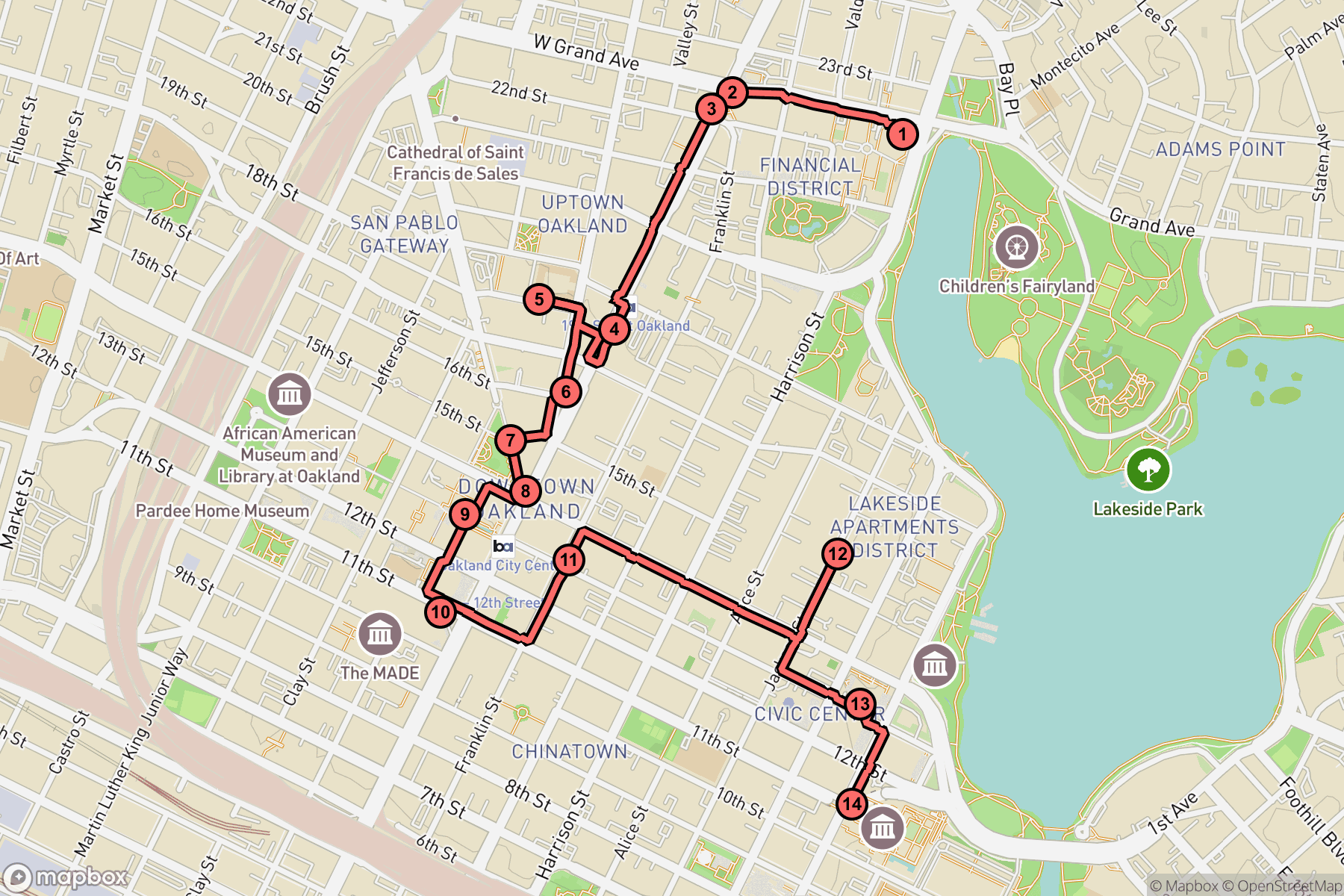
オークランド音声ツアー:ダウンタウンの革新と芸術の響き
メ Merritt 湖の上にはガラスの尖塔がそびえ立ち、オークランドの近代的なスカイラインの下には隠された反逆の歴史が響き渡ります。この活気ある街の通りには、伝説と秘密があなたの足元に潜んでいます。 ダウンタウン・オークランドを巡り、輝かしいキリストの光大聖堂を通り過ぎ、オークスターダムの過激な精神の中心へとあなたを誘うセルフガイド音声ツアーを始めましょう。地元の人々が夜な夜な語り合う、ほとんどの部外者には決して聞かれることのない物語を通して、この街を見てみましょう。 どのスキャンダルが聖なる聖域の静寂を打ち破ったのか?どのような失われた発明がオークランドの運命を永遠に変えかけたのか?何の変哲もないコーヒーショップからわずか数ブロックの場所で、誰が反乱の火をつけたのか? 抗議が勃発した路地を通り抜け、禁断の協定を目撃したガラスのアーチの下を進みましょう。一歩ごとに隠されたドラマと忘れ去られた希望が解き放たれます。オークランドの真のリズムを感じてください。 表面のさらに奥深くへ飛び込む準備はできましたか?再生ボタンを押して、街の隠された物語を生き生きとさせましょう。
ツアーのプレビュー
このツアーについて
- schedule所要時間 40–60 mins自分のペースで進める
- straightenウォーキングルート 4.9kmガイド付きパスに沿って進む
- location_on
- wifi_offオフライン対応一度のダウンロードでどこでも使える
- all_inclusive無期限アクセスいつでも、ずっと再生可能
- location_onキリストの光大聖堂(オークランド、カリフォルニア州)から開始
このツアーのスポット
To spot the Cathedral of Christ the Light, look for a strikingly modern glass and steel structure with a soaring, arch-like silhouette that rises far above the concrete plaza-it’s…もっと読む折りたたむ
To spot the Cathedral of Christ the Light, look for a strikingly modern glass and steel structure with a soaring, arch-like silhouette that rises far above the concrete plaza-it’s hard to miss its shimmering walls and sharp curves right here on Harrison Street. Now, imagine standing where you are, feeling the hum of the city drifting around you, and let’s dive into the story of this truly one-of-a-kind cathedral. The Cathedral of Christ the Light isn’t just another church-it’s a symbol of resilience, rebirth, and a dash of architectural boldness plopped smack in the middle of Oakland. Here’s a building that was dreamed up after the old Cathedral of Saint Francis de Sales was damaged beyond repair in the Loma Prieta earthquake of 1989. I’ll admit, that quake rattled a lot more than just the chandelier! When folks set out to build its replacement, they didn’t want just any cathedral; they wanted something that would make you stop, stare, and maybe scratch your head a bit. After all, how many cathedrals look like a glass spaceship that could double as Batman’s lair? The Catholic Diocese launched an international design competition, and for a while, it looked like a dazzling plan by famed Spanish architect Santiago Calatrava was going to win the day. But in a plot twist worthy of a good movie, another design was picked at the last minute, penned by Craig W. Hartman. You might already know his handiwork-he did the international terminal at SFO airport-so you know the man likes to think big. Hartman wanted the cathedral to feel like a bishop’s mitre if a bishop accidentally left it in a high-tech sawmill. The curved glass panels that soar above you aren’t just for show; they’re meant to filter the light the way the sun might break through a grove of redwood trees. Stand quiet for a moment and imagine a beam of sunlight flickering down, like something truly divine is about to happen. The main space is shaped like a vesica piscis-that’s the “fish bladder” shape created where two circles overlap. And if you look up, those fish scales made from overlapping wood and glass panels are a nod to the miracle of the loaves and the fishes, a motif from deep in the Christian tradition. Light is everywhere in here, with a massive “omega window”-a staggering 58 feet high-featuring a 3D image of Jesus Christ made solely by intricate holes in the aluminum. This design was inspired by a centuries-old cathedral in France. Inside, you might even catch the mighty organ-Orgues Létourneau Opus 118, with more than five thousand pipes-blasting out notes so powerful you might think the rafters themselves are going to ascend to heaven. But the Cathedral isn’t just about looks or grandeur. It’s a community hub with a real heart. There’s a health clinic run by the Order of Malta helping those without insurance, and a mausoleum below, where bishops and faithful alike find their resting place beneath your very feet. If you’re hungry, you can grab a pastry at City Lights Cafe or browse the Cathedral Shop-not exactly what you’d expect from most churches, right? Of course, it hasn’t all been incense and hallelujahs. Some worried about the spiraling $175 million cost, wondering if all those donations might be better spent helping Oakland’s poor or local schools. The church replied: “Hey, you can always visit Europe for a Gothic cathedral, but in Oakland you’ve got this!” And you know what? They were right. There’s even a small, quiet garden nearby, designed with survivors of clergy abuse to bring comfort and healing. It’s marked by a simple, powerful plaque that reads, “We remember, and we affirm: never again.” Talk about layers of history and meaning-you can literally walk from jaw-dropping architecture to a place of solemn reflection and back again. And every time an earthquake rumbles, folks can rest easy knowing this place is built to shake but not break. Solid, safe, and-if I’m being honest-pretty stunning to look at. So take a breath, open your eyes to light, glass, and hope splashed across the skyline, and enjoy a landmark that’s as uplifting in spirit as it is in height. Alright, onward to our next stop! Want to explore the design, organ or the costs and criticism in more depth? Join me in the chat section for a detailed discussion.
専用ページを開く →To spot the former site of the Key Route Inn, look for where a grand, castle-like timbered building once stood, complete with an archway big enough for a streetcar to roll…もっと読む折りたたむ
To spot the former site of the Key Route Inn, look for where a grand, castle-like timbered building once stood, complete with an archway big enough for a streetcar to roll straight through its heart-imagine a giant old English manor, right along what’s now West Grand Avenue. Alright, imagine you’re standing right where, over a century ago, one of Oakland’s most impressive hotels proudly stretched across the street, its mighty wooden beams and open timbering promising comfort and adventure. It was the Key Route Inn, a place that looked straight out of an English fairy tale-turrets, pointed gables, and even a giant American flag waving atop its central tower. But this wasn’t just for show: this hotel pulled off a magic trick you wouldn’t see anywhere else in the Bay Area! In the middle of its grand archway, streetcars from the Key Route zipped directly through, dropping off travelers into the lobby itself. Picture the rattle and clang of wheels and the buzz of guests arriving, all echoing beneath the hotel’s wooden rafters. This place overflowed with energy. Presidents-like William Howard Taft and his whole entourage-stayed here, maybe hoping the beds were as solid as the oak beams. Some say guests rushed their bags inside, eager to catch the next streetcar tram or just gawk at commuters chugging through the lobby. The whole building seemed almost alive, a crossroads for travelers, dreamers, and a few lucky bellhops. But fate, as it often does, had other plans. In 1930, a massive fire licked at the old timbers, and much of the magic began to fade. The city was changing fast, too, and soon, progress called for roads where once stood railway arches and chattering guests. Demolition crews moved in, and by the spring of 1932, the grand Key Route Inn was gone-just 25 years after its dramatic debut. Still, close your eyes and listen carefully; perhaps you’ll hear the faint whistle of a streetcar or the distant laughter from a bustling lobby, as if the past just doesn’t want to let go.
専用ページを開く →Look just ahead for a tall, pale-green building with vertical lines, dark windows, and a bright blue sign on the corner; that’s the Oakland Ballet’s home! Now that you’ve found…もっと読む折りたたむ
Look just ahead for a tall, pale-green building with vertical lines, dark windows, and a bright blue sign on the corner; that’s the Oakland Ballet’s home! Now that you’ve found it, let’s take a leap into the story of this dazzling company! Imagine walking through Oakland in the mid-1960s. The world is groovin’ to the Beatles, people are dreaming about the moon, and-right here-a local named Ronn Guidi is dreaming about ballet pirouetting its way into the city’s heart. In 1965, Ronn, an Oakland native with big ideas and even bigger dance moves, started the Oakland Ballet Company. At first, people didn’t know what to expect. Ballet in Oakland? Wasn’t that something you saw in Paris or New York? But Ronn wanted to prove the city could be just as graceful. Soon, the magic took hold. Audiences gasped as dancers brought to life the lost treasures of the legendary Ballets Russes, and stomped their feet to the wild-west energy of Billy the Kid. The company revived classic American stories and even invited Bay Area trailblazers to get creative on stage. Every performance felt like a secret door opened into a world of swirling costumes, daring leaps, and goosebump-inducing music. Ronn eventually passed the spotlight to Karen Brown, a former Dance Theatre of Harlem star. Under her direction, and then with new creative leaders, the company just kept dazzling Oakland, making ballet funky, fresh, and totally local. Today’s artistic director, Graham Lustig, is always cooking up new ideas-from wild Nutcracker shows to a summer Ballet Boot Camp where even shy ducklings get to feel like swans. Plus, Oakland Ballet is big on welcoming everyone, bringing dance straight into schools with their Discover Dance program. So as you stand here, imagine the press of toe shoes backstage, the musicians tuning up, the buzz of a crowd eager for something beautiful and unexpected. This isn’t just a ballet company-it’s a city’s wild, creative heart, skipping a beat just for you.
専用ページを開く →
さらに11件のスポットを表示表示するスポットを減らすexpand_moreexpand_less
Look for large, bold letters spelling “OSA” with the words “Oakland School for the Arts” below-you’ll find the school right next to the historic Fox Oakland Theatre, at the corner…もっと読む折りたたむ
Look for large, bold letters spelling “OSA” with the words “Oakland School for the Arts” below-you’ll find the school right next to the historic Fox Oakland Theatre, at the corner of 18th Street and Telegraph Avenue, where the energetic vibe of Uptown is hard to miss. Alright, let’s take you into a place where talent blooms like springtime in Oakland-welcome to the Oakland School for the Arts, a building that buzzes with rhythm, color, and the occasional tap dance echoing out the windows. Imagine you’re standing here in 2002, before the digital age took over every teenager’s pocket, and the city knew it needed something more than just numbers and science equations. Thanks to then-mayor Jerry Brown, who must have dreamed of jazz hands and oil paints all night, this school was born to blend serious, college-prep academics with the pulse of a real conservatory-style arts education. Standing here, you’re at the heart of the school’s creative storm-a place lit by spotlights, laughter, and occasionally that late-night “did you practice your scales?” panic. But it wasn’t always this way. In fact, if you squint very hard, you might see the ghosts of the building’s many past lives. Before the school moved to this spot beside the Fox Theater, it actually began in the Alice Arts Center downtown and spent time in temporary buildings that, honestly, were probably held together with a bit of duct tape and a lot of Broadway dreams. But in January 2009, when the Fox Oakland Theatre reopened after 30 years of silence, OSA moved in, bringing music, drama, and dance back to a landmark that had been dozing for decades. Suddenly, Uptown Oakland wasn’t just a spot on the map-it was a stage ready for action, and the city’s heart started beating in 4/4 time. At OSA, you don’t just find regular classrooms. You find dance studios where sneakers squeak across the floor, costume rooms that burst with color, and rehearsal spaces humming with hopeful voices. The school started with seven arts emphases: Theater, Dance, Literary Arts, Instrumental Music, Production Design, Visual Art, and Vocal Music. They even merged, split, and shuffled these programs-at one point, they even taught circus arts (imagine doing algebra while juggling clubs!). There was ice skating, too, at the nearby Oakland Ice Center-because hey, who says an artist can’t slide and sketch at the same time? Through its early years, OSA weathered storms-the kind with swirling faculty changes and management headaches. At one point, the turnover was faster than a jazz solo, but then things settled. By 2010, the staff was sticking around like happy stagehands, with retention rates soaring above 90%. Even when budget cuts threatened, the spirit of the place wouldn’t falter-artwork was made, music was played, and students kept dreaming. But for all its creativity, OSA has a side of academic muscle too. In its first years, it scored higher than any school in the area on state tests, and its graduation rate? Nearly 100 percent of students have crossed this stage, with 95 percent heading off to college. The very first graduating class-all of them-got into four-year colleges, which must have made every art teacher’s coffee taste extra sweet that day. And, let’s not forget the school’s sense of drama-it even spilled into the political world! Jerry Brown, ever the showman, used an enormous, glowing billboard to raise money for OSA. It was so bright, you’d probably need sunglasses just to look at it all the way from San Francisco. Some folks grumbled, but others called it the shining star of Oakland (or at least the thing that kept them awake on late-night drives). Every year, hopeful artists auditioned (sometimes twice in one season), showing faculty what they could do with a paintbrush, a pirouette, or a poem. But even that competitive tradition has shifted: as of 2020, the school is moving to a lottery system. That means if you’ve got the spark and you want in, you throw your name in the hat and cross your paint-stained fingers. Notable alumni? This place has been the launch pad for stars like Zendaya, Kehlani, and Angus Cloud-so if you hear a powerful voice, or spot some killer dance moves, you just might be in the presence of a future legend. Even figure skating prodigy Alysa Liu and author Leila Mottley passed through these halls. So as you stand here, soaking up the sounds and anticipation, remember: this isn’t just a school, it’s a living, breathing dream factory. The next standing ovation might just start with one shy kid, a bright stage light, and a heart full of wild, impossible hope. If you're keen on discovering more about the arts, admission or the ranking, head down to the chat section and engage with me.
専用ページを開く →Look ahead for a wide, open lawn surrounded by striking office buildings, and in the very heart of it all, you can't miss the mighty Coast Live Oak tree spreading its grand…もっと読む折りたたむ
Look ahead for a wide, open lawn surrounded by striking office buildings, and in the very heart of it all, you can't miss the mighty Coast Live Oak tree spreading its grand branches like it’s the proud conductor of a leafy orchestra-that, my friend, is Frank H. Ogawa Plaza. Alright, let’s take you back in time and set the scene. Imagine standing right where you are, one hundred years ago. Horses clop along the edge of a bustling park, Beaux-Arts buildings glimmer with hopes and secrets, and on occasion, someone is shouting lively speeches-maybe even a young Jack London, his words swirling through the crisp Bay air, making passersby stop and listen. Today, the city hums with cars and people, but this plaza is still all about gathering-sometimes to celebrate, sometimes to stand up for what’s right, and sometimes just to sit in the sun. This isn’t any ordinary green space. The Commons, with its raised lawn, feels like a green island in a sea of concrete, perfect for picnics or, if you’re brave, a spontaneous cartwheel. Over there, you might spot The Forum, an amphitheater echoing with music, rallies, and laughter during events like the annual Art and Soul Festival. You’ll notice how new buildings play nicely with the old ones, everyone dressed to impress in early 20th-century style. But the real star is that big oak tree right in the middle. That’s the symbol of Oakland, standing tall (well, sprawling would be more accurate-it’s really showing off) and reminding everyone, “Hey, you’re in Oakland now!” Nearby, keep an eye out for the bronze bust of Frank H. Ogawa himself-a civil rights leader who started life as a farm boy and grew into Oakland’s first Japanese American city council member. He served here for decades, always fighting for the people’s voice to be heard. This plaza has seen its share of drama, too. In 2011, the lawns filled with tents when Occupy Oakland set up camp, demanding a better future. Some claimed it was chaos, others said it brought community safety-either way, the air sizzled with passion. Protesters even gave it a fiercely hopeful new nickname: Oscar Grant Plaza, after a young local man who inspired waves of activism. So as you stand here, let your mind wander through old-time protests, lively concerts, and heartfelt speeches-Frank H. Ogawa Plaza has always been where Oakland comes together to dream, to shout, to remember, and to grow, just like that big beautiful oak. Now, are you feeling inspired or just tempted to find the next shady spot? Either way, the plaza’s got your back!
専用ページを開く →Picture it: the late 1950s, when the City of Oakland was dreaming big. City Center was just a twinkle in the eyes of city planners. Picture cozy Victorian and Italianate buildings…もっと読む折りたたむ
Picture it: the late 1950s, when the City of Oakland was dreaming big. City Center was just a twinkle in the eyes of city planners. Picture cozy Victorian and Italianate buildings standing shoulder-to-shoulder, their ornate facades packed with apartments, mom-and-pop shops, and perhaps a few raucous theaters-yes, Oakland had its Moulin Rouge! Instead of smoothies and salads to go, you might catch the scent of fresh bread drifting from Ratto’s delicatessen, a century-old neighborhood staple that stubbornly refused to be swallowed by bulldozers (thanks to some passionate protests). But change was on the menu. The city decided it wanted a gleaming new city center. Time for “Operation Padlock,” an unfortunately not-so-fun operation where residents of those hotels and shops found themselves evicted, almost overnight, for “code enforcement” reasons. And just like that, whole blocks were cleared out. The original plan was wild-up to 70 city blocks razed for a massive, enclosed mall, sparkling office towers, hotels, and even an aboveground parking fortress. But, as you might expect, there was a bit of a showdown. Local residents and the Downtown Property Owner’s Association raised their voices, and the plan shrank from a giant monster to just a dozen blocks. I guess you could say Oakland took the idea for a spin around the block before committing! It wasn’t all gloom and doom-the blueprints sketched out by William Liskamm and Rai Okamoto dazzled just enough to scoop up a 1966 Progressive Architecture Award. But as with most epic tales, progress was slow. The very first office building crept onto 14th and Broadway in 1973. Soon after, the Clorox Building-yes, that Clorox-shot up in 1976. But then it was as if City Center fell asleep, taking a nap through the late ‘70s and ‘80s, leaving most of the site echoing with only the sound of the wind and the ghosts of former residents. By the ‘90s, a new design came to the rescue: an outdoor mall, fresh office towers, and the restoration of some of the old street grid. Yet, just when Oakland was poised for glory, the Loma Prieta earthquake struck in 1989, followed by a recession. Instead of bustling with shoppers and office workers, City Center shuffled along, half-awake, until the mid-‘90s when the federal government stepped in-bringing the Ronald V. Dellums Federal Building and a wave of new footsteps. The tale keeps unfolding. Developers traded parcels like rare baseball cards; some planned high-rises materialized, others stayed dreams. In 2010, a major sale went down, the kind of deal that makes realtors happy for decades. Through all its ups and downs, the City Center you stand in today remains a monument to big ambitions, community spirit, and the enduring magic of Oakland’s downtown. By the way, if you hear murmurs on the wind, it’s probably just the old Moulin Rouge troupe complaining about modern parking rates! Shall we keep exploring?
専用ページを開く →It all started rather unexpectedly, as many great adventures do. Back in July 2008, Alex Handy, a tech journalist with a keen sense of lost treasures, stumbled upon some dusty but…もっと読む折りたたむ
It all started rather unexpectedly, as many great adventures do. Back in July 2008, Alex Handy, a tech journalist with a keen sense of lost treasures, stumbled upon some dusty but magical computer chips-those EPROMs-from the Atari and ColecoVision era at the Laney College flea market down the road. Not everyone would be excited about finding plastic chips that held ancient code, but to Alex, it was as if he’d discovered the Holy Grail of video game development. These chips had early, unfinished versions of games-a behind-the-scenes peek at how your favorite classics came to life, bug and all. Rather than keep these treasures to himself-or sell them to the highest bidder-Alex had a different idea: what if people could pick up a game controller and actually play through history? What if digital art and video games were preserved, not as antiques, but as interactive artifacts? With the help of volunteers, he launched The MADE’s first collection at GDC 2011, showing off a big, colorful poster that traced the complicated family tree of the video game industry. Pros who’d worked at famed studios signed beside their old stomping grounds, almost as if superheroes were autographing the pages of their origin stories. Securing a real home for the museum wasn’t exactly game over in the first level. There was a memorable journey through potential venues-including a spot once belonging to William Hearst, where the city’s newspapers thundered off presses by the ton. Eventually, with a little help from Oakland’s own City Hall, The MADE landed at 610 16th Street. But here’s a fun Oakland twist: their neighbors included the Mongolian Cultural Center and court-mandated anger management classes-so if someone raged while losing in a game, help wasn’t far away! Preservation here isn’t just about gathering old games. The MADE’s partners-Stanford, MIT, Archive.org, and even the Electronic Frontier Foundation-teamed up on projects like reviving Habitat, the world’s very first graphical massively multiplayer online game. If you’re a gamer, think of it as the great-grandparent of the games you love today. The museum helped change copyright law, letting people legally restore old games after their makers vanished. Pretty heroic, right? There have been some epic boss battles, too. In June 2015, the ceiling in The MADE’s classroom crashed down. That’s one way to test your reflexes! Undeterred, a Kickstarter helped relocate The MADE to a shiny 4,000-square-foot ground-floor spot on Broadway. The reopening in 2016 drew in crowds, eager to try hands-on exhibits and enroll in free programming workshops, from drawing 8-bit art to writing their own simple games using Scratch. On Saturday mornings, kids as young as nine tackle creative quests in code-no experience required, just a willingness to mash buttons and learn. As every gamer knows, sometimes the real world throws in its own cheat codes. The pandemic hit in 2020 and forced the museum into storage, with classic consoles and rare arcade machines tucked away like items in a treasure chest. Instead of going silent, MADE’s team launched a podcast, drawing stories from legendary developers like Will Wright-the mind behind SimCity-and even found time for a cameo in a NoClip documentary. In 2022, after two years in timeout, The MADE respawned in its new downtown Oakland home-right where you’re standing today. The reopening party sounded like a victory fanfare, with over a hundred visitors and industry stars like Diablo II’s Matt Householder signing items and swapping tales. In 2024, The MADE leveled up again: hiring its first full-time executive director, Mason Young. The mission? To keep digital art alive and playable for the next generation. Every week, there are game jams, speaker events, and epic tournaments-where nostalgia meets new discoveries. Somewhere inside, the Neohabitat project lives on, rebuilding Habitat from scratch with the help of volunteers like you-yes, you! So, as you stand here, savor the energy of a place where preserving the past means holding a controller, hitting start, and saying, “Let’s play!”
専用ページを開く →Picture Reverend Henry Durant and Dr. Samuel H. Willey, two visionary educators with dreams almost bigger than their hats, founding a school called the Contra Costa Academy. Back…もっと読む折りたたむ
Picture Reverend Henry Durant and Dr. Samuel H. Willey, two visionary educators with dreams almost bigger than their hats, founding a school called the Contra Costa Academy. Back then, their mission was simple (well, simple in theory!): give local boys a well-rounded education with a big emphasis on ancient Greek and Latin. The teachers, trustees, and supporters were an interesting blend of Congregationalists and Presbyterians-think of them as the original “Odd Couple” of education. Within two years, as interest in learning grew, those laughter-filled halls weren’t just echoing-they were bursting at the seams. By 1855, with help from government grants and a shiny new charter, Durant and Willey turned the Contra Costa Academy into the College of California, right here on these four blocks-Twelfth to Fourteenth Streets, from Franklin to Harrison. Close your eyes for a second and picture young students in woolen jackets, their noses buried in books, rushing between classes while horse-drawn wagons roll by. Right from the get-go, the college was less “Think Ivy League” and more “Think Prep-School Deluxe”-it was still mostly about getting kids ready for college, not being the college itself. It only started offering real college courses in 1860, so there might have been more Latin than calculus floating through the air. But as the city of Oakland boomed, so did distractions-noisy markets, saloons, and, yes, more cows. The faculty decided that the bright minds of the future needed some peace and quiet. So, in 1866, the college started eyeing some land far north of here, where the modern city of Berkeley would eventually pop up. Here’s where it gets dramatic: they needed a lot of land, and even more importantly, they needed water. I mean, nothing ruins a lecture on Homer’s Odyssey like a dry throat! So, they bought a big farm near the headwaters of Strawberry Creek and formed something with a very catchy name: the College Homestead Association. Their plan was to sell 128 plots of land to finance the new school. It might have worked if those plots had sold like hotcakes, but imagine a tumbleweed rolling across an empty street-sales moved more like molasses than maple syrup. While waiting for buyers, they got creative and formed the College Water Company, built a reservoir up in Strawberry Canyon, and tried selling running water to their potential neighbors-talk about a thirst for innovation! Meanwhile, there was another twist. The state government created the Agricultural, Mining, and Mechanical Arts College-in theory, at least. On paper, this college sounded grand, but in reality, it was just an empty folder used to scoop up federal funds from the Morrill Land-Grant Act. In 1867, Governor Frederick Low came knocking with a wild idea: “Why not mash up your land and ambition with our state funding?” After a good amount of hesitation and a few internal sighs, the College of California agreed… but only if a real liberal arts mission was baked into what would become the University of California. When the dust settled, the University of California was chartered in 1868. And here’s a bit of drama: the new university wasn’t a simple marriage. It was a completely new institution that barely nodded at its parents. The College of California hoped to have a say, but Governor Haight shut that door pretty fast-he said, “These gentlemen expected to have a good deal to say about organizing the University, but I’ll see that they don’t.” Ouch. Only two trustees and one professor from the College of California got seats at the new table. It took some legal wrangling, a “friendly lawsuit,” and a ruling from the California Supreme Court before the assets officially passed over. By 1873, the university packed its bags and moved-pomp, ceremony, and all-up the bay to Berkeley. Just think: where you stand was ground zero for all this intrigue, innovation, and a touch of real estate melodrama. Today, the official plaque marking the spot is on the corner of Franklin and 13th Street, although it’s sometimes hidden by the ever-changing city. If you listen closely, you might just hear the echoes of old debates, lessons, and dreams from over 150 years ago. And if you spot a confused academic spirit looking for the water company’s next customer, just point them towards Strawberry Creek! Ready to walk on to the next chapter?
専用ページを開く →To spot Downtown Oakland, just look for the cluster of tall office buildings and bustling city streets ahead of you, right where the city feels its most energetic-near Lake…もっと読む折りたたむ
To spot Downtown Oakland, just look for the cluster of tall office buildings and bustling city streets ahead of you, right where the city feels its most energetic-near Lake Merritt and framed by highways on the edge. Now, as you stand on the threshold of Downtown Oakland, get ready to step straight into the heartbeat of the city-where every corner has a story and every street seems to hum with the energy of both today and a couple centuries ago. Imagine, if you will, these bustling avenues echoing with the footsteps of pioneers, businesspeople, artists, and, of course, the occasional parade of black cowboys! Yes, you heard that right: once a year, Downtown Oakland bursts into a spectacle that you’ll find nowhere else-the Black Cowboy Parade. Early October mornings here start with the clippity-clop of horses, the proud shouts of parade marshals, and riders tipping their hats as they move from DeFremery Park to the heart of the city at Frank H. Ogawa Plaza. It’s a wild, joyful tribute to the unsung black cowboys who helped settle the West. This district hasn’t always been so lively. Think back to the late 1800s-these blocks between the Oakland Estuary and Lake Merritt were the cradle of old Oakland, marked by Victorian homes and small workshops, a sharp contrast to the flock of modern towers that now define the skyline. A few of those 19th-century houses still peek out from the corners, stubborn as ever, refusing to be hidden by all the glass and steel. Today, Downtown Oakland is a world of contrast and creativity. The area is home not just to business towers where suits rush past each morning, but also to artists, dancers, diners, and apartment dwellers who call old warehouses, new condos, or historic buildings home. City Center is the commercial bullseye, buzzing with retail shops, the head offices of Clorox, busy plazas, and an underground river of commuters pouring in and out of AC Transit and BART stations. Seriously, if you ever wanted a tour of subway stations, you’re in luck: three different BART stops link Oakland to the rest of the Bay Area, while AC Transit buses dart in from every direction, their stops a patchwork of locals, students, and late-night adventurers. And here’s a futuristic twist-Oakland is even planning a gondola lift! Picture cabins floating over Washington Street, carrying baseball fans to a new stadium at Jack London Square. The city in the sky is closer than you think. But never think the past is forgotten. The Downtown Oakland Historic District is proud enough to have a spot on the National Register of Historic Places, its 43 buildings and a scattering of old-fashioned sites quietly reminding you that history runs deep here. Preservation Park whispers tales of early civic leaders, the Old Oakland warehouses echo the booms and busts of trade, and the Lakeside Apartments district hints at a time when city planners first dreamed of urban lakeside living (before it was trendy). Culture pulses day and night along Broadway-once called Auto Row for its buzzing car dealerships and mechanic shops. Now, it’s better known for glittering marquees at the Fox and Paramount Theatres, where you’re as likely to catch a ballet as a rock concert. Chinatown beckons with the scent of dim sum, and Old Oakland calls with artisan coffee or the clang of a streetcar. Nearby, students spill out of Laney College, mixing with the swirl of international faces from Lincoln University, and cannabis workers-in-training from Oaksterdam University-a business school with a little “green” in the curriculum. And if you’re ever unsure of where you’re going, look for flower baskets hanging from lampposts or artful planter boxes: the Downtown and Lake Merritt community benefit districts have a knack for making things a little brighter, a little cleaner, and full of character. Volunteers and neighbors pitch in, keeping the plazas tidy and adding splashes of color to the urban sprawl. Of course, no city is without its struggles or its mysteries. Tragedy struck here in 2007, when journalist Chauncey Bailey lost his life at the crossroads of 14th and Alice. The city still remembers, and his story is now woven into the tapestry of these streets. So go on, breathe in the city air, listen to the echoes of history, and maybe wish for a gondola to spirit you away to the next adventure. Downtown Oakland welcomes explorers, dreamers, and even a joke-cracking tour guide or two. For further insights on the culture, land use and points of interest or the education, feel free to navigate to the chat section below and inquire.
専用ページを開く →Look up ahead and slightly to your left-spot the tall, narrow, pale building with elaborate gothic details standing at the tip of the intersection like it’s about to stroll right…もっと読む折りたたむ
Look up ahead and slightly to your left-spot the tall, narrow, pale building with elaborate gothic details standing at the tip of the intersection like it’s about to stroll right across the street. You’re now standing in front of Oakland’s one and only “Wedding Cake”-the Cathedral Building! Over a hundred years ago, in 1914, this marvelous Gothic Revival tower shot up above the city like a slice of New York’s Flatiron Building decided to come out west for some California sun. Designed by Benjamin Geer McDougall, its sharp, triangular shape is no accident-Telegraph Avenue and Broadway couldn’t agree which way to go, so the building squeezed right into the angle between them. Picture Oakland back in 1914: rattling streetcars, hats everywhere, and this futuristic skyscraper appearing like it was carved right out of a medieval dream. It was the first Gothic Revival skyscraper west of the Mississippi! Locals lovingly called it the Wedding Cake-though nobody’s tried to slice it yet, at least as far as I know. Peek up and you’ll see ornate spires and decorations, as if it’s wearing a crown. In 2015, the north wall got an upgrade-Bay Area artist Zio Ziegler painted a giant mural to honor the United Nations Charter, bringing fresh color and world history to the old stone. And get this: the third floor was featured as an apartment in the Oakland-based movie Sorry to Bother You. So while you’re gawking, just imagine all the stories stacked up in this tower, and the secrets it might be hiding behind each gothic window!
専用ページを開く →Oaksterdam might sound like a playful mashup of Oakland and Amsterdam, and that’s exactly what it is. The name was coined by Jim McClelland, an early activist and AIDS patient,…もっと読む折りたたむ
Oaksterdam might sound like a playful mashup of Oakland and Amsterdam, and that’s exactly what it is. The name was coined by Jim McClelland, an early activist and AIDS patient, who thought this spot needed its own identity. Think of it as the West Coast’s answer to Amsterdam’s famously relaxed attitude toward cannabis. Picture old-school buildings, blocks of charming shops, funky cafes, and streets alive with a kind of rebel spirit. Now, let’s wind back to 1996. Imagine Oakland as a place buzzing with change, where the Oakland Cannabis Buyers Cooperative was quietly making history. People with medical needs, desperate for relief, would slip through these very streets, hoping to find help. There was tension in the air as laws changed and activists pushed the boundaries. Proposition 215 had just passed, making medical marijuana legal under California law, but not, mind you, under federal law! Picture activists like Jim fighting for their right to care-sometimes with the support of the city, other times dodging federal raids that landed like thunderbolts. When the federal authorities shut down the original buyers’ cooperative, you’d think that’d be the end. But the spirit of Oaksterdam doesn’t quit easy! Some original members simply moved their operations around the corner and started from scratch-leading to a patchwork of dispensaries, like The Zoo and the Bulldog Coffee Shop, founded by Richard Lee. Lee dreamed up Oaksterdam University, right here at 1734 Telegraph Avenue, to help others figure out the fine points of cannabis cultivation, policy, and advocacy. At this university, you could learn anything from horticulture to legal rights-all with a side of witty banter. Oaksterdam’s journey hasn’t been smooth. Imagine: 2012. Oaksterdam University is humming along, students deep in discussion, and suddenly-bam-the IRS rushes in with an unexpected raid. But did the university close its doors? Not for long! In just two days, classes resumed, making the IRS look less like tough guys and more like annoyed substitute teachers. This neighborhood has always bounced back, powered by stubborn hope, a few good jokes, and the kind of people who hang in when the going gets tough. If you look around, you’ll see Oaksterdam isn’t all about cannabis. It’s got a little of everything: from Lincoln University and a glass-blowing school, to a Julia Morgan-designed building that first housed the Oakland YWCA and now stands as a silent sentinel to days gone by. It’s also home to specialty cake shops, musical instrument stores, a tea shop, a hydroponic supply nook, and even a spot for bicycle rentals-perfect for pedaling from a jazz club to a coffeehouse and back. Cannabis, of course, is still front and center. Since 2005, a small handful of licensed dispensaries can operate here, but they require strict patient paperwork-a doctor's note and an official ID. And if you ever wondered about “Measure Z clubs,” those are another Oaksterdam invention. The clubs sell cannabis treats to adults, with or without a prescription, making use of a local city initiative that says city police have bigger things to worry about-like, perhaps, jaywalking squirrels. You never know. And, true to its newspaper roots, Oaksterdam has even fostered its own alternative press. For years, the Oaksterdam News kept residents up to date on cannabis culture and community news. Later, West Coast Cannabis and the West Coast Leaf carried the torch, reaching hundreds of thousands of eager readers. Think of it as the local paper, just a bit more “green.” Right here in Oaksterdam, the air hums with stories of resistance, reinvention, and homegrown happiness. Whether you’re drawn by activism, history, or just the chance to sip tea in a place where almost anything feels possible, this district is living proof that a little stubbornness-and maybe some herbal inspiration-can transform a city block into something legendary. Now, take a deep breath-just the regular kind, unless you have the paperwork-and soak up the atmosphere. Oaksterdam is more than a neighborhood; it’s a movement, a memory, and a pretty groovy pit stop on our tour. Yearning to grasp further insights on the location and character, educational institutions or the neighborhood retail? Dive into the chat section below and ask away.
専用ページを開く →Before anyone dreamt of fancy apartments or Deco facades, the Ohlone people fished and hunted waterfowl here, their canoes gliding softly where AC Transit now rumbles. The Spanish…もっと読む折りたたむ
Before anyone dreamt of fancy apartments or Deco facades, the Ohlone people fished and hunted waterfowl here, their canoes gliding softly where AC Transit now rumbles. The Spanish crowned this land as Rancho San Antonio in 1820, gifting it to Sergeant Luis Maria Peralta. Fast forward a few decades, and after the gold rush fever hit in 1848, a wild cast of ambitious Americans, steered by lawyer Horace Carpentier, started snatching up and selling land-maybe through faith in U.S. law, maybe…not so much. Now, imagine yourself in 1869. Horses clop up Broadway, streetcars ding past as railroad travelers stagger off their trains, desperate for a soft bed and a hot meal. The grid of modern Oakland, mapped by Swiss engineer Julius Kellsburger, emerges. The new residents? They’re not shy about taking risks-the entrepreneurial spirit is strong in these city blocks! Big homes rose along the lake and spirited energy filled new streets. By the dazzling 1920s, the Lakeside Apartments District was booming. Imagine sleek apartment buildings and luxurious hotels mushrooming around you, all within strolling distance from the clattering streetcars. Maybe you fancy an Art Deco apartment or a posh hotel with a bellhop and a bit of jazz? Don’t trip over your top hat! Over the years, the neighborhood weathered a wave of changes, from horse-drawn streetcars to the silent arrival of BART beneath Broadway. Try to picture the hum of construction in the 1960s and 70s as new apartment buildings took root-Oakland’s answer to a housing jigsaw puzzle. There were even some dramatic city council stand-offs. When businesses tried to plow Alice Street straight through Snow Park (to “alleviate traffic,” as they claimed), the City Council put their foot down. In Oakland, even streets argue with each other. Today, Lakeside is a living museum of design-clubhouses, Deco towers, Victorian homes. Don’t miss the elegant Scottish Rite Center on Lakeside Drive or the neon lights of Ideal Cleaners-a place so charming even laundry feels historic. Or stand in awe at Camron-Stanford House-a real-life Victorian mansion-or try spotting the castle-like Tudor Hall that looks like it was imported straight from the English countryside. For a dash of modern, look up at Noble Tower, and for vintage sass, the Essex Condominiums wave from 2001. But it isn’t just architecture. Lakeside Park, just next door, wraps around Lake Merritt like a green velvet ribbon. Established in 1870, this was North America’s first official wildlife refuge-an oasis of birds, butterflies, and nature right in the city. If you shut your eyes, you can almost hear the quack of ducks and the chatter of birdwatchers. Art thrives here, too: the Malonga Casquelourd Center for the Arts on Alice Street has become a pulse point for African and Afro-Brazilian dance and music, drawing artists from all walks and all continents. Even the Oakland Ballet has practiced their pliés on these floors. Of course, Lakeside has always been a hive of transportation innovation. From the city’s first horse-drawn streetcars to modern BART and AC Transit routes, the area is the original “live, work, ride” neighborhood-no car necessary, thank you very much. On any given day you’ll spot cyclists whizzing past, AC buses hissing to a stop, and the occasional pedicab ringing its bell. Developers eye the sky-literally!-with proposals for soaring glass towers. Some folks want to keep things neighborly and historic, others see skyscrapers as future icons. Take the infamous “Trojan Tower,” for example: it lingered half-finished for years, earning its nickname thanks to its shrink-wrapped exterior. Don’t worry, it’s a proper building now! And the future? Well, that’s still a great debate, just as it’s always been in Lakeside. Will the next addition reach for the clouds or protect the roots? Only time will tell. So, as you walk through this district, know you’re treading on land that’s witnessed centuries of transformation-from oak groves and indigenous fishing grounds to a bustling, ever-evolving heart of Oakland. Whatever you do, don’t get too distracted by the skyline-after all, the coolest stories are often right there on the ground. Intrigued by the parks and community assets, schools and colleges or the land development? Explore further by joining me in the chat section below.
専用ページを開く →Look ahead for a large, white, rectangular building with tall windows and colorful banners on the upper walls, nestled among leafy green trees at the busy intersection of 14th…もっと読む折りたたむ
Look ahead for a large, white, rectangular building with tall windows and colorful banners on the upper walls, nestled among leafy green trees at the busy intersection of 14th Street-it’s Oakland’s Main Public Library! So, here you are in front of Oakland’s very own treasure chest-no, not filled with golden coins, but with about 1.5 million stories just waiting to leap off the shelves! Imagine yourself in 1878, when the city’s first public library, the Oakland Free Library, burst onto the scene. It wasn’t always free, though. Back in 1868, the Oakland Library Association was a subscription club, more exclusive than a speakeasy with a secret password. Then, thanks to the Rogers Free Library Act, the doors swung open for everyone-a bit like someone finally remembering to invite the whole neighborhood to the party. And what a party it became! The first librarian was none other than Ina Coolbrith, a poet with a knack for inspiring young readers. If you can picture her-her eyes gleaming with stories-she even nurtured legends like Jack London and Isadora Duncan, who’d sneak through these halls, maybe a little hesitant at first, only to be whisked away into worlds of adventure. Now, listen close......that’s young Jack London, probably trying to find a book about wolves or pirates. When Coolbrith’s time on the library stage ended, her nephew Henry Frank Peterson took over, determined to give the place a makeover that would make even Pinterest jealous: he tossed out dusty old routines and introduced the revolutionary card catalog! Suddenly, everyone could find their favorite tales and tall stories without an accidental trip to the cookbooks when they were looking for Shakespeare. One of the library’s later leaders, Charles S. Greene, kept the spirit alive, keeping the library’s doors wide open to everyone until 1926-imagine, almost three decades of shushing boisterous kids, helping curious minds, and keeping the peace in this ever-buzzing hive of stories. Mabel W. Thomas, chief reference librarian with a flair for all things California, started gathering up treasures for the beloved Oakland History Room in the 1940s-some say if you crack open a book there, you might hear the echoes of old cable cars and distant jazz. The building before you, at 125 14th Street, has welcomed readers since 1951. It's one of the Bay Area’s biggest library spaces, and inside, it’s as lively as a Saturday morning market. Stroll through, and you’ll find the pop and sizzle of the Children’s Room, the quiet hum of teens puzzling over mysteries in TeenZone, adults typing away in the public computer lab, and, tucked away, the Oakland History Room-packed with primary sources, rare books, and memories layered thicker than Grandma’s lasagna. But wait, there’s more! Can you smell the faint sharpness of metal and sawdust? That’s right-the Tool Lending Library lets you check out not just novels, but also hammers, wrenches, even cement mixers. Suddenly, getting your reading fix and fixing your broken fence don’t have to be two separate errands. And the library’s family tree doesn’t end here-there are 16 branches scattered from Brookfield to Rockridge. The César E. Chávez branch, named for the legendary workers’ rights hero, was a pioneer as one of the first totally Spanish-speaking libraries in the U.S., and the Melrose branch is a Classical Revival beauty that’s stood since 1916, making sure no neighborhood is left without a good story. A standout among branches is the African American Museum and Library at Oakland, or AAMLO, where the air practically crackles with history. It’s not just books-there are archives filled with letters, photos, oral histories, and even treasures relating to Martin Luther King Jr. and Malcolm X. Their two galleries host ever-changing exhibitions, shining a bright light on the African American experience in California. Whether you’re after the latest bestseller, a hammer to finally hang that picture, or a peek into Oakland’s past, the Main Library has your back. Picture the generations that have passed through these doors-the dreamers, builders, rebels, and bookworms. Today, it’s your turn to step inside. So, are you ready to lose yourself in the largest collection of the East Bay, or maybe just borrow a hammer and start a new adventure? The Oakland Public Library is waiting just for you! If you're curious about the main library, branches or the african american museum and library at oakland (aamlo), the chat section below is the perfect place to seek clarification.
専用ページを開く →To spot the Oakland Museum of California, look for a tall, bright orange sign with large silver letters right beside a concrete wall and some leafy trees, standing out boldly near…もっと読む折りたたむ
To spot the Oakland Museum of California, look for a tall, bright orange sign with large silver letters right beside a concrete wall and some leafy trees, standing out boldly near the corner of Oak Street. Welcome to the final stop on your Oakland adventure-the Oakland Museum of California, or OMCA for short! Take a look around: you’ll notice the bold, modern concrete architecture, the crisp lines, and-if you peek over the wall-some inviting terraces of rooftop gardens and patios. It’s almost as if the building is asking you to explore both outside and in. But to really appreciate where you’re standing, let’s travel back to the late 1960s, a time when picket signs, powerful voices, and the smell of protest hung in the Oakland air. Three smaller museums-a natural history museum, an art gallery, and a city history museum-decided to join forces like an all-star team for California’s story. Imagine these collections squeezed into old houses and auditoriums, stuffed with everything from Ohlone baskets to delicate photographs and vintage Gold Rush gear. They planned to create something much bigger and bolder, a true “people’s museum” that would welcome everyone in Oakland’s wildly varied community. So, how do you actually get 1.8 million objects-California’s art, history, and science-under one roof? Well, you start with a healthy dose of vision and, thanks to a $6.6 million voter-approved bond, plenty of cement and inspiration. The museum opened its doors in 1969, right next to the Alameda County Courthouse, where protesters were demanding justice for Huey Newton and voicing support for civil rights. The museum was literally born in the shadow of passionate change. The opening was about as smooth as a Bay Area earthquake. The museum’s first director, Jim Holliday, pushed hard for a real community voice-he wanted diverse advisors, lots of input, a new way of running things. The board wasn’t exactly ready for that level of revolution and let him go before the big opening. That decision sparked resignations and fired up even more debate, as staff and neighbors wondered: would this new museum truly belong to Oakland’s people? For a while, some folks even boycotted. Instead of giving up, the OMCA doubled down and turned controversy into creativity. They invited in Ben Hazard, a local artist who worked hand-in-hand with Oakland’s neighborhoods. Out of this, the Cultural and Ethnic Affairs Guild was born, a group that brought community-driven exhibits and celebrations, forming committees to ensure everyone’s stories were told. This energy still pulses through the museum today-every festival, exhibit, and gathering is shaped by the people who live right here. Let’s wander the building in our minds for a moment. It was designed by the modernist team of Roche-Dinkeloo, who made sure you could step outside from almost anywhere-so you might spot a kid catching ladybugs near the koi pond, or an artist painting in the rooftop garden. If you were here on a quiet morning, you could just hear the splash of water in that pond blending with the hum of city life in the distance. The museum’s three main tiers hold California’s treasures-from the wild peace sign sculpture on the roof (yes, it’s big, yellow, and impossible to miss!), to rare paintings, Dorothea Lange’s historic photos, and baskets woven by Ohlone elders, both old and new. OMCA’s renovation in recent years made it a sparkling, welcoming place. They’ve opened up the building even more-imagine sunlight streaming through wide courtyards, laughter echoing off the concrete as families gather for the Friday night block parties or art festivities. And they’re always thinking about the future: plans are already underway to break open new entrances, stretching the museum’s arms even wider to embrace the surrounding neighborhood and Lake Merritt beyond. Why is this museum unique? Well, if you’ve ever wanted to travel through time and culture without leaving one spot, this is your launchpad. Its collection covers everything from the tiniest bug, to the grand sweep of social justice history, and iconic California art. Even a glimpse at the old collections that started it all-a jade pagoda here, some snuff bottles there-reminds us that stories keep growing, just like Oakland itself. So, take a deep breath, soak up the sun and stories swirling right here, and remember: OMCA isn’t just a museum you visit; it’s a museum you become part of, every time someone new adds their chapter.
専用ページを開く →
よくある質問
ツアーはどうやって始めますか?
購入後、AudaToursアプリをダウンロードして引き換えコードを入力してください。ツアーはすぐに開始できます。再生ボタンをタップして、GPSガイド付きルートに従うだけです。
ツアー中にインターネットは必要ですか?
いいえ!開始前にツアーをダウンロードしておけば、完全にオフラインで楽しめます。チャット機能のみインターネットが必要です。モバイルデータを節約するため、WiFi環境でのダウンロードをお勧めします。
これは団体ツアーですか?
いいえ、これはセルフガイド式のオーディオツアーです。ガイドや団体、決まったスケジュールに縛られることなく、スマホから流れるナレーションを聴きながら自分のペースで自由に探索できます。
ツアーの所要時間は?
ほとんどのツアーは60〜90分で完了しますが、ペースは完全に自由です。好きな時に一時停止したり、スポットを飛ばしたり、休憩を取ったりできます。
今日中にツアーを終えられない場合は?
問題ありません!ツアーには無期限でアクセスできます。明日、来週、あるいは来年でも、好きな時に再開できます。進行状況は保存されます。
どの言語が利用可能ですか?
すべてのツアーが50以上の言語に対応しています。コードを引き換える際にお好みの言語を選択してください。注意:ツアー生成後に言語を変更することはできません。
購入後、どこからツアーにアクセスできますか?
App StoreまたはGoogle Playから無料のAudaToursアプリをダウンロードしてください。メールで届いた引き換えコードを入力すると、ライブラリにツアーが表示され、ダウンロードして開始できるようになります。
もしツアーを楽しめなかった場合は、返金いたします。お問い合わせ先: [email protected]
以下の決済で安全にチェックアウト 


