AudaTours logoAudaTours

ノッティンガム音声ツアー:歴史を巡る旅

starstarstarstarstar
5.01 件のレビュー
オーディオガイド12 か所

かつて古代の敵対する町々によって分断され、今なお反乱の音が響く都市、ノッティンガムの心臓は、現代の通りや壮麗なファサードの下で脈打っています。 このセルフガイド音声ツアーは、そびえ立つ大聖堂の尖塔から賑やかな市場、そしてほとんどの旅行者が見つけることのない秘密の場所へと歩きながら、隠された物語を解き明かします。 長く忘れ去られた反乱の最中、オールド・マーケット・スクエアを揺るがした未解決のスキャンダルとは?ノッティンガム大聖堂の祭壇の下には、どんな埋もれた秘密が囁かれているのでしょうか?ビクトリア・センター内にある風変わりな水力時計が、なぜ今日でも地元の人々の話題になっているのでしょうか? 象徴的なものと見過ごされがちなものの間を縫いながら、権力闘争、失われた財産、大胆な先見者、そして静かな反抗の行為をたどります。一歩ごとに、ドラマ、驚き、そしてノッティンガムの石に描かれた歴史の層へと深く引き込まれていきます。 表面の下に何が隠されているかを発見する勇気を持ってください。今すぐ旅を始め、この伝説的な都市がその真の姿を現すのを見てください。

ツアーのプレビュー

map

このツアーについて

  • schedule
    所要時間 40–60 mins自分のペースで進める
  • straighten
    ウォーキングルート 4.6kmガイド付きパスに沿って進む
  • location_on
  • wifi_off
    オフライン対応一度のダウンロードでどこでも使える
  • all_inclusive
    無期限アクセスいつでも、ずっと再生可能
  • location_on
    ノッティンガム大聖堂から開始

このツアーのスポット

  1. Now, this lovely cathedral was built between 1841 and 1844, costing a whopping £15,000 (which is equivalent to £1,600,000 in today's money, can you believe it?). The architect of…もっと読む折りたたむ

    Now, this lovely cathedral was built between 1841 and 1844, costing a whopping £15,000 (which is equivalent to £1,600,000 in today's money, can you believe it?). The architect of this beauty was Augustus Welby Northmore Pugin, who also designed the interior of The Houses of Parliament. Talk about impressive credentials! The cathedral was built in the Early English Plain Gothic style, but let me tell you, the Blessed Sacrament Chapel inside is opulently decorated. Pugin loved his decorations, but sadly, most of them were destroyed during the upheaval of the Second Vatican Council. However, you can still see some fragments of his work in the Blessed Sacrament chapel, which are the highlight of the interior. Now, not only is this cathedral historically significant, but it also houses the tomb of Venerable Mary Potter, the founder of the Little Company of Mary. Quite an esteemed resting place, wouldn't you say? By the way, did you know that the cathedral is embarking on a project to restore some of the original planned designs by A.W.N Pugin? They're even going to uncover the whitewash that covers the original decoration of the Lady Chapel. It's going to be a sight to behold! Alrighty, time to move on to our next stop! We'll be heading to the Old Market Square. Remember to keep your eyes peeled for any pigeons trying to steal your snacks! Let's go, my friend!

    専用ページを開く →
  2. Now, take a look around! On the eastern end of the square, you'll spot the grand Council House, which used to be Nottingham's town hall until it moved to the fancy Loxley House on…もっと読む折りたたむ

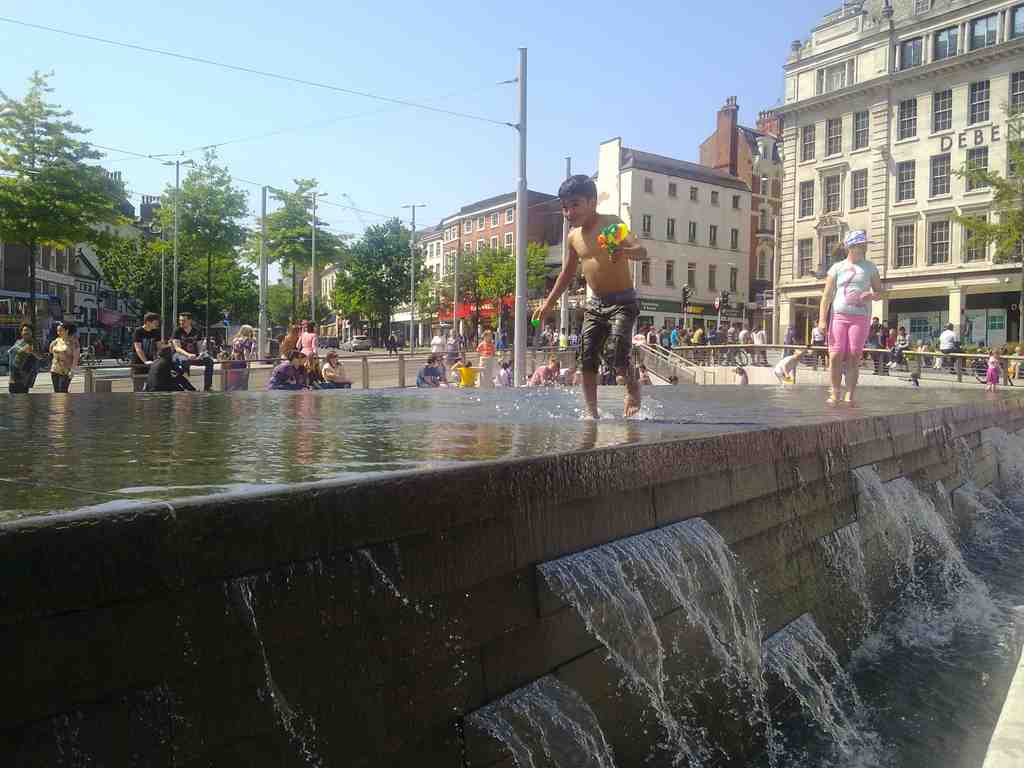
    Now, take a look around! On the eastern end of the square, you'll spot the grand Council House, which used to be Nottingham's town hall until it moved to the fancy Loxley House on Station Street. This place is bustling with life, hosting all sorts of events like fairs, concerts, exhibitions, and even vigils. We love to party! Did you know that this market square has been around for centuries? Back in the day, it marked the center-point between the Norman town of Nottingham, near the famous Castle Rock, and the old Anglo-Saxon town situated around the current Lace Market at St. Mary's Church. Talk about history, right? Oh, speaking of history, did you notice the stainless steel drainage channel running down the center of the square? That actually marks the spot where an old wall used to divide the two towns. Imagine, livestock on one side and agricultural feed on the other. It's like a farm version of Romeo and Juliet! Now, let me take you to our next stop, the Victoria Centre. It's just a short walk from here. Follow me!

    専用ページを開く →
  3. Ah, the Victoria Centre! It's like a shopping haven right in the heart of Nottingham. Originally built between 1967 and 1972, this place is not just your ordinary shopping center.…もっと読む折りたたむ

    Ah, the Victoria Centre! It's like a shopping haven right in the heart of Nottingham. Originally built between 1967 and 1972, this place is not just your ordinary shopping center. It's got it all! Fashion stores, high street chains, delicious cafes and restaurants, a health and fitness center, and even the Nottingham Victoria bus station. Talk about convenience, right? But here's a fun fact for you: Did you know that the Victoria Centre was actually built on the site of the old Nottingham Victoria railway station? Yep, that's right! The railway station was sadly demolished in 1967, but they kept the clock tower and the former Victoria Station Hotel, which is now run by Hilton Hotels. History meets modernity, don't you think? Oh, and let's not forget about the famous "water-powered" clock called The Aqua Horological Tintinnabulator. Quite a mouthful, isn't it? This kinetic sculpture was designed by Rowland Emett, a master of whimsical creations. Back in the day, it used to chime away every hour and half-hour, playing some fancy tune. Now, it's been refurbished and you can find it at the north end of the upper mall. It's quite the centerpiece and a great spot for a meet-up. So, are you ready for some more adventure? Our next stop is the Flying Horse Walk. Come along, my friend, and let's keep exploring!

    専用ページを開く →
さらに9件のスポットを表示表示するスポットを減らすexpand_moreexpand_less
  1. Now, let me tell you a little history about this place. The name Flying Horse Walk comes from a fifteenth-century public house called the Flying Horse Inn. See, back in the day,…もっと読む折りたたむ

    Now, let me tell you a little history about this place. The name Flying Horse Walk comes from a fifteenth-century public house called the Flying Horse Inn. See, back in the day, people used to ride horses and stop for a pint along this very walkway. The façade of this old inn has been preserved and is even listed as a Grade II building. So, while you're enjoying your shopping spree, take a moment to appreciate a piece of history. In 1935, they decided to give the place a makeover and in 1989, it was transformed into an entrance to the shopping centre. And boy, they pulled out all the stops! The Flying Horse Walk is now the entrance to a shopping haven, with horse sculptures adorning the façade and a complete refurbishment that has brought this arcade back to its former glory. It's like stepping into a luxurious time machine! London & County LLP took over the arcade in 2011, and they are planning to convert the upper floors into student accommodation. So, soon enough, students will be studying in a place that oozes style and history. Can you imagine trying to cram for an exam with all those fashionable distractions? It's both a blessing and a curse! But enough chitchat, my friend! We've got more exciting stops to explore. So lace up your walking shoes, and let's head to the next stop on our adventure - the Lace Market Theatre. Follow me!

    専用ページを開く →
  2. The theatre has quite an interesting history. It all started back in the 1920s with two amateur dramatic societies called the Nottingham Playgoers Club and the Nottingham…もっと読む折りたたむ

    The theatre has quite an interesting history. It all started back in the 1920s with two amateur dramatic societies called the Nottingham Playgoers Club and the Nottingham Philodramatic Society. These societies joined forces in 1946 to become the Nottingham Theatre Club. They initially set up shop in a school until they moved to Hutchinson Street, closer to the city center. But it wasn't until 1972, during a slum-clearance project, that the club found its current home in the Lace Market area. They converted a dilapidated paint store, which had once been a chapel built in 1761. Fun fact, William Booth, the founder of the Salvation Army, attended school here! It's quite a historic building and is even Grade II-listed. To make it even more impressive, the members of the club themselves carried out most of the renovations. They created a lovely 118-seat auditorium and an upstairs bar for smaller studio performances. They wanted to bring challenging plays to Nottingham, so people wouldn't have to travel all the way to London to see them. Way to save on train fare, right? The club has always believed in "training by doing," so they regularly staged small-scale productions in the bar area. These productions were called "Fents," in homage to the textile-making history of the Lace Market area. Can you imagine watching a play while sipping a cocktail in their bar? Sounds like a great night out to me! In 1977, the club seized the opportunity to expand by acquiring more land. This led to the formation of the Lace Market Theatre Trust Ltd, which helped raise funds for a three-storey extension. And guess what? They even received grants to support students pursuing drama school. Talk about supporting the next generation of performers! Now, here's a juicy tidbit: Prunella Scales and Timothy West became patrons of the theatre shortly after the extension was completed in 1984. And in 2012, Matthew Macfadyen and Keeley Hawes joined them as patrons. Joyce Redman was also a patron for many years, may she rest in peace. You'll be delighted to know that the Lace Market Theatre has been twinned with the Jakobus Theatre and Die Kaeuze in Germany since 1982. How cool is that? They even exchange productions with each other every few years. That's a long-distance theatre friendship if I've ever seen one! Alright, my friend, it's time to move on to our next stop. We're heading to the Lace Market, which is just a short stroll away. Lace up your walking shoes, and let's hit the pavement!

    専用ページを開く →
  3. Now, despite its name, there were no actual market stalls per se, but the Lace Market was bursting with 19th-century industrial architecture. The area is a protected heritage…もっと読む折りたたむ

    Now, despite its name, there were no actual market stalls per se, but the Lace Market was bursting with 19th-century industrial architecture. The area is a protected heritage site, which means we get to marvel at the Victorian beauty all around us. Keep an eye out for those red-brick buildings, towering 4 to 7 stories high. Oh, and how can we miss those iron railings, old gas lamps, and red phone boxes? It's like taking a trip back in time to Victorian England. One of the notable buildings here is the Adams Building, now part of Nottingham College's City campus. It was designed by a guy called Thomas Chambers Hine for a Quaker named Thomas Adams, who was determined to make Victorian factory conditions more bearable. Good on him! But wait, there's more! You'll also find a handsome Georgian street here called High Pavement. It's home to the Galleries of Justice and St. Mary's Church, which happens to be the oldest Christian Foundation in the city. St. Mary's Church is a sight to behold, completed way back in 1474 and boasting early English Perpendicular architecture. Talk about historical gems! Now, keep your eyes peeled for the distinct features in the area. You might notice turrets, gargoyles, and mock Tudor beams adorning shops, banks, houses, and even churches. These were the handiwork of a local architect named Watson Fothergill, who must have been quite the Gothic revival enthusiast in Victorian times. Just like many other British cities, the traditional lace industry in Nottingham faced a decline as technology advanced. But fear not! The Lace Market has had a fabulous renaissance and is now a shining example of post-industrial regeneration. Thanks to Operation Clean Up, which started in 1978, the area was spruced up with public grants, and many of the old warehouses got a new lease on life as luxury apartments, offices, and academic buildings. You know what else is cool? The National Justice Museum on High Pavement. It's housed in the old law courts and County Gaol, or County Goal if you ask the stonemason who made a little mistake while carving the inscription. Oopsie! You can even take tours of the old buildings and lace machines if you're feeling extra curious. To keep exploring, let's head to our next stop: High Pavement. Just follow me, and we'll continue our adventure through the marvelous streets of Nottingham!

    専用ページを開く →
  4. Ah, here we are at High Pavement, my friend! This street is one of the oldest and most charming in Nottingham. It's like stepping back in time with its beautiful listed…もっと読む折りたたむ

    Ah, here we are at High Pavement, my friend! This street is one of the oldest and most charming in Nottingham. It's like stepping back in time with its beautiful listed buildings. Back in the day, around 1681, a row of houses was built on the south side of St Mary's Churchyard, but they were eventually torn down in 1792 when the street was widened. Fun fact: a new wall was constructed along the south side of the churchyard during this time! In the Georgian era, High Pavement was the place to be for the fashionable residents of Nottingham. They knew how to live the high life here, quite literally! But let's not forget about some interesting events that took place on this street. In 1819, a gas lamp was installed at the top of Drury Hill, replacing the old whale oil lamps. Progress, am I right? And on August 10, 1864, the last public hanging in Nottingham was held here. It's a bit macabre, I know, but it's a part of our city's history. Now, let's take a look at some of the notable buildings on High Pavement. We have the Lace Museum, housed in the Urquhart House, which was once a grand residence. And then there's The Living Room, a trendy bar created by the developer George Fish. Perfect for a little pit stop, don't you think? We also have a shop that was rebuilt by the famous architect Watson Fothergill in 1898. His work always adds a touch of uniqueness. And just down the street, you'll find a house rebuilt by another talented architect, George Attenborough, in 1877. Did you know it was occupied by Renshaw, Shelton and Co in 1832? Quite the impressive tenant! Oh, and keep an eye out for number 23, County House. It has quite the history, once owned by Thomas Hutchinson and even briefly inhabited by Princess Louise, Duchess of Argyll. Talk about royal connections! Next, let's make our way to the Nottingham Crown Court, an important stop on our tour. Ready to continue our adventure? Follow me! The next stop on our tour is Nottingham Crown Court. Let's make our way there, shall we?

    専用ページを開く →
  5. Ah, welcome to Nottingham Crown Court! Or as I like to call it, the "place where justice is served with a side of drama." This magnificent building on Canal Street is not just…もっと読む折りたたむ

    Ah, welcome to Nottingham Crown Court! Or as I like to call it, the "place where justice is served with a side of drama." This magnificent building on Canal Street is not just your ordinary courthouse. It's actually the meeting place of the High Court of Justice and the Crown Court. Fancy, huh? Now, before this fancy courthouse was built, the Crown Court used to sit in the Shire Hall on High Pavement. But, as the number of court cases in Nottingham grew, they realized they needed a more substantial and sassy courthouse for all the criminal matters. So, the Lord Chancellor's Department picked this very spot on Canal Street, which was previously occupied by a row of shops, including a baker's shop owned by an amateur astronomer. I'm not sure if he used the stars to bake his bread, but it's certainly an interesting tidbit! This new building, designed by architects P. Harvard, K. Bates, and J. Mansell, is a sight to behold. It has a glass atrium that juts out, connecting two wings faced with extensive expanses of stone. It's like a fashion runway for justice! Inside, you'll find a whopping nine courtrooms. That's a lot of judgment going on! This place has seen its fair share of high-profile cases. Let me give you a sneak peek into some of the historic moments that have taken place here. We've got convictions for murders, attempted murders, and even some conspiracies. It's like a real-life crime thriller playing out right in our city! Okay, that's enough courtroom drama for now. Time to move on to our next stop! Make sure to grab your metaphorical gavel and follow me as we head to the Royal Children, Nottingham. It's just a short walk from here. Let's go!

    専用ページを開く →
  6. Now, let me tell you a fascinating story about how this place got its unusual name. Legend has it that the inn was named after the children of Princess Anne, the daughter of King…もっと読む折りたたむ

    Now, let me tell you a fascinating story about how this place got its unusual name. Legend has it that the inn was named after the children of Princess Anne, the daughter of King James II. During a tumultuous time in history when her father's reign was crumbling, Princess Anne sought refuge here in Nottingham. She arrived with some VIPs, including the Duchess of Marlborough and the Earl of Dorset. It was said that Princess Anne's children were given shelter at this very inn. But here's the funny part - none of Princess Anne's children who were born before her visit were still alive. Oops! Talk about some mixed-up historical facts. Her next child, Prince William, Duke of Gloucester, wasn't born until eight months after her visit to Nottingham. So, it seems like the name might be more of a fairy tale than a historical truth. Now, back to the pub itself. The earliest reference to this place is in 1799, when the Nottingham Directory lists the landlord as John Clayton. Over the years, it became tied to the Home Brewery Company and underwent a rebuilding phase in 1933-34. You know, renovations can sometimes be a headache, but I'm sure they did a splendid job. Oh, and don't forget to take a look inside! The sign that used to hang outside was actually a whale bone. Can you believe that? But to preserve it, they moved it inside. Just think, you can enjoy your pint while contemplating the mysteries of the sea! Alrighty then, my friends, it's time to move on to our next stop. Get ready for some theatrical magic, because we're heading to the Lace Market Theatre at stop number 5! Just follow me, and let the show begin!

    専用ページを開く →
  7. Back in 1068, just a couple of years after the famous Battle of Hastings, William the Conqueror ordered the construction of the first Norman castle on Castle Rock. It started off…もっと読む折りたたむ

    Back in 1068, just a couple of years after the famous Battle of Hastings, William the Conqueror ordered the construction of the first Norman castle on Castle Rock. It started off as a wooden structure, but it was later replaced by a stronger stone castle during the reign of King Henry II. This new castle had an impressive and complex design, with different sections like an upper bailey, a middle bailey containing the royal apartments, and a large outer bailey. Over the centuries, Nottingham Castle became a crucial fortress for nobles and royalty. Being strategically located near a river crossing and close to royal forests and hunting grounds, it served both as a stronghold and a place for leisure. Legend has it that this castle was even the scene of the final showdown between Robin Hood and the Sheriff of Nottingham! But let's fast-forward a bit. In the 17th century, the castle fell into decline and was eventually demolished after the English Civil War. However, in the 1670s, the first Duke of Newcastle, William Cavendish, and his son, the second Duke of Newcastle, decided to build a ducal mansion on the grounds. Unfortunately, this grand palace was burned by rioters in 1831. But fear not! The castle was later renovated in the 1870s and transformed into an art gallery and museum. Today, while much of the original castle is gone, you can still see remnants like the gatehouse and parts of the ramparts, giving you a sense of what it was like back in the day. Now, it's time to head to our next stop on this adventure. Get ready, because we're off to Nottingham Playhouse! Let's go and see what exciting performances await us there!

    専用ページを開く →
  8. Back in 1948, it started off as a repertory theater, performing in a former cinema on Goldsmith Street. Can you imagine that? Sitting in a cinema and suddenly being surrounded by…もっと読む折りたたむ

    Back in 1948, it started off as a repertory theater, performing in a former cinema on Goldsmith Street. Can you imagine that? Sitting in a cinema and suddenly being surrounded by actors and live performances? It must have been quite a surprise for the audience! But the theater got a major makeover in 1963 when the current building was opened. The architect, Peter Moro, had previously worked on the Royal Festival Hall in London, so you know he had quite the talent. The new Playhouse was a modern beauty, with a circular auditorium and a sleek exterior. However, some people found it a bit controversial because it faces the gothic revival Roman Catholic cathedral. Talk about a clash of styles! Over the years, the Playhouse has seen its fair share of changes and challenges. It had a not-so-great "refurbishment" in the 1980s that tried to hide its character, but luckily in 2004, it was sympathetically restored and refurbished. And guess what? It even won the Nottingham Pride of Place award as the city's favorite landmark! I guess you could say the Playhouse stole the show! Nowadays, the Playhouse is known for its diverse productions, ranging from classic plays to new works for children. They even have pantomimes! There's always something exciting happening on this stage. Oh, and before I forget, there's a cool sculpture called the Sky Mirror by Anish Kapoor installed nearby. It's definitely worth checking out! Alright, time to move on to our next stop. Buckle up and let's head to Park Tunnel. Just follow me, and I'll make sure you don't get lost in the dark!

    専用ページを開く →
  9. Alright folks, welcome to the Park Tunnel, a hidden gem right here in Nottingham! Now, let me give you the lowdown on this historic beauty. Built back in 1855, the Park Tunnel…もっと読む折りたたむ

    Alright folks, welcome to the Park Tunnel, a hidden gem right here in Nottingham! Now, let me give you the lowdown on this historic beauty. Built back in 1855, the Park Tunnel connects The Park Estate with Derby Road. It's quite the landmark, listed as a Grade II listed building. You know, it must be something special if it has its own entry number - 1059025. Fancy! Now here's a cool fact - the tunnel stretches out to about 125 meters, or 410 feet, and right in the middle, there's a nice open section around 25 meters, or 82 feet long. Natural light and ventilation, folks! Gotta give credit where it's due. To get to the tunnel from The Park Estate, you'll find Tunnel Road leading you there. And let me tell you, the original intention of this tunnel was all about wheels! Carriages were supposed to glide in and out smoothly on a ramped access. Fancy-schmancy, right? Now, as you make your way through the tunnel, you'll notice it's carved out of the natural Nottingham Castle Sandstone. But don't fret, there's a cool open section in the center for some fresh air and a bit of sunshine. And hey, there's even a snazzy staircase wrapping around the walls that takes you up to the junction of the Ropewalk and Upper College Street. I'll let you decide if the view is worth the climb! The tunnel keeps on going, passing under College Street as it rises up to meet Derby Road. But it's been through some changes, thanks to those pesky building works. Access to Derby Road now requires you to take a flight of stairs up into the car park of the building above. Hey, a little workout never hurt anyone! Now, let's talk about The Park Estate, a little slice of history. Back in the day, it was the private hunting ground for the Duke of Newcastle, who also happened to own Nottingham Castle right next door. The fancy Fifth Duke of Newcastle brought in the talented architect Thomas Chambers Hine to design and build the Park Tunnel. The plan was to create a swanky entrance to the Park and make it a residential area for the posh folks in Nottingham. You got some serious style, T.C. Hine! But, here's a little twist: the tunnel didn't quite live up to its original purpose. It was meant for horse-drawn carriages, but the steep gradient of 1 in 12 proved a bit too much for them. Oops! Lucky for us, though, the tunnel still serves a purpose. It's still open to pedestrians, giving us a cool passageway to explore. So, there you have it, the Park Tunnel! A little bit of history, a little bit of charm, and a whole lot of character. Hope you enjoyed this stop on our tour of Nottingham. Now, let's move on to the next adventure!

    専用ページを開く →

レビュー

5.0
starstarstarstarstar
1 件のレビュー

よくある質問

ツアーはどうやって始めますか?

購入後、AudaToursアプリをダウンロードして引き換えコードを入力してください。ツアーはすぐに開始できます。再生ボタンをタップして、GPSガイド付きルートに従うだけです。

ツアー中にインターネットは必要ですか?

いいえ!開始前にツアーをダウンロードしておけば、完全にオフラインで楽しめます。チャット機能のみインターネットが必要です。モバイルデータを節約するため、WiFi環境でのダウンロードをお勧めします。

これは団体ツアーですか?

いいえ、これはセルフガイド式のオーディオツアーです。ガイドや団体、決まったスケジュールに縛られることなく、スマホから流れるナレーションを聴きながら自分のペースで自由に探索できます。

ツアーの所要時間は?

ほとんどのツアーは60〜90分で完了しますが、ペースは完全に自由です。好きな時に一時停止したり、スポットを飛ばしたり、休憩を取ったりできます。

今日中にツアーを終えられない場合は?

問題ありません!ツアーには無期限でアクセスできます。明日、来週、あるいは来年でも、好きな時に再開できます。進行状況は保存されます。

どの言語が利用可能ですか?

すべてのツアーが50以上の言語に対応しています。コードを引き換える際にお好みの言語を選択してください。注意:ツアー生成後に言語を変更することはできません。

購入後、どこからツアーにアクセスできますか?

App StoreまたはGoogle Playから無料のAudaToursアプリをダウンロードしてください。メールで届いた引き換えコードを入力すると、ライブラリにツアーが表示され、ダウンロードして開始できるようになります。

verified_user
満足保証

もしツアーを楽しめなかった場合は、返金いたします。お問い合わせ先: [email protected]

以下の決済で安全にチェックアウト

Apple PayGoogle PayVisaMastercardPayPal

AudaTours: オーディオツアー

楽しくて手頃なセルフガイド式ウォーキングツアー

アプリを試す arrow_forward

世界中の旅行者に愛されています

format_quote このツアーは街を見るのに本当に良い方法でした。ストーリーは作り込まれすぎず面白くて、自分のペースで探索できるのが良かったです。
format_quote 観光客気分になりすぎず、ブライトンを知るためのしっかりとした方法でした。ナレーションには深みと文脈がありました。
Christoph
Christoph
starstarstarstarstar
ブライトン・ツアー arrow_forward
format_quote 片手にクロワッサンを持ち、期待ゼロで始めました。アプリはただ一緒にいてくれる感じで、プレッシャーもなく、クールな物語を楽しめました。

オーディオツアー使い放題

世界中のすべてのツアーをアンロック

0 ツアー·0 都市·0 国
all_inclusive アンリミテッドを探索