カークウォール音声ツアー:カークウォールの歴史的な鼓動ツアー
かつてオークニーの薄明かりの中で深紅の王冠が輝き、カークウォールの風が吹き荒れる通りには秘密がこだましていた。これらの古代の石の下では、裏切り、反乱、そしてありそうもない奇跡の伝説が今も息づいている。 このセルフガイド音声ツアーは、絵葉書のような外観の先へ、聖マグナス大聖堂、司教宮殿、伯爵宮殿、そして近くの隠れた場所の影の回廊や壮大な広間へとあなたを誘う。ほとんどの訪問者が見過ごしてしまう物語を発見しよう。 そびえ立つアーチの下で、誰がたった一夜の血なまぐさい夜にオークニーの運命を変える陰謀を企てたのか?なぜ一介の石工が、何世紀にもわたって波紋を広げた未解決の謎を引き起こしたのか?普通のドアの上に刻まれた謎のルーン文字の碑文に何が本当に起こったのか? 陰謀の空気が張り詰める石畳の道をさまよってみよう。壮大な石造りの建物から廃墟となった塔へと歩くにつれて、忘れ去られたささやきが蘇るのを聞こう。一歩ごとにドラマと畏敬の念が明らかになる。カークウォールを遺物としてではなく、あなたの足跡を待つ生きた物語として見てみよう。 カークウォールの隠された章を解き明かす準備はできたか?再生ボタンを押して、物語を始めよう。
ツアーのプレビュー
このツアーについて
- schedule所要時間 30–50 mins自分のペースで進める
- straightenウォーキングルート 4.0kmガイド付きパスに沿って進む
- location_on
- wifi_offオフライン対応一度のダウンロードでどこでも使える
- all_inclusive無期限アクセスいつでも、ずっと再生可能
- location_onオークニー図書館・公文書館から開始
このツアーのスポット
To spot the Orkney Library and Archive, look for a modern building with a large, glass-fronted entrance and a curved metal canopy, set beside a courtyard dotted with stone spheres…もっと読む折りたたむ
To spot the Orkney Library and Archive, look for a modern building with a large, glass-fronted entrance and a curved metal canopy, set beside a courtyard dotted with stone spheres and circular benches. Welcome to the grand Orkney Library and Archive! If you’re wondering whether you’ve found the right place, just look for those round stone balls on the ground - Orkney’s version of marbles for giants - and the arching glass entry that looks a bit like it’s smiling, ready to welcome book lovers and curious minds. Now, let’s set the scene. Imagine Kirkwall in 1683. There are no eBooks here, just wind, sea spray, and a handful of people hoping to bring wisdom to the wild Orkney Isles. Along comes William Baikie, eyes twinkling, arms heavy with the careful bequest of 150 precious books. He had no idea he was planting the seed for what would become the oldest public library in Scotland! The books made their rounds - from local manse to the echoey halls of St Magnus Cathedral, and even to the old Tollbooth, each place tinged with stories and the soft shuffle of turning pages. By 1815, the library was so loved that locals put some coins together and made it a proper club. For years, only subscribers could step inside - you couldn’t just wander in for a spot of reading unless you were in the club! But all that changed in 1890, when Andrew Carnegie, library superhero, swooped in with a donation that let the Orkney Library become truly public. Picture excited townsfolk on opening day in 1909, a few probably tripping over those stone marbles outside. The library finally settled into its bright and modern home, right where you’re standing, in 2003. Inside, over 145,000 treasures await - from worn old maps to the latest crime thriller. And if you listen really hard, you can almost hear the echo of feisty Twitter banter with Shetland Library, the archive’s quiet gossip about local legends, or maybe even the surprised gasp when J.K. Rowling dropped by unannounced. Here at Orkney Library and Archive, every corner whispers a story, just waiting for you to discover it.
専用ページを開く →You’ll spot Balfour Hospital as a large, modern, curved white building set lower than the houses around it-with its gleaming walls and broad glass front, just look downhill and…もっと読む折りたたむ
You’ll spot Balfour Hospital as a large, modern, curved white building set lower than the houses around it-with its gleaming walls and broad glass front, just look downhill and you can’t miss it! Now, take a deep breath of that crisp Orkney air and imagine we’ve rolled back the clock to 1836. The story of Balfour Hospital begins when John Balfour of Trenabie decided his big idea was better than any old birthday present-he set up a trust with the interest from £20,000 worth of Mexican government bonds, all to build a hospital. Not your average piggy bank, right? Let’s fast forward to 1845, when the guardians of the fund bought a house from a local merchant, along with two big gardens and a blacksmith’s shop-because you know, every hospital needs at least one place nearby to fix horseshoes or the odd runaway wheelbarrow. At first, it was simply called Orkney Hospital. But in 1853, the Balfour family name was slapped onto the building-a bit of well-earned bragging rights. If you squint back in time, you might see patients peering out of old stone windows or hear the clatter of horse-drawn carriages rumbling over the cobblestones to the door. By 1927, Orkney had outgrown its first hospital, so a purpose-built building went up on New Scapa Road. As the years ticked by, new wings and wards opened their doors-like the Macmillan House for cancer patients, and later, the Groundwater Suite in 2011. This brought shiny new kit: an operating theatre, sterilizing department, and even a modern x-ray unit. It was named for Bill Groundwater, a local surgeon who stitched up more than a few Orcadians and stories over the years. Now, the hospital you see in front of you is a dazzling 2019 model-costing a cool £65 million and designed with the future in mind. It’s the UK’s very first net-zero hospital, running almost entirely on electricity from air-to-water heat pumps and topped with solar panels. Just imagine the hum of futuristic tech as it keeps things comfortable inside, even if the Orkney weather outside is doing its worst. Today, nearly 136 babies arrive here each year-every one getting a first breath of Orkney air-while the hospital’s six wards bustle with patients and staff. Sure, there’ve been bumps on the road, with headlines about high mortality rates and a closed high dependency unit, but Balfour Hospital is a symbol of local resilience, innovation, and community care. From Mexican bonds to solar panels, this place has always believed in a brighter, healthier tomorrow. So wave hello to the future-who knows, maybe it’s already peeking out one of those big hospital windows!
専用ページを開く →Right in front of you, look for a solid stone building with a round tower rising up near the corner - a small castle-like ruin perched beside the road, just across from the white…もっと読む折りたたむ
Right in front of you, look for a solid stone building with a round tower rising up near the corner - a small castle-like ruin perched beside the road, just across from the white cottages. Now, take a moment to picture the scene here nearly 900 years ago. The Bishop’s Palace was once the grand home of William the Old - Orkney’s very first bishop, whose job title sounded almost as mysterious as his house! When this palace was fresh, it stood proud beside St Magnus Cathedral, towering above the town like a royal fortress. Walk a little closer and you can almost feel the chill of ancient stone under your hand, and hear the soft echo of footsteps on old flagstones. Now, imagine a cold, stormy night in 1263. Inside these very walls, King Haakon IV of Norway - the last Viking king to ever rule these islands - spent his final days. Outside, the winds whipped against those thick walls, and the world changed forever as Norse rule slipped away. But don’t worry, the ghosts of the Vikings are friendly these days - sometimes they just want to know how to use a microwave! After King Haakon’s passing, the palace fell into sorrowful ruin for a time, stones crumbling and windows blowing through with Orkney winds. Yet, history never left the Bishop’s Palace alone for long. There were daring attempts to seize it, like in 1526, when William, Lord Sinclair got his hands on it, only to be ordered by the king to give it right back - maybe he just fancied a better view than his own house. In 1540, Scottish troops stormed through these halls, boots thumping as they were garrisoned during King James V’s visit. But the real fireworks came in 1557. Ships from England arrived, with fleets commanded by William Woodhouse and John Clere, their sails snapping in the wind. Troops burst onto the scene, clashing within sight of the cathedral, as the Bishop’s Palace became the prize in a desperate struggle. In a dramatic twist, the English were thrown back, and many, including their commander Clere, drowned trying to escape to their ships - perhaps learning the hard way that Orkney waters prefer locals! As centuries passed, the palace changed hands with every twist of fortune: from bishops to earls, through sieges, betrayals, and debts. Eventually, nature and time won out, leaving the stone ruins you see today: haunted by tales and watched over by the round “Moosie Toor” - the tower built by Bishop Robert Reid, who also helped found Edinburgh University. These days, it might not have a bishop, but it still has stories to spare. If only these walls could talk, they'd probably have a punchline ready, too!
専用ページを開く →
さらに8件のスポットを表示表示するスポットを減らすexpand_moreexpand_less
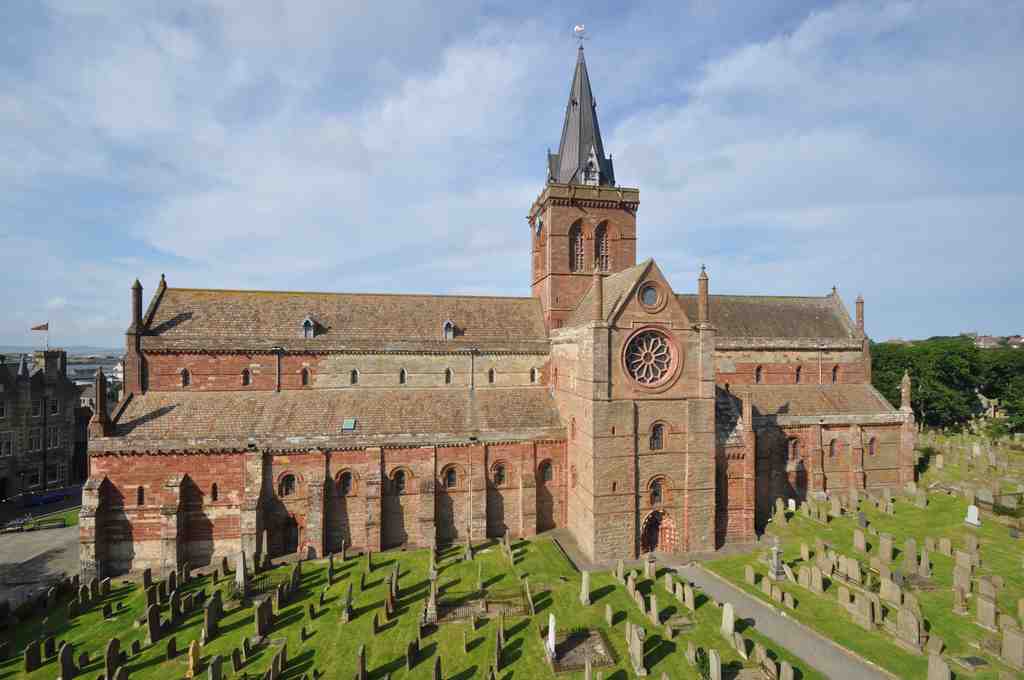
To spot St Magnus Cathedral, look straight ahead for a gigantic red sandstone church with a tall central spire and a striking rose window above the front entrance-it towers over…もっと読む折りたたむ
To spot St Magnus Cathedral, look straight ahead for a gigantic red sandstone church with a tall central spire and a striking rose window above the front entrance-it towers over the gravestones and is almost impossible to miss against the Kirkwall skyline. Alright, are your feet ready for a time-travel adventure? Because you’re standing in front of the beating heart of Orkney’s history! St Magnus Cathedral isn’t just the oldest cathedral in Scotland-it’s the most northerly one anywhere in the UK. Originally built by the Norse rulers when Orkney was practically a Viking outpost, this mighty church looks like it could shrug off a Scottish winter storm with its thick, striped walls of red and yellow sandstone. Seriously, whoever designed this masterpiece in 1137 didn’t skimp on the stone! Now, as you gaze up at that spire, imagine a long-ago Kirkwall alive with construction. The talented stonemasons-maybe still brushing the sand off their boots from Durham-stacked stones in chequerboard patterns, making the walls look like a medieval patchwork quilt. The air would have echoed with shouts in Old Norse, hints of laughter, and the clatter of carts hauling rock from the quarries. But the reason any of this exists? Oh, it’s quite a tale! It all begins with Magnus, a gentle, pious soul who’d rather sing a hymn than swing a sword. When he refused to fight on a Viking raid in Wales, his peaceful ways made him a saint in the eyes of the people-but not so much in the eyes of his cousin Håkon, who did what cousins do best: betray him with extra ships and a hidden axe. Poor Magnus was captured, and when push came to shove, it was Håkon’s cook who delivered the fatal blow. You think your family reunions are tense? Magnus was buried in Birsay, where the rocky ground turned lush and green around his grave. Miracles were rumored-healings, visions-and the Bishop of Orkney, who’d scoffed at it all, suddenly found himself temporarily blind. That’ll make you reconsider your skepticism! Fast forward to Magnus’s nephew, Rögnvald, who arrives on the scene, itching for his share of the earldom. When power wasn’t handed over easily, Rögnvald promised the islanders a church larger and more glorious than any before, dedicated to the now-saintly Magnus. The people agreed, maybe a little dazzled by all the stonework potential, and work began. Relics of St Magnus were brought here, and for centuries, pilgrims journeyed to this very spot with hopes, prayers, and maybe a sore back from walking all the way from the ferry. This cathedral’s long stone arms have seen almost a millennium of drama. It’s survived sieges, fires, and even the wild plans of would-be castle bashers. In 1614, after rebels made mischief in Kirkwall Castle, the crown’s soldiers wanted to destroy St Magnus Cathedral too. Only quick-some would say holy-intervention by Bishop James Law saved it from doom. There’s a touch of the bizarre here too: from the late 1500s to the early 1700s, this cathedral had its own dungeon, Marwick's Hole, where people accused of witchcraft waited for their trial, sometimes for the last time. The stone floor has seen scratchy feet and desperate hopes-an unusual “parish prison” right in the middle of a house of worship. And let’s not forget, this isn’t just a church. It’s a library of memory, crammed with stories. Among the memorials inside, you’ll find tributes to famous Orcadians: explorers, writers, and artists who all came to rest beneath these soaring arches. When the light catches the stained glass on a rare sunny Orkney day, it’s easy to imagine all those voices swirling overhead. But even buildings need a little TLC. Over the centuries, the tower was fried by lightning, the bells tumbled, and repairs had to be made-sometimes with a little extra copper shine or a grand new window for a royal anniversary. Today, St Magnus is part of the life of modern Orkney-a vibrant parish, echoing with Sunday hymns and the ticking clock up in the tower. If you’re very quiet, you might just hear a whisper of old Norse prayers drift down the nave, or the distant clatter of a bell ringer preparing for another day. Take a deep breath, look up, and know that you’re standing in the shadow of nearly 900 years of living, breathing Orkney history. And if you feel a slight chill, well, maybe it’s just the North Sea breeze… or perhaps St Magnus himself dropping by to check on his cathedral.
専用ページを開く →Right in front of you is the Kirkwall Town Hall: look for the tall, golden stone building with two pointy turrets, an intricate entrance framed by statues, and a small castle-like…もっと読む折りたたむ
Right in front of you is the Kirkwall Town Hall: look for the tall, golden stone building with two pointy turrets, an intricate entrance framed by statues, and a small castle-like tower perched on the top right-if you spot something that looks half fairytale, half fortress, you’ve found it! Imagine you’re stepping back through the streets of Kirkwall more than a century ago, the crunch of carriage wheels on Broad Street, and the air buzzing with anticipation-because the townspeople are finally getting a brand-new hall! But here’s a plot twist worthy of any mystery novel: the old town hall, built way back in 1745 with the generosity of James Douglas, 14th Earl of Morton, was once cobbled together with stones nicked from Kirkwall Castle and slates from the Bishop’s Palace. Talk about a recycling project! That ancient hall had served as a council chamber and a county court for years-until it got so rickety that the wind nearly got a vote during council meetings. With much ceremony, the dusty past gave way to an exciting future on 20 August 1884. Walter Erskine, 13th Earl of Kellie, himself laid the foundation stone right here, amid a throng of locals eager for progress. Imagine the scene-this was no quiet affair. Local architect Thomas Smith Peace had dreamed up something grand: a building in the Scottish baronial style, all rugged stone and dramatic towers, fluted columns at the entrance, topped off with statues and a coat of arms like a crown. The date, “1884,” is set in stone above you, proof (if you needed it) that Kirkwall loves to show its work. Take a look at that entrance; it’s an architectural aedicula, which is a fancy way of saying “miniature temple,” dressed up with columns and statues that seem to judge passersby like stone sentinels. Step closer and imagine the tall assembly hall on the first floor, its centerpiece a sparkling tri-partite stained glass window by Ballantine and Gardiner, casting shimmering bands of color-depicting Henry Sinclair, Earl of Orkney, King James III, and King Haakon IV of Norway, who are possibly all looking down, hoping someone remembered to bring cake to the meeting. The town hall wasn’t just for civic order-it was a true hub of drama, debate, and sometimes good old-fashioned tension. In 1909, the suffragists made history within these very walls, led by Mary Anne Baikie, as voices rose in passionate support of the women’s right to vote. During World War I, you’d have found a canteen bustling with service to weary seafarers, offering a warm meal and maybe a tale or two about distant seas. In World War II, the town hall crackled with energy during Warship Week, hosting fundraisers and rallying support for the navy. Fast-forward to election night in 1945: the hall filled to bursting, people straining to hear Sir Archibald Sinclair, Leader of the Liberal Party, as he delivered his campaign speech. The building stayed at the heart of local government until 1975, when new council offices opened elsewhere. But the story didn’t end-its ground floor reinvented as a bustling café, while upstairs, the assembly room became a stage for laughter, protest, and community celebrations. And if these walls could speak, they’d whisper secrets of tense moments too. In 1991, it was the scene of a public inquiry into the Orkney child abuse scandal-a somber reminder that real history is sometimes as stormy as Orkney’s skies. Of course, royalty has made appearances here, with the Duke and Duchess of Rothesay meeting local entrepreneurs and Norwegian royalty sharing lunch with Kirkwall’s leaders. While you can’t see them from here, inside are paintings by Stanley Cursiter-a view of Kirkwall from the Peedie Sea, and Queen Elizabeth II herself, caught forever in a moment of royal visit. So as you stand here, let your imagination wander through centuries of grand entrances, raucous debates, royal visits, and secret struggles-all echoing from these turrets and towers. And remember: in Kirkwall, even the most ordinary-looking building might just hold the whole story of a town inside its stone walls. Ready for the next stop on our adventure?
専用ページを開く →Let’s travel back to the late 1300s-a time when Kirkwall wasn’t just the heart of Orkney, but a true crossroads of kingdoms. Here, Henry Sinclair, the big boss of the…もっと読む折りたたむ
Let’s travel back to the late 1300s-a time when Kirkwall wasn’t just the heart of Orkney, but a true crossroads of kingdoms. Here, Henry Sinclair, the big boss of the islands-granted the Earldom by King Haakon VI of Norway-decided that the best way to mark his new power was with a proper castle. Picture thick stone walls right here at the corner of Broad Street and Castle Street, a fortress so sturdy that even the North Sea wind took a detour around it. Fast forward a couple centuries, and things get a bit spicy. Picture swords drawn and tempers flaring-Patrick Stewart, the 2nd Earl of Orkney (no, not that Patrick Stewart), landed himself in trouble after more than a few feuds. When he was arrested, his son Robert decided, in true rebellious style, to hole up in Kirkwall Castle, taking over not just this place, but the Bishop’s and Earl’s palaces and even St Magnus Cathedral. Not exactly keeping a low profile! Unfortunately for Robert, the king’s troops marched in and, after a tense standoff, the castle surrendered. The order came down: tear it down! But like an unwanted Christmas sweater, it stuck around until the 1700s, when the town finally claimed the stones to build a new jail. By the 1860s, the last hulking wall was dragged away to make space for carts and harbor traffic. But here’s the twist-a true Orkney plot-I bet you didn’t know the castle was hiding beneath Castle Street all along! Roadworks in 2019 uncovered the centuries-old foundations. So, next time someone complains about traffic delays, just tell them the castle wanted one last moment in the spotlight. Or maybe, it’s not quite ready to disappear...
専用ページを開く →Look ahead on Albert Street and you’ll spot a gnarly old tree, with a thick, hollowed trunk and bright green leaves, planted right in the middle of the pavement, just outside a…もっと読む折りたたむ
Look ahead on Albert Street and you’ll spot a gnarly old tree, with a thick, hollowed trunk and bright green leaves, planted right in the middle of the pavement, just outside a shop window-trust me, you can’t miss it! Now, let me bring you face-to-bark with the legend of The Big Tree! Take a moment to really look at it-notice that old, weathered trunk, still clinging to life with a few green branches, and the sturdy black metal pole tucked right inside it like a suit of armor. This isn’t just any tree. This proud sycamore is more than 200 years old and has been standing guard on Kirkwall’s main street longer than the oldest person living on Orkney today. In the 1800s, though, things almost went terribly wrong for this leafy giant. Picture yourself here in Kirkwall in the 1870s. The street is quieter, the houses hum with the bustle of shopkeepers, and right where you’re standing now used to be a private garden belonging to Mr. Thomas Sclater, the local chemist. He had three grand trees, but he wanted to chop them all down to make way for new shops. The townsfolk weren’t having it! Imagine the uproar-fishmongers, postmen, and children all shaking their fists, demanding that at least one tree must stay. Eventually, an unusual deal was struck. Sclater wrote a prim letter to the Town Council: for five pounds-quite the sum back then-they could buy the tree and spare it from the saw, but on one condition: they had to keep its branches trimmed so it wouldn’t poke his house. The tree was saved, and the town cheered! But life wasn’t always easy for our tree. As Kirkwall grew and cars started grumbling up and down the street, the sycamore found itself right in the hustle and bustle. By the mid-20th century, it was looking a bit worse for wear and the council said, “Five years, that’s all it’s got.” Cue a second uproar! Once again, the people of Kirkwall rose to defend their tree, and once again, it survived-clearly not a tree that gives up easily. In recent times, the tree got a little help to keep going. The council hollowed out its old, dead core and gave it a metal pole, almost like fitting a knight with a shiny shield. And look at it now-twisted, hollow, but still full of life, a real survivor in the heart of the town. People gather here, stories are shared, maybe even the odd secret is whispered under its leaves. Awarded Scotland’s Tree of the Year in 2017, this sycamore stands not just as a tree, but as the symbol of a town that refuses to give up on the quirky, wonderful things that make it special. And now you, my friend, are part of its story too!
専用ページを開く →To spot the Orkney Wireless Museum, simply look for a sturdy stone building at Kiln Corner with bold red doors and windows, and a sign above the entrance proudly displaying its…もっと読む折りたたむ
To spot the Orkney Wireless Museum, simply look for a sturdy stone building at Kiln Corner with bold red doors and windows, and a sign above the entrance proudly displaying its name. Welcome to the Orkney Wireless Museum-the place where radio waves and history come together for a bit of static and a lot of stories! Imagine yourself standing here in front of these solid stone walls, the air tinged with the scent of the sea and the promise of secrets from another age. This little building, almost humming with the memory of signals and voices, was once the private collection of Jim MacDonald, a man whose love for wireless radios sparked a treasure trove that would eventually open its doors to the world. Now, take yourself back to the days when Orkney’s winds carried more than just gulls-they brought vital messages to British warships anchored nearby at Scapa Flow. During World War II, Kirkwall was not just a sleepy island town, but a fortress at the heart of military strategy. It was here that wireless radios and radar played a game of cat and mouse with enemy submarines and bombers. Britain's fate often depended on the crackle and hiss of radios like those now resting behind these windows. Step inside this museum (with your imagination, at least!), and you’re whisked into a world where every dial and wire had a story. You’ll spot all sorts of marvelous contraptions: a U-boat radio that once sweated out secret orders, a “spy Suitcase Radio”-no dummy runs there, I promise-and a 1912 working crystal set begging you to pop on the headphones and tune in to BBC Radio Scotland. There’s even a 1930s Ardent hearing aid, which I’d bet was more popular at bingo nights than in covert ops. But it’s not all about wartime gadgets. This place also houses dazzling advertising posters and photographs that capture life in “Fortress Orkney.” Have a squint at the pictures of steely-eyed men building the Churchill Barriers, designed to defend Scapa Flow from sneaky enemy submarines. And don’t miss the photo archive-each image a slice of the lives that buzzed through Orkney at wartime, as tense dispatches bounced between ships and shore. Jim MacDonald, the founder, started out as a curious youngster from South Ronaldsay. He was an apprentice electrician, but truly, he just wanted to fiddle with wireless sets as much as humanly possible! His collection grew from the discarded oddities and scraps of Orkney’s radio past. When war loomed in 1939, Jim’s hands became even busier, wiring up the navy’s signal systems while dodging jobs labeled Top Secret. Radios were so important that they were deliberately destroyed after service, just to stop a flood of surplus-the wireless version of ‘you had to be there.’ Long after the war, Jim kept hunting for those rare sets, even after officials tried to keep everything hush-hush. In the 1980s, his wife and family helped make his dream a reality: a proper museum, at first in the family home, and-after a few years and a lot of support from Orkney’s community-right here at Kiln Corner. Today, the museum is run entirely by volunteers-true wireless enthusiasts keeping the spirit alive. Every year, during September’s Orkney Science Festival, the museum's special Amateur Radio call sign, GB2OWM, is activated, and contacts are made with people across the globe. Imagine the thrill-halfway between bingo and international diplomacy-of swapping QSL cards with radio fans from Tokyo to Tennessee! All this, from this cozy little building, a home for radios and the sound of voices reaching across time. So, if you’re ever in need of a little spark, the Orkney Wireless Museum is the perfect place to tune in-no batteries required!
専用ページを開く →To spot the Kirkwall Lifeboat Station, look out toward the harbour for a white, one-story building with a dark roof, flying the RNLI flag and sitting right next to the…もっと読む折りたたむ
To spot the Kirkwall Lifeboat Station, look out toward the harbour for a white, one-story building with a dark roof, flying the RNLI flag and sitting right next to the water-beside it, you’ll also see the bright orange lifeboat bobbing in the harbour. Alright, cast your gaze over this humble harbour building right before you! What looks like a quiet little hut is, in truth, one of Kirkwall’s beating hearts of heroism-a lifeboat station where adventure, storm, and tension have played out more times than you can shake a soggy oar at. If you listen carefully, you might even imagine the distant clang of a ship’s bell or the shouts of a rescue crew. The story of Kirkwall Lifeboat Station is filled with swirling seas and rugged characters. Back in the late 1960s, the RNLI brought two absolute giants of the sea-the 70-foot Clyde-class lifeboats-testing whether larger boats could outlast even the wildest storms. Now picture this: Grace Paterson Ritchie, a lifeboat as tough as a granite sandwich, first based at Ullapool, was sent here to Orkney, braving some of the North Sea’s meanest moods. One night in November 1971, storms thrashed the harbour. The wind roared, and not one, but four Danish fishing boats broke free of their moorings-yikes! Enter the Grace Paterson Ritchie and her daring crew. With a mix of nerve and know-how, they managed to haul two vessels away from danger, then turned to drag the next pair-Clupea and Kami-clear from Kirkwall Pier. The crew fought surging water and dodged disaster at every turn. For his knock-your-socks-off seamanship, Staff Coxswain Robert Hunter Dennison landed a RNLI Bronze Medal, while his crew got well-deserved certificates-plus a hearty thank you from grateful insurance agencies (who, no doubt, preferred not paying out £100,000 on shipwrecks that day). By 1972, Kirkwall finally earned its own official lifeboat station. Over the years, crews here faced storm after storm, swapping out boats as technology-and tempests-changed. The Grace Paterson Ritchie served ‘til 1988, sometimes replaced by the likes of the Solent-class Douglas Currie, and later by Mickie Salvesen, a powerful Arun-class vessel. These boats weren’t just floating toolkits; they were lifelines, plunging into 20-foot waves and howling force 6 storms to save all sorts-from fishing boats in peril to the cement carrier BC Mercurius, which flirted dangerously close to the rocks north of Noup Head. On one legendary mission, after hours of stubborn towing, the exhausted crew returned to Kirkwall at breakfast time the next day. Talk about working the night shift! The shore-side drama didn’t end with daring rescues. The harbour had to be dredged to make way for newer, larger lifeboats, and the station itself was revamped in 1990. Cozy? Maybe, but with a top-notch workshop and better crew spaces, it became the perfect place to dry out soggy socks after a wild rescue! The pride of the current station is the Severn-class lifeboat Margaret Foster-still here, waiting, orange and ready for the call, all thanks to the generosity of Miss M. E. Foster. Her service has seen some wild moments-like the night a local doctor, green around the gills yet undeterred, boarded in force 9 winds to tend to a heart attack patient at sea. Even the onboard medicine came with a side of seasickness! Medals and honours line the station’s history. Bronze for brave Coxswains, thanks inscribed on vellum for doctors who battled both the waves and their stomachs, even an MBE or two for lifelong dedication. And always, the crew-men and women for whom wild water is just another day at the office. So as you stand here, hear the slap of water on stone, the wind off the sea, and remember: these modest white walls have seen more high-stakes drama than the average action movie. But here, the heroes don’t wear capes-they wear wellies... and maybe carry a big flask of tea! Now, are you ready for our next adventure, or are you just here for the biscuit tin?
専用ページを開く →Alright, you’ve made it to good old Eastbank Hospital-or, at least, what it once was! If you listen closely, you might just hear the echo of nurses’ footsteps and the creak of…もっと読む折りたたむ
Alright, you’ve made it to good old Eastbank Hospital-or, at least, what it once was! If you listen closely, you might just hear the echo of nurses’ footsteps and the creak of hospital beds rolling down the corridors. Back in 1937, this place first swung open its doors, but it didn’t start out as a hospital at all. It began life as Eastbank House, a classic Georgian home perched here on East Road. Imagine a stately old house-a little bit proud, a little bit mysterious, probably with wallpaper only your gran would approve of. Mr. Ferguson, a man with a mission (and perhaps a fondness for a good renovation project), bought Eastbank House and turned it into Kirkwall’s new infectious diseases hospital, replacing the one at Scapa. Talk about flipping a property-with a lot more hand sanitizer! In those early days, this hospital was on the front lines of battling illnesses that nobody wanted to catch. But time marches on, and Eastbank had to keep up. Soon, it wasn’t just infectious diseases. The hospital became a place of care for people recovering from alcoholism, for folks battling mental illnesses, and for elderly patients facing dementia. Imagine the 1960s-Orkney sweaters, the Beatles on the radio, and out here, new extensions popping up as the number of patients grew. The hospital expanded so quickly, you’d think someone hid a “grow” button in the basement. By December 1977, Eastbank House itself got a special honor, too, gaining listed status. Basically, that means Historic Scotland looked at it and said, “This place is a keeper!” But all stories must change, and in March 2000, the hospital closed for good, its patients moved to the bigger Balfour Hospital. There were protests-with a bit of classic Orkney stubbornness-but the decision stood. Today, Eastbank House is a hostel, while the newer wings are now a Christian Growth Centre and youth hub called The Life Centre. So, from remedies to reflection, and from infection prevention to inspiration, Eastbank has reinvented itself yet again. Not bad for a house that just wanted a view of East Road!
専用ページを開く →Here we are, right in front of the UHI Archaeology Institute-a place where mud on your boots is practically a badge of honor. If the walls here could talk, they'd probably say,…もっと読む折りたたむ
Here we are, right in front of the UHI Archaeology Institute-a place where mud on your boots is practically a badge of honor. If the walls here could talk, they'd probably say, “So, did you find anything interesting yet?” But don’t worry, you won’t need a trowel for today’s visit, just your curiosity! Founded in 2014, the UHI Archaeology Institute is still a young’un by Orkney standards, but it’s already made quite a name for itself. It all started when Orkney College’s archaeology department teamed up with the Orkney Research Centre for Archaeology-also known as ORCA. Imagine a group of passionate diggers, cup of tea always at the ready, determined to unearth stories buried deep beneath the Orkney soil. That’s essentially the vibe here. The institute even has a superhero leader-Professor Jane Downes-though I can’t confirm if she wears a cape indoors. You’re standing in the heart of a place where ancient sites and cutting-edge research collide, and where students from all over come to dig up the past-literally! UHI doesn’t just train would-be Indiana Joneses, it helps keep Orkney’s incredible history alive and buzzing. Their programs have been so popular that one year, students gave their Masters courses a 100% satisfaction rating-statistically more than my own cooking ever gets. ORCA, the commercial arm, has its own exciting job-think of them as the detectives-for-hire of the Neolithic world. They help out with excavations all around Orkney (and prevent the postman from tripping over a 5,000-year-old stone). In fact, the institute’s work at hotspots like the Ness of Brodgar has been splashed across the news, drawing in history fans from all over. Between 2014 and 2020, over 700,000 people flocked to see the Heart of Neolithic Orkney, bringing over £50 million into the local economy. That’s a lot of cheese sandwiches at the local café! So next time you pass a muddy archaeologist looking thoughtful, now you know-they might just be on the verge of their next great discovery right here. And you can say you visited the very spot where the adventure begins!
専用ページを開く →
よくある質問
ツアーはどうやって始めますか?
購入後、AudaToursアプリをダウンロードして引き換えコードを入力してください。ツアーはすぐに開始できます。再生ボタンをタップして、GPSガイド付きルートに従うだけです。
ツアー中にインターネットは必要ですか?
いいえ!開始前にツアーをダウンロードしておけば、完全にオフラインで楽しめます。チャット機能のみインターネットが必要です。モバイルデータを節約するため、WiFi環境でのダウンロードをお勧めします。
これは団体ツアーですか?
いいえ、これはセルフガイド式のオーディオツアーです。ガイドや団体、決まったスケジュールに縛られることなく、スマホから流れるナレーションを聴きながら自分のペースで自由に探索できます。
ツアーの所要時間は?
ほとんどのツアーは60〜90分で完了しますが、ペースは完全に自由です。好きな時に一時停止したり、スポットを飛ばしたり、休憩を取ったりできます。
今日中にツアーを終えられない場合は?
問題ありません!ツアーには無期限でアクセスできます。明日、来週、あるいは来年でも、好きな時に再開できます。進行状況は保存されます。
どの言語が利用可能ですか?
すべてのツアーが50以上の言語に対応しています。コードを引き換える際にお好みの言語を選択してください。注意:ツアー生成後に言語を変更することはできません。
購入後、どこからツアーにアクセスできますか?
App StoreまたはGoogle Playから無料のAudaToursアプリをダウンロードしてください。メールで届いた引き換えコードを入力すると、ライブラリにツアーが表示され、ダウンロードして開始できるようになります。
もしツアーを楽しめなかった場合は、返金いたします。お問い合わせ先: [email protected]
以下の決済で安全にチェックアウト 



