AudaTours logoAudaTours

ケンブリッジ・オーディオツアー:大学のパブと中庭の向こうの物語

オーディオガイド15 か所

ケンブリッジでは、石畳さえも秘密を響かせます。古代のホールでの華々しいスキャンダル、磨かれたドアの裏で策略を巡らす反逆的な法律事務所、そしてあらゆる角で突然起こる学生のいたずら。このセルフガイド・オーディオツアーは、ほとんどの訪問者が見ることのない層を剥がし、驚くべき物語や見過ごされた宝石を通して、街のドラマと機知を明らかにします。 政治的陰謀が渦巻く夜、キリスト・カレッジ内で禁断のアイデアのためにすべてを賭けたのは誰だったのか?シドニー・ストリートでライバルの弁護士たちを分裂させた奇妙な争いとは何だったのか、そしてその後に残された裏切りのささやきとは?ケンブリッジの記録的な239日間の法廷闘争の間、弁護士たちは一体何杯の紅茶で持ちこたえたのだろうか? 陽光降り注ぐ中庭から薄暗い路地へと歩みを進めましょう。帝国の興亡を辿り、学術的な反乱をかわし、日常のささやきさえも深い謎を隠していることを発見してください。ケンブリッジは、手に負えないほど並外れた姿であなたを待っています。 黄金の石の下に隠された秘密の生活に足を踏み入れる準備はできましたか?今すぐ聴き始めましょう。

ツアーのプレビュー

map

このツアーについて

  • schedule
    所要時間 40–60 mins自分のペースで進める
  • straighten
    ウォーキングルート 1.7kmガイド付きパスに沿って進む
  • location_on
  • wifi_off
    オフライン対応一度のダウンロードでどこでも使える
  • all_inclusive
    無期限アクセスいつでも、ずっと再生可能
  • location_on
    ケンブリッジ大学クライスト・カレッジから開始

このツアーのスポット

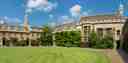
  1. To spot Christ’s College, look for a sweeping, golden-stone frontage wrapped around a perfectly round lawn, trimmed with neat hedges, brightly flowered window boxes, and a clock…もっと読む折りたたむ

    To spot Christ’s College, look for a sweeping, golden-stone frontage wrapped around a perfectly round lawn, trimmed with neat hedges, brightly flowered window boxes, and a clock tower peeking above the roofs. Welcome to Christ’s College! You’re standing in front of a place where stories have been piling up like books in a student’s backpack for nearly 600 years-so prepare yourself for secrets, scholarly dreams, and maybe even the sound of splashing swimmers. Back in 1437, a chap named William Byngham founded this place as “God’s House”-no, not a divine B&B, but the very first secondary-school training college in English history. The mission? To supply England’s dire shortage of grammar-school teachers. The college actually started out where part of King’s College Chapel now stands-so if you hear eager choirboys practicing over the fence, that’s the ghost of God’s House reminding everyone who got there first! But as with many Cambridge tales, change was in the air. In 1505, along came Lady Margaret Beaufort, the no-nonsense mother of King Henry VII. She decided God’s House needed a new name, a royal charter, and a healthy stack of coins. That’s how it became Christ’s College, setting the stage for an institution that’s seen everything from the rise and fall of empires to the invention of rugby tactics involving brown hoops! Take in the view: the main buildings cluster around the so-called First Court. If you spot a wisteria clambering up to the windows of the Master’s Lodge and a curiously round patch of emerald-green grass, you’re not hallucinating-that’s what it’s supposed to look like! Christ’s is famous for that circular lawn, as if designed for a secret society of croquet champions. Now, cast your eyes toward the Great Gate Tower. Looks like something’s a bit off, doesn’t it? That’s because the street level rose, so architects simply lopped off the bottom of the gate-engineers, always cutting corners, literally. The nearby Chapel and the Hall, built in the 16th century and later spruced up in the 1870s, have echoed with the laughter (and complaints) of students ever since. If the Hall walls could talk, they’d probably recite the formal dinner grace, not an epic food fight-though who knows, this is Cambridge! Keep walking and you’ll arrive at the Second Court. On one side, you’ll find the Fellows’ Building from the 1640s-imagine stern scholars in gowns debating science, poetry, and whether the dinner rolls are fresh enough. And beyond the arch? The Fellows’ Garden. Legend has it, the twisted mulberry trees are older than some countries, with one planted in 1608, the very year John Milton was born. Every year, despite storms and toppled trunks, they fruit. If you hear a faint whisper of leaves trembling, you might be catching the secret sighs of generations past. Venture even further and you’ll find the modern “Typewriter” New Court, a quirky concrete-and-glass addition that some love, others... tolerate. It sticks out like a first-year in fancy dress, but every college needs a bit of rebellious flair, right? Now, here’s the splashy secret: Christ’s is one of only five Oxford or Cambridge colleges with its own swimming pool! Fed by Hobson’s Conduit, the “Malcolm Bowie Bathing Pool” claims to be Britain’s oldest outdoor pool, dating from the mid-17th century. If you listen very carefully on a sunny day, you can almost hear the joyful shouts and splashes of students escaping their Latin verbs for a chilly dip. But Christ’s isn’t only about buildings and gardens. It’s a college of legends-poet John Milton once wandered these grounds, maybe dreaming up Paradise Lost, while Charles Darwin tramped from lecture hall to botanic garden, seeding ideas that would shake the world! And if Nobel prizes were handed out for creating famous alumni, Christ’s would be in the running-scientists, politicians, comedians, and even the odd archbishop have claimed these courts as home. Oh, and the students? They’re fiercely proud-so proud, in fact, that unlike most colleges, they don’t bother standing up when the Fellows walk in for dinner. History says it’s because of an ancient quarrel from the English Civil War. Around here, tradition means doing your own thing… sometimes very loudly, especially during the biennial May Ball, which has hosted everything from glittery Parisian nights to wild Shakespearean revels. Soak it all in, friend. Christ’s College is where history, eccentricity, and ambition still blend together like the buzzing of bees among the irises in May. Ready for the next chapter of your Cambridge adventure? Curious about the buildings, academic profile or the student life? Don't hesitate to reach out in the chat section for additional details.

    専用ページを開く →
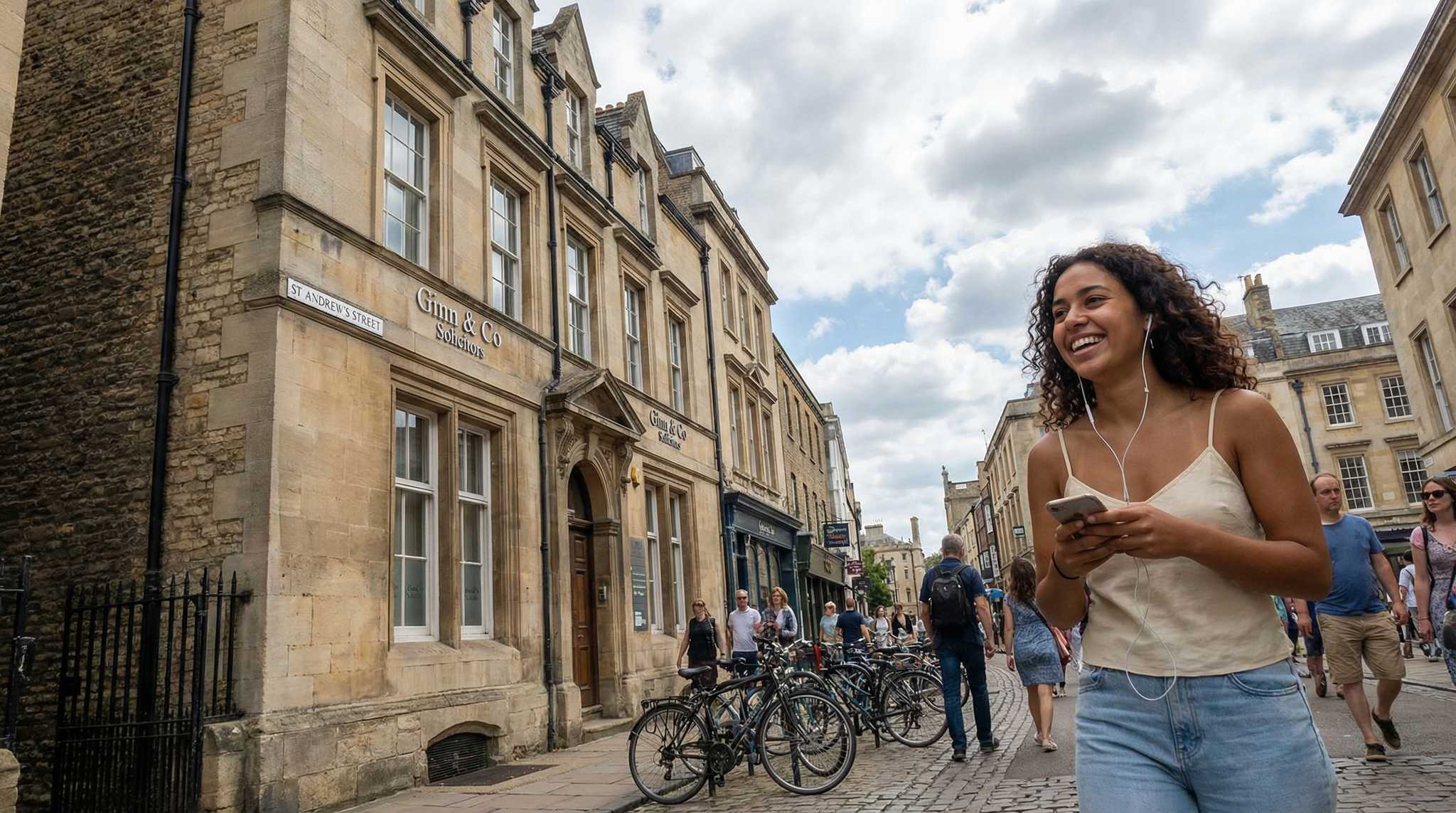
  2. Look for a sleek sign with elegant black lettering spelling out “GINN & CO SOLICITORS” with a flourish-just ahead on Sidney House, you’ll spot it right at street level. Now that…もっと読む折りたたむ

    Look for a sleek sign with elegant black lettering spelling out “GINN & CO SOLICITORS” with a flourish-just ahead on Sidney House, you’ll spot it right at street level. Now that you’re here, let’s unlock the tale of Ginn & Co Solicitors-one of Cambridge’s longest-running law firms, spanning nearly a century and a half. Imagine the bright chatter of clients opening the door, the shuffle of legal papers, and the low, steady hum of serious business in the air. It all started back in 1873, when Samuel Reuben Ginn, a sharp-minded solicitor from a family of lawyers, decided to set up shop right here in the heart of Cambridge. He must’ve liked the city’s energy, because he soon became not just a lawyer, but a big cheese in local politics-serving as Mayor of Cambridge, Deputy Lieutenant of Cambridgeshire, and even Justice of the Peace. But Ginn wasn’t just about fancy titles. During the First World War, when times were tough, he managed the Prince of Wales’ National Relief Fund, lending a hand to families in need. As if that wasn’t enough, he also looked after several manors and could probably juggle law books and mayoral sashes at the same time-though I wouldn’t recommend trying that at home! By the late 1870s, Samuel moved his practice to St Andrew’s Street. If you listen closely, you might almost hear the ring of trams from the Cambridge Street Tramways Company, one of his clients. He actually managed to persuade Parliament to extend the tramway lines, which was a pretty big deal for the city’s growth. A young solicitor named George Alfred Matthew joined Ginn in 1882, and together, the firm became Ginn & Matthews-a legal dream team. George was a fellow of St John’s College and took turns as President of the Cambridgeshire Law Society. Through them, the firm attracted some delicious business-literally! Clients included Chivers & Sons, the famous jam makers, and Hudson’s Breweries, keeping local pubs well supplied and even securing a whopping £75,000 debenture loan for Hudson’s. (That’s enough to keep an army of barristers happy in ale.) In 1903, a talented lawyer named Geoffrey Garland Goodman joined the crew, guiding the practice through two world wars. Talk about keeping calm and carrying on! When George Matthew died suddenly in 1905, the firm became simply Ginn & Co. Samuel’s own son, Dennis Barton Ginn-fresh from the hallowed halls of Trinity Hall, Cambridge-became his partner. And what a family legacy! Dennis not only handled legal work, but during World War I, he served in some of the harshest campaigns, including Gallipoli and Palestine. Imagine writing up contracts in the trenches-now that’s multitasking! Dennis’s second son, Benjamin, would go on to use his engineering skills to mastermind escape attempts from German prisoner-of-war camps in WWII. If only escaping paperwork at a law firm was that dramatic! Meanwhile, across the street, another former partner, John Edward Few, set up a rival practice, which would later merge into another Cambridge institution. There’s a friendly kind of rivalry in law, complete with old halls and secret handshakes-okay, maybe not the handshake. Samuel Ginn, the founder, lived to the grand age of 82, leaving a fortune that, today, would be worth over five million pounds and a generous gift to his loyal staff. Dennis Ginn took over, but the family’s direct connection ended in tragic wartime fashion-his eldest son Samuel Marsland Ginn, having just joined the firm, was killed in action in the Netherlands during WWII. After the war, under the guidance of Eric John Gipson Wright and Geoffrey Goodman, the firm continued to thrive and moved into a fine, neo-Georgian building just here on Sussex Street. In the 1970s, the firm even hit the Guinness Book of Records for the longest commercial arbitration-239 days! Imagine the amount of coffee and biscuits that must have required. More recently, Ginn & Co tackled everything from employment disputes to inheritance mysteries-sorting out family affairs, property deals, and even cases that made it all the way to the Supreme Court. In 2012, they earned the Law Society’s quality mark for legal excellence-proudly displaying their Lexcel badge. But the times changed, and in October of 2013, after 140 years of sorting out Cambridge's legal knots, the firm closed its doors. Today, its legacy still lingers on Sussex Street-proof that, sometimes, the most unassuming buildings have the richest stories to tell. Now, that’s a case closed!

    専用ページを開く →
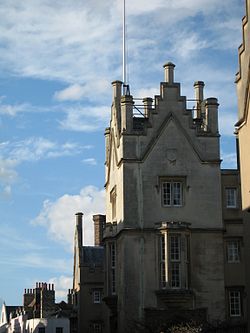
  3. Look for a striking stone building with battlement-like roof edges and tall, narrow windows rising above the street to guide you along Sidney Street. Alright, take a deep breath…もっと読む折りたたむ

    Look for a striking stone building with battlement-like roof edges and tall, narrow windows rising above the street to guide you along Sidney Street. Alright, take a deep breath and imagine you’re standing right where the hustle of Cambridge never seems to slow down-a street packed not just with shoppers, but with stories! Sidney Street stretches before you like a living timeline, one foot in the past and one in the present. To your right, you can spot the ancient-looking Sidney Sussex College, guarding the street with its impressive stonework-straight out of a wizard’s school, if you ask me. Sometimes I wonder if secret duels ever happened behind those walls! On the left, just across the street, you’ll find a parade of bustling shops. You might hear the clink of coffee cups and the cheerful calls of market traders-the kind of sounds that let you know you’re right in the heart of Cambridge. From charming little stores to big names like Boots and Marks & Spencer, the options might ignite your inner shopaholic. And here’s a touch of drama for you: the Lloyds Bank building, once Fosters’ Bank, stands with a grand confidence thanks to its Victorian design. Look up and you’ll notice its bold, ornate facade-rumor has it the architect, Alfred Waterhouse, loved to outdo his neighbors

    専用ページを開く →
さらに12件のスポットを表示表示するスポットを減らすexpand_moreexpand_less
  1. Look for a grand, red-brick building with ornate chimneys, tall windows, and a line of stone arches on the ground floor-just past the leafy trees and lush green lawns dotted with…もっと読む折りたたむ

    Look for a grand, red-brick building with ornate chimneys, tall windows, and a line of stone arches on the ground floor-just past the leafy trees and lush green lawns dotted with umbrellas and benches. As you stand in front of Sidney Sussex College, imagine the steady clip-clop of horse-drawn carts rattling by, carrying bricks for its construction back in 1596. This picturesque college, lovingly known as “Sidney” by locals, was nearly lost to history before it even began-the will of Lady Frances Sidney, Countess of Sussex, launched it into existence with a generous £5,000 and some silverware, all dedicated to her dream of nurturing clever minds at Cambridge. But don’t be fooled by these peaceful gardens; the roots beneath your feet once hid a very different world. Three centuries before this college stood, Franciscan friars prayed, studied, and strolled right where you are now. When excavations took place in the 1950s, all manner of hidden treasures-fragments of shattered stained glass and a giant Saxon jar-returned to the light along with some rather surprised skeletons. Talk about a surprise move to student housing! The original red-brick buildings were designed in a memorable E-shape, which-rumor has it-stood for “Elizabeth,” though no one seems too sure. But trends change: in the 19th century, the college found that red brick was no longer fashionable. Rather than going out of style, Sidney wrapped herself in a layer of cement and raised her roof a bit, just to keep up appearances. Never underestimate the lengths an old college will go to stay in vogue. Picture the early years: imagine Oliver Cromwell, future Lord Protector of England, shuffling across the courtyard in the chilly dawn, his collar buttoned tight against the Cambridge mist. Cromwell arrived here in 1616 and shared his chamber with just one roommate-a real luxury for the time. Some students had to squeeze in with three or more, and with only 35 rooms, you’d better hope your “chamber-fellow” didn’t snore! Beneath the Hall Court’s vaulted cellars-where the college wine collection now ages-lie the shadows of medieval Cambridge. Sometimes, at night, the wind whips through these old stones and you’d almost believe you could hear whispers from centuries ago. Jumping forward, in the 1890s, Cloister Court went up with Gothic flair, all pointed arches and ornate stonework, balancing old-world gravitas with a dash of Victorian ambition. Sidney’s chapel, with its carved wood interior, harpsichord, and a Steinway grand, welcomes everyone, regardless of belief. And in case you’re searching for a proper mystery, there’s a secret here: Oliver Cromwell’s head is buried somewhere near the antechapel. There’s even a tablet marking the spot, but no one knows the exact site-Cambridge’s own spooky secret. Sidney might be small, with about 355 undergraduates and 275 postgrads, but it’s buzzing with life. The students’ union runs everything from wild May Balls (complete with punting in the garden!) to running the lively college bar, and sports fans are kept busy too. The rowing club, which hit the river in 1837, has claimed its share of victories (and sinking boats). Cricket lovers swing for glory every year in the classic ‘Cuppers’ match. Sidney’s choral tradition is alive as ever, with the choir’s golden harmonies floating out on Friday and Sunday evenings, as well as Vespers in Latin on Wednesdays. The music society hosts concerts throughout the year, keeping the college halls warm no matter the weather. And finally, keep an eye out for quiz buffs-Sidney Sussex has twice lifted the University Challenge trophy, even pulling off a comeback in the 2002 “Reunited” series, decades after their original victory. Among riches, secrets, and some world-changing alumni, this cozy college just might be Cambridge’s best-kept treasure. Now go on-peek into those windows and imagine the stories still unfolding behind the glass. If those old bricks could talk, would they sing Sidney’s own college song, boasting it's the best in town? I’d bet my last plate they would! To expand your understanding of the buildings and grounds, choir or the student life, feel free to engage with me in the chat section below.

    専用ページを開く →
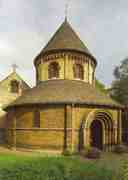
  2. In front of you stands a wonderfully unusual, round, stone church with a conical roof and decorated arches-just look for the circular shape and the striking Norman doorway, right…もっと読む折りたたむ

    In front of you stands a wonderfully unusual, round, stone church with a conical roof and decorated arches-just look for the circular shape and the striking Norman doorway, right at the junction of Round Church Street and Bridge Street. Welcome to one of the quirkiest survivors of medieval England: The Church of the Holy Sepulchre, though you’ll fit right in calling it “The Round Church.” Trust me-if this church looks like it wouldn’t be out of place as a wizard’s hat, you’ve found the right spot. Now, let’s step back in time-almost 900 years back! Imagine the 1130s: horses’ hooves on the Roman road known as Via Devana, travelers arriving dusty and weary, and before them, a brand-new, jaw-droppingly round chapel. The people who built it, the Fraternity of the Holy Sepulchre, wanted to echo the rotunda of the Church of the Holy Sepulchre in Jerusalem. So, not just any old church, but the spiritual sibling of one of Christianity’s holiest sites! Back then, it was a humble wayfarer’s haven-just a small rotunda and a tiny chancel, greeting travelers with sanctuary. But, as centuries rolled by and Cambridge grew, so too did the church. By the 1200s, the middle ages were in full swing, and the church’s life was changing. No longer just a way station, it became the spiritual home for locals under the watchful gaze of Barnwell Priory. It got its own north aisle and the chancel was rebuilt, though in what I like to call “the classic medieval upgrade package”-not necessarily the flashiest add-ons, but sturdy enough to stand the test of time. Fast forward to the 15th century and-well, someone decided that bigger windows were the medieval equivalent of better Wi-Fi. Out went the old Norman windows, replaced by larger, Gothic ones. Angels began to appear, too-not floating above, but carved right into the wooden beams, some with trumpets, others just hanging about, looking down on the faithful from centuries past. You know, the Round Church has had its share of drama. During the Civil War in 1643, the Puritans stomped in, not happy with what they saw, and smashed many of what they called "idolatrous" images. If bricks could talk, the church would probably mutter about its aches and pains. By the 1800s, the place was in such bad repair you’d half expect the pigeons to start holding their own services. That’s when a group called the Cambridge Camden Society swooped in-think of them as the superhero DIY team of the Victorian era-and said, “We can fix it!” Anthony Salvin, the architect, tackled the most pressing problem first: the bell-storey up top was so heavy it was pushing the walls to the limit. Poised for collapse, it was replaced with a roof much lighter and closer to what medieval builders intended. The Gothic windows? Out they went, replaced by Norman-style ones, giving the place back its ancient charm. A gallery and its staircase disappeared, a new aisle sprouted, and tired old stones got some TLC. The bill, by the way, ballooned from £1,000 to nearly £4,000-proof that “just a quick fix” is as eternal as the church itself! During World War Two, a bomb exploded nearby and the magnificent Victorian glass in the east window was blown to pieces. But resilience is this church’s middle name-by 1946, a new window was in place, showing Christ in Majesty and shining colored light onto the interior once more. Now, take a closer look: the door is pure Norman, all round-arched with chunky zigzags and scalloped capitals. Inside, the church is all circles and colonnades-a rare architectural treat. There are bells in an octagonal turret, one from 1663 and the other possibly as old as 600 years! Peek around at the floor tiles: stars of the show here are the Queen Victoria-and-Prince Albert coats of arms, plus animals at the corners that stand for the Four Evangelists. Once upon a time, the congregation here outgrew this quirky round building, so everyone moved to nearby St Andrew the Great (well, everyone except the angels, presumably-they stay put!). These days, the church has found a new lease of life as a centre for visitors, exhibitions, and even concerts. So next time you hear music drifting from the Round Church, don’t be surprised; after all, if these ancient stones have learned anything, it’s how to roll with the times. So, snap a photo, take in the echoes of nearly 900 years, and maybe give a nod to a passing angel-this place has hosted quite the cast of characters!

    専用ページを開く →
  3. To spot The Baron of Beef, look for a welcoming brick-front pub with big windows and bold gold lettering on a black sign above the entrance-it should be right in front of you on…もっと読む折りたたむ

    To spot The Baron of Beef, look for a welcoming brick-front pub with big windows and bold gold lettering on a black sign above the entrance-it should be right in front of you on Bridge Street. Now, step right up! You’re about to hear one of Cambridge’s juiciest stories, and no, it’s not just about the beef. The Baron of Beef isn’t just any pub-it’s a place where legends, quite literally, have thrown down the gauntlet. Imagine the air thick with the smell of ale and the ever-present chatter of curious students and locals, when suddenly, two titans of technology-Chris Curry and Clive Sinclair-end up in a heated showdown here. Was it over a lost pub quiz? Nope, it was even bigger-office drama on a legendary scale. Chris Curry, clutching a pint, and Clive Sinclair, who was never known for his poker face, actually had a spat right in this very spot, all because Curry dared to break away and help start Acorn Computers, the main rival to Sinclair’s ZX80 microcomputer. Their row became so famous, the BBC later dramatized it in “Micro Men.” But that’s not all! Tom Baker, the scarf-wrapped Doctor Who, once called these walls home while filming “Shada.” And if you ever felt like grabbing a drink with Douglas Adams, the creator of The Hitchhiker’s Guide to the Galaxy, well, he used to drink here too. So, whenever you pass The Baron of Beef, remember: great stories-and sometimes hilarious arguments-are always on tap here!

    専用ページを開く →
  4. You’re looking for a grand, white, neo-classical building with four solid columns at the front and a round medallion of a man’s profile above the doorway-it’s directly across the…もっと読む折りたたむ

    You’re looking for a grand, white, neo-classical building with four solid columns at the front and a round medallion of a man’s profile above the doorway-it’s directly across the pavement from you, glowing under the lights at 7a Jesus Lane. Welcome to the front steps of the mysterious and storied University Pitt Club. Imagine you’re standing here, late in the evening, the chill Cambridge air swirling around your ears as the glow from inside spills onto the street. This very spot has witnessed nearly two centuries of secrets, toasts, and a handful of questionable fashion choices. Let’s step out of the cold and into its tale for a moment-mind your feet; a famous chancellor or an actor might have stood right where you are now. The story of the Pitt Club begins in 1835, born in Michaelmas term just as autumn settled over Cambridge, named to honor William Pitt the Younger-who wasn’t just Prime Minister, but a Pembroke College alumnus. Back then, clubs like these popped up all over Britain, meant not just for good company but for a bit of plotting too-the goal was to recruit solid Tory MPs, and maybe squeeze in a splash of party spirit along the way. Rumor has it, the members attended political dinners wearing “party uniforms.” Now, I can only imagine what that means, but I’m guessing the fashion police would have had a field day. In the early days, political fervor gradually melted away in the warmth of camaraderie, cheers, and lavish meals. By 1868, the Pitt Club had dropped its political ambitions, favoring the joys of friendship-though no doubt the debates and banter continued well into the night. But even the heartiest laughter sometimes went quiet: the First World War saw the club shutter temporarily in 1917 as young men went off to fight, only to spring back open in 1919 when celebrations returned, and apparently, so did the search for decent whisky. The club minutes from that time describe a “horrible scarcity of whisky”-a tragedy, I’m sure, in undergraduate terms. During the Second World War, this proud building on Jesus Lane changed hats entirely. The premises were commandeered for the war effort, rebranded as a “British Restaurant,” and the great William Pitt’s face atop the entrance reportedly peered down in horror at the enormous sign. Pitt, famous for his clever wit, would probably have had a few words about his club serving up rationed peas instead of prime rib. With their home in service to the public, club members were forced to find new quarters, ending up above a post office in Trinity Street-dubbed, with a wink, the “Interim Club.” Picture a group of future statesmen and Olympians trying to throw a dignified party wedged between letters and telegrams. Now, this building itself has quite a twisty past. Originally, Digby Wyatt designed it in 1863, not as a club, but as Roman (improved Turkish) Baths-yes, really-though the venture lasted barely a year. After the baths folded, there was a lively liquidation sale and the architect himself snapped up the building. The Pitt Club moved in upstairs, sharing with Orme’s Billiards Rooms, until it managed to buy the whole place in 1907, just in time to survive a fire that called for extensive renovation and gave it the rather stately interior you’d see upstairs today. On the building’s pediment, you’ll spot a large plaque-a gift from a general, salvaged from the wall of Bowling-Green House where Pitt died. It’s been here since 1933, keeping a watchful eye on comings and goings, from secretive politicians to joke-cracking actors like John Cleese and Eddie Redmayne. You might also spot some royal fingerprints in the guestbook, from Edward VII straight through to Charles III. But the Pitt Club wasn’t just for boisterous young men forever. For 182 years, women weren’t allowed, except “after dark”-unless, of course, it was Sunday lunch. Finally, in 2017, a landmark club vote (and a bit of controversy, naturally) flung open the doors, ushering in a new era as women joined the ranks. Imagine the sound as the old ways gave way and new voices echoed through these halls. So, as you stand beneath William Pitt’s stone gaze and the grand columns that have seen it all, remember: this building is far more than bricks and mortar. It’s a patchwork of debates, laughter, fire, food, exclusion, and the slow march of change-a club devoted now mostly to making memories and, if the stories are true, still the occasional shortage of really good whisky. Wondering about the clubhouse, notable members or the women? Feel free to discuss it further in the chat section below.

    専用ページを開く →
  5. To spot the Cambridge Science Centre, look for a lively, welcoming entrance where you can see families and children peering in through the windows or bustling in and out, eager to…もっと読む折りたたむ

    To spot the Cambridge Science Centre, look for a lively, welcoming entrance where you can see families and children peering in through the windows or bustling in and out, eager to explore hands-on exhibits inside. Now, as you stand in front of the Cambridge Science Centre, imagine stepping into a place buzzing with curiosity-a place where it’s actually encouraged to touch everything! When it first opened its doors on Jesus Lane in 2013, this wasn’t just any old museum. Oh no, this was Cambridge’s very first interactive science hotspot, the kind where you could hear the boom of laughter and the zap of experiment after experiment springing to life. In its earliest days, the air inside practically crackled with electricity as children raced to solve puzzles about light, sound, and the secrets of hearing. You might picture Dr. Chris Lennard and Dr. Katia Smith-Litiere, the founders, nervously hoping their dream would fly, while a crowd of scientists and curious folk waited on opening day. And of course, the Vice-Chancellor of Cambridge University himself cut the ribbon-no pressure there! But just as things got rolling, in 2016, the Centre had to pack up shop and move out, leaving behind only echoes of excitement. For a while, the science moved onto the streets-a bit like Einstein running wild in the marketplace. But, in 2018, the Science Centre burst back to life, giving everyone young and old a place to experiment, wonder, and maybe, just maybe, accidentally launch a ping pong ball across the room. Science really is more fun when you’re right in the middle of it-don’t you think?

    専用ページを開く →
  6. Right in front of you, you’ll spot a grand white building with four columns and a triangular roof, glowing under the streetlights-it’s got “7A Jesus Lane” above the door, so keep…もっと読む折りたたむ

    Right in front of you, you’ll spot a grand white building with four columns and a triangular roof, glowing under the streetlights-it’s got “7A Jesus Lane” above the door, so keep your eyes on the left side of the street as you walk. Welcome to Jesus Lane! Now, don’t be fooled by its peaceful look-this street has stories that are anything but sleepy. Imagine yourself here centuries ago, when this lane was known as Nunnes Lane and was nothing more than a muddy footpath leading curious visitors to the Nunnery of St Mary and St Radegund. Back then, you’d likely hear the clopping hooves of horses or maybe the distant chant of nuns echoing across the fields. The world was much quieter, but you’d have to watch your step, because you’d be crossing the fearsome King’s Ditch, which was pretty much Cambridge’s answer to a city moat-minus the crocodiles, sadly. Now, fast-forward to today, and Jesus Lane links some of the best bits of Cambridge. To the north, you’ll spot Jesus College, the proud namesake of the street-if you listen closely, maybe you’ll catch the rustle of academic robes or the muffled debates of students over tea. Little Trinity and number 49 Jesus Lane are famous for being some of the coziest and most impressive houses in town, so if you’re feeling nosy, give their facades a good look. But don’t be tempted to knock-they’re not serving tea! Keep walking and you’ll notice All Saints’ Church-an absolute masterpiece built by the Victorian architect G. F. Bodley. Its tower once rivaled the best in Cambridge, and if those stones could talk, they’d tell tales of grand weddings and the solemn silence of midnight prayers. Just imagine the sound of choir music drifting out on a cold evening, mixing with the modern-day hum of cars and the laughter of students. If you’re hungry-and honestly, who isn’t?-look to your right. That elegant neoclassical building there, well, it once held the Victorian Roman Baths, designed by Sir Matthew Digby Wyatt himself. These days, it shares space with the University Pitt Club upstairs and, wait for it, Pizza Express on the ground floor. Yes, you heard me right-where students once plotted grand debates, you can now plot your attack on a hot pepperoni pizza. You might even catch a choir of hungry customers humming with delight. So, whether you’re tracking ancient footsteps, hunting for pizza, or just soaking up the unique charm, Jesus Lane is where history, mystery, and a slice of modern life all come together-who would have thought a street named after Jesus would have so many surprises?

    専用ページを開く →
  7. To spot All Saints' Church, just look up-right in front of you rises a tall, pointed spire in creamy stone, soaring toward the sky and surrounded by dramatic Gothic windows and…もっと読む折りたたむ

    To spot All Saints' Church, just look up-right in front of you rises a tall, pointed spire in creamy stone, soaring toward the sky and surrounded by dramatic Gothic windows and carvings. Now that you’re standing outside this magnificent church, take a moment to imagine Victorian Cambridge buzzing around you. Picture horse-drawn carriages clattering down Jesus Lane, students with armfuls of books rushing by, and builders craning their necks as the great spire of All Saints’ Church pierced the skyline for the very first time. At 175 feet tall, this spire-which still holds the rank of Cambridge’s third tallest building-must have made quite the impression, dwarfing the townsfolk and even making the pigeons nervous about getting too high and dizzy! The story of All Saints’ is a bit like a game of musical chairs, but with buildings. The church was originally tucked away on St John’s Street, going by the grand title of “All Saints in the Jewry.” That name came from its location near Cambridge’s medieval Jewish quarter-and, before you ask, no, there wasn’t a “Saints’ Hide and Seek” tournament between the castles and hospitals, though wouldn’t that be fun? By the 1800s, the city was packed tighter than a library in exam season, and the old, cramped All Saints’ could only squeeze in a fraction of its congregation. So, Jesus College offered up a new plot, right here on Jesus Lane, and a shiny new church began to rise-brick by brick, stone by stone. Enter the star architect, George Frederick Bodley. He was chosen over the famous George Gilbert Scott and brought all the drama of English Gothic Revival with him. The foundation was laid in 1863. The main structure opened just a year later, but it would take almost another decade for the mighty tower and spire to take their final form. The final crowning glory? A weather vane, fitted with just enough ceremony-legend has it, even the birds lined up to watch. If you duck inside-when open-you’ll discover why this is known as “The Painted Church.” You’ll be dazzled by walls and ceilings with bold, stenciled floral friezes, intricate religious symbols, and verses wrapping the walls. The hand behind much of this decoration belonged to F. R. Leach & Sons, along with David Parr, who loved decorating so much he even painted his own home in the same style. And let’s not forget all those stained-glass windows! The east window, designed by Edward Burne-Jones and produced by Morris & Co., is a masterpiece, glowing with a silvery, pale light-a quiet rebellion against the trend toward darker glass, letting floods of sunshine into the church’s heart. Look closely, and you might spot figures designed by Burne-Jones, Ford Madox Brown, and even William Morris himself. Talk about an all-star cast! There are other magical windows too, showing everything from saints to women who fought for justice, like Elizabeth Fry and Edith Cavell. Now, every great story needs a twist and a bit of tension. By the 1920s, people started worrying that All Saints’ might become redundant. As the city changed and the university colleges grew, the church’s congregation shrank, and by 1973, even the last vicar called it a day. The church sat silent, its grand tower echoing only with the soft shuffle of pigeons and the whispers of history. There was even talk of knocking parts of it down! Can you imagine trying to topple that tower? It practically dares anyone to try. But, just in time, a band of volunteers-and a lot of determined Cambridge campaigners-saved it. Ever since, All Saints’ Church has been looked after by the Churches Conservation Trust, which means today it’s a hub for music, art, and even magic shows! You might even hear the sound of a lunchtime recital drifting through the doorway on a lucky Sunday. So, as you admire those gargoyles grinning from the stone and picture golden sunlight splashing over the arches, you’re standing in front of a church that’s survived centuries of change, brushes with demolition, and the odd negotiation with a stubborn pigeon. And it stands, still and proud, full of stories yet to be sung-both old and brand new. Interested in knowing more about the architecture, interior or the 2021 and beyond

    専用ページを開く →
  8. Look to your left for a small, striking red building with three black-arched windows and a hanging pub sign above the door, standing out against the larger brick structures around…もっと読む折りたたむ

    Look to your left for a small, striking red building with three black-arched windows and a hanging pub sign above the door, standing out against the larger brick structures around it. Ah, welcome to the legendary St Radegund - the tiniest pub in Cambridge, but certainly one with a giant personality! Imagine stepping inside and being greeted by the lively hum of good-natured chatter, the scent of hops hanging in the air, and the sight of cricket bats tucked in the corner, hinting at friendships forged over endless games and even more endless pints. This little gem is named after a Frankish saint, but its spirit couldn’t be more human. For years, it served as a headquarters for clubs with wonderfully odd names like the Cantabrigensis Hash House Harriers, and it was the birthplace of storied cricket rivalries. Fancy trying the King Street Run yourself? It starts and finishes right here, though don’t be surprised if you only manage a wobble by the end. Under the unforgettable landlord Terry Kavanagh, whom many say had a wit as dry as the gin poured on Friday’s Vera Lynn Appreciation Society nights, local legend took on a life of its own. Picture people raising large gin and tonics, singing wartime ballads, and turning every Friday into a roaring trip down memory lane. There were famous cricket matches against The Champion of the Thames pub; wild tales, like when the St Radegund team took on the mighty Croatian Mount Hum on their epic cricket tour - and, yes, the story was good enough to be a book. And would it really be Cambridge without a little eccentricity? For years, the pub proudly displayed a sign that, by a strange twist, honored an Austrian town instead of its namesake saint! The artwork was changed after local uproar, only to be changed back again later, causing even more amusement (and a fair share of media giggles). Though it closed its doors recently, for anyone who squeezed inside, swapped wild stories, or cheered on the underdogs, St Radegund remains a brilliant, mischievous bit of Cambridge spirit. Now, onward to your next unforgettable stop!

    専用ページを開く →
  9. Look slightly to your left for a friendly, cream-colored building with bold wooden trim, green doors, and a sign above the door that reads "Champion of the Thames"-you’ll spot a…もっと読む折りたたむ

    Look slightly to your left for a friendly, cream-colored building with bold wooden trim, green doors, and a sign above the door that reads "Champion of the Thames"-you’ll spot a classic pub scene complete with lanterns and a painted oarsman swinging above the entrance. Welcome to The Champion of the Thames! Imagine the year is 1860, and a dashing oarsman-fresh from victory on the River Thames-has just swaggered into Cambridge, bringing with him a thirst for adventure and, perhaps, a pint or two. This pub was named after that very champion, who was so proud of his river triumph that he made sure all his mail came addressed to him here as “The Champion of the River Thames, King Street, Cambridge.” Where else could you be sure your beer-and your letters-would find you but somewhere this cozy? As you stand here, feel the lively hum that has echoed through these unaltered Victorian walls for over a century. You’re not just looking at bricks and wood: you’re stepping into a rowing club’s home, a champion’s legacy, and the heart of one of Cambridge’s wildest pub crawls, the legendary King Street Run. Picture the fun and a little friendly chaos, as teams down their pints in a race against time. The pub even battles St Radegund in a yearly cricket match-pub pride at stake! And if you hear echoes of laughter and see flashes of rowing blades, don’t be alarmed-it’s just the pub’s spirit celebrating its crown as Cambridge’s Pub of the Year in 2024. So, pull up an imaginary stool and enjoy the champion’s story-cheers to history and a bit of good mischief!

    専用ページを開く →
  10. To spot King Street, just look ahead for a lively street lined with low brick buildings, bustling with cars and red double-decker buses, with “The Bun Shop” pub sign hanging from…もっと読む折りたたむ

    To spot King Street, just look ahead for a lively street lined with low brick buildings, bustling with cars and red double-decker buses, with “The Bun Shop” pub sign hanging from the building on your right. Welcome to King Street - a street that’s seen more barrels rolled than a medieval wine cellar and heard more laughter than a stand-up comedy night! Take a deep breath and imagine you’ve stepped into the very heart of Cambridge’s social scene, where every brick and lamp post could whisper tales of pints, pranks, and historic pub crawls. Here, King Street stretches before you connecting bustling Sussex Street in the west to the giant roundabout in the east, running parallel just south of Jesus Lane. To the north, you've got Victoria Avenue, which threads between Jesus Green and Midsummer Common - perfect spots for a post-pub picnic, though whether you'll walk a straight line there is another story! Sidney Sussex College’s buildings loom thoughtfully at your left as Christ’s College quietly claims a corner to the south. Even the architecture is part of the club here, with each college wall holding secrets from centuries past. Now, keep your ears sharp - King Street is famous for its pubs, and even today, you’re surrounded by living legends: The King Street Run, The Champion of the Thames, St Radegund, and The Cambridge Brew House, all jostling for your attention. And oh, the King Street Run isn’t just a clever name for a pub. It’s a full-blown, belly-trembling, bladder-testing pub crawl that’s been running - or should I say stumbling - since 1955. It all began on a fateful night with three St John’s College lads, the sort who looked like they could drink the Cam dry, debating some rather scientific stuff with a few medical students. Could the noble male bladder hold more than four pints? A serious question, right? Naturally, they did what any scholarly gentlemen would do: set out to drink a pint in every King Street pub to settle the bet! No bathroom breaks, mind you. The challenge quickly became legend. The penalty for “peeing or puking”? Drink another whole pint! Success meant joining the exclusive Pint to Pint Club, and the reward was a navy blue tie with a tankard and crown - a badge of both honor and questionable choices. Long before, King Street boasted more pubs than you can shake a stick at - the Boot, Carpenters Arms, Glaziers Arms, The Garrick Hotel, and so many others, now just memories beneath your feet. The street once rang out with the stomp of boots, the slap of cards on sticky tables, and heated debates over local ale. Some pubs vanished with the 19th century, their names fading but their spirit living on in stories. If you strain your ears, you might hear echoes of raucous celebrations, or even Dostoyevsky grumbling at the bar of The Champion of the Thames, nose buried in a broadsheet. Even the modern scene is alive and brimming with personality - there are restaurants, snug corner pubs, and visitors from every corner of the world. The King Street air smells of malted hops, history, and adventure, with a background hum of bicycles and footsteps. Standing here, you are surrounded by ghosts of “penalty pints,” mischief-makers, and loyal locals. So, if you fancy a drink, you’re in the right street-just remember the unofficial rule... pace yourself, or you might be earning a club tie you never expected!

    専用ページを開く →
  11. To spot Westcott House, simply look ahead for a long, red-brick building with dormer windows and a beautiful, leafy courtyard framed by stone paths and vibrant flower…もっと読む折りたたむ

    To spot Westcott House, simply look ahead for a long, red-brick building with dormer windows and a beautiful, leafy courtyard framed by stone paths and vibrant flower beds. You’re now standing in front of Westcott House, the place where future ministers prep for a life that’s one part inspiration, one part dedication, and-let’s be honest-at least one part sleepless essays! Just imagine, it’s 1881, and the air is crisp with possibilities. This peaceful courtyard wasn’t always filled with the laughter of students or the quiet hum of theological debate. Back then, Brooke Foss Westcott, Regius Professor of Divinity and a true heavyweight in Bible scholarship, had an idea: train clergy not just to preach, but to truly understand, think, and care for their communities. The walls around you, brick and sturdy, grew out of his dream to raise the standard for everyone called to serve, no matter which corner of the Church of England they loved most. Now listen carefully: can you hear them? Those could be the echo of Westcott himself, or perhaps one of the many figures who shaped this college’s spirit. Unlike many stuffy Victorian institutions, Westcott House has never liked labels or getting stuck in one style. Some call it Liberal Catholic, others say it welcomes all shades of Anglican belief. In fact, Westcott was famous for refusing to pick sides. He just wanted his students to be thoughtful, compassionate, and a bit rebellious-because, let’s face it, if you can’t question things in Cambridge, where can you? When the Faith in the City report shook up the Church in 1985, Westcott House decided to double down. They became pioneers in “urban ministry,” sending students into real city neighborhoods, not just to preach, but to learn from people’s lives and struggles. You could say they were “street smart”-but with a little more Hebrew. Not only did they keep that flame burning, but they shared their new techniques across England. Many other theological colleges have copied their context-based learning, hoping to keep up with the Westcott spark-sort of like playing chess against the teacher and hoping for a gentle hint, instead of getting checkmated! As you stand near the stone paths and flower pots, picture the many heads of the college, or “principals.” Frederic Chase wore that honor first, but names like Rupert Hoare and Helen Dawes followed, leading a parade of staff who’ve become bishops, monks, canons, and even global social reformers. The walls here have heard a lot of Latin, laughter, and possibly divine arguments over who gets the last biscuit. Hey, even a future Archbishop of Canterbury, Rowan Williams, taught and prayed here! Throughout its life, Westcott House has opened its arms to people from all backgrounds. If you could peek into the rooms behind those dormer windows, you’d find students not just from the UK, but from across the world. Their voices rise in debate, hope, and the occasional off-key hymn. The college calls itself a home for an “inclusive and international community.” Sounds like the best dinner party ever-intellectual, eclectic, and just a little bit holy. Maybe you hear church bells in the distance, or the buzz of students planning the next big outreach program. The spirit that Westcott began with-fighting ignorance, complacency, and empty faith-still breathes here every day. So next time you pass a group of students in smart black gowns, ask them a tricky question about city ministry or the legacy of Saint Westcott. Just make sure you have enough time for the answer-you might be here all day! Alright, onward! Our next stop is packed with discovery and, I hope, less Latin. Ready to stroll?

    専用ページを開く →
  12. To spot Jesus College, look straight ahead for a striking brick building with a tall, castle-like entrance, topped with battlements and a statue above an arched wooden gate,…もっと読む折りたたむ

    To spot Jesus College, look straight ahead for a striking brick building with a tall, castle-like entrance, topped with battlements and a statue above an arched wooden gate, framed by old stone walls and a path lined with bicycles. Now, as you stand here at the threshold of Jesus College, imagine yourself stepping back through a doorway that’s seen more secrets, stories, and scholarly feet than most of us have had hot dinners. The tall, crenelated gatehouse in front of you has stood watch for centuries, where the ever-watchful cockerel-yes, that’s a rooster!-perches as the college’s proud symbol, a quirky nod to its founder, Bishop John Alcock. The bold bricks you see might look imposing, but it’s friendly enough-after all, this was once the gentle home of Benedictine nuns, back when it was the Nunnery of St Mary and St Radegund, founded in the 12th century. Let’s set the scene: the year is 1496, and Bishop Alcock decides Cambridge could use a college with a little more divine inspiration, so he scoops up this monastic patch and fills it with scholars, turning the nuns’ refectory into the college hall, the prioress’s residence into the Master’s Lodge, and the massive chapel-still the oldest university building in Cambridge-into the spiritual heart of the college. It’s enough to make any lover of old stones swoon. Passing through the entrance, known as the “Chimney,” you’re walking in the footsteps of over 500 years’ worth of students, porters, and perhaps a few robed ghosts hustling to lectures. The word ‘chimney’ here doesn’t mean a place for smoke, but a shortcut from Middle French meaning ‘little way.’ The passage leads straight to the Porter's Lodge and whisks you into First Court, where sunlight dapples the lawns and the old walls catch students’ murmurs like secrets eager to be overheard. Now, Jesus College isn’t just about quiet moments and old books-though there’s plenty of both. Peek through the windows and you might spot the Quincentenary Library, open 24 hours for those midnight oil-burning scholars. There’s a quieter, dustier Old Library too, hiding over 9,000 ancient tomes, including Thomas Malthus’s own collection. Malthus, by the way, came up with ideas about population that gave Charles Darwin plenty to think about. Not bad for a college started with six fellows and six scholars. But not all the drama happened on the page. The Chapel itself, built in 1157 and completed by 1245, had a roof that once soared heavenward before its steeple tumbled in 1277. Twice, flames licked its stones, in 1313 and 1376, but like a stubborn professor with a deadline, it survived and kept its doors open to worship, music, and maybe even a little academic mischief. Alcock made the cavernous medieval church cozier, and later, famous architects like Augustus Pugin and Bodley left their marks with decorative touches and stained glass dazzling enough to make you forget you missed breakfast. Today, the choir fills those hallowed halls with song several days a week. There are actually two choirs-the College Choir and Chapel Choir-each with their own quirks. One is made up of students, and the other combines local choristers. So, on a good evening, you might hear soaring harmonies drifting across the courts, dodging the odd football or rugby ball from the college’s famous playing fields. And don’t think life here is all about books and hymnals. The students of Jesus College are as likely to be debating world politics, prepping for the next boat race (the boathouse is just a short stroll away), or perhaps plotting the next annual May Ball-famed for turning these scholarly corridors into scenes of celebration and glitter. But before you think it’s all tradition and tweed, let’s not forget: Jesus College has broken plenty of moulds. In 2019, Sonita Alleyne was appointed Master-the first Black leader of any Oxbridge college, and only decades after women were first allowed through these doors in 1979. It took 483 years, but sometimes Cambridge moves at its own, careful pace. Oh, and if the cockerel crows a little extra loudly as you look around, it’s probably because he’s proud: three Nobel Prize winners, two International Court of Justice fellows, and a bear-hug’s worth of famous alumni have passed through here. Just don’t ask him which was his favorite-no rooster wants to play favorites with geniuses. So take a moment here at the grand entrance. In the filtered sunlight, with a gentle breeze whispering secrets of centuries past, you’re not just at the end of our tour-you’re at the edge of living, breathing history where every cobblestone, shadow, and melody is part of a story, a little magic, and maybe a joke or two, waiting to be remembered. Fascinated by the academic profile, buildings and grounds or the chapel and choir? Let's chat about it

    専用ページを開く →

よくある質問

ツアーはどうやって始めますか?

購入後、AudaToursアプリをダウンロードして引き換えコードを入力してください。ツアーはすぐに開始できます。再生ボタンをタップして、GPSガイド付きルートに従うだけです。

ツアー中にインターネットは必要ですか?

いいえ!開始前にツアーをダウンロードしておけば、完全にオフラインで楽しめます。チャット機能のみインターネットが必要です。モバイルデータを節約するため、WiFi環境でのダウンロードをお勧めします。

これは団体ツアーですか?

いいえ、これはセルフガイド式のオーディオツアーです。ガイドや団体、決まったスケジュールに縛られることなく、スマホから流れるナレーションを聴きながら自分のペースで自由に探索できます。

ツアーの所要時間は?

ほとんどのツアーは60〜90分で完了しますが、ペースは完全に自由です。好きな時に一時停止したり、スポットを飛ばしたり、休憩を取ったりできます。

今日中にツアーを終えられない場合は?

問題ありません!ツアーには無期限でアクセスできます。明日、来週、あるいは来年でも、好きな時に再開できます。進行状況は保存されます。

どの言語が利用可能ですか?

すべてのツアーが50以上の言語に対応しています。コードを引き換える際にお好みの言語を選択してください。注意:ツアー生成後に言語を変更することはできません。

購入後、どこからツアーにアクセスできますか?

App StoreまたはGoogle Playから無料のAudaToursアプリをダウンロードしてください。メールで届いた引き換えコードを入力すると、ライブラリにツアーが表示され、ダウンロードして開始できるようになります。

verified_user
満足保証

もしツアーを楽しめなかった場合は、返金いたします。お問い合わせ先: [email protected]

以下の決済で安全にチェックアウト

Apple PayGoogle PayVisaMastercardPayPal

AudaTours: オーディオツアー

楽しくて手頃なセルフガイド式ウォーキングツアー

アプリを試す arrow_forward

世界中の旅行者に愛されています

format_quote このツアーは街を見るのに本当に良い方法でした。ストーリーは作り込まれすぎず面白くて、自分のペースで探索できるのが良かったです。
format_quote 観光客気分になりすぎず、ブライトンを知るためのしっかりとした方法でした。ナレーションには深みと文脈がありました。
Christoph
Christoph
starstarstarstarstar
ブライトン・ツアー arrow_forward
format_quote 片手にクロワッサンを持ち、期待ゼロで始めました。アプリはただ一緒にいてくれる感じで、プレッシャーもなく、クールな物語を楽しめました。

オーディオツアー使い放題

世界中のすべてのツアーをアンロック

0 ツアー·0 都市·0 国
all_inclusive アンリミテッドを探索