
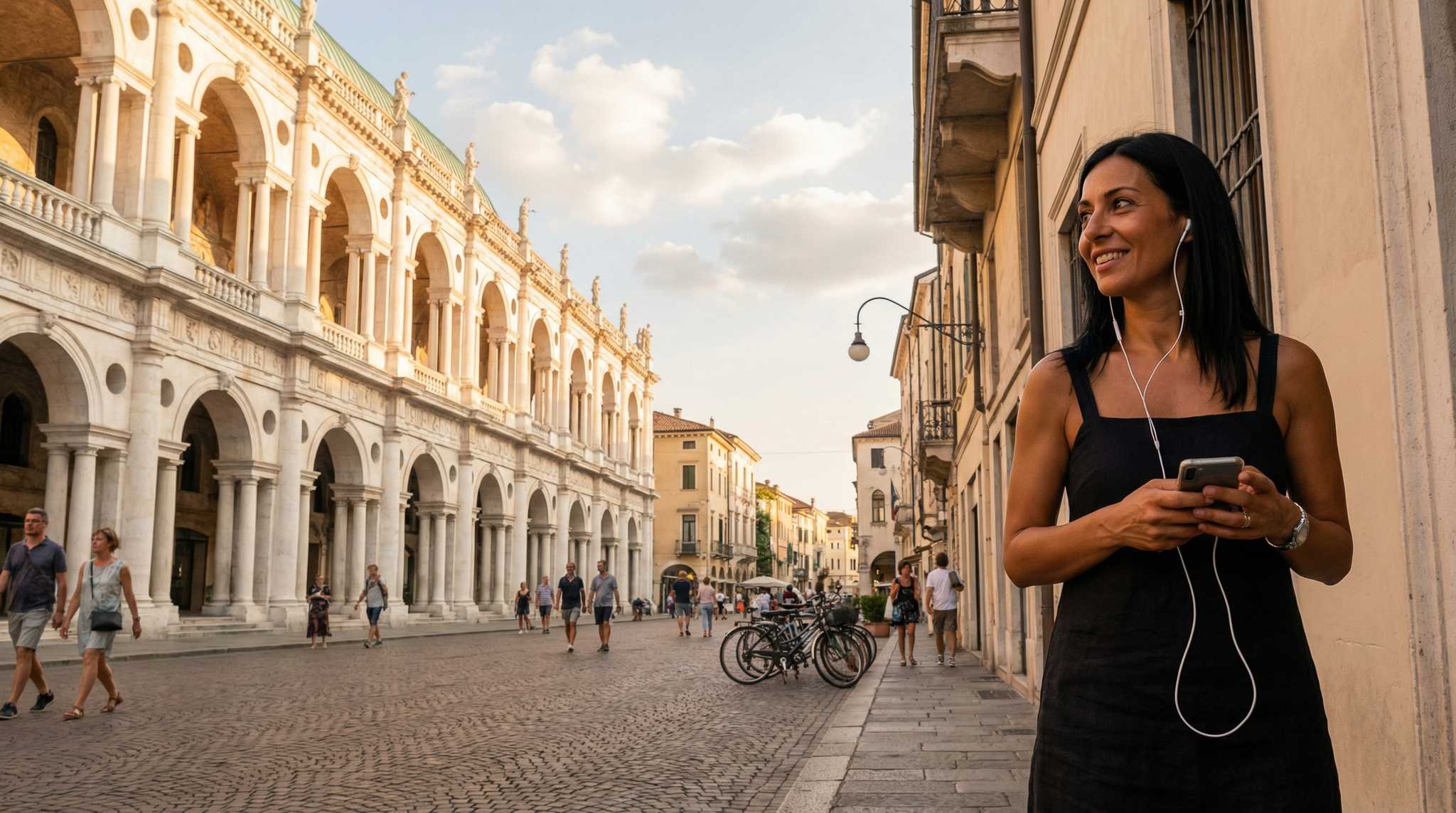
ヴィチェンツァ オーディオツアー:宮殿、劇場、聖なる石の公開
建築と歴史の宝石を巡る魅惑的なツアーで、魅力的な都市ヴィチェンツァを発見しましょう。アンドレア・パッラーディオによるルネサンスデザインの傑作、パッラーディオのバシリカの壮大さに驚嘆してください。素晴らしい芸術作品と穏やかな雰囲気が漂うサンタ・コロナ教会の中へ足を踏み入れましょう。時代を超えた美しさと精神的な遺産が息づく荘厳なサンタ・マリア・アンヌンツィアータ大聖堂を訪れてください。ヴィチェンツァを巡るこの旅は、芸術、歴史、文化の完璧な融合を約束し、あなたにインスピレーションと魅惑を与えるでしょう。
ツアーのプレビュー
このツアーについて
- schedule所要時間 40–60 mins自分のペースで進める
- straightenウォーキングルート 2.6kmガイド付きパスに沿って進む
- location_on
- wifi_offオフライン対応一度のダウンロードでどこでも使える
- all_inclusive無期限アクセスいつでも、ずっと再生可能
- location_on3月のキャンプから開始
このツアーのスポット
To spot the March Camp, look for a wide open park stretching out before you, with paths, bare-limbed trees reaching into the sky, and benches spaced out along a flat expanse of…もっと読む折りたたむ
To spot the March Camp, look for a wide open park stretching out before you, with paths, bare-limbed trees reaching into the sky, and benches spaced out along a flat expanse of grass-just head towards the large green area near the city center and the railway line, with Monte Berico rising up in the background. Welcome! You’re standing at the edge of March Camp-or, depending on who you ask, Campo Marzio. I won’t quiz you on your Latin, but locals still have a heated debate over whether the name comes from “the fields of Mars,” the god of war, or the rather less-glamorous “marshy field.” Imagine that: even the name here is the stuff of legends and local feuds. Now, close your eyes, take a deep breath, and let me take you back in time. Thousands of years ago, long before the city buzzed with life, this spot was a burial ground for ancient peoples. Can you hear the whisper of stories buried beneath the grass? As centuries rolled on, the area became known as Wisega, which basically meant “the meadow” in old Germanic. Then came the medieval monks, and later, powerful bishops and feudal lords. In 1074, records call it “Campi Marcii,”-which could mean “fields of Mars” or simply muddy, marshy land. Not quite as poetic if you ask me, but probably more accurate in rainy season! During the Middle Ages, things were anything but peaceful here. This wasn’t just a park-it was the city’s spot for public executions and, in a pinch, a moat! Can you picture people flooding the field to protect the city from siege? If you’d been walking here around Saint Felice’s or Saint Gallo’s Day, the air would have been thick with the smells of livestock and market goods as Venetian traders haggled at bustling fairs, preparing their wares for the long trip down the river to Venice. By the 1300s and 1400s, trees were being planted, and a swirling marketplace would have filled these meadows with shouts and laughter. For a brief time, the powerful Visconti family handed the land to a loyal knight as a thank you gift-but his sons quickly gave it back. Apparently, even medieval land developers had cold feet! The Renaissance brought new tricks: fancy regulations for market-goers and a creative use of the park as a quarantine zone during deadly plagues. Picture makeshift huts popping up across the grass and wary townsfolk trying to avoid a sneeze at all costs. When drama wasn’t viral, there was always a show-the Field was often transformed into a wooden amphitheater, designed so the good people of Vicenza could wager on rowdy horse races or celebrate with grand parties. Rumor has it Andrea Palladio himself doodled the design for one such arena-now that’s what I call VIP box seats. In the Napoleonic era, the meadows turned military again. Suddenly, you might see regiments camped out on this very spot, the thunder of boots and the stench of army stew hanging in the air. Later, when the city wanted a proper place to stroll, things got fancy. Architect Bartolomeo Malacarne designed leafy boulevards lined with majestic plane trees-though over the years, the poor trees suffered a mysterious “colored cancer.” Don’t worry, those have been swapped out for sturdy maples! By the 1800s and 1900s, the park’s character shifted again and again. There was the famous Arco del Revese-a grand arch that eventually stood right at the entrance... until, in true Italian fashion, it became a traffic hazard and had a date with the demolition crew just before Mussolini came to town. When bombers swept over during the Second World War, the air would have rattled with and splintering glass as historic buildings and trees fell to rubble. But like a stubborn dandelion, March Camp came back to life. In the late 20th century, after years of neglect and debates fiercer than any medieval duel, it was reborn as a proper public park. Now you’ll find free WiFi, dog runs, summer theaters, and playful children in the western playground. During September-the Festa dei Oto-the area bursts with carnival rides, music, and the excited shrieks of residents celebrating the city’s patron saint. So as you stand here, imagine all those layers: monks and livestock, soldiers with muddy boots, bustling markets, daring horse races, and flighty fairground lights. This isn’t just “the park by the railway”-it’s Vicenza’s living, storied backyard, always changing, always at the heart of the city’s dreams and dramas. Ready to discover the next chapter? Let’s head for stop number two-the Cathedral of Santa Maria Announced!
専用ページを開く →Take a look straight across the Piazza del Duomo-spot the long, stately façade stretching along the whole western edge of the square, its reddish, brick-like ground level topped…もっと読む折りたたむ
Take a look straight across the Piazza del Duomo-spot the long, stately façade stretching along the whole western edge of the square, its reddish, brick-like ground level topped by elegant columns and rows of windows; that’s the Bishop’s Palace right in front of you. Welcome to the Bishop’s Palace, or as the locals once called it, the Vescovado! You’re now standing before one of Vicenza’s great survivors, a building that’s seen bishops, builders, bombs, and... well, more bishops. It's like the ultimate Italian reality show, but with fewer dramatic roses and more Renaissance makeovers. So, imagine Vicenza in the Middle Ages. Squint, and you might see a very different palace-one that looked nothing like today’s grand residence. Back then, this was actually a patchwork of three connected structures. The oldest part hugged the south side of the square-right beside the Cathedral-dominated by a mighty tower and a cozy chapel dedicated to Saint Nicholas. If you could travel underneath your feet, believe it or not, bits of that ancient chapel are preserved in the basement of today's Diocesan Museum. Fast forward to the late 1400s, during the heyday of Venice’s golden age. The bishop at the time-Giambattista Zeno-wasn’t just any old cleric. He was a cardinal with a flair for style and a serious case of building envy. He decided his palace needed to match the glamor of the Serenissima, Venice’s mighty republic. So, the next phase took shape-a brand-new section appeared, still clinging to the old, but flaunting windows so beautiful they practically demanded applause. Walk along the north side of the palace and you’ll spot six of these original windows, each a miniature piece of Renaissance art, along with the proud Zeno coat of arms from 1485 squeezed between the fourth and fifth window. The lush details keep coming: look for the gothic windows with three-lobed arches, probably the work of Lorenzo from Bologna, and two more classic windows from the 1600s, their namesake-Bishop Giambattista da Brescia-etched in the frieze. The roofline, still supported by sturdy wooden brackets, hints at how carefully every detail was designed to impress. Back in the main square, your eyes are drawn to the palace’s striking face. This was the vision of architect Ottavio Bruto Revese, commissioned in 1627 by-wait for it-yet another Venetian cardinal, Federico Cornaro. Picture dusty craftsmen in their tunics, carving rough, red stone for the lower level, which today still stands out thanks to its meaty, hammered-brick pattern. It’s like a bold red velvet jacket beneath a sharp white collar-the upper floor's columns inspired by Palladio himself. The Doric frieze up top might look simple now, but Verda, another ambitious architect, originally wanted it to be festooned with lively garlands. Maybe too much party for the bishops? Now, hold onto your hat, because the palace didn’t have a quiet modern history. During the rule of Napoleon’s French Empire, things got a little wild. The original southern wing was torn down and rebuilt-from 1812 to 1814 a brand-new design by Bartolomeo Malacarne appeared, but guess what? No one liked it, so... they knocked it down almost right away. Architects, I tell you, they can be a dramatic bunch! The central part was next to go, replaced by Giacomo Verda’s vision, but bombings in World War II tore much of it apart. The palace you see today had to be carefully rebuilt between 1947 and 1952. If you spot the big coat of arms above you, it belongs to Bishop Carlo Zinato, who watched over the reconstruction. Makes you wonder-does every stone whisper its harrowing past to his shield? Hidden within these walls is one of the palace’s true gems: the courtyard and the Loggia Zeno. Originally built in 1494 for our stylish bishop Zeno by Bernardino da Como and Giovanni Fugier, its delicate arches and candle-adorned balustrade were almost lost in the bombings of 1945 but have been meticulously restored. Imagine a tranquil well in the center, shaded walkways, and fancy little columns-perfect for quiet contemplation, or maybe an after-mass selfie. Through all these centuries, the Bishop’s Palace has seen almost everything. Once, it boomed with the daily bustle of ecclesiastical business-the bishop’s home, the diocesan curia, endless meetings, anxious priests pacing up and down. Nowadays, the bishop and his staff have moved to the modern Diocesan Center, but the palace still buzzes with vibrant life as the Museo Diocesano and hosts special events. So, next time you see an old building, remember Vicenza’s Bishop’s Palace: more than just stone and brick, it’s a living tapestry of history-rebuilt, reimagined, and still watching over the Piazza Duomo just as it has for nearly a thousand years. And who knows, maybe the walls are still listening. If you hear faint whispers in Latin, don’t worry-it’s just the bishops comparing their favorite window styles.
専用ページを開く →To spot the Cathedral of Santa Maria Announced, look for the grand Gothic-style facade just ahead, decorated in a colorful pattern with four tall layers, five prominent arches at…もっと読む折りたたむ
To spot the Cathedral of Santa Maria Announced, look for the grand Gothic-style facade just ahead, decorated in a colorful pattern with four tall layers, five prominent arches at the base, and a striking dome that peeks above the roof-trust me, you can't miss this beautiful giant! Welcome to the heart of Vicenza-stand still a moment, breathe in the history, and just imagine: you’re about to step into a story that stretches all the way back to ancient Rome. Now, don’t get spooked, but under your feet lie the remnants of Roman streets and homes, and maybe, just maybe, a weary Roman shoemaker once grumbled right where you’re standing about how long it takes to build things. The Cathedral of Santa Maria Announced is the grand centerpiece of Catholic faith in Vicenza, but it hasn’t always looked like this. In fact, it’s had more makeovers than a reality TV star! Archaeologists think the first Christian gathering space was carved into a Roman building from the first century. Whispered legends say that after Constantine’s Edict in 313, Vicenza’s Christians put down roots here-a humble church arose, nothing as grand as what you see now, but the seed was planted. Fast forward to the 5th century. Vicenza has taken a beating from the Huns-yes, the real Attila the Hun kind! After the destruction, the little church grew bigger, sprouting three grand naves. A few centuries later, the first local bishop, Oronzio, flexed his architectural muscles and built an even bigger, three-aisled structure, almost as big as today’s cathedral. By about the year 1000, the church had expanded with three shining apses. But fate wasn’t done stirring the pot! In 1117, a massive earthquake rattled the city, reducing much to rubble. The people weren’t discouraged-they rebuilt, now with five naves. By the 1200s, another round of chaos from Emperor Frederick II’s raiders left scars, so the indomitable Bishop Bartolomeo da Breganze ordered a fresh round of improvements, cutting back to three naves with dramatic vaults overhead. Donors, wealthy families, and faithful townsfolk chipped in, filling the cathedral with side chapels, a southern portal, and treasures through the 13th and 14th centuries-everyone wanted to outdo their neighbors in generosity. By the mid-1400s, the face you see today slowly emerged, with a grand Gothic facade built between 1444 and 1467, its bright patterned blocks and deep arches welcoming everyone who walked through Vicenza’s streets. Now, if you look up at that elegant dome, you’re gazing at the handiwork of Andrea Palladio, Vicenza's superstar architect, whose design here is so special that UNESCO put it on the World Heritage list. Palladio also crafted the northern portal, inspired by his obsessions with ancient Roman architecture. His lantern, perched atop the dome with minimal decoration, later popped up in his Venetian masterpieces and even sketches of lost Roman temples. Makes you wonder if Palladio ever dreamed that one day, his work would top bucket lists all over the world! Over the centuries, Vicenza’s cathedral kept changing its hat-from Gothic to neogothic, getting fixed and restyled throughout the Austrian Empire’s reign in the 1800s. But tragedy struck on a spring day in World War II. Heavy Allied bombs rained down, sending the cupola crashing and tearing through the nave. The cathedral’s precious frescoes? Just memories and dust, echoing away into the past. Yet, like a persistent old cat, this cathedral refused to stay down. Reconstruction began almost at once and lasted until 2002. Inside today, the style remains pure Gothic with soaring vaults and chapels on either side. Walk in and you’ll see modern altars, ancient tombs, and an altar-piece called the Paramento Civran sparkling at the apse-paintings on the left show wild scenes from the Old Testament, while the right side celebrates Emperor Constantine and the famous True Cross. Between them, angels and saints keep watch, locked forever in a cosmic tug-of-war between light and shadow. Beneath your feet, don’t forget, the cathedral’s underground is a treasure map-an archaeological layer cake. There are Roman streets, medieval walls, stone relics from the eighth century, and even inscriptions honoring Emperor Gratian. It’s like time travel without the time machine! Finally, if you’re lucky, you might hear the bells from the proud campanile-built partly as a fortress, with parts dating back to the tenth century (and far too many repairs to count). Listen for the distinctive harmony, and remember: as Vicenza has weathered Huns, emperors, earthquakes, and wars, the bells still ring out, telling the city’s stories to anyone who stops to listen. Now, ready to explore even more? Let’s march to the next stop-our adventure has only just started!
専用ページを開く →
さらに10件のスポットを表示表示するスポットを減らすexpand_moreexpand_less
You’re now standing in front of the Palladio Course, Vicenza’s main street-a broad avenue lined with grand, stone palaces and elegant facades, stretching out ahead as if inviting…もっと読む折りたたむ
You’re now standing in front of the Palladio Course, Vicenza’s main street-a broad avenue lined with grand, stone palaces and elegant facades, stretching out ahead as if inviting you to stroll right into history. To spot it, look directly forward; you’ll see the street framed by tall cream-colored buildings with ornate windows and bustling life moving along the cobblestones, often with locals and visitors alike on foot or whizzing past on bicycles. Now, let’s take a walk down memory lane-quite literally! The Palladio Course isn’t just a street, it’s Vicenza’s ancient backbone, built along the same path the Romans used when this was the decumanus maximus, the city’s main east-west road. Imagine dusty sandals, the clack of horseshoes, and merchants calling out to passersby, because nearly two thousand years ago, this was already a bustling thoroughfare connecting distant Verona and lively Padua. If you listen closely, you might even hear the distant as you stand where Romans once strolled. Over the centuries, this roadway-sometimes called Strá grande or simply Strá-became everything to Vicenza: a public square, a parade ground, a hub for raucous inns and sparkling cafés, and a place where proclamations and the day’s news rang out for all to hear. In the Middle Ages, officials would proclaim government decrees at four key spots along the street. Just imagine a medieval crier, bell in hand, drawing a crowd to hear the latest law or scandalous sentence! By the 1800s, the street had grown a character of its own, with different stretches sporting colorful names: from the chic “corso all’Azzardo,” beloved for its stylish café, to the “corso al Casin” where aristocrats gathered in secret societies (lock up your monocles!), to the lively “corso alla Stella d’Oro,” named after a legendary inn with a golden star sign. There’s even “corso al Bo d’oro,” a tribute to the golden apothecary shop where locals may have once swapped both medicines and the latest gossip. If you’d taken this walk 200 years ago, you’d encounter carriages clattering past-the final stretch being “corso al Nolo,” close to the city’s carriage depot. And for those in need of a bed, the grand hotel called Al Cappello Rosso (Red Hat!) would be waiting, its doors open until it was finally shuttered in 1852. The Palladio Course is also a collage of architecture. On one side, you’ll spot the stoic remains of the Porta Castello and the mighty medieval tower, echoes of a time when lords and soldiers kept watch over the town. Just steps ahead, you pass grand palaces like the Thiene Bonin Longare-a masterwork by none other than Andrea Palladio himself (the superstar architect this street is named for). UNESCO even declared these marvels part of world heritage, so there’s a bit of celebrity glitz under all that marble. And yet, this street has known hardship too. In World War II, bombs fell on this very ground, damaging many of its proudest buildings. But, like a boxer with a strong chin, the street bounced back-restoring the glories of Ca’ d’Oro and building anew where ruins once stood. You can almost feel the buzz of change as workmen hammered and sawed to heal the city’s heart. Since 1983, the street has been closed to cars, its old stones replaced with polished porphyry so you can window-shop in peace-because, let’s face it, dodging traffic while eyeing pastries is nobody’s idea of fun! Today, the people of Vicenza still walk “vasche,” meandering up and down, greeting neighbors, or shopping for the latest styles. Some say this street is so elegant, if it weren’t for Venice’s Grand Canal, it might be the swankiest avenue in all Europe. So, as you stand here, take a deep breath and picture the centuries flowing by: Romans in togas, medieval townsfolk gathering for a heated announcement, aristocrats riding high, and World War II survivors rebuilding with hope. All of it, right under your feet-and there’s still more of Vicenza’s story ahead. Keep your eyes sharp: you never know when the past might pop up and wink at you from a palace window!
専用ページを開く →Right ahead, you’ll spot the Palladian Basilica-a huge white marble building dressed in elegant arcades and arches, stretching proudly along Piazza dei Signori, just look for the…もっと読む折りたたむ
Right ahead, you’ll spot the Palladian Basilica-a huge white marble building dressed in elegant arcades and arches, stretching proudly along Piazza dei Signori, just look for the grand loggias sparkling in the sunlight above the busy street. Take a good look-what you see is a building that has witnessed centuries of bustling life, echoing with the voices of rulers, merchants, and, well, a nosey tour guide or two! Imagine the year is somewhere around 1460: The air smells of roasting chestnuts from nearby market stalls, and out of the dust and chatter rises a towering Gothic palace, known then as the Palazzo della Ragione, its dramatic pink-and-yellow diamond facade still peeking out up there behind the arcades. But, ah, even palaces have their drama. After Tommaso Formenton wrapped the old structure in stylish loggias, part of the building promptly decided it didn’t want to stick around-*crash!*-the southwest corner collapsed, which left everyone arguing for the next forty years about how to fix their half-dressed giant. All sorts of famous architects came with advice and wild ideas, some of them so creative it’s a miracle they didn’t suggest putting a moat and a drawbridge across the piazza. Eventually, in 1546, in swoops a not-very-famous local architect named Andrea Palladio-imagine a shy but brilliant contestant on a Renaissance reality show, ready to win hearts and votes. His mentor, Giangiorgio Trissino, must’ve convinced everyone that Andrea was the man for the job, because the city council handed him the biggest commission of his life. Of course, because Vicenza never did things the easy way, they made Palladio build a wooden model first, just in case his new-fangled “serliana” arches wouldn’t win over the local critics. The serliana-also called the Palladian window-is what makes the building so special. Instead of boring arches all in a row, Palladio gave us a recipe: one striking round arch in the middle, flanked by two rectangular side openings. Depending on the space, sometimes those side rectangles squeeze so narrow they’re hardly there at all! It’s a smart design, borrowed from ancient Roman basilicas, and it wraps elegantly around this old heart of Vicenza. It’s like the building is wearing a fabulous Renaissance cloak, but you can still spot its medieval pajamas underneath. Palladio’s design won massive applause (even if it took another three years, and a few more sleepless council meetings, to get it approved). The work crept along: the first floor finished in 1561, the second only in 1597-seventeen years after poor Palladio had passed away! The gorgeous balustrade above you, crowded with stone statues by Giovanni Battista Albanese and others, is like a row of marble fans lining up for the opening night of a star-studded show. And what a show! Inside, the upper hall-the Salone del Consiglio dei Quattrocento-is an enormous expanse, 24 meters high with not a single pillar in the center, just a soaring, copper-roofed ceiling shaped like the hull of a ship flipped upside down. Talk about an ambitious roof: it was inspired by one in Padua, built back when nobody had ever heard of Palladio (or pizza). Throughout its life, this basilica has been a hotspot not just for the city’s politicians-who argued, ruled, and probably snuck snacks up here in secret-but also for traders and travelers. Downstairs, merchant shops buzzed with deals and gossip, while upstairs, the grandees debated Vicenza’s destiny or, for a while, staged one of the earliest wooden theaters ever designed by Palladio, a sort of try-out before his masterpiece, the Teatro Olimpico. But it wasn’t all glamour. In March 1945, the building caught the wrong kind of spotlight during a World War II bombing raid. Despite being on the "Do Not Bomb" list, an incendiary destroyed its roof alongside damage to the ancient Torre dei Bissari nearby. Yet, like a true survivor, the basilica was lovingly restored after the war, with timber donated from the local mountain communities. And then, another twist. In 2007, the entire structure was wrapped for a new makeover-in fact, the restoration team even let curious locals wander through the construction site to see history in action. They peeled off decades of grime, rebuilt with modern wood beams, and installed a new lighting system, finally unveiling the sparkling result in 2012. Today, you can even visit the rooftop terrace, now crowned by a chic café, and look out over Vicenza as if you were a local noble coming up with your next great plan-or next great snack. No wonder UNESCO declared this a World Heritage Site in 1994, and in 2014, the basilica was promoted to national monument status. If buildings could take bows, I’d ask you to applaud right now! So take a moment, soak in the magnificence, and remember-this isn’t just a building, it’s the beating marble heart of Vicenza, filled with stories, arguments, triumph, and the timeless hum of the piazza below.
専用ページを開く →If you’re searching for the Church of San Vincenzo, look straight ahead for an ornate stone façade right in the center of the square, standing proudly with two stacked arcaded…もっと読む折りたたむ
If you’re searching for the Church of San Vincenzo, look straight ahead for an ornate stone façade right in the center of the square, standing proudly with two stacked arcaded loggias, tall Corinthian columns, and a handful of impressive statues gazing down at you from the rooftop-like stone superheroes on patrol! Now, as we stand here together on the lively Piazza dei Signori, let me whisk you back through the centuries to imagine what secrets and stories have seeped into these ancient stones. The Church of San Vincenzo has witnessed everything from medieval processions and city drama to mysterious pawnbroker dealings and actual bombings, so buckle up-history has been anything but boring here! Our tale begins almost invisibly, in the foggy mists of the first millennium, when San Vincenzo of Saragossa became known as one of Vicenza’s guardian saints. Legend says his fame spread so fast across Europe, he might have been the first influencer-except instead of selfies, he had stories of faith and martyrdom. He was such a big deal here that, in 1311, the proud city fathers named him their protector, perhaps also because “Vincenzo” sounded comfortingly close to “Vicenza”-and every city likes a patron with a punny name, right? By the late 1300s, devotion to San Vincenzo spiked, and a little church was built, snug up against the bustling city walls, right in the heart of the old “platea magna.” As power swapped hands and noble families jostled for control, this spot witnessed both grandeur and chaos. Not long after, in 1486, the city ran into a financial pickle-local moneylenders were shown the door, and to help people pawn valuables, the Church of San Vincenzo became the headquarters for the brand-new Monte di Pietà, sort of an early community bank. If you look closely, you can still glimpse tiny windows where precious items and coins were quietly passed through-imagine the whispers and nervous glances of those transactions. Of course, nothing stands still in Vicenza! By the 1500s, the church was being squeezed-literally swallowed-by the expanding palace of Monte di Pietà on either side. San Vincenzo’s façade became a spectacular sandwich filling: shorter than its flanking palazzi but adorned more gloriously. The church got a face-lift in 1614, thanks to architects Paolo and Pietro Bonin, who added those dramatic arcades you see-three arches stacked high, crowned by a parade of statues. And right up top above the entrance, you get a dramatic baroque marble scene crafted by Giovanni Battista Albanese: the grieving Christ surrounded by angels, practically glowing in the sunlight, ready to outshine all the neighbors. But it’s not just pretty on the outside. Stepping inside, past a grand iron gate, you’d find an atmospheric atrium with old red marble steles, bits of vintage measurements carved for city tradesmen, and a nobleman’s sarcophagus, who helped bankroll the very first church construction. Back in the day, four altars crowded the sacred hall, each humming with prayers to different saints or for Corpus Christi. Here, family dramas unfolded, deals were struck, and the city’s poorest citizens came to beg help at the Madonna della Mercede chapel-just inside, enveloped in centuries of frescoes and old scents of candle wax and incense. As time rolled on, even the church’s orientation changed-like someone rearranging furniture to let in better sunlight. The doors, once facing the side alley, started opening toward the main square, inviting all of Vicenza in. In the 1700s, architect Francesco Muttoni stretched the church further, adding a sweeping baroque altar, where even today, you’ll find dazzling paintings and marble columns presiding over the old space. And if you cock your ear to the sky, you might just hear three bells from the slim, towering campanile-though one original bell, cast in 1418, now sleeps on display inside after surviving centuries and even wartime fire. Oh, and if you’re lucky enough to be here on the right day of the week, step inside and you can catch mass sung in Latin-a rare treat in Vicenza! So here it stands, both a palace and a shelter, a witness to devotion and daily life, blending opulence and charity, and layered with stories of saints, bankers, artists, candles, and curious locals. Take a moment to soak it all in-after all, San Vincenzo has had centuries to perfect the art of being unforgettable!
専用ページを開く →Right in front of you, you’ll spot the Bertoliana Civic Library-just look for the long, weathered building with tall arched windows and sturdy iron bars, along with a big sign…もっと読む折りたたむ
Right in front of you, you’ll spot the Bertoliana Civic Library-just look for the long, weathered building with tall arched windows and sturdy iron bars, along with a big sign above the main double doors that proudly reads “Biblioteca Civica Bertoliana.” Now, take a moment and imagine the air tinged with the crisp, papery scent of old books and the gentle creak of wooden floors echoing through these walls. The story of the Bertoliana Library begins right here in Vicenza, back in 1696, when a local nobleman, Giovanni Maria Bertolo, was struck by a truly wild idea-he decided to give away his entire book collection, some 9,000 volumes, so that everyone in the city could explore the wonders of reading. Talk about a generous donation! But there was one rather quirky catch: all those precious tomes had to be kept in a place as splendid as the knowledge they contained. No dusty basements allowed. By 1706, Bertolo’s private library had been settled into the grand halls of the Palazzo del Monte di Pietà, and two years later, the doors swung open for the city’s book lovers. The people of Vicenza honored their benefactor by naming the new institution after him: Bertoliana. Ironically, Bertolo himself didn’t live to see his dream realised, but his books didn’t gather any dust-they were catalogued, expanded, and cherished. As the years passed, the Bertoliana gobbled up new books like a very hungry caterpillar-after the death of economist and senator Fedele Lampertico, the collection ballooned by another 20,000 titles! Suddenly, the shelves were so full, they needed a bigger home, and the choice fell upon the former Convent of San Giacomo, a place once humming with the quiet prayers of the Somaschi fathers. In 1910, after much hammering and the odd architectural debate, the Bertoliana reopened, ready to house hundreds of thousands of books, pamphlets, and historical treasures. But the library’s life hasn’t been all quiet reading and polite shushing. During World War II, the rarest treasures were spirited away, hidden in secret nooks and crannies across villas and abbeys-like a literary spy mission! When things got dangerous after the armistice, the most valuable works were transferred to Monte Berico’s underground chambers and, for extra precaution, to Venice itself. Only in 1945 did they return home, safe and sound. In the aftermath of war, the library was renovated and reorganized over and over again, making space for even more books and for the curious minds of Vicenza. Just imagine generations of librarians bustling around, some so devoted they wrote whole histories and catalogues about the library, arguing about how to store the books, or perhaps sneaking a peek at the city’s secrets. The Bertoliana isn’t just about printed words-it guards manuscripts, journals, family archives of Vicenza’s nobles, ancient hospital documents, even a massive photography collection with images reaching back to the 1800s, and enough maps to satisfy the most adventurous explorer. And here’s a fun twist: once upon a time, no one was allowed to take a book outside these walls. Lending was strictly forbidden-you could read, sure, but not step outside. Can you imagine a modern library with that rule? Nowadays, things have loosened up a bit, and there are not just one but seven library branches dotting the city, from Villa Tacchi to Villaggio del Sole, each with its own specialty-from women’s history to comic books and everything in between. Today, the Bertoliana’s main home inside Palazzo San Giacomo isn’t just a building; it’s a living memory of Vicenza, echoing with centuries of laughter, whispers, and shouts of discovery. It now shelters around 450,000 volumes-yes, you heard that right!-plus ancient manuscripts, periodicals from every era, and a thriving multimedia section. There’s even a room for people who just want to browse the daily newspapers, old and new. So while the library’s stone façade may look a little severe on the outside, inside it’s a treasure chest-full of drama, heroics, narrow escapes, and stories waiting to be read. If only those library walls could talk… but lucky for you, you have me instead! So, are you ready for the next chapter on our Vicenza adventure? Interested in a deeper dive into the patrimony, catalogs or the historical librarians? Join me in the chat section for an insightful conversation.
専用ページを開く →Directly ahead of you is a long, cream-colored palace with a row of grand columns on the ground floor and many elegant windows above, so just look for the impressive, sunlit…もっと読む折りたたむ
Directly ahead of you is a long, cream-colored palace with a row of grand columns on the ground floor and many elegant windows above, so just look for the impressive, sunlit facade stretching along the narrow street. Now, as you stand here, let’s imagine ourselves whisked back to 16th-century Vicenza-where the clatter of horse hooves mingled with the lively banter of finely dressed nobles. This stately building before you is the Palazzo Barbarano, or as some would say with a touch of flair, the Barbaran Da Porto Palace. No ordinary address, mind you! Monte Barbarano, the music-loving noble who lived here, wanted a house so magnificent that even the neighboring palaces would glance over and sigh in envy. Picture the renowned architect Andrea Palladio-this is the only large town palace in Vicenza he managed to fully create from start to finish. I can almost see Palladio, pacing around with blueprints under his arm, occasionally muttering about “asymmetrical doorways” and “stubborn pre-existing walls.” You see, Montano’s family already owned a jumble of smaller houses on this spot and-just as poor Palladio thought he’d figured it all out-Montano bought yet another house and said, “Can you add this too?” The result? The entrance isn’t right in the center, but don’t worry: with each challenge, Palladio got more creative. Once inside, imagine stepping into a dazzling atrium held up by four strong Ionic columns-a design inspired by the ancient Theater of Marcellus in Rome. The space had to do some serious heavy lifting because the grand salon above is not exactly light as a feather! And then, as if building on uneven ground wasn’t tricky enough, he had to make it look symmetrical-because nothing upsets Palladian harmony quite like a wonky wall or two. He solved this by cleverly joining the columns with stretches of straight decoration, blending all the inherited chaos into a single majestic hall. But Montano Barbarano wasn’t just an owner-he was a true Renaissance man: a lover of books, songs, and gatherings. You might have heard the echo of flutes overhead; this place was once alive with musical evenings that drew the city’s best artists and performers. In fact, the old 1592 inventory lists so many flutes, you’d think they were trying to start a one-man orchestra! The decorations of the Palazzo were entrusted to the finest craftspeople of the era. Imagine frescoes by Battista Zelotti and the staccato chip-chipping of stonemasons led by Lorenzo Rubini, who was also beautifying the city’s iconic Loggia del Capitanio at the time. Rubini’s work here was so admired that, when he passed away, his son stepped in to ensure the legacy continued-just like a generational relay of artistry. After centuries of aristocratic drama, dances, and whispers behind velvet drapes, the palace needed a nap-roughly twenty years of restoration! But now it’s wide awake again, gleaming with Palladian ambition. Today, you can find the International Center for Palladian Studies and the Palladio Museum inside. So, as you gaze up, just imagine the mix of sweat, genius, and maybe a little exasperation that created this parade of columns, windows, and stories. And if you close your eyes, maybe you’ll still hear the faintest sound of a flute-Montano’s favorite-drifting down from upstairs.
専用ページを開く →To spot the Church of Santa Corona, look for a striking red-brick building with a tall bell tower and a pointed, castle-like front topped by five pinnacles-if you see a rose…もっと読む折りたたむ
To spot the Church of Santa Corona, look for a striking red-brick building with a tall bell tower and a pointed, castle-like front topped by five pinnacles-if you see a rose window above a grand entrance and plenty of decorative arches, you’ve found it! Now, let your imagination wander back more than 700 years, as you stand before Santa Corona. Picture this: it's the 1260s, and Vicenza is bustling with excitement. People crowd the streets, not for a market day, but to help build a church-one big enough to guard a piece of Christ’s crown of thorns. Yes, that’s right! The local bishop, Bartolomeo da Breganze, brought back this sacred relic all the way from King Louis IX of France. You can almost feel the air thick with hope, ambition, and maybe a bit of sawdust. This spot wasn’t chosen by chance. The church took over the land where the old “bad guys”-the Cathars-and a certain Ezzelino’s fortress once stood, giving the city a new symbol of unity and renewal, perfect after decades of strife and feuding families. The Dominicans became the guardians, and the townspeople pitched in, offering houses and palaces for the project. Imagine them, sleeves rolled up, all in: nobility, merchants, wily lawyers and locals, each laying a brick for the future. By the late 1200s, the church was up and running, right as Vicenza was swept under Padua’s rule. Bartolomeo, who built up so much hope, saw his power fade, and after his death in 1270, he was laid to rest in the very church he created-now, that’s what you call a home project. Santa Corona quickly became the city’s spiritual heart, its annual processions for the Sacred Thorn rivaling the Carnival of Venice for spectacle. Even as fashions changed, from Gothic to Renaissance, Vicenza’s big shots kept adding chapels and art, each elbowing for eternal bragging rights… and maybe a shortcut through Purgatory. Families like the Barbaran and Valmarana sponsored stunning side chapels; one, by Andrea Palladio himself, looks like a slice of ancient Rome, hidden beneath the church in the Valmarana Chapel. Some families even demanded front-row tombs-one way to ensure your neighbors remember you! But Santa Corona wasn’t just about high society-picture rowdy Dominican friars teaching philosophy, running a school packed with books, while secretive tribunals hunted both heretics and, well, sneaky loan sharks. And although the inquisitors wanted to save souls, sometimes cunning usurers would slip a “generous donation” to the church instead of paying their victims back. You’ve got to admire the hustle! As centuries rolled by, each period stamped its mark. The Renaissance brought riotous color and grand new altarpieces, like Paolo Veronese’s “Adoration of the Magi.” The Baroque era filled the walls with saints and epic scenes, especially after the Battle of Lepanto, when the locals celebrated with marble and gold in the enormous Rosary Chapel. Then came Napoleon, marching in like an unwanted guest at dinner. He closed the convent, scattered the Dominicans, and turned the sacred halls into hospitals and schools. Vicenza’s old noble glories faded, and the church became a quieter neighbor, though its beauty survived bombs, occupation, and years of change-a bit battered, but still breathtaking. Today, Santa Corona is a treasure chest: look up at its red-brick facade, at the rose window and five pinnacles, and you’ll see echoes of medieval faith. Step inside, and the story comes alive-gothic pillars march down three naves, glowing altars invite you to pause, and sunbeams slip through centuries-old stained glass, as if whispering secrets from the city’s past. And if, on a quiet moment, you sense a chill or the faintest wisps of music swirling through the cloisters, don’t worry-it’s just the memories of saints, artists, scholars, and mischievous merchants, all keeping an eye on their beloved Santa Corona. Because in this church, everyone-sinner, saint, or just a lost tourist-becomes part of the story.
専用ページを開く →To find the Palazzo Chiericati, look directly across Piazza Matteotti-you’ll spot a grand white stone building with a two-level columned façade, raised proudly above the street,…もっと読む折りたたむ
To find the Palazzo Chiericati, look directly across Piazza Matteotti-you’ll spot a grand white stone building with a two-level columned façade, raised proudly above the street, topped with a line of statues that look like ancient guardians posing for a Renaissance family photo. Welcome to the Palazzo Chiericati, a place where the Renaissance decides it wants to show off a little-okay, a lot! Imagine you’re standing in the 1550s as carriages rattle past on uneven stones, and the air is alive with merchants’ voices from the bustling Isola market. This square used to be surrounded by flowing water from the Retrone and Bacchiglione rivers, with cows and timber rolling in for sale-so let’s just say, the world’s most elegant villa almost had a side gig as a barn. Picture a bright morning, and a man named Count Girolamo Chiericati, stylish and full of ambition, pulling up to his inherited patchwork of old houses. Inspired by the rising star architect Andrea Palladio, he wants something big, bold, and unlike anything Vicenza has ever seen. He brings in Palladio, who fans out his blueprints. “How about we build it tall, raise it on a podium so it doesn’t get flooded-oh, and let’s keep the cows out, if you don’t mind.” The columns and loggias you see were revolutionary, making the building look both like a stately palace and a suburban villa, with a striking double row of arcades reminiscent of a Roman forum. The idea of “villa-meets-palazzo” was unheard of. To top it off, Palladio borrowed inspiration from Roman temples, adding that impressive staircase you’re eyeing right now. Construction starts in 1551, but the project soon hits its own dramatic cliffhanger-Count Girolamo passes away! Everything grinds to a halt, and the palace stands unfinished for over a century, with travelers sketching its awkward, incomplete silhouette. Inside, Girolamo’s son Valerio tries to fill the spaces with dazzling artwork. He brings in a super-team of Renaissance decorators: you might say it was the “Avengers” assembly of the 1500s, from Ridolfi to Zelotti. Despite all this glamour, the project moves at a snail’s pace and only around 1680 does the dream complete-more than 100 years after Palladio first drew his plans. Now, here’s where things switch from palace drama to civic pride: by the 1800s, the city of Vicenza steps in, snapping up the Chiericati family’s legendary pile of stone. They restore the building, finally giving it the attention it deserves. In 1855, with great fanfare (and probably some more cow jokes), the Civic Museum opens its doors. Imagine Victorian ladies and gentlemen gasping at paintings and sculptures: masterpieces by Tintoretto, Van Dyck, and even Picasso eventually find their way here, thanks to local nobles’ extremely generous donations. Let’s step inside with our imagination. You’re walking on creaking wooden floors, sunlight casting patterns from the loggia across glowing portraits and glittering gold backgrounds. Each room feels like it’s pulled from a different century. Medieval icons tell ancient legends, and grand rooms hold statues and maps, with a little bit of numismatic magic-fancy word for “tons of coins.” Find time to spot Tiepolo’s Immaculate Conception glowing in breathtaking color, or the “jewel of Vicenza”-a silver scale model of the historic city center-crafted as an ex-voto, a thank-you to the Madonna from grateful townsfolk. The Chiericati’s treasures don’t stop at just paintings and sculptures. The attic, for example, now vaults you into the vivid world of impressionist and modern art-Picasso, Manet, Pissarro, and even antique toys and textiles line the storied halls. If only the old marble statues could gossip, imagine the stories they’d tell from centuries of banquets, market days, crises, and quiet admiration. When they restored the palace in the late 1990s, they uncovered more hidden clues to the original design-like peeling back layers of history, each with surprises. Even today, the ground-level arcades are alive with exhibitions, echoing just a little of the lively chaos that once surrounded the “Isola” market. So, as you admire Palazzo Chiericati’s perfectly balanced façade, remember: you’re seeing a building that took generations to finish, that watched Vicenza evolve from medieval town to Renaissance jewel, and that now stands as a proud UNESCO World Heritage site. Who would have guessed that old Girolamo’s multitasking house-part palace, part villa, almost part barn-would be one of Italy’s most brilliant intersections of art, architecture, and ambition? And don’t worry, the cows are gone, but the art and the stories inside? They’re utterly unforgettable. Now, shall we head onward to our next stop?
専用ページを開く →Right ahead of you, the Olympic Theater appears as a pale, grand classical façade set back from the street, framed by elegant columns and topped with statues-just look for the…もっと読む折りたたむ
Right ahead of you, the Olympic Theater appears as a pale, grand classical façade set back from the street, framed by elegant columns and topped with statues-just look for the impressive stone entrance nestled among the more modest neighboring buildings. As you stand here, close your eyes just for a moment and let your imagination travel back to the year 1580. Picture the clatter of horses’ hooves outside and the bustle of people in Renaissance garb, eagerly lining up for a glimpse of something absolutely revolutionary. Open your eyes! The building in front of you-the Teatro Olimpico-wasn’t always here. Once, this site held a stubborn old medieval fortress and even a prison, thick with mystery and secrets. Then along came Andrea Palladio, the legendary Renaissance architect, with a dream as big as the myths themselves: he would bring ancient Roman theater back to life, right here, in Vicenza. Now, imagine Palladio, already a respected member of the Accademia Olimpica-a group of scholars who loved classic plays almost as much as Italians love their morning coffee. They wanted a fixed, indoor stage for shows, instead of improvising in city squares every time the weather couldn’t decide. Palladio accepted the challenge with gusto, sketching out his vision, but fate, as it often does with dramatic timing, had a plot twist: he died before construction was complete. <u></u> Luckily, Palladio’s son Silla and another star architect, Vincenzo Scamozzi, picked up the plans. Scamozzi even invented something that would change stage design forever-those incredible wooden and stucco stage sets inside. They’re masterpieces of illusion, creating the sense that you’re peering down endless, sunlit streets of a mythical Thebes. If you could step inside right now, you’d see these same sets, miraculously preserved for more than 400 years, despite fires, wars-even critics! The grand opening in 1585 was the event of the season. The theater debuted with Sophocles’ Oedipus Rex, complete with choruses whose haunting voices swirled in the acoustic perfection of the space. For lighting, they used an ingenious early system-Venetian poet Angelo Ingegneri orchestrated a dazzling play of artificial light and shadow, making the audience believe they were watching a drama unfold in a living, breathing city at sunset. After the show, the cast and crew probably went out for a well-deserved pasta, but that’s just my guess. <u></u> This building isn’t only a marvel of architecture-it’s also a monument to memory and legacy. Desperate to capture the glory of the ancient world, Palladio studied the ruins of Roman theaters and pored over Vitruvius’ ancient texts, obsessing over arches, sightlines, and symmetry. His design for the frons scaenae, or stage front, mimics a Roman triumphal arch, with mighty columns and three gateways: a central portal once reserved for regal entrances, and two flanking side doors for everything else. Above, Roman-style statues stare down, including figures inspired by local luminaries (dressed rather heroically, if you ask me). Fun fact-one statue, perched above the seating, depicts Leonardo Valmarana, who bankrolled the whole dream and is shown as if he were a Roman emperor. Not a bad way to be remembered, right? There are 95 statues inside overall, each representing someone tied to the theater or to Vicenza’s scholarly scene. Fame, glory, and a front-row seat guaranteed for eternity! This place has hosted festivities, competitions, and at least one visit from the German writer Goethe. Napoleon popped by. Kings and emperors admired it. Through war, danger, and the odd leaky roof, this theater has survived intact-partly because it’s never been fitted with modern heating or air conditioning, which protects the delicate woodwork. Today, it’s still used for concerts, ceremonies, and those spine-tingling classic plays (though with only 470 seats, you’ve got to reserve early-beats fighting a gladiator for a spot). In 1994, UNESCO recognized its genius and beauty, giving it World Heritage status. And if you want to know what Renaissance harmony sounded and looked like, this is still the stage. So the next time you see a broad, curved theater seating area or elaborate stage set-just remember, it all started right here, thanks to a dream, a bit of drama, and a dazzling blink of Renaissance genius. Maybe that’s why, even after all these centuries, audiences still walk out of the Olympic Theater grinning, feeling like they’ve witnessed a little bit of ancient legend brought to life.
専用ページを開く →You’ve made it to Vicenza itself - right in the heart of the city, where paths from every time period seem to cross beneath your feet. If you listen closely, you might just hear…もっと読む折りたたむ
You’ve made it to Vicenza itself - right in the heart of the city, where paths from every time period seem to cross beneath your feet. If you listen closely, you might just hear the whisper of centuries, the gentle laughter of Romans, the clatter of medieval hooves, or the echo of a Renaissance chisel shaping these timeless stones. Take a deep breath. You’re standing on land where people have walked for over two thousand years. Life in Vicenza actually began long before the Romans, but it was during the Roman era, around the first century BC, that the town was “officially” refounded. Back then, the Bacchiglione and Retrone rivers met nearby, winding through green wetlands and rough farmland. Imagine soldiers and traders in sandals trudging across wooden bridges, the aroma of olives and fresh bread in busy marketplaces, and stonemasons setting the very blocks that might now be humming beneath your shoes. The Romans made Vicenza a municipium - which meant Roman citizenship, government, and rules, but also roads, aqueducts, and amphitheaters. You’d find the grand Theatre Berga back then, crowded with townsfolk who were just as eager for drama as folks in Netflix binges today. After the Roman Empire fell apart, the Longobards rolled in - let’s just say, if you thought “Game of Thrones” was complicated, you should have seen the power struggles here. Yet Vicenza never really fell to invaders’ swords. Instead, like someone politely handing over the TV remote, the city often “gifted” itself to the local superpowers through diplomacy rather than destruction. First to Padua, then to mighty families like the della Scala and the Visconti, and finally to the glamorous Republic of Venice in 1404. Each time, Vicenza managed to slip into a new pair of shoes without getting trampled. The Renaissance marks Vicenza’s golden hour. Imagine the city bursting into creative bloom, like a painter splashing gold across a canvas. The secret to all this sparkle? A man named Andrea Palladio. He turned Vicenza into the architectural envy of the world, designing stunning palaces and villas - and, rumor has it, might have been as big a star in the 1500s as any pop diva today. Strolling down these streets, you’ll see his legacy everywhere: the Palladian Basilica, grand palazzos, and even the Olympic Theater, which remains the world’s oldest covered stage. It's no wonder that centuries later, Vicenza was crowned a UNESCO World Heritage site, dazzling visitors from every corner. But not all was peace and gold dust. Through the centuries, the city faced floods, more than a few battles, and even the gnawing teeth of war. During the Revolution of 1848, Vicenza’s defenders - outnumbered and nearly outgunned by the Austrians - held firm, earning themselves a special respect. Even the enemy commander admitted, “You fought so bravely, you can walk out with honor.” Talk about the ultimate mic drop. Fast forward to World War II, and the city’s story crackled with danger and resilience. Allied bombs ravaged theaters, homes, and Palladio’s beautiful Basilica. Yet, the people rebuilt, determined as ever, proving that if anything is stronger than brick and mortar, it’s the heart of Vicenza’s citizens. After the dust settled, the city didn’t just recover - it surged ahead, riding a wave of industrial growth, becoming the “City of Gold” as the jewelry trade sparkled to life. But Vicenza’s history isn’t just about grandeur and drama; it’s also about water. The city lives and breathes by its rivers, with the Bacchiglione and Retrone weaving stories of bounty and chaos, from medieval days through modern flooding. These rivers, once blessings and now occasionally mischievous, have shaped the city’s fortunes and its spirit. If you see the red shield with a silver cross nearby, you’re looking at Vicenza’s proud symbol - one that has waved from the city’s banner for generations. It’s a mark of resilience, of rebellion, and of two hard-won Medals of Military Valor, one for the fight against the Austrians and the other for courage in World War II. Not many Italian cities can boast two! Vicenza’s name has changed over time, from Berga to Vicetia, Vicenza, and, fittingly, “the City of Victory.” Even today, you might catch a glint of gold in a jewelry store window or see craftsmen bent over ancient tools - carrying on a thousand-year-old tradition. And don’t be surprised if someone mentions the “Gioiello di Vicenza,” a lost silver model of the city that once dazzled worshippers and has only recently been reborn by the hands of modern artists. So, as you look around, imagine: Romans to your left, Renaissance nobles to your right, rivers swirling beneath your feet, and echoes of courage floating through the air. Vicenza is living history - a city that has survived, thrived, and sparkled, come floods, empires, and even the odd lost bomb or two! Now, that’s what I call a legendary layover. Exploring the realm of the physical geography, origins of the name or the monuments and places of interest? Feel free to consult the chat section for additional information.
専用ページを開く →To spot the Church and Monastery of San Pietro, look straight ahead for a pale, classical facade with three statues perched along the roof’s edge and a tall, red-brick bell tower…もっと読む折りたたむ
To spot the Church and Monastery of San Pietro, look straight ahead for a pale, classical facade with three statues perched along the roof’s edge and a tall, red-brick bell tower with a pointed roof rising just beside it-you really can’t miss those statues keeping watch from above! As you stand here before San Pietro, close your eyes for just a moment and imagine the air shifting through more than a thousand years of history-if walls could talk, these would have a lot of gossip to share! The Church and Monastery of San Pietro actually gave this neighborhood its name and, for centuries, it was the beating heart of one of Vicenza’s oldest and most powerful Benedictine communities-run entirely by women, no less. Picture it in the early days: a small, humble church, its stone floors worn by the footsteps of hopeful worshippers. Some say its origin goes back as far as the 800s-so ancient that no one really agrees exactly when it all began, but we do know whispers of devotion lingered here since at least the early Middle Ages. In the ninth and tenth centuries, this monastery survived invasions, disasters, and feisty neighboring landowners. Imagine the nervous hush in the cloisters as rumors grew of invading Hungarians-outside, chaos, but within, nuns trying to keep their prayers louder than the troubles outside. Legends claim that noblewomen of Vicenza spent their lives here, tending to sacred duties but sometimes getting into fierce feudal squabbles about land and water rights. Apparently, keeping order wasn’t always the nuns’ strongest suit-the bishops and even the Pope himself tried more than once to sort out whatever mischief was happening behind these ancient gates! At various points it must have sounded almost like a soap opera: forbidden visitors sneaking through iron grates, nuns disagreeing over who was in charge, and popes sending stern letters since the monastic discipline sometimes slipped a bit (maybe those grates weren’t quite strong enough). But across the centuries, the monastery grew richer-by the 1300s, the nuns had sheep, iron workshops, and even a leather shop in the city. It’s as if they were medieval businesswomen, though if you didn’t pay them their dues, you might find yourself getting a visit from the Pope! During its golden years, the church was rebuilt and expanded. If you gaze up at the facade now, you’ll see it wears its history well-tall Corinthian columns, smooth pale stone, and above the door, the symbol of Saint Peter’s keys, guarded on each side by statues of saints standing firm against the sky. On either side, the monastery buildings stretch calmly, but you’ll notice an impressive, tall bell tower peeking just behind-a proud survivor of many rebuilding efforts. The cloisters nearby would have rung with the soft whispers of prayer and the shuffling of many habits over the tiles. As the world shifted into the modern era, San Pietro adapted-no easy feat! In the 1800s, after Napoleon’s troops kicked all the monks and nuns out, the monastery became a home for the elderly and the poor, echoing not just with prayer, but with the sound of new feet. One of Vicenza’s big-hearted nobles, Ottavio Trento, kicked in the funds so it could keep helping the city. Step inside and you’ll find a special monument to him, created by the renowned sculptor Antonio Canova-a little surprise, like finding a celebrity in an old family photo album. Inside the church, the drama continues in the art: columns hold up grand round arches, while above you, spectacular paintings and marble altars dazzle the eye. Look for masterpieces by the Maganza family and the Albanese-their works fill the space, telling biblical tales in vivid, swirling color. At the main altar, there’s a painting where Christ is handing keys to Saint Peter, almost as if to say, “You’re in charge now. Good luck!” Behind these walls and under these stones, everyday life hummed-sometimes serene, sometimes scandalous, always intertwined with Vicenza’s fortunes. The next time you walk by, imagine the laughter of nuns in the cloister, the worried footsteps of abbesses during stormy nights, and the joyful ringing of that resilient bell tower. At San Pietro, every stone has a story-some serious, some secretive, some surprisingly funny. Isn’t history just full of surprises?
専用ページを開く →
よくある質問
ツアーはどうやって始めますか?
購入後、AudaToursアプリをダウンロードして引き換えコードを入力してください。ツアーはすぐに開始できます。再生ボタンをタップして、GPSガイド付きルートに従うだけです。
ツアー中にインターネットは必要ですか?
いいえ!開始前にツアーをダウンロードしておけば、完全にオフラインで楽しめます。チャット機能のみインターネットが必要です。モバイルデータを節約するため、WiFi環境でのダウンロードをお勧めします。
これは団体ツアーですか?
いいえ、これはセルフガイド式のオーディオツアーです。ガイドや団体、決まったスケジュールに縛られることなく、スマホから流れるナレーションを聴きながら自分のペースで自由に探索できます。
ツアーの所要時間は?
ほとんどのツアーは60〜90分で完了しますが、ペースは完全に自由です。好きな時に一時停止したり、スポットを飛ばしたり、休憩を取ったりできます。
今日中にツアーを終えられない場合は?
問題ありません!ツアーには無期限でアクセスできます。明日、来週、あるいは来年でも、好きな時に再開できます。進行状況は保存されます。
どの言語が利用可能ですか?
すべてのツアーが50以上の言語に対応しています。コードを引き換える際にお好みの言語を選択してください。注意:ツアー生成後に言語を変更することはできません。
購入後、どこからツアーにアクセスできますか?
App StoreまたはGoogle Playから無料のAudaToursアプリをダウンロードしてください。メールで届いた引き換えコードを入力すると、ライブラリにツアーが表示され、ダウンロードして開始できるようになります。
もしツアーを楽しめなかった場合は、返金いたします。お問い合わせ先: [email protected]
以下の決済で安全にチェックアウト 


