
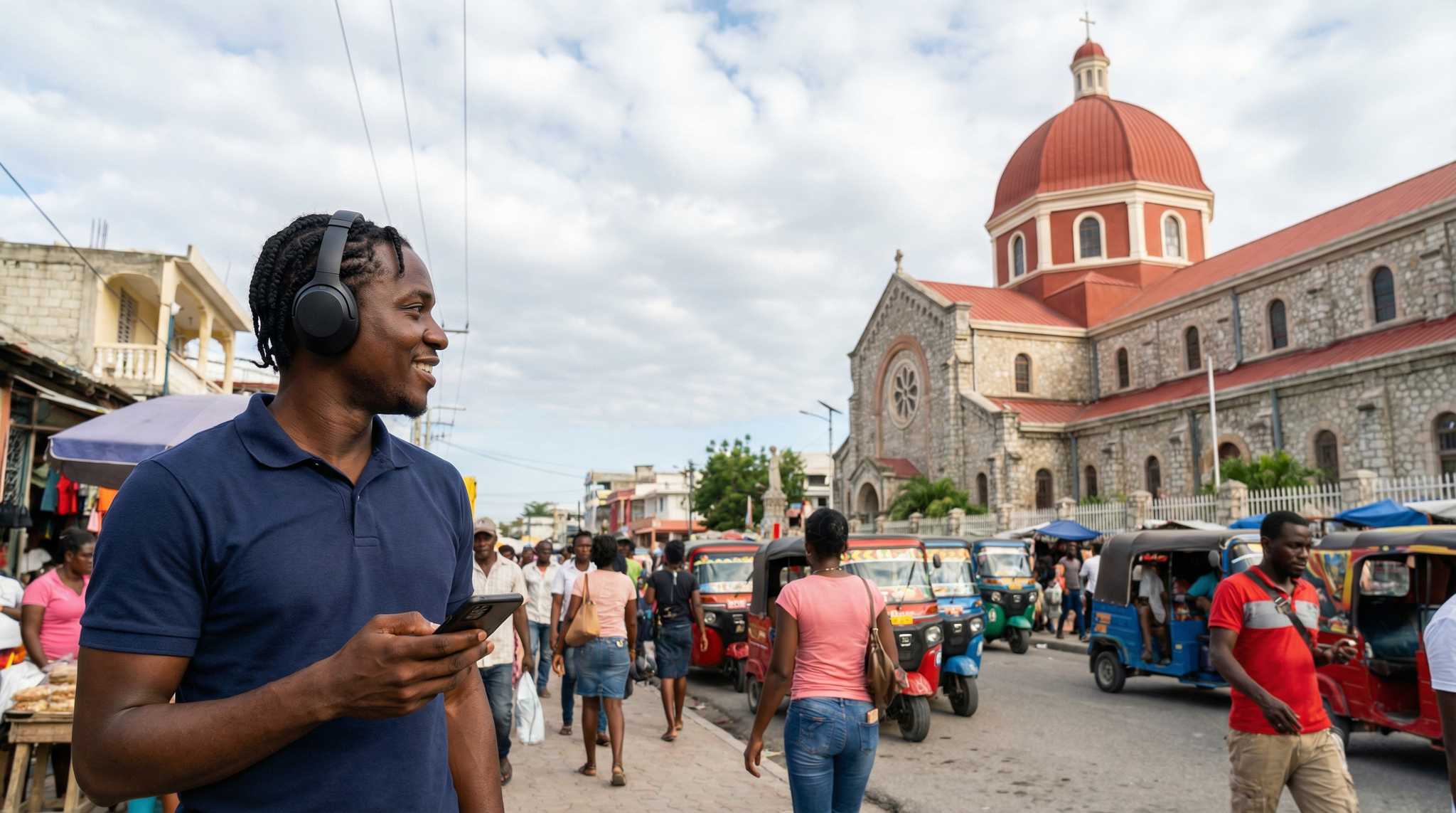
ポルトープランス オーディオツアー:聖人、物語、そして革命の残響
鉄の宮殿が灰の中から立ち上がり、大聖堂が決して沈黙しない街――ポルトープランスは、その賑やかな通りが示す以上に多くの秘密を抱えています。このセルフガイドオーディオツアーは、通常のルートを外れ、神聖な聖地、炎に包まれた市場、そしてほとんどの旅行者が見過ごす物語に満ちた記念碑的な遺跡へとあなたを導きます。 災害に見舞われた後、奇跡の聖域がなぜ国家的な癒しの象徴となったのでしょうか?どのような隠れた力が、炎と政治的混乱の中でマルシェ・アン・フェールを立たせ続けたのでしょうか?そして、かつて真夜中に駐屯地全体を目覚めさせた、消え去った大聖堂の鐘とは何だったのでしょうか? 影に包まれた礼拝堂から、ハイチの歴史ある首都の日当たりの良い広場へと進むにつれて、反乱、回復力、スキャンダル、そして驚きの物語を解き明かしましょう。一歩ごとに歴史の固く結ばれた結び目を解き放ち、すべての石の中に希望を感じてください。 奇跡が地震を生き延びた場所を歩く準備はできましたか?今すぐ始め、ポルトープランスがその心を開くのを感じてください。
ツアーのプレビュー
このツアーについて
- schedule所要時間 30–50 mins自分のペースで進める
- straightenウォーキングルート 4.0kmガイド付きパスに沿って進む
- location_on
- wifi_offオフライン対応一度のダウンロードでどこでも使える
- all_inclusive無期限アクセスいつでも、ずっと再生可能
- location_onポルトープランスの永続的援助の聖母の聖堂から開始
このツアーのスポット
Right in front of you, you’ll see a huge iron building with two long halls, a row of dramatic arches along the sides, and domed towers peeking out from the rooftops-just look for…もっと読む折りたたむ
Right in front of you, you’ll see a huge iron building with two long halls, a row of dramatic arches along the sides, and domed towers peeking out from the rooftops-just look for the striking, lattice-like patterns on the walls and the crowd bustling outside. Welcome to the famous Marché en Fer, or, as some like to call it, the Iron Market! Picture this: over a century ago in Paris, a beautiful iron structure was built, all ready and waiting to become a grand railway station in Cairo, Egypt. But plot twist! Cairo changed its mind, and the building never even got to see a single camel. Instead, Haitian President Florvil Hyppolite-maybe the luckiest bargain hunter of the 1890s-snatched it up and shipped the whole thing across the ocean to Port-au-Prince. In 1891, with a puff of steam and a lot of sweat, the Iron Market landed in Haiti and has stood here dazzling the city ever since. Imagine the scene inside: two gigantic, iron-framed halls stretching as far as your nose can smell spices or your ears can hear haggling. The whole place is painted a fiery red, with dashes of green, and topped by a row of four domed towers and an impressive clock-no need for a wristwatch here! But life in Port-au-Prince sure keeps you on your toes. The Marché en Fer has stared down more disasters than most soap opera stars: it’s been scorched by fires, shattered by earthquakes, and, just when you think it’s safe, fire strikes again. In 2008 it was nearly lost, in 2010 the earthquake tore it down entirely, and then in 2018, flames licked one of the halls to ash. But don’t let all this drama fool you-the market is pure resilience. With a bit of Irish luck (and $12 million from Denis O'Brien of Digicel fame), plus some presidential flair with Bill Clinton himself relaunching it, the Marché en Fer rose from the ashes. Even the original French roof tiles made a comeback! Today, every bustling stall and whistling vendor carries echoes of its wild, iron-clad journey-a true heart of Port-au-Prince, unbreakable and always ready for the next twist.
専用ページを開く →
さらに7件のスポットを表示表示するスポットを減らすexpand_moreexpand_less
To spot the Roman Catholic Archdiocese of Port-au-Prince, look for an imposing, light-colored building with classic lines and architectural touches that hint at its deep history;…もっと読む折りたたむ
To spot the Roman Catholic Archdiocese of Port-au-Prince, look for an imposing, light-colored building with classic lines and architectural touches that hint at its deep history; it should be standing prominently right in front of you, its facade set apart by elegant arches and a sense of dignified calm amid the lively city around. Let’s take a breath and stand before the Archdiocese of Port-au-Prince-a place where sacred history is as thick in the air as the scent of tropical flowers drifting across the street. Imagine catching a whisper on the breeze, the kind that makes you wonder about the stories hidden in those walls. The archdiocese stands not just as a religious center, but as the beating spiritual heart of Port-au-Prince, supporting hundreds of thousands of Catholics across Haiti and connecting the city to suffragan dioceses as far as Jacmel, Jérémie, Anse-à-Veau, Miragoâne, and Les Cayes. Back in 1861, when the archdiocese first took shape, the clergy-mostly French-lifted this institution out of the dust of colonial history, guiding a flock that today numbers over 668,000. Over the decades, bishops have come and gone, their names echoing through history like footsteps on old marble floors: Testard du Cosquer, Guilloux, Hillion, and, further down the line, the likes of François-Wolff Ligondé and Joseph Serge Miot. Each brought their own flavor to the faith, threading French liturgical tradition together with local Haitian rhythm. You might say the only thing more complex than a bishop’s hat is keeping track of who wore it last! But the story isn’t all incense and choirs. The archdiocese has also weathered loss, most tragically in 2010 when a devastating earthquake shook Port-au-Prince to its foundation, crumbling buildings-including the chancery here-and claiming the life of Archbishop Joseph Serge Miot. It was a moment that shook not just stone, but souls, leaving this seat of Catholicism silent for a while, a church without its shepherd or its songs. Even the chancellor was lost in the collapse, and parishioners gathered outside, heads bowed not just in prayer, but mourning. Yet resilience is the ever-present theme in Haitian faith. In 2011, on the grim anniversary of that terrible quake, hope returned in the form of Pope Benedict XVI’s announcement: a new archbishop, Guire Poulard, former Bishop of Les Cayes, would lead Port-au-Prince forward. With him came Glandas Marie Erick Toussaint as auxiliary bishop, ready to help mend hearts and rebuild faith brick by spiritual brick. It’s said the list of bishops and clergy of Port-au-Prince is nearly as long as a Sunday sermon-and just as full of surprises. Some, like Louis Nerval Kébreau or Jean-Baptiste Décoste, went on to serve elsewhere, spreading their experience like so many seeds. A few were promoted up, others moved sideways, and more than one turned unexpected corners in their careers. All of them left their footprint in some way-sometimes profound, sometimes peculiar. So as you linger here, let the weight of these stories ground you, even as life swirls in the city all around. The archdiocese stands as a living monument, marked by sorrow, renewal, and undying hope-a reminder that history, like faith, is built by all who pass through.
専用ページを開く →To spot the Holy Trinity Cathedral, look ahead for a large, light-colored building at the busy corner where Ave. Mgr. Guilloux meets Rue Pavée-its facade once proudly guarded the…もっと読む折りたたむ
To spot the Holy Trinity Cathedral, look ahead for a large, light-colored building at the busy corner where Ave. Mgr. Guilloux meets Rue Pavée-its facade once proudly guarded the entrance to some of the city’s most beloved art. Now, picture yourself standing here years ago, as sunlight spilled through the doors and music echoed softly. The Holy Trinity Cathedral, though battered by history, was a place that pulsed with color and life. The walls inside were covered in magnificent murals-imagine scenes from the Bible, but every figure has the faces of Haiti. Legendary Haitian painters like Philomé Obin and Castera Bazile filled these walls, making the old stories feel fresh, familiar, and full of hope. The air buzzed with creativity as artists climbed ladders, their brushes flashing bright red and blue and gold. Just think, back in 1950 and 1951, young artists rushed about, maybe laughing, maybe arguing over which shade of blue to use for the Jordan River! Then came a moment that changed everything: the great earthquake of 2010. Suddenly, the world rumbled and this mighty building, along with its enormous Caribbean organ and vibrant murals, collapsed into dust and memories. But even now, as you stand here, if you close your eyes and listen, you might just hear the echo of children’s footsteps running through old school halls, the hum of music teachers tuning strings, and the heartbeat of Haitian art that still lives on in every mural you imagine.
専用ページを開く →In front of you, look for a grand white building with tall columns and a lion statue perched on the right side-if you spot the words “Cour de Cassation” above the entrance, you’ve…もっと読む折りたたむ
In front of you, look for a grand white building with tall columns and a lion statue perched on the right side-if you spot the words “Cour de Cassation” above the entrance, you’ve found it! Now, imagine the air buzzing with the anticipation of justice-because you’re standing before the highest court in Haiti! The Court of Cassation is like the referee in a football match, only the stakes are much higher and the uniforms are fancier. Here’s where the toughest legal battles reach their final whistle, where twelve judges-each chosen by the president but only from a shortlist crafted by the Senate-sit for ten-year terms. They’re not easy to move or remove; once appointed, these judges are as solid as the building’s stone pillars. If they ever leave, it’s usually because of serious misbehavior or ill health, so you can picture them almost glued to their seats, robes and all! But justice here wasn’t always delivered within these pale walls. The devastating earthquake of 2010 tore down the court’s old building in downtown Port-au-Prince, leaving nothing but rubble and shattered gavels behind. For a while, the judges set up shop at the National School for Magistrates-imagine the honking of school bells mixing with the solemn silence of court-until the new courthouse rose like a phoenix with a little help from friends in Taiwan. In 2015, trumpets blasted-okay, maybe just in my imagination-and the new Court of Cassation was inaugurated at Champ-de-Mars. This court reviews the very last word on legal matters, checking if other courts played by the rules. If they find a foul, they send the case back for a replay! The Court even helps sort out fights between courts and checks if laws fit the Haitian constitution. And fun fact: it’s part of a big French-speaking judicial club-so if you listen closely, on certain days you might almost catch the sound of judges discussing law over croissants… or maybe that’s just my hunger talking. Fascinated by the composition, powers or the seat? Let's chat about it
専用ページを開く →To spot the Musée du Panthéon National Haïtien, look straight ahead for a low, modern structure half-sunken into the ground, with a series of conical fountains and pale stone, all…もっと読む折りたたむ
To spot the Musée du Panthéon National Haïtien, look straight ahead for a low, modern structure half-sunken into the ground, with a series of conical fountains and pale stone, all set amongst green trees and mountain views in the background. Alright, traveler, welcome to the Musée du Panthéon National Haïtien! If this looks a bit like a secret lair from a James Bond movie, you’re not alone-this museum is mostly underground, like a treasure chest waiting to be discovered. Step closer and imagine it’s 1983: the air is thick with the excitement of a new beginning as First Lady Michèle Bennett opens these doors, determined to give Haiti’s heroes a home worthy of their courage. The museum’s mission? To guard the stories of the "Fathers of the Nation" like a loyal watchdog with a history book instead of a bone. Inside, you’ll spot chains from the days of slavery-cold, rusty, and heavy with memory. There’s even the legendary silver pistol Henri Christophe used to escape capture, and the mighty bell that rang out for independence. If you’re feeling curious, search for the four-meter anchor from Columbus’s Santa Maria-good luck trying to lift it! What’s amazing is, despite the 2010 earthquake, this museum barely trembled-its clever, semi-buried design kept those stories safe. So as you stand here, imagine whispers of Taíno, Spanish, and Haitian heroes swirling around you, all woven together in this remarkable place where history stands its ground-ready to surprise anyone who dares to listen.
専用ページを開く →Picture this: Back in 1911, a stately home called Maison Laroche sprang up on this very ground, built by Haiti’s Minister of Commerce during President Cincinnatus Leconte’s term.…もっと読む折りたたむ
Picture this: Back in 1911, a stately home called Maison Laroche sprang up on this very ground, built by Haiti’s Minister of Commerce during President Cincinnatus Leconte’s term. It wasn’t just a pretty house, though; after a tragic explosion destroyed the National Palace in 1912, Maison Laroche was suddenly promoted-temporarily serving as the National Palace itself. Imagine official decrees echoing down its hallways, the heavy shuffle of presidential feet, important decisions made before breakfast. And that’s just the opening act. Over a few wild years, from 1914 to 1919, four Haitian presidents called this home-making it arguably the most musical-chairs residency in city history. Then, the neighborhood started feeling a bit less presidential and a bit more... military. During the American occupation, Maison Laroche was transformed into the headquarters for the U.S. Marines. Now, if you’re picturing Marines in sun hats, fanning themselves and sipping cold drinks on the porch-well, I can’t say that didn’t happen! Later, it became the officer’s circle for Haitian forces, before the French diplomatic mission took up residence. With the start of World War II, the house saw another whirlwind: the French legation packed its bags and headed for the hills (well, for Turgeau), and the U.S. ambassador moved in instead. By 1960, the French were back at Maison Laroche, feeling right at home-at least until Mother Nature decided it was time for another renovation. Enter the earthquake of January 12, 2010. The ground rumbled with fierce violence, shaking Port-au-Prince’s old city to its bones. That catastrophic day, Maison Laroche suffered irreparable damage, and by October, the grand old building was demolished-leaving behind little more than dust, memories, and maybe a lingering whiff of French roast coffee. But the French diplomats didn’t give up easily. They set up shop in temporary buildings nearby while dreams of a stronger, more resilient embassy began to take shape. Within months, an international contest was launched for the new design, and the winning concept-by French architects, of course, with a little British engineering backup-was revealed in 2011. The blueprint blended Haitian inspiration and the latest earthquake and hurricane-resistant technology, along with an open, welcoming design to suit the hot Caribbean air. Construction wrapped up at the end of 2014, and what you see today is the product: a building made for speedy construction and safety, and a nod to Haiti’s stormy past and hopeful future. But let’s not leave out the side stories-like the tale of the Résidence de France, which until the earthquake was a gorgeous manor called Manoir des Lauriers. Built in 1927 for an American businessman, later bought by President Élie Lescot, it was home to French ambassadors for decades. After the 2010 disaster, even that residence was destroyed, and the French moved to “Les Orangers” in the Hauts de Turgeau-proving, perhaps, that French diplomats can be just as adaptable as their hosts. Now, a quick quiz! What do French diplomats call their favorite drink in Haiti? “Le jus de canne-à-souhait!” It means “sugarcane juice... as you wish!” OK, OK, I’ll stick to history and leave comedy to the professionals. Beyond the buildings, relations between France and Haiti go back a long, dramatic way. In 1825, France finally recognized Haiti’s independence-on the condition that Haiti pay an enormous indemnity, the so-called “debt of independence.” It took thirty years and more than a few headaches to shrink the bill, but it marked the start of formal diplomatic ties. The French established a permanent legation, which became a full embassy in 1950, shaping nearly two centuries of cultural, economic, and political exchange. Even today, this embassy is more than a building; with consulates in Jacmel and Cap-Haïtien, it supports the French community in Haiti and remains the last diplomatic outpost in Port-au-Prince’s historic heart. If you listen carefully, you might just hear echoes of generations gone by-presidents, marines, diplomats, and dreamers-all woven into the story of this remarkable site. Thank you for making this journey with me through Port-au-Prince’s most storied corners. If these places could talk, I hope they’d say, “It was great to have you-come back soon!”
専用ページを開く →



よくある質問
ツアーはどうやって始めますか?
購入後、AudaToursアプリをダウンロードして引き換えコードを入力してください。ツアーはすぐに開始できます。再生ボタンをタップして、GPSガイド付きルートに従うだけです。
ツアー中にインターネットは必要ですか?
いいえ!開始前にツアーをダウンロードしておけば、完全にオフラインで楽しめます。チャット機能のみインターネットが必要です。モバイルデータを節約するため、WiFi環境でのダウンロードをお勧めします。
これは団体ツアーですか?
いいえ、これはセルフガイド式のオーディオツアーです。ガイドや団体、決まったスケジュールに縛られることなく、スマホから流れるナレーションを聴きながら自分のペースで自由に探索できます。
ツアーの所要時間は?
ほとんどのツアーは60〜90分で完了しますが、ペースは完全に自由です。好きな時に一時停止したり、スポットを飛ばしたり、休憩を取ったりできます。
今日中にツアーを終えられない場合は?
問題ありません!ツアーには無期限でアクセスできます。明日、来週、あるいは来年でも、好きな時に再開できます。進行状況は保存されます。
どの言語が利用可能ですか?
すべてのツアーが50以上の言語に対応しています。コードを引き換える際にお好みの言語を選択してください。注意:ツアー生成後に言語を変更することはできません。
購入後、どこからツアーにアクセスできますか?
App StoreまたはGoogle Playから無料のAudaToursアプリをダウンロードしてください。メールで届いた引き換えコードを入力すると、ライブラリにツアーが表示され、ダウンロードして開始できるようになります。
もしツアーを楽しめなかった場合は、返金いたします。お問い合わせ先: [email protected]
以下の決済で安全にチェックアウト 


