パリ オーディオツアー:17区の芸術的な通りと隠れた名所
パリの静かな影の中に、かつて伝統に逆らい、その扉にスキャンダルを引き寄せたアールデコ様式の金色の教会が立っています。17区の各ブロックは、緑豊かな大通りと堂々たるファサードの裏に、幾重もの陰謀を隠しています。 このセルフガイドオーディオツアーは、ほとんどの訪問者が見過ごしてしまう物語や場所を解き明かします。サント=オディール教会、ペレール大通り、ベルティエ大通りなどに織り込まれた伝説や秘密を発見してください。 どのような謎めいた野望が、建築家を古代の象徴を現代の石に刻むように導いたのでしょうか?なぜシンプルな教会の塔をめぐって、市全体を巻き込む騒動が勃発したのでしょうか?どの忘れ去られた発明が、これらの通り沿いの数えきれないパリの夜の運命を変えたのでしょうか? 反乱、ひそかなスキャンダル、そして建築の驚異の物語を巡りながら、街の鼓動をたどってください。パリを絵葉書としてではなく、あなたの足跡を待つ生きた物語として見てください。 今すぐ始めましょう。17区の秘密があなたを待っています。
ツアーのプレビュー
このツアーについて
- schedule所要時間 30–50 mins自分のペースで進める
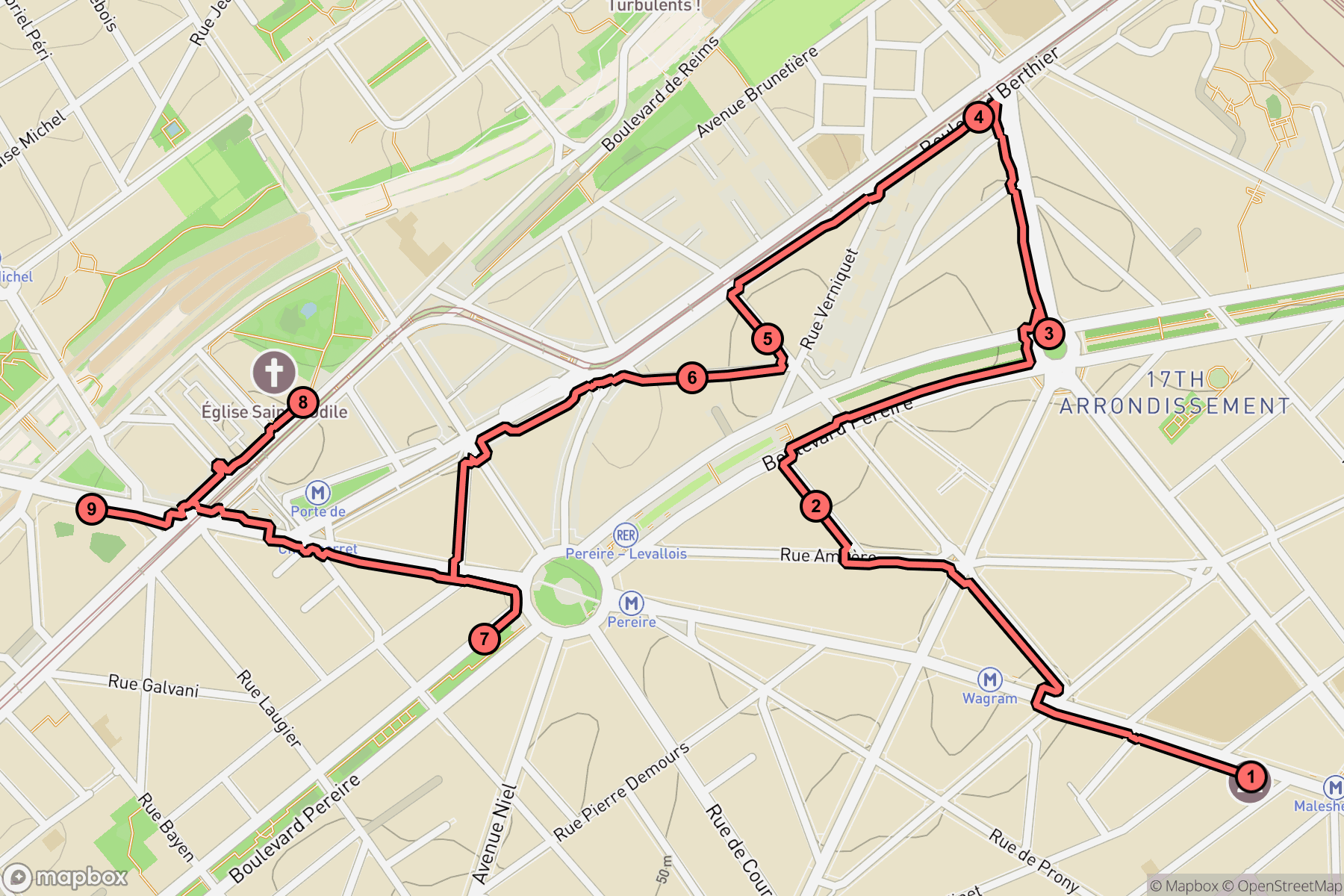
- straightenウォーキングルート 3.4kmガイド付きパスに沿って進む
- location_on
- wifi_offオフライン対応一度のダウンロードでどこでも使える
- all_inclusive無期限アクセスいつでも、ずっと再生可能
- location_onジャン=ジャック・エネール国立美術館から開始
このツアーのスポット
Standing outside the Musée national Jean-Jacques Henner, you’re looking at a classic Parisian mansion with a bit of a backstory. This place was built in 1878-right when Paris was…もっと読む折りたたむ
Standing outside the Musée national Jean-Jacques Henner, you’re looking at a classic Parisian mansion with a bit of a backstory. This place was built in 1878-right when Paris was obsessed with grand townhouses for folks who definitely did not have to check their bank balance before ordering a second café crème. The museum isn’t one of those ancient institutions by Parisian standards; it opened its doors in 1924, all thanks to some serious determination by Marie Henner-family connections and a penchant for following instructions too thoroughly. Inside, the art is almost all by Jean-Jacques Henner, an Alsatian painter who loved portraits and surreal, dreamy scenes long before those were trending on Instagram. There are more than a thousand sketches, letters, and even notes from critics. Walk through and you will spot his studies set right next to the finished masterpieces-like a peek behind the curtain, or an artist’s messy desk preserved for nosey parkers. Alright, ready for a bit of a stroll? Rue Puvis-de-Chavannes is just west from here, a 9-minute walk that’ll stretch your legs and your imagination.
専用ページを開く →Alright, coming up on your left is Rue Puvis-de-Chavannes-a street with a name that’s a bit of a mouthful, and a past filled with character, drama, and, inevitably, a dash of…もっと読む折りたたむ
Alright, coming up on your left is Rue Puvis-de-Chavannes-a street with a name that’s a bit of a mouthful, and a past filled with character, drama, and, inevitably, a dash of Parisian style. On the surface, this leafy residential street might look like the well-behaved sibling of Parisian boulevards, but there’s more to it than meets the eye. Rue Puvis-de-Chavannes only joined the Paris map in 1899, making it a late arrival compared to its older neighbors. Before that, what you’re standing on would’ve been the last rugged bump of the old Butte de la Planchette-a hunting spot that, back in the 1600s, was a playground for aristocrats who had a thing for feathers, fur, and flintlocks. You and your fellow urban explorers would have been ducking stray pheasants, rather than SUVs. The street gets its name from Pierre Puvis de Chavannes, one of France’s big names in classical painting. When he died in 1898, the city, still mourning, speedily decided to name this brand-new street in his honor. You could say he barely made it out of his own funeral before the sign went up. Puvis de Chavannes lived nearby at Avenue de Villiers, so the tribute was a bit of a local affair. Now, check out number 4 Rue Puvis-de-Chavannes. Here stands a small neo-Renaissance ‘hôtel’-not a hotel where you’d check in for the night, but a fashionable townhome style for Paris’s upper crust. Built in 1903 for a wealthy bachelor-art collector, it boasts grand reception rooms upstairs and a dramatic top-floor gallery with enormous windows-perfect for gazing at your art, or out at nosy neighbors. Thing is, our bachelor lost his nerve when friends grumbled the street was too far from the social whirl, so he sold up before even decorating the inside. Some people just can’t handle the quiet. Enter Louis Renault, the young car magnate who leased the place with his partner, the glamorous opera singer Jeanne Hatto. Renault insisted on having his very own garage-the street’s original ‘remise à automobile,’ right there at ground level-a rare luxury when cars themselves were something you bragged about. In today’s money, those early automobiles could easily set you back the equivalent of several hundred thousand dollars. Admittedly, if you wanted to impress the Parisian crowd before World War I, that was one way to do it. A little further down at number 10, you’ll find an Art Nouveau building with delicate floral touches. It was here, much later in the twentieth century, that celebrated Russian filmmaker Andrei Tarkovsky spent his final days-proof that the street has long attracted creative, and at times tragic, souls. Keep walking and you’ll spot more early 1900s buildings, like the clean-lined corner office of Michelin Tyres-not as modern as it looks, because back in 1909, reinforced concrete was all the rage among architects looking to impress their friends and clients. So, Rue Puvis-de-Chavannes-part artists’ haunt, part social experiment, home to drivers, dreamers, and more than a few elegant façades. Whenever you’re ready, the Plaine-de-Monceaux district is just a 7-minute stroll northwest.
専用ページを開く →Alright, take a look to your right-what you’re seeing isn’t just another elegant slice of Paris, it’s the Plaine-de-Monceaux district. You might think this area has always felt so…もっと読む折りたたむ
Alright, take a look to your right-what you’re seeing isn’t just another elegant slice of Paris, it’s the Plaine-de-Monceaux district. You might think this area has always felt so neat and deliberate, but its roots are tangled in farmland, fox hunts, and more than a little real estate drama… Paris has always been a city that knows how to make an entrance. To start, the name “Plaine-de-Monceaux” is a bit of a linguistic tug-of-war. It either points to a bald hill (mons Calvus), a mossy patch (Muscelli), or just a small mound (Monticellum). So, if you ever struggled to figure out French spelling, you’re not alone-the locals couldn’t agree for centuries either. For centuries, this was wild, open land-perfect for nobles to gallop after deer, and maybe for the occasional farmer to grumble about runaway animals trampling their fields. Picture it: before Paris crept out this far, you’d mostly see fields, a patchwork of small hamlets, and the odd, stately hunting lodge. Parisian nobles treated this place like their backyard-until, around the time of the Revolution, things got... tense. Fed up with their crops being flattened by game escaping from aristocratic hunting grounds, locals tore down the hunting enclosures, leaving the old regime with nowhere to stash their deer. Fast forward to the mid-1800s. For a while, not much happened-big grand plans for development in the 1830s fizzled out and the landscape remained more barnyard than boulevard. But then came the Pereire brothers, a pair with more ambition than sense. They not only built the city’s first urban commuter train line-like a “proto-metro”-but also insisted a wide boulevard should run alongside it. They were basically betting the farm, and it paid off. And then, enter Baron Haussmann-the guy behind much of Paris’ famous look. He managed to get three big landowners-including the Pereires-to hand over some prime real estate for the sake of his grand boulevards. Now get this: the City pocketed the land for only about 3.2 million francs at the time, which would be- -about 17 million US dollars today, give or take. Not bad, considering what a square meter goes for around here now. With new wide streets mapped out and the city annexing the area in 1860, Plaine-de-Monceaux got a new identity. Developers built it almost from scratch as a residential haven for Paris’ upper crust-the grand bourgeoisie. The result? Unlike the city’s older, more jumbled districts, the architecture here is strikingly consistent: orderly townhouses with petite gardens, elegant facades, and blocks that seem to march in line. You’ll spot flashes of Greek and Roman revival, a little Louis XVI, and just a hint of architectural one-upmanship. And if you’re feeling drawn to those hidden gardens and imposing iron gates, you’re not alone. Plenty of villas and fancy hotel particuliers from those days still line these streets-though, let’s be honest, good luck scoring an invite inside. It’s hard to believe that, less than 200 years ago, this was all open farmland dotted with just a handful of houses-and cows, plenty of cows. Whenever you’re ready, head west for about 4 minutes and we’ll meet again at Boulevard Berthier.
専用ページを開く →
さらに6件のスポットを表示表示するスポットを減らすexpand_moreexpand_less
Alright, pause here and just take in the sprawl of Boulevard Berthier off to your left. It might not look like much more than a wide, busy street, but trust me-this stretch is…もっと読む折りたたむ
Alright, pause here and just take in the sprawl of Boulevard Berthier off to your left. It might not look like much more than a wide, busy street, but trust me-this stretch is Parisian storytelling at its finest. Spanning almost two kilometers, Boulevard Berthier is part of something called the “Boulevards des Maréchaux”-that’s basically Paris’s version of a city border, weaving through military roots and creative outbursts at every turn. History first: this road rose up in the 1860s, built right where the old city fortifications once ran. Back then, Paris was wrapped in a wall-pretty literal about keeping things “exclusive.” When those walls came down, Berthier popped up. It was named after Louis Alexandre Berthier, one of Napoleon’s top marshals-a guy famous for his military maps and for following Napoleon all over Europe, mostly without losing the luggage. Now, about Berthier itself: the dimensions change as you walk along, from about 40 meters wide up to a whopping 60. Imagine the room for carriages, then trams, and eventually impatient drivers and café-bound locals. These days, trams, buses, and three different metro lines keep everyone moving-though, let’s be honest, nothing moves fast in Paris rush hour except strong opinions. In the late 1800s, the artists started trickling in-lured not by the glamour, but by the northern light. Picture studios scattered up and down the odd side of the street, artists in smocks arguing about whether purple was even a real color. You had Georges d’Espagnat at number 19, Paul Chabas up at 23, Pierre Carrier-Belleuse at 31, and John Singer Sargent-yes, the Sargent-calling number 41 home at one point. It sounds like the world’s fanciest apartment block, but for painters. Not just artists, either. Yvette Guilbert, a singer famous enough to have her own statue in Montmartre, lived at 23 bis. Her American husband built her a house in 1900, no expense spared. Back then, that probably ran him something like 60,000 francs-think around $400,000 today, once you factor in real estate inflation and the Paris premium. A few steps down, filmmaker Preston Sturges rested between Hollywood escapades at number 61-apparently, he needed a break from California sunshine. As you wander, you’ll spot Art Nouveau mansions, a splashy Art Deco apartment at 100, and here and there, echoes of the old world-like the gothic home built for an opera star, or a 1930s school still filled with the murmur of kids plotting minor rebellions. And if you see the Moldovan flag at number 95, that’s no accident-the embassy moved in, swapping studio light for diplomatic flair. Alright, ready for the next stop? Rue Alfred-Roll is just southwest-about 6 minutes walking.
専用ページを開く →Alright, so you’re standing outside Rue Alfred-Roll-one of those Parisian streets that's so tucked away, you almost want to whisper its name so it stays a secret. It barely…もっと読む折りたたむ
Alright, so you’re standing outside Rue Alfred-Roll-one of those Parisian streets that's so tucked away, you almost want to whisper its name so it stays a secret. It barely stretches past 130 meters, which is, as the French say, *not very far at all*. But don’t let its size fool you. This tiny street is a real heavyweight in terms of stories. Let’s set the scene. We're in the late 1800s. The Plaine-de-Monceaux area was the “in” place for artists and the emerging bourgeoisie-think of it as SoHo before anyone ever thought to sell a twelve-dollar espresso. Back then, some pretty legendary creative types lived, worked, and-honestly-gossiped right here. The street’s namesake, Alfred Roll, was no starving artist. He was such a big deal painter that he became an official “painter to the Republic.” He actually lived and worked at what is today number 17, right here. Imagine canvas after canvas, brushes bristling, maybe a little creative arguing about the best local wine. By the time Roll passed away in 1919, his home was almost as famous as his work. But Roll had some stylish neighbors. Number 1 isn’t just any building-it used to house Edmond Rostand, who gave the world Cyrano de Bergerac. Yes, the one with the nose. In 1897, Rostand bought what was then called 29 Rue Alphonse-de-Neuville, now incorporated into Rue Alfred-Roll. By the way, in those days, a modest house in this area cost a few thousand francs-today, you’d need the modern equivalent of hundreds of thousands of dollars... and a good amount of luck. Take a look at number 6. That’s a classic late 19th-century mansion-red brick, white stone trim, and a whimsical roofline loaded with “troubadour-style” detail. It looks a bit like a gingerbread house designed by someone with expensive taste. The legendary opera singer Jeanne Hatto lived here. Rumor has it she had a long-running romance with industrialist Louis Renault. Ah... romance, Paris, and the early automobile-what could possibly go wrong? Number 8? That’s now the Embassy of Togo. At 14, you’ll spot another vintage mansion-once home to playwright Sacha Guitry and actress Yvonne Printemps. Today, it’s the Siegmund Freud University. From drama to drama therapy, you could say. Let’s not forget the social scene. Famed actress Réjane, so adored she inspired characters in Marcel Proust’s novels, threw parties here that, as the papers said, “revolutionized the neighborhood.” Her invitations even joked about the half-developed state of the area, instructing guests to look for her “cute little house in the wild lands off Avenue de Villiers.” So, when you walk past these doors, you’re quite literally brushing against history-a history that's less about big headlines and more about lively, slightly scandalous stories played out behind closed doors. Ready for Rue Eugène-Flachat? Just head southeast for about 2 minutes.
専用ページを開く →Alright, you’ve made it to Rue Eugène-Flachat-Paris’s answer to “quiet luxury with a twist of railway history.” Stand still for a second and listen. If you can hear the faint…もっと読む折りたたむ
Alright, you’ve made it to Rue Eugène-Flachat-Paris’s answer to “quiet luxury with a twist of railway history.” Stand still for a second and listen. If you can hear the faint rumble, that’s not your stomach-it’s the Métro, gliding along just a hundred meters to the south. Now, this street may look calm, but it’s got stories. Named after Eugène Flachat, an engineer who helped shape France’s railways in the 1800s, the street actually starts right where two old train lines once met up-think midpoint between railroad titans and upper-crust households. Take a look around: from end to end, Rue Eugène Flachat is a straight shot, not a single crossing street to trip you up. And it’s short-just 175 meters, so you’d be hard pressed to get lost unless you try really, really hard. But it’s what’s lined up on your left-the even-numbered side-that gives this street its quiet power. Picture Paris in the late 1800s: well-off families, tired of the city’s noise, investing a few thousand francs in grand houses here-think about $100,000 to $200,000 today. Not a bad spot to call home, right? Number 8 was dreamed up by architect Gaston Aubry in 1881. Number 14? That’s a charming villa built in 1895 by Charles Girault. But check out number 16: a neo-Louis XIII townhouse designed by Georges-Louis Bayard, where Stephen Sauvestre-the guy who would later design the Eiffel Tower’s spire-once lived. Turns out this street used to host more than just fancy cocktail parties. Number 22 is where things get dramatic. Famous painter Roger Jourdain lived here, and during World War II, writer Tristan Bernard was welcomed home after returning from an internment camp. Later, this very spot became a Montessori school-a place where learning replaced turmoil. If you’re a fan of architecture, you’ll appreciate the red and white brickwork, bold stone facades, and a sense of Parisian pride that you just can’t mass-produce. Alright, when you’re ready to move on, just keep heading west for about nine minutes-you’ll find yourself at Boulevard Pereire.
専用ページを開く →Take a look around-this is Boulevard Pereire, the kind of place where stories linger in the brickwork and the trees seem to stand with a little extra pride. Now, this isn’t your…もっと読む折りたたむ
Take a look around-this is Boulevard Pereire, the kind of place where stories linger in the brickwork and the trees seem to stand with a little extra pride. Now, this isn’t your run-of-the-mill Parisian avenue. It’s a grand, tree-lined sweep that stretches out for about two and a half kilometers-give or take a few enthusiastic steps-and it’s packed on both sides with layers of modern Parisian life. Let’s go back to the mid-1800s for a moment. Imagine this whole area as wide-open countryside-fields, maybe a lone cow or two giving you the side-eye-until a pair of ambitious brothers named Pereire came along. They wanted to run a railway, and the city said, “Sure, but build us a fancy boulevard on both sides first.” Deal struck, they laid rails for the Auteuil line down the center, with leafy lanes branching out on either side. It was all wild grass and stubborn shrubs before then, but this was the launching pad for the elegant neighborhood you see today. The boulevards’ birth is still marked in the old legal documents: August 2nd, 1855, thanks to the city council of Neuilly. There’s a bit of intrigue to the naming-fast forward to World War II, and someone actually proposed to erase the Pereire name because of the brothers’ Jewish background, swapping it for something more “acceptable” to the occupying forces. Thankfully, that awful idea never made it past the brainstorming phase. Notice how the two sides of the boulevard are separated by green stretches and the trace of old railway lines, which are mostly gone now-except for the piece that’s become a kind of secret garden, the Petite Ceinture. If you listen closely, you might hear the ghostly echo of steam trains from a different century. Since the ‘80s, much of the old line has been covered up and turned into promenades, gardens, and even tennis courts instead of rails. Not a bad upgrade, right? Now, let’s talk about the neighbors. This boulevard isn’t just pretty, it’s got a serious artistic pedigree. Composer Maurice Ravel called number 19 home for a while-yes, the same guy behind "Boléro,” which you probably recognize even if you can’t place the name. Sarah Bernhardt, the most famous French actress of her day, spent her final years at number 56. She paid a cool 11,000 francs a year for her digs back then-today, that’s enough to make your wallet sweat; we’re talking about roughly 50,000 USD, just for a year’s rent. Keep walking and you’ll pass addresses where artists, composers, actors, and even Michelin (the tire company and map-maker) worked and lived. In fact, during the Liberation of Paris, American troops stopped off here at number 97 to load up on thousands of those famous Michelin maps-nothing says "victory march" like a good road map. Even the buildings themselves tell a story. The earliest were big villas, replaced by elegant Haussmannian apartment blocks, and later by Art Deco facades. A keen eye might still spot a surviving old house clinging to its plot, refusing to let all those new kids on the block steal the show. This boulevard has seen it all-rural emptiness, bohemian glory, war, transformation, and now, everyday Parisian bustle. And if you dig into local literature, you’ll find novels like "Cri des profondeurs" set right here, capturing the drama of occupied Paris. Not bad for a stretch of road that started off as farmland and ended up as the home turf for musicians, actors, generals, and, yes, even a few friendly cows. When you’re ready for something a little more spiritual, head northeast for about 9 minutes-Sainte-Odile Church in Paris is waiting.
専用ページを開く →Here we are, with the striking Sainte-Odile Church rising to your left. Look up-no, really, all the way up. That slender bell tower stretches a full seventy-two meters into the…もっと読む折りたたむ
Here we are, with the striking Sainte-Odile Church rising to your left. Look up-no, really, all the way up. That slender bell tower stretches a full seventy-two meters into the Parisian sky, making it the *tallest* church spire in the city. Not quite the Eiffel Tower, but it does give the neighbors something to gossip about. Now, the story of Sainte-Odile isn't just about height. Try to picture Paris in the 1930s: tough times, post-war uncertainty, and a city still patching itself up. In 1934, Cardinal Jean Verdier and Edmond Loutil decided it was time to build a new place of worship out here near Porte de Champerret. Funding churches back then was usually a tricky business-think never-ending bake sale energy. But here’s the twist: this church was funded almost entirely by the local parishioners, with a hefty contribution from Loutil himself, a novelist-turned-priest. In today's money, imagine a neighborhood fundraising effort pulling together enough to build a landmark-several million dollars-and no one had to auction off their family heirlooms. Construction crawled along for eleven years, from the first ceremonial shovel in 1935 to the final stone in 1946, with a little world war in between to complicate things. They dedicated the church to Sainte Odile, the patron saint of Alsace-because, as it turns out, Loutil’s mother was Alsacienne and clearly left quite the impression. You may notice the unusual look-part fortress, part Byzantine fantasy. Credit goes to architect Jacques Barge, who opted for reinforced concrete dressed up in pink sandstone, the same stuff used for Strasbourg Cathedral. The pink brick glows warmly when the late light hits, and those three shallow domes on the roof? They’re a nod to the Christian Trinity. Meanwhile, the bell tower is topped with a copper rooster and cross, a sort of holy weather vane courtesy of artist Robert Barriot. Now, let your ears tune in-on certain Sundays and holidays, the air here shimmers with the sound of the only completely manual carillon in Paris: twenty-three bells, rung by hand. That carillon spent World War II buried near Chartres to avoid being melted down by the Germans. Imagine the tension: sacred music, hidden underground, waiting out the occupation. Step closer to the main portal. Sculptor Anne-Marie Roux-Colas created a scene here that tells its own story: Sainte Odile herself, ushered into heaven by the Virgin Mary, with angels holding a book and a tiny church-nods to devotion and, well, architectural ambition. Even the railings have stained glass cabochons designed by Auguste Labouret, each tiny bit reflecting one of the litanies of the Virgin Mary. Inside, the decoration carries on-monumental stained glass by François Décorchemont, twelve columns to represent the apostles, and a stunning retable crammed with references to the Book of Revelation. Still feeling curious? The church hosts both modern and traditional Latin masses-so you might catch a little Latin chant competing with the hum of the city buses. There have been some hiccups along the way-like a vandal going full rampage in 2014-but Sainte-Odile stands firm, as much a neighborhood beacon as a parish church. Paris never lacks for passion, that’s for sure. When you’re ready, let’s head to Latin America Square. It’s only a 4-minute stroll southwest from here.
専用ページを開く →Alright, on your right, you’ll spot Latin America Square-Paris’s little salute to the southern side of the globe. Now, if you’re expecting Versailles-level grandeur... well, I…もっと読む折りたたむ
Alright, on your right, you’ll spot Latin America Square-Paris’s little salute to the southern side of the globe. Now, if you’re expecting Versailles-level grandeur... well, I hope you’re not easily disappointed. This patch of green barely cracks two thousand square meters, making it the kind of park where, if you sneeze at one end, someone at the other will bless you. Planted back in 1931 on the grounds of the old Thiers fortifications-think less moat-and-castle, more 19th-century city defense-this triangular garden has seen its share of tribute. By 1936, Paris wanted to show a little international flair, so they scattered busts and statues in a gentle arc, all honoring Latin America’s greats. You’ve got Andrés Bello from Venezuela, Rubén Darío from Nicaragua, Ricardo Palma from Peru, and so on; a veritable intellectual United Nations, all staring each other down across flowerbeds. Taking center stage now is Francisco de Miranda-Venezuelan revolutionary, globe-trotter, and general overachiever. Statue by statue, these bronze folks hold court over, let’s be honest, a sandbox and a swing set. Kids play amidst literary giants; imagine explaining that at school. And, for something a little more avant-garde, “Mythic Poem” by Costa Rica’s Jorge Jiménez Deredia watches from one entrance. It’s abstract enough to spark arguments-Which side’s the front? Is it smiling? Does it have one of those existential crises French philosophers love? Oh-and fun fact-there was once a legendary nightclub under the park called “La Main Jaune.” Neon skates, synth beats, all-night dances... Paris kept its cool both above and below ground. This square is proof: in the 17th, even the smallest park throws a global party.
専用ページを開く →
よくある質問
ツアーはどうやって始めますか?
購入後、AudaToursアプリをダウンロードして引き換えコードを入力してください。ツアーはすぐに開始できます。再生ボタンをタップして、GPSガイド付きルートに従うだけです。
ツアー中にインターネットは必要ですか?
いいえ!開始前にツアーをダウンロードしておけば、完全にオフラインで楽しめます。チャット機能のみインターネットが必要です。モバイルデータを節約するため、WiFi環境でのダウンロードをお勧めします。
これは団体ツアーですか?
いいえ、これはセルフガイド式のオーディオツアーです。ガイドや団体、決まったスケジュールに縛られることなく、スマホから流れるナレーションを聴きながら自分のペースで自由に探索できます。
ツアーの所要時間は?
ほとんどのツアーは60〜90分で完了しますが、ペースは完全に自由です。好きな時に一時停止したり、スポットを飛ばしたり、休憩を取ったりできます。
今日中にツアーを終えられない場合は?
問題ありません!ツアーには無期限でアクセスできます。明日、来週、あるいは来年でも、好きな時に再開できます。進行状況は保存されます。
どの言語が利用可能ですか?
すべてのツアーが50以上の言語に対応しています。コードを引き換える際にお好みの言語を選択してください。注意:ツアー生成後に言語を変更することはできません。
購入後、どこからツアーにアクセスできますか?
App StoreまたはGoogle Playから無料のAudaToursアプリをダウンロードしてください。メールで届いた引き換えコードを入力すると、ライブラリにツアーが表示され、ダウンロードして開始できるようになります。
もしツアーを楽しめなかった場合は、返金いたします。お問い合わせ先: [email protected]
以下の決済で安全にチェックアウト 


