AudaTours logoAudaTours

プラハ・オーディオツアー:旧市街広場の時計仕掛けの伝説

オーディオガイド8 か所

プラハ旧市街広場では、時間はただ刻むだけではありません。それは演じられます。天文時計は今もなお、石に刻まれた暗号めいた警告のように感じられます。 このセルフガイドオーディオツアーは、旧市庁舎、石の鐘の家、そしてほとんどの訪問者が見過ごしてしまうような近くの角々を巡ります。再生ボタンを押して、足元で街が動き出す中、プラハがその政治的抗争、反乱、スキャンダル、謎、そして忘れ去られた瞬間をあなたの耳元で明かしてくれるでしょう。 旧市庁舎の下で群衆が押し寄せるとき、どんな歴史が再び現れようとしているのでしょうか? 暗くなってから、石の鐘の家のゴシック様式の壁にはどんな秘密の物語がしがみついているのでしょうか? なぜ天文時計には、過去からの個人的な冗談のように感じられるほど奇妙に具体的な詳細が含まれているのでしょうか? 狭い路地や開けた広場を、影から日差しへとたどり、街が絵葉書からスリラーへと変化するのを感じてください。 今すぐ始めて、プラハに時計を動かしてもらいましょう。

ツアーのプレビュー

map

このツアーについて

  • schedule
    所要時間 40–60 mins自分のペースで進める
  • straighten
    ウォーキングルート 1.0kmガイド付きパスに沿って進む
  • location_on
  • wifi_off
    オフライン対応一度のダウンロードでどこでも使える
  • all_inclusive
    無期限アクセスいつでも、ずっと再生可能
  • location_on
    石の鐘の家から開始

このツアーのスポット

lock_open 3件無料プレビュー · 5件は購入でアンロック

  1. Take a look at the tall, narrow facade in front of you, built of pale, exposed stone, and see if you can find the small stone bell incorporated into the corner of the…もっと読む折りたたむ

    Take a look at the tall, narrow facade in front of you, built of pale, exposed stone, and see if you can find the small stone bell incorporated into the corner of the building. This is the House at the Stone Bell. While it looks like a perfect slice of the fourteenth century, what you are seeing is actually a massive architectural resurrection. This building is a survivor, having worn a heavy mask for hundreds of years before its true face was revealed. To understand why this house matters, we have to go back to the year 1310. At that time, the Prague Castle up on the hill was uninhabitable following a devastating fire. So, when John of Luxembourg and his wife, Elisabeth of Bohemia, arrived in Prague to claim the throne, they needed a place to live that was safe, central, and suitably royal. They likely chose this spot. It is widely believed that their son, the future Holy Roman Emperor Charles IV-the man who would reshape this entire city-was born right here within these walls. The house gets its name from that stone bell on the corner. It isn't just decoration; it is a nod to a dramatic legend involving John of Luxembourg. The story goes that in 1310, John was trying to take back Prague from rival forces. His army was stuck outside the city walls, unable to breach the fortifications. They needed a signal from spies on the inside to know when the gates would be unguarded. That signal was the ringing of a specific bell from a nearby church. When the bell tolled, John’s forces stormed the gates, and the city was taken. The stone bell was placed here to memorialize that victory. However, the rugged, Gothic look you see today-with those pointed arches and intricate stone carvings-was completely hidden for centuries. In 1685, the owners decided that Gothic architecture was hopelessly old-fashioned. They wanted a modern, Baroque home, which meant symmetry, smooth plaster, and fancy stucco. But they didn't just cover up the old facade; they attacked it. They hacked off the beautiful Gothic ornaments, the statues, and the pointed archways to create a flat surface for the new walls. They smashed the medieval stone carvings and used the rubble as filler to level out the masonry. For nearly three hundred years, this was just another Baroque house in the square. It wasn't until the 1960s that researchers realized what was hiding underneath. They found the original Gothic face battered but intact beneath the plaster. This kicked off a massive project called "regotization" between 1975 and 1987. It was essentially a three-dimensional jigsaw puzzle. Workers recovered over twelve thousand stone fragments from the rubble used in the walls. They painstakingly pieced together the window tracery and the arches. They even found fragments of statues that once adorned the facade, including figures of a King and Queen seated on thrones, which you can actually see remnants of in the ground-floor chapel today. The restoration wasn't without controversy, though. Since the original roof was long gone, the architects had to improvise. They added that concrete gallery at the very top, which definitely wasn't there in the Middle Ages, but it holds the structure together. Inside, the house was just as clever. It had a sophisticated heating system where warm smoke from a lower room was channeled into a hollow space beneath the floor of a wooden living chamber above, keeping the royals warm without choking them on fumes. It was a palace disguised as a townhome, a piece of French-style architecture dropped into the heart of Bohemia. Take a moment to admire the stonework that was hidden in the dark for so long. When you are ready, we can make our way to the next stop.

    専用ページを開く →
  2. Look around at the expanse of gray cobblestones beneath your feet, the ring of pastel-colored facades enclosing the space, and the sharp gothic spires piercing the skyline…もっと読む折りたたむ

    Look around at the expanse of gray cobblestones beneath your feet, the ring of pastel-colored facades enclosing the space, and the sharp gothic spires piercing the skyline above. You are standing in the heart of Praha, or Prague as you know it, a city that has spent the last eleven centuries trying to decide if it wants to be the center of the universe or just a very well-kept secret. The locals call it Praha, but where does that name actually come from? Well, linguists and historians have been arguing about it over pints of beer for generations. The most poetic theory ties back to a legend about a mythical princess named Libuše. She was a soothsayer who reportedly stood on a cliff overlooking the Vltava river and proclaimed, I see a city great, whose glory will touch the stars. She told her people to go into the forest and find a man hewing the threshold of a house-in Czech, a prah. And thus, the city was named for that humble threshold. There is a slightly less romantic theory that suggests the name comes from the word pražit, meaning to burn or parch, implying the original settlers simply scorched the forest to clear some space. But let’s stick with the threshold idea. It fits better. Prague has always been a threshold between East and West, a meeting point of cultures. By the fourteenth century, this wasn't just a trading post; it was the capital of the Holy Roman Empire. Emperor Charles IV, a man with a serious building addiction, decided Prague should rival Rome and Paris. He founded the New Town, which is actually quite old now, and established one of the oldest universities in Europe here in 1348. He wanted this city to be the Praga Caput Regni-Prague, Head of the Kingdom. But history here hasn't all been golden ages and gothic spires. This city has a habit of finding itself in the middle of Europe's messiest conflicts, from the Protestant Reformation to the Thirty Years' War. In the twentieth century alone, it went from the capital of a new democracy to a Nazi protectorate, then a Soviet satellite state following the invasion in 1968. You might notice that despite all that turbulence, the buildings are remarkably intact. Unlike Berlin or Warsaw, Prague wasn't flattened during the Second World War. It suffered damage, certainly-Americans actually bombed parts of it in 1945 by mistake, thinking they were over the German city of Dresden-but the medieval core survived largely unscathed. Today, Prague is the thirteenth largest city in the European Union and acts as a massive economic engine. It is statistically one of the richest regions in Europe, with a GDP well above the EU average. It is a place where you can walk through a thousand years of architecture without ever leaving the city limits. They call it the City of a Hundred Spires, though a mathematician in the nineteenth century counted them and got to one hundred and three, and today the count is likely five times that number. It is a city that feels permanent, carved from stone, just as the traveler Ibrahim ibn Yaqub described it back in the tenth century. Take a moment to appreciate that you are standing in a place that refused to be destroyed. When you are ready, we can head to the next stop just a few steps away.

    専用ページを開く →
  3. Look to your left for the massive, dark bronze sculpture featuring a tall, draped figure rising from a swirling, ship-like crowd on a wide granite base. This monument is…もっと読む折りたたむ

    Look to your left for the massive, dark bronze sculpture featuring a tall, draped figure rising from a swirling, ship-like crowd on a wide granite base. This monument is essentially a masterclass in holding a historical grudge. Back in 1889, there was a heated debate about honoring Jan Hus, the reformist priest who was burned at the stake in 1415 for challenging the church. A prominent aristocrat, Prince Karel Schwarzenberg, was definitely not a fan. He publicly called Hus’s followers a "band of robbers and arsonists." The Czech public didn't take that insult lying down. Instead of a quiet memorial plaque, they organized a public collection to fund this enormous Art Nouveau masterpiece by sculptor Ladislav Šaloun, ensuring Hus would dominate the most important square in the city. The statue is actually a narrative map of Czech history. If you look closely, Hus isn't alone; he is rising out of a sea of humanity divided into two distinct groups. On the side facing the Týn Church-the massive gothic building with the spiky towers across the square-you see standing, defiant warriors. That church was the center of the Hussite movement in the 15th century. On the opposite side, the figures are slumped over and weary. These represent the defeated emigrants forced to flee the country after the rebellion failed in the 1600s. They are facing the spot where twenty-seven nobles were executed. Hus stands in the middle, gazing toward the church, acting as the moral center. The grand unveiling was scheduled for July 1915, marking exactly five hundred years since Hus's execution. But history has a dark sense of humor. World War I was raging, making public nationalist rallies illegal. There was no fanfare and no cheering crowds. The official "unveiling" happened essentially in secret, behind closed doors in a meeting hall nearby, leaving the monument to stand as a silent witness to the war rather than a symbol of triumph. It has seen plenty of drama since then, too. In June 1990, shortly after the end of communism, a bomb was detonated right on the granite pedestal, injuring eighteen people. The attacker was never found. It is a resilient structure, though. Despite its heavy appearance, it is actually hollow inside, made of bronze plates bolted together. If you look at the base, you can still see the inscription Hus is famous for: "Love each other, wish the truth to everyone." It is a striking reminder that history here is rarely peaceful, even when carved in stone. When you are ready to move on, we can head toward the white baroque church nearby.

    専用ページを開く →
さらに5件のスポットを表示表示するスポットを減らすexpand_moreexpand_less
  1. To your left rises a dramatic Baroque monument characterized by its undulating white façade, a central dome weathered to a pale green, and twin towers that frame the…もっと読む折りたたむ

    To your left rises a dramatic Baroque monument characterized by its undulating white façade, a central dome weathered to a pale green, and twin towers that frame the entrance. This is the Church of St. Nicholas, but do not let its confident, pious appearance fool you. If buildings could have identity crises, this one would be in therapy. While it looks like a permanent fixture of the square, the structure you see was only completed in 1737. It was designed by Kilian Ignaz Dientzenhofer, the heavy hitter of Prague Baroque architecture, to replace a burned-down Gothic church that had stood here since the 1200s. The Benedictine monks moved in, expecting to stay forever. They were wrong. Just fifty years later, Emperor Joseph II decided he had too many monasteries and not enough cash. He deconsecrated the church and kicked the monks out. What followed was essentially a massive yard sale. The altars, paintings, and bells were sold off to the highest bidder. Local legend says one of the bells went to a village called Dolany, while a statue ended up guarding a bridge in a town called Přeštice. That poor statue actually fell into the river in the 1980s, which seems to be just the sort of luck associated with this place. Once the church was stripped, the city bought the empty shell and turned it into a warehouse. During the Napoleonic Wars, instead of incense and prayers, the nave-the soaring central hall of the church-was filled with sacks of grain. It served as a military supply depot, which is a fairly humble comedown for a Dientzenhofer masterpiece. Its fortunes turned again in 1870 when it was leased to the Russian Orthodox Church. This brings us to the most impressive artifact inside. If you peek in, look for the massive crystal chandelier. It is shaped like an imperial crown and weighs fourteen hundred kilograms-that is roughly the weight of a compact car hanging from the ceiling. It was a gift from the Russian Tsar Nicholas II to the Orthodox congregation here. History kept moving. We just came from the monument to Jan Hus, and his legacy actually circles back here. In 1920, this building became the birthplace of the Czechoslovak Hussite Church, a modern denomination that broke away from Rome, led by a man named Karel Farský. Despite the years of abuse and being treated as a storage locker, the artistic soul of the building survived. The ceiling frescoes by Kosmas Damian Asam, depicting the lives of saints and scenes from the Old Testament, are stunning. They were once whitewashed over-perhaps to match the grain sacks-but have since been restored. From a Benedictine jewel to a grain silo, a concert hall, a Russian outpost, and finally a Hussite church, St. Nicholas has proven to be the ultimate shapeshifter of Old Town Square. St. Nicholas stands as a testament to Prague’s ability to reinvent itself, no matter how many times the furniture gets sold. Take a moment to admire the curves of the façade, and when you are ready, we will continue our walk.

    専用ページを開く →
  2. Look to your right and locate the intricate medieval structure on the tower wall, defined by two massive circular dials stacked vertically and flanked by dark gothic statues. You…もっと読む折りたたむ

    Look to your right and locate the intricate medieval structure on the tower wall, defined by two massive circular dials stacked vertically and flanked by dark gothic statues. You are standing in front of the Prague Orloj, the oldest astronomical clock in the world that is still in operation. It is a masterpiece of medieval engineering that functions as much more than a simple timekeeper. Think of it as a primitive planetarium or a mechanical astrolabe-a complex tool used by astronomers and navigators to calculate the position of the sun, moon, and stars. The oldest parts of this mechanism date back to 1410, created by a clockmaker named Mikuláš of Kadaň and a mathematics professor named Jan Šindel. Let’s decode that upper dial, the astronomical one. It is designed to show the state of the universe. The background represents the Earth and the sky; the blue center is the Earth itself, the upper blue is the sky above the horizon, and the black area is night. The golden sun arm sweeps across this background to tell you the time in three different ways simultaneously. First, the golden hand points to Roman numerals for our standard local time. Second, the position of the sun on the curved golden lines shows "unequal hours." In the medieval mind, an hour wasn't fixed; it was simply one-twelfth of the daylight, meaning hours stretched longer in summer and shrank in winter. Finally, the outer ring with the gothic numbers marks Old Czech Time, which counts the hours passed since sunset. It is also a theater of morality. Look at the four figures standing on either side of that upper dial. These represent the anxieties of medieval citizens. On the far left, you have Vanity, a figure admiring himself in a mirror. Next to him is a Miser holding a bag of gold, representing greed. On the far right is a figure representing earthly pleasures. But the most important character is the skeleton standing next to the Miser. That is Death. Every hour, he rings his bell and inverts his hourglass. The other three figures shake their heads side to side, signaling that they are not quite ready to go yet. Above them, two small windows slide open to reveal a procession of the Twelve Apostles peering out at the square. For centuries, a legend persisted that this clock was built later, in 1490, by a master named Hanuš. The story goes that the city councilors were so possessive of their beautiful clock that they ordered Hanuš to be blinded so he could never recreate his work for another city. In retaliation, the blind master supposedly reached into the gears and destroyed the mechanism, silencing the clock for a hundred years. While it makes for a dramatic tale, historical records corrected this in the 20th century, confirming the original 1410 creation date. The clock has survived real violence, however. In May 1945, during the Prague Uprising, Nazis fired on this tower from armored vehicles. The wooden sculptures burned, and the calendar dial-the large circle at the bottom-was heavily damaged. It was painstakingly restored, but the drama didn't end there. In 2018, during a major renovation, a painter named Stanislav Jirčík was hired to restore the calendar dial. A local heritage group later noticed that the figures didn't look right. The painter had radically changed the faces, ages, and even genders of the characters, allegedly painting in the likenesses of his own friends as a joke. The deputy mayor called the work "botched" and "banal," a rather harsh review for a piece of public art. Take a moment to watch the gears and figures if you like. When you are ready, we can continue on to the Old Town Hall just a few steps away.

    専用ページを開く →
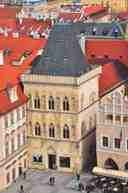
  3. Look to your left at the massive beige stone tower rising high above the square, attached to a distinctive pink building with ornate dark windows. You are standing before the Old…もっと読む折りたたむ

    Look to your left at the massive beige stone tower rising high above the square, attached to a distinctive pink building with ornate dark windows. You are standing before the Old Town Hall, but to call it a single "building" is actually a bit misleading. It is really more of an architectural Frankenstein’s monster, stitched together over centuries. Back in 1338, the city councillors decided they needed a headquarters. But rather than building something new from the ground up, they simply bought a large patrician house from a local clan called the Volflin family. As the city grew, the councillors played a real-life game of Monopoly, gradually buying up the neighboring properties-the Mikeš house, the Cockerel house, the "Minute" house-and knocking down walls to connect them all. That is why the architecture looks a bit disjointed; it is a row of separate lives forced to work together as one institution. The most prominent feature is, of course, that massive square stone tower. It was finished in 1364 and stood as the tallest structure in the city throughout the Middle Ages. If you look at the dark, projecting bay window on the corner of the tower, you are looking at the Town Hall Chapel. It is a stunning piece of Gothic architecture. If you could float up there and inspect the stonework on the columns, you would see a repeating emblem: a kingfisher bird and the letter "E" inside a twisted wreath, technically known as a torse. These were the personal symbols of King Wenceslas IV, marking the work as a royal project. It was the King’s way of autographing the building. Scan your eyes down to the facade of the buildings attached to the tower. You might spot a window from the 1520s bearing the Latin inscription "Praga caput regni," which translates to "Prague, the capital of the kingdom." It sits on a high cornice, supported by brackets and pilasters-those are flattened columns built into the wall for decoration rather than support. It is a bold declaration of the city's importance, etched right into the stone for everyone to see. Inside this complex, the architecture is just as impressive, particularly in the old council chamber. It has a beautiful wooden coffered ceiling-meaning it has a grid of sunken panels-dating from around 1470. But my favorite detail is a bit darker. There is a wooden sculpture of a suffering Christ from the early 1400s, positioned right where the councillors sat. It bears the inscription "Judge justly, O Sons of Man." It was placed there intentionally as a heavy-handed warning to the politicians: do your job honestly, or face the consequences. Nothing like a little divine pressure to keep a city council meeting on track. However, the building is not whole. If you look to the side, you will see a scar where a wing once stood-a result of the Second World War which we will investigate in the next stop. When you are ready, let's step closer to look at that missing piece.

    専用ページを開く →
  4. From this angle, take a closer look at the beautiful, protruding bay window on the tower known as an oriel. This oriel belongs to the Chapel of the Virgin Mary, consecrated in…もっと読む折りたたむ

    From this angle, take a closer look at the beautiful, protruding bay window on the tower known as an oriel. This oriel belongs to the Chapel of the Virgin Mary, consecrated in 1381. It was built by the workshop of Peter Parler, a famous master builder whose name you might hear quite a bit in this city. Inside the tower, above the chapel, there was once a bell used to summon the council, which had a rather dramatic end. That brings us to the darker chapter of this landmark. In May 1945, during the final days of World War II, the Old Town Hall became a headquarters for the Czech resistance during the Prague Uprising. On May 8th, mere hours before the German surrender was signed, the building came under heavy shelling from German tanks. A massive fire broke out. The destruction was catastrophic. The bell I mentioned crashed down from the tower and melted from the intense heat. A precious city archive, documenting centuries of Prague’s history, was turned to ash. The fire completely destroyed a large Neo-Gothic wing that used to stand on the north side of the complex. If you look at the site today, you might notice an open space or park area where a building seems like it should be. That gap is a scar from the war. Since the late 19th century and continuing well after the fire, there have been at least eight different architectural competitions to design a replacement for that wing. Architects have argued over it in 1905, 1947, 1966, and even 1988. Yet, every single competition either ended without a winner or produced a design that was never built. It seems the city simply cannot agree on how to fill the void, so the space remains empty. More recently, between 2017 and 2018, the surviving tower and facade underwent a massive renovation costing a fortune to restore their authentic look, ensuring that what remains of this patchwork complex stands strong. It is a resilient witness to the city's turbulent past, wearing its history in its mismatched architecture. When you are ready, we can head to the next stop.

    専用ページを開く →
  5. Look for the massive fortification made of blackened sandstone blocks, rising to a high, steep slate roof crowned with four corner turrets and golden spires. You are standing…もっと読む折りたたむ

    Look for the massive fortification made of blackened sandstone blocks, rising to a high, steep slate roof crowned with four corner turrets and golden spires. You are standing before what is arguably one of the most beautiful Gothic gateways in Europe. This is the Old Town Bridge Tower. It wasn’t just designed as a defensive fortification; it was built as a triumphal arch, a symbolic curtain-raiser for the coronation processions of Czech kings as they moved from the Old Town across the river to the castle on the hill. Emperor Charles IV commissioned this masterpiece in the mid-fourteenth century. He hired Peter Parler, the same brilliant architect-or master builder-who created the soaring choir of St. Vitus Cathedral. Parler was a true polymath, skilled in sculpture and engineering, and he poured that genius into this stone. If you look at the decoration on the eastern side facing the Old Town, it is actually a diagram of the medieval universe. It is divided into spheres: the earthly world of commoners at the bottom, the royal sphere in the middle with statues of Charles and his son Wenceslas IV, and the heavenly sphere at the top protected by saints. There is a hidden layer of magic here, too. Charles IV was obsessed with numerology and astrology. For instance, there are exactly twenty-eight decorative stone elements, known as crabs, on the lower arch, representing the twenty-eight days of the lunar cycle. Above them, twenty-four more represent the hours of the day. The architecture is actually a calendar. If you were standing here on the summer solstice, the twenty-first of June, at noon, you would see the shadow of a stone lion head fall perfectly onto a stone eagle. It is a celestial alignment that only happens once a year, symbolizing the union of the Bohemian and Roman legacies. However, this tower has witnessed horrors that contrast sharply with that golden symbolism. In the early seventeenth century, the mood in Prague shifted from glory to tragedy. After a failed Protestant uprising against the Catholic Habsburg dynasty, twenty-seven Czech lords were executed in the Old Town Square in 1621. To send a brutal message, the executioner placed the severed heads of twelve of those men into iron baskets and hung them from the gallery of this very tower. They didn’t just leave them there for a week or a month. Those heads remained there, rotting in the wind, for ten long years. It was a grim, silent warning to anyone crossing the bridge: do not defy the emperor. The tower suffered physically, too. Toward the end of the Thirty Years' War in 1648, the Swedish army tried to storm across this bridge to capture the Old Town. The fighting was fierce. The defenders were not just soldiers; they were local students and professors from the nearby university, barricading the gate with logs. The Swedish cannon fire completely destroyed the Gothic decorations on the side of the tower facing the river. That is why, if you walk through the arch and look back, the western face looks significantly plainer than the side you are facing now. As you pass through, you might be walking under a magical trap. The roof once hid a palindrome-a phrase that reads the same backward and forward-in Latin: Signa te, signa, temere me tangis et angis. It translates roughly to "Cross yourself, cross yourself, you touch me foolishly and suffer." It was a spell meant to ward off demons, ensuring that while armies might damage the stone, the spirit of the tower would endure.

    専用ページを開く →

よくある質問

ツアーはどうやって始めますか?

購入後、AudaToursアプリをダウンロードして引き換えコードを入力してください。ツアーはすぐに開始できます。再生ボタンをタップして、GPSガイド付きルートに従うだけです。

ツアー中にインターネットは必要ですか?

いいえ!開始前にツアーをダウンロードしておけば、完全にオフラインで楽しめます。チャット機能のみインターネットが必要です。モバイルデータを節約するため、WiFi環境でのダウンロードをお勧めします。

これは団体ツアーですか?

いいえ、これはセルフガイド式のオーディオツアーです。ガイドや団体、決まったスケジュールに縛られることなく、スマホから流れるナレーションを聴きながら自分のペースで自由に探索できます。

ツアーの所要時間は?

ほとんどのツアーは60〜90分で完了しますが、ペースは完全に自由です。好きな時に一時停止したり、スポットを飛ばしたり、休憩を取ったりできます。

今日中にツアーを終えられない場合は?

問題ありません!ツアーには無期限でアクセスできます。明日、来週、あるいは来年でも、好きな時に再開できます。進行状況は保存されます。

どの言語が利用可能ですか?

すべてのツアーが50以上の言語に対応しています。コードを引き換える際にお好みの言語を選択してください。注意:ツアー生成後に言語を変更することはできません。

購入後、どこからツアーにアクセスできますか?

App StoreまたはGoogle Playから無料のAudaToursアプリをダウンロードしてください。メールで届いた引き換えコードを入力すると、ライブラリにツアーが表示され、ダウンロードして開始できるようになります。

verified_user
満足保証

もしツアーを楽しめなかった場合は、返金いたします。お問い合わせ先: [email protected]

以下の決済で安全にチェックアウト

Apple PayGoogle PayVisaMastercardPayPal
世界中の旅行者に愛されています

数千のツアーが始まった。
みんなの感想。

App StoreとGoogle Playで総合4.8。何度も読み返したくなるレビューを集めました。

starstarstarstarstar
観光客気分になりすぎず、ブライトンを知るためのしっかりとした方法でした。ナレーションには深みと文脈がありました。
starstarstarstarstar
片手にクロワッサンを持ち、期待ゼロで始めました。アプリはただ一緒にいてくれる感じで、プレッシャーもなく、クールな物語を楽しめました。
download アプリを入手

ヘッドフォンを付けて。
外へ出よう。

ダウンロード無料。世界中の都市でツアー体験。60秒で開始 — アカウント不要、カード不要。

Download on the App StoreGet it on Google Play
starstarstarstarstar_half
4.8
AudaTours app icon
headphones
約4分 最初のツアーが始まるまで
public
1,000+ 世界中の都市
all_inclusive
AudaTours
Unlimited

すべてのツアー。すべての都市。 ひとつのサブスク。

3335 ツアー2280 都市140 国50+ 言語

