
Tour audio di Zurigo: Storie di Rivoluzione, Cultura e Leggende Urbane
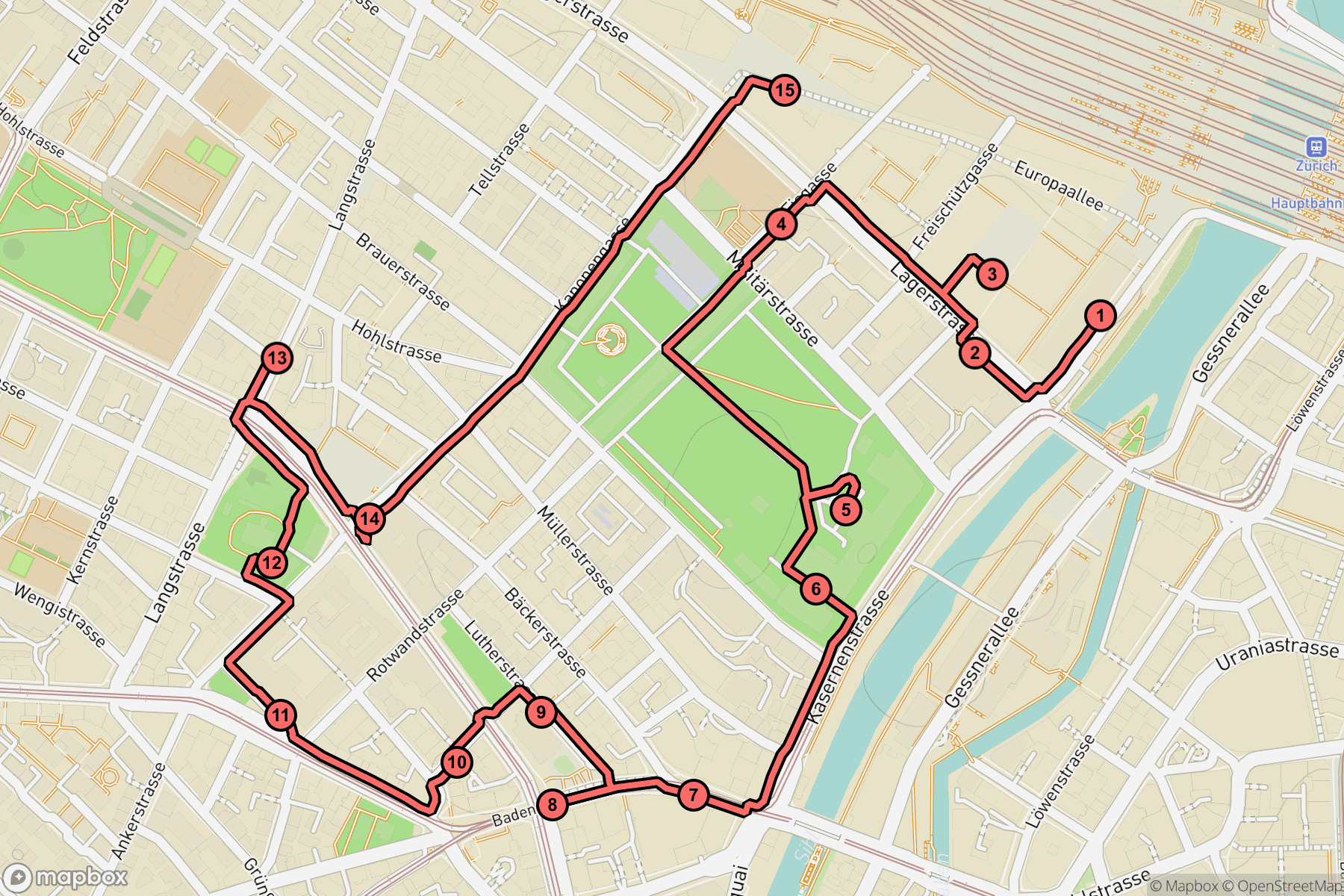
Un tempo il fuoco dei cannoni echeggiava lungo le rive della Sihl, dove ora batte il cuore moderno di Zurigo. Sotto facciate eleganti e piazze animate, pulsano segreti: racconti di sfida, sopravvivenza e le ombre che la storia cerca di cancellare. Con questo tour audio autoguidato, trasforma le passeggiate in città in viaggi nel tempo. Svela scandali e drammi nascosti in piena vista mentre esplori percorsi che pochi turisti percorrono. Perché gli eserciti si scontrarono proprio dove i pendolari ora sorseggiano il caffè? Cosa si è svelato così improvvisamente nel più grande centro islamico della città? Quale dettaglio sepolto nella trasformazione di Europaallee è più strano della finzione? Attraversa i secoli in un pomeriggio, attraversando campi di battaglia, luoghi di scandali e incroci inaspettati dove Zurigo si è reinventata, a volte a caro prezzo. La città rivela nuovi volti ad ogni svolta per coloro che ascoltano attentamente. Pronto a seguire le orme di ribelli e visionari? La tua Zurigo sotto la superficie ti aspetta. Inizia ad ascoltare e lascia che gli strati si svelino.
Anteprima del tour
Informazioni su questo tour
- scheduleDurata 40–60 minsVai al tuo ritmo
- straighten2.6 km di percorso a piediSegui il percorso guidato
- location_on
- wifi_offFunziona offlineScarica una volta, usa ovunque
- all_inclusiveAccesso a vitaRiascolta quando vuoi, per sempre
- location_onParte da Sihlpost
Tappe di questo tour
To spot Sihlpost, look for a long, six-story, rectangular grey building with rows of windows and a striking clock tower at the corner, right at the busy intersection of…Leggi di piùMostra meno
To spot Sihlpost, look for a long, six-story, rectangular grey building with rows of windows and a striking clock tower at the corner, right at the busy intersection of Kasernenstrasse and Lagerstrasse. Welcome to the mighty Sihlpost! If you feel like you’ve stepped into a time machine set to the late 1920s, you’re not far off. This isn’t just any old post office-it’s Zurich’s historic postal powerhouse and a classic example of “Neues Bauen,” a style so modern for its time that the building still looks sharp nearly a hundred years later. Imagine Zurich in the roaring 1920s: postal workers in crisp uniforms, trains puffing at the Hauptbahnhof, and engineers with rolled-up sleeves dreaming up something brand new. In 1927, construction began under architects Adolf and Heinrich Bräm, who designed the Sihlpost to be ultra-modern. The engineer Robert Maillart pitched in to make sure this place was built to last. By autumn of 1929, the building’s strong concrete skeleton stood proud-so efficient that the rooms inside could be changed with a snap of your fingers (or maybe a Swiss army knife), thanks to its clever window grid and flexible facade. But let’s not forget the outside-a smooth cloak of windows framed in strict lines, a bold tower now highlighted in dark grey paint. That color’s been debated by architects-some say it’s moody, some say it strays from the original lighter shade. Architects and their color swatches, am I right? Peek closer, and you might spot two ceramic mosaics crafted by artist Carl Roesch, gracing both entrances. No over-the-top decorations-just Swiss post-modern efficiency at its finest. The only bling you’ll find is the skillful stonework made from Mägenwiler limestone. Upstairs, the ceilings were built as “mushroom slabs”-no, not for pizza-but so the mighty mail-sorting machines of the 1930s had room to stretch out. Smell the crispness in the air as you picture the clatter of sorting machines, the chatter of workers, and the occasional whistle from the bustling rail lines. Originally, Sihlpost was a world-class mail-processing center-one of the most modern in the world. The Swiss Post and Swiss Federal Railways ran the show on the upper floors, while downstairs, the public pressed eagerly at counters for stamps and packages, and a secret tunnel linked the building directly to the Hauptbahnhof. No need for snail mail here-at least, not by Zurich standards! Ever heard of the post subway? In 1938, Zurich built a 340-meter underground rail line specifically for Sihlpost mail. Picture this: tiny, driverless wagons dashing along tracks, powered by copper wires-and when they reached the end, an elevator would whisk them up into the heart of Sihlpost. For decades, postcards scurried underground like burrowing moles. Not bad for a city famous for clockwork precision! By the late 20th century, the Sihlpost was running out of room. The Swiss Post kept expanding, new wings opened, and the place buzzed like a beehive. But eventually, Zurich’s clever people decided to shift most processing to a new center in Mülligen, freeing up space for fancy offices and even a school. Today, check the upper floors: Google calls the top three stories home, while the Zurich School of Business occupies the first two. Below, you’ll find a thriving post office, shops, and places to grab a quick espresso-no carrier pigeon required. Oh, and did I mention the drama? In 1994, the Sihlpost was the scene of one of Switzerland’s most mysterious post robberies-five daring thieves slipped away with a haul meant to board a train, and to this day, nobody knows what really happened. If these old walls could talk, they’d have some serious tales about disappearing mail bags, mysterious shadows, and alarms blaring in the Zurich night. So, while you stand here, picture decades of innovation, secret tunnels, and the whiff of fresh ink on postcards from around the world. Not bad for a building that started as a humble mailbox! Dust off those walking shoes-the next stop on our adventure is just around the corner.
Apri pagina dedicata →But let’s set the scene-picture the city in 1986, a time when big hairdos and business suits ruled, and Switzerland was watching a growing need for smart, practical business…Leggi di piùMostra meno
But let’s set the scene-picture the city in 1986, a time when big hairdos and business suits ruled, and Switzerland was watching a growing need for smart, practical business minds. Two visionaries-KV Schweiz, the major trade association, and the trailblazing Juventus Schools-teamed up to start what would soon become this very school. Back then, it was known as the Höhere Wirtschafts- und Verwaltungsschule (HWV). Instead of snoozing through lectures all day, students could work by day and study by night. Legends say some graduates were so tired they drank their coffee with two sugars... and an extra shot of determination! In just over a decade, this was no longer an experimental after-hours gig. By 1998, the Swiss federal government granted HWZ the power to become an official university of applied sciences. Now, don’t think that was easy-imagine mountains of paperwork so tall, they nearly rivaled the Alps. Over the years, the HWZ carved its own spot, separating from its sibling schools, and by 2006, it had its signature name. In 2010, it became a full-fledged company-HWZ AG. Today, it’s a proud, state-accredited private university that’s fully woven into Zurich’s professional tapestry. Why stop at business basics? HWZ is famous for keeping up with the times. In 2016, HWZ launched its Academy, pioneering workshops and advanced learning for Switzerland’s brightest firms. Just a year later, it launched the first Institute for Digital Business in the whole country, right here! So when you hear students chatting about AI, digital leadership, or business strategies, don’t be surprised if they predict the next big tech trend before your next tram arrives. Let’s talk about what you could learn here-if you dare. The menu of degrees could make your head spin faster than a Swiss fondue pot. There are Bachelor’s in Economics, Business Communications, or Digital Business & AI, with specialties like “AI Marketing & Sales,” “Sustainable Business Development & Entrepreneurship,” and even “UX & Data Driven Organizations.” And if you’re already a business legend, there are Masters, Executive MBAs, and an alphabet soup of certificates: CAS, DAS, MAS... it’s like collecting trading cards, only with fancier job titles. Here at Sihlhof, part of the bustling Europaallee area, HWZ rubs shoulders with the Zurich University of Teacher Education and the SIB School of Economics. It’s not just a campus; it’s a living, breathing hub of opportunity. And while it may look peaceful from the outside, inside, brains are buzzing and careers are being jump-started at lightning speed. So, as you look up at this modern hub, imagine yourself stepping inside: the air is tinged with fresh ambition…and probably a hint of coffee. Who knows, maybe you’ll get a business idea before you even reach our next stop!
Apri pagina dedicata →To spot the Pestalozzianum Research Library, look for a modern, bright building with large glass windows that open onto a sleek interior filled with rows and rows of colorful…Leggi di piùMostra meno
To spot the Pestalozzianum Research Library, look for a modern, bright building with large glass windows that open onto a sleek interior filled with rows and rows of colorful books-step closer and you can’t miss the inviting reading tables inside! Welcome to the Pestalozzianum Research Library-one of Zürich’s most fascinating time capsules, disguised as a library! Now, don’t let the minimalist design and peaceful atmosphere fool you; this place is a treasure chest crammed with stories, secrets, and even a bit of educational magic. Imagine, for a moment, the sound of shuffling old paper and books being opened as we leap back in time together. Our adventure begins in 1874, so dust off your imaginary top hat! The library actually traces its roots to the Gewerbemuseum in Zürich and Winterthur. Back then, visionary teachers and education innovators decided that learning materials deserved a grand stage-and voilà, the Swiss permanent school exhibition was born! It was here that curious minds could marvel at schoolbooks, teaching devices, and all things “pedagogical”-which is just a fancy word for ‘stuff that helps people learn.’ By 1878, this growing mountain of educational treasures caught the eye of Karl Otto Hunziker, who, no joke, was probably the kind of guy who would have color-coded his sock drawer. He was so dedicated that, for the Swiss Teachers’ Day in 1878, he organized an epic display about Johann Heinrich Pestalozzi, the legendary Swiss educator. From that day on, ‘Pestalozziana’-all things related to Pestalozzi-became a key part of the collection. The library’s name changed to ‘Pestalozzianum’ in 1891, and the collection grew faster than a teacher’s pile of homework in September! Some of these books, journals, and teaching materials were so precious that, for many years, teachers had to read them right there-taking them home would’ve been as unlikely as a snow day in July. Over time, the rules relaxed, and the library began to let people borrow its educational gems, so Zürich’s teachers could keep lessons lively and innovative. But here’s where things get truly interesting: the Pestalozzianum isn’t just shelves of books. It holds a colossal archive of over 14,500 cataloged pieces, ranging from documents handwritten in 1615, to modern treasures from 2010! Picture passionate teachers jotting ideas, educational associations plotting the next big thing, and even experts on Pestalozzi himself, scribbling late into the night by candlelight. The collection includes vivid posters and more than 64,000 children’s drawings from the 1930s to the 1980s-if only the walls could talk, I’m sure they’d complain about all those crayon colors! Some of the library’s most enchanting works are historical glass slides created between 1900 and 1950. Imagine dimming the lights and sliding one of these images onto an ancient projector -suddenly, you’re traveling into the past without leaving your seat! There are also more than 2,600 large teaching wall charts-like the PowerPoints of old Switzerland-some dating back to 1880. Let’s not skip over the drama: the Pestalozzianum has packed its bags and moved house more times than an over-caffeinated university student! It’s been everywhere: from the Fraumünster-Schulhaus, the Haus zum Rüden, the Wollenhof, and the Beckenhof, all the way to the Kurvenstrasse, before finally landing here at the campus of the Zurich University of Teacher Education. If you’re feeling curious, know that everyone is welcome! The public can explore its resources and even sit in the bright study room, tapping away at a research station as they uncover the story of Swiss schooling. Researchers from all over Europe visit to dig through archives and collections, teasing out secrets and writing new histories. And thanks to Zürich’s lottery fund, many of the oldest, most precious documents and images are now digitally preserved-perhaps even whispering through the internet to curious people like you. By the way, the library is hooked into the Swiss Library Service Platform-meaning its vast collection is just a few clicks away, alongside resources from 450 other libraries across Switzerland. It even has an ongoing partnership with scholars in Berlin, so Zürich’s school stories can have a German accent, too. So whether you fancy yourself a book detective, a history buff, or you just like the smell of old paper, Pestalozzianum Research Library is living, breathing proof that education is always evolving. Besides, with that many children’s drawings, you’re bound to find at least one stick figure that looks like you! Shall we keep wandering, or would you like to step inside for a closer peek?
Apri pagina dedicata →
Mostra altre 12 tappeMostra meno tappeexpand_moreexpand_less
Directly in front of you, you’ll notice Europaallee as a canyon of gleaming, modern buildings lining a broad, open pedestrian street, their glass facades glowing with life and…Leggi di piùMostra meno
Directly in front of you, you’ll notice Europaallee as a canyon of gleaming, modern buildings lining a broad, open pedestrian street, their glass facades glowing with life and activity-just look for the symmetrical rows of mid-rise blocks stretching forward with shopfronts and café umbrellas on either side. Now, let’s dive into the story of this vibrant urban avenue! Imagine standing here just a couple of decades ago-not amidst stylish shops and cozy bistros, but ankle-deep in the old, noisy railway yards of Sihlpost. For years, the only things dashing through this space were train carriages and the dreams of city planners eager to transform this prime Zurich real estate. Their ideas? Let’s just say they came and went as often as the express to Basel. But the tale of Europaallee has a twist! Picture the late 1970s: Zurich was humming with ambition, two Swiss architects bravely sketched a futuristic bridge across the tracks, possibly to host some epic dances or at least a solid game of hopscotch. However, their plans stayed right where many of us keep our boldest dreams-on paper. Then in the 1980s and ‘90s, new investors, particularly the major Swiss bank UBS, saw promise and a little glitter under the dust. The grand vision was finally unleashed. Ralph Bänziger Architekten, a Zurich-based studio, stepped up to the challenge and, after years of design rivalry and architectural debate, their vision-solid, modern, unmistakably Zurich-won out. After all, what’s more Swiss than a project perfected over twenty years of careful planning? From 2009, the clang of construction replaced the rumble of trains, and by 2020, Europaallee opened as a fresh artery pumping new life into Zurich. Today, you get Ginkgo trees, sunlit squares, bubbling fountains (locals lovingly call one the ‘Europuddle’), bustling shops, and even Google’s offices. With the Pädagogische Hochschule Zürich-and yes, a hotel for those who can’t bear to leave-Europaallee turned into an all-day, all-night urban playground. Bridges and tunnels now link you back to the main station and river Sihl, making this spot a beating heart of connection and innovation. So, take a deep breath. Smell the aroma from the bakeries, listen to the friendly chaos, and maybe, just maybe, spot a tech whiz, a freshly caffeinated teacher, and a very confused tourist, all sharing this snazzy corner of Zurich. Europaallee isn’t just a street; it’s a living memory of what Zurich can dream and build, with a little patience-and perhaps a sprinkle of Swiss efficiency!
Apri pagina dedicata →You’re standing now in front of the Zürich Islamic Center-a place that’s usually filled with quiet reflections, murmurs of prayer, and neighbors going about their day. But let’s…Leggi di piùMostra meno
You’re standing now in front of the Zürich Islamic Center-a place that’s usually filled with quiet reflections, murmurs of prayer, and neighbors going about their day. But let’s wind back to a winter evening, December 19, 2016, when something truly shocking happened right here. Imagine the city, just after dusk. Soft golden lights glimmered on the streets and there was the usual rush around Zürich Hauptbahnhof. But inside this mosque, mostly used by refugees from Somalia and Eritrea, people were gathered for prayer, seeking comfort away from the hustle outside. Suddenly, the ordinary calm was shattered. A young man stepped into the prayer room, silent and tense. Without warning, he opened fire. Three men were hit-two from Somalia, one a Swiss man of Somali descent. There was confusion and terror, as the others rushed to barricade themselves in a small adjoining room, hearts pounding, breaths held, while the gunman slipped away into the Zürich night. Police sirens wailed in the distance, closing in, but by the time they arrived, the attacker was gone. That was just one chapter of a chain of events that began the morning before, across town in Schwamendingen. There, on an ordinary playground, a body was found-a young man, stabbed several times, his life cut short far too soon. The police moved swiftly: DNA evidence at the scene pointed them to a suspect who, as it turned out, was a former friend of the murder victim. There was something haunting in the story-two lives once connected, now both spun into darkness. But the suspect, Manuel O., a 24-year-old man from Uster, was already gone. Witnesses remembered him as a complex soul: his mother Swiss, his father Ghanaian-though he’d never met his father, who’d had to leave Switzerland. Young Manuel grew up struggling with school, drawn to shadows, deeply interested in the occult. Some neighbors thought him an ardent Christian who didn’t much like Islam, while others recalled him complaining about extremists, but also defending Muslims as just misunderstood people. If you think that sounds mysterious, you’re not alone-the police themselves could never quite untangle his true motives. Jump forward again to that December evening. After fleeing the shooting, Manuel disappeared beneath the Gessner bridge, less than half a kilometer from here. There on the banks of the River Sihl, his story ended quietly as he died by his own hand. It left the police and the community reeling: the reasons for his rampage remained clouded in uncertainty, with no clear connection to political extremism or mental illness. All that was certain was that pain had spread far beyond this building’s walls. For the people who survived, recovery was a long road-multiple surgeries, and a trauma that made it hard to return even to prayer. There were complaints, too, about how little information they were given afterward; sometimes it felt as if the violence had thrown them into a silent void. After the attack, Zürich’s police presence around mosques grew overnight, while leaders from both the Muslim and Protestant communities spoke out for peace, unity, and support, realizing the risk that hate can spread like wildfire. The local Somali community found comfort from unlikely places-a Protestant church offered its support, perhaps reminding everyone that the real heart of Zürich isn’t beaten by gunfire or suspicion, but by neighbors coming together in times of trouble. There was also a dash of international drama-on that same day, far away, there were major world events unfolding: an assassination in Turkey and a truck attack in Berlin. Even the American President-elect chimed in, calling all three incidents “terror attacks.” But here in Zürich, the story was less about global politics and more about the mysterious world of one troubled young man. When the case was finally closed in September 2017, it left more questions than answers. There were no accomplices, no manifesto, just confusion and sorrow. In his apartment, the police found strange evidence-supplies for the end of the world, an entire room set aside for occult rituals, and not a single television; Manuel didn’t want “outside influences.” Perhaps it was all part of his fear: of war, of surveillance… or perhaps just of people, of being truly seen. So as you stand here, take a moment to soak in the ordinary sounds and sights of Zürich today. Remember that even where tragedy once struck, life goes on-full of mystery, resilience, and, yes, even the occasional oddball prepping for the apocalypse. Just be glad the strangest thing you’ll hear today is probably me telling you this story! Seeking more information about the schwamendingen stabbing, shooting or the perpetrator? Ask away in the chat section and I'll fill you in.
Apri pagina dedicata →Directly in front of you, you'll spot a grand, fortress-like building with sturdy stone towers, large arched doors, and a clock above the entrance, flanked by tall trees and set…Leggi di piùMostra meno
Directly in front of you, you'll spot a grand, fortress-like building with sturdy stone towers, large arched doors, and a clock above the entrance, flanked by tall trees and set behind a metal footbridge-just look straight ahead across the bridge for the best view. You’re now standing at the historic Zurich Barracks area-the Kasernenareal-a place where echoes of marching boots and steely orders once mingled with the wind. Imagine it: in the 1860s, the city was reshaping itself, old military buildings made way for the now-famous Bahnhofstrasse, and right here, on this former defensive earthwork, Zürich raised its new army barracks. It wasn’t built in a day! Between 1864 and 1876, these stout stone halls, sturdy enough to make a Swiss cheese jealous, grew under the watchful eye of two architects, Johann Caspar Wolff and Johann Jakob Müller. For a few decades, you would have seen Zurich’s citizens enjoying sports and lively festivals on the very parade ground before you-but then the world changed. When World War I came, the place clanked shut for civilians, becoming a strictly military domain, guarded fiercely. If you’d walked here back then, you’d have hit a locked gate…or maybe even a moustached guard glaring at you! During the tense twentieth century, the site bustled with police and military activity-until, in 1987, the troops withdrew, leaving behind a mystery: what should become of all those empty halls and yawning parade fields? The answer came slowly, like a cautious old soldier. Bars and theaters crept in by the riverside stables; artists, actors, and film students claimed forgotten corners. Even today, peeking around, you might spot a hip café or a rehearsing theater troupe. But a big chunk of the area was locked tight behind police fences for decades, complete with a temporary prison-certainly not the place you’d want to drop your keys! Only recently did the police finally march away, and the city tore down the fences. It’s funny, sometimes liberation comes with the hum of construction rather than the clash of swords. Now, the barracks are undergoing a slow, dramatic makeover. The grand old buildings, which-let’s be honest-are in need of some serious Swiss TLC, are being restored bit by bit. Plans are growing for a new adult learning center and creative spaces for the public. Soon, you might take a language class inside the same walls that echoed with military commands, or dance at a concert where officers once inspected their troops. What remains constant? The building’s endurance. It’s seen armies march, festivals rage, police patrol, and now, citizens picnic, dream, and create. So, as you stand here, picture not just the past, but the bustling, hopeful future, where the only thing more lively than the history is the promise of what’s to come. And remember-if these walls could talk, they’d probably have some wild stories…and maybe a pretty good sense of humor too!
Apri pagina dedicata →Look for a large, modern grey building with clean lines and a rectangular layout, positioned beside the train tracks and surrounded by city streets-it's right at the center of…Leggi di piùMostra meno
Look for a large, modern grey building with clean lines and a rectangular layout, positioned beside the train tracks and surrounded by city streets-it's right at the center of your view, dominating the area with its size. Stop right there, detective! You’re at the nerve center of justice in Zürich: the sleek and imposing Zurich Cantonal Police headquarters, or “Polizei- und Justizzentrum.” This isn’t your average cop shop-here, behind all those glass windows, about 3,900 hardworking souls keep the entire canton in check, making sure even the cows out in the countryside behave (well, mostly). If you close your eyes for a second, you might hear the buzz of activity inside-phones ringing, feet hurrying down glossy corridors, the faint clatter of keyboards and maybe someone accidentally dropping a coffee mug with a dramatic crash. The roots of this mighty institution stretch all the way back to 1804, when it was founded as the “Landjäger-Corps” after the Bockenkrieg, a time when troublemakers were more likely to wield a pitchfork than a smartphone. Back in those days, policing was a little rougher around the edges-imagine creaking boots and the clink of sabers instead of smartphones and radios! Now, the Zurich Cantonal Police handle everything from stopping bank robbers to helping little old ladies cross the street (although, let’s be honest, little old ladies in Zürich can probably cross it just fine themselves). They divide their heroic efforts into several special units. There’s the Communications Department, who are a bit like the voice of the people-handling everything from urgent press conferences to social media updates (they’re all over Facebook, Twitter, Instagram... if only the criminals would follow them there instead of running off). This team ensures that both dramatic events and good news stories get out to the public, sometimes with an added sprinkle of Swiss politeness. Meanwhile, the Prevention Department is quietly working behind the scenes. They’re the ones reminding kids not to run with scissors, teaching teenagers about the dangers of bad company, and working with all kinds of community groups, especially people new to Switzerland. It’s not easy to prevent every disaster, but you can bet they’re giving it their best shot, building bridges-literally and figuratively-right in this very spot! Upstairs, Command Area 1 keeps everyone trained and mentally fit; part HR, part psychologist, part legal eagle. If you imagine a boot camp with a dash of group therapy and some complex paperwork thrown in, you’re getting close. They’re also the ones making sure that when all else fails, there’s always a friendly (and well-qualified) new recruit on hand. In Command Area 2, it’s all about logistics, money, and tech-the beating heart powering police ops across Zürich. This is where budgets are balanced, computers kept humming, and the fuel for every patrol car is tracked to the very last drop. Let’s just say, if the internet ever goes down in here, you might hear a collective gasp like a storm hitting a calm lake. Criminal Police? That’s where the real action is. They tackle the big cases: robberies, arson, cybercrime, and yes, those sneaky things you wouldn’t expect your neighbor to be up to. Their best crime-solvers combine state-of-the-art technology with good, old-fashioned intuition-the kind that makes you double-check if your fridge light really goes off when you close the door. Special units like the Security Police swoop in for the most dangerous interventions and keep a watchful eye on everything from police dogs to the illegal cheese trade (okay, maybe not the cheese, but almost everything else illegal). And don’t miss the Traffic Police, who handle crashes and untangle traffic jams with the patience of a saint-plus the grit to stand out in Zürich’s snow, rain, or sunshine. Even the airport is under police protection here-if you ever get lost at baggage claim, you might just bump into the Flughafenpolizei, always on patrol with armored vehicles, guarding borders, and keeping the runways safe. So next time you see one of Zürich’s blue uniforms, remember: they’re just the tip of a very large, extremely well-organized, coffee-fueled iceberg, all headquartered right behind these modern walls. Makes you feel safer already, doesn’t it?
Apri pagina dedicata →To spot this landmark, look ahead for a historical depiction showing armored knights clashing with spears, colorful banners flying, a small chapel, and a dramatic wooden bridge…Leggi di piùMostra meno
To spot this landmark, look ahead for a historical depiction showing armored knights clashing with spears, colorful banners flying, a small chapel, and a dramatic wooden bridge leading right up to the city’s stout walls. Welcome to the very ground where swords clashed, banners waved, and chaos echoed over the fields during the Battle of St. Jakob an der Sihl. Picture it: the air thick with the shouts of thousands, swords and armor gleaming under the summer sun, while the Sihl river glitters just beyond. It’s July 1443, and Zürich is in trouble. Outside the city walls, about 6,000 confederate soldiers face off against Zürich’s own defenders-who, I must admit, could’ve used a better alarm clock that day, because they were pretty disorganized. To beef up their strength, Zürich had called in about 500 of those fancy Austrian knights in shining armor. By dawn, the confederates surge forward-straight into the clamor of crashing shields, the smell of sweat, and the panic of losing ground. Hamburgers are centuries away, but these knights are in a real pickle! Zürich’s defenders are pushed back, tripping over each other as they rush for the safety of the city. The confederates are fierce, but thankfully, their siege skills are as bad as my jokes-they can’t break through the city gates. Now, let’s talk drama! Inside the little chapel of St. Jakob, Albrecht Freiherr von Bussnang, the Habsburg commander, meets his end behind the altar. And on the bridge over the Sihl, Zürich’s own burgomaster Rudolf Stüssi becomes a legend (or, at least, the subject of some serious Zürich propaganda). With a mighty axe, he stands his ground, yelling, “Halt, citizens, halt!”-before a fellow Zurich man, probably sick of all the noise, stabs him, blaming him for, well, everything. Oops! But the hero of the day? None other than Anna Ziegler, the gatekeeper’s wife, who times it perfectly and drops the portcullis just as the confederates sprint for the gates-saving Zürich by a hair’s breadth. So, as you stand here, imagine the dust, the uproar, and a city almost lost… but saved by courage, luck, and a well-timed drop of the gate. That’s history for you-messy, thrilling, and sometimes just plain unbelievable!
Apri pagina dedicata →To spot Stauffacher, look for the busy tram stop with blue and white trams lined up beneath a glass-roofed shelter, right at the big crossroads with shops nearby-including a…Leggi di piùMostra meno
To spot Stauffacher, look for the busy tram stop with blue and white trams lined up beneath a glass-roofed shelter, right at the big crossroads with shops nearby-including a famous golden “M” across the street. You’ve arrived at Stauffacher, the beating heart of Zürich’s tram universe, where the everyday rhythm of trams clanging and people bustling has almost become a city soundtrack on its own! If you close your eyes for a second and listen, you might even imagine you’re standing on the set of a Swiss version of “Tramspotting.” But there’s a lot more to this spot than the daily traffic jams of trams and bikes. Long ago, this crossroads was better known by another name: St. Jakob. Imagine dusty medieval paths winding through meadows, when, back in 1221, a little hospice for people with leprosy stood here, with its chapel under St. James’ protection. Over time, as Zürich boomed, that old hospice became a retirement home (no Netflix back then, just lots of prayers and soup!) and lasted until the mid-1800s. Just across the street from here, after 1820, a brand-new cemetery and prayer house were built. Then, in 1901, the impressive St. Jakobskirche opened, giving the area a fresh face. But let’s not skip the drama! In 1443, right on these grounds, the Battle of St. Jakob an der Sihl raged-picture clashing armor, shouting soldiers, and Zuricher citizens holding their breath. These streets have seen far more action than just people running for coffee or a tram today. Now, Stauffacher is named in honor of Werner Stauffacher, a legendary Swiss hero. And as you stand here, trams lines 2, 3, 8, 9, and 14 are all synchronized like a perfectly choreographed dance hoping you’ll be impressed. Fun fact-this very spot was supposed to be a main hub of Zürich’s underground, but in 1973, that plan went out the window when the people voted “no way!” Maybe they just liked the view above ground better. So, next time you feel stuck in traffic here, remember-you’re standing on centuries of history, more tangled than a pile of tram cables.
Apri pagina dedicata →If you’re facing St. James' Church, just look up for a tall, stone tower crowned with a dramatic black spire and two giant gold-rimmed clockfaces-no way you’ll miss it! Alright,…Leggi di piùMostra meno
If you’re facing St. James' Church, just look up for a tall, stone tower crowned with a dramatic black spire and two giant gold-rimmed clockfaces-no way you’ll miss it! Alright, welcome to the mighty St. James’ Church! Or, should I say, “St. Jakob,” as the locals would call it. Picture this: you’re standing beside one of Zürich’s true giants, a church whose stone façade towers over the busy intersection and trams whizzing by on Stauffacherstrasse. That 86-meter spire you see? It’s the tallest on the block, easily outshining its neighbor, the Catholic Church of St. Peter and Paul-by a whole 20 meters, in fact. Looks like church rivalry gets measured in meters here! But let’s pull back the curtains to the 1800s for a moment. This whole quarter, Aussersihl, was booming with newcomers in search of work-Swiss and folks from across the border flocked in, packing the place tight. Soon, the little old chapel here, which had started out as a hospital and then turned into an almshouse, just couldn’t hold the crowds anymore. It isn’t easy fitting everyone in for Sunday service when your neighborhood is growing faster than yeast in a bakery! So, they decided, out with the old, in with the new. Here’s where the intrigue spikes. When the nearby Catholic church got a shiny new extension and an ultra-impressive 60-meter tower, the local reformers thought, “Oh no you don’t!” They started an international competition to design something even grander. The winning blueprint, crafted by Berlin’s church-design dynamic duo, Johannes Vollmer and Heinrich Jassoy, gave Zürich this very building, finished between 1899 and 1901. And what a creation! Renaissance stonework, dramatic twin-paned windows, and, of course, the glorious spire-soaring high for all to see, with a five-bell chime that rings out across the city. Take a breath and imagine the church’s setting: behind you, a lively green park; at your feet, a curving pathway leading right up to the grand entrance; all around, a trim hedge and stone wall making a protective embrace. Even today, all this greenery here is carefully protected, just like the church itself. Step inside (if you get the chance after our tour), and you’d be under a sweeping barrel vault-the kind that seems to gather up prayers and carry them skyward. The designer made sure the church could fit 1400 worshippers by adding elegant balconies on either side-talk about maximizing space! When packed full during a service, the preacher would stand at a side pulpit, but for the main show, the focus was always on the altar table and vaulted choir. There are treasures from every era: the original altar table, a pulpit foot crafted by Emil Schneebeli, intricate pulpit reliefs by Josef Regl, Gothic choir stalls, and stained glass by master Heinrich Huber-Stutz. But wait till you hear this-time for a bit of music history! The church’s organ, originally installed in 1901 by the celebrated organ builder Kuhn, was powered by-you guessed it-a water motor! That is, until someone thought, “Wouldn’t electricity be handier?” and switched things up in 1908. Over the years, the organ kept getting more complex, transforming like a musical Transformer with new elements and mechanics: more keyboards, basses, wind pressures adjusted, pipes shuffled around, and even a full renovation as recently as 2012. Today, it’s a true hybrid: capable of lush French symphonic music or sparkling baroque, sometimes playing both at once, thanks to its electronic wizardry and massive selection of registers. The crescendo and “tutti” buttons would make any organist break a sweat with excitement, not fear! The church was even “purified” in the 1930s to match the minimalist style of the times-no frills, just clean lines. But no worries, in the early 2000s, new restorers brought back much of its original spirit. Now, as “Citykirche Offener St. Jakob,” the church is open to everyone, echoing both the prayers of the past and the bustling voices of today’s Zürich. Imagine, as the bells ring out above you, all those years of ambition, rivalry, and devotion wrapped into one mighty building-who knew a church spire could throw so much shade, and a little bit of friendly competition, on its neighbors?
Apri pagina dedicata →It all started with Italian workers dreaming of “Socialist cooperation.” These folks wanted not just good food but a sense of community, so they set up the Coopi-where the prices…Leggi di piùMostra meno
It all started with Italian workers dreaming of “Socialist cooperation.” These folks wanted not just good food but a sense of community, so they set up the Coopi-where the prices were gentle on a worker’s hard-earned wages and the bookshelves overflowed with radical ideas. It quickly became a refuge, especially during tough times. During World War II, things got dicey. The restaurant buzzed with whispered secrets and nervous glances. Socialist exiles huddled over steaming cups of espresso, rallying against fascism while outsmarting suspicious eyes. The bust of Filippo Turati, founder of the Italian Socialist Party, still keeps watch today. Think of those exiled reporters, hunched over typewriters, quickly packing their freshly printed newspapers-Avanti! and L’Avvenire dei Lavoratori- into double-bottomed suitcases. You could almost hear the brisk footsteps of couriers ready to smuggle forbidden words across the border. The Coopi was a magnet for rebel minds-legends like Vladimir Lenin, who is said to have eaten his final Swiss meal here, plotting revolution between bites. Even a young Benito Mussolini-yes, before the dictator days-once dined here after a May Day rally. And Bertolt Brecht, the brainy German writer, once looked around and asked why Karl Marx’s face was on the wall but not Lenin or Stalin. The answer? As staff said, “No dictators here… not even on the walls!” That’s the Coopi spirit-fiercely independent, no nonsense, a little cheeky. Through the years, the Coopi has moved around Zürich, each time bringing tales of protests, political intrigue, and a fair bit of pasta along for the ride. And don’t forget: the Coopi’s legacy faced its own battle in 2006, fighting for survival in the face of skyrocketing rents-not quite as dramatic as dodging secret police, but still nerve-wracking for the waiters! Today, the Coopi stands for history, resistance, and the joy of a shared meal-so if you’re craving more than just spaghetti, you’re in the right place.
Apri pagina dedicata →Look to your left for a large, red building with a rounded corner tower and rows of pale-framed windows stretching above the bustling street - that’s the Volkshaus Zürich,…Leggi di piùMostra meno
Look to your left for a large, red building with a rounded corner tower and rows of pale-framed windows stretching above the bustling street - that’s the Volkshaus Zürich, unmissable against the bright sky. Welcome to Volkshaus Zürich! Now, don't worry, you won't need your passport for this leg of the tour, but you might want to bring your curiosity and maybe even a towel - but let’s save the explanation for a moment. Picture it: Zürich, over a century ago. The air was buzzing, not with traffic, but with the sounds of debate and the clink of teacups in the city’s very first alcohol-free people’s house. When the Volkshaus opened in 1910 right here at Helvetiaplatz, it was a beacon, calling together workers, reformers, politicians, city officials, and some forward-thinking women who later started the city’s women’s association. Instead of the usual bar brawls and pints, you’d have found heated discussions about politics, progress, and, possibly, the best way to make rösti without starting a revolution. The building you see today has always kept its roots in public life. In its early days, people would come here not just to dine at an alcohol-free restaurant (a brave move in Switzerland!) or to bathe in the grand baths in the basement, but also to mingle in meeting rooms, attend rallies, and, later on, catch a show in the vast theater. The theater itself, a grand old space, opened in 1928 and could squeeze in about 1,200 people for a seated show - or up to 1,600 if you felt like getting cozy for a standing event. It’s said the walls could practically hum with excitement during those nights. A curious fact for you: The famed painter Eduard Gubler lived and worked in an artist’s studio apartment upstairs after the theater opened. Imagine him, peering out the windows, painting while listening to the city’s heartbeat below and the faint echo of applause drifting up from the stage. Books have always been a big part of Volkshaus too. Since 1939, a bookstore has taken up residence here, starting life as a cooperative and blossoming into the “Bookstore in the Volkshaus” you might see today. Under the direction of Marthe Kauer, the first manager, it became known for its focus on education, politics, and children’s stories, with secretive literary events bubbling away in its cellar, affectionately nicknamed “The Catacomb.” There's always been a dash of mystery along with the learning. Over the years, Volkshaus has weathered changes both grand and subtle. The original green-gray paint gave way to a deep red in the 1930s, a color that returned in a major 2021 renovation, after experts and historians pored over old paint chips and photographs. Not without debate, of course - this is Zurich! Even the very tone of its walls has sparked fair discussion. Today, you’ll find not just a venue for concerts and art happenings but a gathering point for football fans - FC Zürich celebrates big wins right on the balcony above you, with Helvetiaplatz rumbling beneath. Want a spot of relaxation? There’s even a Hamam spa tucked inside now, so you can sweat away Zurich’s worries - a fitting twist for a building where no idea, and almost no person, has ever been left out in the cold. So whether you come for a play, a protest, a pint (yes, alcohol is finally allowed inside the theater since 1979), or just a peek at Zurich’s own living room, Volkshaus remains a tower of togetherness in every sense.
Apri pagina dedicata →To spot Langstrasse, look ahead for a lively street lined with colorful old buildings, outdoor café seating shaded by striped awnings, and a steady line of street lamps…Leggi di piùMostra meno
To spot Langstrasse, look ahead for a lively street lined with colorful old buildings, outdoor café seating shaded by striped awnings, and a steady line of street lamps overhead. Alright, you’re standing at the edge of one of Zurich’s most colorful arteries-Langstrasse! Let me paint you a picture: Imagine a street buzzing with so much life that it almost hums as you walk along it. Langstrasse is like the main character in its own urban movie-stretching between Districts 4 and 5, tying together people, stories, and a bit of mischief. When Langstrasse wakes up, it greets you with a patchwork of sights-yellow, rusty-red, and cream buildings, iron balconies with plants spilling over, and shopfronts with blue or orange striped awnings. You might hear the clatter of cups from a bustling café or the low rumble of traffic rolling by. In front of you is the heart of a district that never quite sleeps. But this street isn’t just about today’s espresso bars. It’s seen history unfold, sometimes with a wink and a spark of rebellion. Take Helvetiaplatz, brushing right up against Langstrasse-on May Day, the place explodes with passionate marches, drums, banners, laughter, and the sizzle of grill stands during festivals. Nearby, the Kanzlei schoolhouse grounds are alive with cultural happenings, often spilling out into the open-air cinema hosted by Kino Xenix in summer, where you might catch a breeze of popcorn and laughter drifting down the street. Now, don’t miss the “Piazza Cella”-named after Erminia Cella, who once ran a famous eatery here with her husband, feeding hungry hearts and sparking conversation long into the night. Another hidden gem: Emilie-Lieberherr-Platz, named for a women’s rights pioneer, sits quietly between Josefstrasse and Johannesgasse, keeping watch over the steady thrum of city life. If you think this street’s just all cute cafés and stories, think again! Langstrasse is famous for its nightlife and red-light buzz, where the neon flickers after dark and the unexpected waits around every neon-lit corner. In years past, thousands flocked here for the Langstrassenfest-a festival so wild the whole street turned into a party confetti couldn’t quite keep up with. When there wasn’t a festival, there was the Longstreet Carnival or Caliente, the biggest Latin festival in all of Europe. Picture swirling music, laughter, and a blur of salsa steps right under these hanging lamps! And as if drama and celebration weren’t enough, there’s a touch of urban tension here too. The city’s trying to tame the wild streets, planning to keep parts of Langstrasse car-free during the day to give residents a break from the traffic roar. Some say it will bring more calm, while others worry… But hey, what’s Langstrasse without a little spirited debate? Let yourself wander here-it’s a street that invites you in with a smile, a story, and, if you listen closely, the living rhythm of Zurich itself. Want to explore the places, festivals or the traffic noise in more depth? Join me in the chat section for a detailed discussion.
Apri pagina dedicata →In front of you is a long, white wooden building with lots of big windows and a bold sign on the roof reading “KINO xenix”-just look for the quirky structure nestled in the trees,…Leggi di piùMostra meno
In front of you is a long, white wooden building with lots of big windows and a bold sign on the roof reading “KINO xenix”-just look for the quirky structure nestled in the trees, with colorful benches and posters in glass cases outside. Welcome to one of Zurich’s most legendary little rebels: the Xenix cinema! Just imagine the crackle of gravel under your feet as you stand on the bustling square-the air alive with laughter and conversation from the nearby bar’s terrace, and a quiet hint of anticipation from the cinema’s doors, like they’re holding secrets behind them. Now, Xenix didn’t just show up quietly one morning like a polite neighbor! No, its story starts way back in the early 1980s, a time when Zurich’s youth were bubbling with energy, ideas…and, well, a tiny bit of mischief. Picture the scene: street protests, demands for more freedom, and amidst it all, a group of film-obsessed young people decided cinema could be a weapon for challenging ideas and connecting people. They started a film club with just a rickety 16mm projector-maybe about as powerful as a flashlight in a rainstorm, but with enough passion to light up a city! Their first film wasn’t even shown here-it was a journey, hopping from one borrowed hall to another, sometimes in smoky theater basements or at the legendary Volkshaus. In 1982, the club finally found a home in an occupied house by Tessinerplatz, and they gave their project a name with a sense of irony and a nod to Amsterdam’s famous “Xinix” cinema: Xenix, which in Swiss German cheekily means, “I see nothing.” Good name for a cinema, right? The joke being, half the time, it was hard to know where or if the next show was happening at all! Eventually, when another temporary home was demolished-classic Xenix luck-they landed, by both fortune and sheer stubbornness, here on Kanzleiareal. Set up in a former schoolhouse barrack from 1904, Xenix never looked back. Today, that same old wooden building, a little stretched and expanded, is still home to all sorts of cinematic adventure. And those cozy sofas inside? You might spot a row of them-they’re left over from the very first days, when the audience lounged around like cats, almost as keen on conversation as on the films. The spirit inside is anything but sleepy! Xenix is fiercely dedicated to offering a platform for films that dig deep-sometimes shining a spotlight on forgotten voices, sometimes diving into loaded political themes or celebrating outlandish artistic visions. Every month, the program turns on a dime: sometimes it highlights a social cause, sometimes a country’s hidden cinematic gems. There are retrospectives that feel like time travel, and regular Sunday brunch documentaries that fuel your body and your mind. It’s a place where directors and audiences argue, laugh, and learn together. Sometimes, it feels more like a living, breathing brain than a cinema. When summer hits, the cinema spills outside, turning this very gravel yard into an open-air movie theater under the stars. The bar out front becomes a local hangout, with people pausing for a drink before the show-or just catching the sunset, even if they aren’t planning to see a film. During the football World Cup? Xenix becomes a raucous fan-zone, with matches beamed onto a big screen, hosts flipping BBQ, and the crowd roaring loud enough to wake the pigeons. There’s been a generous dash of courage among all these stories-the legendary Xenia women’s nights that kept Thursdays strictly for women, and the times when Xenix lent a helping hand, whether setting up open-air movie nights in distant Senegal or helping rebuild a bombed-out cinema in Sarajevo. And the technology? Oh, it’s a museum and a spaceship all at once: original 16mm and Super-8 projectors snuggle up beside digital projectors with surround sound, ready for anything from retro classics to modern masterpieces. So as you’re standing here, maybe feeling a mix of curiosity and nostalgia, take a deep breath and imagine the thousands of movie lovers who, since 1984, have crossed this same gravel, eager to see a film, challenge ideas, or just find a space for something offbeat. Xenix may look modest, but it’s a treasure chest of stories, ideas, and maybe a few film reels that squeak in the night. Now, if you see someone racing past you with a poster under their arm and a coffee in hand, don’t worry-they might just be rushing to set up tonight’s next great cinematic surprise!
Apri pagina dedicata →In front of you stands a grand, pale yellow building with a high pointed roof, stone columns, and three soaring entryways-you can spot it just across the open plaza, partially…Leggi di piùMostra meno
In front of you stands a grand, pale yellow building with a high pointed roof, stone columns, and three soaring entryways-you can spot it just across the open plaza, partially framed by leafy trees and crowned with a decorative relief above the main doors. Now, welcome to the mighty District Court of Zurich! Imagine this spot bustling with nearly 400 people inside-lawyers in sharp suits, clerks with rattling trolleys of documents, and the occasional nervous defendant clutching a coffee. This is Zurich’s courtroom heavyweight, handling about 20,000 cases every single year. If these walls could talk, they’d probably demand a lawyer before saying anything. Since 1798, this court has been untangling Zurich’s knottiest problems-back then, folks called it the “District Court.” It’s changed names a few times, a bit like someone in the witness stand dodging a tricky question, but since 1831 it’s carried the name you see today. For a long time, it was the largest court in all of Switzerland, and before the administrative court opened in 2007, judges here could barely find a break-unless they hid behind their overflowing files. The court is actually spread out around here, but this building, with its formidable facade, is the central hub. Inside, there are ten departments where teams of judges-elected by Zurich’s citizens, no less-gather to hear civil and criminal cases. There’s even a special labor court, departments for quick audience sessions, and experts who decide what happens when rents go sideways. And just imagine 240 sharp-minded lawyers plus 140 support staff, all working together-it's a legal beehive in there! For a final twist, until 2008, even the neighboring district of Dietikon had to come here to sort out their messes-so you could say Zurich has always been the big sibling, ready to sort out family arguments. Today, the president of the court is Marie Schurr, but everyone who works here shares a common goal: getting to the truth, and maybe drinking a lot of coffee along the way. If you listen closely, you might just hear the faint echo of a lawyer’s dramatic closing argument-though, of course, it’s all strictly confidential!
Apri pagina dedicata →
Domande frequenti
Come inizio il tour?
Dopo l'acquisto, scarica l'app AudaTours e inserisci il tuo codice di riscatto. Il tour sarà pronto per partire immediatamente – tocca play e segui il percorso guidato dal GPS.
Ho bisogno di internet durante il tour?
No! Scarica il tour prima di iniziare e goditelo completamente offline. Solo la funzione chat richiede internet. Ti consigliamo di scaricare tramite WiFi per risparmiare dati mobili.
È un tour guidato di gruppo?
No – è un tour audio autoguidato. Esplori in autonomia al tuo ritmo, con la narrazione audio riprodotta dal tuo telefono. Nessuna guida, nessun gruppo, nessun orario.
Quanto dura il tour?
La maggior parte dei tour richiede 60–90 minuti, ma sei tu a controllare il ritmo. Metti in pausa, salta le tappe o fai pause quando vuoi.
E se non riesco a finire il tour oggi?
Nessun problema! I tour hanno accesso a vita. Metti in pausa e riprendi quando vuoi – domani, la prossima settimana o il prossimo anno. I tuoi progressi vengono salvati.
Quali lingue sono disponibili?
Tutti i tour sono disponibili in oltre 50 lingue. Seleziona la lingua preferita quando riscatti il codice. Nota: la lingua non può essere cambiata dopo la generazione del tour.
Dove accedo al tour dopo l'acquisto?
Scarica l'app gratuita AudaTours dall'App Store o Google Play. Inserisci il codice di riscatto (inviato via email) e il tour apparirà nella tua libreria, pronto per essere scaricato e avviato.
Se il tour non ti piace, ti rimborseremo l'acquisto. Contattaci a [email protected]
Pagamento sicuro con 


