AudaTours logoAudaTours

Tour Audio di Johannesburg: L'Anima di Johannesburg

Audioguida10 tappe

A Johannesburg, giganti di cemento sfiorano l'ampio cielo africano mentre i segreti indugiano nelle loro ombre. Questo tour audio autoguidato conduce nel cuore di Braamfontein, dove ogni facciata nasconde storie mai raccontate e la maggior parte dei visitatori si limita a sfiorare la superficie. Quale lotta di potere echeggiò nei corridoi dell'Eskom Centre mentre una città nascente assetava di luce? Perché i vertici della South African Airways alla Logistics House custodivano alcuni rituali del lunedì mattina con la stessa ferocia dei loro piani di volo? Quali abitudini eccentriche valsero a John Schlesinger la sua infamia all'interno di queste cupe pareti di vetro? Passa da grandi torri ad angoli nascosti, ripercorrendo le orme di magnati, ribelli e sognatori. Senti l'ambizione politica pulsare attraverso le torri degli uffici e lo scandalo balenare dietro le finestre a specchio. Guarda la vecchia città prendere vita ad ogni passo mentre la storia si svela in raffiche imprevedibili. Sei pronto a lasciare che i grattacieli di Johannesburg ti raccontino cosa ricordano? Premi play e scopri cosa emerge dal marciapiede sottostante.

Anteprima del tour

map

Informazioni su questo tour

  • schedule
    Durata 30–50 minsVai al tuo ritmo
  • straighten
    2.9 km di percorso a piediSegui il percorso guidato
  • location_on
  • wifi_off
    Funziona offlineScarica una volta, usa ovunque
  • all_inclusive
    Accesso a vitaRiascolta quando vuoi, per sempre
  • location_on
    Parte da Eskom Centre

Tappe di questo tour

  1. Imagine the scene: dust swirling in the air as the work began, the sound of hammers echoing across Braamfontein... This spot, once home to a humble dairy and a handful of small…Leggi di piùMostra meno

    Imagine the scene: dust swirling in the air as the work began, the sound of hammers echoing across Braamfontein... This spot, once home to a humble dairy and a handful of small houses, was set to become the realm of bright minds and big plans. The land itself cost a whopping R522,441-which, if you ask me, was probably more than all the milk in the dairy! The architects, R C Rinaldi & Partners, must have felt like they were building on the moon, so tall and modern was their creation. But Eskom’s team grew even faster than the city. By the mid-sixties, offices started spilling into nearby buildings, wires crossed, people got lost-maybe not literally, but close! Finally, Eskom decided to pack up and head north to Sandton, turning this tower from a company’s buzzing hive to a legend. So, as you stand here, let your eyes climb those windows and imagine the city’s power pulsing from within

    Apri pagina dedicata →
  2. Now, here’s where it gets fun. This was once the nerve center of South African Airways, the very building where serious airline bosses plotted sky-high adventures. Picture it:…Leggi di piùMostra meno

    Now, here’s where it gets fun. This was once the nerve center of South African Airways, the very building where serious airline bosses plotted sky-high adventures. Picture it: pilots in crisp uniforms darting through these doors, flight plans being discussed so passionately they might as well have been launching rockets. If you stood here on a Monday morning in the seventies, you would maybe catch a whiff of jet fuel lingering on a suit jacket-a perfume called "Aviation Ambition." But don’t let the serious façade fool you-legends say there were some wild office parties on the 25th floor, where tales of lost luggage became company folklore! So the next time you spot an airplane far overhead, remember: some of its biggest journeys started right behind those glass windows. And if you listen closely, you just might hear the echo of distant dreams, soaring higher than even this mighty tower.

    Apri pagina dedicata →
  3. Whoa, take a look at that mighty Schlesinger Building towering above you! Back in 1965, when bell-bottoms were big and hair was bigger, this skyscraper shot up into the…Leggi di piùMostra meno

    Whoa, take a look at that mighty Schlesinger Building towering above you! Back in 1965, when bell-bottoms were big and hair was bigger, this skyscraper shot up into the Braamfontein sky, stretching 110 metres tall-about as high as a stack of 20 double-decker buses. The man behind its name, John Schlesinger, wasn’t just a sharp businessman; he was one of Johannesburg’s very first serious art collectors. Imagine him strutting in here, top hat in hand, dreaming up ways to make this spot the talk of the town. Now, if you look closely, you’ll see it isn’t just tall, it’s stylish, too! That glimmering grey-green glass looks almost moody-like the building just watched a dramatic soap opera. Doreen E. Greig, a legendary architect (and the Institute’s first female chief, no less!), called it ‘immense’ and ‘sombre and monumental.’ Not hard to see why, right? It almost feels like the Schlesinger Building is a silent guardian, keeping secrets behind its shiny, swollen façade. The vertical aluminium strips racing skyward are perfectly balanced by the horizontal glass bands, creating a pattern that’s as precise as a chessboard-but hopefully, with fewer missing pieces. They say if you stand here at sunset, the glass lights up with deep green reflections, as if the building is winking at you! So go ahead-give it your best wink back. You just never know who, or what, is looking out!

    Apri pagina dedicata →
Mostra altre 7 tappeMostra meno tappeexpand_moreexpand_less
  1. To spot Johannesburg Park Station, look straight ahead for a long, wide, modern building with a curved, diamond-patterned ceiling and plenty of glass and steel, buzzing with…Leggi di piùMostra meno

    To spot Johannesburg Park Station, look straight ahead for a long, wide, modern building with a curved, diamond-patterned ceiling and plenty of glass and steel, buzzing with activity; the bustling concourse and elevated walkways are usually alive with people and flooded with light even at night. Now, as you stand before Johannesburg Park Station, take a deep breath and listen to the hum of voices, the rhythm of footsteps, and the occasional screech of a distant train. The air here feels alive, filled with a century of arrivals and departures, laughter and worry, meetings and goodbyes-a true crossroads of a city that never stands still. But imagine this spot in 1887, when Johannesburg was just a hint of city dust on the wind, and this land north of Noord Street was little more than wild veld. Instead of this vast steel and glass marvel, you might have seen a simple tin shed. In fact, that original “Park Halt” was named after the nearby Krugers Park, later called Old Wanderers, and it quickly became the heart of transportation for a restless gold rush town. The railway then was more like a bustling conveyor belt of coal and hope, run by the grandly named De Nederlandsche Zuid-Afrikaansche Spoorweg Maatschappij, or NZASM for short-try saying that quickly after your morning coffee! Early on, the lines here carried coal to Braamfontein and restless passengers east to Boksburg, west to Krugersdorp, north to Pretoria, and beyond. The railway brought in dreamers, workers, and even the occasional fortune hunter, all knitted together by steel tracks. By 1892, you could hop a train from Cape Town all the way up here, and not long after, from Pretoria via the newly lowered tracks-practical, of course, so errant cows and excited gold seekers wouldn’t get flattened by passing trains. The station grew as the city did-sometimes faster than its own shoes. At one point, they shipped a steel and glass building from the Netherlands, which had first dazzled crowds as part of the Amsterdam Exhibition in 1895. Imagine a glass-domed roof, ornate ironwork, carved oak walls, and a restaurant splashed with Dutch proverbs-“A full stomach knows no dance,” one might say while waiting for a train bound for Cape Town. A bit grand for a rough-and-tumble railway stop, but this was Johannesburg after all. Of course, big dreams come with big drama. In 1913, riots swept the city over layoffs at the mines, and the station was set ablaze during a night of chaos when rioters-showing their creative side-cut open the fire brigade’s hoses. The station rose from the ashes, only to be outgrown again by the roaring crowds of passengers. Negotiations, wrangling, and a hefty pile of money later, Park Station expanded north onto the old Wanderers’ sport ground-imagine the uproar as train whistles replaced the shouts of cricketers. By the early 1930s, the place had a grand new look: Tuscan columns out front, giant painted panels by local artist Jacobus Hendrik Pierneef on the walls, and the snazziest blue and white tiles in the restaurant. If you popped in for coffee, you might even find more Dutch proverbs-practically as lively as the comings and goings of white-clad officials and non-white passengers using separate, far less splendid facilities. History, for all its switchbacks, kept moving forward. Then, in the bustle and chaos of mid-century Johannesburg, the old iron-and-glass structure was dismantled, moved, and rebuilt twice-quite a nomad itself-finally landing in Newtown where it waits, perhaps dreaming of visitors in a future museum. Expansion came again in the 1950s and ’60s, with gleaming new concourses, even deeper sunk railway lines, and bridges swooping overhead. If you’d stood here in 1965, with the station officially opened, you’d have sensed the pulse of ten suburban lines and six main lines, and at times, a staggering 130,000 people thundering through daily-a city in perpetual motion. But not everything here has been ordinary or safe. In 1964, Park Station was the site of a deadly bombing on a whites-only platform-a grim marker of South Africa’s tangled history. And even today, it’s a place to keep your wits about you, as reports of trafficking and crime have shadowed its corridors. Yet, through all the decades of change, Park Station remains the central knot in Johannesburg’s web of travel. Nowadays, it’s also the proud southern end of the Gautrain-South Africa’s answer to high-speed, modern railways. Dive below Smit and Wolmarans Streets, tap your smartcard, and in ten minutes a train whisks you north through nine miles of tunnel, straight as an arrow, to the next big adventure. So, whether you’re heading out, coming home, or just pausing for a bite under this futuristic roof, remember: Park Station is more than a place to pass through-it’s Johannesburg’s grand front door, always open, always bustling, and always ready for its next story.

    Apri pagina dedicata →
  2. Look up-yep, way up! You’re now face-to-face with the towering Hekro Towers, a real giant here in the Central Business District. Thirty stories of pure ambition, rising up to 384…Leggi di piùMostra meno

    Look up-yep, way up! You’re now face-to-face with the towering Hekro Towers, a real giant here in the Central Business District. Thirty stories of pure ambition, rising up to 384 and a bit feet! Imagine the year is 1969-long hair, groovy music, and right here, this brand-new skyscraper was the talk of the town as the President Hotel. Johannesburg was buzzing as guests rolled in, their laughter echoing in the shiny lobby. The building later switched things up and became a Holiday Inn-so you could say it’s had more costume changes than a soap opera star. Thousands of guests have slept just above your head, possibly even a few who confused their room keycards after a fun night out! But every building has its twist. The President Hotel and Holiday Inn days are now over. Hekro Towers has traded luxury suites for office chairs-think less pillow mints, more paperwork. Still, next door, the Universal Church of the Kingdom of God rings out its bells, reminding us that every floor and corner here has its own secret story. So, before you move on, pause for a moment. Can you sense the building’s heartbeat, echoing with all those footsteps from decades past? If these walls could talk, their stories would reach the very top floor!

    Apri pagina dedicata →
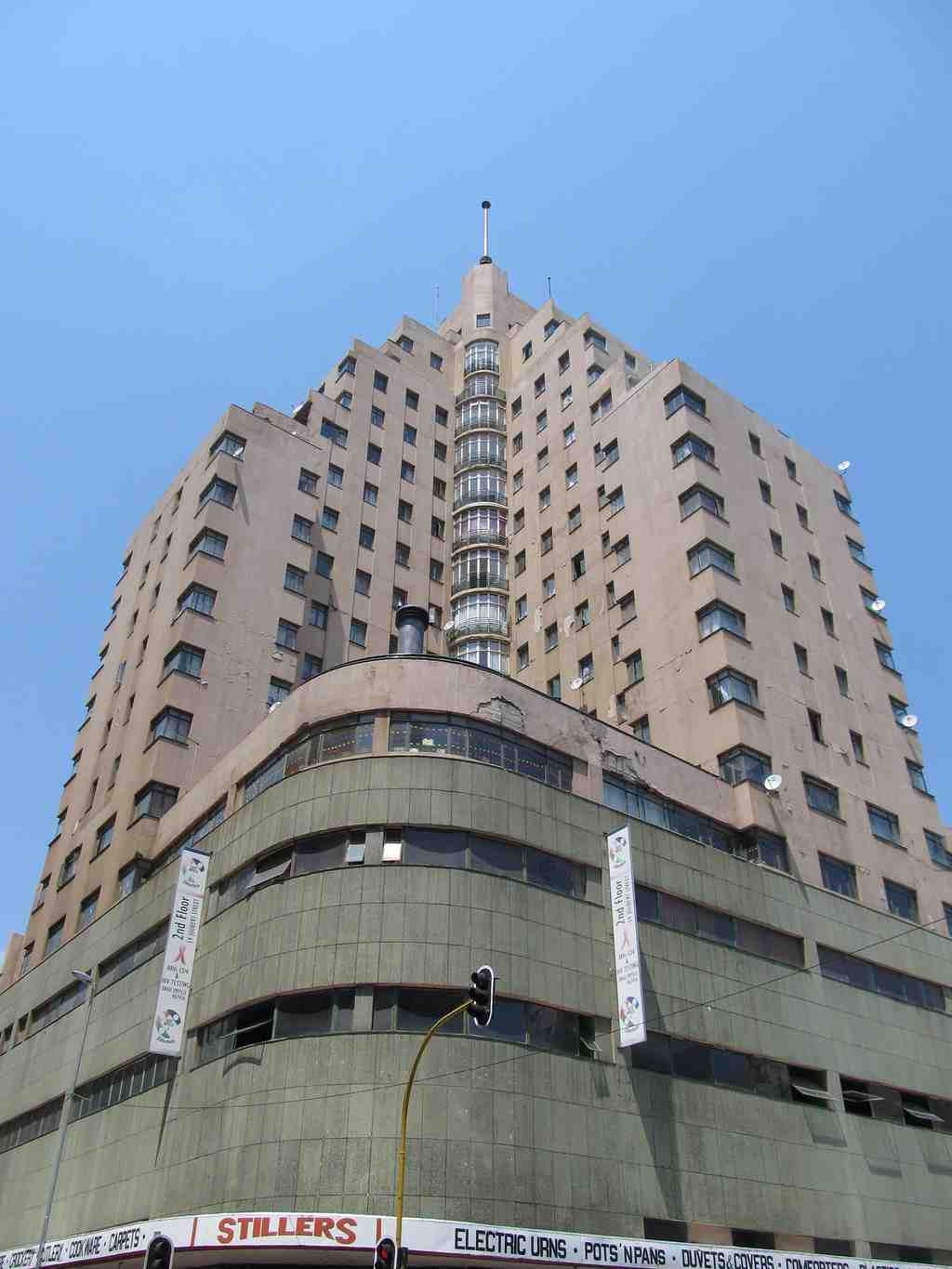
  3. To spot the Ansteys Building, look up for a striking, zigzag-shaped high-rise with elegant curves and bands of windows set above a tall greenish podium right at the busy street…Leggi di piùMostra meno

    To spot the Ansteys Building, look up for a striking, zigzag-shaped high-rise with elegant curves and bands of windows set above a tall greenish podium right at the busy street corner in front of you. Welcome to the Ansteys Building, where Johannesburg’s jazz-age dreams still cling to the skyline! Picture yourself standing here in the heart of the city in the 1930s, just as the building first rose up, its dramatic ziggurat steps and sleek Art Deco curves making every passerby stop and stare. You can almost hear the echo of polished shoes clicking on the tiled pavement, the excited chatter of shoppers looking for the latest fashions behind those wide, gleaming plate-glass windows at street level. Imagine the dazzling displays-bright and bold-to lure everyone inside Norman Anstey’s famous department store, right underneath your feet. Norman Anstey wasn’t just some businessman; he was a local legend, the founder of one of the city’s most beloved shops and even mayor of Johannesburg for a while. His name was stamped right onto the building-it was a sign you’d made it if you shopped or worked here! Now, don’t get confused. Across the road stands the “other” Anstey’s, the second building to bear the mighty name. But the one you’re looking at now, with its two dramatic wings jutting out at right angles, is the third and most iconic. The architects Emley & Williamson pulled out all the stops: look up at those stepped terraces and the bay window balconies on the corners. If you squint, the whole place almost looks like a giant tiered cake, and believe me, every slice has a view. The cylindrical glass tower at the center, shimmering in the sun, was the talk of the town-people wondered if daring superheroes might leap from terrace to terrace. But this building’s life wasn’t all glitz and glamour. In 1989, disaster almost struck-plans were drawn to tear it down! Luckily, a brave architect stood firm and said, “Nope, not on my watch!” Anstey’s survived, and thanks to the efforts of a dedicated Preservation Trust and some very determined city residents, it got a second chance at stardom. Over time, stylish renovations have brought young artists, doctors, and even kids to play in its crèche. Nowadays, its grey-painted exterior and restored Art Deco lobby greet a new crowd chasing their dreams, mixing old Johannesburg grandeur with fresh energy. With every step, you’re touching a building that has more comeback stories than your favorite TV drama-Anstey’s refuses to let go of its place in the city’s heart. Now, shall we go hunt for those legendary window displays, or is that just a trick of the light?

    Apri pagina dedicata →
  4. In front of you, you’ll see a dramatic rocky ridge, sliced by tumbling white waterfalls flowing down reddish cliffs and lush green patches-just look for water cascading from high…Leggi di piùMostra meno

    In front of you, you’ll see a dramatic rocky ridge, sliced by tumbling white waterfalls flowing down reddish cliffs and lush green patches-just look for water cascading from high above. Alright, take a nice deep breath of that fresh, misty air-it’s story time on the legendary Witwatersrand! Imagine yourself standing here millions and millions of years ago, on a deserted ancient landscape. Instead of the city’s distant buzz, you’d hear only the gentle splash of falling water. This ridge, the Witwatersrand, means “white water ridge” in Afrikaans, which makes sense-the cliff faces seem to shimmer under the sunlight as waterfalls tumble and chatter down to the plains below. But believe it or not, these ridges aren’t just pretty to look at. They are made of tough, ancient rock called quartzite, forged nearly three billion years ago! And underneath your shoes runs a 56-kilometre stretch of history and mystery-quite a long walk if you forget your lunch. The Witwatersrand isn’t just old; it’s a superstar of geology. It’s a stony backbone stretching across Johannesburg from Bedfordview all the way to Krugersdorp, standing tall and proud above the Highveld. Picture yourself looking out from this edge-on a good day, you could see all the way to the Magaliesberg mountains, with suburbs like Observatory and Linksfield Ridge sprinkled below. The whole thing forms a natural plateau, like a raised balcony above the plains, more than 1,700 metres above sea level. Did you know the Witwatersrand actually divides the continent? Rain falling on this side might eventually travel out to the Indian Ocean; just a few steps away, it begins a long journey to the Atlantic. Talk about a natural fork in the road! Now, here’s where things get really sparkling-this isn’t just a beautiful ridge, it’s the glittering heart of South Africa’s gold story! Thanks to the stubborn rocks right beneath your feet, the Witwatersrand earned its place in history as the greatest gold field ever found. Since 1886, over 40,000 tonnes of gold-about a fifth of all gold counted across the world-has been fetched from these rocks. That’s enough gold to build a solid-gold city, or perhaps a very fancy set of dentures for every Johannesburg resident. Of course, all that digging created more than riches; it shaped the city and even gave the country’s currency its name: the rand. But not every part of these rocks is golden. The gold comes in streaks, hidden amongst pebbly conglomerates which early prospectors called “banket,” like nature’s own buried treasure chest. Some days miners would strike a rich patch, and other days-well, let’s just say there were plenty of grumpy miners muttering under their breath. And it was right near here, on a quiet farm at Langlaagte, that George Harrison found a sparkling outcrop in 1886. He probably thought he was dealing with alluvial river gold, until they kept finding more, and more, and… well, you get the idea. Soon, the quest for gold stretched across 50 kilometres, with dreams and fortunes rising and falling almost as quickly as those waterfalls. Now for a bit of drama: about two billion years ago-a blink in earth’s eye-a massive meteor thundered out of the sky and slammed into the ground, pretty close to where you’re standing now. It was such a tremendous bang, it created the colossal Vredefort Dome and twisted the rocks into the perfect shape for gold discovery right here. If not for that one cosmic accident, Johannesburg might have just been another grassy hill and you’d have to listen to me talk about… sheep. Lucky for us, right? But there's always a plot twist: all that mining left some unwanted gifts behind. When rainwater seeps through the mine waste, it creates “acid mine drainage,” which means some less-than-friendly chemicals trickle into the soil and water below. If you catch a whiff of anything odd, that’s not Johannesburg’s famous curry-it's science, unfortunately! So, as you gaze up at these cliffs and listen to the song of the water, remember: under your feet lies a whole world-away story. From ancient seas and roaring rivers, to gold rushes and star-shaking meteors, the Witwatersrand has shaped the fortunes and faces of this city. And just think-next time you see a shiny rand coin in your pocket, you’ll know where it got its sparkle!

    Apri pagina dedicata →
  5. You’re standing in front of the Kine Centre-look up and let your neck do some exercise! This towering modern skyscraper is a real show-off at 123 meters tall, with 25 floors…Leggi di piùMostra meno

    You’re standing in front of the Kine Centre-look up and let your neck do some exercise! This towering modern skyscraper is a real show-off at 123 meters tall, with 25 floors stretching high above the Johannesburg streets. But believe it or not, there’s a story underneath your feet, too. This ground once rumbled with applause and echoed with laughter from the Empire Theatre. Imagine it: velvet seats, golden lights, the smell of popcorn, and performers nervously peeking from behind the red curtains. In April 1971, the curtain fell for the last time, and soon the roar of bulldozers replaced the applause. But, like any good drama, a new act began when the Schlesinger Corporation built the Kine Centre in 1974-a glittering palace for both business and pleasure. Offices? Check. Giant stores? Check. And, of course, the crown jewel: a mega cinema complex that could seat 2,500 people across ten screens! The place was a popcorn paradise until the projectors went silent in 2004. Still, legend whispers about the famous penthouse up top-did movie stars party there, looking down on the city lights? Here’s a little twist: this building has its own secret tunnel, leading right to the Carlton Centre. Who knows who hurried through it-office workers or moviegoers on a mission to buy more popcorn? So, whether you’re smelling ghosts of popcorn or just fresh city air, remember, you're standing on a stage where every floor has a story.

    Apri pagina dedicata →
  6. To spot the Johannesburg Sun Hotel, just look straight ahead for two connected glassy towers rising tall above the busy street, wrapped in a shell of deep blue-green…Leggi di piùMostra meno

    To spot the Johannesburg Sun Hotel, just look straight ahead for two connected glassy towers rising tall above the busy street, wrapped in a shell of deep blue-green windows. Now, picture yourself standing before what used to be one of Johannesburg’s grandest hotels-these twin towers once sparkled with luxury. Back in 1970, the smaller rear building was known as The Tollman Towers, run by the famous Stanley Tollman. But things went big in the 1980s when hotel mogul Sol Kerzner took over-he poured R100 million into transforming the entire site, adding the massive 40-storey front tower and connecting them with a podium complete with a pool deck and even a running track! Imagine the splash of swimmers and the sound of shoes pounding the track high above Johannesburg. By 1985, the Johannesburg Sun and Towers had 672 plush rooms, dazzling the city’s elite. But as the neighborhood’s fortunes faded, the glamour slipped away. The giant hotel became a modest Holiday Inn, then finally closed its doors in 1998, creaking quietly in the night. For a brief moment, the building woke up during the 2002 Earth Summit, hosting thousands of police officers-but the good times didn’t last. There were wild tales: a murder, system failures, and desperate guests stranded by broken elevators. Afterward, silence returned and today, the once-buzzing towers stand empty, a ghostly palace keeping the stories of wild parties and quieter mysteries locked inside.

    Apri pagina dedicata →
  7. Right in front of you stands a tall, bold skyscraper with narrow stripes running from top to bottom, towering over everything around it-just look up and you can’t miss the Marble…Leggi di piùMostra meno

    Right in front of you stands a tall, bold skyscraper with narrow stripes running from top to bottom, towering over everything around it-just look up and you can’t miss the Marble Towers at the busy corner of Jeppe and Von Wielligh Streets. Now, let’s rewind to 1973. The world was grooving to funky music, bell-bottom jeans were all the rage, and Johannesburg was eager to show off its own glitzy star-the Marble Towers. Built from a mix of hardy concrete and swanky marble, this 32-storey giant sprouted up to become one of the highest points in the city’s skyline. Imagine office workers racing up and down those gleaming marble-floored lobbies, the clack of their shoes echoing like a corporate stampede. Down below, the eight-storey parking garage would welcome a never-ending parade of cars-at least, if you could squeeze your vehicle in before someone else stole your spot! Back then, folks called it the Sanlam Centre, and it was Johannesburg’s answer to New York skyscrapers-a symbol of ambition in the heart of the bustling Central Business District. Even today, you might hear stories whispered about business deals made behind those high-up windows, or maybe mysterious lights on late nights as cleaners swap their own tales. With its bold stripes and marble face, the Marble Towers is more than just a building-it’s a monument to the city’s dreams, grit, and maybe, just a tiny bit of 1970s swagger.

    Apri pagina dedicata →

Domande frequenti

Come inizio il tour?

Dopo l'acquisto, scarica l'app AudaTours e inserisci il tuo codice di riscatto. Il tour sarà pronto per partire immediatamente – tocca play e segui il percorso guidato dal GPS.

Ho bisogno di internet durante il tour?

No! Scarica il tour prima di iniziare e goditelo completamente offline. Solo la funzione chat richiede internet. Ti consigliamo di scaricare tramite WiFi per risparmiare dati mobili.

È un tour guidato di gruppo?

No – è un tour audio autoguidato. Esplori in autonomia al tuo ritmo, con la narrazione audio riprodotta dal tuo telefono. Nessuna guida, nessun gruppo, nessun orario.

Quanto dura il tour?

La maggior parte dei tour richiede 60–90 minuti, ma sei tu a controllare il ritmo. Metti in pausa, salta le tappe o fai pause quando vuoi.

E se non riesco a finire il tour oggi?

Nessun problema! I tour hanno accesso a vita. Metti in pausa e riprendi quando vuoi – domani, la prossima settimana o il prossimo anno. I tuoi progressi vengono salvati.

Quali lingue sono disponibili?

Tutti i tour sono disponibili in oltre 50 lingue. Seleziona la lingua preferita quando riscatti il codice. Nota: la lingua non può essere cambiata dopo la generazione del tour.

Dove accedo al tour dopo l'acquisto?

Scarica l'app gratuita AudaTours dall'App Store o Google Play. Inserisci il codice di riscatto (inviato via email) e il tour apparirà nella tua libreria, pronto per essere scaricato e avviato.

verified_user
Soddisfazione garantita

Se il tour non ti piace, ti rimborseremo l'acquisto. Contattaci a [email protected]

Pagamento sicuro con

Apple PayGoogle PayVisaMastercardPayPal

AudaTours: Tour Audio

Tour a piedi autoguidati, coinvolgenti e convenienti

Prova l'app arrow_forward

Amato dai viaggiatori di tutto il mondo

format_quote Questo tour è stato un ottimo modo per vedere la città. Le storie erano interessanti senza sembrare troppo scriptate, e mi è piaciuto poter esplorare al mio ritmo.
Jess
Jess
starstarstarstarstar
Tour Tbilisi arrow_forward
format_quote Un ottimo modo per conoscere Brighton senza sentirsi un turista. La narrazione aveva profondità e contesto, senza esagerare.
Christoph
Christoph
starstarstarstarstar
Tour Brighton arrow_forward
format_quote Ho iniziato questo tour con un cornetto in mano e zero aspettative. L'app ti accompagna tranquillamente, niente pressione, solo tu, le tue cuffie e delle storie interessanti.
John
John
starstarstarstarstar
Tour Marseille arrow_forward

Tour Audio Illimitati

Sblocca l'accesso a OGNI tour nel mondo

0 tour·0 città·0 paesi
all_inclusive Esplora Illimitato