
Tour Audio di Trapani: Echi di Palazzi, Chiese e Antichi Sussurri
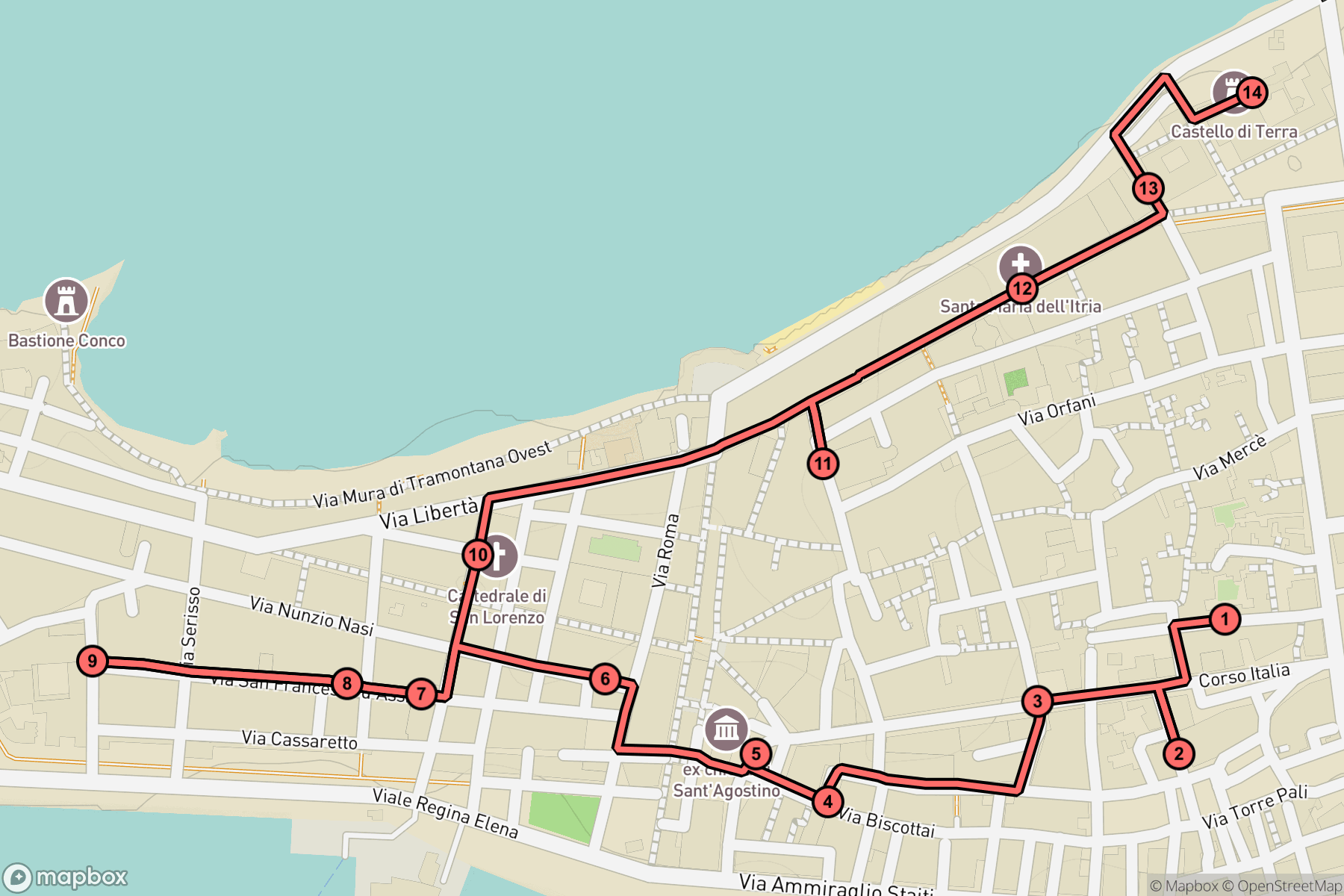
Una campana spettrale di una cattedrale un tempo avvertiva Trapani degli invasori prima di fondersi nella leggenda sotto i tramonti siciliani. Eppure non tutti i segreti della città risuonano così forte — alcuni si nascondono in antiche sale e cortili dove il tempo stesso sembra indugiare. Partecipa a questo tour audio autoguidato e crea il tuo percorso attraverso le intricate strade di Trapani. Ascolta intrighi sussurrati e storie perdute che la maggior parte dei viaggiatori non imparerà mai. Quale monaco ribelle fu cacciato attraverso le ombre del santuario di San Lorenzo? Quale opera d'arte scomparsa scatenò uno scandalo secolare all'interno della Salerniana? Dove un'iscrizione misteriosa in San Francesco ancora oggi incuriosisce anche gli storici più audaci? Supera colonne dipinte e pietre consumate. Segui la scia di potere, perdita e bellezza. Ogni passo ti avvicina al cuore più intimo della città, che respira storie dimenticate. Lascia che il mondo nascosto di Trapani si riveli. Premi play ed entra nella leggenda.
Anteprima del tour
Informazioni su questo tour
- scheduleDurata 40–60 minsVai al tuo ritmo
- straighten2.6 km di percorso a piediSegui il percorso guidato
- location_on
- wifi_offFunziona offlineScarica una volta, usa ovunque
- all_inclusiveAccesso a vitaRiascolta quando vuoi, per sempre
- location_onParte da Palazzo della Giudecca
Tappe di questo tour
Look up along Via Giudecca and spot the palace with striking, diamond-shaped stones on its outer walls and a tall, fortress-like tower-trust me, it’s hard to miss! Now, let’s…Leggi di piùMostra meno
Look up along Via Giudecca and spot the palace with striking, diamond-shaped stones on its outer walls and a tall, fortress-like tower-trust me, it’s hard to miss! Now, let’s step back in time together: Imagine the year is somewhere near 1400, and the city is buzzing with the sounds of merchants, traders, and the chatter of the Jewish community in this very quarter. The Giudecca Palace, towering above you with its fierce, jagged stones, was built by the wealthy Sala banking family-a place every passerby would admire and maybe, just maybe, envy a little! But its walls weren’t just for show. Around 1485, inside this palace you’d find some of the brightest minds, debating and dreaming in a Jewish school of higher learning. If you’re really quiet, maybe you can still hear the echo of their discussions carried by the wind! Then came a twist of fate in 1492: with the expulsion of the Jews, the grand house passed to the Ciambra family, who decided to give it a new look-diamond-pointed masonry, both tough enough to impress and fancy enough to outshine the neighbors, inspired by some of Italy’s most spectacular buildings. And here’s a secret: see that tower? Locals say it’s one of the five stars from Trapani’s own city crest! Today, inside waits a garden, a well, and a staircase so precious it’s been protected since 1939. And while part of the palace is still a private home, it’s all waiting to share its secrets… if you know how to look!
Apri pagina dedicata →To spot the Church of San Pietro, just look for the big, pale yellow church with a rounded apse and a grand dome rising above the surrounding buildings-it's right in front of you,…Leggi di piùMostra meno
To spot the Church of San Pietro, just look for the big, pale yellow church with a rounded apse and a grand dome rising above the surrounding buildings-it's right in front of you, dominating this little square of Trapani! Now, let’s step back-way back-to the days when this spot was just a bunch of rocks and echoes. Imagine you’re standing in ancient Trapani, where the air hums with the sounds of bustling markets and distant waves. The curious thing about San Pietro’s church is, well, it’s like the “Doctor Who” of churches: it’s had more lives than you might count! Legend says this was Trapani’s very first Christian church, built over a pagan temple, right after the apostle Saint Peter himself supposedly wandered through. Picture people sneaking in at dusk to whisper prayers where secrets to both Roman gods and a brand new faith hung in the air. Fast forward to the Norman age-the year is 1076, and Count Roger I of Sicily (who probably had an epic beard) decides this little church needs an upgrade! Under his watchful eye, the church grew grander, even earning the grand-sounding title of “arcipretale insigne collegiata.” Try saying that three times fast! But wait, there’s more: in the 1200s, Trapani’s people stuck by the Aragonese during the Sicilian Vespers-a move that paid off when King Peter III of Aragon came here and swore, inside these very walls, to keep the city’s privileges safe. Just imagine the cheers echoing off the stones as his promise rang out. In 1535, the drama dialed up another notch when Emperor Charles V himself swept in after his victorious campaign in Tunis. He entered the church in a flurry of capes and trumpets, bearing a dazzling banner stolen from the Turkish-Ottoman armies as a thank-you gift to Trapani. That’s right-San Pietro didn’t just see history; it stole the show! Over the next centuries, royals and rulers couldn’t seem to stay away. Vittorio Amedeo II of Savoy popped in shortly after he became King of Sicily, and in 1726 the church was consecrated in a celebration so rich, you might have smelled the incense from blocks away. And do you know what makes this church unique in Trapani? Five naves! Not three, not four, but five-like a cathedral trying to outdo itself at a church talent contest. But history isn’t always easy. The church was battered by bombs in World War II and shaken hard by the earthquake of 1968. For years, it stood silent, its grand organ quiet, its naves empty. It wasn’t until the 1990s that it finally reopened, doors wide, welcoming back the curious and the faithful. The building you see is full of surprises. The west-facing façade is set with several doors, and if you look up at the main portal, flanked by iconic columns and topped with an interrupted pediment, you’ll catch a statue of the Madonna with Child-locals call her “Madonna del Cardello.” Underneath her feet? The symbol of Saint Peter’s triple crown and keys, ready to unlock a hundred stories. As you circle the outside, spot the campanile tower, like a watchful guardian, and the dome rising high-restored and newly lit in 2021 after years in the shade. Inside, the five-naved basilica is held up by fourteen columns and just as many robust pillars-a forest of stone. The organ here is legendary: Trapani’s pride, it’s said to be the second most imposing pipe organ in the world! It was built between 1836 and 1847, capable of imitating every instrument from violins to bagpipes (and maybe, if you close your eyes, the voice of old Roger I telling everyone to move those stones just a bit to the left). And every stone you see, every artwork-paintings by Carrera, statues by Ciotta and Milanti, side chapels bursting with color-tells of Trapani’s craftsmen, its rulers, its faithful, and even its stubbornness to stick to tradition. For centuries, the church rivaled others for the city’s bishop’s seat, always fighting to be Trapani’s heart. So as you stand here, beneath the gaze of the dome and the ghosts of emperors, kings, and apostles, you’re not just seeing a building. You’re stepping into a swirling story of faith, glory, survival, and more than a dash of Sicilian flair. And if you listen closely, you might just catch the faintest hint of organ notes echoing through the past, carrying secrets that only San Pietro itself truly knows. Yearning to grasp further insights on the external, internal or the pipe organ? Dive into the chat section below and ask away.
Apri pagina dedicata →Look ahead for a massive, sturdy stone fortress with rugged walls and a tall, reddish brick tower-an impressive relic rising behind a black iron gate, just off the…Leggi di piùMostra meno
Look ahead for a massive, sturdy stone fortress with rugged walls and a tall, reddish brick tower-an impressive relic rising behind a black iron gate, just off the waterfront. Here you stand in front of the legendary Castle of Land, or as the locals call it, Castello di Terra. Imagine the hum of medieval life all around you-this fortress was born in the 1100s, right on the bones of an ancient Carthaginian stronghold built by a fellow named Amilcare (think ancient generals and even older secrets packed into these walls!). Picture waves lapsing behind you as knights keep a sharp eye out, guarding the mouth of the canal that once joined the wild Tyrrhenian Sea to Trapani’s busy port. As you gaze at those solid walls with their mighty half-round and rectangular towers, know that in the late 1200s, Giacomo II of Aragon thought this place needed even more muscle, so he bulked it up-probably fearing a bit of medieval muscle envy from his rivals across the port. Flash forward to the 1800s: soldiers march in and out as the castle is turned into a bustling army barracks by the Bourbons. But, alas, time is a bit of a prankster-in the 1970s, parts of the castle were knocked down to make way for police offices. Yet, like a stubborn ghost, the northwest facade endures. In 1992, the city dusted off its secret corners with a bit of restoration and archaeology. So while you soak it all in, remember: you’re standing where centuries of warriors, kings, and townsfolk have all tried (and failed!) to tame Trapani’s wild spirit.
Apri pagina dedicata →
Mostra altre 10 tappeMostra meno tappeexpand_moreexpand_less
To spot the D’Alì Palace, look for a grand, yellow building with smooth stonework, sweeping arches around tall windows, and a huge central doorway topped by a balcony-it’s right…Leggi di piùMostra meno
To spot the D’Alì Palace, look for a grand, yellow building with smooth stonework, sweeping arches around tall windows, and a huge central doorway topped by a balcony-it’s right there in front of you. Now, picture yourself in Trapani in the late 1800s. Smell the fresh sea air drifting off the harbor as the D’Alì family is hard at work constructing a palace fit for Sicilian royalty-between 1876 and 1904, no less! They didn’t hold back on style: this place sports a stunning façade with crisp stone blocks, majestic arched windows, and elegant balconies perfect for a secret wave to folks down below. If you’d stepped inside back then, you might have seen painters up on ladders, adding swirls of neoclassical art to the ceilings, or heard the echoes of footsteps on the palace’s grand staircase. Fast forward to 1944, though, and imagine the intrigue: after years of private noble life, the city snapped up the palace. Suddenly, it became the pulsing heart of Trapani’s leadership-council meetings by day, maybe a little bit of scheming at night (but if these walls could talk, right?). These days, it’s still the mayor’s headquarters, and if you think it looks familiar, it even made an appearance in the TV miniseries "Maltese." So go ahead, give the palace your best detective squint-you’re standing in the shadow of more than a century of secrets, drama, and quite possibly, a little bit of grand Sicilian flair!
Apri pagina dedicata →To spot the Church of Santa Maria dell’Itria, look ahead for an ornate, weathered façade packed with tall Corinthian columns and an arched doorway, topped by sculpted details and…Leggi di piùMostra meno
To spot the Church of Santa Maria dell’Itria, look ahead for an ornate, weathered façade packed with tall Corinthian columns and an arched doorway, topped by sculpted details and a greenish metal door that all seem to whisper stories from centuries past. Now, pause right where you are and allow your senses to travel back in time - we’re about to step into one of Trapani’s most captivating tales. The Church of Santa Maria dell’Itria, sometimes cheekily called Santa Rita by locals because of the devotion to Saint Rita of Cascia and the relics of venerable Fra Santo di San Domenico, stands like an elaborate gatekeeper between past and present. Imagine the feeling of footsteps echoing off stone as you walk along Via Garibaldi and see the dramatic baroque façade rising before you. Its history? Oh, it’s as layered as a good lasagna. The story starts in 1621, during Spanish rule, when the barefoot Augustinian monks decided they needed a home. They teamed up with the Confraternity of Santa Maria dell’Itria, who already had a church here, and set out to build not just a church, but a whole convent. But just three years later, in 1624, catastrophe struck Trapani - a deadly plague swept through the city like a shadow across cobblestones. Inside these very walls, the monastery’s peaceful life was shattered as all but one of the eighteen friars fell to the illness. Imagine the silence and the creak of the door at night, knowing you might be the last brother left. You could joke, “The Grim Reaper must’ve liked the Augustinians best - he took almost all of them!” Years later, the church rose again with even more splendor. On January 29th, 1687, Bishop Bartolomeo Castelli held a grand consecration - picture crowds in candlelit processions, their prayers spiraling skyward as the church stood strong once more. But don’t get too attached to the statues you see in old pictures - the façade, designed by Pietro Castro in 1745, originally had four statues in its niches, representing the first canonized Augustinian saints. During a 19th-century sprucing-up in 1827, those statues were knocked down faster than you can say “restoration mistake.” Step inside in your imagination, and you’re greeted by richly decorated chapels on both sides of the nave. To the right, you’ll find paintings by the legendary Giuseppe Felice, and the martyred remains of saints quietly resting beneath altars. You might even sense a chill at the idea of such relics so close by - or maybe that’s just the drafty Sicilian air. One chapel tells the story of Mary Odigitria, another shows the purity of the Immaculate Conception, and yet another is dedicated to Saint Augustine himself, with heartfelt paintings above and martyred holy men below. To the left, you’ll see depictions of the Archangel Raphael guiding young Tobias, a powerful crucifix framed by giant reliquaries, and the Ecstasy of Saint Nicholas of Tolentino. Let’s not forget the high altar: marble crafted by Neapolitan artisans, statues of the holy family by local master Andrea Tipa - and, in a room nearby, the scent of old cypress and walnut from a grand sacristy wardrobe. Here’s where you’d find a huge painting by Domenico La Bruna, showing God gently handing the Baby Jesus to Mary and Joseph. After 1861, the attached convent changed hands, thanks to state confiscation. If you hear voices reciting math equations or scientific formulas, it’s probably just the students of the Vincenzo Fardella High School, which moved in in 1923. There’s even an oratory here, home to paintings of Mary’s life and mysteries so captivating you might just imagine the artists hunched over canvases, candles burning low, shaping the church’s secrets for the next generation. And after all that, the Confraternity of Santa Maria dell’Itria still calls this place home. So whether you’re a saint-seeker, an art lover, or just someone who enjoys a good ghost story, this church has it all. Just beware: history loves to linger in the marble and among the shadows. Curious about the external, internal or the works? Don't hesitate to reach out in the chat section for additional details.
Apri pagina dedicata →Now, close your eyes-just not for too long, I don’t want you bumping into any columns-and let’s step back in time. It all begins in the year 536, right when the Byzantine general…Leggi di piùMostra meno
Now, close your eyes-just not for too long, I don’t want you bumping into any columns-and let’s step back in time. It all begins in the year 536, right when the Byzantine general Belisarius was galloping across Sicily on behalf of Emperor Justinian. Imagine the salty Mediterranean wind swirling as workers lay the foundations for a church dedicated to the Ascension of Our Lord. Why here? Well, the spot was once home to a temple of Neptune. From sea gods to saints-they really know how to recycle their real estate in Trapani! After changing hands and heart several times, the church was eventually rededicated to Santa Maria dei Greci. Fast forward to the flashy whirlwind of the 14th century, and in comes the Chiaramonte family, Trapani’s own local bigshots. They didn’t just add a splash of paint-they rebuilt and restored the building, dedicating it to Saint Nicholas, making it their private palatine chapel. But power and fortune are slippery fish, and after the Chiaramonte’s bad luck with politics, the chapel was handed over to the city itself. Let’s cue the Spanish era, with dramatic entrances from emperors and pirates alike. In 1535, Emperor Charles V, fresh back from bashing pirates in Tunis, stopped over in Trapani and stayed right next door. As an imperial thank you, he gifted the church a marble basin-taken straight from his loot-a little something to remember him by, now used for baptisms. You could say it’s the only baptismal font in Sicily with a “Made in Tunisia” sticker. The basilica’s history is as dramatic as a Sicilian opera. From 1558, it’s officially a “protobasilica”-think of it as being promoted from the minor leagues to the major leagues of churches. In 1564, as pirates were prowling the Tyrrhenian Sea, the statue of the Madonna of Trapani sought sanctuary behind these very walls. Picture it: candles flickering, prayers whispered, hearts pounding with the fear of pirate raids just beyond the horizon. By 1620, San Nicolò is the city’s mother church. Centuries pass, and so do waves of craftsmen, with architect Giovanni Biagio Amico giving the place a baroque facelift in the 18th century. Any church that stands still in Sicily is bound to get a few touch-ups, especially one that aims to be crowned Trapani’s cathedral. Not without drama-rivalries, petitions, and resistance from the Bishop in Mazara del Vallo made this a race worthy of any reality show. After much squabbling (and perhaps a few panicked prayers), the Cathedral title finally went to San Lorenzo, but San Nicolò never lost its shine. Now, gaze at the façade: clean plaster, vertical ribs, and the portal facing west, framed by soaring columns sat on high plinths, and topped with a broken pediment. Peep around the south and you’ll see another beautiful doorway, brackets and curls and an elegant marble bust of Saint Nicholas himself peeking out from his niche. Oh, and if anyone asks, the little battlements up top aren’t just decorative-they once rang out over the city, calling people to prayer and maybe warning of stray pirates. Inside, it’s a cross-shaped masterpiece-three aisles, eleven altars, and five stretches on each side. The very air shimmers under a dome dressed in honeycomb hexagons. There’s a baptismal font, right at the entrance: a block of “African granitello” straight from the spoils of Tunis, given by Charles V. You can almost hear royal footsteps echoing and the creak of wrought-iron gates. Wander down the right aisle and you’ll find paintings of saints and martyrs who seem to step right off the canvas. The left aisle has its own treasures: the Madonna di Trapani with Sant’Alberto degli Abati, the hermit Saint Onofrio receiving communion from an angel, and great, sweeping paintings of the Immaculate Conception. In the apse, lift your eyes to the marble “cona” from 1560, Jesus risen, between Saint Peter and Saint Nicholas-crafted by Giacomo Gagini, who had a habit of making marble do as he pleased. And beneath your feet, secret crypts and catacombs, where clergy have lain for centuries. After withstanding earthquakes, rivalries, and the slow march of time, San Nicolò was lovingly restored in 2006. Today it opens its doors to worshippers and wanderers alike-like you!-carrying the stories of emperors, pirates, and pilgrims in every stone. Isn’t it amazing how one building can outlast so much squabbling and drama and still look simply divine? If you're keen on discovering more about the external, internal or the sacristy, head down to the chat section and engage with me.
Apri pagina dedicata →You’re looking for a stately building with pale yellow walls, tall shuttered windows, and a row of grand arches with columns at ground level-just lift your gaze to the sign that…Leggi di piùMostra meno
You’re looking for a stately building with pale yellow walls, tall shuttered windows, and a row of grand arches with columns at ground level-just lift your gaze to the sign that says “Biblioteca Fardelliana” to spot it! Alright, traveler-pause right here and get ready to step into the world of stories, secrets, and the scent of old parchment! Behind those elegant arches lies the Fardelliana Library, a hidden gem with a history as gripping as any swashbuckling novel. Imagine the year is 1830. Trapani is buzzing with the energy of the times, and Giovanbattista Fardella, a local noble who also happened to be the Minister of War in the Kingdom of the Two Sicilies, had a dream. But instead of collecting battle trophies, he decided to gather books-lots of them! He donated his massive personal collection and, with historian Giuseppe Di Ferro, flung open the doors for the curious folks of Trapani. Their library started off in a grand palace, but after 1860, it found a peculiar new home: the old church of San Giacomo Maggiore. Can you picture the knights of the Order of Santiago, who built this church in the 1200s, stomping around in armor, stone echoing under heavy boots? Centuries later, by the 1700s, the great architect Giovanni Biagio Amico had Jazzed things up with some renovations-I’m sure even the saints were impressed! As you stand outside, imagine the hush of old prayers mixing with the whispers of scholars searching through thick books inside. And get this-the majestic columns you’d spot in the “Sala Fardella” hall weren’t always here… they were salvaged from the church of San Rocco before it vanished, making them the last physical trace of Trapani’s Arab past. Now that's recycling with style! Step inside in your mind: the library’s shelves groan under the weight of more than 170,000 books and ancient manuscripts. You can almost feel the presence of history itself: illuminated tomes, centuries-old city senate documents, and the first-ever printed texts, like a rare 1467 Augustine! And let’s not forget the echoes of the big names in Trapani’s history-famous letters, secret missives, and forgotten musical scores. Fardelliana even tried its hand at publishing-imagine a magazine so wise, it only comes out three times a year! Good news travels slow, right? And the library survived the tides of history and renovation, including a million-euro upgrade, to become the treasure chest of Trapani’s knowledge and culture. So, as you stand here, let the walls whisper to you, inviting you to picture all the stories waiting in this grand home of books-even if they don’t let you borrow a suit of armor to go with your reading!
Apri pagina dedicata →Look for a sand-colored building with a dramatic triangular roof and a mesmerizing, gigantic rose window featuring intricate stonework right above a gothic doorway-you really…Leggi di piùMostra meno
Look for a sand-colored building with a dramatic triangular roof and a mesmerizing, gigantic rose window featuring intricate stonework right above a gothic doorway-you really can’t miss that beautiful carved circle straight ahead! Now, as you stand before the Church of Sant’Agostino, imagine yourself stepping into a time machine set for a thousand years back, right into the heart of medieval Trapani. Beneath your feet, knights in chainmail marched past with clinking swords, because this church was built way back in 1101 as a chapel for none other than the Knights Templar, the superstar warriors of the Crusades! Just picture them gathering here, probably arguing about who gets the best seat before heading out on their legendary quests. Then came the Knights Hospitaller, who took over this sacred spot, filling the little church with prayers... and maybe a few grumbles about cleaning up after the Templars. Fast forward a couple of centuries and-whoosh!-the Augustinians arrive, waving their Gothic blueprints around and expanding the church to majestic proportions. They made this the mother church of Trapani. Talk about moving up in the world! But the drama wasn’t over-oh no. In the 1500s, this very place became the church of the city Senate. Imagine fancy robes, big decisions, and, just for one shining August day in 1535, a royal visit! Emperor Charles V himself swore an oath right here, surrounded by the clatter of armor and the cheers of townsfolk as he returned, victorious from Africa, with 20,000 freed Christian slaves. The excitement must have shaken these medieval stones! But time, as always, brings change-and chaos! The church closed its doors to worship in the 1800s, transformed and battered, especially during World War II when bombs roared overhead and destroyed part of the nave and apse. But Trapani’s spirit is stubborn-after the war, the church was lovingly rebuilt, its grand rose window restored to its former glory, and the gothic Madonna and Child by Gagini still blesses those who pass beneath. Today, you’re standing before a masterpiece of intertwined religions and cultures-if you squint, you’ll spot Arab, Jewish, and Christian symbols woven into the rose window, telling a tale of Trapani’s ever-changing spirit. And the adventure continues inside: now this is a diocesan museum, filled with treasures rescued from time’s tide. Once a courtroom for faith and power, now a house of stories, just waiting for you to uncover them!
Apri pagina dedicata →Look up and you’ll spot Riccio Palace by its extravagant, curve-wrapped baroque balcony and the sculpted faces glaring down as if they’re judging your taste in gelato. Alright,…Leggi di piùMostra meno
Look up and you’ll spot Riccio Palace by its extravagant, curve-wrapped baroque balcony and the sculpted faces glaring down as if they’re judging your taste in gelato. Alright, storytime! Imagine you’re standing here in the heart of Trapani during the wild 1400s. This grand palace started as a stately home, but like any good aristocrat, it’s had more “work done” than a celebrity at a new season launch. In the 1500s, the Rua Grande was the place to be seen, so the Riccio family dressed up their doorway with a Catalan arch to impress other nobles passing by. The palace got even fancier in the 1600s with that huge baroque balcony looming overhead-rumor has it the barons wanted visitors to feel extra small and awestruck as they entered! The real magic happened in the 1700s. Master architect Andrea Giganti came along and couldn’t resist going all out with swirling balconies that seem ready to burst into song (or maybe into a fencing match!). See those iron railings? Don’t lean too far-legend says if you whisper your best secret to the balcony, one of the sculpted faces will keep it safe (or gossip to the next visitor, so choose wisely!). Now, if you could peek inside, you’d find a courtyard with arches stretching like raised eyebrows-a hint that lots of Trapani’s juiciest secrets were traded under those porticoes. Each balcony above was custom-made with swirly “goose-breast” grilles and fat stone brackets, each one hollering, “Look how rich I am!” The Riccio family stashed trophies and crests everywhere, just in case anyone forgot who was boss. After surviving both barons and bombers-World War II gave it quite a scare-the palace became a place for school kids instead of nobles. So if you hear echoes of laughter, that’s not ghosts, just modern students plotting their math homework. From drama, to grandeur, to math tests-Riccio Palace has seen it all! Ready for our next stop?
Apri pagina dedicata →To spot the Cathedral of San Lorenzo, just look for a grand, cream-colored baroque façade with three tall arches at ground level, topped by elegant balconies and a curved upper…Leggi di piùMostra meno
To spot the Cathedral of San Lorenzo, just look for a grand, cream-colored baroque façade with three tall arches at ground level, topped by elegant balconies and a curved upper section, with a bell tower-plus, you can't miss the crowd and the impressive entrance right ahead! Now, imagine yourself standing in the very heart of Trapani’s old town, breathing in the gentle sea air and gazing up at this stunning cathedral. The Cathedral of San Lorenzo isn’t just a church-it’s Trapani’s own time machine! So, keep your eyes on those curved edges, the ornate portico, and that signature bell tower gleaming with colorful tiles, while I weave you a tale that stretches back nearly a thousand years. It all began with the Normans, back in 1102-think chainmail, swords, and, well, an unusually strong love for organizing chapels. Picture a rather bustling medieval neighborhood, with Genovese traders hauling crates of spices and silks off their ships and straight to this spot. Their “Cappella di San Giorgio” wasn’t just a church; it was a heartbeat for this multicultural seafaring crowd and an ally to the mighty Count Roger in his struggle to free Sicily from Arab rule. Jump ahead to 1280-now, under the Aragonese, Trapani’s districts were redrawn and rechristened with the names of saints, including, you guessed it, San Lorenzo, thanks to the grand new parishes cropping up. By 1434, in the Age of Kings and Magnanimous Decrees, the church was elevated to parish status by none other than Alfonso the Magnanimous, with wealthy families kicking off the first expansions-imagine the Vento family poring over blueprints for a shiny new chapel to honor St. Stephen. It pays to have philanthropists in the pews! Tragedy almost struck in the Spanish era, around 1600, when the structure appeared ready to crumble. But don’t panic! The faithful-never short on determination (and donations)-got busy with major restorations and the first grand basilica design, courtesy of a Franciscan architect named Bonaventura Certo. Soon enough, the façade and famous abside took shape. Here comes the drama of the Bourbon period: the church was officially consecrated in 1705, and what a party that must have been! By 1740, a total baroque makeover, led by Giovanni Biagio Amico, gave the cathedral its iconic look-marvel at those three arches of the portico, the curving lines above, and the bell tower gleaming in the sun. Imagine the hammering and sawing as artists sculpted angels, painted intricate frescos, and hoisted a brand new, dazzling dome into the skyline. The interior blossomed with marble, elegant pulpits, vibrant stucchi, angels taking flight, and-here’s a special touch-a depiction of the name of God written in Hebrew right above the central altar. The 1800s brought some tension-who would be the “mother church” of Trapani? After some spirited debate (and maybe just a little ecclesiastical side-eye), an official decree settled it: San Lorenzo reigned supreme as cathedral when Trapani became a diocese in 1844. Then, in 1940, the government gave the building monument status, making it an official treasure. Step inside, and you’ll find three sweeping aisles divided by towering tuscan columns, their arches soaring above. To your right, each chapel brims with masterpieces-like the moving “Martyrdom of St. Lawrence” and even a painting by Antoon van Dyck, who surely stopped by for the cannoli. The left side features saints, madonnas, and a “Deposizione dalla Croce” inspired by Rubens himself. Don’t forget to look up-there’s a grand dome ringed by cupolas, sending sunlight cascading in as if the heavens are giving you a gentle wink. The air is filled with the sounds of not one, but two grand organs-one modern, one classic-sometimes dueling, sometimes singing together, always filling the space with the music of centuries. So, as you stand here, you’re surrounded by echoes of traders, noble families, artists, and clergy whose ambition and faith shaped Trapani’s skyline. You’re looking at more than a building: you’re witnessing a thousand years of passion, invention, and a rather spectacular taste in domes. Ready to continue our adventure? The next tale awaits-just a stone’s throw from here! Exploring the realm of the description, bishop's palace or the image gallery? Feel free to consult the chat section for additional information.
Apri pagina dedicata →To spot the Church of the Souls of Purgatory, just look for the grand cream-colored facade with rows of impressive stone statues and a beautiful green-tiled dome gleaming above…Leggi di piùMostra meno
To spot the Church of the Souls of Purgatory, just look for the grand cream-colored facade with rows of impressive stone statues and a beautiful green-tiled dome gleaming above Piazza Purgatorio. Take a deep breath and let your senses drift back in time. You’re now standing before the Church of the Souls of Purgatory, one of Trapani’s most fascinating treasures. Imagine the year is 1688. Workers are chiseling stone and carrying statues through busy streets--under the guidance of Don Pietro Castro. But the magic touch on this facade, the part that makes you stop and stare, came in 1712 from the creative hands of Giovanni Biagio Amico. Fun fact: Amico loved this church so much, he chose it as his final resting place! You can even find his commemorative marble plaque inside, next to the sacristy. Now lift your gaze-see those twelve figures standing guard above you? They’re the apostles and Jesus himself, all sculpted by Alberto Orlando. If you feel like they’re watching you, don’t worry-you’d have to try pretty hard to sneak past the apostles! The facade has two levels and those dynamic curves and sculpted details create all the drama of Baroque architecture, which, let’s be honest, was the 18th-century equivalent of fireworks. This church is far from just a pretty face. During World War II, its walls shook and were damaged by bombs, echoing with the sounds of fear and hope. After years of silence, it opened its doors again in 1962. Ever since, it’s been home to something spectacular: the twenty sculpted groups for the Mysteries procession-Trapani’s most famous Holy Week event. Every year, thousands gather here, waiting for statues to parade the streets and bring sacred stories to life. If you venture inside, you’ll find a Latin cross layout, three naves separated by columns, side chapels bursting with color and history, and altars that have watched centuries slip by. Paintings like Giuseppe Felici’s cycle of the Passion of Christ and Domenico La Bruna’s works add to the atmosphere-there’s even a mysterious statue, the Mother Pietà dei Massari, quietly waiting in the right apse. So, while the Church of the Souls of Purgatory might not grant you a get-out-of-purgatory-free card, it offers an extraordinary glimpse into Trapani’s soul-full of drama, color, and a bit of old Sicilian flair. Want to explore the description, works or the image gallery in more depth? Join me in the chat section for a detailed discussion.
Apri pagina dedicata →To spot the Salerniana, look ahead for an ancient stone arch spanning a narrow, cobbled alleyway nestled between sturdy stone buildings-the gallery is just beyond that…Leggi di piùMostra meno
To spot the Salerniana, look ahead for an ancient stone arch spanning a narrow, cobbled alleyway nestled between sturdy stone buildings-the gallery is just beyond that arch. Alright, traveler, imagine pausing for a moment under this weathered archway. You’re standing at the threshold of Trapani’s creative heart, the Salerniana, where art and imagination practically echo off the ancient walls. Picture the scene: for decades, artists, poets, and critics have bustled through these passageways, their voices mingling with the sea breeze as they debated the meaning of color and form. The story all began with a poet. No, not the kind who writes brooding verses by candlelight-though some might say Giacomo Tranchida had a bit of that flair. He dreamed up an art prize for spontaneous painters, a spectacle where creativity had to dry as fast as the Sicilian sun. The first art-lovers crowded into Erice’s Salerno Street, craning their necks for a glimpse of creative genius-locals say you could almost smell the fresh paint mixing with flower petals in the summer air. But Tranchida didn’t stop there. He passed the torch to Senator Giuseppe Perricone, a man who thought, “Why stop at one art show when you can have a whole parade of them?” By the early 1980s, Perricone teamed up with artist Michele Cossyro, and the Salerniana had become a regular summer pilgrimage for curious minds. Eventually, they found a home in the old San Carlo convent-imagine artists hanging their work where monks once whispered their prayers. Now, let’s add a dash of star power. In walked Giorgio Di Genova, a Roman art critic who curated shows with names like “Painters of the Eye, Mind, and Imagination” and “The Pond of Narcissus.” Even legendary critics such as Giulio Carlo Argan and Gillo Dorfles lent a hand. The gallery buzzed with excitement. People would gossip about which artist would be next and which piece would steal the show. But mystery and imagination aren’t the only things hidden here. Under the careful eyes of directors like Palma Bucarelli and Rudi Fuchs, the Salerniana shone a spotlight on Sicilian masters-Carla Accardi, Pietro Consagra, Antonio Sanfilippo-each brushstroke telling a piece of Trapani’s story. Later, the gallery hosted bold shows like “From Europe” and “Battle Scenes in the Art of the 20th Century”-which sounds like something that might leave a few canvases in need of a bandage! Through the decades, the collection grew, with each new piece carrying whispers of the art movements that swept through Italy after World War II-from the radical Forma 1 group to the poetic Astrazione Povera. In 2015, the collection found its most recent home here, in Trapani’s Palazzo della Vicaria, thanks to the generosity of countless artists who donated their works, some painting pieces especially for the gallery. Today, as you stand here and inhale the salty Trapani air, you’re only steps from almost ninety masterpieces carefully curated over decades. The Salerniana isn’t just a gallery-it is an evolving treasure chest, alive with stories, ideas, and a flickering glimmer of genius that transcends time. So step inside, and see what happens when countless dreams are given a home within stone walls!
Apri pagina dedicata →To spot the Church of San Francesco d’Assisi, look above the treetops for a striking domed roof with deep blue tiles, gold highlights, and a lantern crowned by a cross that rises…Leggi di piùMostra meno
To spot the Church of San Francesco d’Assisi, look above the treetops for a striking domed roof with deep blue tiles, gold highlights, and a lantern crowned by a cross that rises dramatically against the sky. Now, let’s dive into a story that spans centuries, mystery, and even a splash of rivalry between saints! Imagine standing here, right where the air smells of old stone and sun-baked streets, the echo of distant bells hanging above you. The Church of San Francesco d’Assisi, along with its former convent, didn’t just drop out of the sky with that magnificent Renaissance dome. No, its roots twist all the way back to 1272, on a patch of land then just one of many islets that floated just outside medieval Trapani. Back in those days, a friar named Angelo da Rieti from the order of the Conventual Franciscans arrived here with nothing but big dreams and, I suspect, some very sturdy sandals. When he opened the doors and rang in the very first mass in 1275, the island was so remote, you had to wonder if anyone heard him! As the centuries rolled on, so did the drama. The medieval islets became part of the growing city. The Alessandrians’ consulate next door was abolished-which frankly, probably made the monks’ neighbors a lot quieter! That left space for the convent to spread out and even absorb a chapel dedicated to Saint Mary of Egypt, because who doesn’t enjoy a little historical house extension? Jump ahead to the sixteenth century, and Trapani’s Spanish overlords wanted the place redone-bigger, grander, more impressive. Construction crews hammered away until 1638, but the church was only consecrated in 1646 by Cardinal Giovanni Domenico Spinola. It would take until 1672 before everything was tweaked to perfection. Picture dusty friars bustling about, stonemasons shouting, and priests debating: “Do we need one more statue, or is twenty enough?” All that effort paid off. By the 1700s, architect Giovanni Biagio Amico, whose name was as grand as his taste, spruced up the portico with classical flair. The entrance he created is still a showstopper! Walk up and you’ll spot two saints locking in a dramatic embrace-San Domenico and San Francesco d’Assisi-captured in stucco, as if frozen in an eternal, holy hug-off. Step inside, and your senses are hit with a feast for the eyes. The church is built on a Latin cross plan, with a single, sweeping nave leading to chapels tucked into every wall. You’ll notice a grand chorus of statues, each in crisp white stucco, representing the moral virtues-fortitude, zeal, charity, wisdom, doctrine, humility, and more. Get close and you might almost hear them whisper legendary tales, like the painting of San Giovanni da Capestrano going into battle paired with Fortitude, or Saint Bonaventure caught in a zealous theological debate. The chapels themselves are treasure troves. Peer at old oil paintings that shimmer in the gentle light, or gaze up at Saint Clare holding the Sacred Pyx, the hush of reverence almost audible. Each side of the church is dotted with alcoves, holding relics, statues, and stories-like the life-size Crucifix by Leonardo Milanti, or the Madonna of Trapani posing serenely between the saints. And don’t forget to step beneath the mighty dome-the very one that caught your eye from outside. It soars above you, dotted with colored tiles that gleam in the sunlight, flanked on either side by smaller domes, one for the clock’s bells and another for ringing out mass. It’s as if every sound under this roof runs straight to the heavens. By now, you are probably surrounded by echoes of ancient processions. Every October, the city would fill with music, chanting, and townsfolk dressed in their best, to celebrate St. Francis-the patron saint of Italy. December brings the festival of the Immaculate Conception, with candlelight flickering and the air thick with anticipation and incense. Here, too, beat the hearts of generations of friars-at its peak, thirty-six lived and worked right behind these walls, running one of Trapani’s most active institutions. There were secret oratories, bustling congregation meetings, and-if you listen carefully-a little gossip about whose stew turned out best in the monastery kitchen. And so the Church of San Francesco d’Assisi stands: a treasure chest of devotion, artistry, whispered secrets, and the thunderous applause of centuries past. Not bad for a building that started its life on a humble island, wouldn’t you agree? Intrigued by the style, internal or the documented works? Make your way to the chat section and I'll be happy to provide further details.
Apri pagina dedicata →
Domande frequenti
Come inizio il tour?
Dopo l'acquisto, scarica l'app AudaTours e inserisci il tuo codice di riscatto. Il tour sarà pronto per partire immediatamente – tocca play e segui il percorso guidato dal GPS.
Ho bisogno di internet durante il tour?
No! Scarica il tour prima di iniziare e goditelo completamente offline. Solo la funzione chat richiede internet. Ti consigliamo di scaricare tramite WiFi per risparmiare dati mobili.
È un tour guidato di gruppo?
No – è un tour audio autoguidato. Esplori in autonomia al tuo ritmo, con la narrazione audio riprodotta dal tuo telefono. Nessuna guida, nessun gruppo, nessun orario.
Quanto dura il tour?
La maggior parte dei tour richiede 60–90 minuti, ma sei tu a controllare il ritmo. Metti in pausa, salta le tappe o fai pause quando vuoi.
E se non riesco a finire il tour oggi?
Nessun problema! I tour hanno accesso a vita. Metti in pausa e riprendi quando vuoi – domani, la prossima settimana o il prossimo anno. I tuoi progressi vengono salvati.
Quali lingue sono disponibili?
Tutti i tour sono disponibili in oltre 50 lingue. Seleziona la lingua preferita quando riscatti il codice. Nota: la lingua non può essere cambiata dopo la generazione del tour.
Dove accedo al tour dopo l'acquisto?
Scarica l'app gratuita AudaTours dall'App Store o Google Play. Inserisci il codice di riscatto (inviato via email) e il tour apparirà nella tua libreria, pronto per essere scaricato e avviato.
Se il tour non ti piace, ti rimborseremo l'acquisto. Contattaci a [email protected]
Pagamento sicuro con 


