AudaTours logoAudaTours

Northampton Audio Tour: Clicking, Closing and the Sound of the Town

ऑडियो गाइड12 स्टॉप

Northampton's boots once walked the world, and behind every pair was a parlour, a workshop, a factory floor and a family. This self-guided audio tour traces a working day through England's shoemaking capital, from the open Market Square where shoemakers organised against the new machines, to St Crispin's altar at All Saints, through the cordwainer-chapel where Northampton's shoemakers learned to organise, to the very block where the first 'monster warehouse' broke the parlour trade and triggered the strike of 1858, and finally to a Victorian prison whose vaults now hold one of the world's great shoe collections. You will hear what a clicker actually clicked, why the closing rooms were full of women on rented Singer machines, and how a 1936 super-cinema, a leather-works in Pont Street Dutch brick and a 1940 youth club for the no-collar kids of the Boroughs all share the same streets. Walk slowly. The buildings still hold their shape, and the shoes still hold their stitches.

टूर पूर्वावलोकन

map

इस टूर के बारे में

  • schedule
    अवधि 40–60 minsअपनी गति से चलें
  • straighten
    4.6 किमी पैदल मार्गगाइडेड पथ का पालन करें
  • location_on
  • wifi_off
    ऑफ़लाइन काम करता हैएक बार डाउनलोड करें, कहीं भी उपयोग करें
  • all_inclusive
    लाइफ़टाइम एक्सेसकभी भी, हमेशा के लिए फिर सुनें
  • location_on
    Market Square से शुरू होता है

इस टूर के स्टॉप

  1. Stand here for a moment and you’re standing in Northampton’s public front room... and one of the oldest open-air markets in England. The town got its first market charter in…और पढ़ेंकम दिखाएँ

    Stand here for a moment and you’re standing in Northampton’s public front room... and one of the oldest open-air markets in England. The town got its first market charter in eleven eighty-nine, and in twelve thirty-five Henry the Third pushed trading out of All Saints’ churchyard and onto this “void and waste place” beside it. Ever since, this square has been where Northampton’s boot and shoe trade showed its face in public: buying leather, hiring hands, selling finished pairs, arguing about wages, listening to politics, and occasionally improving matters by rioting. Before factories lined the streets, most shoes came together through the four-step chain: clicker, closer, laster, finisher. The clicker cut the leather patterns, probably named for the click of the knife against a knee-board. The closer, usually a woman, stitched the uppers together. The laster, usually a man, pulled that upper over the wooden foot-shape called a last and fixed it into form. Then the finisher trimmed, polished, blacked, and made the whole thing respectable enough to leave the house. That work often happened through the outwork system. A master cutter handed out leather here in town, then journeymen and families carried it home to parlours, kitchens, and little brick sheds, worked by piece-rate, and brought back uppers or complete boots for payment. In eighteen forty-one, the census counted one thousand eight hundred and twenty-one shoemakers in Northampton. By eighteen seventy-one, about forty percent of the town’s men worked in the trade. Long after factories arrived, home work kept going beside them into the early nineteen hundreds. Industry, in other words, did not begin with a chimney. Sometimes it began beside a cooking fire. Pause a second and listen in your imagination past the market chatter... if this square were full of shoemakers, what would reach you first: the snip of leather, the pull of thread, the hammer on a sole, or the shouting over prices? My money is on the shouting. This square carried more than trade. It carried temper. In eighteen fifty-eight, boot and shoe workers organized here against new closing machinery in what became Northampton’s anti-machinery struggle; we’ll pick up that thread properly later, when we reach the place where the feared “monster warehouse” stood. And in eighteen seventy-four, when supporters of Charles Bradlaugh believed a by-election had been rigged, many of them shoemakers tore up the cobbles of this very square and hurled them as missiles through windows. A working town does not always express itself in polite minutes and committee papers. The square also remembers catastrophe. In September sixteen seventy-five, the Great Fire raced through Northampton and destroyed seven hundred of the town’s eight hundred and fifty buildings in about six hours. After that, Parliament ordered rebuilding in brick or stone with slate roofs, and the widened approaches gave the market much of its spacious shape. Now look down. Beneath the modern paving once lay cellars later linked as air-raid shelters. And here, in the new layout reopened in late twenty twenty-four, the central water feature nods to a shoe shape. That is a neat Northampton trick: even after eight centuries of buying and selling, the trade still sits underfoot. When you’re ready, head east toward Abington Square for The Deco, formerly the Savoy and the A-B-C Cinema, about an eleven-minute walk away.

    समर्पित पेज खोलें →
  2. On your left is the Deco... though a lot of Northampton still knows it by its older cinema names, the Savoy and then the A-B-C. It opened on Saturday, the second of May, nineteen…और पढ़ेंकम दिखाएँ

    On your left is the Deco... though a lot of Northampton still knows it by its older cinema names, the Savoy and then the A-B-C. It opened on Saturday, the second of May, nineteen thirty-six, and it arrived with all the confidence of a building that knew exactly what it was doing. Architect W. R. Glen, the prolific in-house designer for Associated British Cinemas, gave it that sleek International Modern look: clean lines, bold curves, no fussy decoration pretending to be ancient Rome. Modernity had shown up in Abington Square and expected a good seat. The speed of it is part of the story. Builders put this place up in under nine months on the site of the old Technical College. So one kind of education moved out, and another moved in: less algebra, more Hollywood. People called it a cathedral of the movies, which is gloriously over the top... and also not entirely wrong. Inside, the original auditorium held almost two thousand people: six hundred and ninety-six in the circle upstairs, one thousand two hundred in the stalls below. And here is the detail locals like to slip you quietly: Glen designed it from day one as both cinema and theatre, so he included an orchestra pit from the start. That little choice tells you this was never meant to be just a room with a screen. It was built for performance, for spectacle, for a crowd ready to spend the week’s wages on a few hours somewhere brighter and louder than the workshop. And that mattered here: after the factory whistle went on Saturday, Northampton’s shoemakers, outworkers, factory hands, and shop assistants came to places like this to spend the week’s wages. The town that spent its days cutting leather and driving nails also wanted glamour, songs, jokes, a kiss in the back row, and a film star ten feet high. By the nineteen fifties the Savoy took on the group brand name and became the A-B-C. In nineteen seventy-four, managers carved the big single-screen cinema into a three-screen complex, a very practical bit of surgery. It survived as the Cannon until nineteen ninety-five, when the new multiplex at Sixfields pulled audiences away. After five years sitting dark and boarded up, this place reopened in October two thousand and four as a multi-purpose venue, and the old shell carried on with a new job. Northampton is rather good at that... keeping the bones, changing the trade. Then there are the Beatles nights. They played here twice in nineteen sixty-three, both on Wednesdays. On the twenty-seventh of March, they were still supporting Tommy Roe and Chris Montez. By the sixth of November, they came back as headliners on their Autumn tour of England and Ireland. The blue plaque by the entrance marks both visits. On that second night, the set included songs like She Loves You and Twist And Shout, and for a few hours the noise coming out of this building had very little to do with factory discipline and everything to do with teenage delirium. Different rhythm, same release. In about eight minutes, we’ll head to Lower Mounts, the gateway to the Boot and Shoe Quarter, where the working side of Northampton comes back into sharp focus.

    समर्पित पेज खोलें →
  3. Stand here a moment and look at Lower Mounts as a join in the fabric of Northampton... not quite the old town, not yet the full industrial east end, but the seam between them. The…और पढ़ेंकम दिखाएँ

    Stand here a moment and look at Lower Mounts as a join in the fabric of Northampton... not quite the old town, not yet the full industrial east end, but the seam between them. The name itself reaches back to the town’s defenses. Near here, by the old East Gate, people once raised earthwork mounds to protect Northampton in the Civil War. Most of those ramparts disappeared long ago, but the shape of the ground stayed behind. So the slope under your feet is doing a little historical work of its own. Two hundred years ago, this area was still open fields. Then, between about eighteen forty and eighteen eighty, the place changed at remarkable speed. Streets filled with leather dressers, chapels, pubs, working men’s clubs, terraced houses, and factories packed tight together. In one generation, the Mounts turned into the workshop of Northampton. What matters here is how much of that world still survives. In two thousand and eleven, the council created the Boot and Shoe Quarter Conservation Area to protect it, covering the streets between the Mounts, Kettering Road, Lower Mounts, and the edge of the Racecourse. That may sound like a planning document trying not to make eye contact... but it matters. This is the densest surviving industrial shoe district in England, with roughly seventy percent of its original trade buildings still standing. And not all of the work happened in factories. That is the bit people often miss. In these side streets, behind perfectly ordinary front doors, a closer might have spent long days stitching the leather uppers of a boot in her parlour. The clever part of Singer’s success here was not only the sewing machine itself. It was the rental system. Instead of needing a factory owner’s money, a worker could rent a machine by the week and keep production going from a front room. That small financial trick quietly changed the trade. If you picture these streets in their busiest years, you can almost map the labor house by house. Bundles of cut leather arrived from the clicker, then went out again after stitching. A lot of Northampton shoemaking lived in that half-hidden world, balanced between domestic space and industrial discipline. Now lift your eyes from the back streets to the bigger blocks ahead. Around Overstone Road and St Michael’s Road, the trade becomes easier to read in brick. You’ll start to spot the classic three-storey factories built hard against the pavement, with long upper windows flooding the top floors with daylight for the most delicate jobs. Those are the buildings that tell you Northampton stopped being a town that merely made shoes... and became a town shaped by them.

    समर्पित पेज खोलें →
9 और स्टॉप दिखाएँकम स्टॉप दिखाएँexpand_moreexpand_less
  1. On your left stands the G. T. Hawkins factory, and this building tells its story in layers if you read the brickwork carefully. Hawkins started here around eighteen eighty-six…और पढ़ेंकम दिखाएँ

    On your left stands the G. T. Hawkins factory, and this building tells its story in layers if you read the brickwork carefully. Hawkins started here around eighteen eighty-six with a ten-by-three-bay, three-storey factory on the corner of Overstone Road and Dunster Street. By eighteen ninety-nine he had stretched out with a seven-bay extension along Dunster Street and a four-storey block on St Michael's Road, basement included. Then, between nineteen twelve and nineteen sixteen, he swallowed the older Hornby and West works next door, a rival’s factory from eighteen seventy-six, until the whole block worked as one machine. That long frontage, with its shifts in rhythm and scale, is not untidy design... it is industrial conquest in brick. Look up at the corner and you can still catch Hawkins showing off a little: the Royal Warrant, carved into the building, reaches back to the eighteen eighties, when he supplied riding boots to Queen Victoria. From there the firm marched into war work with brisk efficiency: boots for the Boer War, aviation boots in the First World War, and army boots again during the Falklands conflict in nineteen eighty-two. Northampton's boot trade had a very local smell of glue and leather... and a very global reach. You can still spot how the place functioned. On the Overstone Road front there is a taking-in door, used to haul heavy hides and materials up from delivery carts into the upper floors. Inside, a pair of boots passed through many hands. The clicker cut the leather; the closer stitched the upper; the laster pulled it over the foot-shaped form; the finisher gave it its final polish and edge. Not exactly poetry on paper, but it kept half the town fed. And then there is Everest. Here is the bit locals tend to pass on quietly. Hawkins absolutely were respected makers of high-altitude and walking boots, and later they sold a commercial boot called the Everest. But the actual summit boots that Edmund Hillary and Tenzing Norgay wore in nineteen fifty-three did not come off this production line. The Shoe and Allied Trades Research Association, Satra, designed them in Kettering, with Harry Bradley leading the design and Ron Skillman supervising the making of thirty-five hand-made pairs. Hawkins sold the halo afterward... which, from a marketing point of view, you have to admit is pretty nimble. The factory closed in nineteen ninety-five after about one hundred and twenty years of trading. It is now Hawkins Court, with eighty-nine apartments tucked inside the old shell. Before you leave, glance down Dunster Street. The Pont Street Dutch-style brick block from eighteen eighty-eight was Globe Leather Works, James Collier and Company's curriers' works. A currier took tanned hide and dressed, dyed, and finished it for use. Every welt, the strip that joins upper to sole, and every upper in Hawkins, Tricker's, and Crockett and Jones came through a place like that. The leather supply chain started before the factory floor: tanner, currier, then clicker, closer, laster, finisher.

    समर्पित पेज खोलें →
  2. On your right is Tricker’s... and the important thing is that it is not a museum pretending to be useful. It is still a working factory. Roughly eighty-six people here turn out…और पढ़ेंकम दिखाएँ

    On your right is Tricker’s... and the important thing is that it is not a museum pretending to be useful. It is still a working factory. Roughly eighty-six people here turn out about one thousand pairs of shoes and boots a week, and every pair is cut, closed, lasted, stitched and finished under one roof. If you remember the four-part chain from Market Square, here it is alive in front of you: the clicker cuts the leather, the closer stitches the upper, the laster pulls it over the wooden foot form, and the finisher trims, inks and polishes it into something fit for daylight rather than a workbench. Joseph Tricker founded the company in eighteen twenty-nine, which makes Tricker’s the oldest established English shoemaker still trading. This site at fifty-six to sixty St Michael’s Road has carried production since nineteen oh four. The glazed brick front you are looking at comes from a nineteen thirty-seven rebuild, but the purpose stayed stubbornly the same: make serious shoes, and keep making them properly. The technical heart of that story is the Goodyear welt. That sounds a bit mechanical, because it is. A Goodyear-welted shoe is stitched rather than glued: the upper and insole are sewn to a strip of leather called the welt, and then the outer sole is stitched to that welt. The practical result is simple and rather beautiful... you can resole the shoe again and again instead of throwing it away in a fit of modern impatience. Tricker’s adopted that system at the turn of the twentieth century after Walter James Barltrop, Joseph Tricker’s son-in-law, came back from a buying trip to New York with the machine and the idea. American machinery helped push more work into the factory, but it did not kill skill. It just gathered the skill into buildings like this one. That matters in Northampton. This factory is exactly the kind of place that sat behind the arguments over army contracts and piece-rates in the early nineteen hundreds - piece-rates meaning workers got paid by the number of parts or pairs completed, not simply by the hour. When the Raunds men marched in nineteen oh five, they were marching over the economics of work done in factories like this. Tricker’s earned a Royal Warrant from the Prince of Wales in nineteen eighty-nine, and the warrant was renewed in twenty twenty-four by King Charles the Third. So yes, the front carries royal approval, though the real endorsement is that the shop floor still functions as a shop floor. Shoes, after all, are not improved by applause alone. There has been change. In May twenty twenty-five, the Barltrop family sold a seventy-one percent stake to James Fayed of Turnbull and Asser and Roberto Menichetti through their Blu Heartknot vehicle, ending almost two centuries of direct family control. Even so, the Barltrops remain involved in management, which feels very Northampton: change the ownership papers if you must, but keep the making honest. That is the thrill of standing here. This street still holds more than a memory. Behind these walls, the old sequence of Northampton work still happens in the present tense.

    समर्पित पेज खोलें →
  3. Here’s one of Northampton’s great origin stories... and it starts, wonderfully, with a loan application. In eighteen seventy-nine, two brothers-in-law, James Crockett and…और पढ़ेंकम दिखाएँ

    Here’s one of Northampton’s great origin stories... and it starts, wonderfully, with a loan application. In eighteen seventy-nine, two brothers-in-law, James Crockett and Charles Jones, each secured one hundred pounds from the Sir Thomas White Loan Charity. Sir Thomas White set up the wider fund back in fifteen forty-two, and Northampton began making loans from it in sixteen oh nine. The idea was beautifully practical: lend young tradesmen money to start out, charge no interest, and give them nine years to pay it back. Two hundred pounds launched this firm. Today, Crockett and Jones exports to around thirty countries. Not a bad return for paperwork and good character. From where you’re standing, you can read the factory like a timeline in brick and glass. The first major block here went up in eighteen eighty-nine to eighteen ninety, and Charles Dorman designed it. If you look carefully, you can still spot “Crockett and Jones” cut into the broad stone frieze beneath the first-floor windows. Alexander Anderson added to the site in eighteen ninety-six. Then came the real leap in nineteen ten, when Brown and Mayor designed the tall steel-framed extension - probably the first steel-structured industrial building in Northampton. That mattered because steel let the walls open up into great bands of glazing: seven bays of multi-paned windows, almost like a north-light shed turned upright, all carefully planned to pour even daylight onto the clicking and closing rooms. Clicking means cutting the leather pieces; closing means stitching those pieces into the shoe upper. A factory, in other words, built to help hands see. Then F-H Allen completed another phase in nineteen thirty-five, shifting the main entrance to Perry Street and adding a smarter office-and-showroom front with a touch of Art Deco polish. It’s a working building, yes, but it also knows how to hold its shoulders back. And work here could be ferocious. During the First World War, this factory turned into a boot-making engine, producing more than six hundred thousand pairs of army boots in a single year, and more than one million across the war. Imagine the rhythm inside: clickers cutting at speed, women in the closing rooms running stitching machines, lasters pulling leather over wooden foot forms called lasts, and finishers trimming and polishing the edges. Four linked jobs, one relentless chain. What makes this place unusual is continuity. The Jones family has run the company without a break, from Charles Jones through Frank, Gilbert, Richard, Jonathan, and now Philippa and William. That long family memory helped the firm survive the industry’s lean decades, stay independent, and in twenty seventeen earn a Royal Warrant as a manufacturer of footwear. Before you go, take a look up at those long glazed bays and ask yourself what you can almost see through them: the cutters, the stitchers, or the finishers. When you’re ready, continue to Campbell Square, about six minutes away... and keep that picture with you: daylight spilling through the high glass onto benches full of leather, tools, and practiced hands.

    समर्पित पेज खोलें →
  4. On your left is the place where Northampton’s boot trade changed its rules. In eighteen fifty-seven, Isaac Campbell and Company put up a multi-storey brick works here at the…और पढ़ेंकम दिखाएँ

    On your left is the place where Northampton’s boot trade changed its rules. In eighteen fifty-seven, Isaac Campbell and Company put up a multi-storey brick works here at the corner of Campbell Square and Victoria Street, filling it with closing machines - the machines that stitched shoe uppers together - and turning this into the town’s first proper indoor boot factory. Locals called it the monster warehouse, which gives you the mood nicely. In late eighteen fifty-seven, the Mutual Protection Society proposed resisting those machines; in eighteen fifty-eight it formalised the anti-machinery strike. The manufacturers answered with brutal practicality: they sent the work to Leicester. By mid-May, Northampton’s men were beaten, and Leicester’s shoe industry benefited from orders diverted during the strike. Then the future settled in. By eighteen sixty-one Turner Brothers had taken over, and by eighteen sixty-five steam engines here pushed production to one hundred thousand pairs a week. The old outwork system - stitching in parlours and sheds - had lost. From here, Roadmender is about an eight-minute walk.

    समर्पित पेज खोलें →
  5. On your left, look for a sturdy brick building with a broad rectangular frontage and the Roadmender name set across the front. For a place with so much noise in its history, the…और पढ़ेंकम दिखाएँ

    On your left, look for a sturdy brick building with a broad rectangular frontage and the Roadmender name set across the front.

    For a place with so much noise in its history, the outside is almost suspiciously sensible. That is part of the charm. The Roadmender did not begin as a rock venue at all, and it was never some generic youth club with a ping-pong table and worthy intentions. It started life for Northampton’s “no-collar boys and girls” of the Boroughs - working-class young people, the ones who went straight into jobs rather than into office collars and polished careers. Its name came from Michael Fairless’s nineteen oh-two devotional book The Roadmender, which sounds pious enough, but here the idea became practical: give young people somewhere to belong.

    By nineteen thirty-seven, the club had nearly four hundred members. That is not a minor local sideline; that is a small social force. The Duke of Gloucester served as national president of the wider Roadmender movement, while Earl Spencer presided over the Northampton branch. Between royal patronage at the top and hard local need on the ground, the town found the will to build this purpose-made home here in Lady’s Lane. Architect Dalgleish designed it, and the building opened in October nineteen forty, right on the edge of wartime. During the war, it even doubled as a Home Guard headquarters. Not bad for a place founded for kids sitting on orange wooden boxes because proper furniture was a luxury.

    What matters is that the original mission never quite disappeared. In the nineteen eighties, Roadmender still ran community arts work - printing, textiles, music, theatre - especially for disadvantaged young people. But it also turned into something larger, louder, and much sweatier: Northamptonshire’s great music room. From the early nineteen eighties through the late nineteen nineties, this was the key touring stop between London and Birmingham. Radiohead played here. So did Metallica, Oasis, the Manic Street Preachers, Blur, Pulp, Travis. If you worked in shoes, engineering, rail, or on a factory floor, this was the place that took the week’s pressure and turned it into volume.

    And sometimes into absurdity. My Bloody Valentine played here in nineteen eighty-eight with such overwhelming volume that Peter Kember of Spacemen Three later called it a “quantum shift” - meaning the band seemed to become something else entirely through sheer sound. That feels very Roadmender: part youth project, part civic hall, part glorious racket.

    It has survived closures, debt, relaunches, and the sort of financial brinkmanship that would make a bank manager reach for a chair. Roger Daltrey and Jools Holland helped relaunch it in nineteen ninety-two. New owners rescued it again after two thousand and five. Since two thousand and nine, Dave Norris and Natalie Norris-Lee have steered it through modern crises, including pandemic closures, and kept it alive as central Northampton’s only major live venue. If you want a glimpse inside that continuing story, take a look at the image on your screen: the hall still doing exactly what it was meant to do, gathering people and letting the noise out.

    When you’re ready, head on to Castle Hill United Reformed Church, about six minutes away, carrying with you the echo of the place where the shift ended.

    समर्पित पेज खोलें →
  6. Castle Hill Chapel carries more weight than its size suggests. Built in sixteen ninety-five, it is Northampton’s earliest surviving Nonconformist chapel - that means a Protestant…और पढ़ेंकम दिखाएँ

    Castle Hill Chapel carries more weight than its size suggests. Built in sixteen ninety-five, it is Northampton’s earliest surviving Nonconformist chapel - that means a Protestant chapel outside the Church of England - and among the earliest surviving in England. From seventeen twenty-nine to seventeen fifty-one, Philip Doddridge ran this chapel and its academy. Doddridge’s cordwainer congregation - cordwainers are shoemakers - mostly came from the town’s humbler ranks. Many could barely read. Doddridge taught them literacy alongside theology, and that simple act gave Northampton’s boot trade a mind as well as a wage. Here’s the local thread worth keeping: William Carey, later famous as a missionary, still worked as a journeyman shoemaker when people baptized him in the nearby Nene in seventeen eighty-three. Teach working shoemakers to read, organize, and argue, and you should not act surprised when later generations produce Bradlaugh, the eighteen fifty-eight anti-machinery strike, and the marchers of nineteen oh five. That political story starts here. When you’re ready, head on to All Saints’ Church.

    समर्पित पेज खोलें →
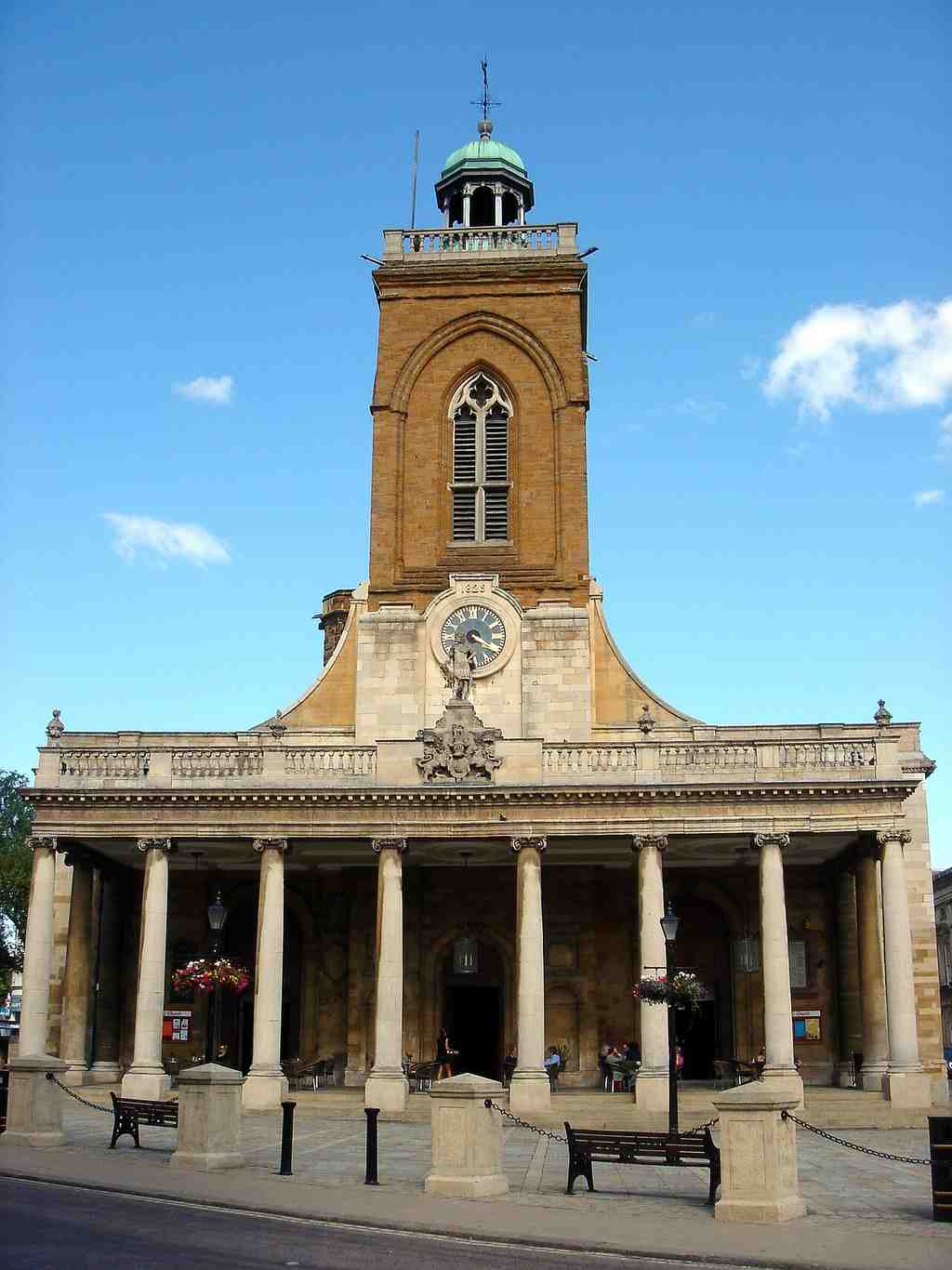
  7. On your left, look for the pale stone church with a deep classical portico, a square tower rising behind it, and a statue of King Charles the Second in Roman dress standing above…और पढ़ेंकम दिखाएँ
    All Saints' Church, Northampton
    All Saints' Church, NorthamptonPhoto: Thorvaldsson, Wikimedia Commons, CC BY-SA 3.0. Cropped & resized.

    On your left, look for the pale stone church with a deep classical portico, a square tower rising behind it, and a statue of King Charles the Second in Roman dress standing above the front.

    All Saints tells you something important about Northampton: here, the shoe trade did not just fill workshops and factories... it reached the altar. This church still holds a thanksgiving service every twenty-fifth of October for shoemakers, leatherworkers, and tanners, in honor of St Crispin and St Crispinian, patrons of shoemakers. Tradition remembers them as brothers associated with shoemaking, and as martyrs. Practical saints, you might say. Northampton liked that.

    And this place needed saints with stamina. In September of sixteen seventy-five, the Great Fire tore through Northampton and destroyed about seven hundred of the town’s eight hundred and fifty buildings in roughly six hours. The old medieval church here, then called All Hallows, went down with the rest. Henry Bell of King’s Lynn took charge of the rebuilding and gave the town a church in the new London style, strongly echoing Sir Christopher Wren. So what you see is a piece of post-disaster confidence: orderly, classical, determined not to look beaten.

    If you glance at the before-and-after image in the app, you can see how the grand west front holds its pose while the town around it keeps updating its wardrobe.

    Now lift your eyes to that figure above the portico. That is Charles the Second, carved by the local sculptor John Hunt and dressed, with admirable royal modesty, as a Roman emperor. The statue commemorates a very real rescue package. The king gave Northampton a thousand tons of timber from royal forests and remitted seven years of chimney tax revenue to help the town rebuild. So this facade carries a thank-you note in stone... with a crown on top.

    If you want a closer look at the royal thank-you, check the statue image on your screen.

    But for working Northampton, the church mattered not only after catastrophe. It helped set the rhythm of ordinary life. St Crispin’s Day was the trade’s feast, a sanctioned burst of rest, worship, and merrymaking. And then there was Shoemaker’s Monday: the old custom, especially in the outwork system, where home-based or loosely supervised workers might lose Monday to drink, recovery, or general human weakness, then claw the hours back later in the week. Industrial discipline met craft independence... and craft independence often won.

    So stand here for a second and think about that. When a town gives a trade its saints, its feast day, and even its own unofficial Monday, who is really keeping the calendar: the church, the employer, or the people with awls, waxed thread, and sore backs?

    That is the feeling to carry onward from All Saints: not just religion, not just architecture, but ritual woven into labor... holiday, hangover, and holy day all sharing the same page. From here, continue toward Northampton Guildhall, about a two-minute walk away.
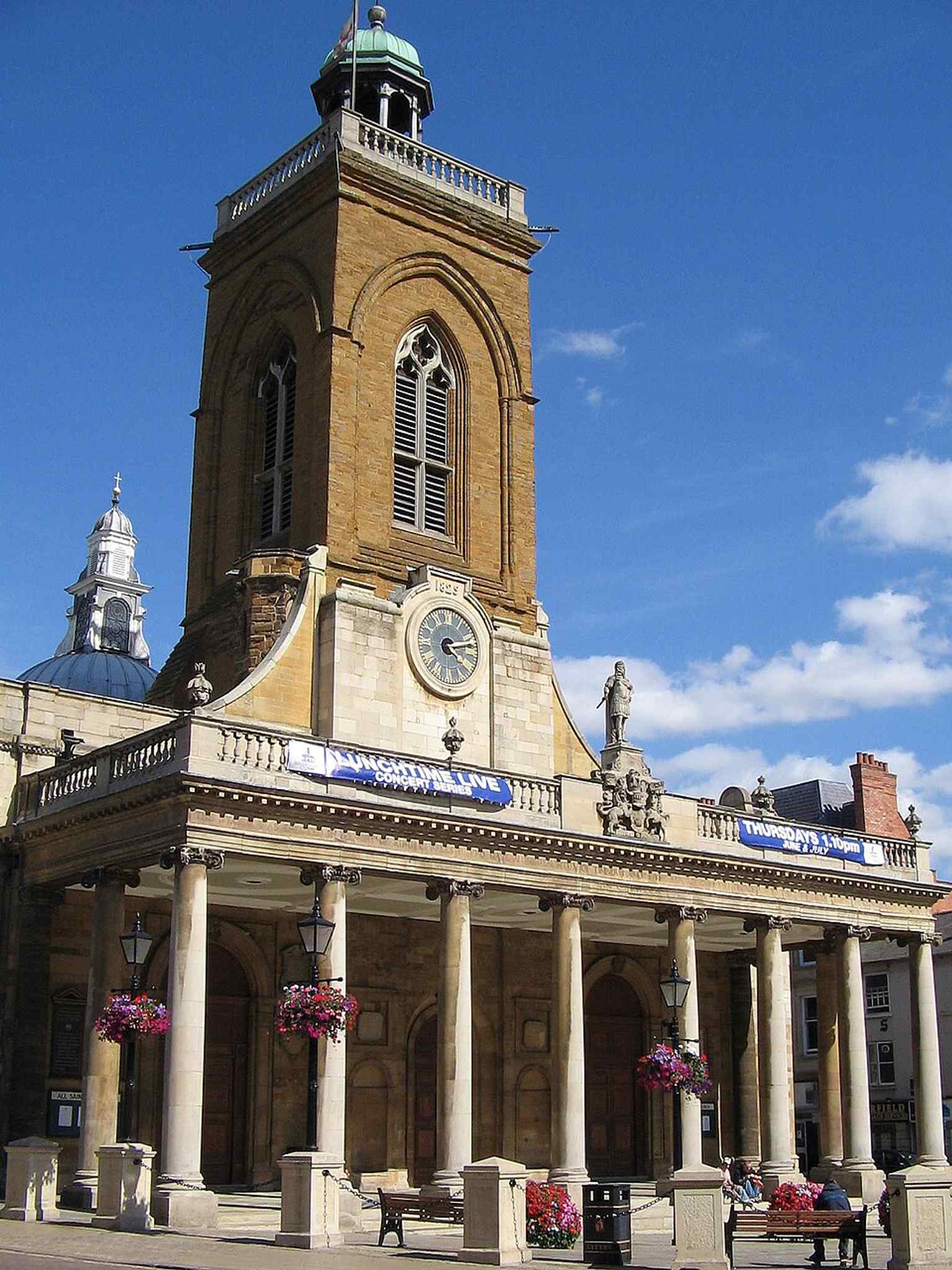
    The west front of All Saints’ Church, where the 1701 portico was added in memory of Charles II’s help after the Great Fire.
    The west front of All Saints’ Church, where the 1701 portico was added in memory of Charles II’s help after the Great Fire.Photo: Original uploader was G-Man at en.wikipedia, Wikimedia Commons, Public domain. Cropped & resized.
    समर्पित पेज खोलें →
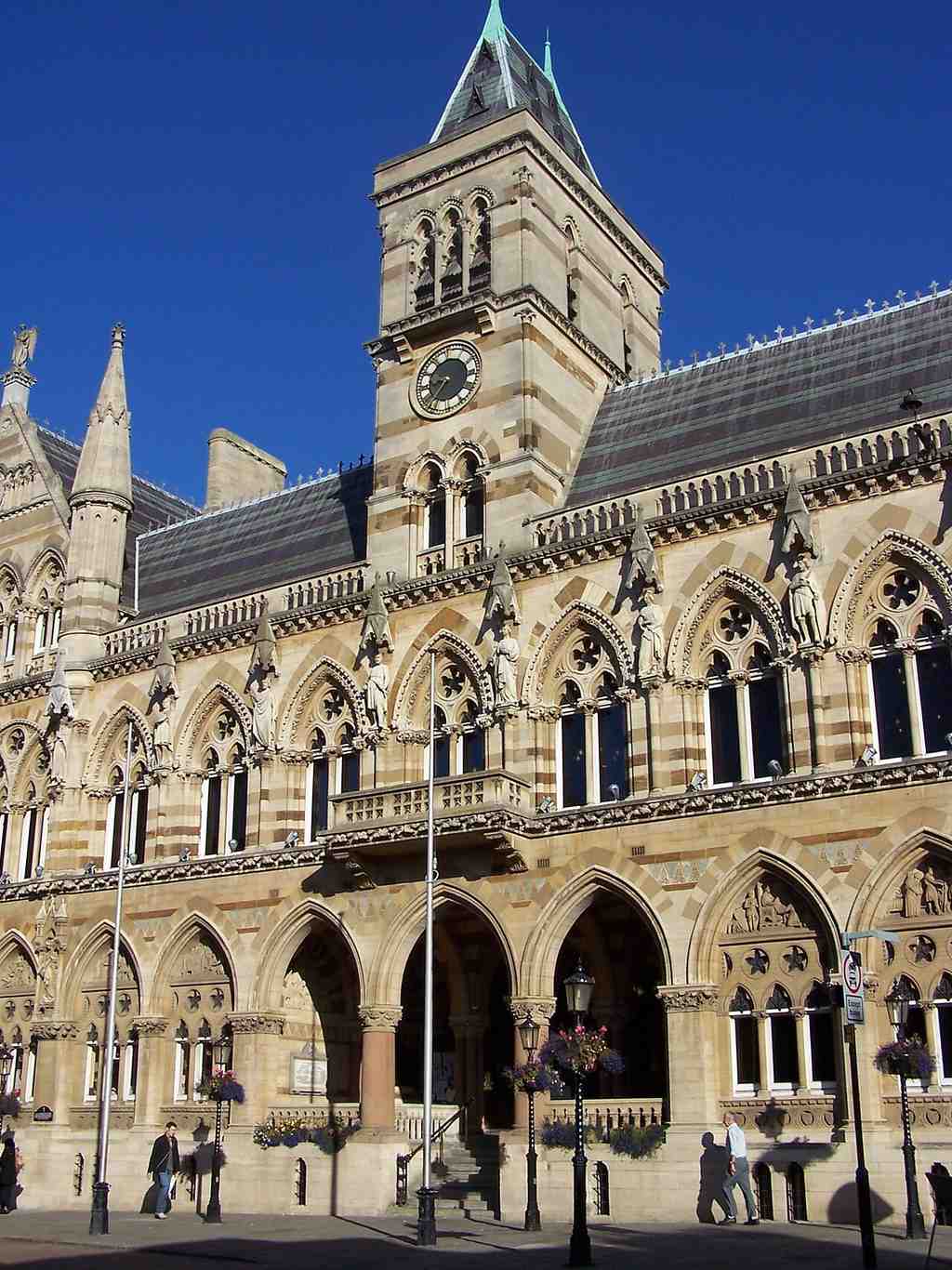
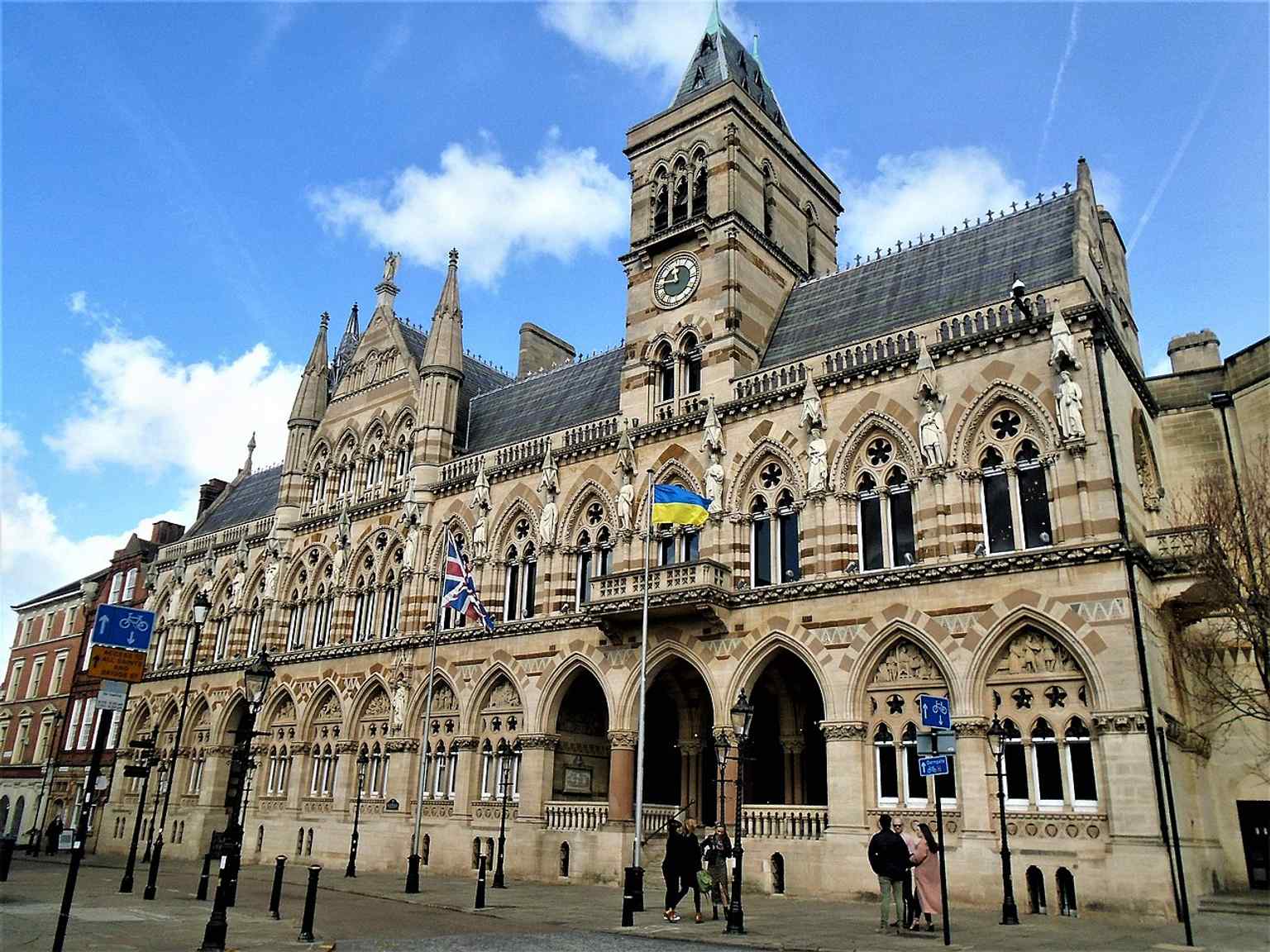
  8. Look for the long pale-stone Gothic frontage with pointed arches, a steep clock tower, and a row of carved figures standing between the upper windows. This is Northampton…और पढ़ेंकम दिखाएँ
    Northampton Guildhall
    Northampton GuildhallPhoto: Chris Nyborg, Wikimedia Commons, CC BY-SA 3.0. Cropped & resized.

    Look for the long pale-stone Gothic frontage with pointed arches, a steep clock tower, and a row of carved figures standing between the upper windows.

    This is Northampton Guildhall... the town dressing itself for public business in full Victorian confidence. Edward William Godwin designed the original building in eighteen sixty-one, when he was only twenty-eight, and he beat more than fifty rival entries to get the job. Not bad for a man still young enough to be mistaken for the intern. He opened it in eighteen sixty-four, giving Northampton a civic headquarters in Gothic Revival style, meaning a deliberate revival of medieval forms: pointed arches, vertical lines, carved stone, and plenty of moral seriousness.

    What you see stretching across the square today is even bigger than Godwin first planned. Between eighteen eighty-nine and eighteen ninety-two, Matthew Holding pushed the building westward, with A. W. Jeffrey shaping the interior, creating this long fourteen-bay front with arcading at ground level and a statue above each upper window. The facade turns local history into a stone cast list: monarchs, saints, benefactors, and scenes tied to Northampton’s legal and religious past. It is a town hall, yes, but also a public argument about who mattered here.

    If you fancy it, have a look at the before-and-after image in the app; the restored frontage feels a bit sharper now, as though the stone has remembered its lines.

    Inside, the council chamber did not belong only to merchants and grandees. In nineteen hundred and three, James Gribble took his seat there as a councillor for the Social Democratic Federation. Gribble had been a bootmaker since the age of twelve, and he was one of three Northampton shoeworkers elected to the council that year. That matters. In this town, people who stitched uppers and cut leather did not just vote on politics... they entered the room and made it.

    Two years later, Gribble proved he was not there to admire the furniture. In May nineteen oh five, he led one hundred and fifteen striking boot operatives from Raunds on a four-day march to Westminster, protesting War Office piece-rates that had sunk to two shillings and sixpence or sevenpence a pair. From the Commons gallery, he broke protocol and shouted his demand at the Speaker. Subtle, he was not. But it worked: the pressure helped force an Arbitration Board, and the rate rose to two shillings and elevenpence a pair.

    There’s a straight line from the literate cordwainers around Doddridge’s congregation to Gribble here: shoemakers in Northampton kept finding their way from the bench to the argument. This building held the magistrates above and authority all around, but working people kept walking in anyway.

    Now turn your gaze toward Guildhall Road. The old County Gaol stands there, the prison built in eighteen forty-six; its east wing later became the museum, and the vaulted cells now hold the shoe collection. In the next stop, the people behind these facades reappear there in stubborn, human detail... and it’s only about a minute away.
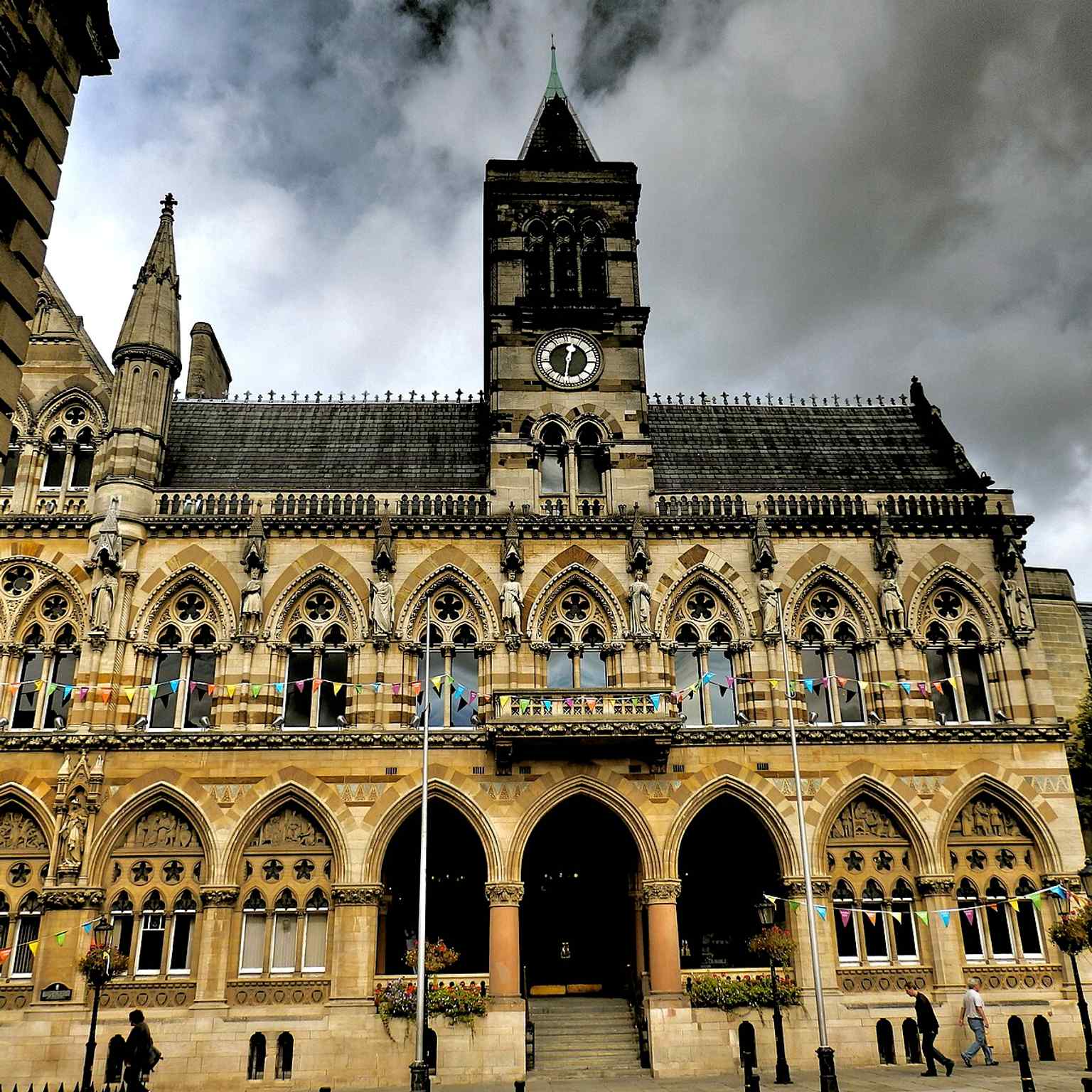
    The grand Gothic front of Northampton Guildhall, with its clock tower and arcaded façade added in the 1890s.
    The grand Gothic front of Northampton Guildhall, with its clock tower and arcaded façade added in the 1890s.Photo: Mickyflick, Wikimedia Commons, CC BY-SA 3.0. Cropped & resized.
    The courtyard of the 1992 eastern extension, part of the modern expansion that now holds the bronze history-maker statues.
    The courtyard of the 1992 eastern extension, part of the modern expansion that now holds the bronze history-maker statues.Photo: Richard Kelly, Wikimedia Commons, CC BY-SA 4.0. Cropped & resized.
    समर्पित पेज खोलें →
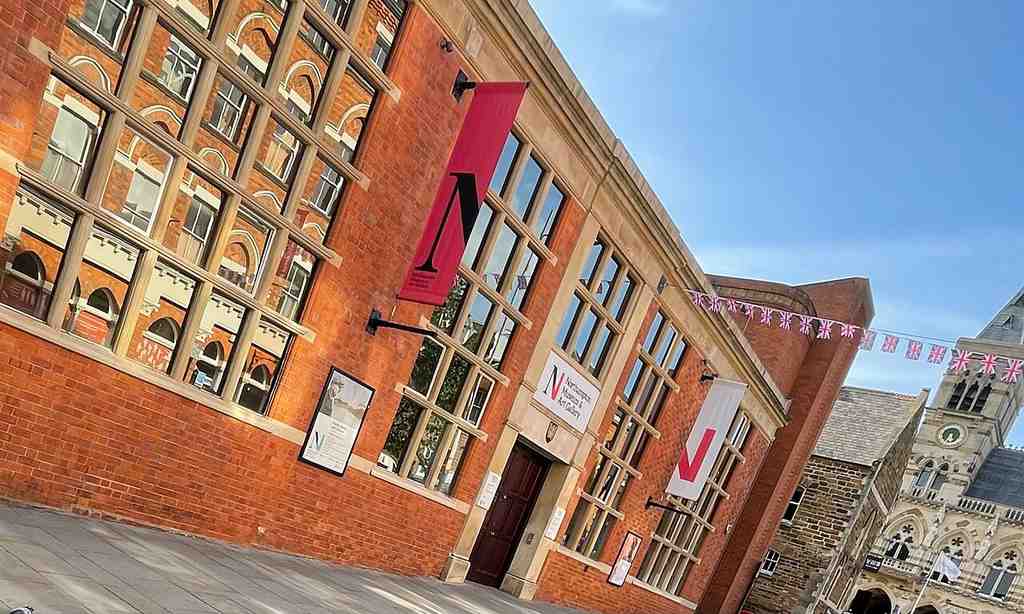
  9. On your right is a long red-brick and stone building with tall rectangular windows and, beside it, a modern glass-and-sandstone extension marked by a high glazed atrium. This is…और पढ़ेंकम दिखाएँ
    Northampton Museum and Art Gallery
    Northampton Museum and Art GalleryPhoto: StJaBe, Wikimedia Commons, CC BY-SA 4.0. Cropped & resized.

    On your right is a long red-brick and stone building with tall rectangular windows and, beside it, a modern glass-and-sandstone extension marked by a high glazed atrium.

    This is Northampton Museum and Art Gallery, but the bones of it tell a sterner story. You’re standing at the old County Gaol on Guildhall Road. In seventeen ninety-one, reformer John Howard argued for a better kind of prison design, and by eighteen forty-six this east wing followed that thinking: a galleried jail, with single cells stacked over four floors for around one hundred and fifty inmates. The place once kept people in line... and now it keeps memory in order, which is a much better use of the space.

    Most visitors never clock what happened after the prison closed. The east wing became a library, public reading room and museum, while the west wing turned into a Salvation Army barracks, with a mineral water factory down in the basement. Northampton, as ever, found a practical second life for everything.

    The town founded its museum in eighteen sixty-five and moved it here in eighteen eighty-four. Not long after, local shoe manufacturer Moses Philip Manfield began donating footwear as a kind of technical library. That was in the eighteen seventies. The idea was simple and sharp: let local workers study the best shoemaking from around the world, and they’d improve their own craft. Very Northampton, really - culture, yes, but preferably with useful stitching.

    If you glance at your screen, the newer work shows clearly there: the redevelopment added that glazed link and courtyard extension in glass and sandstone, more than doubling the public space when the museum reopened in twenty twenty-one. G-S-S Architecture of Kettering led the project, and the new Shoe Gallery now sits in the reclaimed vaulted cells below. Old confinement, new purpose.

    That expansion cost six point seven million pounds, and the money came with a long shadow. In two thousand and fourteen, the council sold the ancient Egyptian statue of Sekhemka for fifteen point seven six million pounds. The sale caused public outrage, raised serious questions about whether the statue should ever have been treated as an asset, and cost the museum its Arts Council accreditation for years. The building you see now is part of the result: improved, bigger, and tied to an argument the town still hasn’t entirely finished having.

    Inside, though, the collection earns its place. It holds more than fifteen thousand pairs of shoes, one of the largest collections in the world. If you look at the interior image, you can see how that story now unfolds in the new gallery space. And it is not only about famous footwear, though Queen Victoria’s wedding shoes, Elton John’s towering boots, and the red boots from Kinky Boots all make their entrance. The deeper story belongs to the people who worked. The anonymous outworkers sewing at home. The closing-room women stitching uppers. The four-step chain of clicker, closer, laster and finisher. The factory hands who made millions of military boots in Northamptonshire during the First World War. The makers from Raunds, from the great workshops, from the Goodyear-welted trade that gave this town its stride.

    That is the quiet triumph here. In the old prison vaults, the last word no longer belongs to warders, magistrates, or donors. It belongs to the workers, and the cells below have turned from places of confinement into rooms of remembrance.
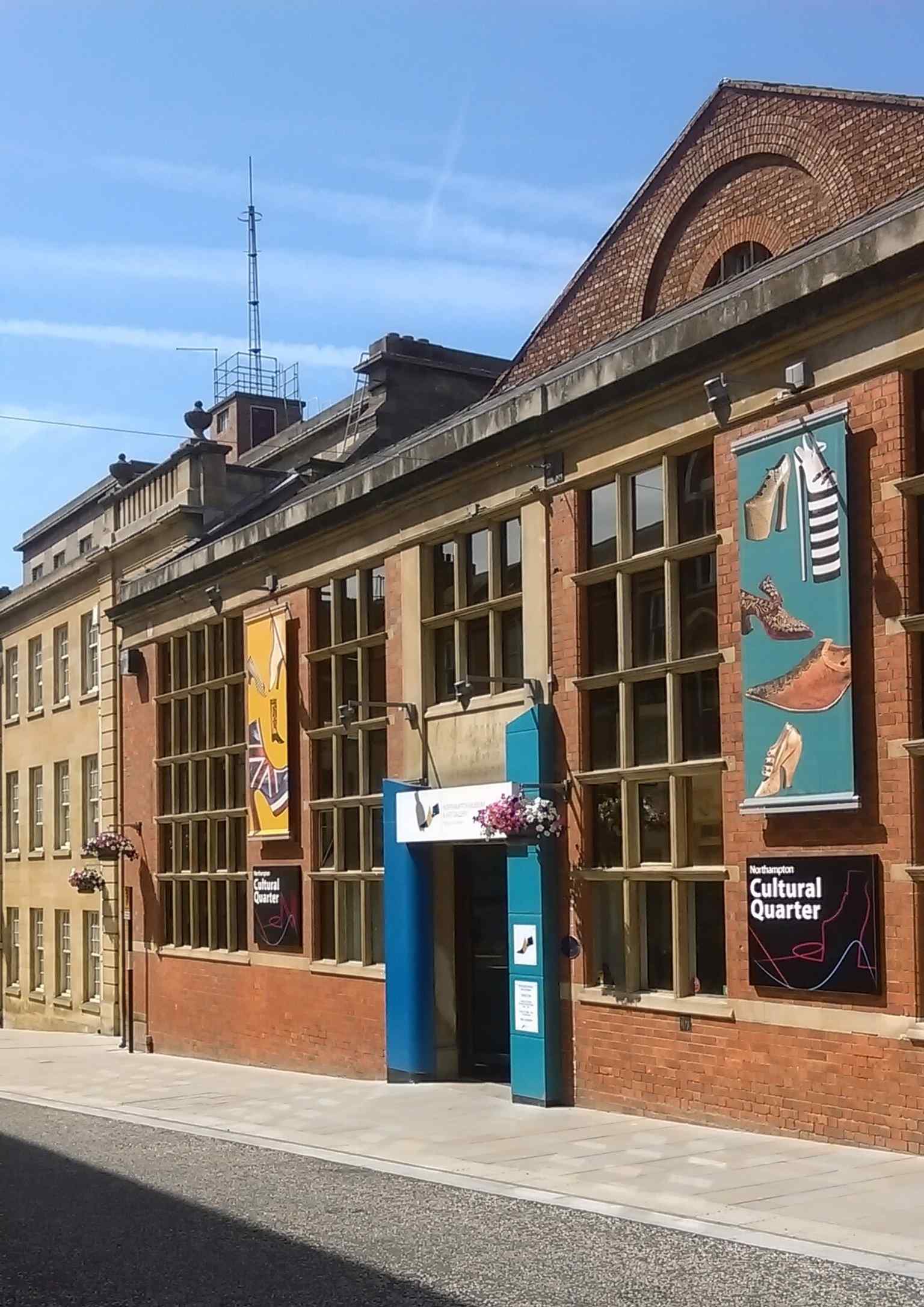
    The museum’s main entrance on Guildhall Road, home to Northampton’s celebrated shoe collection since the 1884 move to the old county gaol site.
    The museum’s main entrance on Guildhall Road, home to Northampton’s celebrated shoe collection since the 1884 move to the old county gaol site.Photo: StJaBe, Wikimedia Commons, CC BY-SA 4.0. Cropped & resized.
    समर्पित पेज खोलें →

अक्सर पूछे जाने वाले प्रश्न

मैं टूर कैसे शुरू करूँ?

ख़रीदारी के बाद, AudaTours ऐप डाउनलोड करें और अपना रिडेम्पशन कोड दर्ज करें। टूर तुरंत शुरू करने के लिए तैयार होगा - बस प्ले टैप करें और GPS-गाइडेड रूट का पालन करें।

क्या टूर के दौरान मुझे इंटरनेट चाहिए?

नहीं! शुरू करने से पहले टूर डाउनलोड करें और पूरी तरह ऑफ़लाइन इसका आनंद लें। केवल चैट फ़ीचर को इंटरनेट की ज़रूरत है। मोबाइल डेटा बचाने के लिए WiFi पर डाउनलोड करने की सिफ़ारिश है।

क्या यह एक गाइडेड ग्रुप टूर है?

नहीं - यह एक सेल्फ-गाइडेड ऑडियो टूर है। आप अपनी गति से स्वतंत्र रूप से खोजते हैं, आपके फ़ोन से ऑडियो कथन बजता है। कोई टूर गाइड नहीं, कोई ग्रुप नहीं, कोई शेड्यूल नहीं।

टूर में कितना समय लगता है?

अधिकांश टूर पूरा करने में 60-90 मिनट लगते हैं, लेकिन गति पूरी तरह आपके नियंत्रण में है। जब चाहें रुकें, स्टॉप छोड़ें, या ब्रेक लें।

अगर मैं आज टूर पूरा नहीं कर सकता/सकती तो?

कोई समस्या नहीं! टूर की लाइफ़टाइम एक्सेस है। जब चाहें रोकें और फिर शुरू करें - कल, अगले हफ़्ते, या अगले साल। आपकी प्रगति सेव रहती है।

कौन सी भाषाएँ उपलब्ध हैं?

सभी टूर 50+ भाषाओं में उपलब्ध हैं। अपना कोड रिडीम करते समय अपनी पसंदीदा भाषा चुनें। नोट: टूर जेनरेट होने के बाद भाषा बदली नहीं जा सकती।

ख़रीदारी के बाद मैं टूर कहाँ एक्सेस करूँ?

App Store या Google Play से मुफ़्त AudaTours ऐप डाउनलोड करें। अपना रिडेम्पशन कोड (ईमेल द्वारा भेजा गया) दर्ज करें और टूर आपकी लाइब्रेरी में दिखेगा, डाउनलोड और शुरू करने के लिए तैयार।

verified_user
संतुष्टि गारंटी

अगर आपको टूर पसंद नहीं आया, तो हम आपकी ख़रीदारी वापस करेंगे। हमसे संपर्क करें [email protected]

सुरक्षित चेकआउट

Apple PayGoogle PayVisaMastercardPayPal

AudaTours: ऑडियो टूर

मनोरंजक, किफ़ायती, सेल्फ-गाइडेड वॉकिंग टूर

ऐप आज़माएँ arrow_forward

दुनिया भर के यात्रियों द्वारा पसंद

format_quote शहर को देखने का यह बहुत अच्छा तरीका था। कहानियाँ रोचक थीं बिना ज़्यादा स्क्रिप्टेड लगे, और मुझे अपनी गति से खोजने का बहुत मज़ा आया।
Jess
Jess
starstarstarstarstar
Tbilisi टूर arrow_forward
format_quote बिना पर्यटक जैसा महसूस किए Brighton को जानने का यह एक शानदार तरीका था। कथन में गहराई और संदर्भ था, लेकिन ज़रूरत से ज़्यादा नहीं।
Christoph
Christoph
starstarstarstarstar
Brighton टूर arrow_forward
format_quote इस टूर की शुरुआत एक हाथ में क्रोसॉन्ट और शून्य उम्मीदों के साथ की। ऐप बस आपके साथ बहता है, कोई दबाव नहीं, बस आप, आपके हेडफ़ोन, और कुछ बढ़िया कहानियाँ।
John
John
starstarstarstarstar
Marseille टूर arrow_forward

अनलिमिटेड ऑडियो टूर

दुनिया भर के हर टूर तक पहुँच अनलॉक करें

0 टूर·0 शहर·0 देश
all_inclusive अनलिमिटेड खोजें