
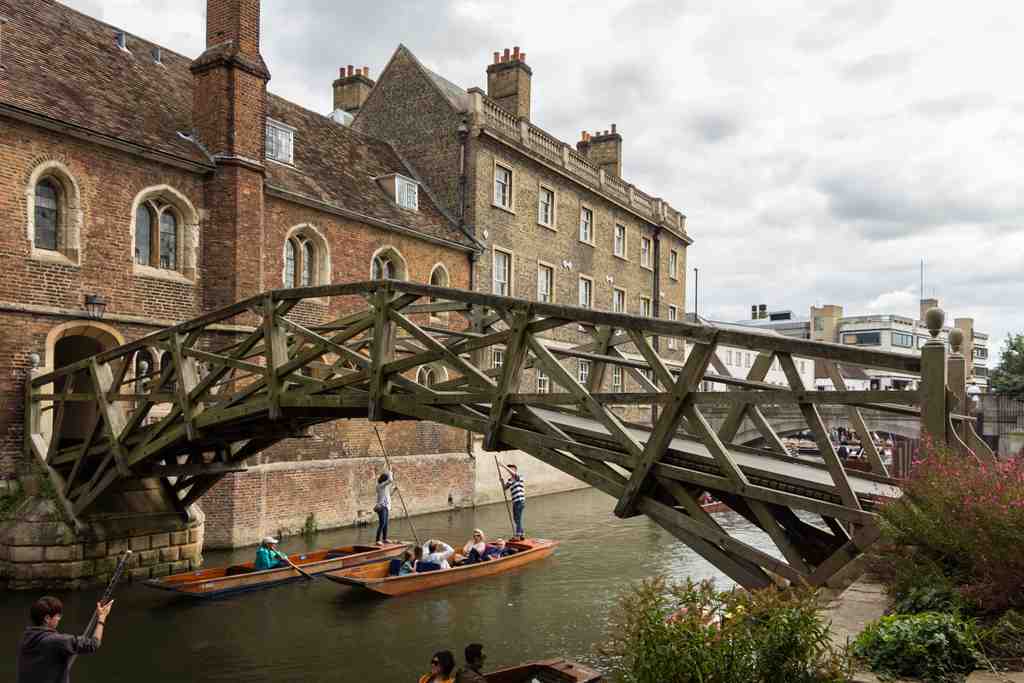
Look toward the river and you’ll spot a graceful wooden arch bridge made from crisscrossed straight planks, linking two historic buildings of Queens’ College on the Cam.
Welcome to our thirteenth and final stop: the famous Mathematical Bridge. And yes, I can hear your brain gearing up: “Mathematical? Where’s the giant calculator?” The trick is the engineering. Even though it curves like a wooden smile, it’s built entirely from straight timbers. It’s the sort of thing that makes you suspect a magician is hiding under the deck, or a math professor is pulling a prank.
Picture Cambridge in 1749: rattling carriages, serious scholars, and the challenge of connecting the two sides of Queens’. The design came from William Etheridge, and it was built by James Essex, a craftsman celebrated for his skill with wood.
Listen for a moment: water sliding beneath the bridge, and the chatter of people punting along the Cam. For centuries, students and visitors have crossed here wondering how straight pieces can form such a perfect arc. The secret is in the joinery, meaning the way the pieces lock together. The planks follow tangent and radial lines: in plain English, they’re set along directions that “hug” the curve and point toward its center, spreading the load so no single beam has to bend too much.
Now, the legends. One tale claims Isaac Newton invented it using no bolts, and that curious students later took it apart and couldn’t rebuild it without adding bolts. Fun story… except Newton had already died before the bridge was built. And those bolts? They were there all along, cleverly hidden.
It’s so iconic Oxford even made a copy in 1923. Not bad for a bridge that turns mathematics into a little bit of poetry over the Cam. Thanks for walking with me, explorer. If you ever need a bridge joke, you know who to call.




