पेरिस ऑडियो टूर: इल मिस्टिक के किंवदंतियाँ और स्थलचिह्न
पेरिस की कालातीत छतों के नीचे, सदियों का तनाव और साज़िश इल दे ला सिटे की छाया में मंडराते रहते हैं। यह कोई सामान्य सैर नहीं है—प्रत्येक पत्थर एक रहस्य छिपाता है, प्रत्येक पुल में खोई हुई आवाज़ों की गूँज है। एक स्व-निर्देशित ऑडियो टूर अनलॉक करें जो उन कहानियों और घोटालों को उजागर करता है जिन पर अधिकांश राहगीर कभी ध्यान नहीं देते। अपनी गति से घूमें और द्वीप के प्रतिष्ठित हृदय की खोज करते हुए छिपे हुए इतिहास को स्वयं प्रकट होने दें। किस संकट ने पेरिस के पुलिस प्रमुख को आधी रात की सड़कों पर घोड़े पर सवार होकर भागने पर मजबूर कर दिया? कैथेड्रल के शिखरों के नीचे क्रांति की साज़िश किसने रची? घरों की एक पंक्ति एक बार सीन नदी में कैसे गिर गई, जिससे शहर का कानून हमेशा के लिए बदल गया? प्लेस लुई लेपिन के पार विद्रोह की लहर का पता लगाएँ, नदी किनारे के बाज़ारों के पास घूमें जहाँ प्राचीन राजाओं ने मोलभाव किया था, और नोट्रे-डेम ब्रिज के ऊपर खड़े हों जहाँ उसके भूत करीब आते हैं। साहसपूर्वक कदम बढ़ाएँ—सस्पेंस और खोज बस आगे हैं। पेरिस जो सादे नज़रों में छिपा कर रखता है उसे उजागर करने का साहस करें। अपनी यात्रा अभी शुरू करें।
टूर पूर्वावलोकन
इस टूर के बारे में
- scheduleअवधि 40–60 minsअपनी गति से चलें
- straighten2.5 किमी पैदल मार्गगाइडेड पथ का पालन करें
- location_on
- wifi_offऑफ़लाइन काम करता हैएक बार डाउनलोड करें, कहीं भी उपयोग करें
- all_inclusiveलाइफ़टाइम एक्सेसकभी भी, हमेशा के लिए फिर सुनें
- location_onपेरिस पुलिस प्रीफेक्चर से शुरू होता है
इस टूर के स्टॉप
You’re now standing outside the Paris Police Prefecture, a building with more stories inside than a bookshelf during a blackout! Take a look at that sturdy stonework-it was first…और पढ़ेंकम दिखाएँ
You’re now standing outside the Paris Police Prefecture, a building with more stories inside than a bookshelf during a blackout! Take a look at that sturdy stonework-it was first built as a military barracks back in the 1860s, designed by Pierre-Victor Calliat, when the city was bracing for all sorts of drama. Imagine the echo of boots marching inside, the clatter of swords, and maybe a few grumpy soldiers complaining about Parisian weather. This isn’t just any police station. The Prefecture is the secret HQ of city safety-like Paris’s own superhero headquarters, but with more paperwork and fewer capes. From here, the Prefect of Police oversees everything from fire brigades rushing out to rescue cats in trees to issuing your ID cards. They even manage security at the main Paris airports-so yes, they’re checking you out before you hit Duty Free. Now, get this: from the days of Louis XIV in the 1600s, Paris has always taken its safety seriously. At one point, the city’s police were called “the archers.” It sounds like a medieval action movie, right? Except now, the public order superheroes might roll up on a bicycle instead of a steed. It wasn’t until 2021 that Paris got its own municipal police. Before then, all the police services were run directly by the national bigwigs, meaning if you lost your wallet-or your poodle-someone at the Ministry of the Interior was in the loop. These days, you might spot the municipal police making sure the streets stay peaceful and people keep their coffee cups off the sidewalk. So, as you stand in Place Louis Lépine, imagine centuries of Parisian guardians-archers, soldiers, and brisk policemen-slipping through these doors, ready to keep the City of Light shining bright, and maybe break up the occasional argument over the last croissant at the bakery. Welcome to the heart of Paris safety, where every day comes with a bit of suspense and a whole lot of stories. Wondering about the jurisdiction, nomination and missions or the organization? Feel free to discuss it further in the chat section below.
समर्पित पेज खोलें →Look straight ahead: you’ll spot Île de la Cité stretching out in the middle of the Seine, with graceful bridges arching across the water on either side, and elegant buildings…और पढ़ेंकम दिखाएँ
Look straight ahead: you’ll spot Île de la Cité stretching out in the middle of the Seine, with graceful bridges arching across the water on either side, and elegant buildings crowned by towers and old rooftops rising above the trees. When the sun is rising or setting, the island basks in a golden light, with the river and the city’s lights dancing on the surface. See those stone arches and the cluster of historic rooftops, right in the heart of the river? That’s your target-Île de la Cité! Take a moment and imagine standing here more than two thousand years ago. The island in front of you isn’t just a pretty patch of land-it’s like Paris’s original VIP section. Let’s travel back in time: Roman governors once built their fortresses here, and Clovis I, Paris’s very first king, picked this island for his royal palace in the year 508. Not a bad real estate pick, right? Listen close, you might just hear the snappy sound of ancient footsteps on stone as soldiers stroll the ramparts. Fast forward to the Middle Ages: the island’s towers weren’t just for show. Below them, merchants bustled, priests whispered prayers, and even kings hurried past-trying not to step in anything left behind by the local geese. By the 12th century, stories got even grander. Here you’d find the mighty Notre-Dame cathedral beginning to rise, and Paris’s grand old hospital, Hôtel-Dieu, where doctors hoped for the best and medieval patients… well, got medieval medicine. There were places for ruling, judging, and unfortunately, some places for dramatic trials during the Revolution-a bit less “lights, camera, action,” a bit more “off with their heads!” But before the Romans, before the kings, even before the cathedrals, this island was a hub for the Parisii tribe-a bold bunch of traders gliding their wooden boats through the misty river. Legend has it their coins traveled far and wide, the original Paris ‘souvenirs.’ It wasn’t all peaceful, of course. In 53 BC, when Julius Caesar came to town, those clever Parisii tried to burn the bridges to outsmart the Romans. Spoiler alert: it didn’t work too well. The Romans won, and the island became a little fortress city, building sturdy stone walls-just the right height for ducking and dodging, but maybe not the best for a dramatic exit. Today, the island is the nerve center for Paris police, law courts, and stories upon stories of Paris’s tangled, dazzling past. If you listen carefully, between the lapping water and the bells in the distance, you can almost hear the whispers of ancient traders, kings in shining armor, and revolutionaries plotting in the moonlight. And next time someone asks where Paris was really born, just point right here-at this island where it all began!
समर्पित पेज खोलें →Just ahead of you is the Our Lady Bridge, or Pont Notre-Dame. To spot it, look straight over the Seine. You’ll see a graceful green metal bridge arching across the river,…और पढ़ेंकम दिखाएँ
Just ahead of you is the Our Lady Bridge, or Pont Notre-Dame. To spot it, look straight over the Seine. You’ll see a graceful green metal bridge arching across the river, connecting two beautiful old stone embankments. Its elegant shape and low arches are perfectly framed by the grand buildings on either bank, and if you glance along the top, you’ll spot rows of traditional Parisian streetlights. Now, let’s travel back in time together. Imagine it’s a chilly morning in the Middle Ages. Instead of this strong metal bridge, you’d find a rickety walkway of planks, called the “planches de Mibray.” Picture the thumping of wooden wheels, shopkeepers shouting, and the sound of the river rushing underneath. This spot has always been the gateway to the very heart of Paris, connecting the right bank to the island of the city-Île de la Cité. It was here, in 1413, that King Charles VI himself hammered in a post and named the bridge Pont Notre-Dame. Back then, houses actually lined each side, with colorful markets and bookshops perched above the water. Imagine the smell of fresh bread, the clang of an armorer’s hammer, and the soft flutter of book pages. But, as you might guess: houses and water don’t always get along. In 1499, after years of warnings, disaster struck. On a stormy night, the city woke to a thunderous crash as the bridge suddenly broke apart, and all those houses tumbled with a splash into the Seine. The people responsible were so blamed that they landed in prison-it’s safe to say, nobody wanted that job after! Today, the bridge is calmer, built strong in the 1800s, and if you listen closely, maybe you’ll hear the whispers of old booksellers and the distant clatter of medieval Paris echoing across the water. Keep walking-Paris has many more secrets for us to discover!
समर्पित पेज खोलें →
11 और स्टॉप दिखाएँकम स्टॉप दिखाएँexpand_moreexpand_less
Look straight ahead - you’ll spot the Hôtel-Dieu de Paris by its pale stone facade peeking through the autumn leaves, with bold letters spelling “HOTEL-DIEU” right above arched…और पढ़ेंकम दिखाएँ
Look straight ahead - you’ll spot the Hôtel-Dieu de Paris by its pale stone facade peeking through the autumn leaves, with bold letters spelling “HOTEL-DIEU” right above arched windows. If you see “Liberté, Égalité, Fraternité” engraved on one of those arches, you’ve found it! The whole building is classic, dignified, and a little formal, like a hospital that dressed up for an important ceremony. Now, pause for a moment and imagine you’re standing here almost 1400 years ago. The island is bustling with travelers, all hoping for shelter and care. Hôtel-Dieu is no ordinary hospital - it’s the oldest one in Paris, said to be founded by the compassionate Bishop Saint Landry. In those days, this wasn’t just a place for the sick but also a refuge for wandering pilgrims, clutching their dusty walking sticks and looking for a miracle. The Hôtel-Dieu was run by devoted nuns. They learned their nursing skills on the job while tending to everyone in need. There were no fancy doctors here in the earliest times! Back then, if you were rich and ill, you’d recover in style at home. But if you were poor, unlucky, or simply lost, this was your safe haven. The building you see now was rebuilt in the 1800s, gracefully mixing old Parisian style with modern ideas. Imagine laundresses scrubbing sheets by the Seine-after all, being so close to water was handy for a hospital, and, let’s be honest, maybe not so great for anyone upstream! Through fires, plagues, and centuries of city life, Hôtel-Dieu stood for kindness and mercy. These days, part of it is planned for new clinics and health start-ups, with maybe even a museum dedicated to Notre-Dame and its restoration. Not a bad comeback for a place that started off just giving tired pilgrims a bed.
समर्पित पेज खोलें →All right, step right up! As you approach, look ahead along the shimmering waters of the Seine-if you spot a sturdy, dark green bridge cutting a gentle curve from right to left,…और पढ़ेंकम दिखाएँ
All right, step right up! As you approach, look ahead along the shimmering waters of the Seine-if you spot a sturdy, dark green bridge cutting a gentle curve from right to left, with elegant iron railings and the grand Hôtel de Ville building behind it, you're facing the Arcole Bridge. Boats often glide quietly underneath, and it's bustling on top with Parisians and tourists crossing in both directions. Now, let’s bring the Arcole Bridge to life! Imagine you’re here in the middle of the 1800s. Paris is buzzing-horses clopping, carriages rattling. The city is changing, and this bridge is the star! It’s not just any bridge. When it was built in 1856 by Alphonse Oudry, it was the very first iron bridge in Paris to cross the Grand Arm of the Seine with a single daring, elegant arch. Can you hear the clang of iron being pieced together? It only took three months to finish! Legend has it the bridge got its name from a brave young apprentice who, during the 1830 revolution, grabbed the French flag and led the charge toward the Hôtel de Ville, shouting, “Remember my name, Arcole!” His courage became part of Parisian legend. Really, the bridge might have also been named in memory of Napoleon’s victory at the battle of Arcole… but let’s not let the facts ruin a good story, right? As you stand here, picture carriages, market sellers, and elegant ladies with parasols crossing where you are now. At first, in the 1820s, there was only a narrow footbridge-just 3.5 meters wide! They called it the “Pont de la Grève,” and only brave pedestrians dared to cross. Then came progress: iron, not cast iron-a real fashion-forward move for the 19th century! But, in 1888, the bridge suddenly sagged by 20 centimeters. Imagine the panic-did someone forget to tighten a bolt? They had to quickly reinforce it. And during World War One, an artillery shell exploded by the bridge, sending shockwaves through the air. In 1944, the bridge saw another moment of glory. Liberation! The first tanks of the Free French Forces rolled right over Arcole Bridge, headed to the Hôtel de Ville-Paris, finally free again. And today? It's been reinforced and made greener with eco-friendly lights. At night, Arcole shines like a jewel over the river. So take in the breeze, the clatter of passing footsteps, the echo of a city’s tumultuous past… and if you feel courageous, channel your inner Arcole and march across, preferably without leading a revolution this time! Seeking more information about the description, origin of the name or the historical? Ask away in the chat section and I'll fill you in.
समर्पित पेज खोलें →Look straight ahead as you approach this open plaza with plenty of space under your feet and an unbeatable view in front: the majestic twin towers and intricate Gothic façade of…और पढ़ेंकम दिखाएँ
Look straight ahead as you approach this open plaza with plenty of space under your feet and an unbeatable view in front: the majestic twin towers and intricate Gothic façade of Notre-Dame de Paris. If you look just to your left, you’ll spot the gray-hatted roof of the Hôtel-Dieu hospital, and to your right, the grand stone structure of the Police Prefecture. And if you see people standing in a loose circle, peering down at the stones like they lost their car keys-trust me, that’s the spot où tout commence: France’s very own point zéro. You’re standing on the Parvis Notre-Dame - Place Jean-Paul II, the historic heart of Paris. Just imagine-in the Middle Ages, this space was a tiny, gritty square, lively with townsfolk, the occasional street peddler, and probably more than a few chickens. Back then, criminals stood right here to confess their sins (talk about public speaking anxiety!) before judgment, while onlookers filled the plaza, their hearts pounding with suspense. But don’t worry, there won’t be any sinners in the stocks today. Instead, look down. Somewhere nearby is a humble bronze marker-Point Zéro des Routes de France. Stand on it, and congratulations, you’re officially at the center of Paris! Sprint north, south, east, or west from here, and every French milestone is measured from under your feet. If someone tries to take a touristy selfie here, jump in and claim you’re at the very middle of all of France-a perfect excuse to make new friends. Right beneath you, just meters below street level, hides the Archaeological Crypt. Down there is a treasure trove of old walls, tombstones, and echoes from Roman Paris-if you listen very quietly, you can almost hear sandals on ancient stone. Above, the Notre-Dame towers rise like silent sentinels, keeping watch over centuries of drama, devotion, and the occasional pigeon with big dreams. This square has changed so much through the ages-churches crumbled, hospitals grew, statues like Charlemagne and his posse popped up, and the riverbank itself wandered off about fifty meters. Ground level has even risen by several meters, so where you’re standing used to be the old riverbank. It’s like Paris hit the "grow" button on an espresso machine-up, up, and away! The name-whew, it’s a mouthful-only became “Place Jean-Paul II” in 2006, a nod to the beloved Pope’s visits, after a good bit of city council drama. But whether you call it the Parvis, Place du Parvis Notre-Dame, or play it safe and use both, it’s always been the grand welcome mat to the Notre-Dame cathedral and the true beating heart of the city. Take a moment here: feel the city thrum around you, picture the throngs of medieval townsfolk, sense the ancient river beyond the Seine’s fences, and know that Paris-in all its magic and mayhem-fans out from this very spot. And if someone asks, you can proudly declare you’ve stood at Paris’s point zéro. Not everyone can say they’ve been right where everything begins!
समर्पित पेज खोलें →Look ahead and you’ll see one of the most instantly recognizable silhouettes in Paris. Notre-Dame de Paris rises grandly before you, with its two massive towers standing guard on…और पढ़ेंकम दिखाएँ
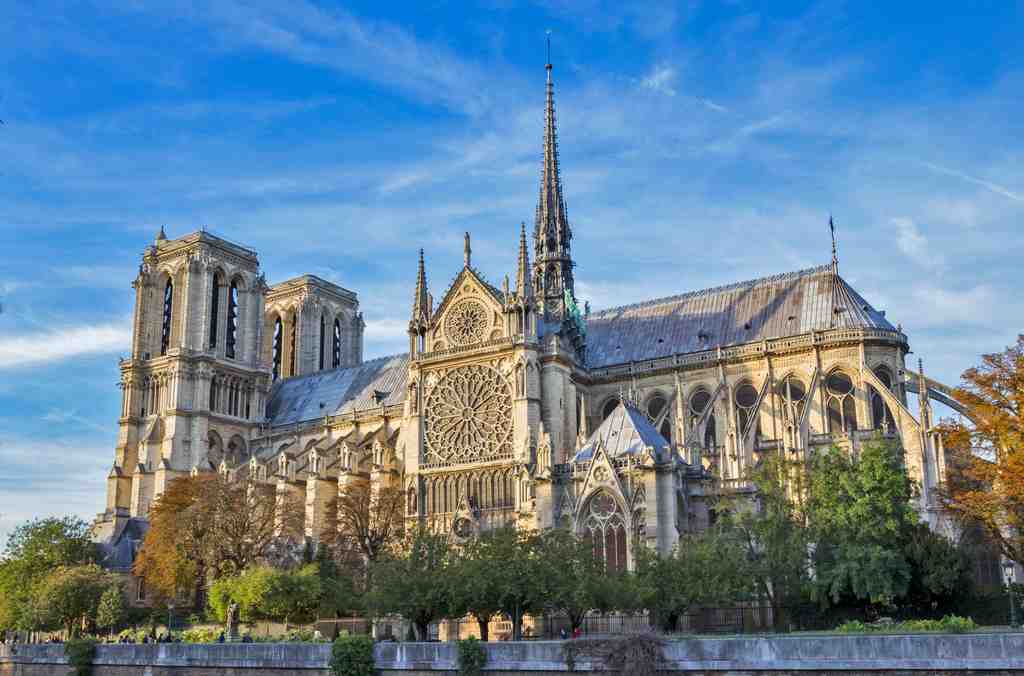
Look ahead and you’ll see one of the most instantly recognizable silhouettes in Paris. Notre-Dame de Paris rises grandly before you, with its two massive towers standing guard on the left, and a forest of delicate stone arches and details running along the sides. You’ll spot the gigantic circular rose window-like a jewel set high in the wall-and the tall spire in the middle, reaching for the sky. Watch how the light plays on all that creamy stone, lighting up the flying buttresses that look like arms holding the building close. Okay, take a moment and imagine you’re stepping back in time-right into the heart of medieval Paris. Here stands Notre-Dame de Paris…the Cathedral of Our Lady. Built on an island in the River Seine, this building has seen kings, revolutions, and the everyday stories of millions. It’s not just any old church-this is the champion of Gothic architecture, where the walls are thinner, the ceilings soar way overhead, and the sunlight pours in through grand, colorful rose windows. If you take a closer look, you’ll notice tons of sculptures-saints, monsters, and some faces that look suspiciously like the builders’ grumpy neighbors. Construction started way back in 1163, when Paris still had more horses than cars. Imagine, workers pulling up huge stones, the echo of chisels, and maybe the odd baker passing with a fresh baguette. It took almost 100 years to get the main structure done. And the excitement didn’t stop there-kings like Napoleon were crowned here, and writers like Victor Hugo made this place the setting of timeless tales. I promise I won’t burst into song, but “The Hunchback of Notre-Dame” truly made this building a superstar! But Notre-Dame has had its tough days, too. During the French Revolution, treasures were destroyed, statues beheaded, and the building almost turned into a warehouse for wine. Even so, the people fought to bring her back to glory after Victor Hugo’s book, and lucky for us, she stands here again-restored after a devastating fire in 2019. After years of silence, the bells now ring once more for visitors and Parisians alike. As you stand here, let your eyes wander. This isn’t just the most visited spot in Paris, but a tapestry of faith, legends, and history-one that’s still unfinished, just waiting for the next story…and maybe for someone to finally count exactly how many birds like to perch on those towers. If you're keen on discovering more about the key dates, towers and the flèche or the iconography, head down to the chat section and engage with me.
समर्पित पेज खोलें →To spot the Archdiocese of Paris, look just to the right of the mighty Notre-Dame Cathedral-the classic Gothic facade with its twin towers dominates the view. The building you're…और पढ़ेंकम दिखाएँ
To spot the Archdiocese of Paris, look just to the right of the mighty Notre-Dame Cathedral-the classic Gothic facade with its twin towers dominates the view. The building you're seeking isn’t nearly as towering, but rather a graceful structure with dignified stone walls, large windows, and a tranquil, almost scholarly, air about it. With Notre-Dame taking center stage, the archdiocese is a distinguished neighbor, so keep your eyes peeled next to the famous cathedral, almost as if the two buildings are old friends, quietly watching Parisians and visitors stroll by. Now, as you stand in front of the Archdiocese, imagine: centuries ago, right where you’re standing, the city’s spiritual leaders would walk in their long, swishing robes, probably thinking deep thoughts-or maybe just wondering what’s for lunch. The Archdiocese of Paris, with its roots stretching all the way back to the 4th century, has witnessed so much of Paris’s dramatic history. Legend says Saint Denis, the city’s first bishop, brought Christianity here-which is heroic, considering he ended up losing his head! (Don’t worry, it’s only a story, and his legacy lived on.) Paris wasn’t always the grand religious center it feels like today. For a while, it was just one small part of a bigger religious patchwork in France. The bishops and archbishops here didn’t even get invited to crown the kings in Reims-the royal parties were somewhere else! But, as Paris grew more powerful, so did its church. In 1622, finally, the Pope gave Paris its very own archbishop, raising its status with an official stamp (or the papal equivalent of a “Like” on social media). And get this: at one point, the archbishops not only led prayers, they were also dukes of Saint-Cloud, with enough land to make a real estate agent swoon. Imagine bishops in miters and velvet capes, riding out to inspect their lands, all with a serious face-but maybe sneaking a smile, knowing their influence stretched far beyond these stone walls. Through revolutions and regime changes, the Archdiocese adapted, sometimes shrinking or stretching with the borders, but always returning home to Paris. Today, it remains an essential heart of the Catholic Church in France. And if you listen closely, maybe you’ll catch those ancient whispers-of saints, kings, and bishops-echoing across the centuries, reminding you that every corner of Paris hides a little bit of its storied soul. Now, shall we stroll onward and see which Parisian secrets await us next? To expand your understanding of the jurisdiction and territorial organization, heritage or the bishops and archbishops of paris, feel free to engage with me in the chat section below.
समर्पित पेज खोलें →Ahead of you is Rue Chanoinesse, or as we lovingly call it, Canoiose Street. To spot it, look for a quaint, narrow street nestled between elegant old buildings, with charming…और पढ़ेंकम दिखाएँ
Ahead of you is Rue Chanoinesse, or as we lovingly call it, Canoiose Street. To spot it, look for a quaint, narrow street nestled between elegant old buildings, with charming brickwork and those classic Parisian windows-like something straight out of a period film. Notice the red-brick building straight ahead, cozy and distinct. And just to your right, you’ll see balconies with wrought-iron railings stacked like a layer cake. If you catch the soft ring of a distant bicycle bell, you’re definitely in the right place. Now, standing here, let your imagination run wild. You’re in the heart of the Île de la Cité, one of Paris’s oldest and most secretive corners. The name “Chanoinesse” comes from the canons who lived here-these were clergymen attached to nearby Notre-Dame Cathedral. Picture them moving about in billowing robes, perhaps whispering important secrets of the church. This street dates all the way back to the days of Charlemagne-seriously, if these cobbles could talk, you’d never get a moment’s peace! Back then, Rue Chanoinesse was the lifeblood of the Notre-Dame Cloister-a kind of gated village right within the city, so exclusive that outsiders and especially women weren’t even allowed in at night. Four big gates would slam shut when darkness fell, keeping the world outside. Among these old houses, number 24 is particularly special-built way back in 1512 and still standing, home to many stories whispered through the centuries. The street once sparkled with tax exemptions, and even kings had to play by the rules here. Louis, son of King Philip I, got in trouble for knocking down part of a house, and he had to promise never to do it again-or pay a hefty fine. Imagine a royal sheepishly handing over a bag of coins-there’s a royal blooper for you! There are mysteries, too: medieval gravestones found underfoot, a vanished ancient chapel, and the towering “Dagobert’s Tower,” which once served as a beacon for the nearby port. Sadly, it’s long gone, but if you close your eyes, maybe you’ll feel its ghostly shadow. In more recent times, this street has survived wars, explosions, and even served as a home for fire brigades and judges. Quite the résumé, don’t you think? So as you stand here, imagine the swish of long cloaks, the clop of horses, the clang of a closing gate at curfew, and the eternal dance of Parisian history swirling all around you. And don’t trip over any medieval spirits-I hear they’re terribly grumpy if you step on them!
समर्पित पेज खोलें →To spot the Mémorial des Martyrs de la Déportation, look for a low, stark stone structure ahead, almost hidden in plain sight near the tip of the Île de la Cité, just behind…और पढ़ेंकम दिखाएँ
To spot the Mémorial des Martyrs de la Déportation, look for a low, stark stone structure ahead, almost hidden in plain sight near the tip of the Île de la Cité, just behind Notre-Dame. The monument is set slightly apart from the busy Paris streets and framed by neat green lawns. You’ll see the words "MARTYRS FRANÇAIS DE LA DÉPORTATION" and the year "1945" carved into the concrete-a bold, solemn mark on this quiet corner. If you walk toward the river, you can’t miss it. Now, as you stand before this monument, imagine stepping away from the Paris crowds into a hush that almost swallows the sound of the city. This is not the grand, towering kind of monument that asks for applause; it’s a space that asks for silence. Under your feet, beneath this stone, lies an underground crypt, reached by narrow stairs and guarded by a metal gate. This memorial honors the 200,000 people taken from Vichy France and sent to Nazi concentration camps during World War II. It was built on the site of a former morgue-talk about chilling! The French architect Georges-Henri Pingusson designed it to feel like a ship’s prow-a symbol of a journey with no return. Inside, it gets even quieter. You’ll find glass crystals shining in the dimness, one for each life lost, and at the end-a single shining light, like hope breaking through darkness. The feeling here is almost claustrophobic on purpose, so you can sense what it must have felt like to be taken from your home to an unknown fate. The words on the walls, written by poets who resisted, survived, or perished, wrap around you. Here’s one line you might see: *I have dreamt so very much of you... That nothing more is left to me of you.* Even if you’re not an expert in architecture or poetry, this place is meant to move you. Pingusson wanted you to feel the weight of history-and perhaps walk away as a “shadow among shadows,” carrying a memory that’s just a little heavier. There’s even a “Tomb of the Unknown Deportee,” holding ashes brought back from the camps. Before you leave, don’t forget to look for the iron gate opening to the Seine. As you listen to the river and the wind rustling over the stone, take in the inscription: *Forgive but never forget.* Not a bad motto, right? A little lighter than lugging around a baguette in your bag, but far more important. If you’re lucky-or well-timed-you might even witness the annual remembrance ceremony here, held every April. This tiny, nearly hidden place may not draw crowds, but it changes everyone who finds it. Onward when you’re ready.
समर्पित पेज खोलें →Just ahead of you is the Saint-Louis Bridge. To spot it, look for a simple, modern-looking structure stretching across the water. Unlike the older, more ornate bridges of Paris,…और पढ़ेंकम दिखाएँ
Just ahead of you is the Saint-Louis Bridge. To spot it, look for a simple, modern-looking structure stretching across the water. Unlike the older, more ornate bridges of Paris, this one is sleek and flat, with a clean line of railings and no vehicles crowding the space-just people like you, strolling, cycling, or pausing to catch the breeze as the Seine flows beneath. On one side, you’ll see trees and classic Parisian buildings, and at your feet, the bridge seems to float gently to the next island. Now, as you stand in front of the Saint-Louis Bridge, take a deep breath and get ready for a leap through time. The bridge you see was imagined by architects Jabouille and Creuzot and made reality by engineers Long-Depaquit and Coste-it was begun in 1969 and finished in 1970. It’s all steel, strong and steady, but don’t let its modern look fool you. This bridge is the seventh to stand here since 1634. If there were an award for most dramatic life story, the Saint-Louis Bridge would definitely be a contender! Long ago, this spot didn’t need a bridge at all-Île Saint-Louis was empty. The very first bridge, called the “Pont de Bois” or “Saint-Landry,” was wooden and angled across the river, built back in the 1630s. Unfortunately, it didn’t last long: harsh winters and floods turned it to kindling more than once. Imagine wooden beams creaking and trembling under heavy ice-yikes. After wood, Paris tried metal. In 1842, a suspended metal walkway hung here, complete with gothic turrets at the ends. Romantic, right? But heavy traffic and collisions were frequent guests; one bridge even gave way in 1939 when a massive boat struck it, sending parts of the bridge and its unlucky passengers into the Seine. That’s drama no Parisian wants to repeat! Today’s bridge, peacefully reserved for pedestrians and cyclists, is a safe haven-no cars here to spoil your people-watching or your photo ops. In spring and summer, the bridge is alive with music and laughter, thanks to street performers who turn it into their own open-air stage. And hey, no tolls today-in the early 1800s, it cost five centimes just to cross on foot! Now glance around and let your imagination paint those lost bridges in the air: gothic turrets, wooden beams, and daring Parisians chasing adventure or just trying to make it home dry. If bridges could talk, Saint-Louis would have quite the tale to tell-and maybe drop a few jokes about boats not paying attention to where they’re going. Onward to our next island adventure!
समर्पित पेज खोलें →If you look straight ahead across the water, you’ll see a charming row of old Parisian buildings with their gray rooftops and lots of windows facing the Seine. There’s a line of…और पढ़ेंकम दिखाएँ
If you look straight ahead across the water, you’ll see a charming row of old Parisian buildings with their gray rooftops and lots of windows facing the Seine. There’s a line of leafy green trees standing guard along the edge of the island, and a quiet walkway runs right along the top of the stone embankment. If you spot these cozy, historic apartments peeking over the river and the peaceful, tree-lined walkway, voilà-that’s Île Saint-Louis right in front of you. Welcome to Île Saint-Louis, Paris’s little “secret island” in the very heart of the city! Believe it or not, this tiny patch of land is older than most Parisian baguettes, and it sits just upstream from the larger and more famous Île de la Cité. It’s the smaller of the two big islands in the Seine, shaped a bit like a wonky diamond, and it’s packed with cobbled streets, quiet neighborhoods, and… not too many people! Only around 2,300 folks live here. The locals actually have special names-they’re called Ludovisiens or Ludovicians. Try saying that three times fast! Imagine centuries ago, monks and nobles wandering around, and even knights having fancy ceremonies here. Back in the day, the island was mostly used for grazing cows and storing supplies. Kings, bishops, and even revolutionaries have all had their turn watching over this spot. During the French Revolution, it was known as the "Section of Fraternity," which sounds quite friendly, doesn’t it? And let’s just say, it definitely saw its share of wild times. Today, five graceful bridges connect Île Saint-Louis to the rest of Paris-Pont Saint-Louis, Pont de la Tournelle, Pont de Sully, Pont Louis-Philippe, and Pont Marie. With all those bridges, you could almost forget you’re on an island in the middle of the city-that is, until you hear the water lapping against the old stone walls. Take a deep breath. Smell that subtle mix of pastries from the local bakeries and the fresh Seine air? Listen for the echo of laughter from the cafés, and the click-clack of bicycles over the cobblestones. If you close your eyes, you might even sense the centuries of stories and secrets hidden in every stone. Here you are, standing where Parisians and travelers alike have strolled for hundreds of years. Might as well linger a moment-there’s nowhere else in the city quite like it! And if you start to feel poetic, don’t worry, it happens to everyone here. Just don’t blame the island if you suddenly crave ice cream-Berthillon, Paris’s most famous ice cream shop, is just around the corner. Now, let’s keep exploring! To expand your understanding of the location and access, historical or the remarkable buildings and places of remembrance, feel free to engage with me in the chat section below.
समर्पित पेज खोलें →The church you see in front of you stands tall and proud, with its slender stone spire poking the sky. Look up-way up-and you’ll spot the unusual clock, perched boldly on the side…और पढ़ेंकम दिखाएँ
The church you see in front of you stands tall and proud, with its slender stone spire poking the sky. Look up-way up-and you’ll spot the unusual clock, perched boldly on the side of the tower like a shop sign, sticking out over the narrow Rue Saint-Louis en l’Île. The beige limestone facade is weathered by centuries of wind and rain, marked by arched windows, high doors, and an entrance watched over by two stone angels who seem to hold the past between their arms. The church is squeezed between neighboring buildings, so its face is narrower than you’d expect, its old stones almost leaning into the hum of Parisian life passing by. Now, let your imagination slip back through time. Picture the year 1664: this island was once a wild, empty spot in Paris, and here, François Le Vau-architect extraordinaire-dreamed up a church just for the new island community. Well, he got more than he bargained for: storms ripping off roofs, the clock tower battered by wind, a never-ending round of architects jumping in to save the day. It took sixty years to finish! Honestly, this church must have had the patience of a saint… or at least Saint Louis, who it’s named after. But Saint-Louis-en-l’Île is a survivor. The French Revolution hit hard-angry crowds smashed royal symbols and the church was turned into a dusty book warehouse. No stained glass, no paintings, just the echo of lost prayers and the shuffle of paper. Luckily, in 1805 a generous soul gave the church back, and not long after, the Pope himself held a mass right here. Imagine that: centuries of secrets swirling in the stone, and suddenly, holy music bouncing off brand-new paint and glittering gold! Peek through the door if you can-inside it feels bright and alive. Gilded angels keep watch, and little side chapels sparkle with art and color. It’s baroque style through and through-a wild party of columns, golden leaves, swirly stucco, and painted light. All this grandeur was pieced together bit by bit over years. Just think: the priest who once led this parish sold his personal library to add more gold and art to the church. Now that’s dedication! (Or maybe a priestly excuse for not returning overdue library books…) Here in front of you, Saint-Louis-en-l’Île is more than stone and wood. It’s a place where storms and revolutions, artists and ordinary Parisians, have all left their mark. Next time you walk past and the clock on the tower catches your eye, remember-this building knows a thing or two about waiting for the right moment. For further insights on the exterior, interior or the art and decoration, feel free to navigate to the chat section below and inquire.
समर्पित पेज खोलें →To spot the Hôtel Lambert as you walk, look ahead for a grand, cream-colored mansion right along the riverside. It’s a tall, elegant building with large French windows, fancy iron…और पढ़ेंकम दिखाएँ
To spot the Hôtel Lambert as you walk, look ahead for a grand, cream-colored mansion right along the riverside. It’s a tall, elegant building with large French windows, fancy iron balconies, and smooth stone walls that seem to glow in the sunlight. The mansion curves out at one end-almost like it’s leaning in to greet you. You’ll see a tall, arched doorway and the building standing slightly above the street level behind a neat wall, all framed by the trees along the Quai. If you spot that jewel-box of a building with classic Parisian style, you’re in the right place! Now, imagine yourself back in the 1600s, standing beside the Seine in your finest wig and silk stockings (yes, you too!). This very spot, number 2 on rue Saint-Louis-en-l’Île, is where Hôtel Lambert first rose in 1640, drawn by the famous architect Louis Le Vau-who might have had an extra espresso, because the design is full of energy and curves. Think of it: grand facades, a sweeping rotunda, and a hidden garden that old Paris still whispers about. Inside, artists like Charles Le Brun and Eustache Le Sueur chased each other up ladders, painting for five straight years. Le Brun created the Hercule Gallery-imagine a hallway so impressive, it inspired Versailles’ Hall of Mirrors! Rich, golden paintings, soaring ceilings, and rooms dripping with myth and adventure filled every corner. Who lived here? Jean-Baptiste Lambert, a man who made a fortune almost before his mustache grew in, and then his brother Nicolas-who, legend says, had so much money he owned over a dozen houses on this very island. Of course, things got a little dicey when Nicolas was caught up in a money scandal and fined a million livres. Ouch! (Remember, even in Paris, too much cheese-and cash-can give you a headache.) The mansion was famously decorated with scenes of love, epic journeys, and classical muses. François Perrier painted heroes fighting monsters; landscapes by Pierre Patel captured distant bridges; and the Cabinet of Love was a room as romantic as its name. Over time, pieces by Le Brun, Le Sueur, and others found their way to the Louvre, so every visit to the museum is a little visit back here. Fast-forward to the 1700s, and Hôtel Lambert was buzzing with philosophers and writers. Madame Dupin, who definitely knew how to throw a party, hosted literary salons that welcomed everyone from Voltaire to Rousseau. I bet half of Paris’ best ideas first floated out over her teacups. Can you imagine the jokes Voltaire told in these very rooms? By the time the marquise du Châtelet owned it, everyone in Paris wanted to peek inside. But as quickly as fortunes came, they went: millionaire after millionaire took their turn at the keys, always dreaming of more glitz, more books, more love. So here you are, outside this riverside mansion, where centuries of secrets, scandals, and sparkling conversations echo behind those windows. If these walls could talk, they’d probably ask for champagne-and then launch into a story that lasts all night. Take one last look-how many legendary tales do you think are still hidden in this grand old home?
समर्पित पेज खोलें →
अक्सर पूछे जाने वाले प्रश्न
मैं टूर कैसे शुरू करूँ?
ख़रीदारी के बाद, AudaTours ऐप डाउनलोड करें और अपना रिडेम्पशन कोड दर्ज करें। टूर तुरंत शुरू करने के लिए तैयार होगा - बस प्ले टैप करें और GPS-गाइडेड रूट का पालन करें।
क्या टूर के दौरान मुझे इंटरनेट चाहिए?
नहीं! शुरू करने से पहले टूर डाउनलोड करें और पूरी तरह ऑफ़लाइन इसका आनंद लें। केवल चैट फ़ीचर को इंटरनेट की ज़रूरत है। मोबाइल डेटा बचाने के लिए WiFi पर डाउनलोड करने की सिफ़ारिश है।
क्या यह एक गाइडेड ग्रुप टूर है?
नहीं - यह एक सेल्फ-गाइडेड ऑडियो टूर है। आप अपनी गति से स्वतंत्र रूप से खोजते हैं, आपके फ़ोन से ऑडियो कथन बजता है। कोई टूर गाइड नहीं, कोई ग्रुप नहीं, कोई शेड्यूल नहीं।
टूर में कितना समय लगता है?
अधिकांश टूर पूरा करने में 60-90 मिनट लगते हैं, लेकिन गति पूरी तरह आपके नियंत्रण में है। जब चाहें रुकें, स्टॉप छोड़ें, या ब्रेक लें।
अगर मैं आज टूर पूरा नहीं कर सकता/सकती तो?
कोई समस्या नहीं! टूर की लाइफ़टाइम एक्सेस है। जब चाहें रोकें और फिर शुरू करें - कल, अगले हफ़्ते, या अगले साल। आपकी प्रगति सेव रहती है।
कौन सी भाषाएँ उपलब्ध हैं?
सभी टूर 50+ भाषाओं में उपलब्ध हैं। अपना कोड रिडीम करते समय अपनी पसंदीदा भाषा चुनें। नोट: टूर जेनरेट होने के बाद भाषा बदली नहीं जा सकती।
ख़रीदारी के बाद मैं टूर कहाँ एक्सेस करूँ?
App Store या Google Play से मुफ़्त AudaTours ऐप डाउनलोड करें। अपना रिडेम्पशन कोड (ईमेल द्वारा भेजा गया) दर्ज करें और टूर आपकी लाइब्रेरी में दिखेगा, डाउनलोड और शुरू करने के लिए तैयार।
अगर आपको टूर पसंद नहीं आया, तो हम आपकी ख़रीदारी वापस करेंगे। हमसे संपर्क करें [email protected]
सुरक्षित चेकआउट