वियना ऑडियो टूर: वियना की विरासत की सामंजस्यपूर्ण ऑडियो ओडिसी
वियना के चमचमाते शाही पत्थरों के नीचे हज़ारों फुसफुसाते रहस्य छिपे हैं, जो साहसी कदमों का इंतज़ार कर रहे हैं ताकि उनकी चुप्पी भंग हो सके। यह स्व-निर्देशित ऑडियो टूर आपको इनरे स्टैड्ट से होकर ले जाएगा, सुनहरे द्वारों के पीछे और छायादार आंगनों में छिपी कहानियों को उजागर करेगा जिन्हें अधिकांश यात्री कभी नहीं देखते। अपनी यात्रा का नियंत्रण अपने हाथ में लें और अपनी गति से वियना के दबे हुए अतीत को उजागर करें। किस क्रूर साजिश ने हॉफबर्ग महल की दीवारों में सदमे की लहरें भेजीं? शाही क्रिप्ट के नीचे, बंद कब्रों के बीच हवा में कौन सा गंभीर रहस्य छाया हुआ है? जुडेनप्लात्ज़ पर एक अकेला घर अभी भी एक लुप्त समुदाय के भयावह परिणामों से क्यों गूँजता है? घुमावदार गलियों और विशाल प्लाज़ा में घूमें जबकि आपके चारों ओर साज़िश, घोटाले और क्रांति के युग उभरते हैं। प्रत्येक पड़ाव एक और परत को हटाने और वियना को वैसा नहीं, जैसा वह दिखता है, बल्कि जैसा वह वास्तव में था, देखने का अवसर है। अभी प्ले दबाएँ और उन रहस्यों को उजागर करें जो वियना के शाही हृदय के नीचे सोए हुए हैं।
टूर पूर्वावलोकन
इस टूर के बारे में
- scheduleअवधि 40–60 minsअपनी गति से चलें
- straighten4.3 किमी पैदल मार्गगाइडेड पथ का पालन करें
- location_on
- wifi_offऑफ़लाइन काम करता हैएक बार डाउनलोड करें, कहीं भी उपयोग करें
- all_inclusiveलाइफ़टाइम एक्सेसकभी भी, हमेशा के लिए फिर सुनें
- location_onसेंट स्टीफन कैथेड्रल, वियना से शुरू होता है
इस टूर के स्टॉप
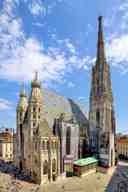
That soaring building ahead with its pointed towers, one shooting up high above the city, and a roof glittering like a patchwork quilt of colorful tiles-yes, that’s St. Stephen’s…और पढ़ेंकम दिखाएँ
That soaring building ahead with its pointed towers, one shooting up high above the city, and a roof glittering like a patchwork quilt of colorful tiles-yes, that’s St. Stephen’s Cathedral! Just look for the dazzling zigzag rooftop and the enormous southern spire: you can’t miss it. Standing here, you are taking in more than eight centuries of Vienna’s most beloved landmark, a place that’s seen crusaders, emperors, everyday Viennese, and arguably even Mozart’s ghost hustle past its massive doors. Imagine: back in 1137, this spot was chosen-not on a quiet field as once thought, but right atop an ancient Roman cemetery. Some very old neighbors lie under your feet-excavators even found graves here from the 4th century. The first church was a humble parish, but Vienna grew so fast, they outgrew four churches in no time. You can almost hear the commotion of the 12th-century construction site as Bishop Reginmar and Margrave Leopold IV figured out where to place this parish church, marking Vienna as a real city for the first time. The cathedral you see now is a patchwork of dramatic stories, fiery disasters, and ambitious dukes. After fires and a whole lot of expansion, the Gothic spire you see-the “Steffl,” as locals affectionately call it-shot up 136 meters and took 65 years to finish. There’s a local joke that it’s so tall that even the clouds must take a detour around it! That spire served as Vienna’s lookout post during the Ottoman sieges, and, believe it or not, there’s even a tiny apartment up there for the night watchmen who would ring the bells if they spotted trouble or a stray fire. Speaking of bells, the cathedral houses a giant called “Pummerin”-the “Boomer”-which weighs over 20,000 kilograms! When it sounds, the whole city listens. This bell is a survivor: it was recast from cannons captured from the Ottomans (take that, invaders!). After World War II, shattered pieces from the old Pummerin were melded into this one, so when the bell tolls, it’s echoing hundreds of years of Viennese courage and a good dose of recycling. Don’t forget to tilt your head and look up at that roof-230,000 glazed tiles create shimmering mosaics: imperial double-headed eagles, the coats of arms of Vienna and Austria-history written in color. The roof’s so steep, when it rains, it gets a good scrub for free; the tiles have been shining ever since (except when air pollution turns bits black, but hey, the restoration crews are on it). Fascinated by numbers? Climb the 256 steps to the spire’s top, and you’ll earn serious bragging rights-and maybe a serious craving for strudel afterwards. At your feet, you’ll find the city’s medieval measurement standards-metal bars that let merchants check the length of their cloth, right on the cathedral wall. And there’s a more macabre detail: the catacombs beneath, packed with the bones of over 11,000 souls, a result of centuries of burials-and the occasional bubonic plague outbreak. Among the honored dead, you’ll find Habsburg dukes and Emperor Frederick III, whose grand tomb took more than four decades to finish. Now, try to spot Vienna’s quirks: by the main door, called the Giant’s Door, there was once a mammoth thighbone hanging above-nothing says “welcome” like prehistoric décor. Look out for “Christ with a toothache” and the playful Fenstergucker, a sculptor peeking from his own window-proof that medieval artists had a sense of humor, too. Inside, the wonders continue, from St. Mary’s famous weeping icon to Mozart’s wedding, kids’ baptisms, and funeral. This was his neighborhood parish! If all these walls could roll their eyes-or maybe tap their foot to a Mozart tune-they’d have plenty of tales. Through fires, wars, and the relentless tick of time, St. Stephen’s Cathedral carries Vienna’s spirit, always watching over the city from its bright mosaic rooftop, rain or shine. If you're curious about the exterior, interior or the conservation and restoration, the chat section below is the perfect place to seek clarification.
समर्पित पेज खोलें →To spot the Stock im Eisen, look at the corner of the large gray stone building right ahead-tucked inside a glass case at street level, you’ll see an old, rough tree trunk covered…और पढ़ेंकम दिखाएँ
To spot the Stock im Eisen, look at the corner of the large gray stone building right ahead-tucked inside a glass case at street level, you’ll see an old, rough tree trunk covered from top to bottom in hundreds of glinting iron nails. Now, are you ready to hear one of Vienna’s most peculiar tales? Picture yourself standing here at the very heart of the city, at the bustling crossroads of Graben and Kärntner Straße, while people and trams whirl past. The Stock im Eisen, which means “staff in iron,” stands quietly at the corner, like a tree plucked from the pages of a medieval fairy tale. Not your everyday tourist attraction, I must say-it’s a 7-foot-tall hunk of spruce wood that’s been completely spiked with iron nails over the centuries! Let’s rewind back to the 1400s. This trunk started growing about 600 years ago-imagine knights, bustling markets, and the odd horse-drawn cart rumbling along the muddy path that became Vienna’s beating heart. It was just a forked spruce outside the city walls. Then, as the legend goes, folks began hammering nails into the live tree. And not just for fun-nails were precious back then. If you’d lost one, you’d probably have to walk all the way to Transylvania to find another! But why all these nails? Well, it’s a bit of a mystery. In the early days, people might have believed that hammering a nail into wood was a way of securing luck, offering thanks for healing, or asking for protection-kind of like tossing coins into a wishing well, except with more hammering and fewer soggy pants. Over time, it became tradition for wandering smiths and apprentices-especially locksmiths, starting around 1715-to add their own nail to the tree, as if to say, “I was here, and I brought my toolbox.” Some even say the Stock im Eisen was the city’s “mythic center,” a sort of magical survey point for Vienna. By the 1500s, people were already writing about it, and by the mid-1800s, this battered bit of wood was covered so thickly in nails you couldn’t squeeze a needle between them. In the 1890s, the grand Palais Equitable rose up around our scrappy relic, and so the tree trunk was carefully tucked behind glass, adorned with wrought iron vines, carvings, and sculptures of apprentices hammering away. Ah, but here’s where the myths and mysteries come in-Vienna wouldn’t be Vienna without a good devilish yarn! According to some old stories, it was the Devil himself who put the trunk in irons, perhaps after an especially naughty locksmith tried to make the world’s most unpickable lock (honestly, seems like overkill). One tale claims the devil guards the trunk to this day, though I doubt he’s unionized. In another, a crafty apprentice who’d pinched a precious nail from his master made a lock so fiendish it could never be opened-except, in real life, the padlock on display is just for show, its insides missing, which is probably more to do with preservation than black magic. There’s also the tall tale that the Stock im Eisen is all that’s left of a great ancient forest, and that every smith who found work in Vienna should honor the memory of some masterful lock by adding a nail of their own. Like many legends, the stories get grander with every telling. A certain Danish journeyman described it in the 1800s, marveling at the nail-clad trunk and the legends that swirled around it. So as you stand in front of this battered, iron-bound relic, picture all the hopeful, determined faces-young apprentices, tired journeymen, mysterious strangers-each leaving a mark on Vienna, one clang at a time. You might not have a nail and hammer handy, but take a moment to soak in the magic and mystery, and remember: not all lucky trees grow in forests-some just grow stories, right here at the city’s heart!
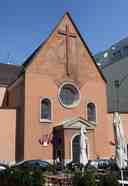
समर्पित पेज खोलें →To spot the Imperial Crypt, look ahead for a salmon-colored church facade with a red cross mounted above a circular window and faded painted figures just under the roof. Alright,…और पढ़ेंकम दिखाएँ
To spot the Imperial Crypt, look ahead for a salmon-colored church facade with a red cross mounted above a circular window and faded painted figures just under the roof. Alright, you’ve found yourself in front of what looks like an unassuming church, but trust me, beneath your feet is one of Europe’s most dramatic royal resting places - the Imperial Crypt. Imagine Vienna in the early 1600s: the city buzzing with horse-drawn carriages, the clang and clatter from the nearby market square, and right here, Anna of Tyrol was hatching a clever plan for her future. She decided she and her husband, Emperor Matthias, deserved something more lasting than just a palace - so in her will, she set aside money to build a crypt and a Capuchin cloister. As fate would have it, she died just a year later, and with her passing, the plan kicked into motion. The first stones went down in 1622, smack in the middle of war and upheaval (you know, just the little distraction called the Thirty Years’ War). Ten years later, the crypt was ready, and a grand ceremony saw the sarcophagi of Matthias and Anna taken downstairs into what’s now called the Founders Vault. The place was dark, plain, and chilly - not exactly a Disney ending, but definitely imperial. But that was just the beginning. As the centuries ticked by, Vienna’s royal family - the Habsburgs - had a habit of expanding, not just their empire, but their burial space! Leopold I, Joseph I, and then Maria Theresa, each added more vaulted rooms. By the mid-1700s, Maria Theresa pushed the crypt out past the church itself and into the monastery garden, capping it all off with a dramatic dome that let sunlight pour into the silence below. Imagine the hushed footsteps on stone, the musty scent of centuries-old metal, and the distant chanting of monks echoing through the air. The Imperial Crypt became the “who’s who” of royal final stops: 12 emperors, 18 empresses, and countless princes and princesses found their last address here. The sarcophagi tell their own tale - some are sturdy and simple, almost as plain as a box, while others are so decked out in bronze, gold, and flourishes you’d think the Habsburgs were holding a rococo parade even after death. Want a bit of a shiver? A few covers weigh as much as a small car! The monks still living upstairs might remind you that dreams of grandeur only last so long. For over 200 years, they’ve kept the crypt’s traditions alive. If you were royalty and you died, your coffin didn’t just roll up. Oh no - your body paused at the chapel doors, where an official knocked, asking admittance for “Emperor so-and-so.” Each time, the monks replied, “We know him not.” Not until the official finally pleaded, “It is only a poor sinner,” did the monks open the doors. Even the grandest ruler gets cut down to size in the end! Of course, time hasn’t always been kind. Damp air, curious visitors, and centuries of change have left scars. In the 1900s, the crypt got a modern twist with air conditioning, careful conservation, and even a new visitors’ route that keeps you from getting lost. Besides the grandeur, it’s a place of fragile memory-delicate bronze, fading silk, the hush of history. So as you stand here, try picturing the scenes below: rows of ornate coffins, guardians tending flickering candles, emperors and empresses resting side by side-for once, no squabbling over the throne! If the Habsburgs were collecting frequent-flier miles for afterlife journeys, they’d definitely be platinum status. And who knows, maybe enough emperors are packed in now that the crypt could compete with Vienna’s best sausage stand for most famous customers! If you're keen on discovering more about the funeral entrance ritual, the sarcophagi or the people buried here, head down to the chat section and engage with me.
समर्पित पेज खोलें →
9 और स्टॉप दिखाएँकम स्टॉप दिखाएँexpand_moreexpand_less
You’ve arrived at the entrance to the iconic Spanish Riding School - or as they call it in Vienna, the Spanische Hofreitschule. Horse lovers, history enthusiasts, and anyone who’s…और पढ़ेंकम दिखाएँ
You’ve arrived at the entrance to the iconic Spanish Riding School - or as they call it in Vienna, the Spanische Hofreitschule. Horse lovers, history enthusiasts, and anyone who’s ever appreciated a horse prancing a bit too proudly: this is your moment. Take a look at those magnificent archways! Right behind them, in the heart of the Hofburg palace, you’ll find one of the world’s most storied arenas where elegance and discipline get mixed with…a good dose of horseplay. Let’s set the scene: you’re standing just a stone’s throw from the Winter Riding School, a hall so majestic you’d expect royalty to burst out at any moment…or at least a very stylish horse. Built between 1729 and 1735 at the command of Emperor Charles VI, this space is all white plaster, gilded stucco, and mirrors. The ceiling soars 17 meters overhead and light drifts through tall windows, casting soft shadows on the sand below. Above the royal box, you’d spot a portrait of Charles VI himself, keeping an eye out for well-behaved horses and any riders with two left feet. The horses you’ll see here are famous Lipizzaners - truly the supermodels of the equestrian world. They’re born in the Piber Federal Stud, which, believe it or not, is in western Styria (not Spain!). So why the Spanish name? It’s all about the horses’ Spanish ancestry, dating back to the 16th century when the Habsburgs wanted fancy horses to match their fancy empire. The breed’s very name hails from the village of Lipica - now Lipizza in Slovenia, which must be the classiest reason anyone has ever named a horse. Now, don’t let these horses’ sophisticated airs fool you - they work hard for their applause. The youngest stallions start their careers at age four, learning how to walk, trot, and canter, all while being praised, pampered, and every now and then, gently reminded not to nibble on any nobleman’s wig. Training is a three-stage journey: first comes Remontenschule, like horsey kindergarten, all about mastering the basics and not tripping over their own hooves. Then, Campagneschule, where they learn more advanced moves and perfect their pirouettes - and yes, horses can pirouette better than some ballroom dancers. Finally, there’s Hohe Schule, which is exactly what it sounds like: horse university, where the bravest and boldest learn the “airs above the ground” - grand leaps that defy gravity and wow the crowds. All these lessons are led by riders in traditional brown tailcoats, bicorne hats, and boots so shiny you could check your hair in them. If you think learning to be a rider is easier than learning to be a horse, think again: new students practice riding without reins or stirrups for up to three years, all to master their balance - which means even the horses get to roll their eyes sometimes. Originally, only men were allowed to train here. But in 2008, the school finally passed the baton - or perhaps the stirrups - to women. Sojourner Morrell and Hannah Zeitlhofer, two trailblazers, passed the rigorous entrance tests and made their own hoofprints on history. Now, when you attend a performance, you’re not just watching dressage; you’re witnessing an art form with roots in military tactics, ancient Greece, and a bit of royal pageantry thrown in for flair. The event starts with the youngest stallions showing off their first steps. Next, four masters perform the most difficult movements you’ll ever see on horseback: pirouettes, piaffes, flying changes - you might even think these horses have magnets in their shoes. It’s a spectacle of tradition and skill, complete with matching uniforms for horses and riders: golden breastplates, red and green saddlecloths trimmed in gold, and perfectly braided tails. Perhaps the idea of horses leaping gracefully through the air seems a bit dramatic - but that’s part of the magic here. The “airs above the ground,” those spectacular jumps, weren’t developed for battle as many believe, but to make sure these horses are as strong in body and mind as they are beautiful. The riders don’t get away with anything less than perfection - even the director’s saddlecloth has three gold bands and matching fringe. Talk about keeping up appearances. From the first click of a hoof in 1565’s wooden arena to today’s grandeur, the Spanish Riding School is a living legend, drawing crowds from around the globe. Their secret? Countless hours of practice, centuries of history, and just a hint of noble mischief. And while you won’t see any dueling knights or fleeing wigs today, you just might witness the world’s finest quadrille, danced by eight of Europe’s most magnificent four-legged dancers. So tip your (imaginary) hat to these stars of the stable - this is horsemanship fit for an emperor and entertainment for us all! Ready to keep trotting to our next royal rendezvous? To expand your understanding of the location, methods or the performances, feel free to engage with me in the chat section below.
समर्पित पेज खोलें →To spot the Hofburg, look for the grand, sweeping curved palace topped with greenish copper roofs and rows of tall windows, facing a wide plaza where a huge statue of a horse and…और पढ़ेंकम दिखाएँ
To spot the Hofburg, look for the grand, sweeping curved palace topped with greenish copper roofs and rows of tall windows, facing a wide plaza where a huge statue of a horse and rider stands proudly in the center-just head toward the equestrian statue, and you’re right in front of it. Now, let me take you on a journey through Vienna’s most dazzling showcase of imperial drama-yes, you’re standing in front of the Hofburg, the “Castle of the Court,” which has watched centuries of power plays, royal intrigue, and maybe even the odd royal with an embarrassing haircut. Imagine the Vienna of the 1200s: muddy boots, flickering torches, armoured knights clanking across drawbridges. Ottokar II of Bohemia started laying the first stones here, building a stronghold that would go on to shape the destinies of empires, with every new ruler tacking on their own flamboyant wing like a competitive game of royal LEGO. The Hofburg didn’t just grow-it sprawled, transforming as the Habsburgs rose from local dukes to emperors of the Holy Roman Empire, then all the way to rulers of Austria-Hungary and beyond. It was always the seat of real power, the winter residence where rules were made and sometimes scandal was stirred. In fact, the palace has expanded so many times, thanks to architects like the Italian Filiberto Luchese and the legendary Baroque master Hildebrandt, that trying to count its windows might cause temporary dizziness-fair warning! Picture the oldest building: the Swiss Wing, once protected by moats and drawbridges-a real “do not disturb” sign if you ever saw one. Not only did knights once patrol its halls, but the treasures of the Holy Roman Empire glittered in its vaults. In one corner, a chapel rings with the sound of the Vienna Boys’ Choir every Sunday, their pure voices echoing through centuries of history. As centuries rolled by, every monarch had a wish-list. The Amalienburg, with its clock-tower, was built for Rudolph II-who, incidentally, had a passion for astronomy, so why not a dome and some gears to keep the cosmos in line? Next to that, the Leopoldine Wing, another Renaissance beauty, which now houses the Austrian president’s offices. It’s rumored the wine cellars beneath these wings once kept the royal parties lively-although some say only half the casks survived the after-parties. Don’t forget the Redoute Wing. Maria Theresia, the party queen herself, transformed an old opera house into grand ballrooms where even Beethoven’s 8th Symphony premiered and the phrase “The Congress dances” was born when Vienna hosted nobility from all corners of Europe. Can you imagine Strauss leading a waltz here? One can almost hear the squeak of the polished dancefloor-or, more likely, the clatter of nervous shoes. Step back and take in Heldenplatz, the Heroes’ Square where you’re standing. In 1938, crowds packed this space as a notorious speech echoed from the palace balcony. But look around-there are quieter heroes too, like the statues of Austrian field marshals, holding the ground against the sweep of history. On the far side, the Neue Burg, or New Castle, showcases turn-of-the-century imperial ambition-so new, it was completed just before the monarchy’s grand finale. Today, you’ll find museums packed with treasures, from armor to ancient musical instruments. If you had an imperial title for every museum in the Hofburg, you’d need a scroll. Today, the Hofburg juggles official state business, glittering events, and tourists like us-a living palace where presidents work, orchestras play, and Viennese balls whirl on into the night. So, as you stand here, remember: you’re at a crossroads of centuries, surrounded by the stories-and maybe a few secrets-of empires past. And if you ever get lost, just follow the nearest imperial mustache or the whiff of schnitzel wafting from a state banquet!
समर्पित पेज खोलें →Right ahead of you is the Graben-a wide, elegant pedestrian boulevard with grand historic facades on both sides, high-end shops at street level, and the remarkable, golden-topped…और पढ़ेंकम दिखाएँ
Right ahead of you is the Graben-a wide, elegant pedestrian boulevard with grand historic facades on both sides, high-end shops at street level, and the remarkable, golden-topped Plague Column rising in the middle like a dramatic exclamation point-just look for the bustling crowds and the ornate monument in the center! Welcome to the Graben, Vienna’s legendary promenade! Picture yourself transported back over 2,000 years-this spot was once the edge of the old Roman settlement, Vindobona. Where you’re walking right now, there used to be a deep ditch, dug in front of the ancient city walls as a defense-hence the name “Graben,” which literally means “ditch”! Now, it’s more fancy promenading and less muddy trench, I promise. Fast-forward to the 12th century, and Vienna’s city plan got an upgrade by the Babenberg Dukes. Their engineers filled in the ditch right here with the help of some rather famous money: ransom paid for none other than Richard the Lionheart! That’s right-an English king literally paid for you to have such a fabulous stroll. Who knew a medieval kidnapping could lead to such stylish shopping? At first, this area wasn’t very posh-think rows of wooden houses, a few fruit stands, and the nagging smell of the Mörung, the local sewage stream. Fire was a constant threat-one epic blaze in 1327 swept through here, prompting a royal rescue mission by King Frederick the Handsome himself. Back then, the residents were mostly Swabians, craftspeople, and a lot of metalworkers in the cramped Schlossergässchen. Apparently, their alley was so narrow that even medieval traffic jams were a hot topic at the local tavern! By the Baroque era, the vibe began to change. As Vienna flourished, the Graben turned into the place to see and be seen. The grand facades you see today started popping up, built by anyone who wanted to show off their wealth-nobles, rich merchants, and more. The Graben became Vienna’s catwalk, where people strolled to show off their finery-and perhaps spot the famous “Grabennymphs,” the city’s most eye-catching ladies of the night. Don’t miss the Plague Column at the heart of the Graben, sparkling in the sunlight. Built by Emperor Leopold I after Vienna survived the Great Plague, it’s both a monument and a thank-you note to the heavens-perhaps the world’s fanciest “Glad That’s Over” card! On either side of you, grand old names of Austrian culture make their mark: the original Freisingerhof-once both a bishop’s pad and an admin HQ-the Trattnerhof, home to a snazzy 18th-century printing baron, and the bold Ankerhaus, which later became a playground for modern artists. Walk a little farther and find the stately Palais Bartolotti-Partenfeld-imagine its baroque halls filled with whispered intrigue and silk rustling. This street has been the scene of every kind of spectacle: processions decked out with incense and banners, emperors parading in golden carriages, open-air markets selling everything from cabbage and bread to rosaries and sausages. Try to imagine the smell of fresh-baked loaves, the chatter of vendors, and the awe-struck faces watching great processions sweep past. By the 19th century, the Graben was right at the heart of the city’s explosive growth-Vienna’s first bus line rumbled through here in 1912, and later the U-Bahn tunneled silently below your feet. Today, the Graben is pedestrian-only, freed from the clatter of cars and filled instead with the sounds of Vienna’s laughter, fashion, and coffee cups clinking at the many cafés. If you feel like an emperor or empress gazing down a boulevard built for memories and grand gestures… that’s entirely on purpose. Just try not to mistake yourself for Richard the Lionheart-after all, you don’t want to leave here owing anyone a hefty ransom! For further insights on the graben as a marketplace, graben as a festival site or the buildings, feel free to navigate to the chat section below and inquire.
समर्पित पेज खोलें →In front of you on Seitenstettengasse, you’ll spot a tall, pale five-story building with rows of windows and a discreet doorway topped with a Hebrew inscription-blink and you…और पढ़ेंकम दिखाएँ
In front of you on Seitenstettengasse, you’ll spot a tall, pale five-story building with rows of windows and a discreet doorway topped with a Hebrew inscription-blink and you might think it’s just another apartment house, but this is the entrance to Vienna’s main synagogue, the Stadttempel. Now, imagine yourself right here on this narrow lane in the early 1800s. The city is alive with the chatter of merchants and the distant ringing of church bells. The Jewish community, experiencing new freedoms thanks to Emperor Joseph II’s Tolerance Edict, dreams of building a synagogue worthy of their hopes. After a few misfires with locations-city officials were picky!-two resourceful men, Michael Lazar Biedermann and Isaak Löw Hofmann, manage to purchase a property. The old building crumbles away, and by 1825, the stage is set for Joseph Kornhäusel, Vienna’s star architect, to create something grand-but with a twist. At that time, laws said non-Catholic houses of worship had to stay hidden. The Stadttempel couldn’t advertise itself; from the street, it had to look like every other building. So, from here you get just a glimpse of the ordinary façade, almost like a secret guardhouse. Inside, though, it’s a whole different story. The real synagogue nestles behind the outer layers-oval, bright, filled with 12 soaring Ionic columns holding up a soaring women’s gallery, topped with a glorious dome. Outside: business as usual. Inside: awe. When the Stadttempel opened in 1826, it quickly became the pulsing heart of Vienna’s Jewish life. Imagine the swirl of community: The men focused on the Torah, the women watching from above, candles flickering, voices rising, filling the dome with melody. One of the very first rabbis, Isaak Mannheimer, was already a legend, and thanks to his suggestion, the famous cantor Salomon Sulzer brought his golden voice here, making music that would echo through generations. But history wasn’t always harmonious. In November 1938, when synagogues across Vienna were set on fire during the terrible Pogrom Night, this one survived-not because of luck, but because the synagogue was so well camouflaged by the buildings that protected it on all sides. Even so, the Nazis stormed inside, ransacked and desecrated the holy space, and used it as a grim waiting hall, trapping the community they’d soon deport. Standing here now, you might sense the weight of memory: in the vestibule, stone tablets bear thousands of names-a granite column cut short stands for a community shattered, but not forgotten. Since 1894, the Stadttempel’s rabbis have also been Vienna’s chief rabbis; their presence marks this synagogue as the beating heart of Jewish spiritual life in Austria. Over the years, the Stadttempel has welcomed mourners, held its collective breath during war and peace, and even displayed the caskets of Theodor Herzl and his family before their journey to Israel. If you ever feared tradition was dull, take note: in 1963, the synagogue was grandly renovated; in 1976, politicians turned up in droves for its 150th birthday. In 1958, the great opera tenor Richard Tucker burst into song here-not opera, but cantorial music, saluting the legacy of Salomon Sulzer with full gusto. I like to think even the stones were humming along. But the synagogue has not only seen celebrations. In 1979 and 1981, terrifying terrorist attacks shattered the peace-grenades and gunfire ripped through what should have been a sanctuary. The scars and the memories linger, and today, police keep a careful eye on the entrance. More recently, in 2020, terror again struck the heart of Vienna nearby, a painful reminder of old prejudices and new dangers. Despite it all, the Stadttempel stands strong-a place where prayers rise, torches of memory burn bright, and each visitor, even those just pausing outside on the cobbles of Seitenstettengasse, becomes part of its unfolding story. Just be careful not to call it a hidden gem-I think it prefers to appear ordinary, until you step inside and feel the extraordinary.
समर्पित पेज खोलें →The Judenplatz is easy to spot thanks to its bold street plaque in black gothic letters, bordered in red, mounted on a crisp white wall-just look straight ahead for the sign…और पढ़ेंकम दिखाएँ
The Judenplatz is easy to spot thanks to its bold street plaque in black gothic letters, bordered in red, mounted on a crisp white wall-just look straight ahead for the sign marking the heart of this square. Welcome to Judenplatz, a place where Vienna’s stories twist together like the oldest city streets, and every corner is bursting with memory. Right now, you’re standing in the heart of the square that was once the epicenter of Jewish life-imagine the clatter of merchants, the laughter of schoolchildren, the gentle hum of scholars as they debated long into the evening. Back in 1150, Jewish settlers arrived alongside the powerful House of Babenberg, and soon this area pulsed with the daily life of a thriving community: bakers, tailors, bankers, and wise rabbis. By 1400, there were around 800 inhabitants behind tightly knit houses whose backs formed a protective wall across 70 homes-almost like Vienna’s first gated community, except instead of a phone entry system, they had four giant gates you didn’t want to slam too loudly. If you could step back just a few hundred years, you’d be in Schulhof-literally the “schoolyard”-so named because the Jewish school stood right here, along with the hospital, a bathhouse, and one of the most important synagogues in all German-speaking lands. Stand still for a second and picture the men and women hurrying in separate entrances for prayer or school lessons, the sound of children’s voices echoing in the air. But, history here wasn’t always so cheerful. Let’s fast-forward to 1421-the square’s darkest chapter. The air must have been heavy with fear as Duke Albrecht V turned against the Jews in a terrifying pogrom called the Vienna Gesera. Imagine the iron gates clanging shut as families barricaded themselves inside their beloved Or-Sarua synagogue for what became a desperate three-day siege of hunger and thirst. There’s an old chronicle-half-heard whisper, half-horror story-that tells how Rabbi Jonah, rather than surrender his flock to forced baptisms, torched the synagogue so the people could choose their own fate. Outside, chaos boiled until, on one dreadful day, the survivors were led away and burned alive in Erdberg. The Duke claimed no Jew would ever live here again, but history has a way of laughing at such claims-by the seventeenth century, a new Jewish quarter thrived elsewhere in Vienna. For close to 600 years, layers upon layers of lives were built, lost, and remembered here. Now, in the center of the square, stands the Judenplatz Holocaust Memorial. Don’t be fooled-it’s not just a block of concrete. British artist Rachel Whiteread designed it to look like a library with its books forever locked away, their spines turned inward-stories untold, names lost, a silent tribute to Austria’s 65,000 murdered Jews. See if you can find the names of the 41 places where they met their terrible fate, engraved around its plinth. There’s even a bit of irony: this memorial looks like a room turned inside out, facing its own mysteries and memories rather than granting easy entry. Right beside you is the Misrachi-Haus-a branch of the Jewish Museum Vienna. Underneath your feet, archaeologists uncovered the foundation of one of Europe’s biggest medieval synagogues, its stones still holding the secrets of centuries past. Inside, you can stand where people once prayed, taught, and debated, and read names and life stories preserved in computer archives. All of this is guarded over by a rather philosophical fellow: the bronze statue of Gotthold Ephraim Lessing, standing in the southern part of the square. Lessing, whose “Ring Parable” in “Nathan the Wise” was all about tolerance, wound up here eventually after his statue survived being melted down for weapons by the Nazis-talk about a philosopher with staying power. And let’s not forget the palatial presence of the former Bohemian Court Chancellery, now home to Austria’s Supreme Administrative Court. Cast your eyes upwards to spot allegorical figures of virtues, coats of arms, and even an angel with a trombone-clearly, even justice in Vienna knows how to make an entrance. You stand now in a place where joy, tragedy, and the everyday have played out for centuries-a square that remembers, teaches, and even smiles at history’s twists. Don’t hurry away: every corner has a story to tell. If you're curious about the vienna gesera, holocaust memorial or the misrachi-haus, the chat section below is the perfect place to seek clarification.
समर्पित पेज खोलें →Imagine stepping back to the late 1800s. Vienna is bustling with horse-drawn carriages, diplomats in top hats, and the faint jingle of emperors’ coins in grand coffeehouses. The…और पढ़ेंकम दिखाएँ
Imagine stepping back to the late 1800s. Vienna is bustling with horse-drawn carriages, diplomats in top hats, and the faint jingle of emperors’ coins in grand coffeehouses. The empire is huge and diverse, and arguments about who rules what aren’t just dinner table drama-they’re full-blown national squabbles. So, in 1867, the Austrians created the Reichsgericht, a court designed to make sense of who had the final say. In fact, the first noisy hearing of the court took place in 1869, with a solemn team of 14 members, some picked by the Kaiser, others by parliament. Probably safer than picking them by roll of the dice. Fast forward to the shaky days after World War I. Empires were falling like dominoes, streets were buzzing with revolution, and Austria turned into a new republic-literally decided just days after the collapse of the monarchy, in 1918. The legal world needed a makeover, too. Enter Hans Kelsen, Austria's answer to Sherlock Holmes meets Atticus Finch. He and his pals drew up the plans for a brand-new Constitutional Court, which officially took over in 1919, passing the torch from the old empire's court. Kelsen was so clever he got called the "spiritual father" of the court, but like many geniuses, he wasn’t always appreciated. With a few pen strokes-and some daredevil legal moves-the court kept getting stronger, able to check if new laws were playing fair. But here comes the plot twist: in the roaring ’20s, court members were often politicians, not always judges. By 1929, folks realized this was a bit like inviting your own mother to judge a pie contest-so the rules changed. Only real legal pros with years on the job were allowed, and they couldn’t serve in government at the same time. This move made the court truly independent. Now let’s add a dash of tension. The 1930s in Austria got stormy. Parliament collapsed, democracy was on shaky ground, and the government feared the court might block their emergency laws. The solution? Not a fair debate-nope, the government simply made a rule letting judges resign so fast that the court couldn’t make decisions, like pulling all the referees out in the first half of a football match. By 1934, the court was gone, replaced by a strictly government-friendly body. When the Nazis took over in 1938, Austria’s high court was just a shadow. After World War II, the spirit of justice got a reboot. By 1945, Austria came back together as a republic. The Constitutional Court revived, leaner but ready, handling everything from squabbles about cremation (yes, really) to mysterious cases like the Sever marriages, where it decided only administrative officials could rule on “dispense” marriages-sorry, nosey judges. Over time, the court regained its bite, moving finally in 2012 to a former bank building near the Freyung-because even justice needs a stylish headquarters. And what about now? The court not only protects constitutional rights but also decides disputes between officials and even checks if laws are written in the spirit of fairness. In 2018, for the first time ever, a woman, Brigitte Bierlein, became court president-then she was promoted again to Austria’s first female chancellor, which probably made lawyers and feminists cheer from their balconies. So, as you stand here, picture those echoing marble halls. Imagine nervous politicians, visionary lawyers, and the steady tick of history inside. The courtroom drama continues-only here, the suspense never really ends. And remember: in Austria, even the lawmakers don’t always get the last word. Sometimes, it’s the judges in this very building who bring down the gavel. Case closed! Interested in knowing more about the significant findings of the constitutional court, organization or the competencies
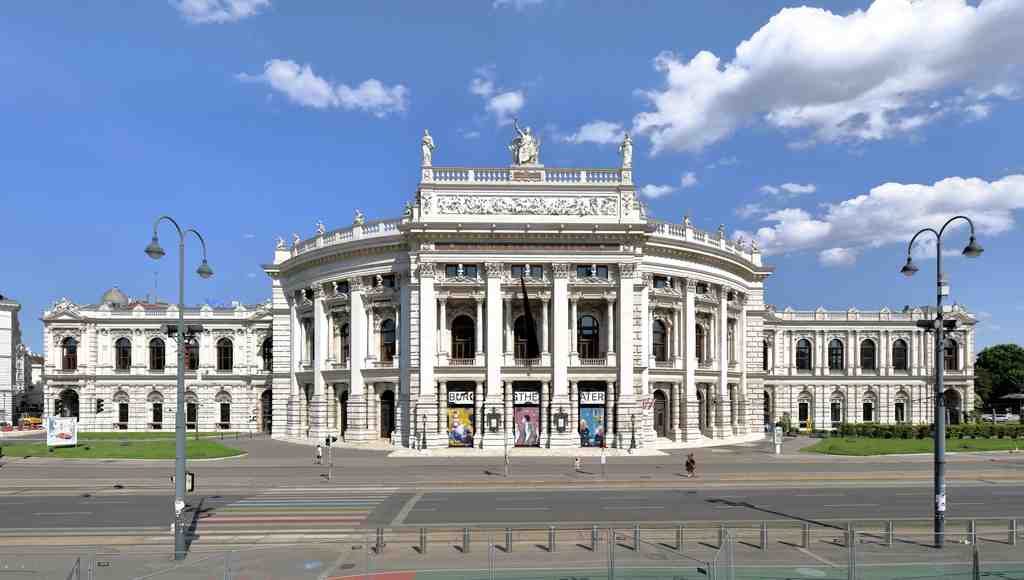
समर्पित पेज खोलें →Looking ahead, you can't miss the enormous white building with grand columns, ornate statues lining the roof, and a rounded facade that looks almost like a crown-this is the…और पढ़ेंकम दिखाएँ
Looking ahead, you can't miss the enormous white building with grand columns, ornate statues lining the roof, and a rounded facade that looks almost like a crown-this is the legendary Burgtheater, right on the Ringstraße! Imagine Vienna in the 1700s, the city humming with the rhythm of horse-drawn carriages and elaborate gowns brushing statuesque archways. In 1741, Empress Maria Theresa decided the city needed more than just music and pastries-she wanted a world-class theater alongside her dazzling palace! The Burgtheater’s first home was actually an old tennis court-yes, right where the royals once sweat it out swinging rackets, soon enough the clatter of tennis balls was replaced by the roar of laughter, applause, and tragic sighs. The “K.K. Theater an der Burg,” as it was known, quickly won over the Viennese. It was so beloved it simply became “die Burg.” This place didn’t just host plays-it set the style for German-language theater for centuries. And let me tell you, any playwright with dreams of immortality wanted their script here. No wonder Mozart himself chose this stage to premiere “Die Entführung aus dem Serail,” “Le nozze di Figaro,” and “Così fan tutte.” Imagine hearing Figaro’s famous aria here for the very first time! Not to be outdone, Beethoven unwrapped his very first symphony to the world in this hallowed hall, bringing the place down with a symphonic bang that is still talked about by music lovers today. The Burgtheater was always a bit dramatic with its addresses. Its first building was snug up against the Hofburg Palace, opposite St. Michael’s Church. But as Vienna grew, so did the theater’s ambitions. By 1888, it had this new address, right here on the grand Ringstraße, in a sparkling palace designed by Gottfried Semper and Karl von Hasenauer. The old location made way for a shiny new palace wing. And just like any theater worth its salt, the Burgtheater has seen its share of drama offstage, too. During World War II, the theater endured tragedy. In 1945, American bombs shattered its grandeur, and just a month later, fire swept through what was left. For years, the only sounds inside these walls were the whispers of old costumes and dusty scripts. But Vienna said “No, the show must go on!” and rebuilt the Burgtheater, reopening in 1955, determined to reclaim its sparkle and spirit. For years, the stage was famous, even infamous, for a tradition so pronounced it inspired its own kind of speech-actors trained here even sounded a bit “Burgtheater!” Its ensemble has numbered some of the best actors anywhere: from Klaus Maria Brandauer and Andrea Clausen to Bruno Ganz and Tamara Metelka, their names now carved in marble on the grand stairways, just in case you ever doubted you were treading sacred theatrical ground. The Burgtheater didn’t stay stuck in the past, though. By the 1970s, it became the cool kid on the European theater scene-directors like Peter Hall and Thomas Vinterberg shook things up, and playwrights such as Thomas Bernhard and Elfriede Jelinek brought modern zing to Viennese drama. It’s a place of tradition and reinvention, where the ghosts of Mozart and Beethoven wink mischievously as Europe’s new stars strut onto stage. The next time you find yourself lost in a story, remember that this grand white palace has heard everything: booming symphonies, thunderous applause, and even, on occasion, a muffled yawn during a long monologue. That’s showbiz!
समर्पित पेज खोलें →Directly in front of you is a long, stately stone gateway stretching across the road with five grand rounded arches and blocks of pale stone - just look for the impressive…और पढ़ेंकम दिखाएँ
Directly in front of you is a long, stately stone gateway stretching across the road with five grand rounded arches and blocks of pale stone - just look for the impressive inscription gleaming in gold above the arches and you’ll know you’ve reached the Outer Castle Gate. Now, let’s travel back in time for a moment - I promise there are no dragons, but there’s definitely enough drama for a Hollywood film! Picture yourself standing here centuries ago, with the mighty city walls of Vienna rising up and this gate, called the Äußere Burgtor or the "Heldentor" - the Gate of Heroes - acting as the grand entrance between the bustling Ringstraße and the grand Heldenplatz. Originally, the old gate stood a little closer to the Imperial Palace and was built back in 1660 as a part of Vienna’s fortress. It endured the chaos of the Second Turkish Siege in 1683, where cannons thundered and defenders held their breath, waiting to see whether the city would stand or fall. But, as fate and French artillery would have it, Vienna’s fortunes took another wild turn in 1809. Napoleon’s soldiers, probably having a bad day, decided to blow up this very gate - and they did a thorough job! Imagine the explosion echoing off the palace walls, a dramatic insult hurled right at the seat of the emperor, even if, by then, city walls weren’t very useful in battle anymore (a bit like trying to use a chocolate teapot in a rainstorm). Yet, Vienna knows how to rebuild. By 1821, on these foundations sprang up the very gate before you, designed by architect Peter Nobile. And here’s a fun bit: Emperor Franz I thought the original design was a bit too tall for his taste. So, after some imperial frowning and a little architectural meddling, the gate took its final elegant form-built with strong local stones and carefully crafted by the hands of Austrian soldiers themselves. This gate wasn’t just about keeping people in or out. Right from its inauguration on the anniversary of the huge Battle of Leipzig in 1824, it stood as a monument to the bravery and sacrifice of Austria’s soldiers. Look up, and you’ll spot golden letters honoring Emperor Franz I, and a little further down, a Latin phrase: LAURUM. MILITIBUS. LAURO. DIGNIS.-or, in easier words, “Laurels for those soldiers worthy of laurels.” The laurel wreaths in gold in the center? Those were added after World War I, part of a city-wide fundraising action for war widows and orphans - people across the empire donated, and their names were immortalized one little leaf at a time. As you walk through, take a deep breath: you’re passing a living memorial. In the 1930s, the central part of the gate was transformed into an open-air Hall of Honor under the sky, commemorating the fallen heroes of the First World War. Inside, tucked away from the city’s busy rhythm, there’s even a solemn crypt that once held books listing the names of those lost-each page turned daily, a quiet gesture of remembrance. But Vienna’s Gate of Heroes has seen its fair share of controversy too. During the Nazi era, it was drawn into pompous political marches, its central passage used for showy displays, and rival monuments erected and removed in a game of political musical chairs. To the south, just beside the gate, you’ll spot a striking modern steel cross-the Papal Cross-marking the spot where Pope John Paul II spoke to thousands in 1983. To the north, a monument honors police and gendarmes lost in the line of duty. So imagine: soldiers with muskets, French artillery, imperial parades, grieving families, Nazi wreaths, and even the Pope, all sharing this patch of ground throughout history. The footsteps echoing through these arches belong not just to tourists and traffic, but to the whole grand, tangled story of Vienna itself. And now, today, you - the latest chapter, passing through the Gate of Heroes. Now, onward to our final stop-Vienna’s treasure trove of curiosity and wonder, the Natural History Museum! For a more comprehensive understanding of the heroes' gate, environment or the post-war period and reorganization of the crypt in the heldentor, engage with me in the chat section below.
समर्पित पेज खोलें →You’re now facing an enormous Renaissance-style building crowned by a large green dome, with a bronze statue of the Greek sun god Helios on top-just look for the palace-sized twin…और पढ़ेंकम दिखाएँ
You’re now facing an enormous Renaissance-style building crowned by a large green dome, with a bronze statue of the Greek sun god Helios on top-just look for the palace-sized twin to the Museum of Fine Arts across the square, and you’ve got it. Imagine Vienna in the late 1800s, teeming with curious minds and scientific explorers, when Emperor Franz Joseph I decided he wanted to give the city-and the world-a palace for nature itself. The Natural History Museum before you is no ordinary museum; it’s a temple dedicated to the marvels of our planet and the wonders waiting to be uncovered. Designed by Gottfried Semper and Carl Hasenauer, this astonishing structure took a decade to construct. Its ornate façade, brimming with mythological figures and statues, boasts a golden inscription just below the dome honoring the “realm of nature and its exploration.” And don’t forget to look up: the sun god Helios is forever watching Vienna from atop the building, ready to give you a tan even on cloudy days. Let’s rewind a bit further for some real-life Indiana Jones adventures-just with fewer snakes and more monocles. It all began with Emperor Francis I in 1750, who, in a move that would make any collector’s heart skip a beat, purchased the world’s largest natural history collection from Jean de Baillou. Picture crates upon crates filled with dazzling minerals, fossils that once rattled through prehistoric jungles, exotic shells, and even snails that could win a beauty pageant among mollusks. The emperor wasn’t content with just collecting-he wanted to bring the world to Vienna. He sponsored the first ever scientific overseas expeditions, sending botanist Jacquin to the Caribbean and South America. Jacquin returned after facing sweltering jungles and stinging insects, bearing crates of strange plants, live animals, and 67 cases filled with mysterious treasures. After the emperor’s death, his wife Maria Theresa gifted the collection to Austria’s people, making this the first museum in Vienna where everyone could see nature’s treasures-essentially the Netflix of the 18th century (minus the pixelation). Under Maria Theresa’s direction and the sharp eye of mineralogist Ignaz von Born, the cabinet of curiosities grew into a cutting-edge research center. Bizarre meteorites from mysterious lands, dazzling gems, and all manner of rare rocks poured in from around Europe. But the adventures didn’t stop there! In the 19th century, the museum’s scientists boarded ships bound for the Brazilian rainforest, collecting animals, plants, and minerals while swatting away clouds of relentless mosquitoes. The most epic tale belongs to the SMS Novara expedition-a globe-circling scientific trip in the 1850s where researchers like Ferdinand von Hochstetter came back with armfuls of glowing minerals, animal specimens, and sketches of never-before-seen creatures. And if you like your science with a side of danger, picture the Austro-Hungarian North Pole expedition: a crew traversing frozen wastelands, sledding across the ice, salvaging scientific treasures in metal cases as their ship, the Admiral Tegetthoff, creaked dangerously beneath the weight of the Arctic. Inside, the museum sprawls across 39 exhibition halls-yes, 39-displaying everything from giant geological crystals to ancient human skulls, rare gemstones to dinosaur bones. It’s like a naturalist’s version of a candy store, except licking the exhibits isn’t allowed! The historic display cabinets, crafted from dark wood over a century ago, remain almost exactly as they were when the museum opened in 1889. On the mezzanine level, hundreds of glittering minerals sit beside meteorites that once blazed across the sky, while upstairs, you’ll travel “up the evolutionary ladder” from the simplest microbe to mighty mammals and (at the end, as the grand finale) our closest relatives, the primates. Above the grand staircase, take a moment-though maybe not too long, or you’ll block traffic-to admire the 100-square-meter ceiling painting by Hans Canon. It shows the endless cycle of life: humans hunting giant catfish on one side and nature taking its turn on the other. There’s even a man holding an hourglass-perhaps a gentle reminder to spend a bit less time on your phone and more time enjoying the wonders all around. Throughout its history, the museum has welcomed hundreds of thousands of visitors, endured the rise and fall of empires, and-fun fact-once bartered slices of meteorites and precious stones just to buy new specimens (so don’t ask about buy-one-get-one-free amethyst deals at the gift shop). It remains a center for world-class research, with 30 million scientific objects behind the scenes and more than 60 scientists on a daily quest to solve the mysteries of our planet. So, whether you’re enchanted by sparkling gems, fascinated by prehistoric monsters, or just looking for inspiration while standing under Helios’ watchful gaze, the Natural History Museum invites you to explore nature’s grandest stories-one display case at a time. Exploring the realm of the directors, the building or the exhibition area? Feel free to consult the chat section for additional information.
समर्पित पेज खोलें →
अक्सर पूछे जाने वाले प्रश्न
मैं टूर कैसे शुरू करूँ?
ख़रीदारी के बाद, AudaTours ऐप डाउनलोड करें और अपना रिडेम्पशन कोड दर्ज करें। टूर तुरंत शुरू करने के लिए तैयार होगा - बस प्ले टैप करें और GPS-गाइडेड रूट का पालन करें।
क्या टूर के दौरान मुझे इंटरनेट चाहिए?
नहीं! शुरू करने से पहले टूर डाउनलोड करें और पूरी तरह ऑफ़लाइन इसका आनंद लें। केवल चैट फ़ीचर को इंटरनेट की ज़रूरत है। मोबाइल डेटा बचाने के लिए WiFi पर डाउनलोड करने की सिफ़ारिश है।
क्या यह एक गाइडेड ग्रुप टूर है?
नहीं - यह एक सेल्फ-गाइडेड ऑडियो टूर है। आप अपनी गति से स्वतंत्र रूप से खोजते हैं, आपके फ़ोन से ऑडियो कथन बजता है। कोई टूर गाइड नहीं, कोई ग्रुप नहीं, कोई शेड्यूल नहीं।
टूर में कितना समय लगता है?
अधिकांश टूर पूरा करने में 60-90 मिनट लगते हैं, लेकिन गति पूरी तरह आपके नियंत्रण में है। जब चाहें रुकें, स्टॉप छोड़ें, या ब्रेक लें।
अगर मैं आज टूर पूरा नहीं कर सकता/सकती तो?
कोई समस्या नहीं! टूर की लाइफ़टाइम एक्सेस है। जब चाहें रोकें और फिर शुरू करें - कल, अगले हफ़्ते, या अगले साल। आपकी प्रगति सेव रहती है।
कौन सी भाषाएँ उपलब्ध हैं?
सभी टूर 50+ भाषाओं में उपलब्ध हैं। अपना कोड रिडीम करते समय अपनी पसंदीदा भाषा चुनें। नोट: टूर जेनरेट होने के बाद भाषा बदली नहीं जा सकती।
ख़रीदारी के बाद मैं टूर कहाँ एक्सेस करूँ?
App Store या Google Play से मुफ़्त AudaTours ऐप डाउनलोड करें। अपना रिडेम्पशन कोड (ईमेल द्वारा भेजा गया) दर्ज करें और टूर आपकी लाइब्रेरी में दिखेगा, डाउनलोड और शुरू करने के लिए तैयार।
अगर आपको टूर पसंद नहीं आया, तो हम आपकी ख़रीदारी वापस करेंगे। हमसे संपर्क करें [email protected]
सुरक्षित चेकआउट