
ब्लुडेंज ऑडियो टूर: ट्रेनें, वस्त्र और कालातीत पत्थर की कहानियाँ
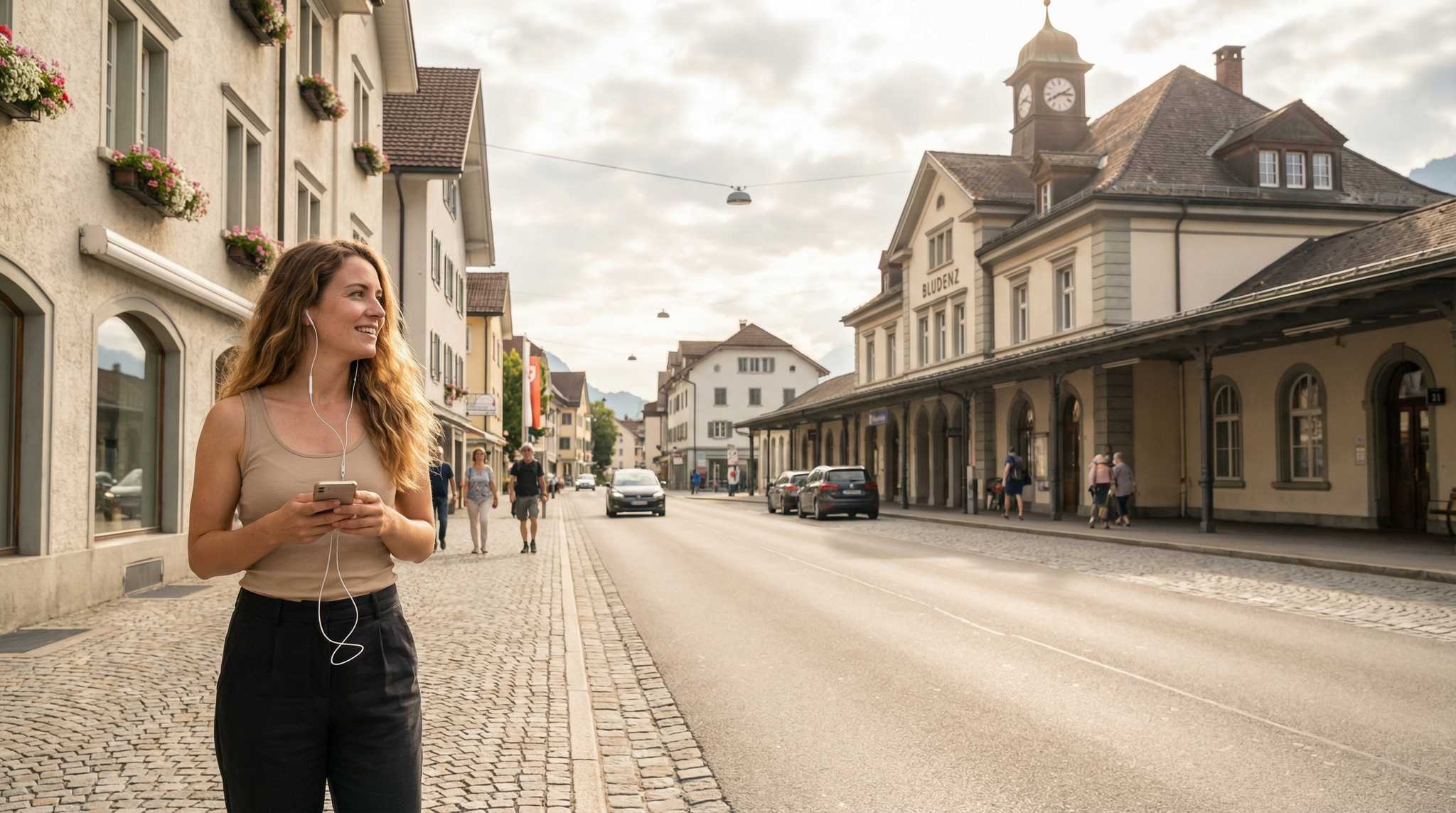
ब्लुडेंज के आकर्षक शहर का अन्वेषण करें, जहाँ इतिहास नवाचार से मिलता है। अपनी यात्रा ब्लुडेंज के केंद्र से शुरू करें, इसकी सुरम्य सड़कों और आरामदायक माहौल में डूब जाएँ। गेट्ज़नर टेक्सटाइल की यात्रा के साथ शिल्प कौशल की दुनिया में गोता लगाएँ, प्रीमियम कपड़ों के पीछे की कला की खोज करें। अंत में, ब्लुडेंज रेलवे स्टेशन के स्थापत्य आकर्षण और हलचल भरी ऊर्जा की प्रशंसा करें, जो शानदार अल्पाइन क्षेत्र का आपका प्रवेश द्वार है। यह दौरा संस्कृति, उद्योग और प्राकृतिक सुंदरता का एक आदर्श मिश्रण प्रदान करता है जो आपको प्रेरित करेगा।
टूर पूर्वावलोकन
इस टूर के बारे में
- scheduleअवधि 30–50 minsअपनी गति से चलें
- straighten3.1 किमी पैदल मार्गगाइडेड पथ का पालन करें
- location_on
- wifi_offऑफ़लाइन काम करता हैएक बार डाउनलोड करें, कहीं भी उपयोग करें
- all_inclusiveलाइफ़टाइम एक्सेसकभी भी, हमेशा के लिए फिर सुनें
- location_onब्लुडेंज रेलवे स्टेशन से शुरू होता है
इस टूर के स्टॉप
To spot the Bludenz Railway Station, look for a long, bright ÖBB-red building with white window trim and a distinctive group of roofed entrances stretching along Bahnhofplatz 3,…और पढ़ेंकम दिखाएँ
To spot the Bludenz Railway Station, look for a long, bright ÖBB-red building with white window trim and a distinctive group of roofed entrances stretching along Bahnhofplatz 3, right behind a busy bicycle stand. Welcome to the beating heart of Bludenz’s travel network! As you stand here outside this strikingly red station building, just imagine the hum of excitement that has pulsed through these walls since 1872. On this very spot, locals once gathered to gape at the first trains rolling in from Lindau, a spectacle that must have felt as futuristic as spaceships landing in your back garden today. Breathe in deeply; you might even catch a faint ghost of coal smoke in the air-or maybe that’s just someone burning toast at the station café. Now, picture this: it’s a brisk morning in the late 1800s, and the station is just a single-story building with one special upstairs bit perched right in the middle. Trains from Lindau trundle to a halt here, the end of the line for many-until the great expansion of 1884, when the Arlbergbahn opened up. Suddenly, Bludenz wasn’t just a sleepy terminus anymore, but a busy thoroughfare whipping passengers east and west through the mountains. You might say Bludenz was no longer the last stop on the line, but a junction where stories began, ended, and overlapped-sometimes with a bit of slapstick confusion as the Austrian state railway and private companies played tug-of-war over the tracks! The station has grown up along with Bludenz. Imagine the excitement and tension as railway workers scrambled in 1925 to prepare for the daring new age of electric trains, with the click and buzz of new equipment everywhere. There’s a twist though: the Montafonerbahn, which ran on direct current, suddenly found its trains powerless, like stubborn mules refusing to budge into the station. For nearly fifty years, strange hybrid locomotives and auxiliary engines puffed and wheezed their way in-a bit like trying to do a relay race with someone on a scooter and someone else on rollerblades! This chess game of technology finally ended in 1972, when the railway voltage was unified and trains could glide smoothly in and out. If you look up at the rooftops, you’re seeing layers of history-first classic styles, later topped with the handsome hipped shapes you see today, all dressed up in their "ÖBB Red" since 2015. This was the era when waiting halls bustled, the clatter of ticket machines mixed with laughter from the railwaymen’s canteen, and station staff zipped through secret doors and hidden passageways. The glass-and-steel structure over your head is much younger but works like a modern umbrella for the entrance-and if you step to your left, you’ll see the Rätikoncenter from the 1990s, now home to everything from bakeries to a Chinese restaurant. Around you stretches a rail yard vast as a small kingdom-200 hectares of crisscrossing tracks, bustling both with sleek passenger trains and cargo cars rattling off to points unknown. In the 1980s, a new container terminal opened up, bringing with it the industrial hum of liquid and powder cargoes being shifted in towering stacks. The grand old freight yard saw a little less action once the Ludesch shunting yard eased its load in 2015, but the station kept evolving-most recently in 2020, opening a shiny new apprentice workshop where future railway whizzes learn their craft. Give a wave to the city buses gliding past-some heading towards the Rätikoncenter, others looping by the historic façade. Taxis perch nearby, ready to whisk passengers into the Alps or down to the city center. Listen: at any moment, a Railjet bound for Vienna or Zurich might rumble through, or perhaps a night train heading all the way to Prague will slip quietly past as dusk falls over the mountains. So here you are, standing in front of a living time machine. The bikes clatter, voices echo, and trains come and go, each promising new adventures. And just for fun, if you ever lose your luggage in this maze of history, don’t worry-you’re walking in the footsteps of century’s worth of forgetful travelers, and I’m sure you’ll find your suitcase somewhere between the waiting hall and the back shop! To expand your understanding of the layer, structure or the environment, feel free to engage with me in the chat section below.
समर्पित पेज खोलें →To spot Bad Fohrenburg, look for a long, yellow building with arched windows and a tiled roof, standing right across the street with the dramatic mountain backdrop behind…और पढ़ेंकम दिखाएँ
To spot Bad Fohrenburg, look for a long, yellow building with arched windows and a tiled roof, standing right across the street with the dramatic mountain backdrop behind it. Alright adventurer, ready to dive into a story that’s all about mystery, healing waters, and a pinch of Bludenz humor? Take a breath of that crisp mountain air as you gaze at Bad Fohrenburg. Imagine it’s the mid-1800s-the air is thick with the scent of trees and the ever-present possibility that someone around you might be soaking their toes in healing water, hoping to leave their aches, pains, and maybe even their mother-in-law’s complaints behind. But let’s rewind-long before this sturdy yellow building existed, the locals in a part of town called Hinterplärsch discovered something curious bubbling up from the earth: a cold sulfur spring. Now, nothing says “cozy spa day” quite like the gentle aroma of rotten eggs, right? But believe it or not, people flocked here, convinced these waters could work miracles. There were ramshackle bath huts set up-nothing fancy, just some planks and a bathing bucket or two, perfect if you didn’t mind brushing elbows with your neighbors… and probably a goat. By the mid-1500s, being the bath master at this spot was an actual job, and anyone who dared to enjoy the healing soak had to pay a “bath tax”-yes, even centuries ago, you couldn’t escape fees. Word spread about these magical waters, and people from all walks of life hiked, trundled, and maybe even got lost along muddy paths for a chance at wellness nirvana. Fast forward to the Biedermeier period, and those creaky huts were finally torn down. In 1838, someone had a bright idea to build a proper bathhouse right here, on the main road. The healing water had to travel 1.2 kilometers in a pipe-a journey so epic, you’d wonder if the water arrived with more stories than minerals. A local legend, Basil Beiser, ran the place as innkeeper and justice of the peace-a man who could soothe your sore muscles and settle your disputes! But as the years rolled toward the twentieth century, the bathing craze fizzled out. The sulfur spring was snapped up by the Fohrenburg Brewery in 1880-imagine, water that once bubbled up for health now destined to help brew beer. So, if you ever taste the local brew, just remember, you might be sipping a drop of Bludenz’s old healing magic. Not a bad story to tell around the table, right? And hey, if anyone asks why you’re grinning at this yellow building, just say you’ve finally found the fountain of youth-right here in Bludenz.
समर्पित पेज खोलें →You can almost hear the early sounds of industry as they install their brand-new steam brewing system from Prague for the first time. Imagine the excitement as the very first…और पढ़ेंकम दिखाएँ
You can almost hear the early sounds of industry as they install their brand-new steam brewing system from Prague for the first time. Imagine the excitement as the very first batch is brewed in February 1881, its aroma wafting out onto the cold Bludenz air. By the end of that year, Fohrenburg beer was being served for the very first time, and locals raised their glasses to celebrate a new era. This was just the beginning - that initial brewing system was almost too small from the start! Just one year later, a new system from Stuttgart had to be brought in, and fermentation cellars were expanded to quadruple production. Talk about growing pains! But Fohrenburg wasn’t about to let anything slow it down. Here’s a fun fact: in those early years, the brewery actually kept about sixty cattle and oxen on site, mainly to use up the leftover grain from brewing. They even used the oxen to transport beer around town! If anyone asks you why the cows in Bludenz always look so happy, now you know. Jump forward a few years: 1884 sees the very first bottles of Fohrenburg beer rolling off the line, and by 1895, production has soared to nearly 39,000 hectoliters a year. The appetite for beer keeps growing - by 1904 they’re already at over 41,000 hectoliters. The brewery keeps expanding, vaults get bigger, and two types of beer are brewed: a dark, Bavarian-style, and a pale, pilsner-style. When people say ‘something for everyone,’ they mean it. The founder, Ferdinand Gasser, remained the driving force until his passing in 1926. His lead brewmaster, Josef Buß, dedicated his career to perfecting the taste and eventually retired in 1907. That’s devotion - or perhaps he just liked the free samples. In 1912, Fohrenburg entered the age of refrigeration, installing a modern cooling plant using artificial ice. Imagine the relief on a hot day, if your beer was *actually* cold and not just wishfully lukewarm. By 1913, the brewery acquired its first delivery truck, a true innovation. No more slow beer deliveries by ox! Of course, history wasn’t always smooth - during the 1920s, the Austrian beer cartel put pressure on brewers, cutting production, but Fohrenburg survived, outlasting many rivals. As decades passed, Fohrenburg didn’t just rest on its laurels, or its hops. By the late 20th century, production rocketed past 150,000 hectoliters and, eventually, a massive 270,000 hectoliters a year. The product lineup grew: in the 1930s, they acquired Diezano, a lemonade brand - because sometimes you need a break from beer too. Fast-forward again: in 2019, they teamed up with Bio Vorarlberg to launch a local organic beer, using barley grown right here in Vorarlberg. Ownership changed hands too: originally local, then part of Rauch juice, and from 2019, joining the Heineken family through Brau Union Österreich. By 2025, Brau Union AG owned almost every drop of Fohrenburg - 99 percent! You might say the unicorn on their logo (designed in 1929 by artist Konrad Honold) really brought them good luck. The unicorn has become a symbol of Bludenz itself, standing for wild power, resilience, and - believe it or not - pure-hearted innocence. Not every beer can claim a magical creature as its mascot! So next time you raise a Fohrenburg, remember the generations who’ve brewed here, the steam and the cattle, the trucks and the unicorns, and join a tradition that’s been going strong for nearly a century and a half. Cheers to history, and cheers to you for being curious enough to stop by!
समर्पित पेज खोलें →
8 और स्टॉप दिखाएँकम स्टॉप दिखाएँexpand_moreexpand_less
To spot Gayenhofen Castle, look ahead for a large, eye-catching pink building with rows of neatly lined windows and a decorative stone doorway; its grand, symmetrical façade…और पढ़ेंकम दिखाएँ
To spot Gayenhofen Castle, look ahead for a large, eye-catching pink building with rows of neatly lined windows and a decorative stone doorway; its grand, symmetrical façade stands proudly just above the city, framed by leafy trees and a set of flags. Now, let me whisk you back through time! Imagine yourself standing here, centuries ago, with the brisk mountain breeze swirling around your cloak and the faint sound of bells from the nearby St. Lawrence Church. Where this striking pink castle now stands, there was once a mighty medieval fortress-built between 1222 and 1245 by the Counts of Werdenberg, who clearly wanted to make sure no one could sneak up on them during dinner. Back in those days, Bludenz wasn’t just a charming town; it was a fortified stronghold that could stand shoulder to shoulder with places like Bregenz and Feldkirch. Picture medieval guards patrolling the walls, merchants haggling in the bustling square below, and maybe, if you were lucky (or unlucky), a nobleman like Count Albrecht III himself staring down at you from one of the tower windows. The castle witnessed feuds and fire-quite literally! In 1491, flames swallowed the old fortress, leaving just smoldering stones and, I imagine, a lot of very dramatic storytelling. Fast forward to the 18th century, when a certain Franz Andreas von Sternbach waltzed in, fresh off building a fine castle in South Tyrol. He didn’t need any big-shot architects-just a loyal crew, some experienced local builders, and, as legend would have it, a stone mason who’d already expanded the neighboring St. Lawrence Church. In 1746, the castle you see was born anew, crafted from the very stones of its smoldered ancestor. Picture the day they laid the foundation: capuchin friars, the local priest, and a whole bevy of dignitaries-all probably wondering if their new castle dreams would actually come true. Over the centuries, Gayenhofen Castle saw more costume changes than a theater star. The city bought it in 1936, and it later became the official government offices-a palace for paperwork! And just recently, the castle garden, nestled on the hillside below, was revived after twenty years tucked away behind closed gates, its walls restored and its paths again buzzing with quiet footsteps. Now, the grounds host small cultural events-imagine concerts beneath the stars or a quiet picnic, with the castle as your pink-hued backdrop. So, whether you’re here chasing history, sniffing out secrets, or just looking for a perfect picnic spot, know that you’re standing where medieval drama, fiery disaster, and renewal have all left their mark. And if you listen closely, you might just hear a whisper from Gayenhofen’s colorful past fluttering between the windows!
समर्पित पेज खोलें →Look up the steep hill to your left and you’ll spot a tall, pale church with a dramatic tower topped by a dark onion dome-like the world’s fanciest cupcake-rising above the city’s…और पढ़ेंकम दिखाएँ
Look up the steep hill to your left and you’ll spot a tall, pale church with a dramatic tower topped by a dark onion dome-like the world’s fanciest cupcake-rising above the city’s rooftops. Welcome to the mighty St. Lawrence Church, also known as Laurentiuskirche! Imagine you’re standing where townsfolk have gathered for over a thousand years-yes, this spot has seen more history than my grandmother’s attic. High above Bludenz, with twin staircases snaking their way to its doors, the church watches over the town just beside the grand Gayenhofen Castle. If you’re catching your breath after climbing up, don’t worry-that covered staircase you might’ve just conquered has helped keep shoes dry since 1694. Fancy that! With its twists and turns, and stone steps worn smooth by centuries of hurried feet, you’ve followed in the steps of nobles, villagers, and perhaps even a few sneaky cats. Picture yourself back in the 800s, when this church was built as a private chapel for the Carolingians-the original VIPs-long before it became the heart of the town’s spiritual life. By the 14th century, its Gothic bones took shape, only to be nearly claimed by a great fire in 1491. But Bludenz wasn’t about to let its church go up in smoke! Like a phoenix (or at least a very persistent local builder), the townspeople rebuilt. The grand nave-the main hall-was finished in 1514, and it has stood strong ever since. Step closer and take in the massive tower, a whopping 48 meters tall. From 1667 to 1670, masons and craftsmen toiled to raise this imposing structure, inspired by Bavarian-Swabian church towers. If you look carefully, you might spot the four stone faces peering down from just below the onion dome. They represent the Four Evangelists-a bit like the ancient world’s security cameras, keeping an eye on everyone below! And if you’re a fan of time, on the sunny south wall you’ll see an old sundial-still (sort of) letting locals know if they’ll make it to lunch or have to skip ahead to dinner. Pause here and imagine the heartbeat of the town echoing from the tower’s bell chamber. Ringing overhead are three ancient bells, including the mighty steel “Big Bell” cast in 1923-it weighs more than three cars! There’s also the delicate “Susanna Bell” from 1506, covered with ornate inscriptions, and the “Laurence Bell” from 1545. These bells have survived wars and turmoil, even avoiding being melted down for cannons. If they could sing, I’m sure they’d prefer a ballad over a battle march. Beneath the soaring roof of the church lies a treasure trove of art and secrets. The ceiling above you is crossed by net-like ribs of stone-imagine a giant spider having a very neat day-with a vivid fresco in the apse, where Christ sits as a worldly judge, flanked by angels brandishing the tools of his suffering. Noble families found their final rest here; if stone floors whispered, you’d hear tales of the Counts of Werdenberg-Heiligenberg and the old lords of the land. The high altar, a monument of black marble, centers a painting of Mary and Child with St. Andrew and St. Lawrence, painted by a Swiss master in 1862. The walls are lined with the “Stations of the Cross,” each telling a piece of the story painted in 1888. Singing along with the ghosts of choirboys past is the mighty organ, whose pipes and case date back to 1875, but whose musical history goes all the way to the year 1602. That’s the kind of longevity even Mozart would envy! On your way up-or, let’s be honest, on your way back down to recover-you might spot the war memorial and a fresco of Christ the Savior, reminding everyone that peace is precious and history runs deep even in the smallest towns. So, before you wander off to the next stop, let St. Lawrence Church whisper a thousand years of stories to your imagination: a church that has watched over fires, feasts, war, peace, and the persistent ringing of its ancient bells. Now, who’s ready for a peek at some baroque history just next door?
समर्पित पेज खोलें →Look for the small, pale-grey church wedged tightly between two shops, with a tall, pointy spire and a figurine above its pointed front door-if you see a church that looks a bit…और पढ़ेंकम दिखाएँ
Look for the small, pale-grey church wedged tightly between two shops, with a tall, pointy spire and a figurine above its pointed front door-if you see a church that looks a bit like it's hiding from its neighbors, you’re in the right spot! Now, take a moment and imagine you’re back in medieval Bludenz. The streets are a little muddier, the air’s thick with the scent of wood smoke and bread baking, and right ahead is the Holy Trinity Church, standing just where you see it today-though back then, it would’ve looked a touch newer (and less squished by modern buildings). More than 700 years ago, around 1300, people here decided the town needed not just a hospital for the weary and ill, but also a place of hope-a church right next door for prayers, comfort, and, hopefully, some divine intervention for tough cases. In 1472, Bishop Burkhard Dubenfluck (try saying that three times fast!) came all the way from Chur to officially bless the church, dedicating it to the Holy Trinity, and making it an official landmark. But, as you gaze up the gabled façade and see its pointed arch and odd little bell tower, remember this old building has survived not just centuries, but its fair share of disasters-no less than THREE giant city fires! The worst of these was in 1682, when flames licked hungrily at Bludenz, reducing the church to little more than smoky memories and singed prayer books. But Bludenz wouldn’t be cowed! Architect Josef Gort led the great rebuilding, giving the church new life. By 1694, they reopened its doors, and-here’s a fun fact!-it still looks much the same. The church has always been more than walls and glass. Picture townsfolk, shuffling in for weekly prayers before city council meetings, or travelers finding refuge-maybe continuing their journey with a lighter step after a night at the neighboring hospital. There’s even a bit of intrigue if you look up at the votive painting above the door: you’ll spot what Bludenz looked like during the fiery disaster of 1638, with flames and chaos captured forever in art. Step inside (if the doors are open) and you’ll spy treasures made by local legends: Melchior Lechleitner’s baroque statues, Johann Purtscher’s high altar, rows of sturdy wooden choir stalls. Ghost stories? Maybe not, but certainly echoes of townsfolk whispering a prayer for luck or love. In its centuries guarding this corner of Bludenz, the Holy Trinity Church has served as a chapel for city leaders, a prayer home for Italian-speakers, even-believe it or not-a storage depot during tough times. But since 1960, and especially after a shine-up in 2009, it proudly stands once again as a place of peace and faith, quietly watching the city that’s grown up all around it.
समर्पित पेज खोलें →To spot the Tschofenhaus, look straight ahead for a pale, gabled corner building with big, faintly painted figures in old-fashioned attire looking down from the upper facade, just…और पढ़ेंकम दिखाएँ
To spot the Tschofenhaus, look straight ahead for a pale, gabled corner building with big, faintly painted figures in old-fashioned attire looking down from the upper facade, just across the street from the Rathaus. Alright, traveler, you’ve stopped in front of a building that has seen more costume changes than a chameleon at a masquerade ball! The Tschofenhaus stands proudly at the heart of Bludenz’s old town, its cream-colored facade telling tales of centuries past. Just imagine: behind those walls, history has been simmering since at least the 16th century-perhaps even the 15th, depending on which historian you ask! Across all these years, it’s weathered not one but two major town fires, back in 1638 and 1682. After each disaster, the place rose from the ashes, a bit taller, a bit wiser, and maybe a touch more cautious about candle safety. If you crane your neck up at the facade, you’ll see striking painted figures dressed in local traditional clothes-the “trachten”-painted in 1937. Back then, these big citizens were the original “influencers” of Bludenz, keeping an eye on the streets and showing off the spirit of the town. This building was a bustling family business for decades, where the Tschofen family sold household goods and, rumor has it, more porcelain than you could shake a stick at-hence the nickname “Tscherpa-Tschofa,” which means “shards” in the local dialect. Accidents must’ve happened! The tales say, if you listened closely, on a quiet day you could hear the clinking of plates and maybe someone muttering about broken dishes. Step inside today, and you’ll find a stylish hotel and restaurant-a transformation completed in 2018 after a massive renovation! But pieces of the old world remain, like protected stucco ceilings and timber beams stretching across the rooms. Imagine the stories trapped in those walls; from fiery chaos to porcelain sales, to luxury stays and fine dining. The next time you sip coffee in their restaurant, raise a glass to Tschofenhaus, the survivor of fires, fads, and feasts!
समर्पित पेज खोलें →Look for the Sparkasse Bludenz-a sleek, modern glass building with bold blue and magenta banners hanging along the outside, right on the corner where the mountains peek into view…और पढ़ेंकम दिखाएँ
Look for the Sparkasse Bludenz-a sleek, modern glass building with bold blue and magenta banners hanging along the outside, right on the corner where the mountains peek into view behind it. Now, imagine stepping back through time as you stand in front of the Sparkasse. If walls could talk, these shimmering glass panels would whisper stories of gold coins, hurried footsteps, and Bludenz’s bustling dreams. The tale begins way back in 1821, when even opening a bank was a bit of an adventure-imagine no internet, not even a calculator, just quill pens and ledgers! Fast forward a few decades to 1892, and Bludenz got its very first savings and loan association. Back then, the sound of coins rattling into small bags must have echoed with excitement, as neighbors gathered to put away money for safer tomorrows. In the wild world of banking, though, nothing ever stays the same for long-by 1923, those first coins and dreams were rolled together into a new cooperative bank, ready to take on whatever the town needed. A pair of sturdy wooden doors stood between Bludenz’s everyday residents and their savings, with local shopkeepers and families hustling in, especially on busy market days. Then came a period of tremendous change during the 1930s. Under the direction of Mayor Toni Hutter in 1938, a proper “community savings bank” was founded-right in the heart of town with the city itself guaranteeing its safety. That was a big deal! If the bank wasn't stable, the city would have to step in-no pressure, right? When it took over the previous bank’s operations in 1939, it set in motion a chain of events that meant, for well over a century, Bludenz has never been without its trusty Sparkasse. Moving into the late 1950s, the Sparkasse’s headquarters were on the ground floor of the district office until, like any proud homeowner, the bank decided it was time for its own place. In 1958 it moved to this spot, on land once occupied by a hotel called the Montafonerhof. Since then, the building has gotten more facelifts than a movie star-major makeovers in 1975 and a big expansion in the late 90s. Just in 2024, the customer center was remodeled again, so the bank is always sprucing up for visitors like you. But don’t be fooled by its fresh look-inside this modern glass shell beats the steady heart of a legend, one that’s seen wars, booming economies, quiet days, and lively markets. The Sparkasse has been the town’s quiet financial guardian for generations, adapting to everything from shillings to euros, from stamped paper to digital signatures. If you listen closely, you might just hear echoes of old coins and whispered secrets-proof that a bank’s real treasure is the trust of its people.
समर्पित पेज खोलें →You’ll spot Bludenz right ahead-marked out in a heart-shaped splash of red on the map, surrounded by the grey outlines of neighboring towns, it sits like a gem set right in the…और पढ़ेंकम दिखाएँ
You’ll spot Bludenz right ahead-marked out in a heart-shaped splash of red on the map, surrounded by the grey outlines of neighboring towns, it sits like a gem set right in the middle of Vorarlberg’s mountains. Welcome to Bludenz, where history clings to the cobblestones and adventure waits around every corner-though hopefully not a wild boar, those are mostly in the stories! Picture yourself now at the crossroads of five legendary alpine valleys. The air is fresh, and if you listen closely, you might even hear the distant -that’s the sound of the Galgentobelbach, shaping the very land beneath your feet since ancient times. Nearly 15,000 people call Bludenz home, but believe me, this town’s spirit is as big as a city twice its size. Built like a grand amphitheater-it stretches in terraces above the Ill river, framed by snow-capped peaks, some soaring well above 2,000 meters. The city was shaped by water, both a life-giver and sometimes a troublemaker. In fact, there are ingenious dams and warning systems scattered all around, ready to alert if a mountain stream gets too enthusiastic after a rainstorm. Picture flashing lights, sirens, and church bells ringing out together-a chorus even the cows would find impressive! But step back in time-way back-to the days when Bludenz was just a rocky hill called Montikel. Imagine Celtic warriors, bronze and iron tools glinting in the sun, and offerings buried in the earth for mysterious mountain gods. It was already a place of stories long before the first townsfolk settled here. By the 800s, Bludenz-or “Pludono,” as it was called in ancient records-was scribbled into history for the first time. Some say its name comes from “pleud,” meaning “to flow,” which makes sense with so much water around. Or maybe it’s from “ad paludines”-“by the swamps.” Swamps aren’t very glamorous, but they make great mosquito breeding grounds, I suppose! As centuries ticked by, drama unfolded. Bludenz was founded as a proper town in the 1200s by the powerful Werdenberg family, who also built themselves a fine castle up above. Flames, however, were not on Bludenz’s side: it burned more times than an unlucky loaf of bread-four major city fires between 1400 and 1700! Each blaze meant a fresh start, so the buildings you see around you sprang up from these ashes, giving the town its mix of sturdy charm. And there’s more than old walls and legends here. Bludenz has crowdsourced its identity from every direction and every era, from Italian-speaking workers who brought a little Mediterranean zest when the railway opened, to local heroes like Bernhard Riedmiller whose courage earns him a statue. Even the industrial revolution didn’t skip Bludenz-first a paper factory in 1834, then spectacular textiles, a thriving brewery (don’t forget the Milka chocolate!), and a train station that turned this once-quiet backwater into a crossroads of Europe. Trains whistle and rumble in and out, each one carrying fresh stories and visitors. Life here is never dull. Concerts in the Remise cultural center, jazz drifting through summer air, bold art displayed in castle halls-there’s always something for culture lovers. And don’t be surprised if the bells ring for a flood drill or a festival; the locals love tradition as much as they love a good party. Of course, mountains always keep you humble. Sheer cliffs watch over the city, protecting it from cold northern winds, and every so often, a rumble reminds everyone that nature is in charge-a rockfall or a muddy surge from above. Hence all the clever barriers and warning systems, standing ready to protect what’s precious here. So, as you gaze around, let yourself be swept up in the lively blend of old and new, past and present. Imagine the layers beneath your feet-the ancient Celts, the medieval merchants, the smoky chaos of city fires, the festive call of market day, and somewhere, the scent of chocolate and fresh bread wafting over the rooftops. That’s Bludenz: not just a town, but a living story, always ready for its next exciting chapter. For a more comprehensive understanding of the geography, culture and sights or the economy and infrastructure, engage with me in the chat section below.
समर्पित पेज खोलें →To spot Getzner Textile, look for the impressive industrial building just ahead, with its modern glass and historic brick textures-it stands along Bleichestraße, commanding…और पढ़ेंकम दिखाएँ
To spot Getzner Textile, look for the impressive industrial building just ahead, with its modern glass and historic brick textures-it stands along Bleichestraße, commanding attention with both contemporary flair and a hint of industrial nostalgia. Welcome to one of Bludenz’s star attractions-Getzner Textile, where over 200 years of history are woven right into the fabric of this town! Imagine, for a moment, you’re standing in the early 1800s. There's the hum of spinning wheels, the steady rhythm of handlooms, and in the air, the faint, earthy scent of freshly dyed cloth. This is where Christian Getzner, Franz Xaver Mutter, and Andreas Gassner rolled up their sleeves and founded the company in 1818. Back then, the world was a bit less “digital,” and a lot more “spin it yourself and hope it doesn’t unravel.” A year after opening their doors, these textile pioneers brought a splash of color to western Austria-they launched the first “red dye works” and spinning mill in the region’s neighboring town, Feldkirch. By 1820, they employed around 3,000 home workers. Just picture it: every corner of Bludenz and its valleys alive with women spinning, weaving, and chatting while making gorgeous textiles for the growing company. In 1827, Getzner took over the city bleachery here on Bleichestraße. Today, this very spot remains the heart of the Getzner empire. But Getzner wasn’t just ahead in fashion-they were trendsetters in power, too! As the years spun by, this family of innovators traded in old-school mechanics for the spark of electricity, building their very own hydropower plants at the end of the 19th century. By 1897, the hum of Nenzing’s Mengbach power station meant the whole factory ran on homegrown electricity-a shocking development, you might say! For decades, they kept the lights and looms running entirely on their own power. Trials weren’t few: in 1902, a mighty fire roared through their big Feldkirch factory, leaving five stories in ashes and not a single patch rebuilt. But Getzner pressed on, expanding internationally, and by 1980 they spun off the textile division as Getzner Textile AG, the global powerhouse you see today. Now, Getzner isn’t just about looking good-they’re about doing good, too. Their textiles clothe people from Africa to Asia, with 95 percent of fabrics heading overseas. They’ve got an armory of green certifications-those labels like “Oeko-Tex” and “bluesign” mean your shirt might be better for the planet than your breakfast cereal is for you! And just behind you, invisible highways of hot water snake through Bludenz-Getzner’s own district heating network, turning steam from their machines into cozy warmth for pools, public buildings, and more. That’s innovation you can feel! And if you wonder why the employees here always seem to have an extra spring in their step, maybe it’s the awards-Best Employer in Vorarlberg, Family Business of the Year, and even national prizes for using waste heat like it’s the latest fashion. From homespun handwork to state-of-the-art, eco-friendly production, Getzner’s story truly has it all-hard work, wild invention, roaring fire, crackling electricity, and a community stitched together across centuries. So, next time you slip on a crisp shirt or see a dramatic damask in the wild, imagine just a bit of Bludenz’s magic, spun right here!
समर्पित पेज खोलें →Take a moment to look up at the Bundesgymnasium and federal gymnasium Bludenz-this is no ordinary old school building. If these walls could talk, oh, the teenage secrets they'd…और पढ़ेंकम दिखाएँ
Take a moment to look up at the Bundesgymnasium and federal gymnasium Bludenz-this is no ordinary old school building. If these walls could talk, oh, the teenage secrets they'd spill! Let’s rewind our story to a world that was very different: it’s October 1939, and Austria is feeling the winds of war. The Reich Ministry issues a decree: Bludenz is going to have its own school just for boys. But there was a little problem-no money for a shiny new building. So, this dream school started out tucked inside the ancient Dominican nuns’ St. Peter’s Monastery, founded all the way back in 1278 by Count Hugo I. of Werdenberg-Heiligenberg. Picture the heavy stone walls, the thick scent of old books and chalk, and the quiet shuffles of 41 nervous boys, barely more than kids, anxious and excited as they stepped into their first classroom in January 1940. Girls, by the way, weren’t allowed to join the boys’ ranks until the second year. Maybe they were afraid the boys would start using hair gel? Who knows! But soon, the building echoed with both girls’ and boys’ laughter and grumbles about homework. But then came chaos. The school year 1944/45 was interrupted again and again. Picture children gathered for lessons, only to hear the sudden wail of air raid sirens:. Classes were canceled, and teachers were hard to find. At one point, the classrooms transformed into a wartime field hospital-beds where desks used to be. Even stranger, in May 1945, imagine a whole regiment of Moroccan mule soldiers from the French occupying forces camping right here in the monastery. I suppose donkeys and algebra never really mixed well. After the war, through the 1950s, things were still cramped. Many lessons took place in the tiniest classroom, a gloomy room on the ground floor, called “the Hole”-because it was just that! Only a single barred window let in a sliver of light. The school was growing and bursting at the seams like a teenager in hand-me-down shoes. So, a temporarily constructed wooden barrack was set up out by the monastery meadow, shaking and rattling every time the wind blew or children ran by. The kids didn’t have a real gymnasium either. If you wanted to play football or do a bit of long jump, you had to hike over to the Unterstein Sports Field. Gym class? The city hall of Bludenz was as close as it got to a sports palace. It was the school’s dynamic director, Ludwig Kert, who had had enough. After rubbing shoulders with bigwigs in America, England, and France, Director Kert cornered Chancellor Leopold Figl during a stop in Bludenz. He made an impassioned plea for a proper school. Bludenz gave the land-22,000 square meters, free of charge! The groundbreaking happened in autumn of 1956, with shovels turning soil and dreams turning real. Fast forward to July 1961, and you’d have seen none other than the Austrian President Adolf Schärf and the governor inspecting the half-built site. When the new school building in Unterstein finally opened its doors in December 1961, the sense of relief was almost as big as the new staircase. Students and teachers paraded in, proud as punch. By 1963, the entrance hall was decorated by artwork from the talented Leopold Fetz. But you know how it is-if you give teenagers an inch, they’ll need a kilometer. The number of students shot up, and soon, even the teachers’ apartments turned into makeshift classrooms, and extra “emergency classes” squeezed into the old St. Josef Mission House until 1980. The school continued to stretch and change shape with its growing population. In 1980, a modern addition on the eastern side soothed the overcrowding, but just for a while. A third sports hall was needed. When it opened in 1998, the echoes of bouncing balls and running feet were probably the happiest sounds in Bludenz that decade! Jump ahead again: between 2002 and 2005, the school went through a total makeover, with a sparkling new south wing added and everything spruced up under Director Fröwis. In 2015, they celebrated 75 years-imagine the school band, old students, and proud parents swapping stories about that old room “the Hole.” Today, almost 800 students and nearly 90 teachers fill these halls. Whether you love languages, want to dive into the mysteries of science and technology, or prefer to explore health, fitness, or business in the modern wings, there’s a path for everyone at BG Bludenz. But whatever your talent, just remember: it all started in a monastery with creaking floorboards and a classroom called “the Hole.” If you listen very carefully, you might just hear the laughter and footsteps of generations of students before you. And hey, don’t be surprised if next year, a herd of mules decides to enroll-after all, stranger things have happened here!
समर्पित पेज खोलें →
अक्सर पूछे जाने वाले प्रश्न
मैं टूर कैसे शुरू करूँ?
ख़रीदारी के बाद, AudaTours ऐप डाउनलोड करें और अपना रिडेम्पशन कोड दर्ज करें। टूर तुरंत शुरू करने के लिए तैयार होगा - बस प्ले टैप करें और GPS-गाइडेड रूट का पालन करें।
क्या टूर के दौरान मुझे इंटरनेट चाहिए?
नहीं! शुरू करने से पहले टूर डाउनलोड करें और पूरी तरह ऑफ़लाइन इसका आनंद लें। केवल चैट फ़ीचर को इंटरनेट की ज़रूरत है। मोबाइल डेटा बचाने के लिए WiFi पर डाउनलोड करने की सिफ़ारिश है।
क्या यह एक गाइडेड ग्रुप टूर है?
नहीं - यह एक सेल्फ-गाइडेड ऑडियो टूर है। आप अपनी गति से स्वतंत्र रूप से खोजते हैं, आपके फ़ोन से ऑडियो कथन बजता है। कोई टूर गाइड नहीं, कोई ग्रुप नहीं, कोई शेड्यूल नहीं।
टूर में कितना समय लगता है?
अधिकांश टूर पूरा करने में 60-90 मिनट लगते हैं, लेकिन गति पूरी तरह आपके नियंत्रण में है। जब चाहें रुकें, स्टॉप छोड़ें, या ब्रेक लें।
अगर मैं आज टूर पूरा नहीं कर सकता/सकती तो?
कोई समस्या नहीं! टूर की लाइफ़टाइम एक्सेस है। जब चाहें रोकें और फिर शुरू करें - कल, अगले हफ़्ते, या अगले साल। आपकी प्रगति सेव रहती है।
कौन सी भाषाएँ उपलब्ध हैं?
सभी टूर 50+ भाषाओं में उपलब्ध हैं। अपना कोड रिडीम करते समय अपनी पसंदीदा भाषा चुनें। नोट: टूर जेनरेट होने के बाद भाषा बदली नहीं जा सकती।
ख़रीदारी के बाद मैं टूर कहाँ एक्सेस करूँ?
App Store या Google Play से मुफ़्त AudaTours ऐप डाउनलोड करें। अपना रिडेम्पशन कोड (ईमेल द्वारा भेजा गया) दर्ज करें और टूर आपकी लाइब्रेरी में दिखेगा, डाउनलोड और शुरू करने के लिए तैयार।
अगर आपको टूर पसंद नहीं आया, तो हम आपकी ख़रीदारी वापस करेंगे। हमसे संपर्क करें [email protected]
सुरक्षित चेकआउट 


