AudaTours logoAudaTours

Visite audio de Los Angeles : Art, élégance et échos de Broadway

Guide audio8 arrêts

À Los Angeles, le passé scintille dans le néon et les portes cachées, chaque pâté de maisons bourdonnant de secrets oubliés et de rébellions silencieuses. Beaucoup traversent ces rues sans voir les échos sous leurs pieds. Avec cette visite audio autoguidée, soulevez la surface de la ville pour découvrir des histoires enfouies et des merveilles négligées – des lieux que la plupart des visiteurs ne voient jamais. Explorez des sanctuaires d'art, d'anciennes légendes de grands magasins et des parcs usés par le temps, tout en découvrant des couches perdues dans l'histoire. Pourquoi les esprits se sont-ils échauffés à l'intérieur du grand magasin Blackstone, déclenchant un scandale à l'échelle de la ville ? Quels rituels secrets d'artistes remplissaient autrefois les salles de la Track 16 Gallery ? Quel arbre de Washington Park protège un mystère qui a hanté les détectives pendant des décennies ? Traversez des ruelles et de grands halls où l'ordinaire devient électrique avec le drame et la découverte. Chaque pas révèle un autre angle inexploré de Los Angeles. Levez le voile. Commencez la visite audio et voyez les visages cachés de Los Angeles émerger.

Aperçu du tour

map

À propos de ce tour

  • schedule
    Durée 30–50 minsAllez à votre propre rythme
  • straighten
    Parcours à pied de 2.8 kmSuivez le sentier guidé
  • location_on
  • wifi_off
    Fonctionne hors ligneTéléchargez une fois, utilisez n'importe où
  • all_inclusive
    Accès à vieRéécoutez n'importe quand, pour toujours
  • location_on
    Commence à Galerie Track 16

Arrêts de ce tour

  1. Seventeen colorful years later, just as the gallery felt at home, progress chugged in-literally. The Expo Line train station rolled through, signaling demolition time! But art…Lire plusAfficher moins

    Seventeen colorful years later, just as the gallery felt at home, progress chugged in-literally. The Expo Line train station rolled through, signaling demolition time! But art doesn’t ride off into the sunset so easily. Instead, Track 16 took its flair to Culver City, reveling in everything from performance art to wild theater shows. A few years and plenty of creative experiments later, Sean Meredith joined Tom Patchett and together they found a new home in the buzzing Bendix Building, where you stand today. And because one creative space is never enough-like potato chips-Track 16 has recently opened a second spot in East Hollywood. Now, try to imagine some of the minds whose work has graced these walls. From the surreal ink brushings of Don Ed Hardy (yes, before he was a fashion icon!) to the provocative performances of Nao Bustamante, and the rebellious political posters of the Vietnam era, Track 16 has showcased every flavor of bold. The gallery remembers everything from punk music’s messy start-think safety pins and attitude-to “Amnesia,” a deep dive into contemporary Latin American art that leaves your memory spinning. Viggo Mortensen-yes, Aragorn himself-once exhibited his “Recent Forgeries” here, just one surprise in a long line of them. Hugely influential artists like Sandow Birk, Robbie Conal, and Galia Linn regularly come through, keeping that experimental spirit alive. This is a gallery that’s ridden out change, embraced unpredictability, and opened its doors to voices you won’t find anywhere else. If you’re lucky, you might just hear whispers of past opening nights drifting up from the floors. For now, let your imagination roam. At Track 16, art doesn’t just hang-it jumps, dances, and sometimes, politely asks you to rethink everything you thought you knew.

    Ouvrir la page dédiée →
  2. Back in the early 1960s, two ambitious brothers, Harvey and Barney Morse, came all the way from New York City. Instead of chasing movie stars, they started a clothing factory…Lire plusAfficher moins

    Back in the early 1960s, two ambitious brothers, Harvey and Barney Morse, came all the way from New York City. Instead of chasing movie stars, they started a clothing factory right here and dreamed bigger-much bigger. Their dream took shape as these 13-story modernist towers, with the first opening its doors in 1963, as fresh as a crisp new suit. Within a few years, the family stacked up two more, with the third joining the lineup in 1979, each building rising like giant bolts of cloth next to the city’s bustling seams. But, just like fall fashion, fortunes change. The Morse family lost the Mart in 1994, and it passed through several hands-each new owner determined this was LA’s next big thing. Jamison Group bought it for $135 million, and by 2017, Brookfield had paid more than three times that! Today, inside is a whirlwind of designers, buyers, and wild runway shows. And outside, you get the best view on the street-no tickets required. Shall we strut to our next stop?

    Ouvrir la page dédiée →
  3. Take a good look at the Broadway Leasehold Building rising up in front of you-yes, the one with the Gothic Revival style and that unmistakable wide arch arching triumphantly over…Lire plusAfficher moins

    Take a good look at the Broadway Leasehold Building rising up in front of you-yes, the one with the Gothic Revival style and that unmistakable wide arch arching triumphantly over three bays of deep-set windows. Imagine it’s 1914: the jazz is hot, the city’s growing faster than a Hollywood plot twist, and this brand-new seven-story beauty is the pride of the street. Down at the street level, shoppers buzz in and out, while the Leasehold Company’s offices hum with business above. If you really listen, you can almost hear the lively footsteps echoing on the tiles. Let’s slip back to the 1920s-yes, the Roaring Twenties, when prohibition made alcohol illegal. But if you found your way downstairs to the basement, no password was needed for this story: it was speakeasy time, and laughter and jazz would drift up through cracks in the sidewalk as guests sipped their not-so-secret cocktails. Western Costume also called this place home for a while, helping Hollywood dress to impress until they moved just across the street in 1923. Guess they didn’t want to walk too far to work. Now, for those of you with keen eyes, check out that fire escape clinging to the main bay and those decorative terra cotta colonettes-each one topped by a capital that curves gracefully into the arch. It’s almost like the building is giving you a dramatic eyebrow raise, isn’t it? The upper floors are gorgeously preserved, though the ground floor’s had a few “makeovers” thanks to signage over the years-hey, even buildings like to try new looks. Speaking of drama, remember the world-famous stunt in Safety Last!? Yes, that’s right-Harold Lloyd dangled from a clock on this very rooftop, high above Broadway. Picture the cameras, the crowd holding its breath, and Lloyd’s shoes scuffing the brick-let’s just say, you wouldn’t catch me on that rooftop for all the coffee in L.A.! Fast forward to 2010, and the famous-and mysterious-Banksy creates his “Girl on a Swing” mural on the southwestern face. It’s like the building itself became a canvas for LA’s ever-changing story, catching everyone by surprise during a film premiere nearby. Across a century, this building has survived facelifts, parties, priceless stunts, and wild auctions-with a sparkle factory thrown in for good measure. Not bad for a place that once hid forbidden gin!

    Ouvrir la page dédiée →
Afficher 5 arrêts de plusAfficher moins d'arrêtsexpand_moreexpand_less
  1. To spot Blackstone's Department Store Building, look for a grand six-story structure on the corner with striking Beaux Arts features-lots of elegant terra cotta decoration, tall…Lire plusAfficher moins

    To spot Blackstone's Department Store Building, look for a grand six-story structure on the corner with striking Beaux Arts features-lots of elegant terra cotta decoration, tall rows of windows, and a chunky cornice topped with little decorative details-right where Broadway crosses 9th Street. Alright, step right up! Imagine it’s 1917, and the brand-new Blackstone’s Department Store just opened its doors here on this bustling corner. The crisp clatter of trolley cars along Broadway splashes against the grand facade, and sunlight bounces off all that delicate terra cotta-this building wants you to notice it. Nathaniel Blackstone, the man behind it all, was on a mission to outshine his brother-in-law, the legendary J. W. Robinson. He spared no expense-over half a million dollars (that’s more than fourteen million today!) for the biggest, fanciest shopping experience around. Look up and you’ll see the details that made shoppers gasp a century ago: broad windows with multi-paned glass, crisscrossed with beams of sunlight, fluted panels connecting the third through sixth floors, and a cornice wrapped with rows of intricate antefixes. Down at street level, the building shouts “modern” with a facelift it got in 1939-Streamline Moderne style, all smooth curves and shiny surfaces, thanks to Stiles O. Clements. By then, Blackstone’s was gone, but the new owners added everything a good Angeleno might need: more shopping, a lunch counter, and a beauty shop, so you could get a sandwich and a haircut before you ran out to catch the bus. But wait-this building isn’t just for shoppers and beauty queens. In 1923, you could’ve caught a glimpse of it as daring Harold Lloyd dangled from a clock in “Safety Last!” Pretty glamorous to be a movie star’s backdrop, right? Over the years, the crowds shifted, the fashions changed, and eventually, in 2010, the six stories of retail were reborn as 82 sparkly new apartments-complete with chic shops below and even parking for everyone’s cars. Now, as you stand at its feet, you’re in the middle of a living time machine-once the nerve center of Los Angeles shopping, now a stylish home in the heart of the city.

    Ouvrir la page dédiée →
  2. Directly in front of you is an eye-popping façade covered in detailed, geometric patterns and fierce-looking sculpted faces-just look up to spot its wild Mayan-influenced design…Lire plusAfficher moins

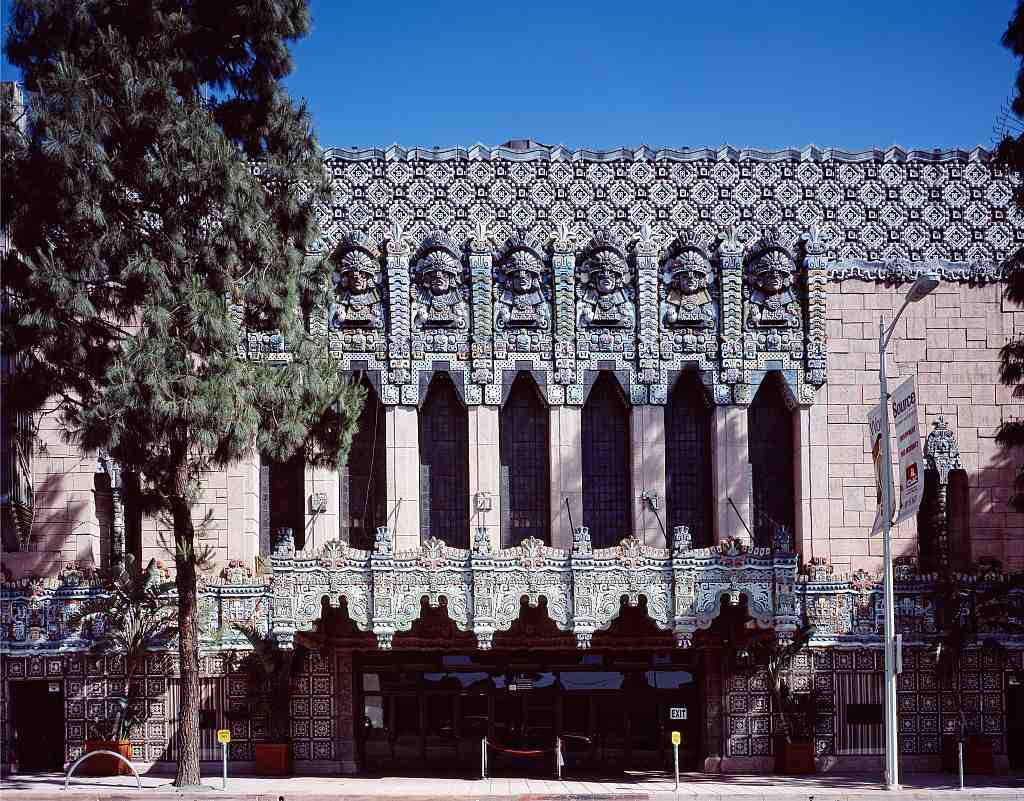
    Directly in front of you is an eye-popping façade covered in detailed, geometric patterns and fierce-looking sculpted faces-just look up to spot its wild Mayan-influenced design among the trees and the neighboring plain buildings. Welcome to the Mayan Theater, where the outside looks like something Indiana Jones might stumble across, and the inside has stories juicier than a bucket of movie popcorn. When it opened back in August 1927, this place was all glitz and glamour, dazzling crowds with musical comedies and lavish premieres. Imagine the hustle and bustle on the sidewalk as famous faces like Ruth Taylor swept past under sparkling lights, excited for night after night of laughter and applause. But this wasn’t just a spot for show tunes; in 1930, it made history hosting the “Sweet N’ Hot” musical, where Dorothy Dandridge wowed audiences and the show packed the house for eleven whole weeks. People could barely get tickets! Fast forward to the wild 1970s and 80s-oh, how the mighty have… gotten a bit risqué! The Mayan became famous (or maybe infamous) for showing movies you definitely wouldn’t bring your grandma to see. Still, it kept its charm, popping up in classic films like The Bodyguard and A Night at the Roxbury, plus the Pointer Sisters filmed their Neutron Dance music video right here. If you could feel a building blush from all the attention, this would be the one. The real showstopper, though, is its design. Stiles O. Clements went all out, covering the theater in pre-Columbian patterns and fierce faces by Francisco Cornejo, including the “Hall of Feathered Serpents” lobby and an auditorium that glitters with a chandelier modeled on the Aztec calendar stone. Each visit feels like stumbling into a colorful temple from another world. Since 1990, it’s been a legendary nightclub pulsing with music and energy, even streaming a Daft Punk concert straight from its dance floor. But all parties must end-by late 2025, this clubbing era will close after 35 unforgettable years. So, snap a photo, take in the details, and imagine the spectacular-and sometimes scandalous-spectacles these walls have witnessed.

    Ouvrir la page dédiée →
  3. Alright, take a look at this striking building in front of you-the Belasco Theater! Just imagine it’s 1926: the street’s abuzz, people are dressed to the nines, and there’s…Lire plusAfficher moins

    Alright, take a look at this striking building in front of you-the Belasco Theater! Just imagine it’s 1926: the street’s abuzz, people are dressed to the nines, and there’s excitement in the air. An oil tycoon, Edward L. Doheny, decided Los Angeles needed more drama-onstage, of course-so he commissioned not one, but two theaters, with this one meant for “legitimate theater.” And no, that doesn’t mean the other theaters were criminal, but hey, you never know with Hollywood! Morgan, Walls & Clements, a hotshot local firm, whipped up the plans in the over-the-top Churrigueresque style. Some say the building’s details are so elaborate, you could stare at them until the next oil boom and still notice something new-kind of like looking at your phone bill. When it first opened in November 1926, over a thousand people lined up on this very sidewalk to see "Gentlemen Prefer Blondes." (That’s the play, not a compliment to passersby... although if the shoe fits!) But the Belasco wasn’t just about glitz. In the 1930s, during the tough days of the Great Depression, the Federal Theatre Project stepped in, turning these seats into a lifeline for struggling actors and audiences alike-a spot where everyone could escape reality for a few hours. Change is a loyal visitor here. When the golden era dimmed, the theater went from stage plays to burlesque and movies in the 1940s. The popcorn may have changed, but the drama? Never. After a final double feature in 1950, an energetic gospel church moved in. Imagine: one week, the stage was filled with tap dancing; the next, it echoed with hymns. In the 1970s, the Belasco became a sanctuary for the Metro Community Church, one of the nation’s early homosexual congregations. They faced challenge after challenge, showing the theater wasn’t just a place for showbiz-it had real heart. Yet, for years the building sat waiting for its next act-until 2011, when its chandeliers flickered on again as The Belasco, a music venue where echoes of Broadway mingled with rock and pop. And, oh, the camera loves this place! Look sharp and you might recognize it from "Being John Malkovich," "Swordfish," "Memoirs of a Geisha," "The Prestige," and even “Jersey Boys.” Honestly, with all its cameos, the Belasco’s agent must be working overtime. So wherever the Belasco’s history was headed-be it glamorous premieres, soulful sermons, or blockbuster films-it’s always been center stage in LA’s ever-changing show.

    Ouvrir la page dédiée →
  4. Look up and ahead for the tall, sleek skyscraper with a distinctive grid of square windows and a crown featuring a glassy upper section-South Park Center’s main tower stands…Lire plusAfficher moins

    Look up and ahead for the tall, sleek skyscraper with a distinctive grid of square windows and a crown featuring a glassy upper section-South Park Center’s main tower stands boldly above the lower buildings nearby. Right here in front of you rises the South Park Center, once known by so many names it could fill a phone book-Occidental Life, Transamerica, AT&T Center, SBC Tower, and now, proudly, the USC Tower. Back in 1965, this 32-story marvel shot up into the Los Angeles skyline, making jaws drop as the city’s second-tallest building. Designed by William Pereira & Associates, its crisp International Style gave it a futuristic look for the time-a monument to white-collar ambition. Just imagine: inside those gleaming rows of windows, the Occidental Life Insurance Company’s computers hummed away, crunching numbers with all the cutting-edge power of the ‘60s. But this tower wasn’t the lone star in the neighborhood. The original Occidental Center covered a whopping 12 acres, tying together multiple buildings with secret underground tunnels. Legend has it that if you worked late, you might escape through these corridors to avoid a surprise rainstorm or a nosy boss! Up top, The Tower restaurant once served French cuisine with views to match-just picture a perfectly crisp soufflé hundreds of feet above LA’s endless sprawl. Ownership shuffled like a Vegas dealer, and before long, the California State Bar Association and even the LAPD moved into the neighboring buildings. The crown was spruced up in the 2000s with a $35 million renovation, making the old tower sparkle like a disco ball at sunset. And for pop culture fans, glance upward-you may recognize this very exterior from Avicii’s “Levels” music video, when it advertised not insurance, but “Levels/Le7vels.inc.” Now, as South Park Center, this building stands as a not-so-quiet witness to L.A.’s style, ambition, and maybe a few secret after-hours escapades. Even on a sunny afternoon, the story of this skyscraper soars as high as its glass crown.

    Ouvrir la page dédiée →
  5. Here it is, the legendary spot where Los Angeles once cheered, gasped, and even munched peanuts with abandon-welcome to the historic home plate of Washington Park! Imagine…Lire plusAfficher moins

    Here it is, the legendary spot where Los Angeles once cheered, gasped, and even munched peanuts with abandon-welcome to the historic home plate of Washington Park! Imagine yourself in the early 1910s, when this wasn’t just another city corner but the very heart of baseball mania in LA. The roar of the crowd, the crack of the bat, the hopeful clatter of vendors selling snacks-it all happened here, where now there might be nothing more than the buzz of traffic and a McDonald’s serving up fries instead of fly balls. Washington Park first opened its doors in March 1911, after the old amusement park, Chutes Park, made way for baseball dreams. The Los Angeles Angels-no, not the ones from Anaheim, but the original Pacific Coast League team-called this their home. These early games weren’t played in some cramped backyard, either. After expanding the stands and outfield for the 1913 season, they finally had space to accommodate the ever-growing sea of baseball fans. There were even special parking areas just for the game days. Who says LA traffic is only a modern-day problem? But the park wasn’t just for baseball-no, Washington Park was a real community stage. It played host to football games like the epic 1915 USC vs. California matchup, when 8,000 fans packed the stands. That was a record crowd for SoCal back then-no wonder the hot dog sellers probably went home with arms twice their usual size. And movie buffs, take note: silent film legend Buster Keaton filmed a scene for “Neighbors” here in 1920. That must have been quite the production, with slapstick gags trading places with home runs. The Angels had their ups and downs here, and the team even shared the field for a while with the Venice Tigers. But when William Wrigley Jr. wanted to take baseball into the underground-literally, with plans for a parking garage-that dream hit the dirt. So he bought new land and built Wrigley Field (the LA one, long before Chicago’s famous ivy). The Angels played their last at Washington Park in 1925, with some dramas-like Seattle forfeiting a game during the closing series for good measure. If you look around today, the only sliding you’ll see is into a booth at McDonald’s, and the stands are packed not for the big game, but maybe for coffee and Wi-Fi. Yet right here, baseball once ruled, and Angel fans filled this spot with cheers, jeers, and the timeless hope that this, finally, would be a home run day. Quite the pitch-perfect ending to our tour, if you ask me!

    Ouvrir la page dédiée →

Foire aux questions

Comment commencer le tour ?

Après l'achat, téléchargez l'application AudaTours et entrez votre code de réduction. Le tour sera prêt à commencer immédiatement - il suffit d'appuyer sur lecture et de suivre l'itinéraire guidé par GPS.

Ai-je besoin d'Internet pendant le tour ?

Non ! Téléchargez le tour avant de commencer et profitez-en pleinement hors ligne. Seule la fonction de chat nécessite Internet. Nous recommandons de télécharger en WiFi pour économiser vos données mobiles.

S'agit-il d'une visite de groupe guidée ?

Non - il s'agit d'un audioguide en autonomie. Vous explorez indépendamment à votre propre rythme, avec une narration audio diffusée par votre téléphone. Pas de guide, pas de groupe, pas d'horaire.

Combien de temps dure le tour ?

La plupart des tours durent entre 60 et 90 minutes, mais vous contrôlez totalement le rythme. Faites des pauses, sautez des arrêts ou arrêtez-vous quand vous le voulez.

Et si je ne peux pas finir le tour aujourd'hui ?

Pas de problème ! Les tours disposent d'un accès à vie. Faites une pause et reprenez quand vous le souhaitez - demain, la semaine prochaine ou l'année prochaine. Votre progression est sauvegardée.

Quelles sont les langues disponibles ?

Tous les tours sont disponibles dans plus de 50 langues. Sélectionnez votre langue préférée lors de l'utilisation de votre code. Note : la langue ne peut pas être changée après la génération du tour.

Où accéder au tour après l'achat ?

Téléchargez l'application gratuite AudaTours sur l'App Store ou Google Play. Entrez votre code de réduction (envoyé par e-mail) et le tour apparaîtra dans votre bibliothèque, prêt à être téléchargé et commencé.

verified_user
Satisfaction garantie

Si vous n'appréciez pas le tour, nous vous rembourserons votre achat. Contactez-nous à [email protected]

Paiement sécurisé avec

Apple PayGoogle PayVisaMastercardPayPal

AudaTours : Audioguides

Des tours à pied en autonomie, divertissants et économiques

Essayer l'application arrow_forward

Adoré par les voyageurs du monde entier

format_quote Ce tour était un excellent moyen de voir la ville. Les histoires étaient intéressantes sans paraître trop scénarisées, et j'ai adoré pouvoir explorer à mon propre rythme.
Jess
Jess
starstarstarstarstar
Tour de Tbilissi arrow_forward
format_quote C'était un bon moyen de découvrir Brighton sans se sentir comme un touriste. La narration était profonde et contextuelle, sans en faire trop.
Christoph
Christoph
starstarstarstarstar
Tour de Brighton arrow_forward
format_quote J'ai commencé ce tour avec un croissant dans une main et zéro attente. L'application vibre tout simplement avec vous, pas de pression, juste vous, vos écouteurs et quelques histoires sympas.
John
John
starstarstarstarstar
Tour de Marseille arrow_forward

Audioguides illimités

Débloquez l'accès à TOUS les tours du monde

0 tours·0 villes·0 pays
all_inclusive Explorer Unlimited