

Visite audio de Fort Wayne : Icônes et histoires du cœur de West Central
Un adolescent, Abraham Lincoln, chassait autrefois dans les étendues sauvages autour de Fort Wayne – et la ligne d'horizon de la ville cache encore des échos de son esprit agité. Ici, des fortunes ont été bâties à côté de complots à la poudre et de coffres de banque cachés. Cette visite audio autoguidée vous emmène hors des sentiers battus, révélant les histoires secrètes et les merveilles méconnues de Fort Wayne. Écoutez les histoires que la plupart des voyageurs ignorent. Qui s'est affronté sous l'ombre froide de la Lincoln Bank Tower lors d'un affrontement politique oublié ? Quel secret persiste dans les lieux de jeunesse de Lincoln, où les légendes se mêlent à la tragédie ? Et pourquoi une seule écriture comptable a-t-elle déclenché un scandale furieux qui a secoué les rues de la ville ? Traversez des décennies d'ambition, de bouleversements et d'intrigues. Sentez le pouls de la rébellion dans la pierre et l'acier. Chaque monument vous plonge au cœur du drame – refaisant Fort Wayne sous vos pieds. Suivez les échos de Lincoln. Découvrez les surprises de la ville. Appuyez sur lecture et commencez votre découverte maintenant.
Aperçu du tour
À propos de ce tour
- scheduleDurée 40–60 minsAllez à votre propre rythme
- straightenParcours à pied de 2.7 kmSuivez le sentier guidé
- location_onEmplacementFort Wayne, États-Unis
- wifi_offFonctionne hors ligneTéléchargez une fois, utilisez n'importe où
- all_inclusiveAccès à vieRéécoutez n'importe quand, pour toujours
- location_onCommence à Gare de Fort Wayne
Arrêts de ce tour
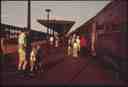
Look for the long, low shelter with red posts and a large “Fort Wayne” sign above the platform-the trains used to pull up right alongside it, and the station is just…Lire plusAfficher moins
Look for the long, low shelter with red posts and a large “Fort Wayne” sign above the platform-the trains used to pull up right alongside it, and the station is just behind. Welcome to the legendary Fort Wayne-or as some folks fondly remember it, Baker Street-Station! Imagine the buzz in the air back in 1914 when this grand American Craftsman-style depot first opened, gleaming at a whopping cost of $550,000. During World War II, this platform was electric with energy. Steam and diesel trains hissed in the background as over 3,000 travelers, soldiers, and tearful families bustled about every single day. The noise must have been something-chatter swirling, suitcases thumping, and maybe even a few lost hats rolling down the platform! Now, picture a sea of campaign hats and flashing cameras-presidents Harding, Coolidge, Hoover, FDR, Truman, and Eisenhower all made appearances here during their whistle stop tours. These walls have heard secrets, promises, and probably a few bad political jokes. In its glory days, the station welcomed famous trains like the Broadway Limited and the Northern Arrow, with passengers connecting from Detroit and Chicago. For decades, a slice of the country’s adventure began or ended right here-people heading to New York, Florida, or even up to Mackinaw City. The last big passenger train rolled through in 1990, and it’s been a little quieter since then, but the echoes of history? Still just as loud. Now, the old concourse hosts parties instead of passengers, and there’s hope yet that trains might return. The station stands as a proud local landmark, carrying its stories on into the future. So go ahead-breathe deep, listen for the whistle, and feel the pulse of Fort Wayne’s soul right under your feet!
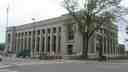
Ouvrir la page dédiée →To spot the E. Ross Adair Federal Building and U.S. Courthouse, look for a grand, three-story limestone structure with tall windows and stately columns lining its facade, right at…Lire plusAfficher moins
To spot the E. Ross Adair Federal Building and U.S. Courthouse, look for a grand, three-story limestone structure with tall windows and stately columns lining its facade, right at the corner of Douglas Avenue and Harrison Street, with the American flag fluttering out front. Welcome to the E. Ross Adair Federal Building and United States Courthouse-an address that’s seen more deliveries, debates, and legal drama than a season of courtroom television! With its stone face towering over Harrison Street, this proud building stands as a silent witness to decades of Fort Wayne’s transformation. But don’t let its serious look fool you-there’s plenty of personality behind those columns. Imagine the late 1920s, a time when Fort Wayne was booming-a crossroads for trains, steamboats, and businessmen with pockets full of canal boat fare. As the city buzzed with industry and commerce, the federal government realized Fort Wayne needed a building worthy of all the excitement. Congress unlocked funds in 1928 with the Public Buildings Act, and suddenly, the city’s dreams of a federal hub had a heartbeat. Local architect Guy Mahurin joined forces with New Yorker Benjamin Morris-they were like the Batman and Robin of architecture, minus the capes. With blueprints rolled out and shovels ready, the ground was broken in 1931. You can almost imagine the clinking and clanking, the laughter of hopeful workers, maybe a few groans over the new reinforced concrete technique, which was a bit of a gamble back then. But what a gamble it turned out to be! That new method saved $30,000, which meant room in the budget for snazzy marble floors and an impressive plaza-proof that sometimes, cutting corners gets you fancier corners. Soon, this Stripped Classical building rose high, with its three stories of buff-colored limestone and granite steps greeting anyone from ambitious politicians to nervous people checking their mail. Above you, the columns with stylized leaf-patterned capitals are so clean and geometric, you might think ancient Greece landed in the 1930s-then took a crash course in Art Deco style. Eagles perch gracefully in the metal panels, while lion heads peer down from the cornice, quietly judging your outfit choices. Inside, it’s a festival of marble-walls, floors, benches-prized stone from distant quarries set off with gold-glazed plaster ceilings that shimmered during the grand opening in October 1932. The entry’s marble star pattern aimed to inspire, though whether it led to more efficient postal delivery remains a mystery. The old postal lobby is still thick with history. Even though the post office packed up and left in 1987, you can spot the original window frames and imagine the lines of folks waiting to send off a love letter or pay their taxes-perhaps accidentally both, if the handwriting was poor. Move upstairs and you’ll find the courtroom-mahogany panels, green marble, a ceiling like a jewel box decorated with colorful octagons and squares. Here, justice was served-sometimes with a side of nerves. The building itself has seen a few new names and faces. In 2000, it was christened in honor of E. Ross Adair-the local boy turned Congressman, WWII veteran, and ambassador. He might not have argued every case here, but you can bet people argued about politics in his honor, at least. The beautiful front plaza is no less important, with its granite steps, bronze flagpole, and a rear 40-foot bench carved with zodiac signs-a nod to all the star-crossed jury selections and fated verdicts over the years. So, take a moment to admire this dignified building-where concrete innovations met classical ambition, and Fort Wayne’s federal heartbeat found its rhythm. And hey, try not to be outshone by those eagle motifs. They take their job very seriously!
Ouvrir la page dédiée →
Afficher 10 arrêts de plusAfficher moins d'arrêtsexpand_moreexpand_less
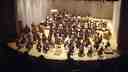
Right ahead, look for a sweeping, golden-lit concert stage filled with rows of musicians, string sections on the left, brass and percussion in the back, and a grand, elegant…Lire plusAfficher moins
Right ahead, look for a sweeping, golden-lit concert stage filled with rows of musicians, string sections on the left, brass and percussion in the back, and a grand, elegant concert hall wrapping around the ensemble. Here you are, standing before one of Fort Wayne’s proudest cultural treasures: the Fort Wayne Philharmonic Orchestra. Picture the year 1944-World War II is raging, and yet, here in Indiana, something beautiful is being born. Under the baton of Hans Schwieger, German-born and bursting with energy, the orchestra plays its very first concert at the Palace Theatre. Imagine the anticipation: jackets pressed, hearts pounding, the stage lights warm and buzzing overhead. Decision-makers and dreamers built an orchestra that would bring out big names-William Kapell, Yehudi Menuhin, and the mighty Mario Lanza. And let’s not forget Igor Buketoff, the music director for an impressive 18 years, whose hair probably grayed as fast as the orchestra grew! When Ronald Ondrejka arrived, things kicked up another notch: the budget tripled (now, that’s one way to encourage your musicians), and the Fort Wayne Ballet started cutting a rug right alongside the Philharmonic. From summer concerts under the sky at Foellinger Theatre to the honeyed acoustics of the Embassy Theatre and Auer Performance Hall, this orchestra isn’t just classy-it’s adventurous. They’ve racked up five ASCAP awards for trying out bold, new music, and even the chorus has its own sparkle, now under Benjamin Rivera. Maybe, if you listen closely, you’ll catch a ghostly aria left behind from decades past, or the deep thump of a double bass that’s been played for generations. Andrew Constantine now leads the baton, keeping the Philharmonic fresh, daring, and delightfully unpredictable-sometimes, even enough to inspire a little friendly fuss between musicians and managers! From scratchy radio rebroadcasts to polished recordings, if you’re ready for a symphonic adventure, this is the spot in Fort Wayne where music never truly stops.
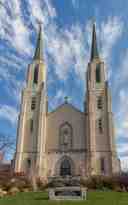
Ouvrir la page dédiée →To spot the Cathedral of the Immaculate Conception, just glance ahead for a grand stone church with two tall, pointed spires topped by golden crosses - they reach up so high it…Lire plusAfficher moins
To spot the Cathedral of the Immaculate Conception, just glance ahead for a grand stone church with two tall, pointed spires topped by golden crosses - they reach up so high it almost looks like they could tickle the clouds! Picture this: It’s the year 1836, and Fort Wayne is still a rough, frontier town. Father Louis Mueller, who’s just been appointed pastor, looks over this very square and starts building a little log church, probably wondering if he’d ever be remembered for more than his carpentry skills. His dreams grew roots, though, because in only a few years, Father Julian Benoit took over as pastor and decided that Fort Wayne wasn’t going to settle for a small chapel. He paid off debts and bought the rest of the land - some whispers say he thought ahead and bought it for cemetery use, ensuring the “spirits” of Fort Wayne would always have a home here. By the 1840s, the parish was bustling so much that different groups split off to build new churches - in 1849, the German members of St. Augustine’s (the old parish’s name!) created their own: St. Mary’s. Meanwhile, the little parish grew, and by 1854, a rectory was added. But perhaps the most dramatic moment - one fit for a movie - happened when St. Augustine’s was destroyed by fire in 1859. Out of the ashes, Father Benoit’s vision took shape, as he personally designed the Cathedral we see today, laid its cornerstone on Trinity Sunday 1859, and even set off on fundraising missions all the way to New Orleans and France. He was so dedicated, he paid many costs out of his own pocket! The new cathedral was triumphantly dedicated on December 8, 1860, the Feast of the Immaculate Conception. Many treasures inside traveled great distances: the huge sanctuary window of Mary and elegant brass candlesticks arrived across the ocean from France, while stained-glass windows from Munich shimmer with scenes from Mary’s life. Workmen brought in grand wood-carved Stations of the Cross from Germany, filling the church with craftsmanship that combines American hope and European artistry. Below your feet rest the remains of several leaders, including the devoted Fr. Benoit himself and four bishops. Nearby, Cathedral Square hosts the old Rectory, MacDougal Chapel, and, in case you like a twist of mystery in your history, the grave of Chief Joseph Richardville, the final chief of the Miami Indians - Fort Wayne’s cathedral square holding a tale within a tale! Through wars, fires, and changes, this cathedral has stood for more than 160 years, its latest facelift completed by skilled hands just recently. Today, it’s still the Diocese’s spiritual heart, looked after by Father Jacob Runyon and his team. And, if you’re lucky enough to pop in when the sunlight streams through those stained glass windows, you might almost forget the modern world outside - at least until the bells ring out and bring you right back to the present! Interested in knowing more about the architecture, burials or the current pastoral staff
Ouvrir la page dédiée →To spot Saint Paul's Evangelical Lutheran Church, just look for the soaring red brick building with a dramatic, pointed steeple reaching into the sky at the intersection of Barr…Lire plusAfficher moins
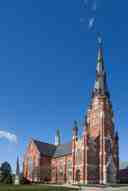
To spot Saint Paul's Evangelical Lutheran Church, just look for the soaring red brick building with a dramatic, pointed steeple reaching into the sky at the intersection of Barr and Madison Streets. Standing here, you’re witnessing the handiwork of generations determined not to let this church disappear-despite fire, growth spurts, and a little architectural drama. Founded way back in 1837, Saint Paul’s is no rookie on the block: it’s the oldest Lutheran church in northern Indiana and the second oldest across the state. Its story is filled with movement-initially a modest structure went up in 1839, but as the congregation boomed (clearly, word spread fast about those Lutheran potlucks), bigger buildings kept popping up. Enter the showstopper of 1889, all High Victorian Gothic curves and spires by Wing & Mahurin. But here’s the plot twist-a disastrous fire in 1903 left it a charred skeleton. Instead of giving up, the congregation rolled up their sleeves, lighting a new fire of determination, and by 1905, the church was meticulously rebuilt, rising from the ashes, quite literally. It’s seen renovations in the decades since, but its role as a local and statewide Lutheran anchor never faded. No wonder it landed safely on the National Register of Historic Places in 1982-this place is practically the superhero of churches!
Ouvrir la page dédiée →Just ahead, you’ll see a tall, modern skyscraper with crisp lines and two distinct towers-one with bold orange-brown stripes-soaring well above everything else around it; just…Lire plusAfficher moins
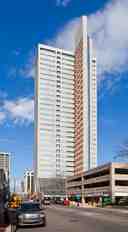
Just ahead, you’ll see a tall, modern skyscraper with crisp lines and two distinct towers-one with bold orange-brown stripes-soaring well above everything else around it; just look up, and you can't miss it, as it's the tallest building in Fort Wayne. Now, let’s step into the shadow of this concrete giant: the Indiana Michigan Power Center-Fort Wayne’s king of the skyline, standing a whopping 27 stories tall! Built in the modern style in 1982 and designed by the same firm that brought you the Metropolitan Museum of Art in New York, this tower was never meant to stand alone. Picture this: back in the fevered late 1970s, a vision danced in developers’ minds-a whole superblock of downtown transformation with this tower joined by two mighty siblings, a bustling new hotel, and a lively plaza below, all humming with stylish ambition. The city was buzzing with plans for grand convention centers, theaters, and even those beloved parking garages that every downtown visitor secretly craves. But, of course, fate loves a twist-cue the dramatic music! The financial backers, People’s Trust Bank, ran headlong into money trouble, caught in the wild storm of the 1981 recession. Imagine construction slowing to a crawl, bank presidents sweating over ledgers, and city officials muttering, “Now what?” With mounting costs and a mid-project contractor swap, only this central tower materialized. The dream faded, but what remained was unexpected: a windswept plaza that now hosts everything from food trucks and farmers’ markets to spontaneous music-Fort Wayne’s happy accident. Inside, the Indiana Michigan Power Center has seen more tenants than your favorite sitcom apartment. Summit Bank first reigned here, but bank mergers-lots of them!-turned these offices into a power hub for Indiana Michigan Power, and a regional outpost for financial titans like JPMorgan Chase. In fact, Indiana Michigan Power’s name is now emblazoned on the building after earning naming rights in 2014, a little like getting your name stitched above the best seat in the house. The thirteenth floor became legendary for its café-changing hands with almost as much suspense as a good mystery novel-while big businesses came and went, adding their own energy to the city. So as you stand here and gaze up, you’re witnessing a monument not only to big dreams and tall ambitions, but also to the unwritten chapters of Fort Wayne’s story, full of unexpected twists, a little luck, and quite a lot of concrete. And hey, if you feel small looking up, just remember: sometimes the biggest things in life are the ones built on hope, even if Plan B is where all the food trucks end up.
Ouvrir la page dédiée →Right ahead of you stands a massive stone building with elegant columns, grand staircases, and a soaring domed clock tower topped by a shining statue-just look for the impressive…Lire plusAfficher moins
Right ahead of you stands a massive stone building with elegant columns, grand staircases, and a soaring domed clock tower topped by a shining statue-just look for the impressive structure with the green lady overlooking the city, and you’ve found the Allen County Courthouse! Imagine it’s the turn of the 20th century: horses clop down dirt streets, carriages rattle by, and right here, workers lay the cornerstone for a courthouse that would become one of America’s greatest architectural showpieces. Designed by Brentwood S. Tolan, the project broke ground in 1897 and became the talk of the town. Picture the mayor and governor beaming with pride on dedication day in 1902, standing before a crowd, with everyone craning their necks hoping to spot President Theodore Roosevelt-who, as it turns out, ditched for a different adventure. The final price tag? Over $800,000 back then, which, today, could just about buy you a few football stadiums. This isn’t just any courthouse-It’s a Beaux-Arts bonanza! Step closer and you’ll see stone from Indiana and granite all the way from Vermont, with Italian marble peeking through the halls. Inside, you’d spot murals big enough to make your living room jealous, twenty-eight different types of decorative “scagliola,” and a copper rotunda so tall you could stack almost three blue whales on top of each other. That Lady Liberty up top? She’d wear a shoe size 28-big enough to make a basketball player blush! Each courtroom glows with its own color scheme, and deep below, there’s even a fallout shelter, just in case. Over a century later, the courthouse gleams thanks to a multi-million-dollar restoration-proof that Fort Wayne knows how to keep a good thing looking sharp.
Ouvrir la page dédiée →If you look straight ahead, you’ll spot the Lincoln Bank Tower rising into the sky with its elegant Art Deco crown glowing golden at the top and an American flag waving above the…Lire plusAfficher moins
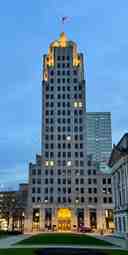
If you look straight ahead, you’ll spot the Lincoln Bank Tower rising into the sky with its elegant Art Deco crown glowing golden at the top and an American flag waving above the limestone-clad façade. Now, imagine you’re standing here in the late 1920s, just as the jazz age is hitting its high notes and skyscrapers are the rockstars of city skylines. Out of the ground climbs this colossal structure-1,774 tons of steel, 21,250 cubic feet of cut Indiana limestone, granite, and a dazzling touch of gold highlights-designed by local architect Alvin M. Strauss. Its Art Deco crown catches the evening light just as it did at its grand opening back in November 1930. If the wind blows in just right, you half expect to hear a blast of triumphant trumpets, celebrating its rise. Now, naming banks after Abraham Lincoln was all the rage, and for good reason. Lincoln National Bank, which originally began life in 1905 as the German American National Bank, rebranded during World War I when “German” wasn’t exactly popular on this side of the Atlantic. They wanted a name that screamed “America!”-and with the Lincoln National Life Insurance Company already thriving down the street and the famed Lincoln Highway running through town, it was a no-brainer. The bank grew, thrived, and soon merged with the Lincoln Trust Company, setting dreams in motion for a cathedral of commerce-the very building you stand before. Picture bulldozers revving up in August 1929, just two months before the stock market crashed-great timing, huh? But despite the Great Crash, the building rose, every stone a symbol of stubborn optimism. President Charles Buesching, himself a German immigrant, wanted this place not just for banking, but as a monument to the community that built Fort Wayne. Rumor has it that the design tips its hat to the Tribune Tower in Chicago. The city watched as this skyscraper reached for the clouds, ending up as Indiana’s tallest building until 1962 and Fort Wayne’s undisputed giant for decades longer. Step closer: see the seven bronze panels above the entrance? Those bring scenes from Abraham Lincoln’s storied life to your fingertips. If you walked through those golden doors, you’d find a grand lobby stretching two stories high-85 feet wide, 110 feet long-with murals painted in the glamorous Art Deco style, mixing Greek and Egyptian symbols, marble from Vermont, limestone from Indiana, and even a vintage 1930s soda fountain that still works-so don’t be shy about asking for an old-fashioned float. This building’s been home to banks that changed names more often than a chameleon at a paint store. It survived foreclosures, sheriff’s sales, historic films, and even a scene in the 1996 indie movie "In the Company of Men." Just imagine actors slinking through the marble corridors as the city’s past and present shimmer in reflection. Today, Old National Bank works here, keeping the legend alive, beneath that iconic observation tower and flagpole. So, next time you spot that golden-lit crown at dusk, remember you’re gazing at a building that’s survived stock crashes, movie shoots, and more than a few bank mergers-with its head held high, literally!
Ouvrir la page dédiée →To spot this landmark, look for sturdy, blocky wooden buildings with stripes of white and dark timbers stacked atop one another-it’s like a super-sized Lincoln Log creation…Lire plusAfficher moins
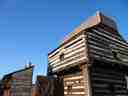
To spot this landmark, look for sturdy, blocky wooden buildings with stripes of white and dark timbers stacked atop one another-it’s like a super-sized Lincoln Log creation popping up against the sky! Alright, let’s take you into the heart of Fort Wayne’s story-where the past was muddy boots, smoky fires, and the clang of hammers on log walls. Imagine the year is 1794, the ground is thick with the smell of wet earth and cut wood, and American soldiers are working furiously to build a brand-new fort under General Anthony Wayne’s sharp-eyed command. This spot wasn’t chosen by chance-three mighty rivers twist together here, making it a crossroads for trade, travel, and the giant chessboard of North American power. Picture the Miami tribe, whose main village of Kekionga stood right here centuries before any Europeans arrived. The sounds of trading, laughter, and treaty debates once bounced between these very walls-sometimes interrupted, of course, by the steady rhythm of a British soldier grumbling about Indiana’s mosquitoes. Over the years, this little patch of earth saw more drama than a soap opera marathon-first as a French outpost called Fort Miami around 1706, a lonely trading post on the edge of the wilderness, where maybe 40 Frenchmen and a thousand Miami people mingled, bartered, and tossed a joke or two about each other’s shoes. Tensions rose and fell; the British muscled in, then lost it, and the Native Americans, fed up with British rule, took it back in Pontiac’s Rebellion. When the dust settled, fortunes changed hands as fast as you could say “trade route.” Eventually, General Wayne and his army rolled through after the fiery Battle of Fallen Timbers, driving out the last resistance and hammering Fort Wayne together, log by log. But let’s fast-forward a bit-Fort Wayne didn’t just hang up its boots and call it quits. Oh no, the canal came through, the railroads puffed in, and suddenly this fort-turned-village was swelling with new faces: German and Irish immigrants, frontier shopkeepers, people with dreams as big as the Indiana sky. Even disasters couldn’t keep Fort Wayne down-the Great Flood of 1913 roared through, dragging away homes and hopes, but the city rebuilt with grit and a splash of stubborn humor. By the early 20th century, Fort Wayne was a humming hive of invention. Refrigerators, gasoline pumps, and the world’s first home video game console all got their start here. The factories’ whistles joined the soundscape, and even as hard times hit with the Rust Belt’s decline, folks here always found a new way to keep busy-whether that meant building pickup trucks, planting rain gardens, or snapping up a sandwich at a riverside festival. Now, take a moment to see how Fort Wayne never forgot its roots. You’ll see Greek Revival houses, sky-piercing Art Deco towers, and those unmistakable log walls where it all began. The city is a mosaic of old and new-church bells chiming, the distant echo of market day, parks filled with tree canopies twice the state average (not bad for a place that once called itself the Summit City). And, here’s a fun fact: nowadays, Fort Wayne is actually the second-largest city in Indiana, boasting one of the largest Burmese American populations in the U.S.-a modern crossroads, just as it’s always been. So standing here, take in the view of those hand-hewn beams, and let yourself hear the layered stories of every step, every forgotten footprint. If these logs creak a little in the wind, maybe they’re just settling in to listen, too. To expand your understanding of the geography, demographics or the economy, feel free to engage with me in the chat section below.
Ouvrir la page dédiée →Directly ahead, you’ll spot a grand, castle-like building made of rugged yellow sandstone, with dramatic towers, arched windows, and eye-catching red awnings-it’s hard to miss on…Lire plusAfficher moins
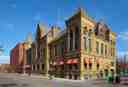
Directly ahead, you’ll spot a grand, castle-like building made of rugged yellow sandstone, with dramatic towers, arched windows, and eye-catching red awnings-it’s hard to miss on the corner! Imagine the year is 1893. Horse-drawn carriages are echoing over cobblestones, and this grand sandstone fortress stands at the heart of city business. Designed by the dynamic duo Wing & Mahurin in the bold Richardsonian Romanesque style, the Old City Hall isn’t just a treat for the eyes-it’s a survivor, having watched over Fort Wayne for more than a century. For nearly 80 years, this was the very headquarters of civic power, where heated debates and life-changing decisions bounced off these thick stone walls. But here’s the twist: in 1971, everyone packed up their briefcases and zoomed off to the new City-County Building, leaving this beauty searching for a new purpose-imagine a melodramatic soap opera exit! Luckily, it wasn’t left gathering dust. Since 1980, it’s worn a brand-new hat as The History Center, overflowing with 32,000 fascinating artifacts. Inside, there’s everything from a broken mastodon rib bone (it’s not every day you get to gawk at prehistoric leftovers!) to a sword given to Miami chief Little Turtle by George Washington himself. There are stories of railroads roaring into town, the wild days when blacksmiths hammered away, and entrepreneurs who dreamed up inventions that would put Fort Wayne on the map. And-brace yourself-if you wander deeper, you’ll find the old City Jail cells. These weren’t glamorous lockups, just a few cramped spaces for late-night troublemakers and folks waiting to face the judge. Today, the building is not just a time machine, but a treasure chest: celebrating Indigenous chiefs, visionary generals, and the wild, unpredictable magic of this city’s past. All of that, wrapped up in these legendary yellow stones, just waiting for the next curious visitor!
Ouvrir la page dédiée →

Foire aux questions
Comment commencer le tour ?
Après l'achat, téléchargez l'application AudaTours et entrez votre code de réduction. Le tour sera prêt à commencer immédiatement - il suffit d'appuyer sur lecture et de suivre l'itinéraire guidé par GPS.
Ai-je besoin d'Internet pendant le tour ?
Non ! Téléchargez le tour avant de commencer et profitez-en pleinement hors ligne. Seule la fonction de chat nécessite Internet. Nous recommandons de télécharger en WiFi pour économiser vos données mobiles.
S'agit-il d'une visite de groupe guidée ?
Non - il s'agit d'un audioguide en autonomie. Vous explorez indépendamment à votre propre rythme, avec une narration audio diffusée par votre téléphone. Pas de guide, pas de groupe, pas d'horaire.
Combien de temps dure le tour ?
La plupart des tours durent entre 60 et 90 minutes, mais vous contrôlez totalement le rythme. Faites des pauses, sautez des arrêts ou arrêtez-vous quand vous le voulez.
Et si je ne peux pas finir le tour aujourd'hui ?
Pas de problème ! Les tours disposent d'un accès à vie. Faites une pause et reprenez quand vous le souhaitez - demain, la semaine prochaine ou l'année prochaine. Votre progression est sauvegardée.
Quelles sont les langues disponibles ?
Tous les tours sont disponibles dans plus de 50 langues. Sélectionnez votre langue préférée lors de l'utilisation de votre code. Note : la langue ne peut pas être changée après la génération du tour.
Où accéder au tour après l'achat ?
Téléchargez l'application gratuite AudaTours sur l'App Store ou Google Play. Entrez votre code de réduction (envoyé par e-mail) et le tour apparaîtra dans votre bibliothèque, prêt à être téléchargé et commencé.
Si vous n'appréciez pas le tour, nous vous rembourserons votre achat. Contactez-nous à [email protected]
Paiement sécurisé avec 


