AudaTours logoAudaTours

Visite audio de Zurich : Des monastères à la modernité – Une promenade intemporelle dans la ville

Guide audio13 arrêts

Les rivières de Zurich reflètent des siècles de révolution et d'intellect, mais les pierres sous vos pieds ont été témoins de bien plus qu'il n'y paraît. Découvrez des scandales cachés, des innovations époustouflantes et des rébellions secrètes alors que cette visite audio autoguidée vous mène à travers des rues sinueuses et des salles étonnantes que le visiteur occasionnel manque. Quelle découverte disparue à l'ETH Zurich a autrefois provoqué la panique à travers l'Europe ? Qui, à l'Université de Zurich, a allumé un débat qui a secoué la politique suisse jusqu'à ses fondations ? Et quelles affaires scandaleuses se tramaient derrière l'ancien glamour des murs emblématiques de Jelmoli ? Suivez ces chemins tortueux et ces conférences imposantes, plongez plus profondément que les vues de cartes postales, et débloquez le pouls de Zurich à chaque pas et à chaque histoire. Les yeux s'écarquillent alors que des places négligées et des couloirs silencieux s'animent d'intrigues et d'ambition. Prêt à voir la façade polie de Zurich se fissurer et révéler son cœur dramatique et agité ? Votre voyage commence maintenant.

Aperçu du tour

map

À propos de ce tour

  • schedule
    Durée 40–60 minsAllez à votre propre rythme
  • straighten
    Parcours à pied de 4.4 kmSuivez le sentier guidé
  • location_on
    EmplacementZurich, Suisse
  • wifi_off
    Fonctionne hors ligneTéléchargez une fois, utilisez n'importe où
  • all_inclusive
    Accès à vieRéécoutez n'importe quand, pour toujours
  • location_on
    Commence à Bahnhofplatz

Arrêts de ce tour

  1. Bahnhofplatz isn’t just a transportation hub-it’s the northern bookend of Bahnhofstrasse, the city’s celebrated boulevard. And while it may look busy and modern today, stuffed…Lire plusAfficher moins

    Bahnhofplatz isn’t just a transportation hub-it’s the northern bookend of Bahnhofstrasse, the city’s celebrated boulevard. And while it may look busy and modern today, stuffed with trams, shopping arcades like Shopville underneath your feet, and the constant rhythm of Zurich’s daily life, this square has an enchanting history brimming with stories. Let's step back in time to when the square first took shape. It was the 1870s and Zurich was eager to impress. The new Hauptbahnhof-the city’s main train station-had just been completed, its grand entrance facing this very square. The north side towered over the plaza, while elegant row houses and bustling hotels-built in the Neorenaissance and Neobaroque styles-lined the south and west sides. Some of these original buildings are still standing; others have burned down dramatically or been rebuilt in dazzling displays of architectural fashion. Imagine, for example, the grand Hotel du Nord, which replaced the less-than-cozy Café Du Nord, famous for lending guests wool blankets in winter. Sure, that’s hospitality, but I think it was also a tricky way to get out of paying the heating bill! But the real centerpiece, the soul of Bahnhofplatz, is the striking Alfred Escher monument. At first glance, it might look like your typical statue: a man in a dignified pose, perched atop a Swedish granite pedestal in the middle of a glimmering fountain. But there’s much more than meets the eye here. Alfred Escher was the mastermind behind Zürich’s transformation into a railway powerhouse-a bit like Switzerland’s own Iron Man, minus the cool suit. The monument was a true community effort, paid for entirely by public donations, totaling 178,500 francs-a fortune in those days. The talented sculptor Richard Kissling wanted the statue to grab your attention, so he added not just Escher, but also water-spewing dragons, representing mankind’s conquest over the wild forces of nature. These dragons are his tribute to the mighty Gotthard railway, which tamed the untamable Alps! Just imagine Escher standing here, surveying his achievements-unless you’re part of the local legend that says the statue should’ve faced the main station, not Bahnhofstrasse. In fact, debates about Escher’s direction have swirled for years. He’s even taken a few vacations! When Shopville was built under the square, Escher was moved all the way out to Wollishofen and later taken down for an art installation. Imagine being such a big deal that people argue about which way your statue should face! But Zurich isn’t afraid of a little controversy. When the monument was unveiled in 1889, the military had to guard it from grumpy workers who saw it as a provocation-talk about an opening day! And lately, in the spirit of reflecting on history, some Zurichers have debated whether Escher's more complicated legacy deserves a new plaque or even a spot in a museum. For now, though, he stands watch, accompanied by allegories of railway planning and education-testaments to his vision and stubborn energy. Look around and you’ll see more than just history; you’ll feel it. The beautiful facades of old hotels, like the Schweizerhof and the vanished Victoria, the banks and travel bureaus that once helped Swiss emigrants chase new lives overseas-these stones remember bustling crowds and wild moments. Even the dramas of renovation, great fires, and city plans that never quite happened are part of Bahnhofplatz’s story. So, as trams rattle by and city life swirls around you, remember-you’re not just crossing a square. You’re stepping into a living stage where generations have strode, paused, and set off on new journeys. And if you hear a dragon snorting somewhere, don’t worry-it’s probably just Escher showing off again. Ready to see where Zurich’s story takes us next? Let’s keep moving!

    Ouvrir la page dédiée →
  2. Here we are, right in front of Migros Bank - a place that’s given Switzerland a different rhythm, one maybe more financial, but still very Swiss. Picture the year: 1958. Zürich is…Lire plusAfficher moins

    Here we are, right in front of Migros Bank - a place that’s given Switzerland a different rhythm, one maybe more financial, but still very Swiss. Picture the year: 1958. Zürich is humming with post-war energy, fashion is sharp, and every corner café is alive with the scent of roasting coffee. On the third floor of the Migros market at Limmatplatz, a new kind of bank opens its doors, all thanks to an ambitious man named Gottlieb Duttweiler. Duttweiler wasn’t your regular businessman; he was stubborn, impulsive, and occasionally prone to telling people his bank was “at least as creditworthy as the big banks.” (A bold move in Switzerland, where even chocolate has to be trustworthy!) As Migros expanded throughout the 1920s and ‘30s, he grew frustrated with banks holding so much sway over his beloved retail empire. He wanted independence, so, in classic Swiss style, he went straight to his customers. Picture envelopes crammed with “Partner-Bonds” and Migros offering a bit more interest than the competition - not just by chance, but because Duttweiler wanted everyone, regular folks included, to benefit. So, as you look at the sleek building today, imagine the clatter of typewriters upstairs back in the 1950s, the surprise of Zürich’s bankers when Migros raised a million Francs with just a few small bond offerings. Duttweiler’s persistence finally paid off: Migros Bank was born, entered into Zürich’s commercial register on a December day in 1957, and by February 1958, started serving customers right here. The very first branch outside Zürich opened soon after, in Winterthur. Migros Bank’s approach has always been a little quirky. In the ‘70s, the bank offered an extra quarter percent on savings and mortgage rates-imagine that, a bank being generous! It wasn’t just kindness either; it was a rebel’s answer to the strict pricing agreements the big banks had at the time. There’s a sense of David-versus-Goliath in the air: Migros Bank stood shoulder to shoulder with giants, but always with a wink. The 1970s also saw Migros Bank testing the waters abroad. They purchased a bankrupt bank in Düsseldorf and operated there for nearly two decades. But, well, even in banking not all experiments pan out - that German adventure ended in 1992, with the bank circling its wagons back home. Switzerland, always ahead of the tech curve, saw its first cashless shoppers in 1987 at Migros Bank - and not just any card, but a test of what would eventually become modern debit cards. Imagine locals trying to pay for their groceries with a plastic card and skeptics whispering, “No way that’ll catch on-right?” As the world sprinted toward the internet, Migros Bank pushed online in 1998 with M-BancNet, jumping into internet banking years before some global giants even logged on. And here’s a bit of trivia: they even joined the Swiss Bankers Association in 2000-after spending decades championing open, competitive markets. The bank has been big on firsts. In 2015, it became the first Swiss bank to let people easily transfer money peer-to-peer online, years before the word “FinTech” was cool. And when it comes to cutting-edge payment systems, their adoption of both SOFORT and the famous Swiss Twint app made cash look, well, a bit old-fashioned. But Migros Bank hasn’t just kept up with technology-it’s kept up with people. In 2019, they scrapped bonuses in favor of fairer salaries. Rumor has it, you could practically hear the applause from staff across Switzerland! Leadership, too, is in motion: current executives are passing the baton to a new generation, keeping things fresh and forward-thinking. And partnerships? Migros Bank is everywhere: with the post office, local tech companies, and all sorts of innovative ventures, including helping you lease your car online or sign up for your home insurance. In 2023, Migros Bank was even ranked number one for digital banking among retail customers by Lucerne University’s Institute for Financial Services. So as you stand here, imagine all those stories threading through the glass and steel. From stubborn independence to digital innovation, Migros Bank isn’t just where Swiss people keep their money; it’s where they find a bit of their own rebellious spirit - and maybe, if you listen closely, you’ll catch a faint “ka-ching” every time someone saves that extra quarter percent.

    Ouvrir la page dédiée →
  3. In front of you, you’ll see a striking, modern glass-fronted building with crisp lines and a brightly lit facade-just look ahead for the corner structure marked with a large…Lire plusAfficher moins

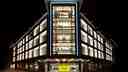
    In front of you, you’ll see a striking, modern glass-fronted building with crisp lines and a brightly lit facade-just look ahead for the corner structure marked with a large “Jelmoli” sign, glowing above the entrance. Welcome to Jelmoli, Zurich’s very own “glass palace”! Now, take a second and imagine the excitement in the air back in 1899, when this place first unveiled its sparkling windows. People probably felt like they’d been teleported to Paris or Chicago-right in the heart of Zurich. The building you see takes up almost the entire block, and its skeleton of iron and glass was a futuristic sensation at the time. But how did it all start? Well, it began not with glass and glamour, but with a clever Italian named Giovanni Pietro Guglielmoli Ciolina. He moved to Zurich all the way from the tiny village of Toceno and, for practical reasons (plus maybe to avoid customers struggling with his surname), he switched to the friendlier “Hans Peter Jelmoli.” Married to the daughter of a textile merchant, he learned his trade and opened his first shop by the Limmat river, just nearby. He even introduced a seemingly radical idea: fixed prices, no haggling! Imagine the shock-shoppers could finally take a break from bargaining and simply pay what the tag said. Revolutionary. The story gets even juicier. As the years zipped by, Jelmoli’s shop became famous, and by the late 1800s, business was booming. That’s when they took a chance and scooped up this plot of land-known as the Seidenhöfe, or “Silk Courts.” And voila, the famous Jelmoli main house began to rise, inspired by the grand department stores of Paris and the soaring towers of Chicago. Right from its opening, people flocked here, curious about the glass walls and the newfangled concept of regular sales-or as Zurichers called it, a “Sensation.” The building didn’t just stay static, though. It grew and evolved, with extensions and daring new designs popping up. In the 1930s, a rounded corner complete with its own mini-tower made an appearance, and there was even a Shell gas station tucked away under the Steinmühleplatz in the 1950s (talk about fueling your shopping spree). Speaking of shopping sprees, Jelmoli didn’t stop in Zurich. By the 1980s, it was Switzerland’s mighty retail giant, with over 200 stores and 5,200 employees. There was even a legendary logistics center (which, let’s be honest, probably looked like Santa’s workshop for grownups) feeding stores from Zurich to Geneva. And they weren’t just about shopping: Jelmoli dabbled in travel agencies, vegetarian restaurants-the famous Hiltl just around the corner was theirs-and even chemical dry cleaning. Some would say they tried to do everything except launch a rocket to the moon. But, not all stories shine forever. As times changed, shopping habits shifted, and even the awe-inspiring “glass palace” couldn’t escape. Step by step, Jelmoli slimmed down until only this flagship store remained, rebranding itself as a “premium department store” by the late ‘90s. The airport shops shut down in 2024, and after one last grand sale-just picture the sound of cash registers ringing and eager shoppers scooping up final bargains-Jelmoli closed its doors for good on February 28, 2025. The Jelmoli archives, packed with old catalogs and advertising, have moved to the city’s care, open to the public for anyone curious enough to peek into this chapter of Zurich’s retail legend. So, if someone tells you that all department stores are basically the same, you can say, “Ah, but have you ever seen Zurich’s ‘glass palace’ and heard the story of Hans Peter Jelmoli?”

    Ouvrir la page dédiée →
Afficher 10 arrêts de plusAfficher moins d'arrêtsexpand_moreexpand_less
  1. It all began in 1234, when two groups of devout women came together. Picture Gertraut Hilzingen and Mechthild von Woloshoven: one was a pious local, the other the daughter of…Lire plusAfficher moins

    It all began in 1234, when two groups of devout women came together. Picture Gertraut Hilzingen and Mechthild von Woloshoven: one was a pious local, the other the daughter of Zurich’s high society. Together, they set up house near the Neumarkt-surviving on charity, and, let’s be honest, probably a lot of patience. Another group crafted a living through handwork in the Oberdorf. They soon built a wooden monastery way out by the Sihl River, in an area about as flood-prone as a bathtub with no drain. Unsurprisingly, their first building got swept away by a flood-hardly divine intervention, but perhaps a celestial hint at poor real estate choices. Not to be discouraged, the sisters secured new land near Lake Zurich, at today’s Zürichhorn. By 1237, their convent received a prestigious seal of approval-a papal protection privilege. Fancy words for: “Please don’t chase us for heresy, we have the paperwork!” The Pope himself encouraged everyone to support Oetenbach’s nuns, so the convent flourished, with its numbers swelling as daughters from noble Swiss families signed up for spiritual pursuits (and, let’s face it, maybe to escape tricky marriage proposals). But the convent’s growing popularity led to some surprising challenges. By 1310, authorities tried to cap the number of nuns at 60, but the place was just too fashionable-think of it as the “it” club for Zurich’s medieval noblewomen. They even introduced reading and Latin knowledge as entrance exams. If only modern clubs asked for a bit of Latin at the door instead of the right shoes! Eventually, high entry fees helped reduce the numbers, making the convent ever more exclusive-a kind of “elite” label that would have made any social climber blush. Inside Oetenbach, life was both austere and highly spiritual. The nuns aimed for mystical unity with Christ, practicing long meditations and even some eyebrow-raising self-discipline that would have made most yoga retreats look like a day at the beach. Their library and scriptorium hummed with activity; some theorize that even the famous Codex Manesse, the crown jewel of Middle High German literature, was copied here by nimble fingers and creative minds. By 1285, the convent had relocated here, inside the city walls, trading the damp lakeside for the (relatively) dry Sihlbühl Hill-right by where you stand. Stories say the move divided the nuns, but safety and a bit more prestige soon won out. The grounds stretched between the Limmat and Sihl rivers, alongside Zurich’s old defenses. Eleven grand structures, lush gardens, and a vast, echoing church soon covered the area-by the 15th century, this was the largest women’s convent in the city. Then came the Reformation. In the early 1500s, Zurich was caught up in wild religious debates. After rousing sermons from reformers like Zwingli and Leo Jud, some nuns left for new lives-one married the future church leader Heinrich Bullinger (I suppose vows could be updated!). By 1525, the cloister was closed for good. But don’t wander off yet-the story isn’t over. The former monastery was reinvented time and again: as a prison, grain store, orphanage, and yes, even as Zurich’s rather imposing police department. The legendary “Giacometti Hall,” painted in the 1920s, still shines in vibrant color within the Amtshaus next door. Today, you won’t find the original buildings (or any sneaky nuns lurking in the shadows), but the spirit of this place lingers-resilient, spiritual, and, dare I say, just a bit mischievous. So the next time you hear a mysterious echo or feel inspired to sing in Latin, remember: you’re standing where centuries of extraordinary women carved out a place of learning, power, and transformation right here in Zurich’s heart. Now, let’s keep walking-there are even more stories ahead, and I promise none of them will ask for your Latin skills at the door! For a more comprehensive understanding of the dominican sisters in zurich, the monastery on the oetenbach on the zürichhorn or the the monastery at sihlbühl in the city, engage with me in the chat section below.

    Ouvrir la page dédiée →
  2. Right now, you’re standing atop the legendary Lindenhof hill-a place where Zürich’s story got its first dramatic spark. Picture this: two thousand years ago, this hill wasn’t just…Lire plusAfficher moins

    Right now, you’re standing atop the legendary Lindenhof hill-a place where Zürich’s story got its first dramatic spark. Picture this: two thousand years ago, this hill wasn’t just a quiet park dotted with linden trees and chess players-no, it was prime real estate for the ancient Celts, the Helvetii, who set up their oppidum, or fortified town, right where you are. Back then, the Lindenhof wasn’t a tranquil city center. It was a strategic, elevated stronghold rising about 25 meters above the Limmat River. On misty mornings, when the damp air drifted up from the water, the hill must have felt like an island of safety surrounded by a watery maze. Seriously, with the Sihl river splitting and flooding its banks, this place could have been the “not-so-dry” version of Swiss security! If you were a Celt living here, most of the neighborhood would have been soggy, swampy, and tricky to cross-a natural moat that even the sneakiest invaders would think twice about. Fast forward to the late Iron Age, around the 1st century BC: right under your shoes lay the traces of wooden houses, fire pits, and mysterious storage pits-some filled with ancient grains, maybe the leftovers of a great Celtic breakfast. Excavations have shown two types of homes: the older ones built with sturdy wooden posts sunk deep into the ground, while the slightly “newer” versions featured classic timber construction-think Swiss chalets, but a few thousand years out of date, and minus the fondue. They even uncovered an enormous boulder with a hollowed center used as a fire pit. If only we could bottle up the scent of roasting ancient grains and woodsmoke-talk about nostalgia! As time went on, the Celts made sure this place put the “opp” in “opportunity.” The location was perfect: close to river routes, lake traffic, and key trade paths. Archeologists found bits of wine amphorae from Italy, fragments of amphoras and coins, and even strange ceramic “dot plates”-the ancient version of a Swiss bank’s money-minting machine. Those dot plates were used for melting precious metals to mint coins. Yes, the Celts of Zürich weren’t just warriors; they had their own money factory! In fact, enormous clumps of fused Celtic coins-now called “Potin lumps”-were found nearby. The biggest one weighed almost 60 kilograms. Imagine trying to sneak that into a Swiss wallet. For a long time, researchers assumed all these ancient clues pointed only to Romans. That is, until the 1990s, when rescue excavations (the archaeological version of calling in the fire brigade) finally uncovered unmistakable Celtic footprints-building foundations, pottery, and even remains from craft workshops filled with iron slag, which proved the local smiths meant business. There were also baffling discoveries-like the Potin lumps, coins with double anchors on one side and mysterious, horned animals on the other. Their exact purpose? Still a riddle! Some think they were offerings, meant for the lake gods or river spirits; after all, the Celts had a thing for sacrificing valuables into muddy waters. I suppose in Zürich, some traditions-like generous bank deposits-go way, way back. And the show didn’t stop with the Celts. By 15 BC, the Romans rolled in and renamed the place Turicum. The hill became the seat of customs officials, bustling merchants, and sturdy stone buildings-some still tucked away under modern streets and cellars. In fact, a Roman gravestone was discovered right here, giving us the earliest recorded mention of Zürich’s ancient name. Nearby, you’d have found public baths and even a temple dedicated to Jupiter, the king of Roman gods. The full story of Lindenhof is still written in fragments-a mosaic of buried houses, ritual sacrifices, fiery destruction, and the evolution from Celtic stronghold to Roman town, medieval fortress, and, yes, a modern park. So next time you sit on a Lindenhof bench and look out over the city, just remember: you’re sharing your seat with more than two millennia of Swiss drama-and perhaps one or two very ancient, very soggy coins! Fascinated by the topography, archaeological research or the findings? Let's chat about it

    Ouvrir la page dédiée →
  3. The Bank Julius Baer stands tall before you, an imposing historic building with grand stone columns and coppery window frames-just look for its bold name proudly displayed above…Lire plusAfficher moins

    The Bank Julius Baer stands tall before you, an imposing historic building with grand stone columns and coppery window frames-just look for its bold name proudly displayed above the entrance among the ornate details facing the street. Welcome to the world of Swiss private banking, where fortunes are managed behind tall, elegant windows and the very bricks have felt a few more zeros on their ledgers than most of us ever will! Picture the year: 1890. The streets of Zurich bustled with trams and horse-drawn carriages, and at Bahnhofstrasse 85, two ambitious men-Ludwig Hirschhorn and Theodor Grob-kickstarted what would become a financial legend by handling money exchanges in a modest office. Soon, Hirschhorn teamed up with his enterprising brother-in-law, Julius Bär, and Joseph Uhl. On a frosty December day in 1896, the company Hirschhorn, Uhl & Bär was born-a trio with more mustaches than any startup today! After Hirschhorn passed away, Julius Bär took the reins, transforming his family name into a brand synonymous with Swiss private banking. Over the decades, sons, grandsons, and eventually great-grandsons steered the ship through the ever-calm and ever-stormy seas of global finance. Imagine Zurich in the Roaring Twenties, the city jazzing up while partners from the Bär family plotted investment strategies over strong coffee. By the time World War II ended, the third generation had taken charge. Eventually, this grand institution opened its doors to outside investors and, by 2005, joined the Swiss Market Index, rubbing shoulders with the banking giants UBS and Credit Suisse. Yet, it always stuck to its roots: managing wealth, not doing everything under the sun. But banking doesn’t always mean calm waters. Julius Baer has weathered storms that must have made its marble corridors vibrate! For example, around 2011, a former employee tried to make headlines by passing supposedly sensitive information to WikiLeaks, waving around empty CDs like a magician pulling coins from behind ears! Then there were investigations-big ones. The Germans wanted answers about untaxed fortunes, and the Americans suspected help with tax evasion. Julius Baer paid millions to put old ghosts to rest, each time promising to do better. In Brazil, during the infamous “Lava Jato” scandal, the bank cooperated by freezing suspicious accounts, casting a stern Swiss glare at corruption. That’s not all-these walls have heard hushed conversations about vanished East German millions, and a few sleepless nights followed a risky loan to an Austrian real-estate empire that ended up costing the bank over half a billion Swiss francs. Even the leadership sometimes changed at lightning speed; chief executives coming and going, responsibility handed from one steady-if slightly nervous-hand to the next. Oh, and don’t forget philanthropy! Since 1965, the Julius Bär Foundation has worked quietly to balance wealth and education, building bridges between privilege and need across the globe. It’s as if, for every scandalous headline, there’s a hopeful story the bank can hold up in return. As you watch the traffic roll by, consider the vast fortunes-around 482 billion Swiss francs-handled under this roof, a quarter of it coming from Asia, making Julius Baer not just a Zurich institution but a global power. Through acquisitions, international drama, and a little family intrigue, it has remained, above all, a place where the ultra-wealthy trust someone else to stress over their money. And frankly, who could blame them? Banking may be serious business, but it’s never boring-especially here at Julius Baer!

    Ouvrir la page dédiée →
  4. If you’re looking straight ahead, you’ll spot the Fraumünster by its tall, slender green spire topped with a golden ball, and a large clock face gleaming above the arched…Lire plusAfficher moins

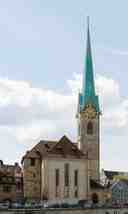
    If you’re looking straight ahead, you’ll spot the Fraumünster by its tall, slender green spire topped with a golden ball, and a large clock face gleaming above the arched windows-standing just along the Limmat, it’s practically waving at you! Alright, let’s step back in time, just for a moment-keep your eyes on that striking green spire, but let your imagination run wild. The Fraumünster isn’t just a church, it’s one of Zurich’s great legends. Picture this: it’s the middle of the 9th century, and two princesses, Hildegard and Bertha-daughters of King Louis the German-leave their royal castle for a life of peaceful devotion in the wilds near Zurich. The forest here was dark and mysterious, but the sisters didn’t need GPS; legend says a glowing stag led them through the woods every night, antlers sparkling like lanterns. That stag pointed its antlers to the exact spot by the river where the sisters should build their sanctuary. King Louis, obviously impressed by his daughters’ navigation skills-or perhaps just a proud dad-founded the mighty Fraumünster Abbey right here in 853. This wasn’t just a humble nunnery either: it grew to be one of the richest and most powerful abbeys in all of medieval Switzerland. If you imagine Zurich’s city council today having a choir and their own coin mint, you’re not far off! The abbess (always a highborn lady, think "the boss of bosses") had the power to run the market, collect hefty taxes, and basically rule Zurich for centuries. A “City Lady,” if you will. The Fraumünster and its abbesses were woven tightly into the city’s fate. Grand emperors and proud kings visited here, epic feasts and royal betrothals were held beneath the soaring arches. In fact, Christmas 1055 wasn’t just ‘silent night’-it echoed with celebration as King Henry IV got engaged in this very church. But even power has its limits. By the 13th century, the city’s burghers-imagine grumpy townsfolk tired of royal rules-managed to kickstart Zurich’s journey to independence, though the abbess kept some truly quirky perks, like the right to overrule the city court whenever she fancied mercy. The Fraumünster controlled land from lakes to mountains, meadows, forests, and even all the city’s mills-imagine being the landlord for almost everyone and everything around. Inside, the abbey bustled with noblewomen who sometimes left the convent to get married-hardly your average medieval strict nunnery! Fortunes shift, though, and by the 1500s things got rather comfortable for the few nuns remaining-they had private apartments, could dress in red and black silks, and were basically Zurich’s most exclusive club. In the upheaval of the Reformation, the last abbess, Katharina von Zimmern, handed everything over to the city with a flourish and promptly married a knight. Well played, Katharina. Let’s not forget the slice of drama and color that shines inside today: the world-famous stained glass windows by Marc Chagall, flooding the choir with blues, reds, and yellows. Modern visitors flock to see their surreal glow-oh, and the organ’s the biggest in the whole canton, with a whopping 5,793 pipes. On Saturday evenings, listen for the ringing of the five bells, a sound that’s crossed centuries of joy, sorrow, and all the daily bustle. So as you stand before that stunning clock and spire, take a moment to imagine the ancient sisters, the lost abbey gardens, the ringing coins and choral echoes-all woven into Zurich’s heart right where you’re standing. And who knows? Maybe somewhere, that magical glowing stag is still showing the way. Want to explore the founding legend, church or the parish in more depth? Join me in the chat section for a detailed discussion.

    Ouvrir la page dédiée →
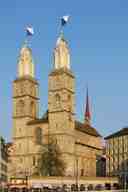
  5. Just ahead of you, the Grossmünster rises with its unmistakable twin towers topped with pointed, lattice-topped domes-simply look for the two stone giants reaching for the sky,…Lire plusAfficher moins

    Just ahead of you, the Grossmünster rises with its unmistakable twin towers topped with pointed, lattice-topped domes-simply look for the two stone giants reaching for the sky, each proudly flying a blue and white Zürich flag high above the rooftops. Welcome to the legendary Grossmünster! Let’s set the scene: imagine standing in medieval Zürich, with the sound of chattering merchants echoing around you and the faint ringing of church bells overhead. This Romanesque masterpiece was begun around the year 1100, built over what was believed to be the resting place of Zürich’s very own patron saints, Felix and Regula. According to local legend, Charlemagne himself rode all the way here, led by a mystical stag, only for his horse to kneel in reverence on this very spot. Some say the emperor was so moved that he declared, “Well, I suppose this is the place!” and set the groundwork for the grand church you see now-a story with just the right amount of royal flair and animal guidance! Inside these ancient walls, whispers of history are everywhere. The Grossmünster began as both a church and a meeting place for the city’s canons, who weren’t your typical monks-no vows of poverty, just plenty of singing and the occasional university degree! By day, these scholarly gentlemen debated theology and law, and by night, they looked after a vast treasure chest crammed full of church relics. In fact, in the old sacristy, there’s still an iron chest that hints at the treasures hidden here in centuries past. But-like any good Zürich story-there’s a rivalry! For centuries, Grossmünster and its neighbor, the Fraumünster, couldn’t resist trying to outdo each other in history, legend, and holy relics. The Grossmünster claimed nothing less than a founding by Charlemagne himself, adding a dose of imperial sparkle that Fraumünster found hard to match. The annual processions, weaving between the churches and over the river, must have looked like a scene from a medieval festival, filled with colorful banners, relics, and the steady hum of chanting pilgrims. Zoom forward to the early 1500s, and something big is brewing. Enter Huldrych Zwingli, the firebrand preacher whose sermons right here helped ignite the Swiss Reformation. With the stroke of a word, he had statues and altar paintings whisked away, making the pulpit-not the altar-the real stage of attention. Imagine the sound of bones and stones clattering as the relics of Felix and Regula were swept aside, only for a hazel nut and some fragments to be found-proof, perhaps, that even history has a sense of humor! Now, look up to those twin towers. They weren’t always identical, you know! For centuries, they squabbled like siblings, until, in the late 1400s, they were given matching “hats” and soaring watch rooms by ambitious city builders. Lightning tried to spoil the party in 1763, setting a timber spire ablaze, but quick-thinking townspeople threw wet ox hides over the bells to save them from melting. Today, the Grossmünster is more than just a church. It’s a symbol of Zürich itself-echoing with concerts, celebrations, and the daily life of the city. If you’re brave enough to climb the 187 steps of the south tower, you’ll be rewarded with a head-spinning view over the rooftops and rivers below. So, as the sunlight glows on Grossmünster’s ancient stone, remember: you’re standing in the heart of centuries of legends, reforms, rivalries, and more than a few good stories. And if a stag happens to wander by? Well, maybe Charlemagne is still keeping an eye on things! Want to explore the name, founding legend or the provost's office of st. felix and regula in more depth? Join me in the chat section for a detailed discussion.

    Ouvrir la page dédiée →
  6. Imagine this area at the southeastern edge of the medieval city. The city wall loomed behind, the Neumarkt and Kronentor gates just nearby, and the Wolfbach stream quietly…Lire plusAfficher moins

    Imagine this area at the southeastern edge of the medieval city. The city wall loomed behind, the Neumarkt and Kronentor gates just nearby, and the Wolfbach stream quietly determining where the monastery buildings should sit. During the Middle Ages, the Barfüsser Monastery wasn’t just a peaceful haven for prayers; it was a true social and political hotspot. Noble families, like the Counts of Kyburg and the Regensberger dynasty, were often in contact with the friars. One Regensberger, Ulrich I, even landed a prime spot in the monastery church after his final curtain call. But this place saw more drama than just burials and prayers. Major decisions and gatherings took place behind these walls. In 1310, King Heinrich VII himself had a meeting here with bishops and nobles-think of it as a medieval boardroom, minus the PowerPoint slides. And when Zürich’s mayor Rudolf Brun led his famous political reboot in 1336, the city’s new constitution was sworn in right on this soil. The Franciscans, by the way, took the side of the people over the patricians, making them a small but mighty political force for the common man. Their lives were humble (mostly), but not dull. By 1513, the six monks residing here had enough vineyard land that, if stories are to be believed, each could enjoy up to 2.3 liters of wine a day. I’d say cheers to that, but moderation is key-even for friars. As the centuries passed, the monastery became a patchwork of buildings: a church with its three long naves, a grand refectory, quiet cells, and a beautiful cloister with 64 arching window pairs that filled the walkways with delicate light. But Zurich’s story is never straightforward. By the early 16th century, winds of change swept in with the Reformation. The Franciscans didn’t exactly run to join Zwingli’s movement, but they couldn’t resist the change either. In 1524, the monastery was dissolved. Soon after, monks from all over town-and their books-found shelter here. In a twist, the precious library survived where others didn’t, simply because these monks stuck around long enough to protect it. After the closure, the building wore many hats. For a while, it was Zürich’s grain store; later, a concert and ball hall known as the Casino, seen as one of the most elegant places in the city. The monastery even had an early printing press set up by Christoph Froschauer-the man who brought Gutenberg’s magic to Zürich. Shakespeare had his Globe, Zürich had its own theatre: the city’s first real playhouse was set up here in the former church. Richard Wagner even conducted his operas here during his exile. But, New Year’s Eve of 1890, a wayward fire turned the theater to ashes-no actors, only firefighters got star billing that night. Now, much of the original medieval buildings are gone or repurposed. The elegant concert halls, the bustling grain store, the echoing cloisters-these have been reshaped as the city evolved. Some remains from the cloister survived, tucked away into museums and even reused in the loge on Lindenhof hill. Every so often, archaeological digs have turned up bones and stones, little reminders that under layers of new stories, old Zürich still peeks through. So as you stand here, think of centuries of prayers, political deals, wine-fueled monastic laughter, resounding applause from theater crowds, judges pondering weighty cases, and maybe, just maybe, a friar or two still wondering where he left his sandals. Let’s keep moving before the “barefooted” joke police catch up with us! Want to explore the layer, church or the monastery in more depth? Join me in the chat section for a detailed discussion.

    Ouvrir la page dédiée →
  7. Picture Zurich in 1833, bursting with new ideas. That’s when the University of Zurich was founded-remarkably, it was the first university in Europe to be created by a democratic…Lire plusAfficher moins

    Picture Zurich in 1833, bursting with new ideas. That’s when the University of Zurich was founded-remarkably, it was the first university in Europe to be created by a democratic government, not a monarch or the Church. I know, it’s Switzerland, so there was probably no dramatic royal decree, just a very polite and efficient meeting-and a celebration on April 29th! One could say the university was born with Swiss precision and a little extra cheese. Zurich’s academic past actually stretches even further back. Theology students were reading the Book of Genesis here as far back as the 16th century. Under the guidance of Zwingli, the city’s great reformer, the Prophezei-a sort of early reading group-made Zurich a hub for religious and philosophical learning. And yes, there was plenty of debate, and maybe a secret snack or two snuck into class. Over time, more and more faculties joined the university. Today, all the classics are here: theology, law, medicine, philosophy, economics, veterinary medicine, and the natural sciences. Fun fact: Zurich’s veterinary faculty, founded in 1901, is one of the oldest in the world. That means the cows in Switzerland aren't just beautiful-they're probably some of the most academically respected animals in Europe. By 1840, the University of Zurich was already a pioneer, becoming the first in the German-speaking world to allow women as auditors. Soon after, Nadezhda Suslova became the first woman in the region to earn a medical doctorate here, and Marie Heim-Vögtlin blazed a trail as the first Swiss woman doctor. Imagine how tense and exciting those early lectures must have been-the whispers, the glances, the old professors secretly rooting for their new students. Space was always a challenge, so in 1914, the university opened this very building before you. Elections, city referenda, and a construction campaign-yes, everything here really is decided by a vote. Can you hear the echo of the opening ceremony as Zurich’s best and brightest filled this hall for the first time? Just three years later, the shiny new Central Library opened, which still serves as Zurich's city, cantonal, and university library all at once. This university has seen its share of famous faces. Albert Einstein, for example, spent two years here as a lecturer in theoretical physics-just imagine him hurrying between classrooms, hair already a little wild, maybe losing a sock in the hallway. In 1946, Winston Churchill delivered his legendary “Let Europe Arise!” speech in the university’s grand hall. I bet students in the back row were jotting down notes about history... or maybe just doodling little hats on Churchill. Throughout the years, the University of Zurich has adapted relentlessly, whether it was building a new campus at Irchel in the 1970s to make space for the sciences, or pushing forward with women’s access to education. It’s not just a place of lectures and exams; it’s hosted world-changing discoveries, created Nobel Prize winners-thirteen of them, from Röntgen, who gave us X-rays, to Schrödinger, who may or may not have brought a cat into his office. A leader in open science, Zurich was the first in Switzerland to commit to open-access research, and nowadays it’s home not only to libraries and labs, but museums, zoological collections, and the latest e-learning systems. The university’s web of connections stretches everywhere-even the Citizen Science Center, co-founded with ETH Zurich, helps researchers and local citizens team up to solve real-world problems. So, as you look up at this magnificent building, know that you’re seeing a place built on centuries of passionate debate, big dreams, and probably a few over-caffeinated students cramming for exams. This is the University of Zurich-where history, humor, and a little bit of Swiss stubbornness come together to make academic magic. Shall we continue to our next stop? For further insights on the overview, faculties or the open science, feel free to navigate to the chat section below and inquire.

    Ouvrir la page dédiée →
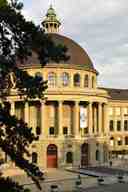
  8. In front of you towers a grand, circular building with a sweeping stone façade, arched windows, and a dramatic domed roof-just look for the impressive dome crowned by a small…Lire plusAfficher moins

    In front of you towers a grand, circular building with a sweeping stone façade, arched windows, and a dramatic domed roof-just look for the impressive dome crowned by a small cupola above a row of tall pillars, and you can’t miss ETH Zurich. Picture Zurich in the mid-1800s: the air is electric with ideas and debate, not because of laboratory experiments (not yet!), but because Switzerland has decided to take a big leap and open its own national technical school. After a heated national discussion-yes, even in Switzerland things could get a little spicy-they settled on Zurich as the home for what would become the ETH. The building you see now was born from a vigorous architecture competition, and an ambitious German architect named Gottfried Semper, who also designed the famous opera house in Dresden, claimed victory. Between 1858 and 1864, Zurich watched as this monumental stone masterpiece rose at the foot of the Zürichberg, its dome soon becoming an unmistakable part of the city’s skyline. Originally, the only classes on offer were purely technical-imagine a group of students in black coats, practicing advanced math and studying steam engines. The Poly, as it was nicknamed, grew quickly, sprouting new buildings every decade. The present dome and stately southern façade stayed true to Semper’s vision, but inside and along the Rämistrasse, new architects couldn’t resist tinkering. So, over the years, the ETH became a blend of old-world ambition and new-world energy-essentially, the mullet haircut of academic architecture: business in the front, party in the back. But the story doesn’t stop at fancy buildings. Inside these walls, more than 23,000 students fill the halls, while over 11,000 staff-scientists in lab coats and administrators wielding coffee mugs-work across 16 departments from chemistry to architecture. The ETH isn’t only a training ground for budding Swiss inventors. Its alumni list sparkles with 22 Nobel laureates. You may have heard of a certain Albert Einstein-his legendary mane may be absent, but you can still visit his old locker here, lovingly preserved as a mini-museum. Now, the ETH isn’t just stuck in the past. Over in Hönggerberg, the Science City project is expanding this scientific playground with state-of-the-art labs, eco-friendly dorms, and even a high-tech sports center-because who says you can’t invent the future and break a sweat at the same time? Naturally, a school this inventive needs its own supercomputer center, the CSCS, which crunches numbers for scientists across Switzerland, and an AI Center where more than 100 professors from all corners of science try to build the next digital Einstein, hopefully with better hair. And let’s not forget ETH’s truly international spirit: it forms part of the ETH Domain with its sister school in Lausanne, working directly for Switzerland-no local politics to slow down these researchers! Of course, life at ETH isn’t just late nights in the lab. There’s a campus sports league, rowing duels with the University of Zurich, and an explosion of student-run initiatives-one even helps bridge the gap between the classroom and the working world. And with over 600 start-ups launched by former students, ETH Zurich is basically a knowledge factory with a side hustle in entrepreneurship. So as you gaze up at the great dome, imagine the thunder of debate in the old halls, the brisk steps of future Nobel winners, and the jittery energy of students on exam day. Who knows, perhaps you’ll invent something world-changing here-or at least master the art of the perfect Swiss chocolate break! Curious about the organization, study data or the spin-offs / start-ups? Don't hesitate to reach out in the chat section for additional details.

    Ouvrir la page dédiée →
  9. The story starts in the Middle Ages, when monks at the Grossmünster canons’ monastery stored precious hand-written manuscripts in a humble library. Imagine the quiet scratching of…Lire plusAfficher moins

    The story starts in the Middle Ages, when monks at the Grossmünster canons’ monastery stored precious hand-written manuscripts in a humble library. Imagine the quiet scratching of quills on parchment and stacks of liturgical tomes - or what was left of them after the infamous book storm of 1525, when overzealous reformers sent most of the collection out the metaphorical window. By the end of those three chaotic weeks, the mighty collection was whittled down to about 470 books. Talk about overdue fines! Luckily, the Alsatian humanist Konrad Pellikan entered the scene, gathering whatever books survived from churches and buying up the private library of Zurich’s own Huldrych Zwingli. By the time he finished his catalogue, the collection was back up to 770 volumes bursting with ideas from every corner of the world. Fast forward to the 17th century, where four young Zurich merchants gathered in Professor Heinrich Ulrich’s parlor. Inspired and maybe a little miffed by the fate of Heidelberg’s great library, they set out to found their own: a Civic Library, open to anyone eager for knowledge. Their motto? “Arte et Marte - through Science and Weaponry!” One can only assume their reading battles were fierce but polite. Soon after, the library opened its doors not in some grand palace but in the late-Gothic Water Church, where the city’s best minds and collections of books, coins, and oddities met to chat. Soon, Zurich had not only a Civic Library but also a University - and suddenly a tug-of-war broke out between the city’s traditions and the university’s need for access. The standoff was so tense that, in 1835, authorities just created a whole new Cantonal Library, stashing thousands of volumes from dissolved monasteries, the university, and even a veterinary school. Where better to keep priceless books than next to textbooks on cows? By the late 1890s, however, Zurich was running out of shelf space, and everyone agreed: time for a grand central library! City architect Hermann Fietz designed a sand-colored structure, calm and dignified, and by 1917, with the help of generous citizens, it opened as the proud Zurich Central Library. The original entrance is still marked by the statues of Conrad Gessner, nature’s biggest Swiss fan, and Johann Jakob Bodmer, who helped give the world a love of German literature. Look up - a little putto (that’s a chubby Renaissance angel for the rest of us) stands atop an owl’s head, clutching books with a gaze that says, “Read or regret it!” Inside, the library holds 6.9 million items. That includes 4.3 million books, 980,000 graphic prints and photos, over 200,000 precious manuscripts, and some microforms so small I once mistook them for lost Tic Tacs. If you crave maps, there are 320,000, some showing Zurich as it grew from medieval town to modern city. Let’s take a detour to the Music Department, with its world-class Wagner collection and centuries of scores. Down the hall, treasures like medieval manuscripts and family letters from Zurich’s most famous thinkers whisper secrets from glass display cases. A few more shelves over, you’ll find collections dedicated to everything from American literature to the history of Swiss worker movements, and even a legendary esoteric library donated by a graphologist named Oskar Schlag. If you ever wanted to read up on ancient mysteries or just find a nice Finnish comic, you’re in luck. The Central Library is more than Zurich’s largest repository: it’s a living house of wisdom, feeding the minds of university students, researchers, and everyday citizens. Rumor has it, if you bring the librarians chocolate, you’ll get the best study spot by the window. And take a moment to appreciate that calm grandeur - this is where Zurich’s ideas rest, ready for the next generation to open the cover and turn the page.

    Ouvrir la page dédiée →
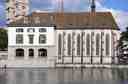
  10. Right in front of you, you’ll spot the Water Church with its steep, shingled roof and tall, pointed Gothic windows facing the river-just look for the long line of arched windows…Lire plusAfficher moins

    Right in front of you, you’ll spot the Water Church with its steep, shingled roof and tall, pointed Gothic windows facing the river-just look for the long line of arched windows stretching right above the water’s edge. Now, let’s dive into this watery wonder’s story! Imagine centuries ago, you wouldn’t be standing on solid ground at all-you’d be getting your feet wet, because the Water Church was once perched on its very own island in the flow of the Limmat. That’s where it gets its name, and yes, for once in Zurich, the name is pretty literal. The church sits here on what was once a mysterious spot, and the legends say there’s a reason for it. Long before trains or tourist crowds, this island was a place of old magic-some say even a pre-Christian cult shrine stood here. But it’s the story of Felix and Regula, Zurich’s beloved saints, that fills this place with drama. Picture this: it’s around the year 300 AD, the Roman Empire rules, and Christianity is most definitely not in fashion. Felix and Regula, two rebel Christians from the Theban Legion, get caught and are sentenced right on this island. They’re tortured and beheaded-but here’s the kicker: Instead of, well, just staying down, legend has it they pick up their heads, march forty steps uphill, and only then decide to finally rest. That hill? That’s now the spot of Grossmünster, your earlier stop. You could say Zurich’s saints were the original headstrong types! For centuries, the very stone where they supposedly lost their heads was the center of devotion, and you can still see it today if you head into the crypt. Pilgrims would flock here, not just for prayers but also to try their luck at a sulfur spring discovered during the late 1400s rebuild-locals claimed it could cure just about anything. In those days the Water Church joined Fraumünster and Grossmünster to form the holiest triathlon of Zurich, and processions wound from one to the next. The church itself weathered more drama than a reality TV show. In the 1200s, it was rebuilt in grand, Gothic style, but Zurich’s city council in the 15th century decided it needed even more sparkle-out with the old, and in with the new! The masterpieces of frescoes and fancy decorations didn’t last long though: roll around to the Reformation and suddenly Zurich’s churches are being stripped bare, organs gone, banners seized, even the magical spring gets plugged up. The Water Church became, of all things, a storage warehouse, with two extra floors squeezed in so tightly that those gorgeous arched windows had to be chopped in half. Then the city thought, why waste space? Zurich’s very first public library was built right inside. Picture monks and scholars wandering among ancient books, sunlight streaming through those mighty windows, maybe stopping for lunch next to the old execution stone-talk about multitasking. Don’t forget to glance at the Helmhaus, attached on the north side-it was once a court, later a marketplace, and now it’s a proud home to Swiss contemporary art. And just behind the choir, if you see a big, heroic statue with sword and Bible out front, that’s the famous Zwingli monument, guarding the church since the 1800s. Today, after much renovation-and perhaps a few arguments along the way-the Water Church stands as a striking example of Zurich’s ability to reinvent itself. Go inside if you can: you’ll spot a beautiful organ, a single bell that rings with a crisp C note, and windows by artist Augusto Giacometti. Not bad for a location that started as an island of legends, rebellion, healing water, and the world’s most determined saints! For a more comprehensive understanding of the equipment, helmhaus or the water house, engage with me in the chat section below.

    Ouvrir la page dédiée →
Foire aux questions

Comment commencer le tour ?

Après l'achat, téléchargez l'application AudaTours et entrez votre code de réduction. Le tour sera prêt à commencer immédiatement - il suffit d'appuyer sur lecture et de suivre l'itinéraire guidé par GPS.

Ai-je besoin d'Internet pendant le tour ?

Non ! Téléchargez le tour avant de commencer et profitez-en pleinement hors ligne. Seule la fonction de chat nécessite Internet. Nous recommandons de télécharger en WiFi pour économiser vos données mobiles.

S'agit-il d'une visite de groupe guidée ?

Non - il s'agit d'un audioguide en autonomie. Vous explorez indépendamment à votre propre rythme, avec une narration audio diffusée par votre téléphone. Pas de guide, pas de groupe, pas d'horaire.

Combien de temps dure le tour ?

La plupart des tours durent entre 60 et 90 minutes, mais vous contrôlez totalement le rythme. Faites des pauses, sautez des arrêts ou arrêtez-vous quand vous le voulez.

Et si je ne peux pas finir le tour aujourd'hui ?

Pas de problème ! Les tours disposent d'un accès à vie. Faites une pause et reprenez quand vous le souhaitez - demain, la semaine prochaine ou l'année prochaine. Votre progression est sauvegardée.

Quelles sont les langues disponibles ?

Tous les tours sont disponibles dans plus de 50 langues. Sélectionnez votre langue préférée lors de l'utilisation de votre code. Note : la langue ne peut pas être changée après la génération du tour.

Où accéder au tour après l'achat ?

Téléchargez l'application gratuite AudaTours sur l'App Store ou Google Play. Entrez votre code de réduction (envoyé par e-mail) et le tour apparaîtra dans votre bibliothèque, prêt à être téléchargé et commencé.

verified_user
Satisfaction garantie

Si vous n'appréciez pas le tour, nous vous rembourserons votre achat. Contactez-nous à [email protected]

Paiement sécurisé avec

Apple PayGoogle PayVisaMastercardPayPal

AudaTours : Audioguides

Des tours à pied en autonomie, divertissants et économiques

Essayer l'application arrow_forward

Adoré par les voyageurs du monde entier

format_quote Ce tour était un excellent moyen de voir la ville. Les histoires étaient intéressantes sans paraître trop scénarisées, et j'ai adoré pouvoir explorer à mon propre rythme.
Jess
Jess
starstarstarstarstar
Tour de Tbilissi arrow_forward
format_quote C'était un bon moyen de découvrir Brighton sans se sentir comme un touriste. La narration était profonde et contextuelle, sans en faire trop.
Christoph
Christoph
starstarstarstarstar
Tour de Brighton arrow_forward
format_quote J'ai commencé ce tour avec un croissant dans une main et zéro attente. L'application vibre tout simplement avec vous, pas de pression, juste vous, vos écouteurs et quelques histoires sympas.
John
John
starstarstarstarstar
Tour de Marseille arrow_forward

Audioguides illimités

Débloquez l'accès à TOUS les tours du monde

0 tours·0 villes·0 pays
all_inclusive Explorer Unlimited