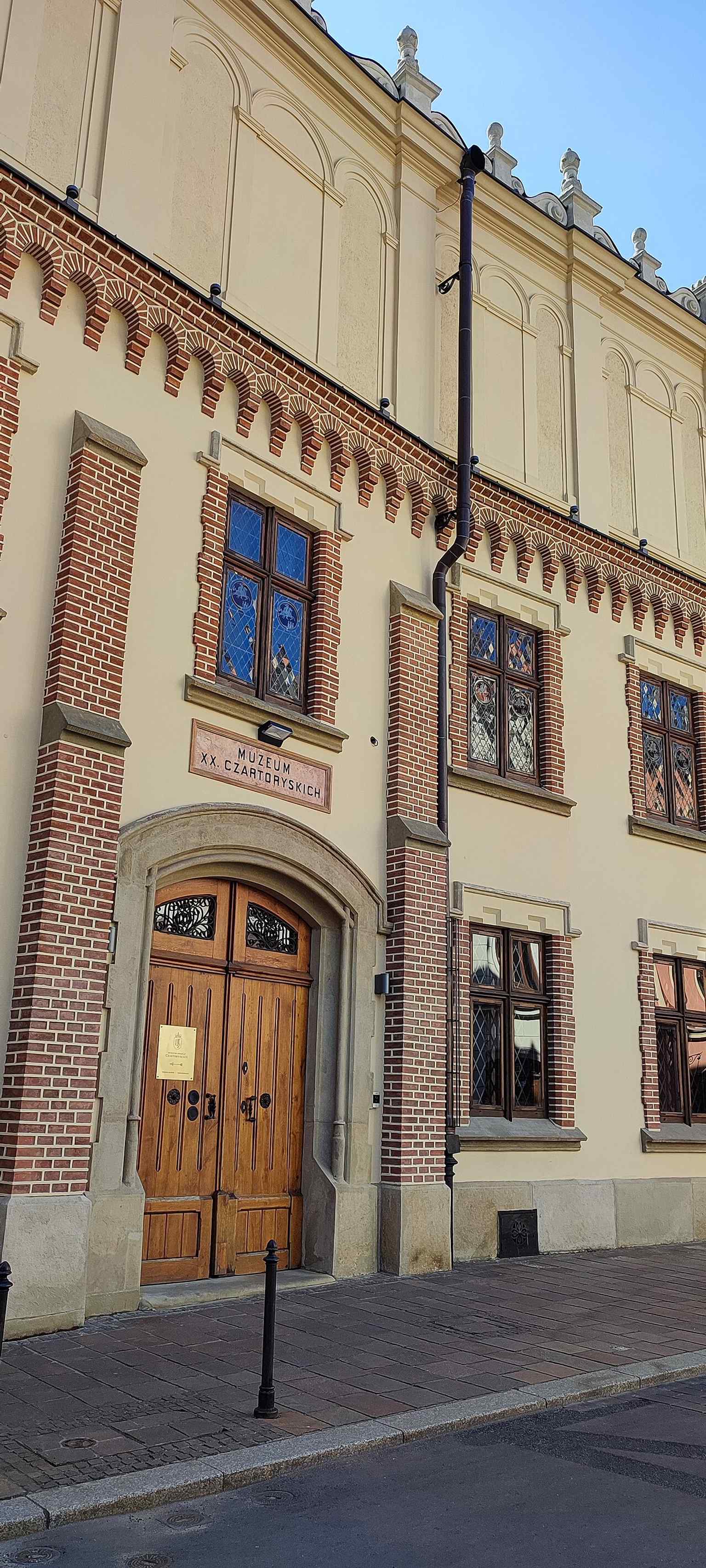
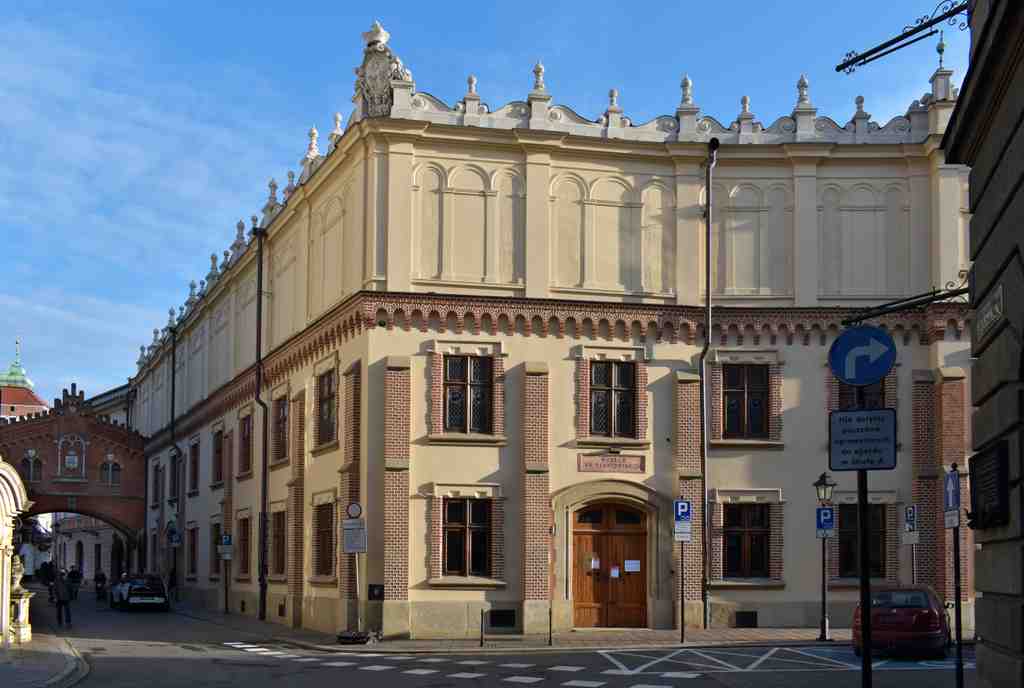
On your left, look for the museum’s long pale stone-and-plaster façade, its tidy rectangular palace shape, and the arched central entrance lined up beneath rows of evenly spaced windows.
This place turns collecting into rescue work. If the Barbican guarded who entered Kraków, this museum guarded what Poland refused to lose.
Princess Izabela Czartoryska is the hero here, and she had the kind of stubborn imagination cities live on. In seventeen ninety-six, in a Poland carved up by foreign powers, she opened her family collection to the public in Puławy and gave it a patriotic job to do. Her motto was “The Past to the Future.” That sounds elegant; in practice it meant, “Save everything before somebody else grabs it.” If you glance at your screen, you can see the little Temple of the Sibyl where she first staged that idea.
Izabela did not collect only pretty things. She gathered trophies from the victory over the Turks at Vienna in sixteen eighty-three, royal relics, treasures tied to Wawel, and objects soaked in story. She even bought “Shakespeare’s chair” in Stratford. Whether it truly deserved that title became a scholarly headache later, but that is part of the point: in the Romantic age, memory and myth often arrived in the same carriage.
The Czartoryski collection in exile began when history got rough, and boy, did it get rough. After the November Uprising of eighteen thirty, Russian authorities confiscated the family estates and damaged the Puławy collection. Much of it survived because the family moved it to Paris, to the Hôtel Lambert, where the museum became a kind of displaced homeland in storage. These treasures were not peacefully inherited; they were rescued, packed, hidden, argued over, and carried across borders.
Then Prince Władysław Czartoryski brought them here. After the Franco-Prussian War, he fled Paris with the artifacts, and Kraków offered him an arsenal built into the old city defenses as a new home. In eighteen seventy-eight, more than eight decades after Izabela’s first museum, this Kraków version opened. That is a very Kraków trick: take a defensive site and give it a second life as a sanctuary for memory.
Its star resident is Leonardo da Vinci’s Lady with an Ermine. On your phone, she looks calm enough to lower your blood pressure. In reality, that painting endured exile, wartime looting, rough handling by the Germans, and a long identity mystery before scholars firmly connected the sitter to Cecilia Gallerani around nineteen hundred.
The collection survived another nightmare in nineteen thirty-nine. General Marian Kukiel organized a last-minute rescue, but the Gestapo found many packed cases. In nineteen forty, eighty-five of the most important objects went to Dresden for Hitler’s planned museum at Linz. The Leonardo came back after the war. Raphael’s Portrait of a Young Man did not. Neither did hundreds of other objects, including hundreds of gold coins. So no, these are not static prizes in glass boxes. They are survivors with passports, bruises, and unfinished legal dossiers.
And the story keeps unfolding next door, because the paintings were only half the rescue. The books and archives scattered too, and in a moment we’ll meet that paper army in the Czartoryski Library.
If you want to return for a visit inside, the museum is open Tuesday through Sunday from ten to six, and closed on Mondays.