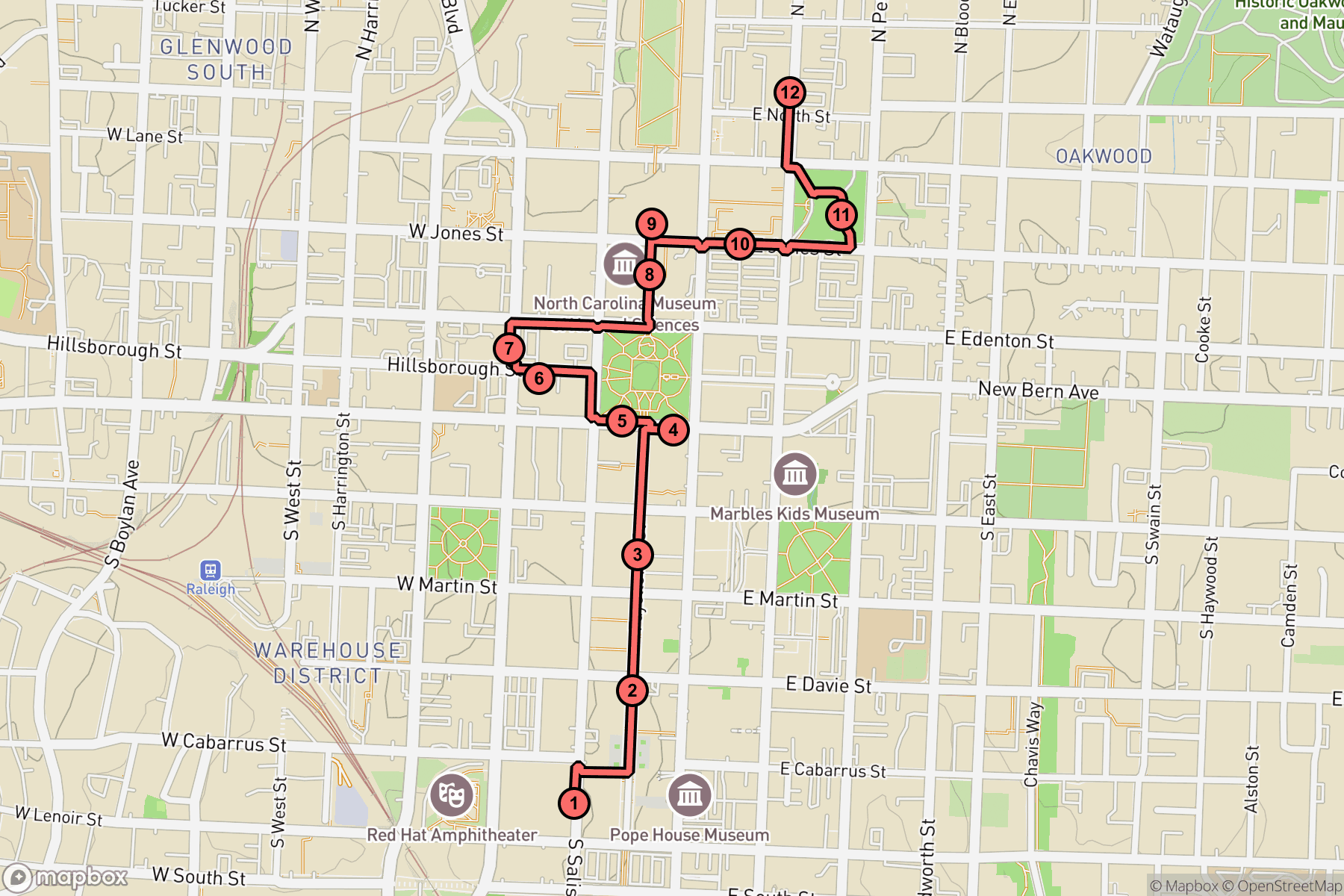
Tour de audio de Raleigh: Poder y pioneros a lo largo del Corredor Capital
Bajo el majestuoso horizonte de Raleigh, los secretos han moldeado el corazón de Carolina del Norte, desde el disenso susurrado en los salones de mármol hasta las rápidas estratagemas judiciales que una vez asombraron a la nación. Realice este tour de audio autoguiado y descubra historias que los libros de texto pasan por alto. Siga los pasos de rebeldes, visionarios y silenciosos agentes de poder, descubriendo cómo la historia resuena en estas animadas calles y sombríos corredores. ¿Qué escándalo se encendió en la Corte Suprema de Carolina del Norte que envió ondas de choque a través del sistema judicial del estado? ¿Qué objeto inesperado dentro de la Asamblea General guarda un misterio olvidado? ¿Por qué un solo libro en la Biblioteca Estatal desató el pánico y un feroz debate? Muévase por el histórico centro de Raleigh, rastreando conflictos olvidados, intrigas políticas y tesoros inusuales escondidos a plena vista. Cada giro encierra nuevas revelaciones, pintando la ciudad con un contraste más nítido a cada paso. Pulse reproducir y deje que Raleigh revele lo que se esconde detrás de sus grandes fachadas. El pulso oculto de la ciudad está esperando.
Vista previa del tour
Sobre este tour
- scheduleDuración 40–60 minsVe a tu propio ritmo
- straighten2.8 km de ruta a pieSigue el camino guiado
- location_onUbicaciónRaleigh, Estados Unidos
- wifi_offFunciona sin conexiónDescarga una vez, úsalo en cualquier lugar
- all_inclusiveAcceso de por vidaReprodúcelo en cualquier momento, para siempre
- location_onComienza en Iglesia del Sagrado Corazón
Paradas en este tour
To spot Sacred Heart Church, look for a sturdy stone building with tall, arched windows, a pointed spire on the corner, and a statue of Jesus above the entrance-you’ll find it…Leer másMostrar menos
To spot Sacred Heart Church, look for a sturdy stone building with tall, arched windows, a pointed spire on the corner, and a statue of Jesus above the entrance-you’ll find it nestled along Hillsborough Street behind leafy bushes and a sign that reads “The Cathedral of the Sacred Heart.” Welcome to Sacred Heart Church! Take a deep breath-you’re standing in front of a place that’s seen Raleigh change and grow for over a century. Imagine yourself here in 1922, when construction was buzzing and the scent of fresh stone and mortar filled the air. This might look like a simple church, but it has a big story to tell-think of it as a little engine that could, just with more stained glass and less choo-choo. Now, let’s time travel back to 1879. The Sacred Heart parish was just getting started and Raleigh’s Catholic community was tiny-so tiny, in fact, that when the church building finally opened in 1924, Catholics were still rare in North Carolina. In a twist worthy of a season finale, North Carolina was actually the very last state to get a Catholic diocese. When that happened, this building-humble as it may seem-became the first cathedral for the whole Diocese of Raleigh. Picture this: priests in flowing robes, bells chiming, and a sense of excitement fluttering through the new cathedral. Now, let your eyes wander across those Gothic features-the pointed arches, the tall lancet windows, the stonework that looks like it could outlast a hurricane. See that spire? It’s like the church’s way of waving hello to the sky. Right above the door, a statue of Jesus with his heart on display welcomes all who enter-talk about wearing your heart on your sleeve! Here’s a fun fact: for years, this was the smallest Roman Catholic cathedral in the continental U.S.-it could squeeze in about 300 people tops! When Sunday came around, the place filled up so many times over that they had to hold eleven Masses a weekend. Imagine being a priest and thinking, “Did I just see you at the last service? Or was that eight services ago?!” In 2017, the local Catholic population had grown so much that a bigger cathedral was needed. They built the new Holy Name of Jesus Cathedral not far from here, seating over six times as many people. Even though Sacred Heart isn’t a cathedral anymore, it still fills up with daily Mass, weddings, and funerals-always echoing with the stories of Raleigh’s faithful. Oh, and if you hear playful laughter, that’s probably coming from Cathedral School next door-a place where kids have been learning and playing since 1909. So take a look around, soak up the history, and give a little wave to the statue-Sacred Heart has been welcoming wanderers just like you for generations!
Abrir página dedicada →Look to your left for a striking grey stone church with a steep, pitched roof and big arched windows-it's the one that looks like it might be imported straight from a storybook or…Leer másMostrar menos
Look to your left for a striking grey stone church with a steep, pitched roof and big arched windows-it's the one that looks like it might be imported straight from a storybook or an old English village, standing tall among bare-branched trees and a spot of green. Now that you’ve found the Church of the Good Shepherd, let’s step back in time together-just imagine the year is 1874, the streets are mostly dirt, horses are clopping by, and there’s a little controversy brewing in Raleigh. The city’s very first Episcopal church, Christ Church, had a habit of renting out their pews-if you could pay, you got the good seats. If you couldn’t, well, hope you liked the view from the back; not exactly the best way to bring people together! Eventually, a group of folks decided enough was enough and, in the true spirit of “love thy neighbor,” they split off to make a new church where everyone was welcome in every seat, no matter their wallet. So here, on this corner, a new dream began. The very first service of the Church of the Good Shepherd was held in Tucker Hall downtown, in 1874, led by the adventurous Rev. Edward R. Rich, who was fresh out of the Civil War and ready for a different kind of battle: building a community. Picture the congregation huddled up in temporary spaces, like renting a house until you finally get your dream home built. By 1875, their first church was ready, designed by an artist-turned-architect, and the parish found its permanent footing-well, for a while. Within a few decades, even the new building was bursting at the seams. Rev. Pittenger, their priest from Long Island, looked around and said, “Let’s think big-a grand, stone church for all of Raleigh!” Many thought he was dreaming a bit too boldly, especially with money still tight after the hard years of Reconstruction. But the idea wouldn’t let go, and soon even the bishop got involved, declaring this the “Pro-cathedral” of the diocese for a while. Imagine the hubbub! Eventually, Rev. Pittenger even traveled all the way to Jerusalem to pick out a special block of marble for the cornerstone. Picture it: the sound of chisels and the excited buzz as the cornerstone was laid in 1899, right under the gaze of Raleigh’s most important people. The church you see today-those thick granite walls, the signature rose window, the roof of pine-was finally finished in 1914, just in time to ring in Easter. It was so grand, the local newspaper called it “one of the handsomest in North Carolina.” You know you’ve made it when the paper writes that about your house! Over the next sixty years, stunning stained glass windows were added one by one, narrating the mighty stories of Moses, the apostles, and scenes from the life of Christ, each in a different style and sparkling in the light. If you peek through the windows, you’ll spot scenes from the Annunciation to the Ascension, and even a pair of giant rose windows casting colored light across the pews. But the Church of the Good Shepherd isn’t just a pretty building. It’s always had its heart out in the city, too. Back in 1877, the church’s first rector, Rev. Rich, started a group called St. John’s Guild, aiming to tackle everything from education to health. This wild bunch of lawyers, doctors, and community leaders launched Raleigh’s very first public library-sadly, too ahead of their time, it only lasted a few years. But then they tried something even bigger: in 1878, they rented an old house to start St. John’s Hospital, taking in anyone in need, regardless of race, at a time when that was controversial. Eventually, this grew and transformed-thanks to a lucky encounter with the trustees of John Rex’s estate-into today’s Rex Hospital, a major medical hub for Raleigh. Flash forward to the 1980s, and the church once again took on a pressing need: hunger. Homelessness was growing, and the solution? A bold $3,000 bet on a soup kitchen. The Shepherd’s Table Soup Kitchen opened its doors, and in just two weeks, nearly 500 people were fed. Today, over 300 meals a day are served here, with an army of volunteers. Inside, you might hear the powerful sound of the Casavant Frères pipe organ, which took over from a wooden predecessor back in 1982-imagine music soaring, echoing under rafters of pine. And every Sunday, you’ll find a mix of quiet reflection and joyful singing, communities large and small gathering for prayer, learning, and sometimes a good old-fashioned supper club. So, as you stand before these granite walls, remember: this church was built on dreams, debate, and the simple idea that everyone belongs-no rented seat required. Now, onward to the next Raleigh treasure!
Abrir página dedicada →If you look to your right, you’ll spot a grand stone building with big, rounded glass windows near the corner and a giant boulder out front carved with “Museum of Natural…Leer másMostrar menos
If you look to your right, you’ll spot a grand stone building with big, rounded glass windows near the corner and a giant boulder out front carved with “Museum of Natural Sciences”-hard to miss if you’re looking above the green shrubs and up at the modern façade. You’ve arrived at the North Carolina Museum of Natural Sciences, a place where ancient fossils, buzzing insects, and the curiosity of more than a century all come together under one enormous roof. Imagine this spot back in 1879-horse-drawn carriages, dirt streets, scientists in heavy coats carrying mysterious boxes of rocks and bones, all trying to bring the wonders of North Carolina’s wild world into a single collection. It all started nearby in the old Briggs Building with just two state collections of geology and agriculture, but the museum’s appetite for all things natural couldn’t be satisfied there for long. As the decades rolled by, with the help of the dedicated Herbert Brimley (a man so committed he probably knew more about snakes than his own neighbors), the treasures kept growing. Imagine the *clang* of moving crates and the laughter of youngsters peering into dusty display cases as they moved into bigger and better homes, from an old hotel to their own building, and finally to this striking structure on Jones Street. Step closer and take a deep breath-inside, more than 1.7 million wonders wait for their next audience. You might catch the chill of prehistoric air on the third floor, where dinosaur skeletons loom overhead, including “Willo,” a Thescelosaurus once believed to have a fossilized heart (though the jury’s still out-science is tricky that way). There’s an entire hall called “Prehistoric North Carolina” that will make you feel like you’ve walked into a time machine, complete with ground sloths, a Eocene ocean, and even the infamous Acrocanthosaurus named “Fran”-who, despite being all bones, still manages to be the museum’s most menacing greeter. Don’t skip the “Terror of the South” exhibit unless you enjoy being out-roared by life-sized dinosaurs. Walk upstairs, and you’ll find blue whales, beaked whales, and a century-old right whale named “Mayflower” still hanging around, always up for a photo op. If you’re a fan of shiny things, check out the gigantic 64.8-carat Carolina Emperor emerald-imagine finding that in your backyard! You might hear the buzz from the Arthropod Zoo -no need to worry, you’re perfectly safe, unless you’re a stray leaf. Hundreds of live butterflies flutter in the Living Conservatory, a tropical escape in the middle of Raleigh that even has a sloth who hangs around-literally. Cross the breezeway next door and you enter the Nature Research Center-don’t be surprised if you see real scientists behind glass, working away like exhibits themselves. Kids can play lab detective, or you can catch a show inside the giant, three-story Daily Planet Theater globe, where science is projected all around you. If you’re lucky, you might stumble upon the SECU DinoLab, where you can watch paleontologists excavating the Dueling Dinosaurs-imagine, two prehistoric titans locked together for 66 million years, now finally sharing their story with the world. Every year, the museum throws Raleigh’s buggiest party, BugFest, where you can marvel at creepy crawlies or even eat a few if you’re feeling brave (cricket cookie, anyone?). There’s also Astronomy Days, full of telescopes, star-gazing, and enough space rocks to make any alien homesick. The museum has even burst beyond this building, with science adventures at Whiteville, Grifton, and Greenville, each one tailored to the wildest parts of North Carolina, from pirate tales to pollinator gardens. Even today, NCMNS is always collecting, always surprising-like that infamous day in 2014 when pranksters tried to swipe a dinosaur replica. Don’t worry, the dino-and their pride-were both recovered shortly after. So whether it’s the thunder of ancient dinosaurs, the glitter of gemstones, the flutter of butterfly wings, or the quiet work of modern science, the North Carolina Museum of Natural Sciences offers a universe of stories, all packed inside these walls. Go on-step inside and let your curiosity go wild! If you're keen on discovering more about the nature exploration center, nature research center or the satellite facilities and branches, head down to the chat section and engage with me.
Abrir página dedicada →
Mostrar 9 paradas másMostrar menos paradasexpand_moreexpand_less
To spot the North Carolina General Assembly, look for a building with bold columns and two waving flags on top-a modern, low structure set back from the street with the United…Leer másMostrar menos
To spot the North Carolina General Assembly, look for a building with bold columns and two waving flags on top-a modern, low structure set back from the street with the United States and North Carolina flags flying proudly. Now that you’re here, let me invite you into the living, breathing engine room of North Carolina’s government-where laws are made, history is constantly in the making, and coffee is probably consumed by the gallon. Imagine, even before there were smartphones, cars, or even lightbulbs, decisions that shaped this land were being hammered out right here-well, in spirit anyway! Let’s turn back the clock for a second. It all began in 1663, when King Charles II decided the best way to keep things running smoothly in the colonies was to hand out huge chunks of land and hope for the best-not exactly the tightest management style. The first “assembly” was a group of freemen in Albemarle County, gathered on a North Carolina spring to see if they could, together with the governor, figure out how to keep things moving. Their meetings were lively, filled with talk, arguments, and occasional stubbornness as they split the county into precincts and decided who got to call the shots in early government. They liked independence so much that, by the 1770s, they were already clashing with the British crown! Fast forward to the American Revolution. Picture 1774: the people here elected their own congress, entirely ignoring the royal governor. These fiery delegates did everything from taking a stand against the British “Intolerable Acts” to picking North Carolina’s first ever governor. As cannons boomed in the distance, the assembly moved between towns, occasionally fleeing redcoats, never pausing their work. Their efforts helped birth the state’s first constitution-imagine quill pens scratching out rules that would guide countless generations. By the late 1700s, our legislature was flexing its muscles. It grew and changed, with the eventual seat settled right here in Raleigh. New buildings rose, one capitol even burned to the ground-whoops!-before a grand new one was built. Over the years, the General Assembly wrote laws, grew in size, changed how votes were counted, and slowly adapted from annual sessions to biennial, and back again. During the Civil War, the Assembly was even busier, passing urgent laws, meeting in extra sessions, and navigating the stormy waters of secession and war. But after the war, new voices started to be heard-black lawmakers joined for the first time in 1868, bringing fresh energy and new debates to these halls. Of course, it hasn’t always been smooth sailing. Battles over who could vote and what fair representation looked like rocked the state, leading to landmark legal changes and-in the 1960s-huge efforts to end the overrepresentation of rural areas. Over time, more and more women and people of color entered the Assembly, transforming the debates and decisions heard inside. Jump to the 20th century. The State Legislative Building you’re facing was finished in 1963, designed to accommodate growing numbers of staff, committee rooms, and the ever-increasing needs of democracy in action. Imagine a typewriter being swapped out for the very first computer in the ‘60s. These days, over 600 staff members help keep the gears turning. Even the police and a legislative library are dedicated to keeping lawmakers on track. Today, you’ll find 170 lawmakers arguing, negotiating, cajoling, and occasionally high-fiving each other as they pass laws you feel every day-from your school to your roads to your favorite barbecue joint. They debate the state’s budget, wrestle over taxes, redraw election maps, and sometimes, just sometimes, put aside their arguments for a group photo. So, as you stand in front of the General Assembly, imagine generations of lawmakers-ranging from landowning farmers in buckled shoes to today’s businessfolk in sharp suits-each carving the path for North Carolina’s future. Whether history’s pages are turning slowly or frantically, the story in this building is always being written. And if you listen closely, I swear you can hear the echo of all those voices-past and present-hard at work for the people of North Carolina. To expand your understanding of the membership, structure and process or the powers, feel free to engage with me in the chat section below.
Abrir página dedicada →Look ahead for a large, impressive brick mansion with steeply-pitched roofs, ornate wooden porches, and a lush garden wrapping right up to its grand entrance-that’s the North…Leer másMostrar menos
Look ahead for a large, impressive brick mansion with steeply-pitched roofs, ornate wooden porches, and a lush garden wrapping right up to its grand entrance-that’s the North Carolina Executive Mansion, standing tall amid the greenery. Now, imagine stepping back into Raleigh in the 1880s. You’re standing here when all around is a flurry of activity-dust swirling, bricks being stacked, the sound of chisels and hammers filling the air. Right on this spot, what you see rising before you was meant to be the crowning jewel of the city-a house fit for a governor and grand enough to impress the neighbors (and maybe make South Carolina a bit jealous). This is the North Carolina Executive Mansion, the official home of the governor and family-the White House of North Carolina, but with a Southern twang and a much shorter commute to the science museum. But before it became a home to politics and parties, there was a battle of blueprints. The original plans for Raleigh marked Burke Square as the place for just such a house, but as luck would have it, that square was already taken, occupied by the Raleigh Academy. So, state leaders picked out this very site and, in true government fashion, put the whole thing up to a vote-passing a bill that said, “Yes, we will actually make this happen. This time for real!” In 1883, architects Samuel Sloan-Philadelphia’s own master builder-and his assistant Adolphus Gustavus Bauer were handed the keys (well, blueprints) to make this dream a reality. Sloan arrived in Raleigh, brimming with plans for a Queen Anne-style home-think gables, turrets, porches, and enough decorative woodwork to impress even your pickiest aunt. But halfway through construction, Sloan passed away, leaving Bauer, his right-hand man, at the helm. Bauer rose to the challenge, carrying the project through to completion in 1891, and went on to become one of North Carolina’s architectural legends. It’s as if the mansion was built with a bit of drama cooked right into the brick! And speaking of bricks-fun fact-these beauties were molded from Wake County clay and crafted by prison labor from the local penitentiary. If you walk the surrounding sidewalks, keep your eyes peeled; you might spot names scratched into some of the bricks, a glimpse back at the hands who built them. Sandstone trim was hauled in from Anson County, marble steps (later moved to the north side) rolled in from Cherokee County, and strong oak and pine came from nearly every corner of North Carolina. There’s more state pride packed into these walls than a barbecue cook-off! In 1891, Governor Daniel G. Fowle and his daughter Helen were the first to move in-even as the paint was drying and some rooms were missing doors. Over time, the mansion saw babies born in its halls (Frank Daniels Aycock was the first “baby of the house”), major makeovers, and a slew of lively gubernatorial parties. From the outside, the mansion has changed very little-a living time capsule-though the porches on the north and east were enclosed later to make extra room for kitchens and security (because even governors get hungry, and they don’t like uninvited raccoons). Inside, the place went through a big “let’s-fix-everything” renovation in the 1970s, including plumbing and an essential service elevator-added thanks to First Lady Alice Willson Broughton. During WWII, she also grew a victory garden here, right on the lawn, showing that even political leaders had green thumbs. Look at the rose garden on the northwest side; you can thank First Lady Margaret Rose Sanford for planting it in the 1960s. Later, First Lady Jeanelle C. Moore started a movement to protect and celebrate this mansion, calling in art experts, raising funds, and working to ensure everyone knew just how special this place is. Her efforts blossomed into an endowment, a committee, and a legion of supporters-the Friends of the Executive Mansion-proving that, at its heart, this place is more than just brick and lumber. It’s the ongoing story of North Carolina itself! So, take a look-every decorative flourish, every carved panel here whispers with stories of governors, first ladies, famous guests, and everyday folks who all left their mark on this stately home. And remember: even if you can’t move in, you can always tell everyone at your next party that you’ve seen where the governor sleeps!
Abrir página dedicada →Look just ahead for a striking, elegant grey and white mansion with detailed trim, arched windows, and a grand porch supported by decorative columns-its stately presence makes it…Leer másMostrar menos
Look just ahead for a striking, elegant grey and white mansion with detailed trim, arched windows, and a grand porch supported by decorative columns-its stately presence makes it hard to miss as it rises above the lush green lawn. Welcome to the Andrews-Duncan House! Take a moment to really drink in the splendor of those intricate columns and arching windows-imagine standing here almost 150 years ago as horse-drawn carriages paced by, their wheels crunching the gravel drive. It’s 1874, and the city of Raleigh is abuzz with growth. Who could afford to build something quite this lavish? Alexander Boyd Andrews, that’s who-a sharp railroad executive with just enough flair to hire architect George S. H. Appleget, a man famous for putting his creative fingerprint on Raleigh’s finest buildings. Before you stands a classic example of Italianate architecture-a style imported from a faraway Mediterranean land, right onto North Blount Street. The house stretches across more than 10,000 square feet and towers two and a half stories tall, with walls of lapped siding and a gable roof that juts confidently towards the sky. Step closer and notice the etched glass double doors, framed by curving wooden trim-imagine the sunlight sparkling through them as well-heeled guests arrived to attend lavish Victorian dinners. The porch across the center of the home was a spot for stories and sweet tea, the kind of place where Raleigh’s movers and shakers swapped railroad secrets and weather predictions. From the moment Andrews bought the land in 1873-from a man named Richard Stanhope Pullen, no less-he made sure his new house was as modern as it could be. Notice how the windows follow a rhythm, rounded and repeating, guiding your gaze up to the ornate brackets and the false gable perched like a crown above the front. The little details, from the paneling beneath the roof to those paired posts, all whisper the ambitions of a man who wanted his house to be noticed, and his story to be told. Now, let’s add a little plot twist. In 1919, after decades of Andrews family stories echoing these halls, the house passed to Laura Duncan Pearson and the distinguished Duncan family held on, watching the world shift around them. By the 1970s, the once-glamorous home had become offices for state government employees. Picture file cabinets stacked beneath regal windows and the smell of instant coffee where grand banquets once reigned supreme! The house truly became a time traveler, living through every chapter Raleigh wrote. But here’s where things get dramatic. Under government care, the old mansion slipped into neglect-cracks in the paint, creaks in the floorboards, maybe even a ghostly sigh or two on windy nights. But this landmark had more chapters to write. In 2017, just as the story could’ve ended in dust and shadows, a new family took the helm. Tina Konidaris and Jeff Turpin poured their hearts into restoration, bringing back every cornice and corner, and in 2023, the echoes of laughter and life filled the old rooms once again. The house-rescued, restored, and shining with awards for historic preservation-is now a private residence, but it still stands as a beacon of Raleigh’s ever-changing saga. Now, behind this house once stood a living legend-a giant white oak known as the Henry Clay Oak, maybe older than the United States itself. Legend has it the politician Henry Clay sat under this tree in 1844, writing a letter that would cost him the presidency. For centuries, branches stretched across the property, watching over secret meetings and summer parties. The mighty oak finally fell in 1991, claimed by age and root fungus, but two historical markers keep its memory rooted in Raleigh’s soil. One even claims Henry Clay’s pen changed the course of American history right here-imagine, a single letter, a single spot, reshaping a nation’s future. So as you gaze up at the Andrews-Duncan House, know you’re not just looking at a beautifully restored mansion, but a home that has weathered every storm, celebrated every victory, and stood witness to the tall tales, tiny dramas, and big dreams that make Raleigh unforgettable. Now, who’s up for their own chapter of adventure?
Abrir página dedicada →To spot the State Library of North Carolina, look for a long, modern-looking white building with tall narrow windows in neat rows, set just off the street-it’ll be right in front…Leer másMostrar menos
To spot the State Library of North Carolina, look for a long, modern-looking white building with tall narrow windows in neat rows, set just off the street-it’ll be right in front of you. Step up and take a breath, because you’re standing in front of a real powerhouse of knowledge: the State Library of North Carolina! If books could whisper, oh, the tales you’d hear in this place. Come closer-listen for the faint sound of turning pages through time -and let’s dive into a story that starts all the way back in 1812. Picture it: horses kicking up dust on unpaved roads, and state officials in crisp coats, gathering piles of books and documents. The North Carolina General Assembly decided it was high time to organize all the important papers and books-because, let’s face it, nobody likes losing a government document under a pile of old quills! The Secretary of State became the keeper of the books, and thus, the State Library was born. At first, it was a private treasure chest just for government officials and legislators. Imagine, a hush falling as they leafed through pages in pursuit of decisions that would shape the state’s future. But by 1845, the doors squeaked open just wide enough for the public to peek in and use the reference collection, at least while standing on library grounds. Imagine Raleigh residents, wide-eyed, stepping through those doors and seeing shelves full of knowledge stacked tall. For a little while in the 1870s-perhaps during a stretch when everyone was feeling extra generous-anyone could check out books and wander off with them, until, alas, that privilege was shut down in the mid-1880s. If you’d lived in North Carolina during those days, this was about as close as it got to having a public library! Fast forward to the early 1900s. The world is changing-trains, telegraphs, the electric light, and, of course, a good dose of library fever! In 1909, the General Assembly formed the North Carolina Library Commission, which sounds like something straight out of a detective novel. Their mission: help small towns and schools build their own libraries, spread library fever, and hand out advice and support-because sometimes, even library trustees get a little lost in the stacks. Then, in 1918, a local legend takes the helm: Carrie Lougee Broughton becomes the head of the library, making history as the first woman to run a state department in North Carolina. She helped make the library a place where everyone felt welcome-well, as long as you followed the library rules, of course. As decades passed, the library’s role only grew. By the middle of the 20th century, new responsibilities stacked up like overdue books. Everything from newspapers, films, books, and government documents passed through these walls. The library even started delivering books to the blind and people with physical challenges-let’s call that knowledge on wheels. In 1973, the library packed its bags (full of books, obviously) and moved under the new Department of Natural and Cultural Resources. And that made perfect sense, since the library was already a guardian of the state’s stories, helping to promote and protect North Carolina’s culture and history. But the library wasn’t done evolving. In the digital age, it sprinted ahead. Today, inside this building, librarians digitize huge collections, creating the North Carolina Digital Collections-a treasure chest of more than 90,000 historic photographs, government publications, and family records, all just a click away. Imagine the quiet whir of scanners bringing history online. They even archive government websites and social media-so you can browse the past, even if it was only posted last week! And don’t forget all the other gems: NCpedia, the state’s own digital encyclopedia, crafted right here; NC LIVE, giving libraries and universities access to a world of digital resources; and the library’s central role in supporting public librarian certification across North Carolina. So whether you’re a genealogist chasing family roots, a state employee on a mission, or just a curious soul with an itch for history, the State Library of North Carolina stands ready, shelves creaking with stories-yours to discover, no whispering required! Want to explore the services, government and heritage library collections or the library for the blind and physically handicapped collection in more depth? Join me in the chat section for a detailed discussion.
Abrir página dedicada →To spot the Monument to North Carolina Women of the Confederacy, look for a bronze statue of a seated woman with a book in her lap, beside a young boy, all perched atop a…Leer másMostrar menos
To spot the Monument to North Carolina Women of the Confederacy, look for a bronze statue of a seated woman with a book in her lap, beside a young boy, all perched atop a light-colored stone pedestal in a shady patch of green grass. Alright, imagine you’re standing here on a crisp morning in 1914-horses’ hooves clop somewhere nearby, the air smells a bit like pine and excitement, and a crowd gathers to see this grand new statue. This monument, crafted by Augustus Lukeman, was made to honor the women of North Carolina who lived through the Civil War-mothers, wives, and sisters who held their families together while the world around them changed. The lady sits serenely, book in hand, passing down stories and knowledge to a young boy clutching a scroll, and you can almost hear her words traveling through time. For more than a century, this statue stood as a symbol of sacrifice and memory, nestled in the shadow of mighty oak trees near the State Capitol. But here’s the twist-during the protests in June 2020, after the murder of George Floyd, this monument became a flashpoint for deep and difficult conversations about history. Just like that, something that stood silent for generations was suddenly at the heart of a whirlwind of emotions and change, eventually being removed for good. It’s a story of memory, meaning, and the way our understanding of history constantly evolves-sometimes slowly, and sometimes in a great rush, like now. Speaking of rushing, ready to head to our next stop?
Abrir página dedicada →To spot the North Carolina Supreme Court, just look for the stately Justice Building ahead with classic columns and a grand, official seal above its entrance-if your nose picks up…Leer másMostrar menos
To spot the North Carolina Supreme Court, just look for the stately Justice Building ahead with classic columns and a grand, official seal above its entrance-if your nose picks up a faint whiff of important decisions in the air, you’re in the right place! Now, let’s step out of the present and imagine it’s a chilly morning back in 1819. Picture judges in wool suits brushing past-you might even hear the rhythmic clack of their shoes on old stone steps. The Supreme Court of North Carolina was born out of a need for order, law, and, let’s be honest, a fair bit of heated debate. Back then, legal disputes from far and wide were piling up, and the state needed a group of wise minds to sort out what was right and just. That was no easy job. But let’s rewind a bit further to the days after the American Revolution-already, the state government saw the need for “Judges of the Supreme Courts of Law and Equity,” but they didn’t actually get around to founding a high court until the closing years of the 18th century. The first attempt was called the Court of Conference, where a bunch of superior court judges would huddle together twice a year-imagine less of a courtroom and more of a very tense family dinner, but with lawyers arguing about land and sheep instead of who forgot to bring dessert. The real leap came in 1818 when the legislature decided, with a dramatic flourish (or maybe just a lot of paperwork), to form a truly separate and independent Supreme Court. The first official meeting? January 1, 1819. I bet those judges didn’t even get the day off to celebrate the New Year! John Louis Taylor was the first chief justice, chosen from among his friends Leonard Henderson and John Hall-and like picking teams for dodgeball, they picked him right out of the lineup. At first, the court met inside the shiny-new state capitol, but Raleigh wasn’t always kind to its buildings. In 1831, the capitol burned down to the ground, sending the justices scrambling across the street to hold legal proceedings in a nearby church. The court got plenty of drama, too-there were times when fiery legislators wanted to cut their pay or even do away with the whole court altogether. The court survived mainly because the judges themselves-especially Thomas Ruffin and William Gaston-won over the crowd with their wisdom and, presumably, their excellent sideburns. By the mid-1800s, the judges had to travel to other cities each year so lawyers in far-off Morganton wouldn’t have to trek across the state. No law library there, though-so, let’s just say some decisions made in Morganton were a bit... “adventurous.” The justices soon stopped traveling much after war broke out in the 1860s, and they barely managed any court business during those dark days. After the Civil War, change came quick and bold. Now you had five justices, elected by the people, forced to wrestle with some of the biggest questions facing North Carolina. Sometimes, change meant chaos-like in 1901, when the state’s House of Representatives actually impeached the chief justice and one associate! Thankfully, the Senate said, “Nah, we’ll keep ‘em,” and the justices continued their work. It’s the only time this court ever got that close to a full-on workplace ejection! Eventually, the court moved into the Justice Building you see now, right near the State Capitol. Over the decades, the court’s bench has grown, shrunk, and grown again, adapting to the times-sort of like a goldfish, but with more lawyers. In 1967, the state finally created a Court of Appeals to help the Supreme Court out before the paperwork got so high you needed a ladder. This court has also made history that’s more about people than paperwork. Susie Sharp became the first female justice in 1962, breaking the marble ceiling-then rose to chief justice in 1974. And Henry Frye, sworn in 1983, became the first Black justice, showing how the court, like the rest of North Carolina, slowly grew more representative of the people it serves. Inside, the top-floor courtroom hosts cases on everything from constitutional mysteries to utilities fights-some days, it’s about justice, other days, it’s about who pays the electricity bill. And if the governor or lieutenant governor faces impeachment? The chief justice presides over that high-drama trial; no popcorn allowed, unfortunately. So as you stand here, imagine the echoes of centuries’ worth of law, debate, frustration, hope, and even a little humor swirling just beyond those columns. The North Carolina Supreme Court isn’t just a building-it’s the state’s living memory of struggle, progress, and the constant quest for justice. If only those walls could gossip! Seeking more information about the function, court composition or the justices? Ask away in the chat section and I'll fill you in.
Abrir página dedicada →Glancing ahead, you’ll see Fayetteville Street stretching out in front of you, a wide avenue lined with grand old brick buildings, decorated with flags and old-fashioned…Leer másMostrar menos
Glancing ahead, you’ll see Fayetteville Street stretching out in front of you, a wide avenue lined with grand old brick buildings, decorated with flags and old-fashioned signs-just follow the sound of city life and the buzz of history in the air! Welcome to the Fayetteville Street Historic District, the very heart of old Raleigh! Imagine you’ve stepped into a time machine, back to when men wore bowler hats, ladies strolled with parasols, and downtown bustled with streetcars and horse-drawn wagons. This stretch, packed with history, covers the 100 to 400 blocks of Fayetteville Street and the busy corners all around. You’re standing where the city’s movers and shakers once made deals in buildings like the mighty Masonic Temple, or where families shopped for hardware at Briggs-by the way, word on the street is that Raleigh’s wildest gossip always started at the Five and Dime. If you listen closely, maybe you can hear the secrets those old bricks could tell! Twelve of these structures are so special they’ve made the National Register of Historic Places. Each one has a story, whether it’s the mysterious goings-on at the Capital Club, the echo of coins clinking at the Raleigh Bank, or laughter from the Odd Fellows’ gatherings upstairs. Flags once fluttered for parades here and the air sizzled with excitement for festivals and rallies. So take a deep breath, let your imagination wander, and remember: every step you take down this historic avenue, you’re walking right through the very soul of Raleigh’s past. Just don’t trip over a trolley rail!
Abrir página dedicada →To spot the Sir Walter Hotel, look for a tall, L-shaped, ten-story red brick building with large arched windows and decorative stonework near the sidewalk-right ahead, towering…Leer másMostrar menos
To spot the Sir Walter Hotel, look for a tall, L-shaped, ten-story red brick building with large arched windows and decorative stonework near the sidewalk-right ahead, towering above the street with a classic 1920s flair. Alright, time to step onto the red carpet of Raleigh’s grandest stage-the Sir Walter Hotel! Imagine you’re standing here in the roaring twenties, just as this hotel opened its doors in 1924, meant to be the bustling heart of Raleigh’s business-and oh, did it live up to expectations. The brickwork was fresh, the street was alive with the hum of conversations, and the locals were excited to show Greensboro and Durham that Raleigh could host a convention or two just as well as anywhere. The Sir Walter quickly became more than just a place for out-of-towners to rest their heads. Local politicians, journalists, lobbyists, and business folks flocked here like bees to honey. Ever heard someone joke about politicians living at work? Well, at one point, over 80 percent of North Carolina’s state legislature stayed here. The hallways practically echoed with secrets and dealmaking, with the smell of bourbon lingering in the air, thanks to the legendary Room 215 and its mysterious weekly deliveries of nine cases of liquor-always in brown paper bags, always with a knowing wink. It became known as North Carolina's "third house of government" because, frankly, more government business happened here than almost anywhere else. Senator Sam Ervin himself once called it "the most politically saturated inn in America." But the Sir Walter’s story is far from a straight walk down Fayetteville Street. The Great Depression hit hard, and in 1934 the owners went bankrupt. But if Raleigh folks are anything, it’s resilient. The hotel was snapped up, lovingly renovated, and by 1938 it was not just big-it was the biggest in the state! For decades, it was the go-to for every convention, every power lunch, every sly handshake and whispered plan. Imagine the lamplight shining on evening dresses and suits, the faint smell of cigar smoke, the rich laughter echoing across polished floors. Now, let’s fast-forward to the 1960s: business shifts, interstate highways pull guests to the suburbs, and the new Legislative Building draws political hustle elsewhere. The Sir Walter changed hands, became a Sheraton for a blink-then changed back, almost like it couldn’t quite decide what hat to wear. At one point, it was even owned by North Carolina State University-profits from the hotel helping students, which must have made parents proud and students say, “I live in a hotel!” But the wheels of time spun on. As Raleigh’s downtown scene faded a bit, our grand old hotel morphed again, into apartments for seniors-still full of stories, but now with more bingo nights and less bourbon in brown paper bags. And now, as you look up at its proud, brick face and classic stone flourishes, the Sir Walter still stands as Raleigh’s oldest surviving hotel building, now a historic landmark and a place where time whispers. Who knows? Maybe one day, it’ll welcome travelers again as a hotel-the perfect excuse to check yourself in and see what secrets this grand dame might tell you after sunset. Ready for our next adventure?
Abrir página dedicada →You’ve made it to the final stop, Animazement! If you listen closely, you might even hear the distant clatter of dice rolling and the buzz of excited voices. Welcome to Raleigh’s…Leer másMostrar menos
You’ve made it to the final stop, Animazement! If you listen closely, you might even hear the distant clatter of dice rolling and the buzz of excited voices. Welcome to Raleigh’s very own anime extravaganza, held right here at the Convention Center every May. Animazement isn’t just an anime convention; it’s a wild celebration of fandom, creativity, and let’s be honest, some of the best cosplay you’ll ever see. Whether you’re dodging pirates, chasing Pokémon, or debating which anime villain has the best hair, there’s something here for you-and yes, families and kids are welcome! Can you picture it? The artist alley overflowing with amazing artwork, dancers spinning at the masquerade ball, the clacking of game controllers during heated tournaments, and maybe a very mysterious masked ninja passing by so quickly you wonder if they were real or just your imagination. Animazement actually began with a single, marathon anime screening back in 1997-36 hours non-stop! Over the years, it’s grown, moved venues, and brought thousands together to share their love for all things anime. There have even been moments of drama-like when guests were canceled because of swine flu, or when COVID-19 paused the fun for two years. But Animazement always bounces back, powered by a huge team of volunteers. They’ve even given back by raising thousands for charity. So if you hear music, laughter, and the swoosh of a samurai’s sword, don’t worry-you’re exactly where the fun is. Welcome to the creative heart of Raleigh’s pop culture!
Abrir página dedicada →
Preguntas frecuentes
¿Cómo empiezo el tour?
Después de la compra, descarga la app AudaTours e ingresa tu código de canje. El tour estará listo para comenzar de inmediato - solo toca play y sigue la ruta guiada por GPS.
¿Necesito internet durante el tour?
¡No! Descarga el tour antes de empezar y disfrútalo completamente sin conexión. Solo la función de chat requiere internet. Recomendamos descargar en WiFi para ahorrar datos móviles.
¿Es un tour guiado en grupo?
No - esta es una audioguía autoguiada. Exploras de forma independiente a tu propio ritmo, con narración de audio reproduciéndose en tu teléfono. Sin guía, sin grupo, sin horario.
¿Cuánto dura el tour?
La mayoría de los tours toman 60–90 minutos para completar, pero tú controlas el ritmo completamente. Pausa, salta paradas o toma descansos cuando quieras.
¿Qué pasa si no puedo terminar el tour hoy?
¡No hay problema! Los tours tienen acceso de por vida. Pausa y continúa cuando quieras - mañana, la próxima semana o el próximo año. Tu progreso se guarda.
¿Qué idiomas están disponibles?
Todos los tours están disponibles en más de 50 idiomas. Selecciona tu idioma preferido al canjear tu código. Nota: el idioma no se puede cambiar después de generar el tour.
¿Dónde accedo al tour después de comprarlo?
Descarga la app gratuita AudaTours desde App Store o Google Play. Ingresa tu código de canje (enviado por email) y el tour aparecerá en tu biblioteca, listo para descargar y comenzar.
Si no disfrutas el tour, te reembolsamos tu compra. Contáctanos en [email protected]
Paga de forma segura con 



