
Audioguía de Leicester: El Tour Atemporal del Tapiz de Leicester
Un castillo maltrecho esconde historias de ambición real y rebelión bajo muros de ladrillo rojo. Una iglesia milenaria guarda secretos de reinas y amores perdidos, su torre abruptamente truncada contra el cielo. Cerca, ruinas romanas irregulares se alzan desafiantes sobre céspedes verdes, piedras que susurran nombres olvidados y antiguas disputas. Esta audioguía autoguiada te permite descubrir el pulso oculto de Leicester. Pasea desde el Castillo de Leicester hasta la Iglesia de Santa María de Castro y la Muralla Jewry, escuchando historias que la mayoría de los visitantes nunca encuentran. ¿Qué traición de un noble incendió una ciudad durante un asedio medieval? ¿Por qué una aguja legendaria fue cortada sin ceremonias de su elevado pedestal? ¿Podrían los bañistas romanos haber discutido realmente por sandalias robadas dentro de estos antiguos arcos? Camina tras los pasos de reyes, poetas y rebeldes cotidianos mientras los siglos chocan en cada esquina. Redescubre Leicester a través de pasillos resonantes, puertas sombrías y muros cargados de intriga. ¿Listo para desvelar los secretos de Leicester que aún perduran tras la piedra y el ladrillo? Comienza tu viaje ahora.
Vista previa del tour
Sobre este tour
- scheduleDuración 30–50 minsVe a tu propio ritmo
- straighten3.8 km de ruta a pieSigue el camino guiado
- location_onUbicaciónLeicester, Reino Unido
- wifi_offFunciona sin conexiónDescarga una vez, úsalo en cualquier lugar
- all_inclusiveAcceso de por vidaReprodúcelo en cualquier momento, para siempre
- location_onComienza en Castillo de Leicester
Paradas en este tour
As you approach Leicester Castle, look for a long, red-brick building with tall, narrow white-framed windows and a grand double wooden doorway in the center. The roof is dark and…Leer másMostrar menos
As you approach Leicester Castle, look for a long, red-brick building with tall, narrow white-framed windows and a grand double wooden doorway in the center. The roof is dark and steep, with little gabled windows peeking out up top. The building feels sturdy and stately-just the sort of place you'd imagine the fate of a city being decided. You’ll spot a stretch of green lawn in front, like a royal doormat inviting you back in time. Alright, step up and imagine the air crackling with excitement! Banners flutter, horses neigh in the distance, and you'd be standing right at the heart of centuries of drama. This is Leicester Castle-home of mighty earls, scheming royalty, and more history than you could fit into a knight’s tale. Back in the days just after the Norman Conquest, this place was a fortress-a real stronghold with huge defensive walls, a massive earth mound (that’s called a motte, if you want to sound fancy), and enough intrigue to fill a season of your favorite medieval TV series. Walk through its shadow and picture bustling messengers, visiting kings, and maybe even a few sneaky spies. Over the centuries, Leicester’s most powerful families-like the Beaumonts, the Montforts, and eventually the Lancasters-called this place home. Want a fun fact? It was even a royal residence-imagine the clatter of armor and the whispers of state secrets bouncing off these walls. But not everything here was royal banquets and shining armor. In 1173, the castle came under siege-angry rebels, roaring fires, and the shouts of battle must have filled the air. The king’s men destroyed parts of the castle, smashing its defenses. You can almost hear the chaos--and the determination of people trying to protect their city. Years rolled by and the castle saw even stranger things. It held Parliament meetings, was battered during the English Civil War, and even survived riotous election-time mobs. Sometimes, the only drama was a high-stakes court case in the imposing Great Hall-where J. M. Barrie, creator of Peter Pan, once sat quietly among stern-faced judges and mischievous lawyers. Today, as you stand in front of these proud red bricks, you’re touching the edge of a thousand stories-of earls, rebels, kings, and everyday folks who made Leicester what it is. So, take a breath and look around. If these walls could talk, I’m pretty sure they’d spill all the best secrets! Ready to carry on to the next stop, or do you need a moment to check for invisible knights?
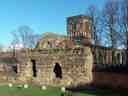
Abrir página dedicada →To spot the Jewry Wall, look straight ahead for a rugged, reddish-brown stone structure with two large arched gaps-almost as if giants punched tunnels straight through it! It…Leer másMostrar menos
To spot the Jewry Wall, look straight ahead for a rugged, reddish-brown stone structure with two large arched gaps-almost as if giants punched tunnels straight through it! It stands low and broad, halfway between a wall and a mini-fort, with rough layers of brick and stone visible up close. Just behind it, you’ll see the tall, square clock tower of St Nicholas’ Church. The wall stands out against the neat grass and the bricks around it, so you can’t miss it. Now, take a good look at this mighty chunk of history. You're gazing at the Jewry Wall, an ancient survivor from Roman times, nearly two thousand years old! Imagine it: the year is about 130 AD, and this wall is the pride of Roman Leicester. Soldiers in sandals, townsfolk in togas… and right here, steam rises from the huge public baths behind the wall. The Jewry Wall is huge-23 metres long, as tall as a two-story house, and thick enough to hide a Roman legion behind it! And yet, nobody can quite agree why it was built. Some claimed it was a temple, others were sure it was a city gate, and a few would have sworn it was for secret Roman meetings. It took an archaeologist, Kathleen Kenyon, in the 1930s to discover: these were public baths where Romans came to soak, gossip, and-if we’re honest-probably show off their best towels. Even the name, “Jewry Wall,” is wrapped in mystery. No big medieval Jewish community lived here, so the name likely comes from folk stories. Across England, any ancient, crumbling ruin that puzzled people was often thought to be Jewish, as if the walls themselves were keeping secrets. Look closely at the stones: see the stripes of bright Roman bricks and rough granite and limestone? The two mighty arches in the middle once echoed with the footsteps of bathers. Imagine their voices bouncing off these walls-maybe even the odd argument about who pinched whose sandal! Leicester's Roman town once bustled right where you’re standing. Today, the Jewry Wall is watched over by English Heritage, officially a Grade I listed building. And if you’re hungry for more old stories, the Jewry Wall Museum next door is your ticket back in time. So, as you stand among the stones and stories, remember: history here isn’t just old-it’s a little mysterious, occasionally confusing, and always waiting for the next visitor to peek through those ancient archways. Intrigued by the etymology, description or the function and context? Explore further by joining me in the chat section below.
Abrir página dedicada →

Mostrar 6 paradas másMostrar menos paradasexpand_moreexpand_less
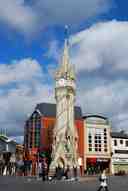
Keep your eyes peeled ahead! The Haymarket Memorial Clock Tower is hard to miss-it rises up like a giant stone needle right in the heart of the city. Look for a tall, slender…Leer másMostrar menos
Keep your eyes peeled ahead! The Haymarket Memorial Clock Tower is hard to miss-it rises up like a giant stone needle right in the heart of the city. Look for a tall, slender tower with lots of intricate stonework and four clock faces, topped by a pointy spire that catches the sunlight. It’s surrounded by a cluster of statues at the base, each one keeping a silent watch over the crossroads. If you see Pizza Hut and some shops nearby, then you’re definitely in the right spot. Now, as you stand here, let’s go back in time-and mind your head, you’re pretty much at Leicester’s number one meeting point! Before this magnificent clock tower reigned over the crossroads, this spot was famous for… hay! Yep, piles and piles of hay and a building that had everyone grumbling-it was even called the “Haymarket Obstruction.” People dodged carts and horses, probably wishing for some kind of magic roundabout. When rumors started flying about a new clock at the other end of the city, local shopkeepers here threw their own hats in the ring: “Why not have a grand clock right here?” they said. How else could everyone be sure they were fashionably late? So, the people of Leicester chipped in, even organizing a fundraising concert-imagine singing for a clock! Designs poured in; there were proposals for illuminated dials and statues, and finally, Joseph Goddard’s design was chosen. In 1868, with a lot of muscle and a bit of granite and Ketton stone, the tower rose up. Four statues took their places: Simon de Montfort, Thomas White, William Wyggeston (or Wigston if you read the plinth closely)-all local legends. For years they’ve braved the weather and watched the ever-changing city go by. At first, the only things ringing out here were horses’ hooves and tram bells. Later, with crazy busy roads, some folks wanted the clock tower gone-in the 1930s, 1960s… but the tower stood stubborn, a bit like a grumpy but lovable grandparent. And when Leicester decided the heart of its city needed a face-lift, the Clock Tower was restored and its surroundings opened up. Now, it’s easier for you to cross the street without bumping into a hay bale or dodging traffic. Still, if you listen carefully, maybe you’ll catch a whisper from the statues above-wondering what stories you’ll add to their watch tonight.
Abrir página dedicada →To spot the Haymarket Shopping Centre as you approach, look for a massive blocky building right by the busy intersection - it’s hard to miss! The shopping centre has a concrete…Leer másMostrar menos
To spot the Haymarket Shopping Centre as you approach, look for a massive blocky building right by the busy intersection - it’s hard to miss! The shopping centre has a concrete and brick exterior, and its front faces onto bustling streets near the famous Clock Tower. If you see wide glass windows, rows of shops, and a few big signs above the entrance - with plenty of people drifting in and out like it’s a big city beehive - you’re in the right place! Alright, take a deep breath and soak in the soundscape: the buzz of chatter, rolling suitcase wheels, rustling shopping bags, and maybe even the tempting scent of pasties from Greggs just inside. This isn’t just a shopping centre - it’s Leicester history in a boxy suit. The Haymarket Shopping Centre burst open with fanfare back in 1973, making it one of the oldest modern malls in the country. It was only the second one built in the UK, hot on the heels of Birmingham’s Bull Ring. Imagine the first shoppers, bell-bottoms and all, marveling at escalators and dreaming of next-level convenience! And now you, standing here, are part of that ongoing shopping story. The centre is quite a maze inside, with about 65 different shops. Got your eye on a pastry? There’s Greggs. Scoping out bargains? Primark’s standing guard upstairs like a retail fortress. And all around you, echoes of the past linger: this place had nightclubs perfect for a boogie, and there were once footbridges connecting stores like secret passageways - now gone, but you can picture the city’s night-owls and shoppers crisscrossing above the streets. If you look up, see those big glass panels? They’re like a greenhouse roof - let there be light on those bargains! The whole centre’s had a few facelifts over the years; the old brown-and-beige colour scheme is long gone, replaced by bright whites and slick surfaces. In fact, the only thing still guaranteed to get lost in here, apart from new shoppers, might be a memory or two from the 1970s. Just picture this whole block before the shopping centre: trams rattling past horse depots, country hotels, and backstreet pubs. Today, you’ve got WiFi, food courts, and escalators, but if you hear ghostly clopping hooves, don’t worry - it’s just the spirit of Leicester’s horse repository, watching as you choose your bargains. So, whether you’ve come to browse, buy, or just escape Leicester’s drizzle for a bit, you’re standing in the lively heart of local history. Ready to see what’s just around the corner on our next stop?
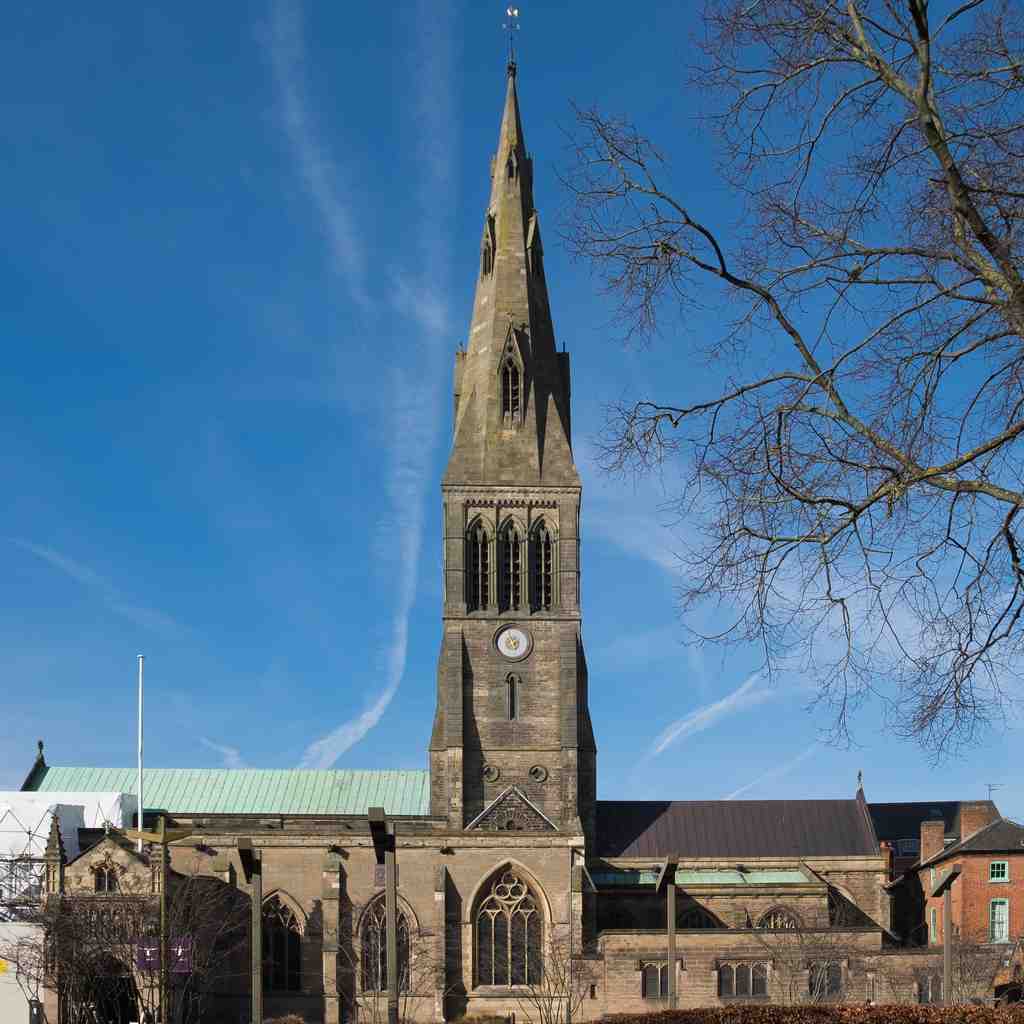
Abrir página dedicada →To spot Leicester Cathedral, just look ahead for the building with the tall, pointy stone spire stretching high into the sky-a real “needle in the city,” but easier to find! The…Leer másMostrar menos
To spot Leicester Cathedral, just look ahead for the building with the tall, pointy stone spire stretching high into the sky-a real “needle in the city,” but easier to find! The cathedral is a grand, rectangular stone structure with arched windows and a clock right in the center of the tower. If you catch the sun hitting its weathered stone, you’re definitely in the right spot. Alright, here you are, standing before the majestic Leicester Cathedral. Take a moment-listen as the wind whistles around the towering, 220-foot spire overhead. This place is more than just stone and glass; it’s the epicenter of centuries of history and real drama. Leicester Cathedral is also known as the Cathedral Church of Saint Martin. It’s the main seat of the Bishop of Leicester and one of just five medieval churches left in Leicester’s city center. Back in the day, this spot buzzed with merchants and city leaders since it stood right beside the Guild Hall-the social media hub of medieval times, you might say. In fact, the cathedral’s roots run so deep you’re standing on the site of ancient Roman ruins. Imagine Roman sandals crunching underfoot, and fast forward a thousand years-this place has seen everything from Norman rebuilding in the 12th century to serious Victorian makeovers. That sky-piercing spire? Built in 1867, designed to impress! But what really draws visitors is the story of King Richard III. His remains were lost for over 500 years before being found in, believe it or not, a local car park. Now, Richard lies here in the cathedral, beneath a single chunk of Swaledale fossil stone-three tonnes of royal resting place. Inside, you can see the pall, a beautiful embroidered cloth that once covered his coffin, telling the tale of Richard’s wild ride from his last battle to his unlikely comeback in a car park. Inside, keep your eyes open for some quirky sights-like 14th-century wooden carvings of people with aches, pains, and, yes, even a medieval hearing aid. Proof that every age has its own “can you hear me now?” moments! So take a breath, listen to the sounds, and feel the history. Leicester Cathedral isn’t just a building; it’s a living story, a place where old kings rest and new legends rise. Now, as you gaze up at the spire, imagine how many stories have unfolded right here, under the ever-watchful eyes of those stone angels. Wondering about the architecture, services or the choir? Feel free to discuss it further in the chat section below.
Abrir página dedicada →To spot this landmark, keep your eyes peeled for an area marked out beside Leicester Cathedral, where plaques and signs tell the story of a king lost and found. The discovery…Leer másMostrar menos
To spot this landmark, keep your eyes peeled for an area marked out beside Leicester Cathedral, where plaques and signs tell the story of a king lost and found. The discovery happened right below what once was a regular car park-yes, you heard that right! Imagine backing your car into history. Here, decades of quiet city life piled up above England’s dramatic past-until archaeologists dug down into dark, crumbly soil and revealed a skeleton with a twisted spine and a story to wake the dead. Take a deep breath and picture it: Under your feet, hidden away for more than 500 years, rested King Richard III-the last English king to die in battle. It’s 1485, and Leicester is buzzing with rumors. Imagine the clatter of armor, swords drawn, the cries from the Battle of Bosworth Field just outside town. After the dust settled, Richard’s battered body was brought here, quietly buried by monks in their church, his head split by a massive blow in battle. No grand parade, just a rough grave-a far cry from royal marble! For centuries, curious tales swirled: Some claimed his bones were tossed in the river. Others thought he’d simply vanished into legend. Then, in 2012, a devoted group started looking right here, and on the very first day, a set of bones came to light. The excitement was electric-a skeleton with injuries fit for a warrior king, and a back as crooked as history described. Scientists rushed in, like detectives at the scene. Was it really him? DNA matched Richard’s distant relatives! After all these years, he was found-and not in a royal palace, but under a plain old parking lot. Thanks to these modern tests, we finally solved a centuries-old mystery. After all that waiting, Richard’s remains were lifted gently into the daylight again, crowds gathered, cameras flashed, and in March 2015, he received the royal burial he never got the first time. Imagine the hush inside Leicester Cathedral as history was set right, and Richard III, the last Plantagenet king, finally got his crown of peace. So, what’s the joke? For over 500 years, Richard III was literally lost in the parking lot! If only finding your car keys was that exciting, right? Interested in a deeper dive into the death and initial burial, looking for richard project or the greyfriars project and excavations? Join me in the chat section for an insightful conversation.
Abrir página dedicada →As you stand here, take a look around - you’re right in front of De Montfort University, or “DMU” as the locals call it. It’s come a long way from its humble beginnings. Picture…Leer másMostrar menos
As you stand here, take a look around - you’re right in front of De Montfort University, or “DMU” as the locals call it. It’s come a long way from its humble beginnings. Picture it: back in 1870, the Leicester School of Art was just a few rooms filled with hopeful students clutching their sketchbooks, the air smelling faintly of fresh paint and pipe smoke. Fast-forward to today - DMU is bustling with nearly 27,000 students and over 3,000 staff. That’s a lot of minds in one place! Just imagine all those late-night essay crises across campus. The university takes its name from Simon de Montfort, a 13th-century Earl of Leicester. He was famous for helping set up the English Parliament - although, word of warning, he’s a bit of a mixed bag in history; let’s just say not everyone was a fan! Nobody’s perfect, right? Back when it first started, this spot was where future artists, engineers, and pharmacists learned their craft. The Hawthorn Building, which you can spot if you look around, still anchors the campus, just as it did for its first 500 art and 1,000 technical students. Imagine the flurry of activity: blackboards filled with chalky sketches, the clang of engineering tools, and students plotting their future over a cup of strong, probably-tragically-undrinkable tea. Over the years, De Montfort grew fast. In the 1920s, they were renting extra buildings just to fit everyone. By the time the Duchess of Atholl herself came to lay a foundation stone in 1927, the place was buzzing with ambition and a hint of royal drama. The school started taking on more scientific and technical courses - pharmacy, engineering, building trades. By the 1960s, even the Queen Mother dropped by to open the new Fletcher building. I can only imagine that's the sort of day where people actually ironed their shirts. Nowadays, DMU isn’t just lectures and libraries; it’s also a Sustainable Development Hub, which means students here are trying to help build a more peaceful and fair world for all. Talk about homework with impact! It’s come a long way from chalk and easels to digital design, robotics, and more - all under the watchful eye of past royals and ambitious teachers. Just remember, if you bump into a student yawning, be gentle; chances are, they’ve just discovered the magic of a 9am class after a midnight deadline. When you’re ready, let’s move on to our final stop - and no, it doesn’t involve homework! Fascinated by the campus, organisation and governance or the reputation and rankings? Let's chat about it
Abrir página dedicada →



Preguntas frecuentes
¿Cómo empiezo el tour?
Después de la compra, descarga la app AudaTours e ingresa tu código de canje. El tour estará listo para comenzar de inmediato - solo toca play y sigue la ruta guiada por GPS.
¿Necesito internet durante el tour?
¡No! Descarga el tour antes de empezar y disfrútalo completamente sin conexión. Solo la función de chat requiere internet. Recomendamos descargar en WiFi para ahorrar datos móviles.
¿Es un tour guiado en grupo?
No - esta es una audioguía autoguiada. Exploras de forma independiente a tu propio ritmo, con narración de audio reproduciéndose en tu teléfono. Sin guía, sin grupo, sin horario.
¿Cuánto dura el tour?
La mayoría de los tours toman 60–90 minutos para completar, pero tú controlas el ritmo completamente. Pausa, salta paradas o toma descansos cuando quieras.
¿Qué pasa si no puedo terminar el tour hoy?
¡No hay problema! Los tours tienen acceso de por vida. Pausa y continúa cuando quieras - mañana, la próxima semana o el próximo año. Tu progreso se guarda.
¿Qué idiomas están disponibles?
Todos los tours están disponibles en más de 50 idiomas. Selecciona tu idioma preferido al canjear tu código. Nota: el idioma no se puede cambiar después de generar el tour.
¿Dónde accedo al tour después de comprarlo?
Descarga la app gratuita AudaTours desde App Store o Google Play. Ingresa tu código de canje (enviado por email) y el tour aparecerá en tu biblioteca, listo para descargar y comenzar.
Si no disfrutas el tour, te reembolsamos tu compra. Contáctanos en [email protected]
Paga de forma segura con 


