
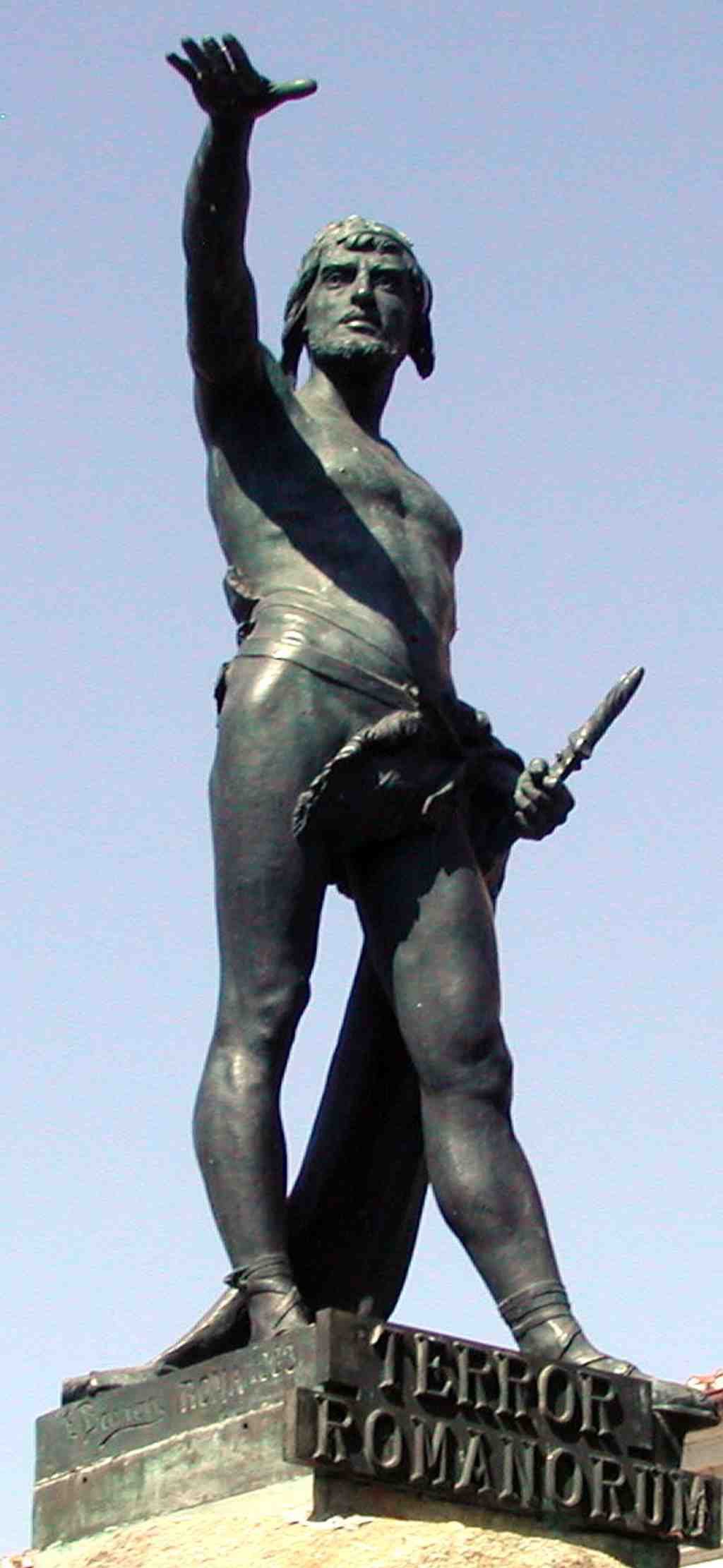
On your right, look for a bronze standing warrior on a rough granite pedestal, with one arm stretched outward and a bronze battering ram thrust from the stone front.
This is Viriathus... or rather, Zamora’s idea of Viriathus, carefully staged in metal and stone. The sculptor, Eduardo Barrón, had a deep link to the city long before this monument arrived here. In eighteen seventy-five, the banker Anastasio de la Cuesta Santiago gave the teenage Barrón a small daily stipend so he could train with the local sculptor Ramón Álvarez and study drawing at the provincial institute. That kind of quiet local backing changed a life, and years later it came back as public art and civic gratitude.
Barrón finished this figure in Rome in eighteen eighty-three, while he was on a state artist’s pension. Critics there liked the clay model, Nelli’s foundry cast it in bronze, and the piece won a first medal at the National Exhibition in eighteen eighty-four. So when Zamora embraced it, the city was not just honoring an ancient rebel chieftain... it was also claiming a successful son of its own making.
The hero himself is presented with all the usual ingredients: nearly naked, standing tall, right arm extended as if rallying troops, left hand gripping a sheathed sword with a handle so long that, from certain angles, the sculptor gives posterity a slightly awkward problem. On the bronze base, Viriathus is called the “terror of the Romans.” Beneath him sits granite from Torrefrades, a village that claimed to be his birthplace, and from the front projects that bronze battering ram added in nineteen oh-three.
And yet the unveiling in nineteen oh-four was wonderfully ungrand. No big official ceremony... ordinary passersby more or less became the first audience. Later, under Franco, the Falange seized on the raised arm and turned the statue into a political emblem. Then, in nineteen seventy-one, the city moved it from the center of the square to this corner, changing the whole performance of the monument.
That is the trick with public heroes: they look fixed, but every age edits the script. We’ll see that problem of ownership sharpen again at the Church of María Magdalena, about a three-minute walk away. And conveniently, this stop is always accessible, day or night.




