
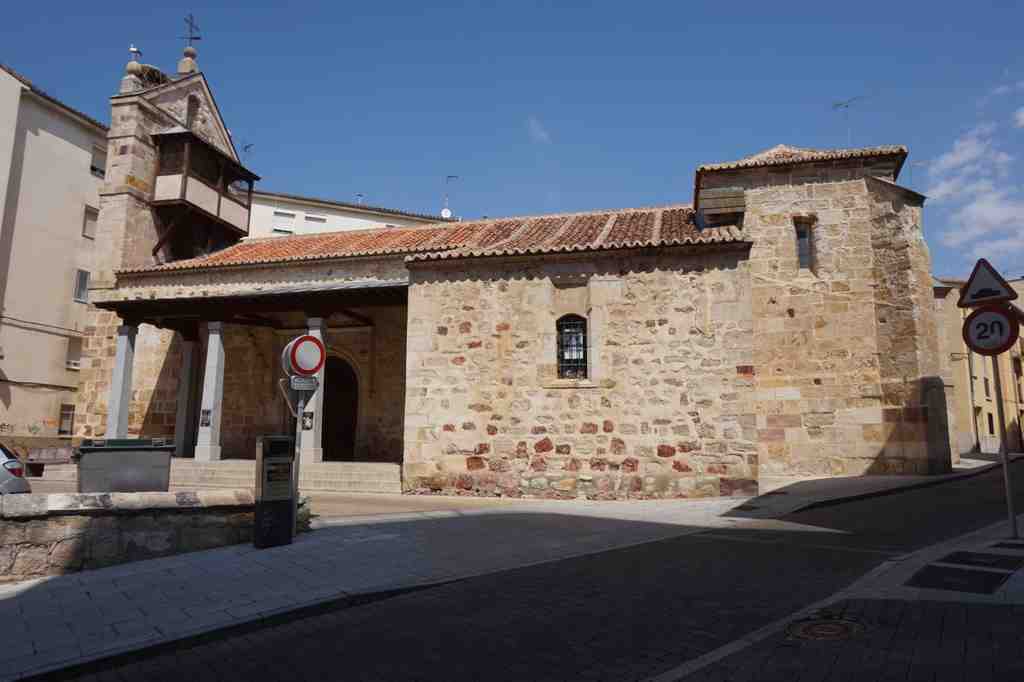
Look for the rough stone church with its compact cross-shaped body, a tall classical bell gable, and a porch that protects a single Gothic doorway.
This is San Antolín, and it makes a good place to begin because Zamora does not start only with rulers and battles. It starts with neighbors. At first glance, you’re looking at an old Romanesque church, though the building has changed so much over time that its plan now forms a Latin cross, with uneven arms at the crossing. But San Antolín is more than old masonry. It is a container for memory: for arrivals, loyalties, promises, and the stubborn habit of a city repeating what matters.
The story begins with people from Palencia who settled here in the wool-working district, the Barrio de la Lana. They brought trades, families, and one very practical instinct: if you want to belong somewhere, build a place that remembers where you came from. So they raised a church to their own patron, Saint Antolín, and they installed an image of the Virgin they had carried with them. At first she was known as the Virgin of San Antolín. Then Zamora embraced her so fully that, around the year eleven hundred, local tradition says the city swore her as its patron.
Later, because her annual pilgrimage gave her a more road-tested identity, people added a shell to her image and began calling her the Virgin of the Concha. Every Pentecost Monday, the mass of the pilgrims begins here, and then the image sets out for nearby La Hiniesta, accompanied by residents and civic authorities. So this church does something stone alone cannot do... it sends memory walking through the streets. Even when the modern city gets in the way, devotion adjusts instead of retiring politely. In two thousand fourteen, work linked to the high-speed rail line forced the return route to change. Tradition, it turns out, knows how to take a detour.
You can read that long life on the outside. Along the south wall, a few Romanesque corbels still survive, those little projecting stones that once carried weight and now carry age. In fifteen ninety-six, the stonemasons Juan de Rubayo and Juan Fernández raised the bell gable above you. Much later, in nineteen ninety-eight, Lucas del Teso designed the porch to shield the church’s only Gothic entrance. Sensible, really. Even buildings need a bit of help aging gracefully.
So here’s the question to carry with you: when do newcomers stop being outsiders and start shaping the identity of a whole city?
From this neighborhood church, Zamora’s memory now widens outward. In about three minutes, at the Gate of Doña Urraca, that memory starts arguing with power, legend, and politics.




