Ecos de poder: Leyendas, faroles y el sendero del legado de Vitoria-Gasteiz
Bajo la elegante mampostería y los imponentes arcos de Vitoria-Gasteiz, los secretos laten en cada plaza. Aquí, las calles cotidianas esconden capas de viejas disputas, promesas rebeldes y festivales que una vez cambiaron el futuro de la ciudad de la noche a la mañana. Embárcate en un recorrido de audio autoguiado por estos rincones históricos, descubriendo momentos dramáticos e historias no contadas que la mayoría de los visitantes pasan por alto. Esta es una oportunidad para ir más allá de las guías y adentrarte en escenas moldeadas por la controversia, la tradición y la invención. ¿Qué feroz batalla terminó en shock cuando un querido mercado de alimentos desapareció de la Plaza de los Fueros? ¿Quién lo arriesgó todo con un solo juramento junto al muro de la iglesia en la Plaza del Machete? ¿Por qué hay un mapa oculto solo visible para las aves que pasan bajo tus pies? Deambula entre palacios, canchas para juegos vascos, mercados que resuenan con chismes y plazas donde incluso el silencio significaba suspenso. Siente cómo chocan los siglos mientras sigues las corrientes invisibles que moldearon Vitoria-Gasteiz para siempre. Que tu viaje comience donde se encuentran la discusión y el arte, en el corazón mismo de esta ciudad secreta.
Vista previa del tour
Sobre este tour
- scheduleDuración 40–60 minsVe a tu propio ritmo
- straighten1.7 km de ruta a pieSigue el camino guiado
- location_onUbicaciónVitoria-Gasteiz, España
- wifi_offFunciona sin conexiónDescarga una vez, úsalo en cualquier lugar
- all_inclusiveAcceso de por vidaReprodúcelo en cualquier momento, para siempre
- location_onComienza en Plaza de los Fueros
Paradas en este tour
If you’re looking for Fueros Square, glance to your right for a wide, open space set below street level. Look for pink granite steps and large, simple stone walls, with a sweeping…Leer másMostrar menos
If you’re looking for Fueros Square, glance to your right for a wide, open space set below street level. Look for pink granite steps and large, simple stone walls, with a sweeping staircase leading down into the heart of the plaza. The square is wrapped by grand stone buildings, with a post office nearby and several rows of windows looking down over you. If you see children zooming around on scooters, or maybe a group playing pelota against one of the stone walls, you’ve found it. Now, as you stand in front of Fueros Square, imagine yourself stepping into a giant sculpture. This isn’t just a simple meeting place-this whole space is like an artwork you can walk through. It was created in 1979 by Eduardo Chillida and Luis Peña Ganchegui, turning what was once a bustling food market, full of the sounds of buyers and stallholders haggling over baskets of onions and hams, into something entirely new. But imagine, over a hundred years ago, this very spot was the site of heated arguments. Local shopkeepers grumbled, and the townsfolk could hardly agree. There was drama, suspense-who would win? The old market stood for nearly 80 years, with the smell of fresh bread and fruit everywhere. But the battle ended-though not everyone was happy-when the old building was replaced with the modern square you see now. Notice the odd, block-shaped monuments, the sharp lines, the unexpected changes in level. Listen to your footsteps echo on the granite, and feel how the place is meant for gathering-a place that fills each August with the chaos and joy of the Virgen Blanca Festivities. Hidden in plain sight, there’s a giant map of Alava carved into the square itself-although only the birds see its full shape. Here, with a special metal sculpture marking the Trebiño area, history is sealed into the stone. There are courts for Basque games like pelota and fronts for bowling, blending tradition with the bold shapes of Chillida’s art. Stand here for a moment and soak in the atmosphere-the history, the arguments, the festivals, and everyday life, all layered over centuries in this one small corner of Vitoria-Gasteiz.
Abrir página dedicada →Just ahead, you’ll see a grand, almost regal building framing a wide, open square. As you walk closer, look for symmetrical rows of arched doorways on the ground floor, topped by…Leer másMostrar menos
Just ahead, you’ll see a grand, almost regal building framing a wide, open square. As you walk closer, look for symmetrical rows of arched doorways on the ground floor, topped by a line of elegant balconies with tall wooden doors. Right in the center, the building rises a little higher with a triangular pediment, crowned by a small clock and a sculpted crest. The square stretches out in front of you, smooth and echoing slightly under your footsteps. The space feels open, but the tall stone walls wrapping around you make it cozy too. Now, imagine you’re standing here not just in front of a building, but at the heart of the city’s story. This is Plaza de España, also lovingly called Plaza Nueva-the ‘New Square’… even though it has kept its same majestic look since the late 1700s. For centuries, people have gathered here under these arcades, sheltering from the rain to swap news or share a laugh while the bells above the square mark the passing hours. This place is more than just stone and arches. It’s the stage for some of Vitoria-Gasteiz’s biggest moments-festivals, protests, and late summer nights when every inch of the square fills up with noisy, cheerful crowds eating local pintxos. If you close your eyes, you can almost hear the echoes of old markets and the chatter of people who’ve met here, over and over, for hundreds of years. In 1984, Spain recognized the magic in these stones, officially protecting Plaza de España as a cultural treasure. The walls hold secrets of families, city council meetings, and impromptu music that spilled out late at night. When you stand here, don’t just look around-imagine what stories this square could tell if only it could talk.
Abrir página dedicada →As you walk up towards Machete Square, look ahead for a cozy stone plaza hemmed in by several old buildings, their golden walls glowing against the sky. On your left, you’ll spot…Leer másMostrar menos
As you walk up towards Machete Square, look ahead for a cozy stone plaza hemmed in by several old buildings, their golden walls glowing against the sky. On your left, you’ll spot the grand yet simple walls of the Church of San Miguel Arcángel, rising up with their Gothic and Renaissance touches. On the right, there’s a distinguished building with many windows and a short flight of steps - that’s the Villa Suso Palace. You’re looking for a quiet, slightly sloped square with stone paving-right in the heart of Vitoria’s oldest streets. Now, as you stand here, take a moment to imagine this very spot hundreds of years ago. This square, la Plaza del Machete, was once where the hustle and bustle of the emerging city met the ancient secretive maze of the medieval quarter. The air would have been filled with clattering carts, the smell of fresh produce, and the sharp shout of sellers at the busy market that once stood here. Picture the drama that’s unfolded on these stones: long ago, the powerful leaders of Vitoria would gather right at that church wall, where there’s a small niche. Here, they would place a machete as they took a solemn oath to obey the laws-knowing that if they failed, the machete was a warning that their lives could be forfeit. The square even earned the nickname Plaza of Judgment because, believe it or not, executions once took place right where you’re standing. Surrounding you, history is written in stone. To your right, the Villa Suso Palace started out as part of the city wall itself when Don Martín de Salinas built it in 1542. The arched walkways called the Arquillos-curving beyond the square-were built in the 1700s to connect old neighborhoods with new and today are recognized as a World Heritage Site. Close by, beneath the slope of San Vicente, the Covachas were once busy food stalls not unlike a medieval supermarket. Originally, this was the Plaza de los Bueyes, full of market energy, with meat vendors calling out for buyers. Only later, in 1806, did it become Plaza del Machete-named for that blade used in pledges, a symbol of power, justice, and sometimes fear. Today, the original machete lives safely in the Municipal Archive, but here you’ll see a faithful replica. Stand here a moment, and let yourself feel the echoes of old Vitoria. The shouts, laughter, and perhaps even some nervous silence from those swearing their lives to the city. Today, it’s a peaceful place, often filled with traces of music and art from cultural events, but the stories in these walls are just waiting to be remembered.
Abrir página dedicada →
Mostrar 9 paradas másMostrar menos paradasexpand_moreexpand_less
Look just ahead of you. Notice how the narrow street seems to snake between tall, rough stone walls, catching the light from old-fashioned iron lanterns hanging above your head.…Leer másMostrar menos
Look just ahead of you. Notice how the narrow street seems to snake between tall, rough stone walls, catching the light from old-fashioned iron lanterns hanging above your head. On your right, the wall stretches high and long, its centuries-old stones worn smooth by time, while to your left there’s a glimpse of smaller, more modern buildings and balconies. The street feels almost like a secret passage-a cozy, quiet lane leading you deeper into Vitoria-Gasteiz’s hidden heart. This is the Street of the Palace, one of the city’s smallest streets, and, despite its modest length, it’s bursting with stories. Imagine the year is 1887-the air is crisp, and cobblestones echo with the steps of locals and carriages. Back then, this lane was officially named “calle del Palacio,” and it was already famous for the building that gives it its name: the Montehermoso Palace, a grand former bishop’s palace whose stone façade you can see rising up beside you. It’s easy to feel the past here. The street hasn’t changed much since those days. Perhaps you can almost hear the hushed conversations of noble visitors hurrying along its path, anxious to enter through the palace doors without being noticed. Or picture local children daring each other to tiptoe closer to the palace, inventing thrills and mysteries in these shadowed corners. José Colá y Goiti, who wrote about Vitoria back in 1901, described this street with affection, knowing that, even though it was small, it was packed with character-a hidden piece of the city, full of secrets and stories hiding behind each stone. If you listen closely, you might hear the faint echoes of those old footsteps. Small, sure, but somehow grand in their own quiet way. And just ahead, the alleyway leads on, promising yet more tales just around the next turn. Shall we continue?
Abrir página dedicada →To spot the Palace of Villa Suso, look up and to your right-search for a grand stone building rising from the edge of the Machete Square. Its light-colored stone walls stand tall…Leer másMostrar menos
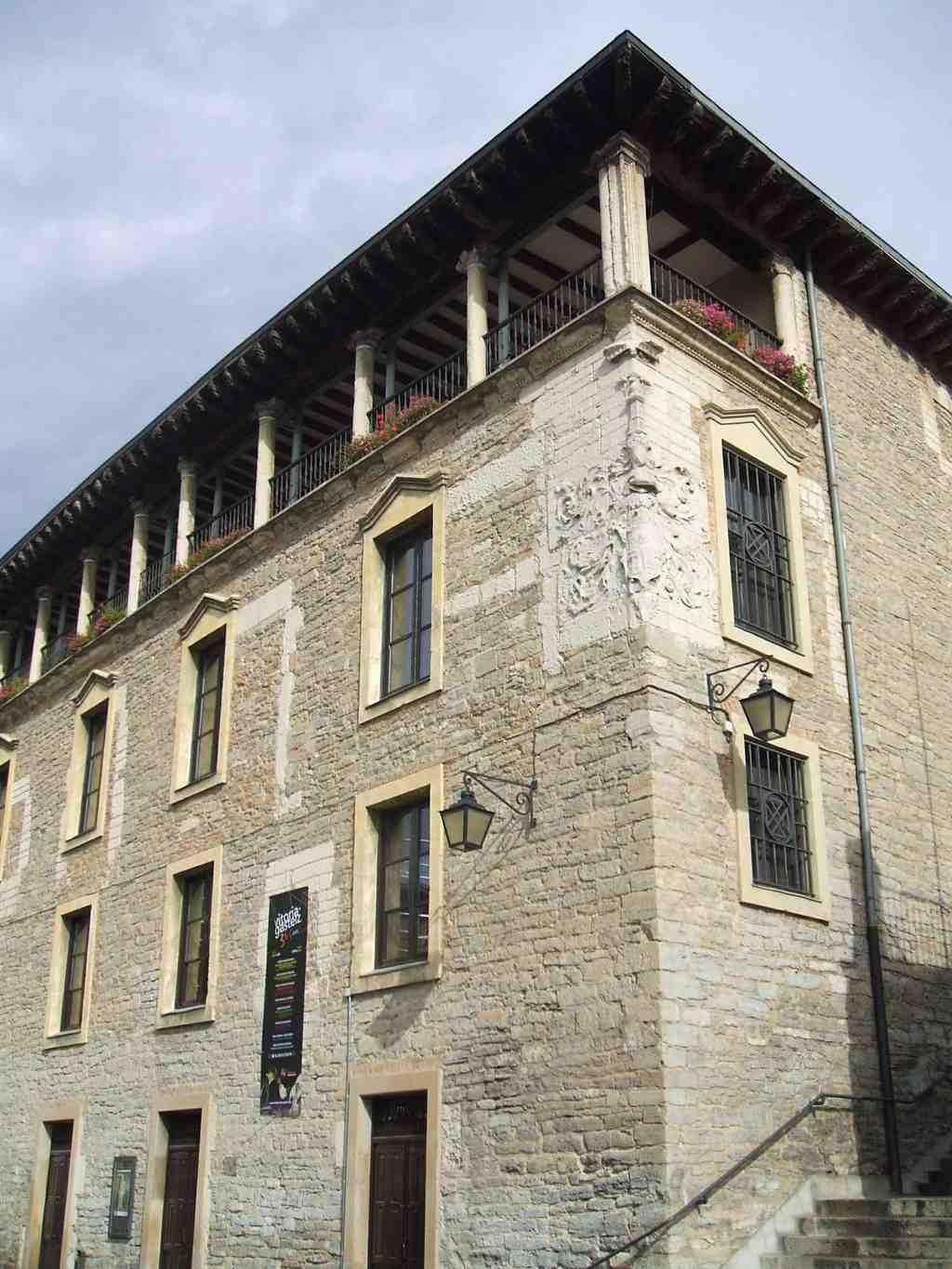
To spot the Palace of Villa Suso, look up and to your right-search for a grand stone building rising from the edge of the Machete Square. Its light-colored stone walls stand tall above you, with elegant windows framed in soft yellow, and a balcony at the very top lined with slender pillars and bright flowers. Notice the large stone crest carved into the corner just above the stairs, right where the two façades meet. Now, take a moment to imagine this very spot echoing with footsteps and voices from nearly five centuries ago. The year is 1539, and a man named Martín Salinas, an ambassador to the mighty Emperor Charles I of Spain, is overseeing the creation of this stunning Renaissance palace. He wants something strong enough to last through centuries, but also decorated with pride-look up and you’ll see his family’s crest standing guard, like a stone shield, over the entrance. The crest isn’t just decoration. If you look closely, you’ll see a beautiful cross with tiny floral details, little round fruits known as "panelas," and mysterious moons and stars. There’s even a crowned eagle-this special touch was granted by King Ferdinand of Hungary himself, back when honor was worth more than gold. Salinas built this palace as a home, yes, but also as a symbol-he wanted everyone who walked into this square to know his family’s strength and spirit. That tower you see, and those steep stairs, remember the wild story of Juan de Salinas, Martín’s grandfather. Picture him charging up a similar staircase, sword clashing and boots pounding, as he retakes a fortress that had fallen to enemies. Today, though the palace is filled with technology-translation booths, ceiling speakers, bright projectors-none of that steals away its quiet magic. If you stand still, you can almost hear the whispers of nobles planning a feast, or the clatter of messengers bringing news from the emperor. So, as you stand in front of Villa Suso, you’re not just at a building. You’re at the heart of old Vitoria, where history lives in stone and every window has a secret to tell.
Abrir página dedicada →As you walk ahead, look for the tall tower rising above the nearby buildings, with rounded arches at its base and a clock shining at the very top. The stonework has a warm, golden…Leer másMostrar menos
As you walk ahead, look for the tall tower rising above the nearby buildings, with rounded arches at its base and a clock shining at the very top. The stonework has a warm, golden color and stands out against the more modern, pale facades next to it. When you see that elegant bell tower, you’ve found the Church of San Vicente Martyr right in front of you. Imagine the distant echo of bells as we arrive here, right at the edge of Vitoria’s old town. This church, built between the 1400s and 1500s, is packed with stories. Its walls are Gothic, almost shifting into the Renaissance style, and they’re built on what was once a powerful fortress. Picture armored knights patrolling these grounds during the reign of King Sancho VI of Navarre. The fortress was handed over to the city by the Catholic Monarchs in 1484, and during the wild bandit wars of medieval Vitoria, this place was captured and recaptured-one Christmas night, it was stormed and conquered under cover of darkness! As you look at the side walls, you’ll spot strong arches and a dramatic porch with six stone arches, reused from a lost monastery. Slip closer and you might spot the grand stone shells filled with holy water, gifts sent from faraway Philippines by the Marquess of Montehermoso. Beside the door is another old font and a 1500s stone carving of Calvary. The air in here tends to feel cool and serene, but don’t be fooled by the calm-these stones witnessed centuries of fierce fighting and tense peace. Step inside with your imagination: Three tall naves stand equal in height, separated by round pillars with barely any decorations. Each column carries the weight of simple, soaring vaults above you. Look up and imagine seeing stone animals, carved into the walls, silently watching over every visitor. Where the great choir once sang, the pillars suddenly double in strength, as if bracing themselves for the giant silvery voices above. Then there’s the tower-a whopping 54 meters tall, built in the 1800s in an eye-catching neo-Byzantine style, replacing an even older, likely medieval tower. Today, guided tours take visitors up to see the sprawling city below. In the main chapel, there’s a display of royal power: the Catholic Monarchs’ coat of arms, and a lavish Baroque altarpiece, glimmering with statues and carvings that tell the trials of Saint Vincent, the church’s namesake martyr. Take a moment to imagine the older gothic tomb beneath a pointed arch: Here rests Don Nicolás, who died in 1349, his tomb stone marked by ancient shields and strange creatures. So as you stand here, you’re on the very ground where enemies clashed, legends were born, and quiet moments of faith carried people through the centuries.
Abrir página dedicada →As you stand here, take a look straight ahead. You’ll notice an old, sturdy tower rising above the rooftops with thick stone walls and a traditional tiled roof, looking like…Leer másMostrar menos
As you stand here, take a look straight ahead. You’ll notice an old, sturdy tower rising above the rooftops with thick stone walls and a traditional tiled roof, looking like something from a medieval story. Look around you-the street slopes gently down, framed by houses with overhanging balconies. To your left, you’ll spot a colorful mural splashed across one wall, telling its own modern tale while the heavy, fortress-like buildings remind you of centuries past. Welcome to the heart of Vitoria-Gasteiz’s Old Quarter, or Casco Viejo. This neighborhood, shaped like an almond and hugging the sides of a gentle hill, is where the city first burst into life. Close your eyes for a moment and imagine the creaking of wagon wheels and merchants shouting their wares, echoing off these ancient stone walls. For hundreds of years, nearly everyone in Vitoria squeezed inside this very space, protected by tall stone walls, with narrow streets twisting below. Outside, the rest of the city didn’t exist yet-just rolling fields and forests, waiting for the centuries to pass. Here’s something that might surprise you: the name “Vitoria” comes from “Nueva Victoria,” meaning New Victory. In 1181, King Sancho the Wise crowned this hilltop village as a fortified outpost, calling it Gasteiz after the original settlement. The king’s dream was to keep his enemies far away, but only two decades later, after a dramatic siege-imagine the clash of swords and pounding of battering rams-the city switched hands from the Kingdom of Navarre to Castile. Vitoria was never just a fortress. It was a true crossroads-a meeting place for traders, wanderers, and dreamers headed north and south between Spain and the rest of Europe. In the Middle Ages, three lively markets were held every week right here, and from 1399, two grand fairs a year filled the hills with travelers and laughter. One odd thing you might sense about this old quarter is its air of equality. Long ago, the city had a special law: all its residents were declared equal-no difference between nobles and commoners, at least in the eyes of the city. Today, the Casco Viejo is a treasure trove for explorers like you. Around you, waiting to be discovered, are places like the Fournier Playing Card Museum, the Escoriaza-Esquivel Palace, the medieval walls, and towering churches-Santa María Cathedral, San Vicente, San Pedro, and San Miguel. You’re walking on the very stones that have survived hundreds of years: this quarter kept its medieval layout so well, it was named a monumental site in 1997 and has won prestigious awards for how beautifully it’s been restored. Listen closely now. This is a place where every echo and every brick has a story to tell. As you continue through these winding streets, let your imagination roam and see what secrets you can uncover in the heart of old Vitoria-Gasteiz. Curious about the ubicación, historia or the lugares de interés turístico? Don't hesitate to reach out in the chat section for additional details.
Abrir página dedicada →As you walk along this quiet stretch, look for a fairytale-like palace rising up on your left, crowned with creamy stone walls and elegant arched windows. The Palacio…Leer másMostrar menos
As you walk along this quiet stretch, look for a fairytale-like palace rising up on your left, crowned with creamy stone walls and elegant arched windows. The Palacio Escoriaza-Esquivel stands proud, facing a small plaza. Notice the grand stone entryway-it’s richly decorated and you might spot sculpted faces looking down over everyone who passes. Now, as you stand before this mysterious manor, imagine stepping back in time to the sixteenth century. Fernán López de Escoriaza was no ordinary citizen here-he was doctor to both King Henry VIII of England and Emperor Charles V. It was Fernán and his wife, Victoria de Anda y Esquivel, who dreamed up this magnificent house to show off their status and love. The real magic lies inside, where the palace hides a breathtaking patio-called the “courtyard of love.” Picture warm sunlight spilling through a glass ceiling, lighting up two stories of airy stone arches. All around, you’ll see medallions and carvings of ancient legends, each linked to tales of love, courage, or heartbreak. There’s Lucretia, the noble Roman who chose honor above all; Venus and Mars, locked in their forbidden romance; and even the brave Cayo Mucio, who proved his devotion by burning his own hand for his city. High up in the corners are two statues of women, meant to remind visitors of the difference between human love and a greater, almost magical love. If you listen closely, maybe you can hear whispers from gatherings past, when the Basque Royal Society would meet upstairs to discuss grand ideas. Finally, back outside, look at the main entrance. Above the door, Fernán and Victoria’s portraits watch over the street. Below, their family shields hint at long stories of loyalty, family pride, and a touch of rivalry. For centuries, this palace belonged to private owners, its wonders hidden behind closed doors. Now, the city of Vitoria welcomes curious explorers like you-even if only for a glimpse from the street or a rare special visit. If the walls could talk, what love stories, secrets, or plots would they reveal to you tonight?
Abrir página dedicada →As you walk up the gentle slope of El Campillo, look ahead for a stately stone building, wider than it is tall, with an elegant façade showing pointed neo-Gothic arches and a…Leer másMostrar menos
As you walk up the gentle slope of El Campillo, look ahead for a stately stone building, wider than it is tall, with an elegant façade showing pointed neo-Gothic arches and a sense of quiet grandeur. You'll notice the soft golden color of the walls against lush green trees in the background. The entrance is approachable, and if you peek in, you might catch a glimpse of its inner courtyard, a secret world hidden just behind the doors. Imagine yourself here in the 1500s. The year is 1524. There’s the faint clatter of horse hooves and the murmuring of finely dressed nobles. This is the new home for someone powerful: Hortuño Ibáñez de Aguirre, a man of the King’s own council-and even the Inquisition. He and his wife, María, first dreamed this place would be a home for Dominican nuns, but once it stood finished, shimmering bright and new, they decided to live here themselves. They promised the nuns a convent somewhere else, while within the palace, guests gathered in the cool, shadowed courtyard, their voices echoing off the two-story stone arches. Kings and queens, grand dukes, and even the infamous Joseph Bonaparte-yes, Napoleon’s own brother-slept here when passing through Vitoria. Picture the royal wagons creaking to a halt, servants bustling, and perhaps a watchful, suspicious glance from a palace guard. The name “Montehermoso” comes from the marquises who lived here. One marchioness even nannied the children of Spain’s kings. Tales of secret meetings and high drama unfolded behind these walls-political alliances, whispered plots, and romances, all hidden from the city below. The palace changed with the times. Once seized by the church and remade as a bishop's seat, it later became a soldiers’ barracks during the turbulent Carlist wars. The façade you see today owes its castle-like look to a grand makeover in the 1800s. Every stone hints at drama-from royal banquets to moments of collapse and ruin. Now, the world within Montehermoso springs with creativity. Since 1997, it's a living center of art and culture, humming with music, photography, dance, and teamwork, often crafted by Vitoria’s own artists. Beyond the old walls is something even stranger: a tunnel leads to the city’s Victorian-era Water Depository, a vast underground space used for wild, futuristic exhibitions. Imagine music echoing under stone, paintings glowing in hidden chambers, and children laughing as they discover the secrets left by centuries. Pause here and take it in-the crisp air, the timeless stones. If these walls could talk, you’d hear stories of queens, soldiers, rebels, and artists, all woven together into the heart of Vitoria-Gasteiz.
Abrir página dedicada →As you near this stop, let your eyes drift to the building just ahead. You’ll notice it because it looks almost like a treasure chest-its entrance is understated, but there’s an…Leer másMostrar menos
As you near this stop, let your eyes drift to the building just ahead. You’ll notice it because it looks almost like a treasure chest-its entrance is understated, but there’s an air of anticipation, as if inside waits something glowing. And inside, you will find an explosion of color and light: the Lantern Museum. If you peek through the windows or step just inside, you’ll see what looks like a line of stained-glass crowns, with gold and blue details that catch even the smallest glimmer of daylight. Now, imagine you’re standing here during a cool summer dusk, the city preparing for its famous Virgen Blanca festivities. For over a century, these very lanterns have come alive every August, when the Rosary of the Lanterns procession fills the cobblestone streets with shimmering colors. But the magic begins long before that-since the early 17th century, people have gathered for this procession, though the lanterns themselves didn’t appear until 1895. Metal, glass, and flame come together; imagine young hands carefully fitting candles inside each lantern, gold and blue reflecting off every wall as night fell. This building, where you stand now, was built in 1901 with the mayor’s help-almost as if Vitoria itself wanted a permanent home for its light-filled guardians. The design, shaped by Fausto Íñiguez de Betolaza, is simple from the outside, but step in and you’re wrapped in colors: blue, red, green, and gold, the lanterns each telling a mystery, a prayer, a secret wish carried on candlelight. Inside, you can count them: 273 lanterns, each one different, each one glowing with its own secret. There’s a Great Cross towering for the Virgen Blanca herself, columns of faith, and lanterns for every Mystery of the Rosary-except the Luminous Mysteries, which shine from one single lantern. Some lanterns count prayers-fifteen glow for the Lord’s Prayer, one hundred and fifty for the Hail Mary, even the rare Gloria Patri and Agnus Dei. The museum keeps getting bigger, just like the tradition, with the most recent additions waiting years for their first procession because of the pandemic-like actors trapped backstage, waiting for their cue. It’s hard not to feel a shiver of anticipation, imagining all those lanterns shining in the night, warming the city with their hopeful light, the prayers of generations swirling in the glow. So take a moment-press your face just a little closer to the glass, let the colors dance on your cheeks, and listen: if you’re quiet, you might just hear a whisper from history-a story told in color and flame. Ready to head to our next stop?
Abrir página dedicada →Look around you for a striking, elegant stone building with light-colored blocks, grand windows edged with delicate ironwork, and a row of brilliant red doors. To spot the General…Leer másMostrar menos
Look around you for a striking, elegant stone building with light-colored blocks, grand windows edged with delicate ironwork, and a row of brilliant red doors. To spot the General Boards of Álava, just follow the street on your right until you see a group of tall buildings, then look for those eye-catching red doors and the ornamental iron balconies above. This is where the story truly begins. Can you hear the echo of footsteps across stone? Right in front of you stands the home of one of Europe’s oldest parliaments - the General Boards of Álava. It’s not just one building, but three, all connected like secret passageways in an old detective novel. Travel back to 1463, when the air was filled not with the honking of cars, but the clatter of horse-drawn carts and distant voices rising in debate. Under these roofs, powerful decisions shaped the life of the whole province. Imagine the old council members clutching their cloaks tight on chilly mornings, stepping through these doors to decide the fate of their neighbors. Everything happened here - laws were born, taxes set, arguments settled, and sometimes, legends say, a bit of drama played out in the darkened corners. For centuries, these halls held not only administrators but stories: of rebellion and silence, of celebration and worry. Under the grand nineteenth-century facade, you can almost hear heated words bouncing off the walls - and maybe even the sound of parchment being unfurled for a historic decree. Though the outside looks calm and stately, inside these doors the work never really stops: from approving budgets, to picking leaders, to guarding ancient rights that go back to the days when villagers gathered to drive out bandits and keep peace on these green hills. This is government, not as a distant idea, but as a living, breathing part of local life - alive just behind those bold red doors you see before you. If you're keen on discovering more about the sede, funciones y competencias or the historia, head down to the chat section and engage with me.
Abrir página dedicada →You’re now standing before the Basque Parliament, a place where many voices, ideas, and passions come together. Imagine for a moment the energy inside-debates swirling, footsteps…Leer másMostrar menos
You’re now standing before the Basque Parliament, a place where many voices, ideas, and passions come together. Imagine for a moment the energy inside-debates swirling, footsteps echoing as deputies hurry through the hallways, shuffling papers, raising questions, making decisions that shape the Basque Country. The building itself wasn’t always meant for politics. In fact, it used to be a high school, transformed into a parliament back in 1982. It was just two years earlier, in the spring of 1980, that the first session was held-not here, but in Guernica, under the symbolic shelter of an ancient oak tree. This was no ordinary choice. For centuries, under the great tree of Guernica, Basques gathered to decide their fate in the open air-a symbol of freedom. In tribute, you’ll find inside a striking wooden sculpture by Nestor Basterretxea, a stylized oak tree that seems to whisper ancient secrets to those who listen. Within these walls, seventy-five deputies sit-each representing one of the three Basque provinces, whether it’s bustling Biscay, mountainous Gipuzkoa, or tranquil Álava. It doesn’t matter how many people live in each province; the voices here are equal. That might have caused a bit of haggling behind the scenes, as regions big and small argued for their place. And, just imagine, even today, votes are cast in two languages-Basque and Spanish-with translators making sure every word is understood, no matter which language is spoken. So, as you stand here, feel the sense of decision and debate that fills the air. The stones of the old school may remember laughter and lessons from the past, but now they hold the weight of the Basque people’s future.
Abrir página dedicada →
Preguntas frecuentes
¿Cómo empiezo el tour?
Después de la compra, descarga la app AudaTours e ingresa tu código de canje. El tour estará listo para comenzar de inmediato - solo toca play y sigue la ruta guiada por GPS.
¿Necesito internet durante el tour?
¡No! Descarga el tour antes de empezar y disfrútalo completamente sin conexión. Solo la función de chat requiere internet. Recomendamos descargar en WiFi para ahorrar datos móviles.
¿Es un tour guiado en grupo?
No - esta es una audioguía autoguiada. Exploras de forma independiente a tu propio ritmo, con narración de audio reproduciéndose en tu teléfono. Sin guía, sin grupo, sin horario.
¿Cuánto dura el tour?
La mayoría de los tours toman 60–90 minutos para completar, pero tú controlas el ritmo completamente. Pausa, salta paradas o toma descansos cuando quieras.
¿Qué pasa si no puedo terminar el tour hoy?
¡No hay problema! Los tours tienen acceso de por vida. Pausa y continúa cuando quieras - mañana, la próxima semana o el próximo año. Tu progreso se guarda.
¿Qué idiomas están disponibles?
Todos los tours están disponibles en más de 50 idiomas. Selecciona tu idioma preferido al canjear tu código. Nota: el idioma no se puede cambiar después de generar el tour.
¿Dónde accedo al tour después de comprarlo?
Descarga la app gratuita AudaTours desde App Store o Google Play. Ingresa tu código de canje (enviado por email) y el tour aparecerá en tu biblioteca, listo para descargar y comenzar.
Si no disfrutas el tour, te reembolsamos tu compra. Contáctanos en [email protected]
Paga de forma segura con 



