Tour de Audio de Las Palmas: Arenas y Mar en Santa Catalina-Canteras
Al atardecer, la Torre Woermann recorta una línea irregular contra el cielo resplandeciente de Las Palmas, ocultando historias bajo su moderna fachada. Este tour de audio autoguiado desvela la superficie de la ciudad, llevándote a través de mercados empedrados y antiguas fortalezas para descubrir secretos que la mayoría de los viajeros nunca escuchan. ¿Quién planeó una dramática fuga de la Fortaleza de Santa Catalina bajo asedio enemigo? ¿Qué misteriosos intercambios se susurraron una vez por el Mercado del Puerto de La Luz después de medianoche? ¿Por qué una plaza discreta cercana lleva la cicatriz de un escándalo casi olvidado? Pasea desde fortalezas azotadas por el mar hasta bulliciosos lugares locales y siente cada giro del pasado en capas de Las Palmas bajo tus pies. Cada paso trae una oleada de intriga, conexiones sorprendentes y destellos de rebelión donde la historia aún late en las piedras. ¿Listo para desvelar las torres y túneles del lado oculto de Las Palmas? Dale al play y deja que la ciudad revele sus historias más audaces.
Vista previa del tour
Sobre este tour
- scheduleDuración 30–50 minsVe a tu propio ritmo
- straighten3.7 km de ruta a pieSigue el camino guiado
- location_onUbicaciónLas Palmas, España
- wifi_offFunciona sin conexiónDescarga una vez, úsalo en cualquier lugar
- all_inclusiveAcceso de por vidaReprodúcelo en cualquier momento, para siempre
- location_onComienza en Elder Museum of Science and Technology
Paradas en este tour
Look for the long, turquoise-and-white façade with big gold letters reading “MUSEO ELDER,” and the plane nose peeking in from the left by the entrance. Welcome to the Elder…Leer másMostrar menos
Look for the long, turquoise-and-white façade with big gold letters reading “MUSEO ELDER,” and the plane nose peeking in from the left by the entrance. Welcome to the Elder Museum of Science and Technology, opened here in Santa Catalina Park on December 10th, 1999… a place that took a building with a working-life past and gave it a second career explaining how the universe behaves. The museum lives inside the old Elder building, originally tied to the ship-consigning business back when the port was the city’s loudest heartbeat. Late 1800s bones, now about 6,800 square meters of building with roughly 4,600 dedicated to exhibits… which is a polite way of saying: you won’t “just pop in” unless you’ve cleared your schedule. Inside are four exhibit floors covering the greatest hits: physics, math, astronomy, biology, medicine, geology, and plenty of hands-on experiments that make you feel smart right up until the museum quietly proves you wrong. There’s a digital planetarium and a big-format 3D cinema, too, because apparently regular reality isn’t immersive enough. Fair. Now for the real show-stoppers… some are literal machines. Through that big glass, you can spot a restored 1885 steam locomotive hanging out by the café like it’s waiting for a sugar cube. It was built in Belgium by Couillet for station shunting, and yes, it has a numbering mix-up after restoration-science museum, human error included. Outside, near the main door, you’ve also got a DC-9 cockpit and fuselage section, plus an actual CASA-Northrop F-5 fighter jet inside that you can sit in… which is a very Las Palmas way of saying “welcome.” When you’re set, Santa Catalina Fortress is a 7-minute walk heading east.
Abrir página dedicada →Keep walking with it on your left... and here’s the twist: Santa Catalina Fortress isn’t really “here” anymore. Back in its day, this spot sat by the narrow strip of land linking…Leer másMostrar menos
Keep walking with it on your left... and here’s the twist: Santa Catalina Fortress isn’t really “here” anymore. Back in its day, this spot sat by the narrow strip of land linking La Isleta to the rest of the city, a perfect choke point for anyone sailing in with bad intentions. You can almost picture it: salt in the air, boots on stone, and watchmen scanning the horizon like their job depended on it... because it did. The fortress was drawn up by military engineer Próspero Casola as a key partner to the Castillo de la Luz, part of a whole necklace of defenses Las Palmas built to protect itself. Then time, construction... and the modern naval base swallowed it. Archaeologists think the foundations may still be down there, quietly holding their breath under the concrete. In 2009, the city offered a small stone replica as a memorial, built using old two-century stones kept by the town hall... a pretty classy way to say, “We haven’t forgotten.” When you’re set, Aquarium Poem of the Sea is a 1-minute walk heading east.
Abrir página dedicada →On your right, look for a big, bright-white, boxy building with tiny dot-like perforations and a huge colorful fish logo beside the words “Poema del Mar.” This is Poema del Mar,…Leer másMostrar menos
On your right, look for a big, bright-white, boxy building with tiny dot-like perforations and a huge colorful fish logo beside the words “Poema del Mar.” This is Poema del Mar, one of Las Palmas’ newest headline acts, opened in December 2017 right here inside the port zone of Puerto de la Luz. You can almost feel that “gateway city” energy around you... sea air, ship traffic, and the sense that the island’s always half a step away from the wider world. Local leaders labeled it strategically important, basically saying: if we’re going to invite the planet to visit the Canaries, we might as well show off the Atlantic properly. The building itself is about 12,500 square meters, and its look nods to the designs of Néstor Martín-Fernández de la Torre. The name comes from his painting “Poema del Atlántico”... which is a very classy way of saying, “Yes, this is an aquarium, but we’re putting it in a nice frame.” Inside are three big worlds. First comes “The Jungle,” where you get lush scenes inspired by different continents. Then “Reef,” a walk that loops around a giant cylinder tank packed with corals and fast-moving fish... the kind of place where you catch yourself whispering like you’re in a library, even though nobody asked you to. And then there’s “Deep Sea,” built around an enormous curved viewing window-so big it’s basically underwater cinema. The acrylic alone weighs about 140 tons, stretching roughly 36 meters long and about 7 meters tall. Altogether, the tanks hold around 7.5 million liters across 35 ecosystems, and it’s billed as Europe’s largest saltwater aquarium. They also lean into ocean protection-partnering with European and United Nations environmental efforts to cut plastic pollution, running education programs, and helping rescue injured sea turtles for rehab and release. But… the opening had a little drama. The official ribbon-cutting happened weeks before the public could enter, and for a stretch the place didn’t even have full operating permission-meaning some animals were relying on construction lighting from outside. And on day one, a shark transfer went sideways enough that videos made the rounds online. Like I said: headline act. When you’re ready, AC Hotel Gran Canaria is about an 8-minute walk heading south, going through one roundabout.
Abrir página dedicada →
Mostrar 7 paradas másMostrar menos paradasexpand_moreexpand_less
On your right, look for the tall, round-edged concrete tower with stacked balcony bands and big “HOTEL” lettering near the top, rising above the palm trees. This is the AC Hotel…Leer másMostrar menos
On your right, look for the tall, round-edged concrete tower with stacked balcony bands and big “HOTEL” lettering near the top, rising above the palm trees. This is the AC Hotel Gran Canaria... one of the city’s classic “look up” moments. It’s a proper high-rise for Las Palmas: 26 floors, about 84 meters tall, planted right by Santa Catalina Park like a confident exclamation point. When it opened in 1972, it debuted as the Hotel Don Juan, catching that early-70s wave when modern travel was getting louder, brighter, and a lot more vertical. Because what says “holiday by the sea” quite like a concrete tower? Over the years, the building kept changing its name as owners came and went-Los Bardinos, Sol Inn, and now AC-like a celebrity with a new agent. And of course it sits close to Las Canteras beach and just a short stroll from the Elder Museum... so you can do science, sand, and skyline in one neat little radius. When you’re set, Santa Catalina Park is a 3-minute walk heading east.
Abrir página dedicada →On your right, look for the broad open square with stepped stone platforms, clusters of tall palm trees, and that round, stacked high-rise hotel looming behind it. You’re…Leer másMostrar menos
On your right, look for the broad open square with stepped stone platforms, clusters of tall palm trees, and that round, stacked high-rise hotel looming behind it. You’re standing at Santa Catalina Park, one of Las Palmas’s great “everyone ends up here” places. You can feel it in the air: the rumble of buses pulling in, the shuffle of cruise visitors figuring out which way is “the beach way,” and locals cutting across the plaza like they’ve got a personal relationship with every shortcut. This park sits in the northern part of the city, in the Isleta-Puerto-Guanarteme district, right where the Santa Catalina-Canteras neighborhood starts to buzz. The name “Santa Catalina” goes back to Saint Catherine of Alexandria. It once labeled a nearby fortress… but that fort didn’t get a graceful retirement. It was effectively erased when port construction took over the coastline, replaced by the working infrastructure that helped turn this area into a true maritime gateway. History is full of “out with the old, in with the dock.” The park itself really takes shape with the big push in 1883, when the Santa Catalina pier was planned alongside the expansion of the Port of La Luz. That project-promoted by Fernando León y Castillo and designed by his brother Juan-kicked off the city’s spread across what had been sandy northern ground. The main road linking town to port even got a rebrand: from the optimistic “Promenade of Victories” to León y Castillo Street, because nothing says legacy like naming the route after the guys who built your economic engine. Today, with bus stops and the nearby transport interchange, it’s still the city’s meeting point… and when Carnival or WOMAD sets up stages here, it turns into the island’s outdoor living room. When you’re set, La Regenta Art Center is a 3-minute walk heading south.
Abrir página dedicada →On your right is La Regenta Art Center, a contemporary art space with a past that smells faintly of tobacco and industry... even if the smoke is long gone. This building started…Leer másMostrar menos
On your right is La Regenta Art Center, a contemporary art space with a past that smells faintly of tobacco and industry... even if the smoke is long gone. This building started life around the 1940s as a cigarette factory, designed by architect Fernando Delgado. Picture workers filing in, machines clacking, and that sharp, sweet cured-leaf scent hanging in the air. Then in the 1980s, the Canary Islands government bought it and chose a better habit: art. After renovations, it opened as an exhibition center in 1987. Take a look at the façade: clean lines, simple geometry, with a nod toward art deco. Step inside and it’s organized around a big central patio with surrounding galleries, like traditional Canarian courtyard homes... only instead of family gossip, you get installations and painting. La Regenta runs rotating shows year-round, plus a documentation center, workshops, and studios where younger artists can experiment, swap ideas, and actually make work. A factory again... just with fewer nicotine breaks. When you’re set, Playa de Las Canteras is a 10-minute walk heading north.
Abrir página dedicada →On your left, look for a long sweep of golden sand curving beside calm, deep-blue water, with the low dark outline of La Isleta’s hills sitting across the bay like a backdrop.…Leer másMostrar menos
On your left, look for a long sweep of golden sand curving beside calm, deep-blue water, with the low dark outline of La Isleta’s hills sitting across the bay like a backdrop. Welcome to Playa de Las Canteras… the city’s front porch, essentially. Three-plus kilometers of sand right in the middle of Las Palmas, where locals come to walk, swim, gossip, and practice the ancient art of doing absolutely nothing in the sun. And yes, the name literally means “Beach of the Quarries,” which is not the most relaxing mental image… but it makes sense once you know the trick. Out there in the water is the reason this beach feels so unusually friendly: “La Barra.” It’s a long natural rock bar that runs parallel to the shore, kind of like a bouncer for the Atlantic. Instead of letting the north swell crash straight into town, it breaks the energy offshore, leaving these calmer waters for swimmers. You can even reach La Barra by swimming out from the beach on a good day… and at low tide, bits of it rise up like a reef, with seabirds hanging out as if they own the place. They very much act like it. Long before this was the city’s go-to hangout, the geography here was doing some serious work. La Isleta used to be a separate islet, with water between it and the main island. Over time, ocean currents dropped sand, trade winds pushed it, and marine life added calcium-rich material that helped cement things together. The result was the Guanarteme isthmus, a skinny land bridge that stitched La Isleta to Gran Canaria. Las Canteras sits on the western side of that stitch… while the port grew up on the eastern side. Now, about that “quarry” name. For a while, people actually extracted stone from La Barra. The rock was useful for building projects in the city… including major construction like the Cathedral of the Canary Islands. Imagine looking at the calm water now and realizing parts of the city were literally taken from the sea’s doorstep. Sustainable beach management, 17th-century style. The beach itself is a bit of a choose-your-own-adventure. The northern stretch, often called Playa Grande, is the most protected and tends to feel gentler. The central section gets rockier, with famous offshore stones like the Peña de la Vieja-one of those local reference points people use the way other cities use street corners. And down south, around La Cícer, you’ll notice more wave action because La Barra doesn’t shield it as much… which is exactly why surfers love it. By the late 1800s, as Puerto de La Luz gained muscle, this former dune-and-sand landscape started filling with houses, workshops, and eventually a proper promenade. Early tourism arrived with English and French visitors tied to port businesses, and by the 1920s Las Palmas was marketed as a winter escape. After the mid-century tourism boom, the city later gave the whole promenade a major upgrade starting in 1991-new paving, lighting, and smart infrastructure-helping Las Canteras earn its modern reputation for quality, accessibility, and environmental credentials… the kind of place that can fly the EU Blue Flag and still feel like a neighborhood beach. If you want the beach’s signature “personality,” it’s right there in that protected waterline: a wild ocean, politely filtered. When you’re set, Woermann Tower is a 13-minute walk heading northeast.
Abrir página dedicada →On your left, look for a tall glass tower wrapped in dark horizontal bands, with bright yellow panels popping out like highlighter marks across the façade. This is the Woermann…Leer másMostrar menos
On your left, look for a tall glass tower wrapped in dark horizontal bands, with bright yellow panels popping out like highlighter marks across the façade. This is the Woermann Tower, finished in 2005, and it’s one of Las Palmas’ boldest “yes, we’re a modern city too” statements. The architects, Abalos and Herreros, teamed up with Joaquin Casariego and Elsa Guerra to make a mixed-use building that doesn’t just rise up… it performs. Down at street level you’ve got shops and the main entry, and on the first floor there’s a library, like a little quiet surprise tucked into all this glass and steel. Above that: apartments, usually four or five per floor, stacked with 3.6 meters between slabs… meaning those Atlantic views get plenty of breathing room. Now, the tower’s real trick is sun control: those horizontal “fins” act like sunglasses for the building, and the glass is etched with plant-like motifs. Because even skyscrapers need a little botanical self-care. When you’re set, Puerto de La Luz Market is a 4-minute walk heading north.
Abrir página dedicada →On your left, look for a long, low building with a dark wrought-iron canopy and repeating iron columns, like a sheltered street-front arcade wrapped around the block. You’re…Leer másMostrar menos
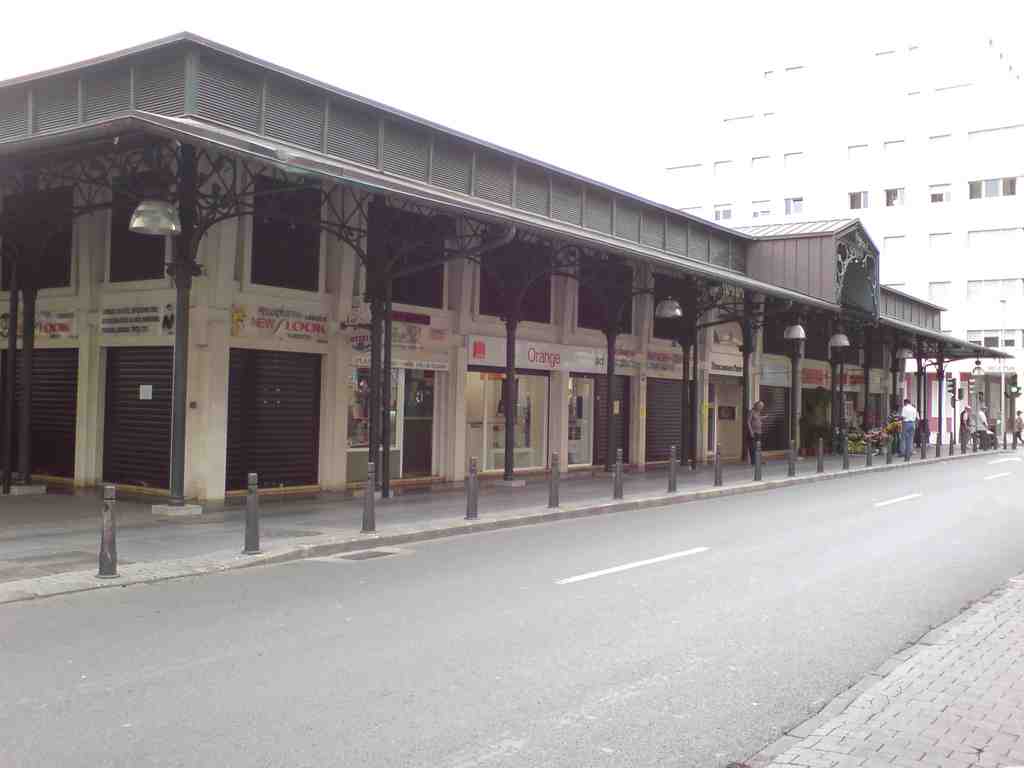
On your left, look for a long, low building with a dark wrought-iron canopy and repeating iron columns, like a sheltered street-front arcade wrapped around the block. You’re standing beside the Mercado del Puerto, one of Las Palmas’ classic food markets… and quietly one of its best pieces of engineering. Because nothing says “fresh produce” like a building designed by the same French company that helped finish the Eiffel Tower just two years earlier. This market went up in 1891, right when the Puerto de La Luz was pulling people in fast-workers, sailors, families, small businesses-everyone needing daily supplies close to the docks. Before the iron-and-glass structure arrived, this spot already had informal stalls selling food; the city basically looked at the bustle and said, “Okay… let’s give chaos a roof.” And what a roof. The building is a perfect square that fills its whole block, framed by four streets like a picture in a tight urban frame. Step back and you can read the design: four entrances, and inside, two vaulted lines crossing to meet under an octagonal dome. It’s practical-easy to navigate, easy to ventilate-and still manages to feel a little theatrical, the way good public buildings should. Now, clock the metalwork. Those cast-iron profiles aren’t just doing the heavy lifting; they’re showing off. Some people even tag the decoration as Art Nouveau, and you can see why: the iron turns structural parts into ornament, and the glass openings and roof sections let daylight spill in so the place doesn’t feel like a cave. The bones are mostly cast iron for support, with rolled or forged iron used where the structure needs to bend and stretch without cracking. Around the outside you’ve got rows of columns-lots of them-spaced with near-metronome regularity, and another set inside keeping the whole canopy steady. It’s basically a steel corset for a busy neighborhood. Over time, the market evolved with the city. A major remodel in 1994 refreshed the building, and in 2012 the city pushed another update, encouraging more food-and-drink businesses so the market became not just a place to buy dinner… but a place to linger over it. Ready to keep going? Isleta-Port-Guanarteme is a 2-minute walk heading west.
Abrir página dedicada →On your right is Isleta Port Guanarteme... and if it feels less like “a single place” and more like a whole slice of city life, that’s because it is. This district was officially…Leer másMostrar menos
On your right is Isleta Port Guanarteme... and if it feels less like “a single place” and more like a whole slice of city life, that’s because it is. This district was officially created in 2004, when the old Puerto area and La Isleta were merged into one. Bureaucracy, yes... but it neatly admits what locals already knew: the port, the beach, and the neighborhoods here are stitched together like one well-worn jacket. Take a second and listen. You’ll usually catch a mix of sounds in the air: waves from the bay, traffic humming along the GC-2, maybe a delivery truck heading toward the port. This is a coastal district that includes the isthmus of Guanarteme and the La Isleta peninsula-tourism on one shoulder, industry on the other. It’s not small, either: about 12.8 square kilometers, home to roughly 71,000 people. Do the math and you get a seriously packed neighborhood-over 5,500 people per square kilometer. That’s a lot of neighbors, a lot of cafés, and a lot of opinions about the best place to catch the sunset. And the names you’ve been hearing all tour? They live here. Las Canteras promenade, Santa Catalina Park, the Elder Museum, La Regenta, the Mercado del Puerto, the Woermann building... this district is basically Las Palmas’ greatest hits album. It even hosts the biggest Carnival crowds around Santa Catalina-music, costumes, and enough energy to keep the Atlantic awake at night.
Abrir página dedicada →
Preguntas frecuentes
¿Cómo empiezo el tour?
Después de la compra, descarga la app AudaTours e ingresa tu código de canje. El tour estará listo para comenzar de inmediato - solo toca play y sigue la ruta guiada por GPS.
¿Necesito internet durante el tour?
¡No! Descarga el tour antes de empezar y disfrútalo completamente sin conexión. Solo la función de chat requiere internet. Recomendamos descargar en WiFi para ahorrar datos móviles.
¿Es un tour guiado en grupo?
No - esta es una audioguía autoguiada. Exploras de forma independiente a tu propio ritmo, con narración de audio reproduciéndose en tu teléfono. Sin guía, sin grupo, sin horario.
¿Cuánto dura el tour?
La mayoría de los tours toman 60–90 minutos para completar, pero tú controlas el ritmo completamente. Pausa, salta paradas o toma descansos cuando quieras.
¿Qué pasa si no puedo terminar el tour hoy?
¡No hay problema! Los tours tienen acceso de por vida. Pausa y continúa cuando quieras - mañana, la próxima semana o el próximo año. Tu progreso se guarda.
¿Qué idiomas están disponibles?
Todos los tours están disponibles en más de 50 idiomas. Selecciona tu idioma preferido al canjear tu código. Nota: el idioma no se puede cambiar después de generar el tour.
¿Dónde accedo al tour después de comprarlo?
Descarga la app gratuita AudaTours desde App Store o Google Play. Ingresa tu código de canje (enviado por email) y el tour aparecerá en tu biblioteca, listo para descargar y comenzar.
Si no disfrutas el tour, te reembolsamos tu compra. Contáctanos en [email protected]
Paga de forma segura con 



