
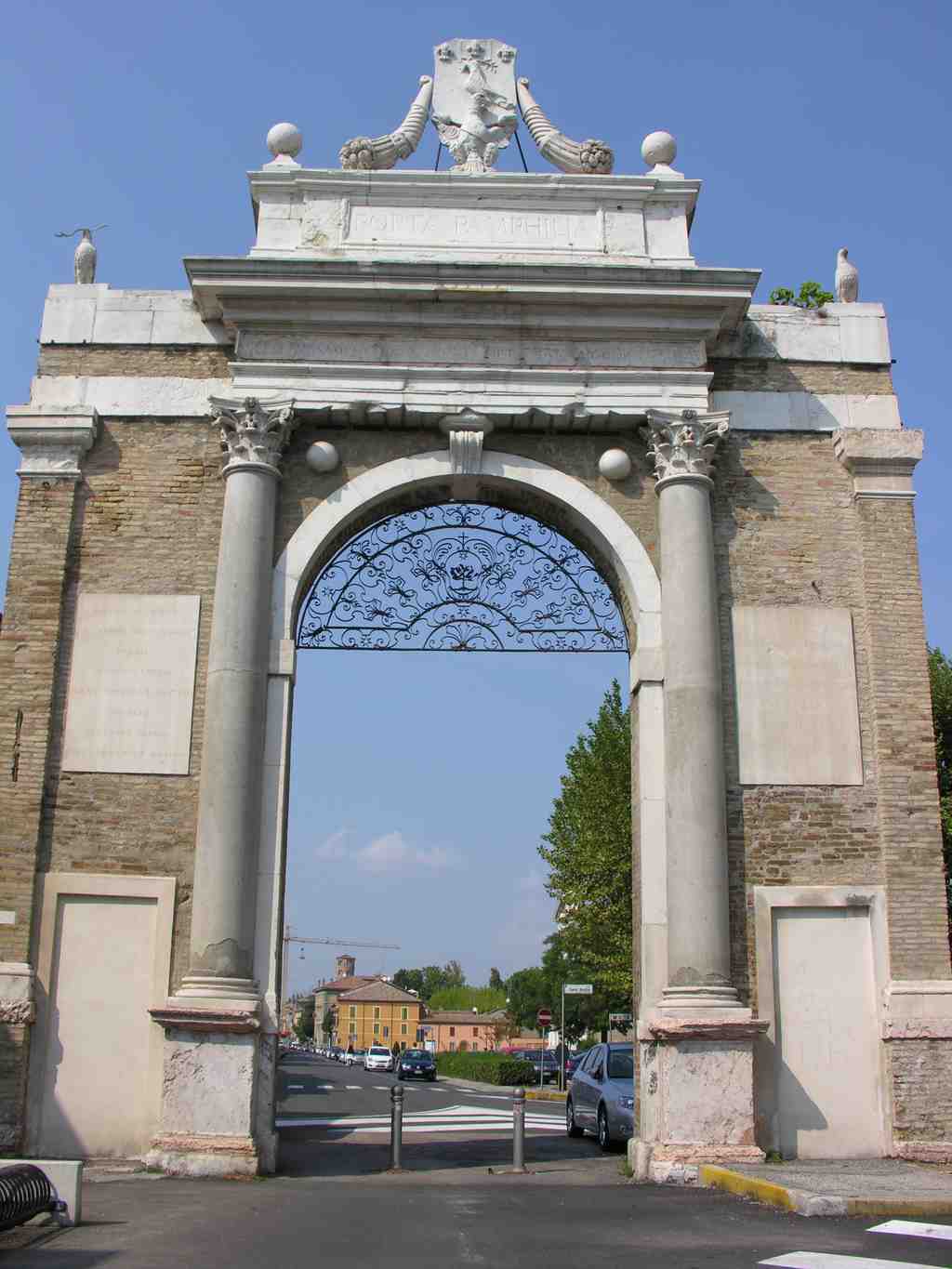
Look to your right for a pale stone gateway with one broad round arch, an iron half-moon grille set into the opening, and a sculpted papal crest perched on the attic above.
Porta Nuova tells you something essential about Ravenna: a city introduces itself through its gates. This is where power decides who enters, what arrives, and how the city wishes to be seen. A threshold is never only a gap in a wall; it is a public statement about order, ambition, and belonging.
In fifteen seventy-eight, city leaders decided that the old Porta San Lorenzo had grown too worn and too inadequate for the Ravenna they wanted. So Pope Gregory the Thirteenth’s officials shifted the entrance about a hundred and fifty metres and raised this new gate between fifteen eighty and fifteen eighty-five. They called it Porta Gregoriana, and Giovanni Pietro Ghisleri, president of Romagna, carried the work through.
That move was part of a larger rewriting of this southern edge of the city. The same programme that transformed the area around Santa Maria in Porto also refreshed the road toward Cervia, added a bridge over the Ronco, drained marshland, repaired the Cervia saltworks, and restored the port of Cesenatico. In other words, this gate did not merely defend Ravenna. It advertised a plan.
A century later, Cardinal Giovanni Stefano Donghi pushed the idea further. He wanted Ravenna tied back to the sea, so he ordered a navigable canal, the Pamphilio, to run toward the city, with its dock ending right in front of this gate. In sixteen fifty-three he restored the portal, and soon people renamed it Porta Pamphilia for Pope Innocent the Tenth Pamphili. If you look up, the message is still there in stone: the Pamphili dove with an olive branch in its beak, flanked by two cornucopias, the horns of plenty. Peace and abundance, displayed over an entrance built to manage movement and trade.
There is a detail locals cherish. The older Porta San Lorenzo never vanished entirely. Its remains survive, rather slyly, inside the entrance of a modern condominium about a hundred and fifty metres away. Ravenna has a habit of tucking its past into the fabric of the present.
And this arch itself is a kind of historical collage. The iron lunette above the opening, that decorative grille, did not begin life here. Workers salvaged it from Porta Alberoni in eighteen eighty-five when the railway demanded that gate’s demolition, then fitted it into Porta Nuova. Even the city’s entrances get rewritten.
People passed under this arch for every sort of reason: trade, travel, return, escape. From eighteen eighty-three to nineteen twenty-nine, the Forli-Ravenna tram ran straight beneath it. But memory here is not only civic and grand. On the inner face, small plaques recall Francesco Segurini, a fifty-five-year-old socialist worker shot dead here on the first of May, nineteen twenty-one after he ran unarmed toward gunfire, and Mario Montanari, an anti-fascist accountant killed nearby by the Black Brigades, fascist militia of the war’s final years, on the third of November, nineteen forty-four. A few days after liberation, Allied troops entered through this gate, and the Irish Regiment of Toronto marched beneath the arch with bagpipes.
That is what a city edge does: it changes the story depending on which side you stand. When you are ready, in about six minutes we leave this formal threshold and step into a more local, close-grained world at the Church of San Rocco. You can return to Porta Nuova whenever you like; it stands open all day and all night.




