
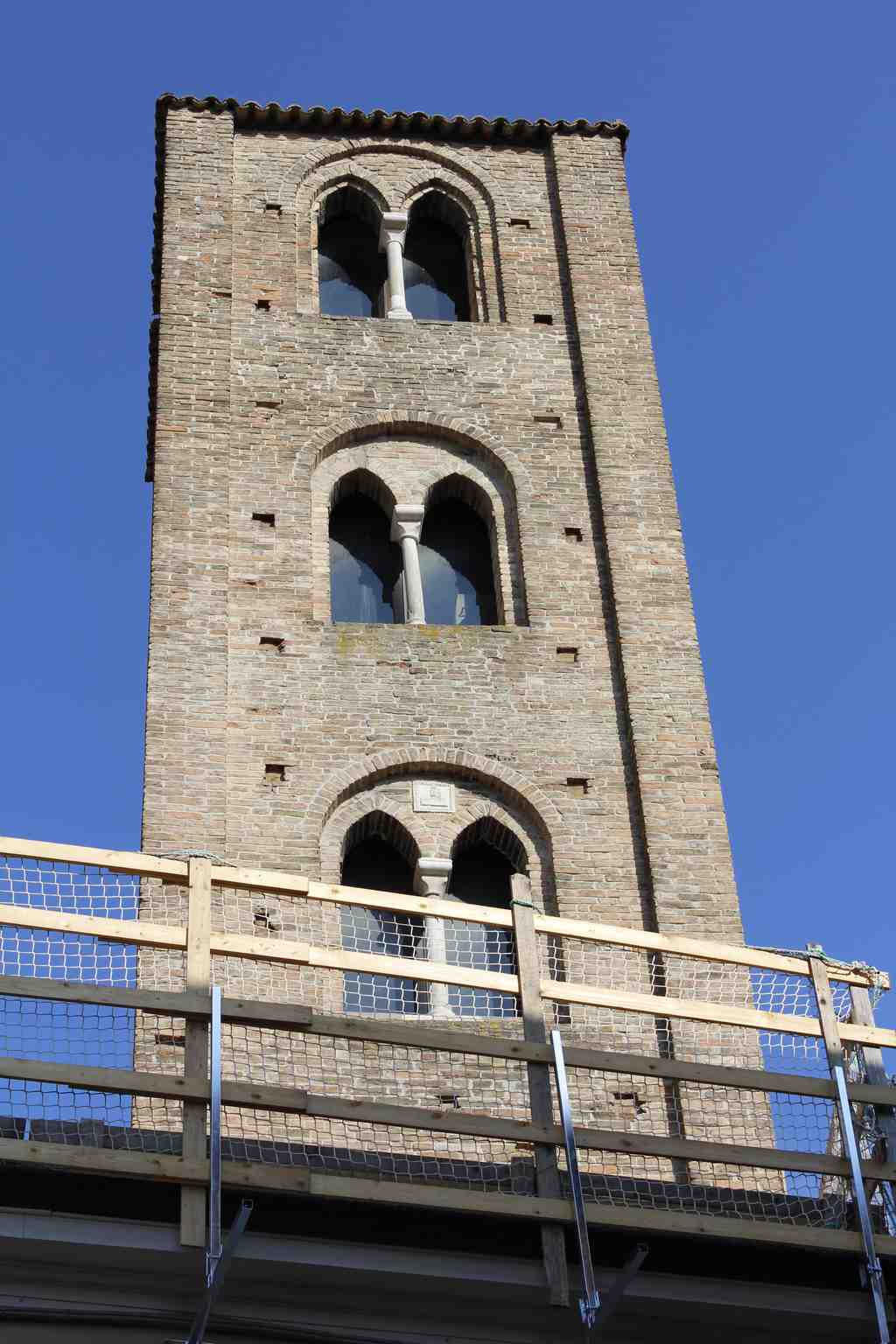
Look for the curved red-brick apse built in long, thin bricks, with the surviving bell tower beside it and a later, plainer front masking its older heart.
San Michele in Africisco is one of Ravenna’s most revealing disguises. It began in the sixth century as a small basilica, a church with a central hall and side aisles, raised in the world that also produced the great orthodox monuments of the city after the age of the lost Basilica Ursiana, Ravenna’s old cathedral. Here too, belief was not simply prayed. It was argued, declared, almost pressed into the walls.
A wealthy banker and imperial official, Giuliano Argentario, financed this church with his son-in-law Bacauda to fulfil a vow to the Archangel Michael. Bishop Vittore dedicated it on the seventh of May, five hundred and forty-five, and Archbishop Massimiano consecrated it two years later. Even the name Africisco carries an old echo, probably linked to Phrygia in Asia Minor, though in Ravenna it came to mean this particular quarter.
Now, the detail most visitors miss is the sharpness of the message once glowing inside the apse. The lost mosaic did not merely show a young Christ between the archangels Michael and Gabriel. Christ held an open book with two lines from Saint John: “Who has seen me has seen the Father” and “I and the Father are one.” In sixth-century Ravenna, that was not decorative piety. It was a clear answer to Arian belief, which denied the full equality of Son and Father. So this church stood as a visual rebuttal, laid in gold and glass. Ravenna argued theology in mosaic.
And yet, like so much in this city, the holy place kept being rewritten rather than erased. The rivers that once met near this site disappeared under streets. The da Polenta family later absorbed the area into one of their urban courts. Restorers altered the church in the Middle Ages and again in the Renaissance, adding the façade and bell tower. For a time, Ravenna even set its clocks by an old sundial here.
Then came the long unmaking. Napoleon’s requisitions pushed the church into final deconsecration in eighteen oh five. In eighteen twelve, Andrea Cicognani bought it for just eighty scudi, perhaps only a few thousand euros in today’s terms, and turned part of it into fish stalls for the market outside. Another owner, Giuseppe Buffa, used the apse as a wood store. He promised to protect the mosaic, then let it be sold off all the same.
One Ravennate refused to assist in that removal: Alessandro Cappi, secretary of the local academy of fine arts. He would not help strip the decoration from its church. Others did. After damage, transport, restoration, and heavy nineteenth-century remaking, the apse mosaic ended up in Berlin, where it still survives in altered form, far from the bricks that first held it.
Even after sanctity drained away, memory lingered. The historian Girolamo Fabri lay buried here in sixteen seventy-nine; when this church decayed, people carried his tomb elsewhere rather than let him vanish with the building. That, perhaps, is Ravenna’s true habit. It keeps moving its meanings, its images, its dead, but never quite lets them go.
In a few minutes, at Dante’s Tomb, that instinct becomes intimate. We leave arguments about heaven and arrive at the city’s care for one beloved soul.




