
Tour de Audio de la Provincia de Aosta: Ecos de Imperios y Leyendas Alpinas
Ecos de campanas antiguas una vez convocaron a reyes y conspiradores bajo la sombra nevada de las montañas de Aosta. Esta ciudad esconde siglos de luchas de poder y leyendas entre piedra y silencio. Embárcate en una aventura de audio autoguiada por Aosta, desvelando las historias ocultas y los rincones secretos que la mayoría de los visitantes pasan por alto. Descubre cómo las icónicas catedrales y castillos de la ciudad se convirtieron en escenarios de drama, intriga y desafío. ¿Qué secreto prohibido obligó a los obispos a reunirse en susurros dentro de la Catedral de Aosta? ¿Quién lo arriesgó todo para irrumpir en el Castillo de Bramafam durante una revolución en una noche de tormenta? ¿Y por qué los antiguos susurros aún resuenan en las criptas bajo Sant'Orso justo antes del amanecer? Recorre calles serpenteantes donde el escándalo y el santuario se encuentran, siguiendo los pasos de rebeldes y gobernantes. Cada giro ofrece una nueva leyenda y cada piedra brilla con historias no contadas. Pulsa reproducir y desentraña los enigmas de Aosta, un secreto a la vez.
Vista previa del tour
Sobre este tour
- scheduleDuración 40–60 minsVe a tu propio ritmo
- straighten3.0 km de ruta a pieSigue el camino guiado
- location_on
- wifi_offFunciona sin conexiónDescarga una vez, úsalo en cualquier lugar
- all_inclusiveAcceso de por vidaReprodúcelo en cualquier momento, para siempre
- location_onComienza en Castillo de Bramafam
Paradas en este tour
Look for a tall, round stone tower with jagged battlements at the top, rising beside some evergreen trees and a patch of autumn-colored leaves-this is Bramafam Castle, standing…Leer másMostrar menos
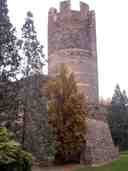
Look for a tall, round stone tower with jagged battlements at the top, rising beside some evergreen trees and a patch of autumn-colored leaves-this is Bramafam Castle, standing right at the corner of Via Bramafam and Viale Carducci, along the old Roman wall. Standing here, picture the clang of armor and the shuffle of medieval boots as you gaze up at these ruins. The castle of Bramafam was once the pride of the noble Challant family, perched high over the ancient Roman fortifications. Don’t let its battered appearance fool you! That massive, brickwork main building and its sturdy, round tower once guarded the “main right gate” into the ancient city. Imagine windows with graceful twin arches-the kind that would make any medieval architect jealous-and a grand arched doorway where a drawbridge once rattled up and down, probably causing headaches for anyone who forgot their keys! Beneath your feet, and on the southern face, peek for traces of the original Roman wall, still stubbornly clinging to life after all these centuries. The tower's top bristles with that classic “Guelph” crenellation-perfect for yelling at invaders, or, perhaps, at neighbors who played their lutes too loudly. Uniquely, this castle boasted an above-ground water cistern on its southern side, a feature so unusual you’d almost expect to find someone trying to grow tomatoes out of it. The story of Bramafam isn’t just about stones and walls; it’s a tale of heartache, betrayal, and long-forgotten drama. The first tower was already here in the early 1200s, named after Beatrice of Geneva, who was both a newlywed and a bit of a trendsetter. The Challant family, masters of the city’s southwest corner, held sway here until the castle was plundered by Giacomo di Quart in 1253-yes, even castles sometimes go on unwanted diets. By 1295, the property was passed over to Count Amadeus V of Savoy in exchange for a feudal estate, but the Challants hung on to their castle rights until the 1700s, renting out the ruins and defending every last stone with almost comical persistence. Why is it called Bramafam? The name comes from the local dialect for “crying out for hunger.” One legend claims a jealous husband locked away his wife in the tower, leaving her to starve. Another, more community-minded version says hungry townsfolk gathered outside, shouting to the lords above for something to eat-talk about food delivery gone wrong! By the 1500s, Bramafam was already little more than a shell, its vaults and rights handed over from viscounts to notaries as power shifted and the world moved on. So, standing here today, you can admire both medieval design and a dramatic tale, with Bramafam’s jagged crown keeping watch over centuries of hunger, hope, and history.
Abrir página dedicada →To spot the Church of Santo Stefano, look for a building with a sloping roof and a beautifully painted façade featuring colorful religious frescoes and two arched wooden doors,…Leer másMostrar menos
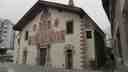
To spot the Church of Santo Stefano, look for a building with a sloping roof and a beautifully painted façade featuring colorful religious frescoes and two arched wooden doors, right at the busy city corner. Step closer and imagine you’re standing where ancient footsteps echo-because beneath your feet once lay a Roman necropolis, a city of the dead, that predates this very church by centuries! As you look up at the lively frescoes on the façade, freshly restored, you’ll see saints, angels, and even the dramatic martyrdom of Saint Stephen himself, their painted expressions almost daring you to guess what secret conversations they might have at midnight. The first whispers of the Church of Santo Stefano date all the way back to a parchment from 1234. Back then, this was a parish traded between religious orders bigger than the biggest football trades! Fast forward to the 18th century, and the present church emerges, built over the older 15th-century structure, proudly displaying the inscription of a certain Jaquemin Pastor above the right door. He might not have been a medieval influencer, but his signature work still welcomes everyone who walks through these doors. The robust, stone portal in front of you was carved from Aymavilles stone in 1729 and remains as solid as your grandma’s fruitcake-nobody’s getting through here uninvited! Inside, if you could sneak a peek (no climbing through windows, please), there are three long naves leading to an immense, gold-painted baroque altar. It’s like something out of a royal palace, adorned with twisting columns, golden statues, reliquaries, and even paintings of the Holy Trinity and the dramatic martyrdom of Saint Stephen. Peer around and you’ll spot a grand chorus area, rich walnut wood decorated with garlands and angel heads, rescued from a long-vanished Franciscan convent. But wait for it-the left aisle is home to a true giant: a wooden statue of Saint Christopher, over four and a half meters tall, carved from a single trunk. It’s so huge he’d have trouble fitting on any bus in Aosta! And high above, the sound of music might surprise you-the magnificent 19th-century pipe organ, all gears and pipes, designed by Costantino Mazzia, still waits to breathe life into the church’s ancient stones. There’s mystery, memory, and marvel all crammed into this street corner. So, look up, listen close, and see if you can hear the stories swirling through the air…
Abrir página dedicada →
Mostrar 9 paradas másMostrar menos paradasexpand_moreexpand_less
You’re looking for a large yellow building with rows of white windows and a grand triangular top-just ahead, right where the banners hang and frescoes peek out above the…Leer másMostrar menos
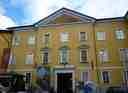
You’re looking for a large yellow building with rows of white windows and a grand triangular top-just ahead, right where the banners hang and frescoes peek out above the entrance. Welcome to the Regional Archaeological Museum of Valle d’Aosta! Now, I know what you’re thinking-does this elegant, golden building whisper old secrets? Actually, it does one better-it practically shouts them through layers of time. Right here, beneath your shoes, once stood the mighty Roman Porta Principalis Sinistra, a gateway into ancient Augusta Praetoria. The ground below is a treasure trove, so packed with history that eager archaeologists are still busy digging, dusting, and discovering forgotten fragments. You can even tiptoe atop walkways inside that let you gaze into the ongoing excavations. And believe it or not, this venerable spot didn’t start its life as a museum. First, it was a fort for the proud Vaudan nobles, then, in 1633, it transformed as the Convent of the Visitandine-created by the high-and-mighty Marquis Pierre-Philibert Roncas and his wife, who wanted to give a home to the nuns devoted to Saint Jeanne de Chantal. The peaceful sound of prayers and whispers of cloaked footsteps must have filled these halls back then. But peace never seems to last-a couple centuries later, the building geared up for action as Caserma Challant, a roaring military barracks. If these walls could have rolled their eyes, they would’ve seen horses, soldiers, and even a stage with wild local theater. At some point, they even ended up being used as a barn and-wait for it-a storage room for farm tools. It’s a museum now, but its résumé is as wild as a time traveler’s diary. Once inside, you’ll discover objects from every age of Valle d’Aosta. Imagine holding a prehistoric vase, or a stony funerary ornament-each item a thread to a different world altogether. The museum's Roman exhibits glisten with glass plates, statues, old spoons, and-my favorite-toys from centuries past. Just picture a Roman child, grumbling over a lost game piece; apparently, kids haven’t changed all that much. Then step into the Christian-Medieval section, where you’ll see an 8th-century ambo, dug up from the Cathedral. Try to spy the golden cups with painted saints, or even a knight’s sword-spurs and all-from Sant'Orso, ready for battle or a jousting selfie. Make sure to look for the scale model of Augusta Praetoria: it’s like Google Maps, but for Romans. Downstairs, even more mysteries lurk. Among the museum’s most guarded secrets are the underground ruins of the south-west corner of the original Roman gate, complete with ancient layers and-would you believe it-the last standing section of the ancient city ramparts with earthy embankments. Now for a numismatic twist: fancy meeting coins from the Greek era to the times of the Savoy? You’ll find them here, plus Celtic, Gallic, and Padane coins-a real pocketful of history. If you like to globe-trot without leaving Aosta, hunt for the Etruscan, Egyptian, and Mesopotamian relics housed in the Carugo collection. You might stumble into a temporary exhibition, too: from vibrant Swiss expressionism to the poetic dreamscapes of Joan Miró, the modern magic of Felice Casorati, or even artistic explorations of numbers across centuries. Sometimes, the museum even transforms to showcase the works of Italo Mus, local artist and chronicler of his times. So when you step inside, take a moment-this isn’t just a museum; it’s a time machine that has worn many hats-a convent, a theater, a barn, a barracks-and now, a keeper of the region’s secrets, waiting for you to uncover each one! For further insights on the the headquarters, the main collection or the other collections, feel free to navigate to the chat section below and inquire.
Abrir página dedicada →Back in the day, nobody really agreed on what the cryptoporticus was for. Was it a fancy shortcut to get from the sacred temples above to the busy forum? A backstage for religious…Leer másMostrar menos
Back in the day, nobody really agreed on what the cryptoporticus was for. Was it a fancy shortcut to get from the sacred temples above to the busy forum? A backstage for religious ceremonies where only the VIPs-think gods and important locals-could creep along unseen? Or just an immense storage room for ancient Roman lost and found? By the third century, that's what it became: a place to stash stuff nobody wanted on display. Still, all agree this place helped support a gigantic artificial terrace above, where two magnificent temples looked down over the forum-one for Augustus himself, the other for Rome’s top trio, the Capitoline gods. Today, very few cryptoporticuses are open to the public; you can brag you’ve seen one of the rarest Roman underground secrets in Europe!
Abrir página dedicada →You’ll spot the Cathedral of Aosta by its impressive white neoclassical façade topped with three statues waving down at you like they’re at a very fancy parade-just look to the…Leer másMostrar menos
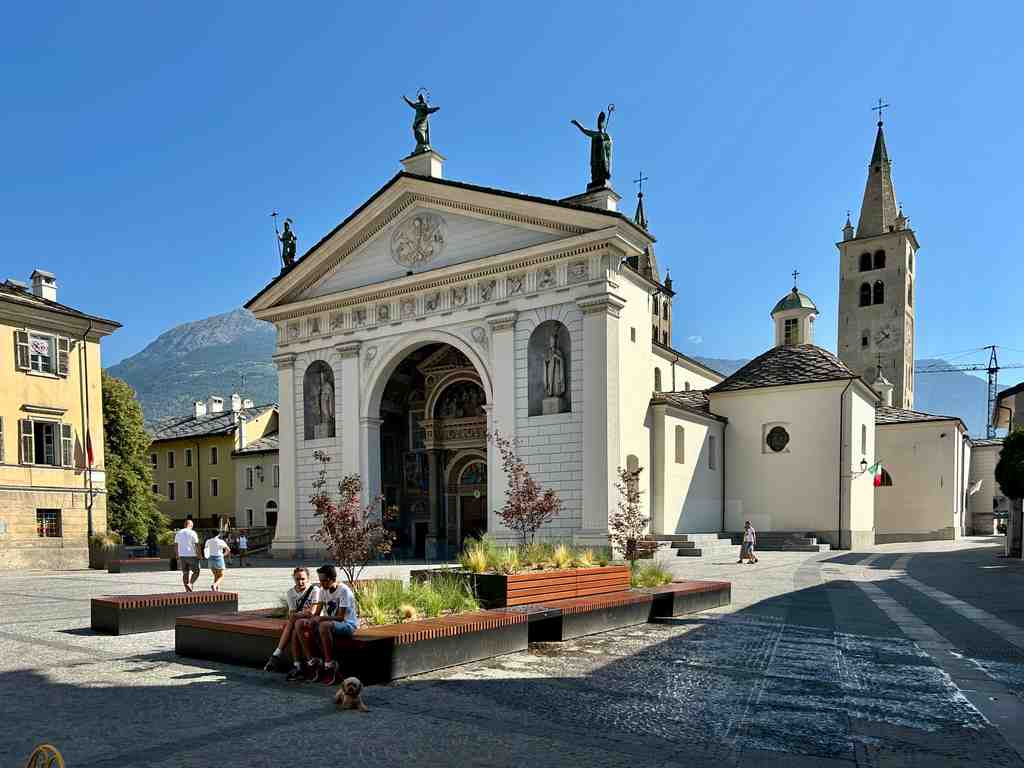
You’ll spot the Cathedral of Aosta by its impressive white neoclassical façade topped with three statues waving down at you like they’re at a very fancy parade-just look to the tall twin bell towers, the tallest in the city, and you can’t miss it. Standing here, you’re about to enter a time machine hidden in stone and color. The Cathedral of Aosta, or Santa Maria Assunta, has roots that stretch back all the way to the 4th century, when a “Domus Ecclesiae,” an early Christian gathering house, stood right on this spot-imagine people in sandals and tunics whispering secrets of a brand-new faith. Fast forward to the 11th century, when Bishop Anselm I (not to be confused with the other famous Anselm from Aosta, who was a philosopher and later got his own saintly glow-up) rebuilt the church. His vision soared skyward with a Romanesque basilica, three naves, and twin bell towers that still reach above your head today, almost challenging the mountains behind them to a height contest. If you listen carefully, you can almost hear the echo of monks’ footsteps on cold stone as they entered the cloister for prayer. Over time, the Cathedral was shaped and reshaped by different eras-like a noblewoman changing gowns for every important party. Here came the French-inspired Gothic style in the 13th century, with tall windows and soaring arches. Then the Renaissance gave us that lively, colorful façade you see under the porch, with its painted scenes from the life of Mary and Jesus framed by terracotta busts and figures so expressive they practically wave at you along with the statues above. Inside, the drama unfolds just as powerfully. You’ll find a large wooden crucifix dating back to 1397 dramatically suspended between the nave and altar, its detail so striking it could almost make you gasp. The sunlight glimmers through medieval stained glass windows, scattering reds and blues onto the stone like confetti. Below your feet, ancient mosaic floors tell their own stories-the Cycle of the Months, showing bustling medieval life, and another with wild beasts, real and imaginary, who are apparently big fans of interior decorating. Descend into the crypt beneath the main aisle, and you’ll find the oldest part of the church, with mysterious Roman columns reused to support its ceilings-some say it’s because the builders wanted extra strength against further collapse, but personally, I think they just knew how to upcycle. Up above, behind the walls, are medieval frescoes from the 11th century, only rediscovered in 1979, depicting scenes of miracles, plagues, and saints. If you’re lucky enough to catch a tour up to them, you’ll feel as if you’ve stumbled into a hidden art gallery sprinkled with a bit of medieval magic dust. Through the centuries, the Cathedral has transformed-sometimes for prestige, sometimes for practicality. Nobles and bishops left their mark with fancy tombs and sculpted choir stalls, some complete with carved angels and hidden creatures (keep an eye out for those, you never know where a sneaky little stone lion might be resting). Even the organ here is legendary, once hosting some of Europe’s grandest musicians-a festival so powerful, the vibrations practically threatened the mountain. So take a deep breath. Imagine centuries of prayer, art, celebration, and daily life swirling around you. Here at the Cathedral of Aosta, every stone whispers a story, every window casts colored light on secrets of the past. And don’t forget, the statues on the roof are still watching-maybe they’ll wave at you as you move on!
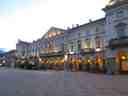
Abrir página dedicada →To find Place Émile Chanoux, look for a wide, open square with a grand cream-colored building lined with arches and small glowing lights straight ahead of you. Here you are,…Leer másMostrar menos
To find Place Émile Chanoux, look for a wide, open square with a grand cream-colored building lined with arches and small glowing lights straight ahead of you. Here you are, right in the heart of Aosta, the city’s beloved living room-Place Émile Chanoux! Picture it: the broad stones beneath your feet and this elegant rectangle, hugged on one long side by the majestic neoclassical Town Hall. If you listen carefully, you might catch the faint sound of footsteps echoing under those arched porticoes as evening falls. Today’s peaceful square hides a rather dramatic history-almost like Aosta’s very own soap opera. This spot wasn’t always a civic showstopper. Back in 1352, you’d have been craning your neck to see the towering bell tower of the San Francesco Monastery, reaching almost forty meters high! The monastery complex dominated this area for centuries until the 1830s, when, bit by bit, chisel by chisel, and finally with a satisfying-okay, probably alarming-blast of explosives, its last bricks tumbled so that the sparkling new Town Hall could rise in its place. That was 1836, and I bet the monks still haven’t forgiven those demolition crews. Stare up at the exquisitely decorated façade and spot the two stone figures at the base; they aren’t just for show-they represent the two rivers, Dora Baltea and Buthier, that keep the city refreshed. If you’re squinting at the rooftop, you’ll see not just a clock but a sneaky sundial too. Yep, you’ll never have an excuse to be late here. The Hôtel des États next door has its own tales. Built in the 1700s as a humble one-story job, it eventually bulked up and started welcoming the local rulers and lawmakers-the “States General” and Conseil des Commis, making all those crucial decisions about taxes, health, and, I imagine, what snacks to serve at meetings. Piazza Chanoux has always attracted a vibrant crowd: posh hotel guests at the Hôtel de la Couronne et de la Poste, writers like Xavier de Maistre, and the chattering regulars at the historic Caffè Nazionale, which, after a brief nap, returned dressed up and Michelin-starred, because even old cafés deserve a glow-up. Oh, and that statue out front-replace your best “serious face” here because it honors the local soldiers, keeping bravery front and center. So, as you stand in this glowing square, imagine the layers of history, the celebrations, the debates, and a few over-caffeinated politicians hustling across this very ground. History, anyone? Or just a good cappuccino!
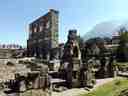
Abrir página dedicada →Straight ahead you'll spot a huge, ancient stone wall still standing tall with rows of arched windows and open entrances, framed by crumbling ruins and dramatic mountain…Leer másMostrar menos
Straight ahead you'll spot a huge, ancient stone wall still standing tall with rows of arched windows and open entrances, framed by crumbling ruins and dramatic mountain views-just look for the tallest structure in the area that seems to have more holes than a block of Swiss cheese! Now, picture the scene nearly two thousand years ago: instead of the peaceful town and mountain air around you, the city buzzed with excitement as crowds streamed toward this very place-the Roman Theatre of Aosta. Built shortly after Aosta’s founding in 25 BC, this wasn’t just any theater; it was the city’s entertainment hotspot, big enough to host up to 4,000 Romans eager to take in a show, gossip, and maybe enjoy a snack or two. Imagine colorful banners, the scent of togas and olives, and a chorus of chatter filling the air as everyone scrambled for the best seat in the house-or, since the seats are gone today, for a bit of shade! What makes this theater extra special is its rather quirky shape-not perfectly semicircular like you’d expect, but almost squarish, with a southern wall rising 22 meters high, so tall you could stack two giraffes and still have room! Now, brace yourself for a plot twist worthy of a gladiator movie: in 1833, someone wanted to turn these ancient stones into bricks for the new city hall. If not for the dramatic dash of local priest and history buff Jean-Antoine Gal all the way to Turin to plead with the king, you’d be looking at a parking lot. Over the years, archaeologists uncovered layers of Roman homes-imagine people back then complaining that the neighbors were too noisy every time the drumroll started. Even today, the theatre springs back to life, hosting summer concerts and winter holiday markets. The echo of ancient applause might be gone, but the magic of this place is very much alive!
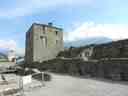
Abrir página dedicada →Look ahead for a tall, square medieval stone tower rising just beyond the lower ruins, with a strikingly simple and sturdy design-this is the Tour Fromage, standing proudly next…Leer másMostrar menos
Look ahead for a tall, square medieval stone tower rising just beyond the lower ruins, with a strikingly simple and sturdy design-this is the Tour Fromage, standing proudly next to Aosta’s ancient walls. Now, as you stand before the Tour Fromage, let your imagination whisk you back to the twelfth century. Picture the clang of blacksmiths, the scent of wood fires, and this formidable tower, built for the Du Fromage family-who, by the way, weren’t the local cheese makers, but important allies to Aosta’s bishop and the rulers of Porta Sant’Orso. Life around the tower wasn’t always peaceful: the documents of 1191 prove it was precious enough for Tommaso I of Savoy himself to restore it to the bishop-perhaps after a dramatic game of medieval keep-away! Centuries later, the last heiress of the Casei family, the famous Jeannette du Fromage, married Claude Vaudan, tying the tower’s fate to yet another powerful family-and probably creating some very complicated dinner parties. In 1549, history took a tasty twist, as the tower hosted a grand feast for Ferrante I Gonzaga, the Governor of Milan, on imperial business-imagine the music, laughter, and the anxious organizers hoping not to spill soup on the VIP guest! Today, the tower is owned by the Region of Aosta and sometimes transforms into a dreamy exhibit space. Just think: all those centuries of whispers, footsteps, and secrets-right here, beneath your feet.
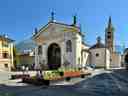
Abrir página dedicada →Look ahead for a cream-colored facade with striking red-gothic trim around a pointed doorway and a pair of quirky brick spires poking up at the top-when you see that mix of neat…Leer másMostrar menos
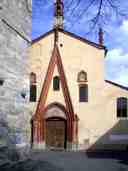
Look ahead for a cream-colored facade with striking red-gothic trim around a pointed doorway and a pair of quirky brick spires poking up at the top-when you see that mix of neat oddness right off the little square, you’ve found the Collegiate Church of Sant'Orso! Alright, imagine yourself here centuries ago-the air is buzzing with hushed prayers, bells ringing, and the cobblestones under your feet echoing history. This church stands as a real-life time machine, showing off the artistic journey of Aosta’s sacred heart. Before the stones were even stacked for the first walls, an ancient cemetery lay here, with generations resting in peace just outside Roman Aosta. The first church was a simple hall with a rounded back, but then-pow!-along came the Carolingian builders in the 800s, who made everything bigger and grander. In 989, a bell tower was stuck onto the side, and part of its bones are still visible, almost like seeing the skeleton of a medieval giant clinging to the current facade! By the time Bishop Anselm arrived in the 990s, it was time for a full upgrade. He rolled up his sleeves, said “Let’s go Romanesque!” and reshaped the space into three naves, wooden beams, and a trio of apses, with a crypt holding local VIPs below-one crypt for high drama ceremonies, another for the all-important ancestors. Inside, thick square pillars hold up arched ceilings. Step softly because beneath your feet, hidden until 1999, there’s a 12th-century mosaic-with black and white tesserae and a splash of pale brown, it’s like a secret carpet for medieval bigwigs. You’ll spot an elaborate wooden choir from the late 1400s, all hand-carved, and five stained-glass windows blazing with color, made between 1494 and 1503. Look to the right-if you could step down into the crypt, you’d find ancient rooms radiating like a sun, with echoing silence and a scent of centuries-old stone. Now the show-off in the square is the bell tower-44 meters tall, one of the tallest in the area! The lower half is made with ancient blocks that probably gave the medieval masons some serious back pain. But the tower’s not just a bell-bearer. It was a refuge, a fortress in itself. It’s loaded with 12 bells: the biggest, cast in France in 1589, is so heavy it’s nearly half the weight of the old “big bell” at the Vatican! When that thing rings, you can be sure everyone north of the Alps knows it’s lunchtime. The pretty cloister is a masterpiece-arches, delicate columns, and 37 marble capitals remaining from an original 52. These white marble blocks were made waterproof with a special glue, but over time it oxidized, turning many of the once-sparkly stones a mysterious dark. You’ll want to run your fingers along them, but trust me, security is less forgiving than medieval monks. Hidden above the church’s main nave, there are rare Ottonian frescoes from the 1000s-imagine colorful saints and angels peering at you from their perch between the wooden roof and the gothic vaults, painted by artists with wild imaginations and no television to distract them. Last but not least, there’s the Priorate beside the church: built like a little fortress itself, complete with its own octagonal tower and a spiral staircase to secret upper rooms and a tiny chapel. Over the centuries, the church’s priors, canons, and even bishops all left their mark, arguing, singing, and sometimes hiding out from trouble. So, whether you’re here for the art, the architecture, or just to snap a selfie with history, Sant'Orso is more than a church-it’s Aosta’s story carved in stone and marble, echoing through the centuries. And hey, those bells? If you hear them ring, that’s the mountain’s way of saying “Don’t forget to look up!”
Abrir página dedicada →To spot the Tower of the Bailiffs, look ahead for a tall, square stone tower rising above a chunky rounded turret at the street corner, its pale walls set against the crisp…Leer másMostrar menos
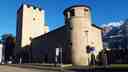
To spot the Tower of the Bailiffs, look ahead for a tall, square stone tower rising above a chunky rounded turret at the street corner, its pale walls set against the crisp mountain views. Welcome to a place that’s seen more plot twists than your favorite TV drama-the Tower of the Bailiffs! Standing here, you can practically sense the layers of history pressed into these ancient stones. Back in 1192, this spot was just one of many corner towers along Aosta’s formidable Roman walls. But the fun really began in the 12th century, when the powerful De Palais family decided to make some bold home improvements-by recycling parts of the actual city wall! (Talk about medieval upcycling.) Fast forward to 1263: the tower switches owners, landing in the hands of the Count of Savoy, who said, “Perfect-just the place for my bailiff!” Suddenly, the fortress is buzzing with courtly business. During the 1300s, it was even known as Turris Comitis, or the Count’s Tower. Of course, medieval families being what they are, there were plenty of property squabbles and inheritances, all echoing through the feudal halls. But the story doesn’t stop there. Over the centuries, masonry crews were called in to build, rebuild, and extend the tower-sometimes to provide more living space, sometimes for extra security, and, at least once, to fit in the local prison and courthouse. Yes, by the 1400s, judges and prisoners occupied room next door to each other-imagine the awkward elevator rides! Eventually, the tower became just a prison, then sat brooding and empty for decades after the last prisoner left in 1984. Now, its ancient halls are alive with music, serving as the local music institute since 2014. From fortress to courthouse, from jail to conservatory-this corner of Aosta wears every chapter of its story with pride.
Abrir página dedicada →To spot the Roman amphitheatre of Aosta, look ahead and you'll see an ancient stone wall built right into the side of a larger, much newer building-the old arches, rough blocks,…Leer másMostrar menos
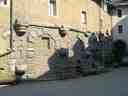
To spot the Roman amphitheatre of Aosta, look ahead and you'll see an ancient stone wall built right into the side of a larger, much newer building-the old arches, rough blocks, and scattered columns are a dead giveaway that you’ve found the right place. Welcome! Take a moment to stand right here, next to these weathered stones-imagine you're at the edge of a roaring Roman crowd, instead of a peaceful courtyard. More than two thousand years ago, this very spot was alive with the excitement and chaos of Augusta Praetoria Salassorum’s gladiator games. The amphitheatre, with its massive ellipse, could once seat up to 15,000 spectators-yes, more than the entire city at the time. Just picture it: the stone stands packed so tightly a sneeze would send ripples all the way across the arena! The Romans didn’t just build for function; they built for spectacle. The cavea-the big seating area-was partly dug into the ground for strength, with the top ring propped up on graceful arches and rounded columns cut out of grey bardiglio, a marble so local you could practically hear the mountains grumbling as they chiseled it out. If you look closely, you’ll even spot eight ancient archways pressed right into the convent wall in front of you-those used to be the second floor of the amphitheatre, but now, thanks to centuries of rising ground, you can practically touch them. For centuries, these stones echoed with the stomp of feet and the clash of swords. But as the empire fell and Christianity rose, the games stopped, the crowd hushed, and nature reclaimed the arena. People forgot what this place had once been. Locals just called it palatium rotundum-the "round palace"-because why not give it a fancy new nickname once the gladiators left? By medieval times, some noble families even used the surviving spaces as wine cellars. “Welcome to the Roman basement! Gladiators not included.” Then, with a sharp twist in 1247, Viscount Godefroy de Challant brought in a group of canons fleeing from the Valais and had a convent built right over the ruins. He probably didn’t realize just how many Roman ghosts the new tenants might inherit! He even added a church and a bell tower, sandwiching centuries of architecture together. You can still spot impressive frescoes above the doorway, thanks to a sprucing-up job in 1496 by Francesco di Carmagna. Every layer tells a piece of Aosta’s story, like a lasagna baked in history. There’s more! After Napoleon swept through, the convent changed hands. It wasn’t until 1831 that the Sisters of St. Joseph settled here, still caring for those inside these very walls. If you’re feeling curious, you can even ask the sisters-politely, of course-to let you peek at more Roman remains. Their kindness keeps the past alive in the present. So pause here and imagine: Gladiators thundering. Stones repurposed as medieval basements. Sisters singing in the quiet dawn. This place, with its arches and shadows, is a living timeline. And oh-beware lingering too long, or you might just end up volunteering for next season’s games! For further insights on the description, late antiquity and the middle ages or the the convent, feel free to navigate to the chat section below and inquire.
Abrir página dedicada →

Preguntas frecuentes
¿Cómo empiezo el tour?
Después de la compra, descarga la app AudaTours e ingresa tu código de canje. El tour estará listo para comenzar de inmediato - solo toca play y sigue la ruta guiada por GPS.
¿Necesito internet durante el tour?
¡No! Descarga el tour antes de empezar y disfrútalo completamente sin conexión. Solo la función de chat requiere internet. Recomendamos descargar en WiFi para ahorrar datos móviles.
¿Es un tour guiado en grupo?
No - esta es una audioguía autoguiada. Exploras de forma independiente a tu propio ritmo, con narración de audio reproduciéndose en tu teléfono. Sin guía, sin grupo, sin horario.
¿Cuánto dura el tour?
La mayoría de los tours toman 60–90 minutos para completar, pero tú controlas el ritmo completamente. Pausa, salta paradas o toma descansos cuando quieras.
¿Qué pasa si no puedo terminar el tour hoy?
¡No hay problema! Los tours tienen acceso de por vida. Pausa y continúa cuando quieras - mañana, la próxima semana o el próximo año. Tu progreso se guarda.
¿Qué idiomas están disponibles?
Todos los tours están disponibles en más de 50 idiomas. Selecciona tu idioma preferido al canjear tu código. Nota: el idioma no se puede cambiar después de generar el tour.
¿Dónde accedo al tour después de comprarlo?
Descarga la app gratuita AudaTours desde App Store o Google Play. Ingresa tu código de canje (enviado por email) y el tour aparecerá en tu biblioteca, listo para descargar y comenzar.
Si no disfrutas el tour, te reembolsamos tu compra. Contáctanos en [email protected]
Paga de forma segura con 


