
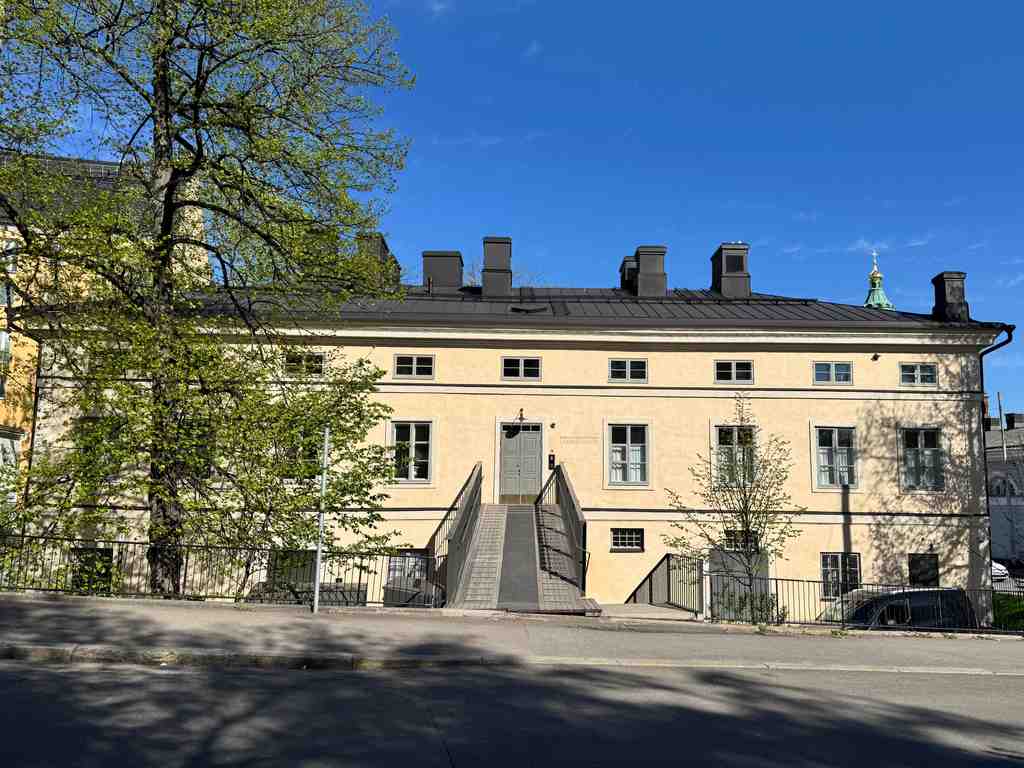
On your left, look for the low pale stone building with a simple gabled roof, rows of rectangular windows, and a footprint that sits slightly crooked against the street.
This old customs and packing house was Helsinki’s gatekeeper. Here, the city decided what could come in from the sea, what it was worth, and how tightly it should be controlled.
That may sound dry... but imagine the real traffic of it: barrels of salt, sacks of coffee, spices, clay pipes, glass, and everyday goods from far beyond the harbor. A customs officer judged the cargo’s value. Then the goods went into the packing room, really a warehouse under the same roof, for a second inspection before anyone could claim them. Long before the nearby palaces and ministries spoke for the city, this building handled the flow that fed them.
Its story feels especially human when you meet Samuel Berner, the German-born master mason who took on the job. Helsinki had only one mason of his rank, and the city gave him a nightmare of a site. In the seventeen fifties, this edge of town still met the water. Builders had to lay huge log rafts under the foundations to spread the weight over soft shoreline clay. Berner fought that ground for years and died in seventeen sixty-one, four years before the building finally opened in seventeen sixty-five. His successor, Johan Christopher Hillert, finished the work... but Berner’s struggle never disappeared. You can still sense it in the building’s odd angle. It does not obey the later straight street grid, because it follows the old shoreline, and it still leans slightly from those sinking foundations.
That crookedness is part scar, part memory.
This is one of the very few surviving buildings in central Helsinki from the Swedish era, and for a time it held more than trade. From seventeen sixty-five to eighteen oh four, the city council met here because the old town hall had become unusable. In one sturdy stone shell, commerce and government almost shared a desk.
Fire changed it in eighteen oh eight. Flames swallowed its high mansard roof - that steep double roofline you see on many eighteenth-century buildings - and after the blaze, the house got the lower, simpler roof it wears now.
Then came its wonderfully ordinary afterlives. Customs moved out in the eighteen eighties. The building turned into an auction chamber, known as the poor man’s department store, where people bid on goods from bankrupt estates and homes after a death. One family’s loss became another family’s bargain. Later it served as a police station, and in the late twentieth century many locals knew it less as a historic treasure than as the place where angry drivers came to argue about parking fines. Cities do that... they wrap huge history inside very everyday inconvenience.
And even now the ground keeps talking. During later renovations, archaeologists found traces under the floors of a Russian fortification from the Great Wrath, the brutal wartime occupation earlier in the seventeen hundreds, along with Venetian glass, German stoneware, and pipe fragments. Beneath this customs house, the city kept its older checkpoints buried in silence.
Ahead, we leave customs and policing for another kind of authority, one devoted to knowledge. In about three minutes, we’ll arrive at the House of Science and Letters.




