
Peoria Audio-Tour: Echos und Ikonen der Altstadt
Unter Peorias stattlicher Skyline hallen Geheimnisse durch Justizhallen und über Kathedralentürme. Wenige Städte vereinen Tradition und Turbulenzen so wie diese. Diese selbstgeführte Audio-Tour führt Sie von den geschichtsträchtigen Straßen der Altstadt zu majestätischen Wahrzeichen. Entdecken Sie Legenden und Skandale, die sich im Verborgenen abspielen, und lüften Sie Geschichten, die selbst Einheimische übersehen. Warum schlossen sich einst die Türen des Gerichtsgebäudes für den umstrittensten Prozess der Geschichte? Welche heilige Figur wusch die heimliche Schande einer Stadt unter dem Buntglas der großen Kathedrale weg? Wessen Name verweilt im Schatten hinter der Bühne des Peoria Civic Centers und weigert sich, aus der Erinnerung zu verblassen? Bewegen Sie sich durch die Zeit, während die Stadtviertel vor Drama pulsieren. Wandern Sie unter Marmorfassaden, vorbei an geflüsterten Intrigen und in ruhige Ecken, die von Macht und Buße geprägt sind. Lassen Sie keinen Stein unversucht und spüren Sie Peorias Geist, der mit jedem Schritt aufsteigt. Bereit, aufzudecken, was Peorias Mauern nie preisgeben sollten? Die unerzählte Geschichte der Stadt beginnt jetzt.
Tourvorschau
Über diese Tour
- scheduleDauer 30–50 minsEigenes Tempo
- straighten3.7 km FußwegDem geführten Pfad folgen
- location_onStandortPeoria, Vereinigte Staaten
- wifi_offFunktioniert offlineEinmal herunterladen, überall nutzen
- all_inclusiveLebenslanger ZugriffJederzeit wiederholen, für immer
- location_onStartet bei Peoria Civic Center
Stopps auf dieser Tour
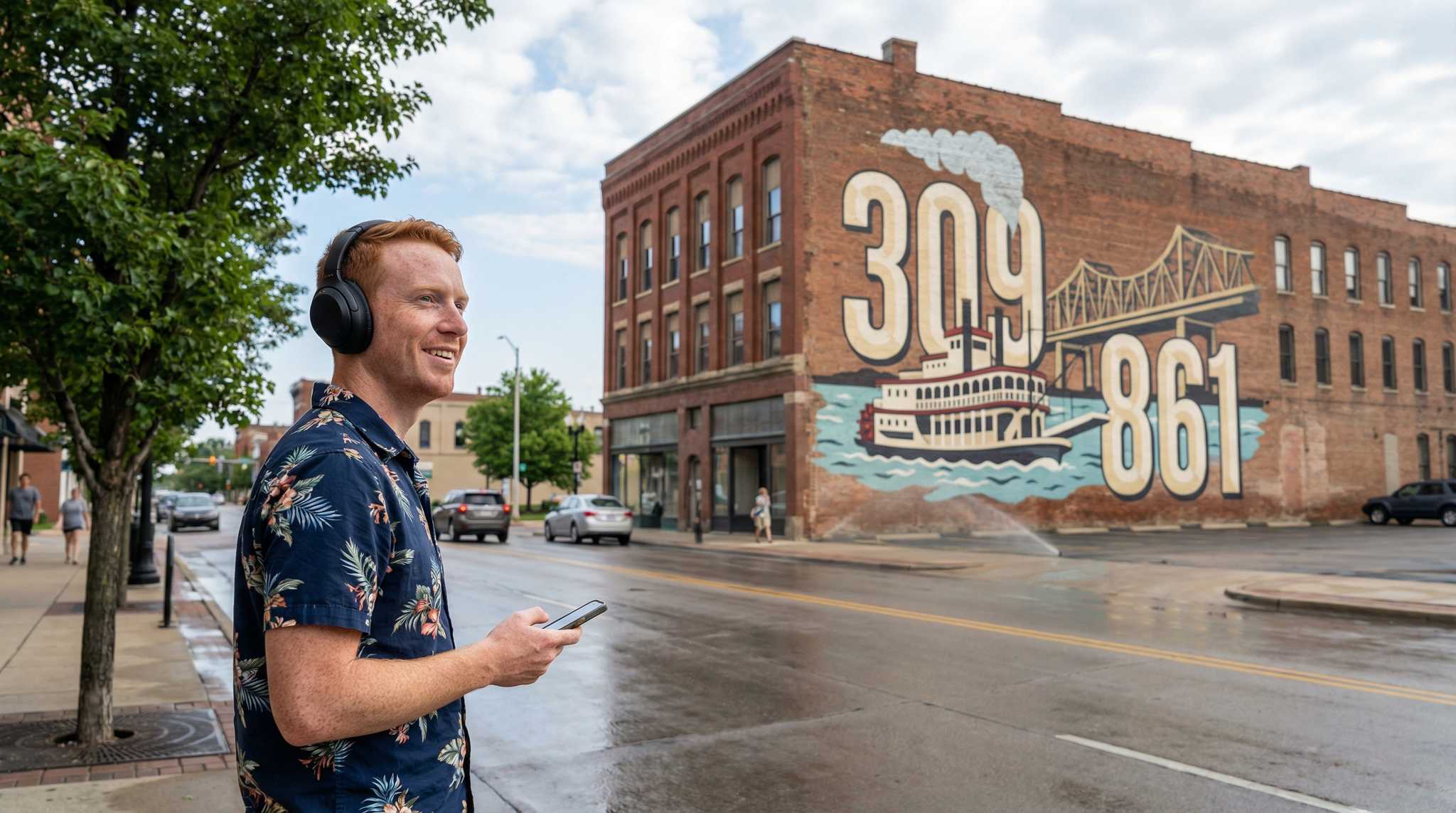
On your left, you’ve got one of the most invisible “landmarks” in Olde Towne… and you probably use it without thinking: area codes 309 and 861. Not much to look at, sure, but…Mehr lesenWeniger anzeigen
On your left, you’ve got one of the most invisible “landmarks” in Olde Towne… and you probably use it without thinking: area codes 309 and 861. Not much to look at, sure, but these three little digits are basically west-central Illinois’s verbal handshake. Back in 1947, when the phone system was getting organized nationwide, Illinois was carved into big zones so operators and early dialers could actually make sense of the growing web of lines. Up north and out this way, a lot of folks were living under area code 815. Then, in 1957, the region got split-like slicing a pie along a diagonal-and the western half became 309. If you were in places like Peoria, Bloomington-Normal, Galesburg, the Quad Cities… 309 became part of your identity. Nothing says “home” like arguing about whether you should answer an unknown 309 number. Then the modern twist: ten-digit dialing. In 2021, even before a new area code officially moved in, 309 had to start using all ten digits. The reason is surprisingly heavy… 988 became the national number for the Suicide Prevention Lifeline, and that created a conflict anywhere seven-digit dialing still existed. By 2023, 309 was running out of available phone numbers, so 861 arrived as an “overlay,” meaning the same geographic area now has two possible area codes. Because what we all needed was one more way to mistype a form online. When you’re ready, Peoria City Hall is a 3-minute walk heading northwest.
Eigene Seite öffnen →

8 weitere Stationen anzeigenWeniger Stationen anzeigenexpand_moreexpand_less
On your right, look for the big, pale stone federal building that stretches along the block, with long rows of square windows and an American flag out front. This is the United…Mehr lesenWeniger anzeigen
On your right, look for the big, pale stone federal building that stretches along the block, with long rows of square windows and an American flag out front. This is the United States District Court for the Central District of Illinois… which is a mouthful that basically means: a very serious place where the federal government comes to talk things out, with rules, robes, and a lot of paperwork. The Central District serves forty-six counties across a huge swath of Illinois-farm towns, small cities, college communities, river towns-split into four divisions with courthouses based in Peoria, Rock Island, Springfield, and Urbana. So even though you’re standing in Olde Towne, this building’s reach stretches way beyond a few downtown blocks. The court system here has been rearranged more times than a living-room furniture layout. The original federal court for Illinois was created in 1819, back when the state was still young and the whole setup was so new it didn’t even belong to a judicial circuit. If you lost an appeal back then? Surprise… your next stop was the United States Supreme Court. No pressure. By 1837, Congress created the Seventh Circuit-headquartered in Chicago-so appeals had somewhere more practical to go. Then in 1855, Illinois got split into Northern and Southern Districts. In 1905, an Eastern District appeared, pulling counties from the other two like someone trying to make teams even. And in 1978, the modern Central District was officially formed, mostly from the Southern District, with a few counties shifted back north. Judges from the older districts were transferred over automatically-no dramatic moving boxes scene, just legal reality. One more twist: in 2018, Rock Island’s court operations were moved to Davenport, Iowa, because the Rock Island courthouse was deemed uninhabitable. Even federal buildings have their bad-days stories. Most appeals from here go to the Seventh Circuit-except special categories like certain patent cases and Tucker Act claims, which take a different route. And the district’s top federal prosecutor, as of January 3, 2025, is Acting United States Attorney Gregory M. Gilmore. When you’re set, Madison Theatre is a 3-minute walk heading southwest.
Eigene Seite öffnen →On your left, look for the compact, temple-like limestone building with tall columns framing green doors, an arched stained-glass window above, and a little stack of cannonballs…Mehr lesenWeniger anzeigen
On your left, look for the compact, temple-like limestone building with tall columns framing green doors, an arched stained-glass window above, and a little stack of cannonballs out front. This is the Grand Army of the Republic Memorial Hall… though it also goes by the Greenhut Memorial, carved right into the stone. It went up in 1909, designed by Hewitt and Emerson in that confident Classical Revival style-Corinthian columns, arched windows, and limestone eagles perched like they’re still on watch. For a veterans’ meeting hall, it’s dressed like it’s hosting a summit. Which, in a way, it was. The hall honors Peoria’s Civil War soldiers and is dedicated to Joseph B. Greenhut, a captain in Company K of the 82nd Illinois Volunteer Infantry. Here’s the part that makes the building feel personal: Greenhut put up $15,000 of the $22,000 total cost-about two-thirds of the bill. That’s roughly $500,000 to $700,000 in today’s money… a serious check to write so the place could open debt-free. Inside, there are six stained-glass windows, including one with the GAR emblem, and in the main ballroom their motto is spelled out: “Fraternity, Charity and Loyalty.” You’ll also find portraits of Greenhut and his wife, plus a marble bust of General John Logan by local sculptor Fritz Triebel. By the 1950s, the GAR organization faded as its members passed on. In the 1970s, local preservationists stepped in, restored it, and rededicated the hall in 1979-so it could keep doing what it does best: remembering, and gathering. When you’re set, the YWCA Building is a 4-minute walk heading northwest.
Eigene Seite öffnen →On your left, look for the long, tan-brick block of a building with rows of windows and a few tall arched windows near the top floors. This is Peoria’s YWCA Building, finished…Mehr lesenWeniger anzeigen
On your left, look for the long, tan-brick block of a building with rows of windows and a few tall arched windows near the top floors. This is Peoria’s YWCA Building, finished in 1928 and designed by Hewitt, Emerson and Gregg... sitting right on the corner at 301 Northeast Jefferson with Fayette. The local YWCA chapter had been around since 1893, but by the late 1920s they’d outgrown their old space, so they pulled off a fundraising sprint: $350,000 in eight days... roughly about $6.5 million today. No bake sale energy there. When it was dedicated on September 16, 1929, it wasn’t just offices. It was a whole little world: an auditorium, a swimming pool, a chapel, club rooms, and beds for 86 residents. Over the decades, the organization moved on, struggled financially, and ultimately closed in 2012. But the building didn’t quit. Since 2008 it’s been New Hope Apartments, 79 supportive housing units after an almost $8 million renovation... including apartments built right over the old pool. Even the past had to make room. When you’re set, Scottish Rite Cathedral is a 7-minute walk heading northwest.
Eigene Seite öffnen →On your right, look for the big, dark-brick, church-like building with a steep roof, tall buttresses along the sides, and green-tipped spires rising above the corner. This is…Mehr lesenWeniger anzeigen
On your right, look for the big, dark-brick, church-like building with a steep roof, tall buttresses along the sides, and green-tipped spires rising above the corner. This is the Scottish Rite Cathedral… though these days it’s more often called the Scottish Rite Theatre, which is a pretty polite way of saying, “Yes, it looks like a church, but the show’s inside.” You’re standing by 400 Northeast Perry, right at the corner with Spalding, and this place is important enough to be a contributing part of Peoria’s North Side Historic District. The Scottish Rite group that calls this home has been around a long time. They organized back in 1867 in Yates City, then shifted to Peoria in 1869, bouncing through three different downtown meeting spots before they finally planted their flag here. Take a second and enjoy the Gothic attitude: those flying buttresses, the vertical lines, the stained glass meant to whisper in symbols instead of shouting in neon. The design was inspired by European travels, and the building went up under the architectural firm Hewitt, Emerson and Gregg for about $400,000 in the mid-1920s… call it roughly $7 million today. The cornerstone was set on May 7, 1924, and by January 13, 1925, they dedicated it with a public ceremony. Inside is an auditorium with a stage and around 900 seats… because mystery societies, apparently, love a good production number. But big buildings come with big upkeep. Membership once neared 15,000, then dropped to about 1,200 by 2019, and the math stopped working. That year, a local buyer, Kim Blickenstaff, stepped in for $490,000, aiming to run it as a community venue while guaranteeing Scottish Rite members permanent access. COVID slowed the opening, but work kept going, and in 2020 the restoration team earned a historic preservation award. Then in early 2023, the venue announced it would close, and it went up for sale that spring… a reminder that even stone-and-brick institutions can feel fragile. When you’re set, Cathedral of Saint Mary of the Immaculate Conception is an 8-minute walk heading southeast.
Eigene Seite öffnen →On your left, look for the big limestone Gothic church with TWO needle-sharp spires and round rose windows staring out over the street like quiet, stony eyes. This is the…Mehr lesenWeniger anzeigen
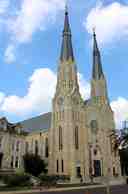
On your left, look for the big limestone Gothic church with TWO needle-sharp spires and round rose windows staring out over the street like quiet, stony eyes. This is the Cathedral of Saint Mary of the Immaculate Conception... and it’s been anchoring Peoria’s Catholic story for a long time. Long before these spires showed up on the skyline, the first Mass in this area happened across the river at Fort Crevecoeur, with French Récollet missionaries-names like Gabriel Ribourde and Louis Hennepin-trying to keep faith going on the edge of the frontier. By 1839, Mass was being celebrated in Peoria itself, and in 1846 St. Mary’s parish was officially founded. The first St. Mary’s church building went up in 1851. Then Peoria decided to go big. In 1885, Bishop John Lancaster Spalding laid the cornerstone for this very cathedral, designed by Chicago architect Casper Mehler with a clear nod to St. Patrick’s Cathedral in New York. Because if you’re going to build in limestone, why not think tall? The exterior is Anamosa limestone, and those twin spires climb about 230 feet into the sky. Step a little closer... this place is also tied to Archbishop Fulton J. Sheen-born and raised in the diocese, an altar boy here, ordained a priest here in 1919, and since 2019, entombed here after a real-life court fight over where his remains should rest. Even in death, the man drew a crowd. Inside, there’s a lingering link to the older cathedral-an 1873 Crucifix painting by Spanish artist Yzquierda, plus a bell that survived when Old St. Mary’s was taken down in 1898. And if you ever catch the organ: the 1936 Wicks instrument has 3,329 pipes... which is just an objectively excessive number of ways to be loud in church.
Eigene Seite öffnen →

Häufig gestellte Fragen
Wie starte ich die Tour?
Laden Sie nach dem Kauf die AudaTours-App herunter und geben Sie Ihren Einlösecode ein. Die Tour ist sofort startbereit – tippen Sie einfach auf „Play“ und folgen Sie der GPS-geführten Route.
Benötige ich während der Tour Internet?
Nein! Laden Sie die Tour vor dem Start herunter und genießen Sie sie vollständig offline. Nur die Chat-Funktion benötigt Internet. Wir empfehlen den Download über WLAN, um mobiles Datenvolumen zu sparen.
Handelt es sich um eine geführte Gruppentour?
Nein – dies ist ein selbstgeführter Audioguide. Sie erkunden unabhängig in Ihrem eigenen Tempo, wobei die Audioerzählung über Ihr Telefon abgespielt wird. Kein Reiseleiter, keine Gruppe, kein Zeitplan.
Wie lange dauert die Tour?
Die meisten Touren dauern 60–90 Minuten, aber Sie kontrollieren das Tempo vollständig. Pausieren Sie, überspringen Sie Stopps oder machen Sie Pausen, wann immer Sie wollen.
Was, wenn ich die Tour heute nicht beenden kann?
Kein Problem! Touren haben lebenslangen Zugriff. Pausieren Sie und setzen Sie sie fort, wann immer Sie möchten – morgen, nächste Woche oder nächstes Jahr. Ihr Fortschritt wird gespeichert.
Welche Sprachen sind verfügbar?
Alle Touren sind in über 50 Sprachen verfügbar. Wählen Sie Ihre bevorzugte Sprache beim Einlösen Ihres Codes. Hinweis: Die Sprache kann nach der Tour-Generierung nicht mehr geändert werden.
Wo greife ich nach dem Kauf auf die Tour zu?
Laden Sie die kostenlose AudaTours-App aus dem App Store oder von Google Play herunter. Geben Sie Ihren Einlösecode (per E-Mail gesendet) ein, und die Tour erscheint in Ihrer Bibliothek, bereit zum Download und Start.
Wenn Ihnen die Tour nicht gefällt, erstatten wir Ihnen den Kaufpreis. Kontaktieren Sie uns unter [email protected]
Sicher bezahlen mit 


