Kingman Audio-Tour: Spuren, Prüfungen & Geschichten entlang historischer Schienen
Eine Lokomotive pfeift unter dem endlosen Himmel Arizonas, doch Kingman birgt weit mehr als Wüstenhorizonte und Eisenbahnschienen. Unter diesen staubigen Straßen verbergen sich Geheimnisse in Stein und Stahl. Diese selbstgeführte Audio-Tour enthüllt die überraschenden Geschichten hinter Kingmans ikonischsten – und oft übersehenen – Wahrzeichen, sodass Sie die schattigen Ecken und stolzen Momente der Stadt entdecken, an denen die meisten Reisenden vorbeieilen. Welcher Gerichtsskandal änderte über Nacht den Lauf der Gerechtigkeit in Mohave County? Warum rühren Echos aus der Saint John's Methodist Episcopal Church Gerüchte über eine tragische Liebe auf? Welche vergessene Eisenbahnrivalität spaltete einst die Bürger Kingmans direkt am Bahnhof und veränderte das Schicksal der gesamten Stadt? Verfolgen Sie die Strömungen von Rebellion, Herzschmerz und Ehrgeiz, während Sie durch große Hallen, stille Heiligtümer und die Echos verschlossener Zellen gehen. Erleben Sie Kingmans Seele mit jedem Schritt aus einem neuen Blickwinkel. Die Gleise warten. Tauchen Sie ein in Kingmans unerzähltes Drama und lassen Sie seine Geheimnisse Ihr nächstes Abenteuer neu gestalten.
Tourvorschau
Über diese Tour
- scheduleDauer 40–60 minsEigenes Tempo
- straighten3.1 km FußwegDem geführten Pfad folgen
- location_onStandortKingman, Vereinigte Staaten
- wifi_offFunktioniert offlineEinmal herunterladen, überall nutzen
- all_inclusiveLebenslanger ZugriffJederzeit wiederholen, für immer
- location_onStartet bei Bahnhof Kingman
Stopps auf dieser Tour
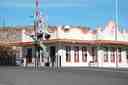
Look for the bright white stucco building with its distinctive curved roofline, vibrant orange trim, and the iconic Santa Fe cross emblem right by the tracks. The Atchison, Topeka…Mehr lesenWeniger anzeigen
Eigene Seite öffnen →Look for the bright white stucco building with its distinctive curved roofline, vibrant orange trim, and the iconic Santa Fe cross emblem right by the tracks. The Atchison, Topeka and Santa Fe Railway literally laid the foundation for this town's existence, and to this day, it remains an active, vital artery pulsing through Kingman.
Back in the late nineteenth century, simply keeping a station standing here was surprisingly difficult. The very first depot was just a boxcar in 1883. Then came a two story wooden building, but in 1900, hot cinders from a passing steam locomotive burned it to the ground. The railway confidently built a third depot in 1901, touting it as completely fireproof. Five years later, another locomotive smokestack sparked a blaze that destroyed that one too.
Taking absolutely no chances, the railway constructed the building you see now in 1907. They used poured reinforced concrete for the entire structure, roof included, before finishing it with Spanish Mission style stucco siding. That architectural style takes its cues from the old colonial missions of the southwest, which explains those elegant, sweeping curves along the roofline. The concrete did the trick, and the curse of the fires finally ended.
With its walls secure, this depot became the town's true heartbeat. During World War Two, it processed thousands of troops arriving to train as aerial gunners at the nearby Kingman Army Airfield. Later on, mid century freight trains rolled through so slowly that a nearby bar made a habit of keeping a tray of beers ready. The train engineer would hop off the front of the moving engine, run into the bar to pay, grab the drinks, and still have enough time to jump onto the rear of the train as it passed.
Yet by the early two thousands, this grand old building had fallen into such severe disrepair that it was entirely closed to the public. Amtrak passengers were actually forced to use a makeshift waiting room in a nearby storefront, completely overlooking the historic depot next door. But a community cannot abandon its roots, and the 2011 restoration reflects a deep desire to preserve our rough and tumble past while confidently moving forward. Today, accented with that bright orange trim to celebrate the Route 66 revival, it serves as a busy Amtrak stop and a museum run by the local Whistle Stop Railroad Club. If you want to take a look inside, the building is open to visitors on weekdays from nine to five thirty.
Now, let us head down toward Beale Street to uncover the hidden lives of early merchants, starting with the Armour and Jacobson Building just a short three minute walk from here.
Just to your left is a rectangular two-story white stucco building with striking maroon trim framing its large display windows and a flat roofline. Built in 1921 by local…Mehr lesenWeniger anzeigen
Eigene Seite öffnen →
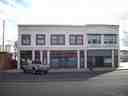
The Armour and Jacobson Building, completed in 1921, featuring its original white stucco exterior and clerestory windows designed to flood the interior with natural sunlight.Photo: Rayc, Wikimedia Commons, CC BY-SA 3.0. Cropped & resized. Just to your left is a rectangular two-story white stucco building with striking maroon trim framing its large display windows and a flat roofline. Built in 1921 by local contractors Gruninger and Son, this is the Armour and Jacobson Building, sitting right here at 426 to 430 Beale Street. It looks like a polite, standard commercial storefront, but the businesses it originally held tell a much more interesting story. You see, around 1916, this region experienced the Mohave Mining Boom, a massive surge in local prospecting for gold and silver that drew dreamers and experts alike, including a mining engineer named Robert Jacobson. Jacobson partnered with E. E. Armour, who was known around town simply as a humble baker. The two men built this structure to house a rather unusual combination. One side was a bakery, providing daily bread for the growing town. The other side was Jacobson's assay office, a specialized laboratory where local prospectors brought chunks of rock to be chemically tested for precious metals. Bread and gold, right under one roof. But Armour was not just kneading dough while Jacobson tested ore. Historical records reveal the baker was deeply entangled in the mining boom himself. In 1921, the exact same year this dignified building went up, Armour was busy applying for patents on several local lode mining claims, including the Portland and Sunshine sites. He was quietly funding and profiting from the very gold and silver rush his partner was evaluating. Together, they captured how a dusty frontier camp was cementing itself into a permanent, thriving commercial hub built on rock, enterprise, and serious ambition. Notice those large plate glass display windows and the clerestory, the row of smaller windows just above the main entry. Before reliable electric lighting, those were crucial to flood both the bakery and the testing lab with natural sunlight during working hours. From hidden mining investments, let us wander toward some actual secrets. We are heading to the IOOF Building next, just a three minute walk away, where we will look into the secret societies that helped organize this community.
Look to your left for a rectangular stucco building featuring a series of filled-in arches across the second floor and a wavy Mission Revival parapet, which is that decorative…Mehr lesenWeniger anzeigen
Eigene Seite öffnen →
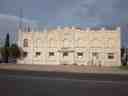
The historic IOOF Building in 2019, showcasing its wavy Mission Revival parapet and sturdy stucco-sheathed walls built to withstand fire.Photo: Marine 69-71, Wikimedia Commons, CC BY-SA 4.0. Cropped & resized. Look to your left for a rectangular stucco building featuring a series of filled-in arches across the second floor and a wavy Mission Revival parapet, which is that decorative wall extending upward along the roofline. Early Kingman was a rough place, prone to spontaneous combustion. Devastating fires routinely swept through town, often thanks to a severe lack of water and miners carelessly smoking opium or tobacco in bed at the local boarding houses. Naturally, rebuilding from ashes gets exhausting. To prevent these disasters, the town began a broad transition to fire-resistant materials like native tufa stone, while the architect of this specific 1912 structure opted for reinforced concrete with thick stucco sheathing. But it took more than fireproof walls to turn a rugged frontier outpost into an organized community. That is where fraternal orders came in. The Independent Order of Odd Fellows, a massive social hub even larger than the Freemasons, built this lodge to help tame the frontier by hosting dances, lectures, and charity events.

Historic commercial structures like the Armour and Jacobson Building, seen here in 2012, eventually accompanied the lodge as the frontier evolved into a more established and organized town.Photo: Rayc, Wikimedia Commons, CC BY-SA 3.0. Cropped & resized. Local Lodge Number 8 originally met at the nearby Elks Lodge before raising funds for this dedicated clubhouse. The Odd Fellows were famous for their elaborate, secretive initiation rituals, which sometimes involved real human skeletons. Those rituals must have been compelling, because they attracted historical figures ranging from Wyatt Earp to Charlie Chaplin. As fraternal membership declined in the late twentieth century, the Odd Fellows shifted to commercial tenants to generate revenue. This led to minor architectural changes, like filling in those original arched windows you see on the second story. Eventually, the lodge moved out entirely. Today, the building is the office for the Historic Electric Vehicle Foundation. Founded by electric car pioneer Roderick Wilde, the group actually built the world's first all-electric street rod from a 1929 Ford Roadster back in 1995. While their massive vehicle collection is housed at a nearby museum, this fire-hardened lodge remains standing as a testament to a town building for the future. Now, point yourself down the street toward a place that once housed both the dead and the well-shod, as we make the brief one-minute walk to the Van Marter Building.
11 weitere Stationen anzeigenWeniger Stationen anzeigenexpand_moreexpand_less
On your right, look for the light blue stucco building featuring a corrugated metal awning and a distinctly curved scalloped roofline rising in the center. This is the Van Marter…Mehr lesenWeniger anzeigen
Eigene Seite öffnen →
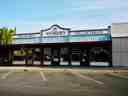
The historic Van Marter Building in Mohave County, featuring its distinct Mission or Spanish Revival architecture. (2016)Photo: Jon Roanhaus, Wikimedia Commons, CC BY-SA 3.0. Cropped & resized. On your right, look for the light blue stucco building featuring a corrugated metal awning and a distinctly curved scalloped roofline rising in the center. This is the Van Marter Building, constructed in 1921 by contractor J. B. Lammers in the Mission or Spanish Revival style, which you can easily spot by that smooth plaster exterior and the sweeping arched parapet on the roof. Back in the early days of Kingman, businessmen had to wear a lot of hats to survive the rugged desert economy. So, Ray Marion Van Marter Senior decided to combine two services every town needs. He opened a mortuary, and right alongside it, a shoemaker shop. Nothing says convenience quite like getting your boots resoled while shopping for a headstone. But jokes aside, the Van Marter family was the bedrock of this community during some incredibly dark times. Before this solid stone structure anchored the street, the 1918 Spanish Influenza epidemic devastated the nearby mining camp of Oatman. The county contracted Ray's funeral parlor to handle the overwhelming number of indigent burials and provide emergency services. It was grueling, tragic work, but his steady efforts were exactly the kind of resilience that forged a lasting, connected society from a dusty frontier outpost. Ray's dedication extended far beyond city limits. In the nineteen thirties, he teamed up with a local woman, Mrs. Joe Daniels, to identify unmarked graves in the remote Hackberry silver mining cemetery. They painstakingly placed mortuary markers on the graves. Unfortunately, because they wrote the names on paper protected only by glass, the project ended in disaster. The harsh desert elements and wandering cattle eventually smashed the glass and destroyed the paper, leaving many of the graves anonymous once again. Still, the chapel inside this building became the central gathering place for the town's grief. When highly respected local pioneers or miners perished, the crowds were so massive that mourners spilled out onto Beale Street, pressing every available wagon and car into the funeral procession. It is quite the legacy for a man who also ran a shoe shop and held a registered Arizona cattle brand. Now, let us keep walking for about two minutes. Next up is the J. Max Anderson House, where we will meet one of Kingman's toughest women.
Look to your left for a house built of native rough stone, featuring a steep red gable roof and framed by tall cypress trees. Officially, the registry calls this the J. Max…Mehr lesenWeniger anzeigen
Eigene Seite öffnen →
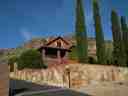
Max J. Anderson House NRHP 86001110 Mohave County, AZPhoto: Jon Roanhaus, Wikimedia Commons, CC BY-SA 3.0. Cropped & resized. Look to your left and you will see a building that looks like a miniature Greek temple, built from rough-hewn local tufa stone with a wide concrete staircase leading up to a porch…Mehr lesenWeniger anzeigen
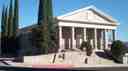
Eigene Seite öffnen →Look to your left and you will see a building that looks like a miniature Greek temple, built from rough-hewn local tufa stone with a wide concrete staircase leading up to a porch supported by six smooth columns. This is Saint John's Methodist Episcopal Church, built in 1917. The native tufa stone, a porous rock formed from ancient volcanic ash, anchors the building firmly in the harsh landscape.
The congregation itself is the oldest religious group in Kingman, dating back to the late nineteenth century when this area was just a rough-and-tumble mining camp. But as the roads and rails expanded, this dusty outpost transformed, linking the grit of the frontier with the wider, modern world. And with that connection came an unexpected dose of Hollywood glamour.
Picture this. It is March 1939. Clark Gable gets a surprise day off from filming Gone With the Wind. He calls his fellow movie star, Carole Lombard, and suggests they elope. To dodge the relentless Los Angeles press, they enlist a friend to provide a brand-new DeSoto car, slap on temporary cardboard license plates, and pack homemade sandwiches so they will not be recognized stopping at roadside diners.
After taking turns driving four hundred and fifty miles through the dark desert night, the exhausted but thrilled group rolled into Kingman. A thoroughly stunned local court clerk processed their marriage license and sent them right up these steps to Reverend Kenneth Engle.
The young pastor quickly pulled together a private ceremony. Gable wore a sharp blue suit with a patterned tie, and Lombard dressed in a dove-grey flannel suit. Reverend Engle was fiercely protective of their privacy, strictly refusing to let anyone photograph the wedding. As soon as the vows were spoken, the newlyweds hopped back in the car and drove another ten hours straight back to California, arriving just in time to face a massive press conference on their lawn.
Sadly, the love story cemented within these rugged stone walls ended in tragedy just three years later. Returning from a highly successful war bond rally in 1942, Lombard won a fateful coin toss to decide her travel plans, opting to fly rather than take a train. Her flight crashed into a mountain in Nevada, leaving no survivors. Gable was utterly devastated. Though he eventually remarried, he never truly recovered from the loss, and upon his death in 1960, he was interred right beside the woman he married in this quiet Kingman church.
Today, the building has found a new life. If you go inside now, you will not find a congregation, but rather the Mohave County Office of the Public Defender. It is a wonderful example of how Kingman adapts its historic spaces, letting modern attorneys walk the very same floors where Hollywood royalty once stood.
When you are ready, let us take a short three minute walk over to the Mohave County Courthouse and Jail, where we will see how this same local stone meets grand civic ambition.
On your left, you will spot the courthouse, a commanding structure built from light, rough-hewn stone, featuring four massive round columns that support a triangular peak proudly…Mehr lesenWeniger anzeigen
Eigene Seite öffnen →
The Neoclassical Mohave County Courthouse and the jail complex in the background, photographed in 1976.Photo: Calvin Beale, Wikimedia Commons, Public domain. Cropped & resized. On your left, you will spot the courthouse, a commanding structure built from light, rough-hewn stone, featuring four massive round columns that support a triangular peak proudly displaying the building's name.
Kingman had a bit of a public relations problem in the early nineteen hundreds. It was a rugged frontier town trying to prove it was a respectable place, but its territorial jail was an absolute joke. In nineteen oh seven, the entire inmate population literally just walked away. The local papers mocked the facility, joking that the fugitives had simply grown tired of the menu. When the town finally decided to upgrade, they did not just build a better lockup, they made a permanent statement in stone.
The adjacent courthouse you see today went up in nineteen fifteen, just three years after Arizona achieved statehood. They deliberately chose the Neoclassical style. That means architecture inspired by ancient Greece and Rome, characterized by grand symmetry and those towering pillars out front. It was a popular national trend meant to project democratic ideals and prove this county seat was an established, civilized cornerstone of the newly minted state. Built from native cut stone from a nearby quarry, it was designed to look proudly unshakable.
The new jail next door, built a few years prior in nineteen oh nine, was meant to erase the grim, chaotic legacy of the old days. The old jail yard had hosted the county's only hanging. A man named C. C. Leigh was sentenced to hang for murder, but his bravado vanished and he slashed his own throat with a smuggled razor right before the execution. He was bleeding so heavily that deputies had to physically hold him up on the scaffold just to finish the job. Not exactly the orderly image the growing town wanted.
So, the nineteen oh nine jail was outfitted with state of the art steel cells and poured reinforced concrete, touted as the most impenetrable facility in the territory. It mostly worked, though even modern times saw some drama. In twenty nineteen, an inmate faked a severe leg injury so he would not be shackled, then made a brazen dash from a transport van. He enjoyed about thirty minutes of freedom before they found him hiding in a nearby drainage ditch.
Through it all, these stately buildings stood as a proud testament to a town that willed itself into permanence. If you need to handle any county business, the courthouse is open Monday through Thursday from seven in the morning to six in the evening, and closed Friday through Sunday. For our next stop, we are heading a short two minute walk away to the A T and T Building, where we will see how a different kind of modern marvel finally pierced this desert isolation.
Look for the rectangular light-colored stucco building on your left with a red clay tile roof and a set of distinct white double doors sitting squarely in the middle of its…Mehr lesenWeniger anzeigen
Eigene Seite öffnen →
ATTkingmanPhoto: Rayc, Wikimedia Commons, CC BY-SA 3.0. Cropped & resized. Look to your left for a sturdy house built of native stone, featuring a striking pale-yellow boxy front balcony and a low stone wall right at the sidewalk. The man who built…Mehr lesenWeniger anzeigen
Eigene Seite öffnen →
J. B. Wright House NRHP 86001178 Mohave County, AZPhoto: Jon Roanhaus, Wikimedia Commons, CC BY-SA 3.0. Cropped & resized. Look to your left for a massive rectangular building made of rough-hewn stone, featuring deep arched entryways on the corner and a line of tall, slender cypress trees standing…Mehr lesenWeniger anzeigen
Eigene Seite öffnen →
The rough-hewn stone exterior of Elks Lodge No. 468 on the corner of Fourth and Oak Streets. (2013)Photo: Lancethelistener, Wikimedia Commons, CC BY-SA 3.0. Cropped & resized. Look to your left for a massive rectangular building made of rough-hewn stone, featuring deep arched entryways on the corner and a line of tall, slender cypress trees standing guard along the side. This is Elks Lodge Number 468. Building a culture in the middle of nowhere didn't just happen overnight... it took serious heavy lifting. In 1903, locals began hauling this native stone down from the Metcalfe Quarry in the Cerbat Mountains to construct a grand Romanesque clubhouse. Romanesque architecture is famous for exactly what you see here... thick, heavy walls and rounded arches designed to look permanent and imposing. Local builder John Mulligan actually laid many of these massive quarry stones with his own two hands. The sheer effort paid off. The upper floor became the social headquarters for several fraternal orders. In fact, remember the IOOF building we passed a little while ago? The Odd Fellows actually shared this upper floor with the Elks until they outgrew it and built that dedicated headquarters we explored earlier.

A view of the historic Elks Lodge building, showcasing its imposing Romanesque architecture and thick heavy walls. (2016)Photo: Jon Roanhaus, Wikimedia Commons, CC BY-SA 3.0. Cropped & resized. But the real magic happened on the ground floor. It was originally designed as Kingman's first opera house. By 1907, it was upgraded into a formal theater, bringing the sights and sounds of the outside world straight to this remote mining town. Residents packed the hall to watch early color newsreels of King Edward the Seventh's funeral, traveling minstrel shows, and even the original silent film adaptation of Frankenstein. It was a literal cornerstone of a blossoming, connected community. If you look closely out front, you will see an old street light. That is one of only two remaining lamps from a 1915 initiative to modernize the downtown streets. The building still sees plenty of action today, including a dramatic moment in 2008 when local artist Bob Boze Bell suffered a massive heart attack inside while rehearsing with his rock band. Thanks to the quick actions of his bandmates, he survived to tell the tale. Today, the lodge continues to host charity events, masquerade balls, and community gatherings, and it happens to be open twenty four hours a day, seven days a week. Next, we are taking a quick one minute walk over to the Little Red School to meet this town's most famous childhood resident.
Up ahead on your left, you will spot the Little Red School, a striking red brick building with a steeply pitched roof and a distinctive white wooden belfry crowning the top. As…Mehr lesenWeniger anzeigen
Eigene Seite öffnen →Up ahead on your left, you will spot the Little Red School, a striking red brick building with a steeply pitched roof and a distinctive white wooden belfry crowning the top. As you might guess from the name, this was indeed a place of learning, but its creation tells a bigger story about Kingman growing up. You see, turning a rough frontier outpost into a civilized, permanent community took more than laying railroad tracks. It took building a foundation for the next generation. Before this handsome structure went up in 1896, the local children were crammed into a tiny, eighteen by forty foot wooden shack. By 1893, the local newspaper publicly shamed the town, calling the cramped room a complete disgrace to the forty three scholars stuck inside. The public guilt trip worked. The town held an election and passed a six thousand dollar bond to build a real school. That is about two hundred and thirty thousand dollars in today's money. The builder, a man named T.T. Hines, went above and beyond. Rather than ordering expensive building supplies from back east, he hunted down suitable clay right here in the local desert. He fired up a large kiln and built this entire schoolhouse from homemade Kingman brick. He designed it in the Queen Anne style. This was an architectural trend popular at the time, recognizable by its steep roofs, asymmetrical facades, and decorative brickwork that gave frontier towns a touch of refined elegance. The school had its share of notable characters. The legendary character actor Andy Devine, who appeared in over four hundred films, attended classes right here. His father, Tom Devine, had moved the family to Kingman in 1906 to purchase the nearby Hotel Beale. If you have ever heard Andy Devine act, you know his signature raspy voice. That unique sound was the result of a freak childhood accident right here in town, where he tripped and fell while running with a curtain rod in his mouth, permanently injuring his vocal cords. The Little Red School closed its doors to students in 1928, but it never stopped serving the community. It later housed everything from a World War Two ration board to a library, and even hosted meetings for the Elks Lodge we just walked past a moment ago. Today, it serves as the city magistrate court. Interestingly, the bell in the tower is not the original. That was lost to history. The current bell was rescued from a Catholic church in the nearby ghost town of Goldroad, an old mining camp that ran out of luck. Now, let us keep exploring how this ambitious desert town powered its way into the modern era. We are going to head toward the Desert Power and Water Company Electric Power Plant, which is about a ten minute walk away.
Looking to your left, you will spot a massive rectangular concrete block building capped with a long metallic roof and featuring a large central entrance framed by green window…Mehr lesenWeniger anzeigen
Eigene Seite öffnen →Looking to your left, you will spot a massive rectangular concrete block building capped with a long metallic roof and featuring a large central entrance framed by green window panes. This is the Desert Power and Water Company Electric Power Plant, an absolute monolith of early industrial ambition.
Back in 1906, the Mohave Mining Boom was demanding serious energy. To meet that need, an entrepreneur named Mr. Monteverde envisioned this heavy oil-fired steam plant to power both the distant mining camps and the town of Kingman itself. Construction began in 1907 and cost about three hundred thousand dollars, which translates to roughly ten million dollars today. Building it required serious grit. During construction, a wooden platform collapsed and a falling beam struck a worker named W. P. Vestal right on the head. Though he suffered a massive scalp gash and severe bruises, the tough fellow survived and was expected back on the job just days later.
The plant finally juiced its transmission lines in July 1909, ready to light up the town. Yet, the residents were oddly unimpressed. The reluctant march of progress strikes again. People were highly suspicious of invisible energy running through wires into their parlors. In fact, it was such a novelty when a resident named J. E. Perry finally wired his house a month later, it made the front page of the local newspaper. Even the prestigious Harvey House downtown stubbornly clung to their glowing coal oil lamps until the summer of 1912. The plant owners eventually had to launch a marketing campaign, practically begging locals to Do It Electrically, promising the power was as reliable as the sun itself.
Eventually, the town caught on. The plant expanded massively, and in 1922, a showroom managed by James F. Davidson was added to help locals order parts to build their very own in-home radios. But by 1938, the massive new Hoover Dam took over the region's electrical supply, making this expensive oil-fired plant obsolete overnight. The generators were stripped, leaving an empty shell that sat neglected for decades.
That changed in 1984 when two local women formed a preservation group called the Powerhouse Gang. They convinced the corporate owners to hand over the dilapidated property for a tax write-off. After years of hard work, they transformed this rugged frontier powerhouse into a modern visitor hub. In a fitting twist of fate, this former steam plant now houses the world's first museum dedicated entirely to electric vehicles. If you want to explore inside, the building is generally open eight to five Monday through Thursday, and nine to four Friday through Sunday.
Now, it is time for a proper farewell to the steam era, so let's head over to the Santa Fe 3759 locomotive, which is just a four-minute walk away.
Right in front of you sits a colossal black steel locomotive with a long cylindrical boiler and a gleaming brass bell perched near its front headlight. Much like the power plant…Mehr lesenWeniger anzeigen
Eigene Seite öffnen →Right in front of you sits a colossal black steel locomotive with a long cylindrical boiler and a gleaming brass bell perched near its front headlight. Much like the power plant we just left, this machine represents the raw energy that pulled a remote desert outpost into the modern age.
Built in 1928, Atchison, Topeka and Santa Fe 3759 is a heavy mountain type steam locomotive, a 4-8-4 model. That numbers code just means it has four small leading wheels in front, eight massive eighty inch driving wheels in the middle, and four trailing wheels in the back to support its heavy firebox. And heavy is the right word. With its tender... the car behind the engine carrying its fuel and water... the whole thing weighs a staggering 468,800 pounds. Dragging all that iron across the desert meant it had an incredible thirst, requiring twenty thousand gallons of water and over seven thousand gallons of fuel oil just to make its runs. That massive appetite made Kingman an essential water stop on the Los Angeles to Kansas City line. This was the lifeline that kept the town thriving.

ATSF 3759 Kingman-cPhoto: Didier Duforest, Wikimedia Commons, CC BY-SA 4.0. Cropped & resized. By 1953, diesel was taking over, and the reluctant march of progress pushed the 3759 into retirement after over two and a half million miles. But it had one last hurrah. In 1955, it was called out of storage for a special excursion run dubbed the Farewell to Steam. Rail enthusiasts from all over packed the train for a final ride between Los Angeles and Barstow. The demand was so absurdly high that the railway attached a Horse Express baggage car... a car usually reserved for transporting actual racehorses. People happily crammed inside, breathing in the lingering smell of horseflesh just to be a part of history.
One fanatic, a bold cameraman named Al Hawkins, wasn't settling for a window seat. He strapped his tripod to the roof of the locomotive's massive tender, standing tall in the open air as the train blasted through Cajon Pass at speeds nearing one hundred miles per hour. He risked his life to capture color film of the engine's final roar.

Kingman Santa FePhoto: Patrick Pelster, Wikimedia Commons, CC BY-SA 3.0 de. Cropped & resized. After that wild ride, the Santa Fe donated the engine to Kingman in 1957. Three decades later, in 1987, the town received Caboose 999520, an old mobile office and living quarters for the train conductors, complete with a coal heating stove. To fit the caboose on the tracks behind the engine, the locals did not hire an industrial crane. Instead, the townspeople gathered with thick ropes and hauled this four hundred sixty eight thousand, eight hundred pound beast forward thirty feet purely by hand.

Kingman, AZ, View East on Old Route 66 at the Railroad Park - panoramioPhoto: Chris English, Wikimedia Commons, CC BY-SA 3.0. Cropped & resized. So, when a railway owner proposed leasing the 3759 in 1991 to use as a luxury tourist train near the Grand Canyon, you can guess the town's response. They firmly rejected the offer. Having quite literally pulled its weight themselves, the residents felt a deeply personal bond with the machine. It stays here permanently, a silent iron monument to the era that built Kingman.
Now, we are off to our final stop, a gymnasium that survived against all odds, just a five minute walk away.
Look to your right and you will spot a massive reddish-brown stucco building featuring a classic gabled roofline and a distinctly layered, stepped entryway. This is the mo-hah-vee…Mehr lesenWeniger anzeigen
Eigene Seite öffnen →
The Mohave Union High School Gymnasium features a classic gabled roofline and reddish-brown stucco, serving as a historical centerpiece. Photographed in 2019.Photo: Marine 69-71, Wikimedia Commons, CC BY-SA 4.0. Cropped & resized. Look to your right and you will spot a massive reddish-brown stucco building featuring a classic gabled roofline and a distinctly layered, stepped entryway. This is the Mohave Union High School Gymnasium, and it is a fitting final stop for our journey. Before we look at the architecture, we should acknowledge what rests beneath our feet. This campus was built directly over Kingman's Pioneer Cemetery. A relocation effort in 1944 charged families a 45 dollar transfer fee, which is roughly 780 dollars today. That was a steep price during wartime, meaning hundreds of early settlers and Hualapai tribal members were left interred beneath the soil. When modern renovations began, workers unearthed coffins, graves, and personal artifacts. Naturally, local lore insists the campus is haunted by a ghostly little girl and a phantom man in a bowler hat. The eerie atmosphere even prompted some modern construction crews to participate in a Native American smudging ceremony, burning sacred herbs to calm the restless spirits. The school also honors heroes of a more recent era. In 1973, a railway gas tanker exploded in Kingman, claiming the lives of twelve volunteer firefighters. Among them was former high school principal Richard Lee Williams. Today, the new school on this site bears his name, and the students proudly compete as the Volunteers.

A broad exterior perspective of the Mohave Union High School Gymnasium captured in 2012, showcasing the distinct Moderne architectural style and structural supports.Photo: Rayc, Wikimedia Commons, CC BY-SA 3.0. Cropped & resized. Now, take a glance down the side of the gymnasium. You will notice thick, angled supports projecting from the exterior walls. These are buttresses, structures designed to brace the walls against outward pressure, and this is the only building in Kingman that uses them. Inside is another rarity called a lamella roof, which is a beautifully vaulted ceiling made from a crisscrossing diamond pattern of short wooden beams. Both are unique touches of its Moderne design, an architectural style famous for clean, geometric lines. Constructed in 1936 by the Works Progress Administration, the gym cost 50,000 dollars, or about 1.1 million today. The man who brought it to life was contractor P.W. Womack. Womack was a true rags-to-riches figure who actually skipped most of high school to work as a carpenter. It is quite poetic that a high school dropout went on to build a massive construction empire, cementing his legacy with this very educational monument. That enduring construction was put to the ultimate test in January 1973, when a devastating suspected arson fire completely destroyed the main school building next door. While the rest of the campus burned to the ground, Womack's gymnasium stood firm and survived the inferno intact. As our tour comes to a close, this steadfast gymnasium stands as a perfect symbol of Kingman itself. We have seen how a raw, dusty outpost was steadily hammered into a thriving, unified city by iron rails, sturdy bricks, and the sheer determination of the people who settled here. Thank you for walking these streets with me, and enjoy the rest of your time exploring this incredibly resilient town.
Häufig gestellte Fragen
Wie starte ich die Tour?
Laden Sie nach dem Kauf die AudaTours-App herunter und geben Sie Ihren Einlösecode ein. Die Tour ist sofort startbereit – tippen Sie einfach auf „Play“ und folgen Sie der GPS-geführten Route.
Benötige ich während der Tour Internet?
Nein! Laden Sie die Tour vor dem Start herunter und genießen Sie sie vollständig offline. Nur die Chat-Funktion benötigt Internet. Wir empfehlen den Download über WLAN, um mobiles Datenvolumen zu sparen.
Handelt es sich um eine geführte Gruppentour?
Nein – dies ist ein selbstgeführter Audioguide. Sie erkunden unabhängig in Ihrem eigenen Tempo, wobei die Audioerzählung über Ihr Telefon abgespielt wird. Kein Reiseleiter, keine Gruppe, kein Zeitplan.
Wie lange dauert die Tour?
Die meisten Touren dauern 60–90 Minuten, aber Sie kontrollieren das Tempo vollständig. Pausieren Sie, überspringen Sie Stopps oder machen Sie Pausen, wann immer Sie wollen.
Was, wenn ich die Tour heute nicht beenden kann?
Kein Problem! Touren haben lebenslangen Zugriff. Pausieren Sie und setzen Sie sie fort, wann immer Sie möchten – morgen, nächste Woche oder nächstes Jahr. Ihr Fortschritt wird gespeichert.
Welche Sprachen sind verfügbar?
Alle Touren sind in über 50 Sprachen verfügbar. Wählen Sie Ihre bevorzugte Sprache beim Einlösen Ihres Codes. Hinweis: Die Sprache kann nach der Tour-Generierung nicht mehr geändert werden.
Wo greife ich nach dem Kauf auf die Tour zu?
Laden Sie die kostenlose AudaTours-App aus dem App Store oder von Google Play herunter. Geben Sie Ihren Einlösecode (per E-Mail gesendet) ein, und die Tour erscheint in Ihrer Bibliothek, bereit zum Download und Start.
Wenn Ihnen die Tour nicht gefällt, erstatten wir Ihnen den Kaufpreis. Kontaktieren Sie uns unter [email protected]
Sicher bezahlen mit