AudaTours logoAudaTours

Hartlepool Audio-Tour: Geschichte, Erbe und Höhepunkte Audio-Erlebnis

Audioguide9 Stopps

Unter Hartlepools salzbesprühter Skyline erheben sich die kühnen Betonbauten der Stadt und jahrhundertealte Geheimnisse hallen durch jede Straße – eine Stadt, die ebenso sehr von Skandalen und Ambitionen wie von Meer und Stein geprägt ist. Diese selbstgeführte Audio-Tour führt durch verborgene Ecken und Schlagzeilenmomente und enthüllt die Schichten im Einkaufszentrum Middleton Grange, dem Kriegerdenkmal West Hartlepool, den Machtzentren des Boroughs und darüber hinaus. Schlendern Sie in Ihrem eigenen Tempo und entdecken Sie Geschichten, die selbst langjährige Einheimische oft übersehen. Welcher Bürgermeister tauschte einst Roben gegen ein Maskottchen-Kostüm und schrieb die lokale Geschichte neu? Welcher hitzige Streit hinterließ seine Spuren auf dem feierlichen Granit des Victory Square? Und wie löste der Einkauf von Regenschirmen in den 1990er Jahren eine stadtweite Transformation aus? Lassen Sie sich von jeder Geschichte mitreißen – durch Flüstern der Rebellion, epische Wiederaufbauten, politische Umwälzungen und vergessene Triumphe – und sehen Sie Hartlepool mit neuen Augen, während Sie von der Marina zum Denkmal streifen. Entdecken Sie die Geheimnisse, die sich hinter vertrauten Mauern verbergen. Beginnen Sie jetzt, in das wahre Herz von Hartlepool zu gehen.

Tourvorschau

map

Über diese Tour

  • schedule
    Dauer 30–50 minsEigenes Tempo
  • straighten
    2.4 km FußwegDem geführten Pfad folgen
  • location_on
  • wifi_off
    Funktioniert offlineEinmal herunterladen, überall nutzen
  • all_inclusive
    Lebenslanger ZugriffJederzeit wiederholen, für immer
  • location_on
    Startet bei Einkaufszentrum Middleton Grange

Stopps auf dieser Tour

  1. To spot the Middleton Grange Shopping Centre, glance toward the large, blocky building with a modern, straightforward design-a structure that stands tall behind an open area often…Mehr lesenWeniger anzeigen

    To spot the Middleton Grange Shopping Centre, glance toward the large, blocky building with a modern, straightforward design-a structure that stands tall behind an open area often bustling with people. Now, take a deep breath and imagine yourself standing here just as you are now, but suddenly it’s 1970: the air is buzzing with excitement and the scent of fresh concrete is everywhere. Crowds are gathered, hats and best coats on, murmuring expectantly as a young Princess Anne steps forward to officially open this brand-new shopping centre. Yes, right here where you’re standing, Hartlepool’s fortunes seemed ready for a fresh start! But Middleton Grange wasn’t always the shopping powerhouse you see today-in fact, if you’d been here in the 1960s, you’d have found a maze of old terraced streets. When those streets came down, people wondered: what modern marvel would take their place? And so rose Middleton Grange, a gleaming example of 1960s brutalist architecture. Brutalist-that’s really just a fancy word for “bold concrete with no nonsense,” almost as if the building itself dares you to try shopping anywhere else. Originally, you’d have needed an umbrella to shop here-not because of sales, but because the entire centre was outdoors. Shoppers used to dash from one storefront to another dodging the unpredictable English drizzle. That changed in 1992, when the roof finally came on-cue the collective sigh of relief from everyone who forgot their brolly at home. Ownership changed hands in the 1990s, and with new bosses, the centre started getting makeovers. In 2011, Middleton Grange underwent a £2 million facelift: goodbye to the retro mosaic tiles and sea blue décor, and hello to new signs and a fancy battleship grey colour scheme-very nautical for a town like Hartlepool! Stores were the soul of the centre, and while Boots has loyally served shoppers since day one, others like Woolworths and Marks & Spencer have come and gone, each leaving their echo in the halls. In its heyday, the centre bustled-but tough times hit during the 2007 recession, and some units in the East Mall and Market Walk fell quiet, their shutters down. Hope flickered again when big name stores like BHS opened huge spaces, but the winds of change never stay still and even they packed up eventually. Today, as you stand here, the centre is still home to the likes of Primark, Sports Direct, Iceland, Poundland, and Ecigwizard. Middleton Grange isn’t just a place to shop-it’s Hartlepool’s living memory, its shifting heart. And who knows? Maybe the next chapter of its story starts with your very own visit!

    Eigene Seite öffnen →
  2. Back in the years after World War I, it took some serious debate (and probably more cups of tea than you’d think possible) just to decide where to put this memorial. Some clever…Mehr lesenWeniger anzeigen

    Back in the years after World War I, it took some serious debate (and probably more cups of tea than you’d think possible) just to decide where to put this memorial. Some clever folks thought, “Let’s put it in the very heart of town, right where everyone will see it!” And so, Victory Square was born-a patch of ground once called Armoury Field, where people had planned to build municipal buildings. But Alderman Charles Macfarlane, mayor during those tough war years, pushed for this site to remember the fallen. It was a bold move, and the cost wasn’t exactly pocket change-try imagining a bill for £150,000 in the 1920s. That was enough to make even the bravest wallet quiver! The project grew beyond just a monument; the town banded together to help the living as well, raising funds for cottage homes for elderly and disabled survivors. People like J. W. Crosby, a shipping magnate, chipped in with generous donations-he gave £5,000, probably more than he’d spend on a year’s worth of fish and chips. The memorial itself is full of meaning, but also a bit theatrical. At its base, the five terraced steps each stand for one year of World War I, inviting reflection as people walk up with bowed heads. Each face of the obelisk is decorated with bronze laurel wreaths, some up high, glinting against the sky, and another near the bottom, embracing the town’s coat of arms with the motto “E Mare ex Industria.” That’s Latin for “Industry comes from the Sea”-a nod to the generations who made a living on water, and sometimes gave their lives in service at sea as well. And if you’re counting, the names of 1,545 people from Hartlepool who died in World War I are inscribed here, spread across twelve bronze panels. Just imagine carving each name, unit, and story into enduring bronze. How did it all come together? The design competition was organized by no less than Ernest Newton, President of the Royal Institute of British Architects. The winner, George J Coombs from Aberdeen, put forth the vision you see today, and after his untimely death, George Bennett Mitchell stepped in to finish the job. The monument was cast and built by a team stretching from London to Scotland, but its heart belonged right here. The day of its unveiling-October 11, 1923-was set to be a grand affair. The Earl of Durham was expected to do the honors, but fate threw a curveball and he fell ill. So, his brother, Brigadier-General Charles Lambton, got his moment in the sun, while the Bishop of Durham blessed the proceedings. As those first words rang out-“The Great War 1914-1919”-it must have been an emotional moment. Just above your head, you’ll find the King’s message: “In grateful remembrance of the men of this town…” If you listen closely, maybe you’ll feel the reverberations of that crowd, standing with heavy hearts and proud spirits. On the south side, the monument reminds everyone just who gets the credit for victory: “Thine O Lord is the Victory,” with an elegant cross watching over. When World War II cast its own shadow, four new white granite pillars were added beside the obelisk. Each one is topped with a bronze plaque, every side covered in the names of those lost in that next conflict. Trees were planted between the pillars-perhaps as a promise that new life and peace would grow from such hard times. If you imagine the breeze rustling through the leaves overhead, you can almost hear time gently passing. These days, the Hartlepool Borough Council keeps the memorial crisp and clean, though restoration takes a bit of elbow grease. In 2008, the plaques and stones were lovingly restored, with the stains and marks of the years gently washed away. So next time you stroll by, look up and remember: this square is more than a meeting place. It’s the heart of Hartlepool’s stories, carved in granite, whispered through the trees, and kept alive in every name you see. And never forget, behind every grand monument, there’s always at least one committee-often with more arguments than granite blocks! Intrigued by the victory square, world war i memorial or the world war ii pillars? Make your way to the chat section and I'll be happy to provide further details.

    Eigene Seite öffnen →
  3. To spot the Borough of Hartlepool, look just past the marina-you’ll see a broad, red-bricked building lined with rows of white windows and a clock set above the main entrance,…Mehr lesenWeniger anzeigen

    To spot the Borough of Hartlepool, look just past the marina-you’ll see a broad, red-bricked building lined with rows of white windows and a clock set above the main entrance, stretching parallel to the edge of the water and blending into the bustle of the marina’s boats. Now then! Take a moment to breathe in the salty air and imagine the grand journey of Hartlepool’s borough-because what you see in front of you isn’t just an administrative hub, it’s the pulsing heart of a place shaped by centuries of drama, rivalry, and a dash or two of monkey business. Picture the scene 800 years ago-the year is 1200, and a royal charter’s being granted by none other than King John. The original Hartlepool borough was little more than the Headland, facing the wild North Sea, huddled close for warmth and protection. Fast forward to the 1840s, and the marshy lands of Stranton are about to host something brand new: West Hartlepool, carefully laid out to capture the energy of the industrial revolution. Suddenly, two rivals are born-Hartlepool and West Hartlepool, each with its own council, its own character, even its own improvement commissioners (try saying that three times fast when the wind’s up). But the two boroughs just couldn’t keep apart forever. Like longtime neighbours letting their gardens grow over the fence, they merged in 1967, creating a single county borough-Hartlepool, at last. Local kids at the time might have joked that you couldn’t tell which side you were from unless you checked your socks. And, as new rural parishes were invited in from all directions in 1974, the area grew bigger and more varied than ever, stretching from coastal breezes to sleepy fields in the west. That merger meant a whole new world of government headaches and happiness alike-moving paperwork from the grand old Hartlepool Borough Hall to the boxy, bustling Civic Centre you see now, completed in 1976. Imagine the ceremonies and speeches when Queen Elizabeth II herself came to open it in 1977-a moment of crisp suits, pride, and the click of royal heels echoing down Victoria Road. But Hartlepool never lost its knack for standing out. In 2002, after one of the quirkiest referendums in UK history, the people voted for a directly elected mayor. Then something happened nobody saw coming: the football mascot for Hartlepool United, a monkey named H'Angus-yes, you heard right-threw his hat in the ring and won! The very idea raised a few eyebrows, but it gave everyone a story to tell, and, surprisingly, “the man in the monkey suit” turned out to be as committed a mayor as any red-robed official from history. Stuart Drummond, the man behind the monkey mask, was re-elected again and again before the people decided in 2012 to switch back to a regular council leader. Hartlepool’s borough today isn’t just about paperwork and politics. It’s made up of a patchwork of settlements-countryside and seafront, nine lively parishes beyond the town’s main sprawl. The council governs all sorts of things, but some jobs-like the police and fire brigade-are still shared with Hartlepool’s old Cleveland neighbours, giving things a sense of togetherness across the river’s mouth. And the borough’s story is still being written. Recent years have seen changes in political control, new charters for parishes, and plenty of debates about how things should be run. With over 92,000 people calling this place home-and almost everyone living right here in the heart of Hartlepool-there’s a lot of pride, a bit of healthy dispute, and never a dull moment. So, the next time you hear a seagull caw or the gentle clink of masts from the marina, just remember: behind every council meeting and ceremony here is a tale stuffed with twists, rivalries, and adventures worthy of the wild North Sea itself. And perhaps, just perhaps, a mischievous monkey with a knack for local democracy.

    Eigene Seite öffnen →
6 weitere Stationen anzeigenWeniger Stationen anzeigenexpand_moreexpand_less
  1. To spot the Hartlepool Art Gallery, just look for the striking old church with its bright orange roof tiles, tall tower with a clock, and a spiky turret that almost begs for a…Mehr lesenWeniger anzeigen

    To spot the Hartlepool Art Gallery, just look for the striking old church with its bright orange roof tiles, tall tower with a clock, and a spiky turret that almost begs for a castle flag-right across from the roadside. Imagine standing here in Church Square over 150 years ago, as the finishing touches went onto this grand Victorian church. Designed by Edward Buckton Lamb, a man who must’ve thought, “Why not make this building a masterpiece?”-the soaring tower creeps up towards the sky, and you can almost hear the echo of six bells ready to ring out across Hartlepool. Fast forward to the 1990s, and rather than being filled with hymns, the church turns into a place filled with colour, laughter, and a bit less incense-a true gallery of art. Now, paintings and photos have replaced pews, and the only thing holier than the space itself is how good the exhibitions are! The church’s stone walls hold secrets from Victorian times, and the air hums with creativity from craftworkers and artists. Don’t be surprised if you hear a bell-yes, they still ring them. And if you feel a shiver, don’t worry; it’s probably just Edward Buckton Lamb checking to see who’s admiring his lively building! So step inside, soak up the art, and remember: you’re standing in the middle of a masterpiece that’s been inspiring awe for nearly two centuries.

    Eigene Seite öffnen →
  2. Right ahead, you’ll spot Hartlepool railway station by its classic red-brick walls and the long, wide platform sheltered under a bright glass roof, with signs directing you to…Mehr lesenWeniger anzeigen

    Right ahead, you’ll spot Hartlepool railway station by its classic red-brick walls and the long, wide platform sheltered under a bright glass roof, with signs directing you to tickets, taxis, and tasty refreshments-just look for the elegant archways and the buzz of people waiting for their ride. Let’s take a step back in time, right here where the glass ceiling lets in the northern sky and the floor echoes the footsteps of folks heading for trains. Now, imagine it’s the early 1800s. Hartlepool was a bustling port town with dreams of connecting to the rest of England. The very first trains to roll into town came thundering in on the Stockton and Hartlepool Railway in 1839, loaded with goods at first-coal, timber, and who knows, maybe a cheeky stowaway mouse or two. Just a month later, the station flung open its doors to passengers, and the adventure of railway travel began for Hartlepool. Back then, trains were the stuff of legends. Folks in top hats huddled on windswept platforms, the air thick with the tang of coal smoke and salt from the nearby sea. The first station here was called Hartlepool West, but names in this town have had more changes than a train conductor’s uniform! It became West Hartlepool, only to be replaced in 1880 by a shiny new West Hartlepool station. By 1967, after decades of shuffling names and maps, everything merged into the Hartlepool you see today. So, if you ever get lost, just blame the station-it keeps moving! The station’s platforms have their own stories. Today you see two in use: a long, main platform where most trains slide in, and a south-facing bay platform that only gets one train a week. It’s like Hartlepool’s secret handshake-if you catch a train from the bay platform, you’re part of a very exclusive club! And after a bit of a snooze, the old ‘up platform’, once abandoned, is back in business as of 2024, complete with a new footbridge and lifts that are so modern, you half expect them to start making your tea. Plans to modernize didn’t stop there. In the 2000s, somebody dreamed up the Tees Valley Metro project-a wizard’s vision of sleek trains shuttling along the Durham Coast and even running like trams along the high street. The idea was to give Hartlepool a makeover with art, better shelters, new screens, and a glinting glass waiting area. But, like most good magic tricks, the funding disappeared after the 2008 crash and a change in government, so the full transformation never came to pass. Still, Hartlepool got spruced up anyway-resurfaced platforms, new information screens, vending machines that actually work (mostly), and art to brighten your waiting time. When the Tall Ships’ Races landed in Hartlepool in 2010, the station got a major facelift; the brickwork cleaned up, the lines re-signalled, and-finally!-a decent waiting room. Mind you, by that point the poor old manual signal boxes, which kept a careful watch on every departing train, were retired for good. I imagine they went off to enjoy a quiet life, waving little green flags at passing clouds. Today, Hartlepool station connects you far and wide. Fancy a trip to London? Grand Central’s sleek trains will whisk you off to King’s Cross, passing through sleepy Yorkshire towns on the way. If you’re headed along the coast, Northern Trains shuttles up to Newcastle or down toward Middlesbrough every hour-though you might meet a sea breeze or two if you poke your head out at Whitby. And yes, there are still the Super Sprinter and Express Sprinter trains-names that sound so speedy, they might just outrun your thoughts. But this isn’t just a travel hub; it’s a pulse of the town. The ticket office is open from breakfast through tea time, but if you turn up late, never fear-a diligent little machine will print your ticket, no matter the hour. Every train is announced by a chorus of electronic screens and cheerful automated voices, and the sturdy barriers make sure only the rightful wanderers and home-comers pass through. So whether you’re grabbing a quick coffee, searching for the toilets, or planning a grand rail adventure, know that you’re standing where generations have set off for new horizons-and, sometimes, come home just in time for supper.

    Eigene Seite öffnen →
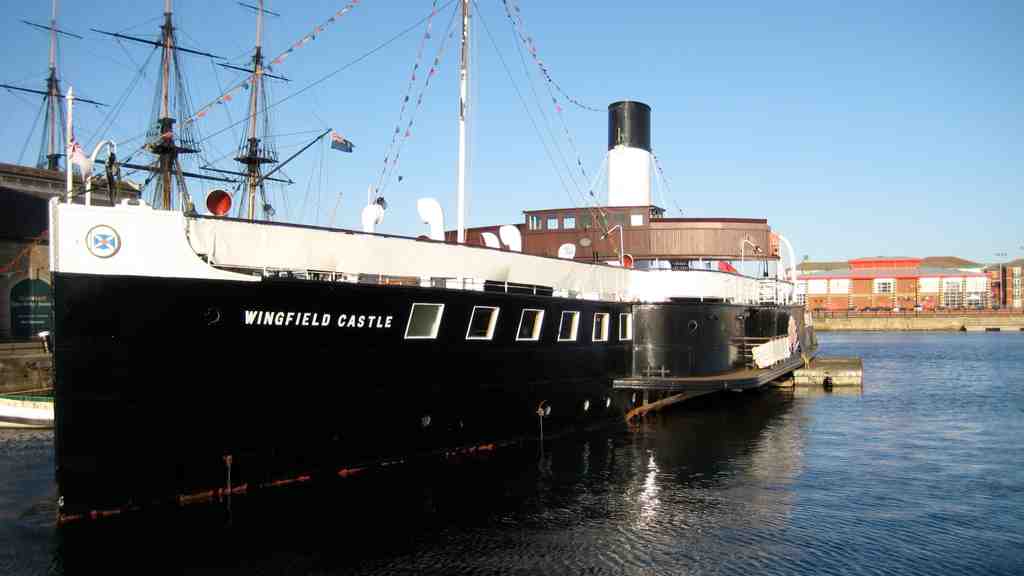
  3. To spot the PS Wingfield Castle, look to your right for a large black and white paddle steamer moored alongside the dock, with its name proudly painted on the side and a tall…Mehr lesenWeniger anzeigen

    To spot the PS Wingfield Castle, look to your right for a large black and white paddle steamer moored alongside the dock, with its name proudly painted on the side and a tall black funnel reaching for the sky. Ahoy there! You’re now standing in front of a real piece of living history-the grand PS Wingfield Castle, once the pride of the Humber Estuary ferries. Built right here in Hartlepool and launched in 1934, she sliced through the water alongside her sister ship, the Tattershall Castle, ferrying passengers across the river with the churning power of her paddles. Imagine the bustle on deck as people hurried on board, their footsteps echoing, the paddle wheels ready to roar into action. But life wasn’t always so smooth sailing for the Wingfield Castle. In the 1980s, she nearly set off on a new adventure as a floating restaurant in Swansea, only to be foiled by the most unlikely foe-a lock gate that proved just a bit too narrow. Talk about a tight squeeze! Now, instead of hosting fancy dinners, she sits here as a museum ship, her paint gleaming in the sun, packed with stories of river crossings and close shaves. Listen closely, and you might just hear the faint memory of her steam whistle, welcoming you aboard the next chapter of her journey. With each footstep along her deck, you're walking through a floating time capsule, one that’s dodged disaster but landed safely in the harbour of history.

    Eigene Seite öffnen →
  4. You should be able to spot the HMS Trincomalee right ahead of you-just look for the huge wooden sailing ship with tall masts and colourful flags, docked beside the water like a…Mehr lesenWeniger anzeigen

    You should be able to spot the HMS Trincomalee right ahead of you-just look for the huge wooden sailing ship with tall masts and colourful flags, docked beside the water like a scene straight out of a swashbuckling adventure film. Now, let’s take you back to the early 1800s-close your eyes for a moment and imagine the air thick with the scent of saltwater, the slap of waves against timber, and the shouts of sailors preparing for a long journey. The HMS Trincomalee isn’t just a ship; she’s a living legend, built in a time when the world’s oceans were filled with secrets and danger. You see, her story starts in Bombay, far from cold, grey England! Britain, fresh from the Napoleonic Wars, was running low on oak, so they turned to the famed Wadia family of shipbuilders in India, who used strong local teak wood instead. Now, here’s a fun twist-before the first plank was laid, the master shipbuilder hammered a silver nail into the keel for good luck. It’s safe to assume ships back then had better luck than most lottery players today. When construction finished in 1817, the Trincomalee cost a whopping £23,000-imagine the number of cannons you could buy with that! Her first trip brought her all the way to England, making a stopover on Saint Helena, an isolated island where Napoleon was exiled. In a curious twist of fate, she even picked up a surgeon who had treated the deposed emperor. Talk about being in the right place at the right time-at least for catching international gossip! For nearly thirty years, Trincomalee mostly waited in the wings, until she got a makeover in 1845-think of it as a Napoleonic version of "Pimp My Ride," swapping out some cannons for bigger firepower and giving her a new, sleeker rear end. When she finally entered full service, adventure followed her everywhere. Imagine her braving tropical storms, the rigging creaking overhead, while a crew of tough sailors helped quell riots in Haiti, stopped rumors of a Cuban invasion, and even sailed up to chilly Newfoundland and Labrador. That’s not your average cruise ship itinerary! The ship’s career spanned oceans and crises, but by the 1860s, her role changed. Trincomalee became a floating classroom, where teenage “Naval Volunteers” learned the ropes-sometimes literally-preparing for a decade of Royal Navy service. You can almost hear the shouts of young recruits running drills and the clatter of wooden practice rifles. She moved from Sunderland to West Hartlepool, tying her fate to the industrial North, where ships were as common as fish and chips. But every grand ship needs a bit of drama: after finishing her Navy days, Trincomalee narrowly escaped being chopped up for scrap in 1897. A sharp-eyed entrepreneur named Geoffry Wheatly Cobb saved her, restored her, then, for a while, even renamed her TS Foudroyant. She became a holiday ship, a floating home, and even spent time in Portsmouth Harbor-proving that even old warships like a good change of scenery (and perhaps a little sun). Finally, after another stint as a training and accommodation ship, Trincomalee made her triumphant return to glory. Lovingly restored, she became the crowning jewel of the National Museum of the Royal Navy right here in Hartlepool. She’s not just any old ship-she’s the oldest British warship still floating. Her only rival, HMS Victory, is a little older, but she’s stuck in dry dock, whereas Trincomalee could technically still bob along with the tides. So as you stand in front of her, take a moment to soak it all in-the gleaming teak, the lines of cannons, the towering masts. Think of the hundreds of sailors and shipbuilders who made her what she is today, the storms she weathered, and the laughter, fear, and hope that echoed across her decks. If there’s a better-preserved ticket to the past floating anywhere in Britain, well, I’d like to see it! Now, are you ready to set sail for the next stop, or do you fancy a bit more time imagining yourself as captain?

    Eigene Seite öffnen →
  5. To spot the National Museum of the Royal Navy, Hartlepool, look ahead for a cluster of charming old-style brick and stone buildings with red-tiled roofs, a bright blue shopfront,…Mehr lesenWeniger anzeigen

    To spot the National Museum of the Royal Navy, Hartlepool, look ahead for a cluster of charming old-style brick and stone buildings with red-tiled roofs, a bright blue shopfront, and the impressive black-and-white HMS Trincomalee’s bow jutting proudly over the dock to your right. Welcome to a true voyage back in time! As you stand here, you’re not just outside a museum-you’re smack in the heart of an 18th-century seaport, brought gloriously back to life on the very waters where shipbuilders once hammered and sailors once dreamed of glory. Imagine the salty sea air swirling with the shouts from bustling docks, the creak of timbers, and the sounds of adventure just around the corner. Nearby, the mighty HMS Trincomalee rests in the water, her black hull and tall masts a living memory of Britain’s naval might. Built way back in 1817 under the blazing sun of Bombay, this grand warship has survived storms, battles, and the steady march of time-and she’s still afloat today, the oldest of her kind in all of Britain! But not everything at this site is what it seems. The museum you see before you, with its period shops and cobbled lanes, was once derelict docks and timber yards-hardly the stuff of elegant history! In the early 1990s, visionaries rolled up their sleeves and turned this abandoned spot into a living snapshot of Lord Nelson’s world. Before you know it, you’re swept from the modern streets of Hartlepool into a place where powder monkeys (watch out for young Jim Henshaw!) scurried under decks, officers barked orders, and the echoes of the Battle of Trafalgar fill the salty breeze. Don’t be surprised if you catch a faint whiff of gunpowder in the air, or hear the ghostly clang of a bell-just part of the immersive experience this museum does so well. There are surprises around every corner here-maybe you’ll duck into the Fighting Ships exhibit, where you can be “pressganged” into service and face the tense, noisy world aboard a warship. Or lose yourself among the hundreds of relics, including the legendary PS Wingfield Castle, a grand old paddle steamer you can explore, or the quirky tale of the Hartlepool monkey! (Spoiler: the townsfolk may have mistaken a French monkey for a spy, but who am I to tell tales?) Adventure, history, and the lively spirit of old Hartlepool are all just waiting for you. Ready to set sail into the past? The dock is open-just watch out for those powder monkeys!

    Eigene Seite öffnen →
  6. To spot Hartlepool in front of you, look for a grassy square surrounded by tidy pathways, with a tall war memorial in the centre and a row of colourful, historic terraced houses…Mehr lesenWeniger anzeigen

    To spot Hartlepool in front of you, look for a grassy square surrounded by tidy pathways, with a tall war memorial in the centre and a row of colourful, historic terraced houses behind it-plus a white lighthouse shining quietly to the right, near the sea. Welcome to Hartlepool! Right now, you’re standing in a place where more than a thousand years of stories swirl in the salty sea breeze. Imagine the footsteps that echo here-from curious monks in the 7th century, to shipbuilders, coal miners, and families who’ve called these Victorian terraces home for generations. Just beyond the houses, the North Sea stretches out, as it always has. Hartlepool’s roots go all the way back to a humble monastery founded in 640 by Saint Aidan, perched atop a headland-the very stretch of land you’re standing on now. Back then, the area was named after the wild stags that roamed here, coming to drink from a pool, which is how Hartlepool got its unusual name: “heort” for “stag” and “pōl” for “pool.” Even the Venerable Bede, the famous chronicler, wrote of this spot as the place “where deer come to drink.” I suppose even the wildlife knew a good view when they saw one. The abbey that once towered over this landscape became fabulously powerful, especially under St Hilda, one of the era’s most legendary abbesses. But the peace didn’t last-Viking raiders stormed the town in the 9th century, leaving little but legends buried below the earth. And you know what? Archaeologists from Time Team unearthed the lost monastery’s foundations just a short stroll from here, beneath St Hilda’s Church. Talk about hidden treasures beneath your feet. As history surged forward, Hartlepool grew into a bustling medieval port. The sea was the town’s highway, bringing in fishermen, traders, and maybe the odd smuggler who forgot to declare his barrels of “medicinal spirits.” The Norman Conquest brought new lords, battles and even a castle up the coast. By the 1300s, Scots swept through, looting the town. Later, the pier was built to help with the ever-busy harbour work. Just imagine the rattle of barrels, the shouts of sailors, and the creak of wooden ships on the dock. Fast forward to the Victorian era, and Hartlepool was determined to put itself on the map. There were two Hartlepools-old and new-bickering like siblings in the backseat of a long car journey. But it was the arrival of the railway, and the tireless work of Ralph Ward Jackson, that turned West Hartlepool into a booming industrial town. Coal, wool, fresh fish, and even ships-the dockyards here built more tonnage than anywhere else in the world at times. West Hartlepool, with its grand plans and sandy roots, grew so quickly it soon dwarfed the old town on the Headland. But with riches often come troubles. Hartlepool has felt the pull of war and the sting of tragedy, too. In 1914, as the First World War thundered across Europe, German ships bombarded the town with 1,150 shells. The sound must have been terrifying, echoing against the stones and out to sea. Yet locals fought back, and Hartlepool became the first place on British soil to lose a soldier to enemy action. Still, this sturdy town also gave more money per head to the war effort than anywhere else in Britain-a community that stands together, rain or shine. Through the 20th century, Hartlepool suffered the decline and rebirth that so many northern towns endured: heavy industry faded, unemployment bit hard, but a spirit of resilience grew. The docks were transformed into a marina, welcoming families, festivals, and fireworks, like the sparkling Wintertide Festival and the thrilling Tall Ships’ Races, when hundreds of sailing ships filled the harbour like a scene from a childhood adventure story. And here’s a curious bit of local colour: Hartlepudlians are often known as Monkey Hangers, thanks to a legendary tale from the Napoleonic Wars, when a ship’s monkey-dressed in a French uniform-was mistaken for a spy and apparently hanged by the locals. No wonder Hartlepool’s football club has a mascot with a lot of cheek! There’s far more: seaside escapes at Seaton Carew, echoes of medicinal springs that once brought curious poets, an active art scene, film studios in the making, breweries, libraries, old churches, and ships that still rock gently to the rhythm of the tides. Today, as you stand in this square surrounded by handsome Victorian homes and the watchful, white lighthouse, you’re catching a breath of living history. Hartlepool is a town shaped by the waves, the work, and the proud hearts of its people-always ready for whatever the tide brings in next. So, take a moment, listen to the wind, and imagine all those centuries whispering through the brickwork and the grass around you. Wondering about the governance, geography or the economy? Feel free to discuss it further in the chat section below.

    Eigene Seite öffnen →

Häufig gestellte Fragen

Wie starte ich die Tour?

Laden Sie nach dem Kauf die AudaTours-App herunter und geben Sie Ihren Einlösecode ein. Die Tour ist sofort startbereit – tippen Sie einfach auf „Play“ und folgen Sie der GPS-geführten Route.

Benötige ich während der Tour Internet?

Nein! Laden Sie die Tour vor dem Start herunter und genießen Sie sie vollständig offline. Nur die Chat-Funktion benötigt Internet. Wir empfehlen den Download über WLAN, um mobiles Datenvolumen zu sparen.

Handelt es sich um eine geführte Gruppentour?

Nein – dies ist ein selbstgeführter Audioguide. Sie erkunden unabhängig in Ihrem eigenen Tempo, wobei die Audioerzählung über Ihr Telefon abgespielt wird. Kein Reiseleiter, keine Gruppe, kein Zeitplan.

Wie lange dauert die Tour?

Die meisten Touren dauern 60–90 Minuten, aber Sie kontrollieren das Tempo vollständig. Pausieren Sie, überspringen Sie Stopps oder machen Sie Pausen, wann immer Sie wollen.

Was, wenn ich die Tour heute nicht beenden kann?

Kein Problem! Touren haben lebenslangen Zugriff. Pausieren Sie und setzen Sie sie fort, wann immer Sie möchten – morgen, nächste Woche oder nächstes Jahr. Ihr Fortschritt wird gespeichert.

Welche Sprachen sind verfügbar?

Alle Touren sind in über 50 Sprachen verfügbar. Wählen Sie Ihre bevorzugte Sprache beim Einlösen Ihres Codes. Hinweis: Die Sprache kann nach der Tour-Generierung nicht mehr geändert werden.

Wo greife ich nach dem Kauf auf die Tour zu?

Laden Sie die kostenlose AudaTours-App aus dem App Store oder von Google Play herunter. Geben Sie Ihren Einlösecode (per E-Mail gesendet) ein, und die Tour erscheint in Ihrer Bibliothek, bereit zum Download und Start.

verified_user
Zufriedenheit garantiert

Wenn Ihnen die Tour nicht gefällt, erstatten wir Ihnen den Kaufpreis. Kontaktieren Sie uns unter [email protected]

Sicher bezahlen mit

Apple PayGoogle PayVisaMastercardPayPal

AudaTours: Audioguides

Unterhaltsame, budgetfreundliche, selbstgeführte Stadtrundgänge

App ausprobieren arrow_forward

Beliebt bei Reisenden weltweit

format_quote Diese Tour war eine großartige Möglichkeit, die Stadt zu sehen. Die Geschichten waren interessant, ohne zu konstruiert zu wirken, und ich liebte es, in meinem eigenen Tempo erkunden zu können.
Jess
Jess
starstarstarstarstar
Tbilisi-Tour arrow_forward
format_quote Das war eine solide Art, Brighton kennenzulernen, ohne sich wie ein Tourist zu fühlen. Die Erzählung hatte Tiefe und Kontext, übertrieb es aber nicht.
Christoph
Christoph
starstarstarstarstar
Brighton-Tour arrow_forward
format_quote Habe diese Tour mit einem Croissant in der einen Hand und null Erwartungen gestartet. Die App schwingt einfach mit einem mit, kein Druck, nur man selbst, Kopfhörer und ein paar coole Geschichten.
John
John
starstarstarstarstar
Marseille-Tour arrow_forward

Unbegrenzte Audioguides

Schalten Sie Zugriff auf JEDE Tour weltweit frei

0 Touren·0 Städte·0 Länder
all_inclusive Unlimited erkunden

