
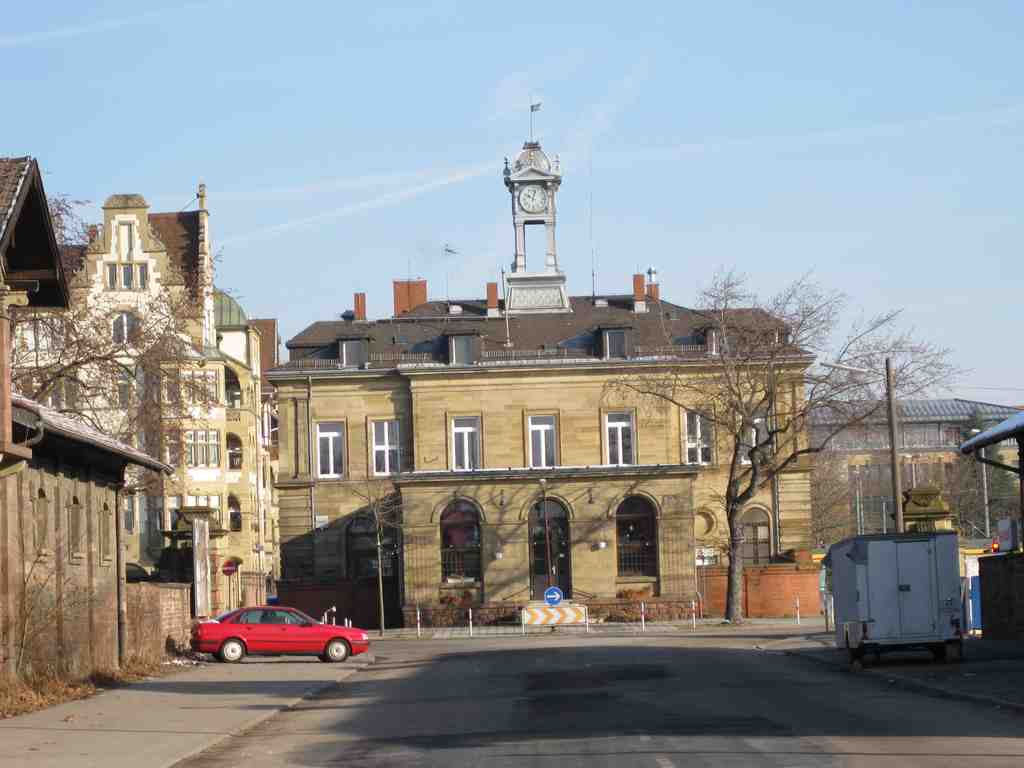
On your left, you will spot a sturdy, symmetrical stone building framed by arched ground-floor windows and topped with an ornate, prominent clock tower.
You might look at that grand facade and think it looks like a respectable municipal hall or a minor baroque palace. That is exactly what the city wanted you to think. Welcome to the Alter Schlachthof, a massive former industrial slaughterhouse complex that has been completely transformed into a vibrant creative park.
Back in the late nineteenth century, city planners decided to build a sprawling meat processing facility right here in the rising, fashionable Oststadt district. The local veterinary councilor, Dr. Lydtin, was panicked. He demanded that the gruesome, disgusting reality of industrial slaughter be hidden behind masterful architecture. So, the city architect designed a brilliant deception. He used elegant red sandstone, decorative masonry, and cast-iron columns to disguise a factory of death as a regal estate. The central layout mirrored a symmetrical seventeenth-century palace, a highly decorative architectural style meant to project wealth and order.
From the street, you would never guess that rivers of blood were flowing just behind the walls.
For over a century, this site was the epicenter of the city's meat production. And things got grim during times of extreme crisis. When standard livestock ran out, pure desperation drove the city to process alternative protein. Historical records show that dogs, cats, and rats were all butchered on these grounds to keep the population fed.
Eventually, the local industry simply could not compete with fully mechanized mega-slaughterhouses elsewhere. In 2006, the facility officially shut down. But instead of tearing it down, the city executed a remarkable feat of urban recycling. They turned the massive seven-hectare site into the Alter Schlachthof, a sprawling creative park.
The transition from heavy industry to digital innovation required some incredibly unpleasant engineering. Take the old pig market hall. The city decided to build a modern startup incubator inside it by stacking nearly seventy massive ocean shipping containers to serve as office pods. Sounds simple enough. Then the engineers looked at the floor. The historic ground was so deeply saturated with a century of pig excrement that the soil was structurally compromised and highly toxic. They had to excavate and entirely replace the foundation before the forklift drivers could begin their millimeter-precise maneuvering of the steel containers through the old doors.
Today, this complex houses an eclectic mix of software developers, designers, and artists. The modern additions deliberately clash with the historic brickwork. And the heritage protection board insisted on keeping the site's morbid charm intact. If you peek into some of the sleek new design agencies or tech startups, you will see heavy steel slaughter hooks still dangling from the ceilings.
Nothing boosts a morning brainstorming session quite like a massive meat hook hanging over your laptop.
Go ahead and wander deeper into the heart of this creative park. Once you have taken in the raw industrial energy, we will head over to our next stop, the Tollhaus Cultural Centre, which is just a four-minute walk away.




