
Moravské Budějovice Audio-Tour: Geschichten in Stein und Geist
Ein einziger Meißelschlag hallte einst durch Moravské Budějovice und schmiedete nicht nur Werkzeuge, sondern auch ein verborgenes Erbe unter diesen stillen Straßen. Diese selbstgeführte Audio-Tour enthüllt Schichten der Geschichte und des täglichen Lebens und führt Sie durch legendäre Arenen, geheime Werkstätten und die weniger bekannten Ecken der Stadt, über die Einheimische flüstern, die Reisende aber oft übersehen. Wer riskierte alles beim berüchtigtsten Aufstand von Moravské Budějovice? Welche geheime Botschaft ist in die Wände des Handwerksmuseums gemeißelt? Und warum geriet ein gewöhnliches lokales Hockeyspiel einst in einen Skandal und stadtweiten Aufruhr? Lassen Sie Ihre Schritte Sie durch Geschichten von Ehrgeiz und Rebellion tragen, wo jeder Stein von Erfindung, Rivalität und dem Puls der Stadtbewohner spricht, die zwischen Handwerk und Konflikt gefangen sind. Jede Wendung bietet eine neue Perspektive auf die lebendige Vergangenheit der Stadt. Ihre Reise ins Herz der Geheimnisse von Moravské Budějovice beginnt jetzt. Hören Sie genau zu und treten Sie ein in das Erbe hinter dem Echo.
Tourvorschau
Über diese Tour
- scheduleDauer 30–50 minsEigenes Tempo
- straighten1.5 km FußwegDem geführten Pfad folgen
- location_onStandortMoravské Budějovice, Tschechien
- wifi_offFunktioniert offlineEinmal herunterladen, überall nutzen
- all_inclusiveLebenslanger ZugriffJederzeit wiederholen, für immer
- location_onStartet bei Moravské Budějovice
Stopps auf dieser Tour
Right in front of you is a deep red, two-gabled townhouse with white trim and little spiral curls on the roofline, facing the square like it owns the place. This is House No. 32…Mehr lesenWeniger anzeigen
Right in front of you is a deep red, two-gabled townhouse with white trim and little spiral curls on the roofline, facing the square like it owns the place. This is House No. 32 on Peace Square, and it’s been holding its ground since the 1400s... which is an impressively long time to stay fashionable. It started as a medieval burgher’s house stretched across two narrow plots, then took a nasty hit in the big fire of 1532. Cities have always had that one year everyone complains about. What you see now is the later, late-Baroque facelift: two matching fronts, a central entrance, shop windows at street level, and those playful volute gables up top with round oculus windows-basically the building equivalent of raised eyebrows. Inside, it gets serious: cross-rib vaults in the front rooms, barrel vaults deeper in, and a classic mazhaus entry hall leading to a bent staircase-designed to funnel people, goods, and gossip efficiently. When you’re set, Blažek's House (Moravské Budějovice) is a 1-minute walk heading southwest.
Eigene Seite öffnen →
7 weitere Stationen anzeigenWeniger Stationen anzeigenexpand_moreexpand_less
On your left, look for the long, orange-and-white house with the big black double doors under a pale arched doorway and the painted sign that reads “BARVY - LAKY.” This is…Mehr lesenWeniger anzeigen
On your left, look for the long, orange-and-white house with the big black double doors under a pale arched doorway and the painted sign that reads “BARVY - LAKY.” This is Purcnerova 64, a protected town house that’s been holding its ground since the early 1600s... back when late Renaissance style was the fashionable choice. Then the 1700s rolled in and Baroque tastes took over, so the place got a makeover-same bones, more drama. From the street you can read its orderliness: the facade is framed by flat vertical strips and lined up windows, capped by a strong cornice like a firm eyebrow. That arched carriage portal? It’s not just pretty-it was built for traffic, the kind with hooves and wooden wheels. Inside, the ground floor is covered in barrel vaults, sturdy enough for busy merchants and their goods, while upstairs relaxes into flatter ceilings. It also sits by where the southern city gate used to be… meaning this was prime real estate, with a front-row seat to who came and went. When you’re set, Masné krámy (Moravské Budějovice) is a 1-minute walk heading north.
Eigene Seite öffnen →On your left are the Masné krámy… the old meat stalls of Moravské Budějovice, and yes, this building is officially protected, because a town should remember where it fed itself.…Mehr lesenWeniger anzeigen
On your left are the Masné krámy… the old meat stalls of Moravské Budějovice, and yes, this building is officially protected, because a town should remember where it fed itself. The first meat market stood right in the middle of the main square, with records going back to 1522. For more than 300 years, this was where you’d come for dinner ingredients and a little neighborhood gossip… until 1837, when locals pushed to have the old stalls torn down. Nothing says “civic improvement” like demolishing the butcher shops. Two years later, in 1839, this newer classicist complex went up here with twelve shops. Today you can still make out the layout: a horseshoe shape opening to the street, a small courtyard behind a stone wall, and that arched gate… practical, sturdy, built for work. By the 1930s the butchers were gone, clubs moved in, the place wore down, then a 1972 rebuild turned it into a museum, with major repairs again in 2001 and 2002. Since 2003, the eight surviving stalls have been part of the Museum of Crafts. When you’re set, Church of St. Giles (Moravské Budějovice) is a 0-minute walk heading west.
Eigene Seite öffnen →In front of you, look for the tall yellow-and-cream church tower with clock faces near the top, rising above the red-tiled roof right beside the château buildings. This is the…Mehr lesenWeniger anzeigen
In front of you, look for the tall yellow-and-cream church tower with clock faces near the top, rising above the red-tiled roof right beside the château buildings. This is the Church of St. Giles, the main Catholic parish church in Moravské Budějovice, sitting just south of the main square on Purcnerova Street. And it’s older than it looks like it should be… the earliest written mention goes back to 1235, when Constance of Hungary donated this church-along with others-to support a hospital connected to the Franciscan monastery in Prague. So yes, this place was already doing community service while most of Europe was still figuring out forks. Architecturally, it’s a single-nave church with a Romanesque core-meaning some of its bones trace back to the medieval world. Over time, it grew in stages: first the presbytery and nave, then the tower with its sacristy and oratory, then a long series of upgrades that tell you one thing… nobody ever truly finishes a church. It also had its share of bad-luck anniversaries: the nearby parish building burned in 1532, and then again in 1633. Still, the church pushed on-new chapels were added, the main space was vaulted, and by the early 1700s the building took on much of its present look. The current tower, just over 50 meters tall, even doubles as a viewpoint if you’re willing to earn it with stairs. Up in that tower hang three bells, with the oldest cast in 1432-still on duty after centuries of weather, war, and human decision-making. When you’re set, the Vicarage is a 1-minute walk heading west.
Eigene Seite öffnen →On your right, look for a small gray chapel with a rounded “bubble” gable and a little dark wooden bell-turret on the roof, tucked between tall trees and two skinny evergreens.…Mehr lesenWeniger anzeigen
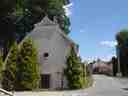
On your right, look for a small gray chapel with a rounded “bubble” gable and a little dark wooden bell-turret on the roof, tucked between tall trees and two skinny evergreens. So this is the Chapel of Saint Anne, sitting here on Peroutka Street... quietly doing what old buildings do best: surviving everybody’s “improvements.” It’s a protected cultural monument today and part of the local Roman Catholic parish under the Brno diocese, but its story starts way earlier, out on what used to be the suburb called Dolní Víska. Before 1406, there was a monastery here, and with it a Gothic chapel. The monastery itself didn’t make it-between 1985 and 1988 it was demolished-but a piece of it still clings on: the sacristy on the north side. History has a brutal edit button sometimes. The chapel kept getting rebuilt and even kept getting re-dedicated, which is a very polite way of saying it couldn’t make up its mind. First it was for Saint John, then in the 1600s it switched to Saint Mark, and since the 1700s it’s been Saint Anne’s place. Around 1715 or 1720, it got a Baroque makeover, including a new ceiling over the main space. The roof changed too-wood shingles out, fired clay tiles in, by 1853. And here’s the fun part: look closely at the south wall and you can still catch traces of the older Gothic chapel-an outline of a stone doorway and a bricked-up Gothic window ghosting through the newer plaster. Even covered up, the past still shows through. When you’re set, HC Žihadla Moravské Budějovice is about an 11-minute walk heading southeast.
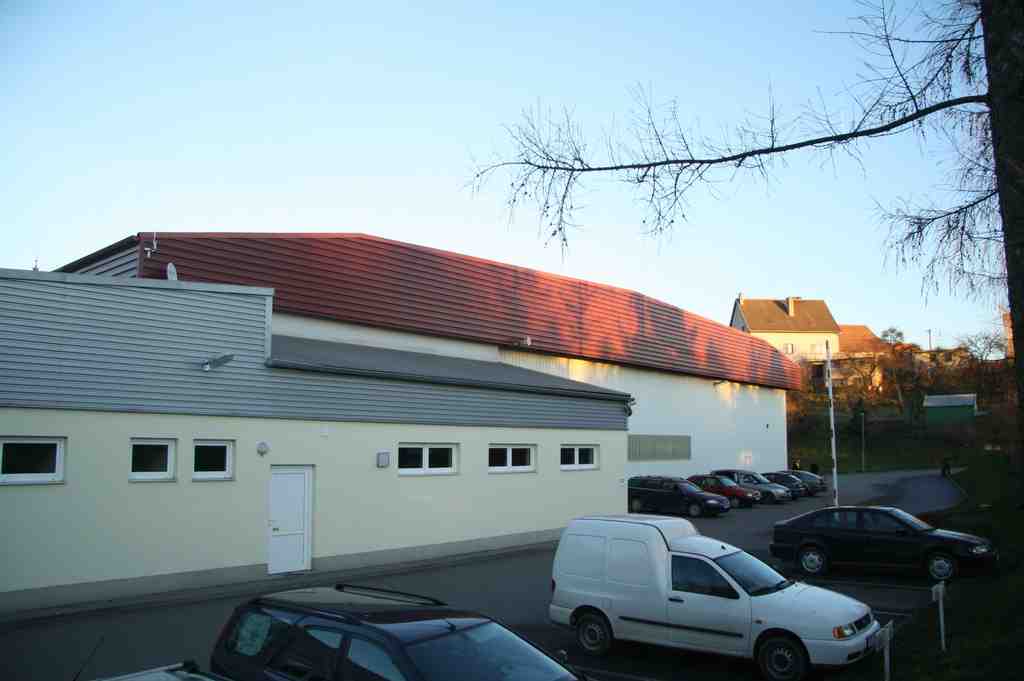
Eigene Seite öffnen →On your left, look for the low, pale sports building with a long row of small rectangular windows and a big curved roof behind it in a rusty red color. This is the home base of…Mehr lesenWeniger anzeigen
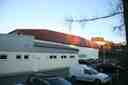
On your left, look for the low, pale sports building with a long row of small rectangular windows and a big curved roof behind it in a rusty red color. This is the home base of HC Žihadla Moravské Budějovice… and if you’re wondering, yes, “Žihadla” means “stings.” Because nothing says a relaxing evening out like being politely threatened by a wasp-themed hockey club. The team plays at the Moravské Budějovice ice stadium right here, a cozy 1,350-seat rink where you’re never far from the action… or the sound of skates carving into ice like someone tearing open wrapping paper in a hurry. On game night, it’s that mix of cold air, hot tea, and the very Czech belief that yelling advice from the stands is a legitimate coaching credential. What’s fun is how long this town had to wait for real ice. Hockey in Moravské Budějovice starts way back in 1919, when a local military unit set up a rink on meadows below the Heřman hills. Not exactly an NHL facility… more like “we found a flat spot and winter did the rest.” By 1925, the Sokol movement-those community gym and sports groups-had their own rink at the city fish ponds. Practical? Maybe. Romantic? Only if you like the smell of carp. Then came decades of trying-and failing-to build an artificial ice surface. The 1970s and 80s were full of ambition, and not much ice. Plans finally started to stick in 1995, serious talks began in 2003, and in 2005 the town opened its first winter stadium… and founded the club that would grow into today’s Žihadla. So yes, it took about eighty years to go from “natural ice if we’re lucky” to “a proper roof and boards.” The club’s name changed a few times-ownership shifts, rebrands, the usual sports-world identity crisis-but the black-and-yellow colors stayed ready for business. Since 2020/21 they’ve been battling in the Vysočina regional league, the fourth level nationally… where grit matters, budgets are tight, and hometown pride is the real trophy. And in 2024 they even added a B-team-smart insurance for young local players who age out of juniors, because Žihadla doesn’t run its own junior squad. The playing coach for 2024/25 is owner Peter Pucher, an experienced forward… which is a very “small-town hockey” thing to do: run the club, then hop on the ice and try to score. Multitasking, but with more bruises. If you’ve made it this far, you’ve earned a seat in the stands… even if only in your imagination.
Eigene Seite öffnen →

Häufig gestellte Fragen
Wie starte ich die Tour?
Laden Sie nach dem Kauf die AudaTours-App herunter und geben Sie Ihren Einlösecode ein. Die Tour ist sofort startbereit – tippen Sie einfach auf „Play“ und folgen Sie der GPS-geführten Route.
Benötige ich während der Tour Internet?
Nein! Laden Sie die Tour vor dem Start herunter und genießen Sie sie vollständig offline. Nur die Chat-Funktion benötigt Internet. Wir empfehlen den Download über WLAN, um mobiles Datenvolumen zu sparen.
Handelt es sich um eine geführte Gruppentour?
Nein – dies ist ein selbstgeführter Audioguide. Sie erkunden unabhängig in Ihrem eigenen Tempo, wobei die Audioerzählung über Ihr Telefon abgespielt wird. Kein Reiseleiter, keine Gruppe, kein Zeitplan.
Wie lange dauert die Tour?
Die meisten Touren dauern 60–90 Minuten, aber Sie kontrollieren das Tempo vollständig. Pausieren Sie, überspringen Sie Stopps oder machen Sie Pausen, wann immer Sie wollen.
Was, wenn ich die Tour heute nicht beenden kann?
Kein Problem! Touren haben lebenslangen Zugriff. Pausieren Sie und setzen Sie sie fort, wann immer Sie möchten – morgen, nächste Woche oder nächstes Jahr. Ihr Fortschritt wird gespeichert.
Welche Sprachen sind verfügbar?
Alle Touren sind in über 50 Sprachen verfügbar. Wählen Sie Ihre bevorzugte Sprache beim Einlösen Ihres Codes. Hinweis: Die Sprache kann nach der Tour-Generierung nicht mehr geändert werden.
Wo greife ich nach dem Kauf auf die Tour zu?
Laden Sie die kostenlose AudaTours-App aus dem App Store oder von Google Play herunter. Geben Sie Ihren Einlösecode (per E-Mail gesendet) ein, und die Tour erscheint in Ihrer Bibliothek, bereit zum Download und Start.
Wenn Ihnen die Tour nicht gefällt, erstatten wir Ihnen den Kaufpreis. Kontaktieren Sie uns unter [email protected]
Sicher bezahlen mit 


