阿伯丁语音导览:阿伯丁的双重地标之旅
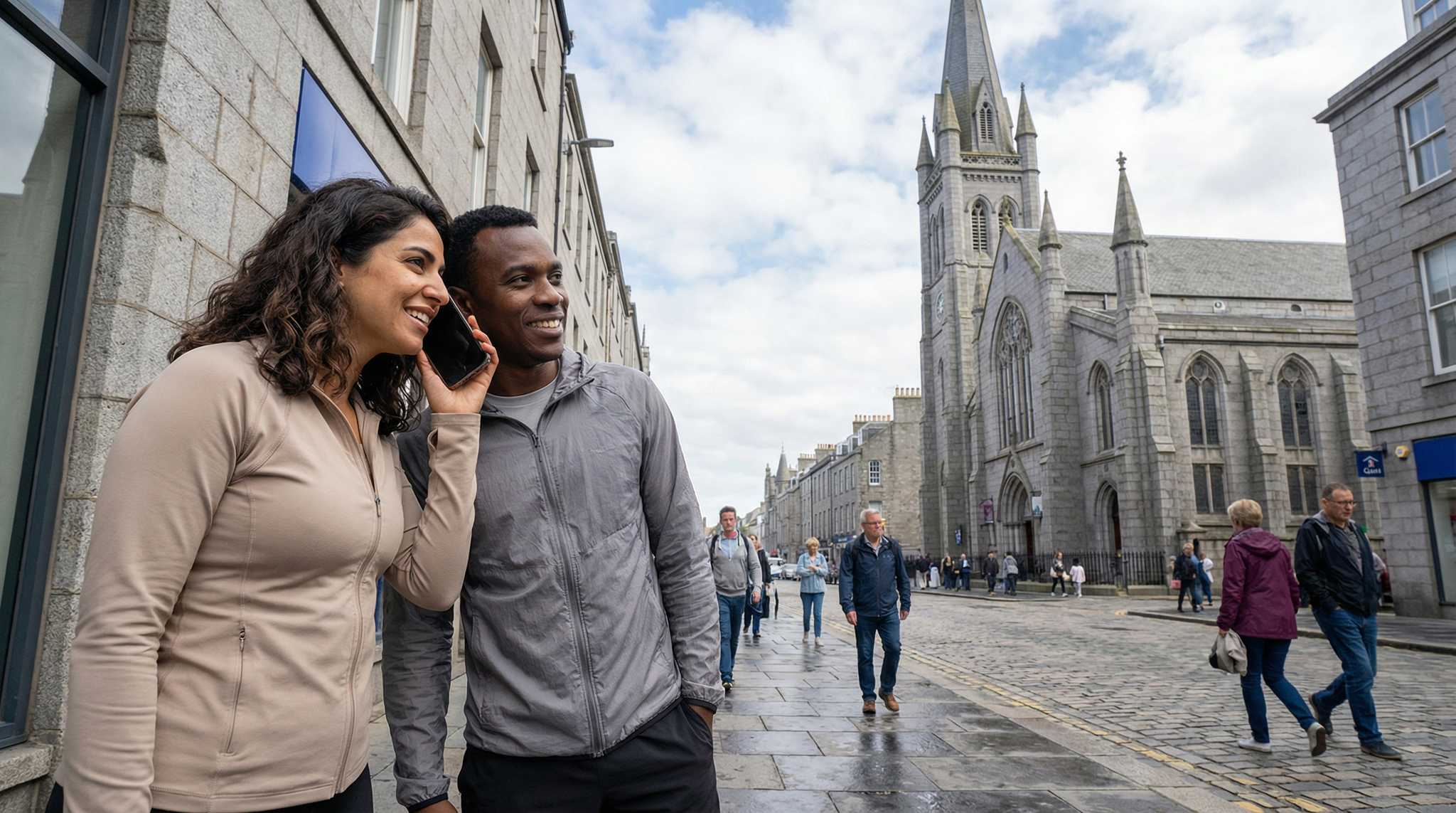
海雾笼罩着阿伯丁的花岗岩英里,秘密在其历史悠久的外墙后徘徊。这不是您从飞驰的汽车中瞥见的城市——这是一次自助语音导览,将科学、丑闻和无声反抗的层层故事,就在您的脚下,一一揭示。 是什么促使海滩舞厅的午夜对决让政客们哑口无言?哪件传奇文物差点永远消失在圣安德鲁大教堂的拱形阴影中?阿伯丁科学中心里,谁在电视直播中试图智胜机器,却惨遭失败? 从大教堂的尖顶漫步到闪烁的海岸线,耳语的阴谋、古怪的发明和未解之谜在清新的北方空气中鲜活起来。每一步,您都将从新的视角审视这座由大胆和魅力塑造的城市。 阿伯丁不为人知的一面正等待被发现。按下播放键,让真实的故事从花岗岩的寂静中浮现。
导览预览
关于此导览
- schedule持续时间 30–50 mins按照自己的节奏
- straighten3.0 公里步行路线跟随引导路径
- location_on
- wifi_off离线工作一次下载,随处使用
- all_inclusive终身访问随时重播,永久有效
- location_on从 城堡门,阿伯丁 开始
此导览的景点
Look for the dark stone, open-arched monument with a chunky carved base and a tall column on top, sitting right in the square at the end of Union Street. Welcome to…阅读更多收起
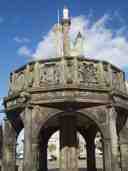
Look for the dark stone, open-arched monument with a chunky carved base and a tall column on top, sitting right in the square at the end of Union Street. Welcome to Castlegate... a small patch of ground with an outsized sense of drama. You can feel it in the way the space opens up, like the city takes a breath here. Officially it’s a central square; in local terms, it’s where Union Street runs out of road and Aberdeen’s history starts throwing elbows. Up at the top end of the area, The Salvation Army Citadel stands with its castle-like look, and that’s no accident. This is the old stomping ground of medieval Aberdeen Castle, and Castlegate literally got its name from the castle gates that once stood here... until they were destroyed in 1308. Nothing says “new chapter” like knocking down the front door. Castlegate was also the city’s practical “in and out” point: first trams, then buses, all funneling people through the same historic pinch point where merchants, soldiers, and ordinary folks have been passing for centuries. And there’s a darker edge too. Just off the square is the Gallowgate, named for the gallows that once stood nearby. A little strip of old granite paving still survives in the bus lane by the courts... right around the spot where public hangings happened. The stones remember. When you’re set, St Andrew’s Cathedral is a 3-minute walk heading northeast.
打开独立页面 →On your right, look for the pale stone church with tall, spiky corner pinnacles and three big pointed-arch windows stacked across the front. This is St Andrew’s Cathedral, the…阅读更多收起
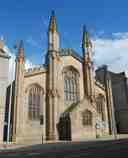
On your right, look for the pale stone church with tall, spiky corner pinnacles and three big pointed-arch windows stacked across the front. This is St Andrew’s Cathedral, the Episcopal cathedral for Aberdeen and Orkney... and it’s got the kind of backstory that starts with politics and ends with architecture trying to keep a straight face. The Scottish Episcopal Church found itself in a rough spot after 1688, when King James VII was pushed out. Episcopalians were suspected of still backing him, and new laws basically told them: hand over your churches, and while you’re at it, don’t build new ones. Oh-and keep gatherings small. Nothing says “religious settlement” like making prayer meetings feel like a suspicious book club. So for a long time, the congregation existed in a kind of semi-shadow. The first clear record we have is from 1716, when a priest named Andrew Jaffrey served the group-but where they actually met is anyone’s guess. Then in 1776, Bishop John Skinner got practical: he built a house in Long Acre and used an upstairs room as a chapel. Imagine climbing the stairs to worship, trying not to creak the floorboards too loud. After restrictions eased in 1792, they finally put up Saint Andrew’s Chapel next door, and worshipped there for about 25 years. By 1817, confidence-and stone-had returned. The building you’re looking at opened that year, designed by Archibald Simpson in a perpendicular Gothic style: crisp vertical lines, pointed arches, and all the “reach for the heavens” energy you could want on a windy Aberdeen day. Most of it is local granite-Aberdeen’s signature stuff-but the front facing the street is sandstone, chosen because it was cheaper. Simpson wasn’t thrilled. Architects rarely are when budgets start talking. The cathedral kept evolving: a chancel was added in 1880 by George Edmund Street, and a porch came in 1911 by Robert Lorimer. Then in the 1930s, renovations took a transatlantic turn-because Aberdeen played a quiet but vital role in American church history. In 1784, Samuel Seabury became the first bishop of what would become the Episcopal Church in the United States, consecrated here in Aberdeen-well, not here exactly, but in that earlier “upper room” chapel setup. Plans were made for a grand expansion funded by the American church... then the Wall Street crash hit, and the big dream shrank to something more realistic. Still, decorator Ninian Comper made sure it looked glorious: a vaulted ceiling with panels showing the coats of arms of the then 48 U.S. states alongside local families, plus a gold-painted canopy in the chancel that catches the light like it’s got something to prove. And here’s a detail worth keeping in your pocket: in 1938, the U.S. ambassador Joseph Kennedy opened an extension-accompanied by his 21-year-old son, John. Yes, that Kennedy. History has a funny way of slipping through side doors. Even recently, this place has had cliffhanger moments. Financial strain and building issues forced a temporary closure in 2020, right in the pandemic mess, but it reopened for worship in December 2021-still gathering on Sundays and Thursdays, still doing what it’s been doing for centuries: adapting. When you’re set, Aberdeen’s Mercat Cross is a 2-minute walk heading south.
打开独立页面 →On your left, look for the dark-stone, open-arched pavilion with a chunky hexagonal base and a tall carved column rising up to a small ROYAL UNICORN on top. This is Aberdeen’s…阅读更多收起
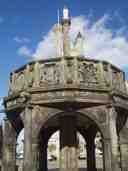
On your left, look for the dark-stone, open-arched pavilion with a chunky hexagonal base and a tall carved column rising up to a small ROYAL UNICORN on top. This is Aberdeen’s Mercat Cross, built in 1686 by local architect John Montgomery... basically the city’s old-fashioned “official announcements go here” spot, only with better stonework. Step closer and you’ll see how showy it gets: a broad, six-sided platform about 21 feet across, wrapped in carvings and round medallions of Scottish monarchs, from James I all the way to James VII. Above that, a central shaft climbs to a Corinthian capital... and then, the unicorn. Because if you’re going to represent royal power, you may as well pick the most dramatic horse available. But this place has bite, too. In 1715, during the Jacobite rising, James Stuart, the “Old Pretender,” was proclaimed king right here... words that could get you cheered or chased, depending who was listening. And locals still swear that on a full moon, a ghostly unicorn circles the Castlegate... sure, why not. Ready for St Peter's Church, Aberdeen? Just walk northeast for 1 minute.
打开独立页面 →
再显示 8 个站点显示更少站点expand_moreexpand_less
On your left, look for the gray granite church frontage tucked into this little courtyard, with tall pointed Gothic windows and those unmistakable bright BLUE doors. This is St…阅读更多收起
On your left, look for the gray granite church frontage tucked into this little courtyard, with tall pointed Gothic windows and those unmistakable bright BLUE doors. This is St Peter’s Church... and it’s a quiet little milestone with a big backstory. After the Reformation, Aberdeen didn’t exactly roll out the welcome mat for permanent Roman Catholic churches. So for a while the faithful made do with something more low-key: in 1774 there was a small chapel here on the ground floor of a house, with living quarters above. Practical, modest, and easier to ignore if you were the suspicious type. Then the congregation grew, and by the time Father Charles Gordon arrived in 1795, the place was getting tight. In early 1803 he started rounding up money and materials, and on 24 February the digging began right here. On 15 April, he laid the foundation stone... a real “we’re doing this” moment. He guessed the whole project would cost £1,049, which is roughly about £100,000 today. Not bad for a community build. Architect James Massie designed it in Gothic Revival style, and the first Mass was celebrated in November 1803, even while work kept going until August 1804. It was dedicated that month by Bishop Alexander Cameron. Later came a gallery in 1815, a finished façade in 1817, and a high altar made in Belgium installed in the late 1890s. The twist? It actually closed in 1860 when a new cathedral opened, briefly serving a boys’ school chapel, then a home for the elderly and infirm... before finally reopening for good in 1880. Some buildings just refuse to retire. Ready for Castlehill Barracks? Just walk southeast for 2 minutes.
打开独立页面 →As you come up on your right… you’re standing near where Castlehill Barracks once kept watch over Aberdeen. This spot started out with a 12th-century castle up on the hill, the…阅读更多收起
As you come up on your right… you’re standing near where Castlehill Barracks once kept watch over Aberdeen. This spot started out with a 12th-century castle up on the hill, the kind of place that made you feel small even before anyone raised their voice. Then, between 1764 and 1796, Aberdeen built proper barracks here-because, at the time, France felt a little too close for comfort. Picture the scene: boots on stone, shouted orders carried on sharp sea air, and rows of men drilling as if a fleet might appear any minute. Later, the army got more organized. In the 1870s and 1880s, reforms turned these buildings into a recruiting depot-most famously for the Gordon Highlanders, after regiments merged and a big new block went up around 1880 to 1881. By the early 1900s, though, the place was tired… and by 1935 the soldiers moved out. In the 1940s and 1950s it became emergency housing, and in 1965 it was demolished for flats. When you’re set, Aberdeen Community Health and Care Village is a 5-minute walk heading northwest.
打开独立页面 →On your left, look for the long, pale, modern building with narrow dark windows and crisp, boxy corners sitting right along the road. This is the Aberdeen Community Health and…阅读更多收起
On your left, look for the long, pale, modern building with narrow dark windows and crisp, boxy corners sitting right along the road. This is the Aberdeen Community Health and Care Village, or as locals often shorten it, the Health Village... which sounds cozy until you remember it’s mostly about appointments. The plan was announced in 2010, and by December 2013 this £15 million complex opened-roughly £21 million in today’s money-run by NHS Grampian. It also made a small bit of Scottish construction history: it was the first healthcare project finished under the Scottish Futures Trust “hub” model, meant to get public buildings delivered without endless faff. Inside, it’s built to handle around 700 patients a day, with 275 rooms: dental suites, minor procedure rooms, and consulting spaces for everything from physio and podiatry to radiology and sexual health. Since 2014, endoscopy joined the list too. And it’s not just treatment-there’s a strong education side for patients, carers, and healthcare staff. Keep an eye out for the big mural started in 2021 by Fanakapan for NuArt... street art, meeting healthcare, very Aberdeen. When you’re set, City Hospital is about a 9-minute walk heading east.
打开独立页面 →On your right, look for the solid gray-granite hospital building with long rows of windows and a central tower topped by a fancy iron crown and a small clock. This is Aberdeen’s…阅读更多收起
On your right, look for the solid gray-granite hospital building with long rows of windows and a central tower topped by a fancy iron crown and a small clock. This is Aberdeen’s City Hospital, a place that’s been quietly doing the hard work for a long time. It opened in 1874-built specifically to handle infectious diseases-back when “public health” often meant “try not to stand too close to anyone.” The architect was William Smith, and you can feel that Victorian confidence in the sturdy stonework… like the building is saying, “Germs, form an orderly queue.” It grew fast-major expansion in 1895-and by 1931 they’d added a nurses’ home, because staff needed to be close when the hours were long and the stakes were higher. In 1948, the hospital became part of the new National Health Service. Then came 1964: Aberdeen’s typhoid outbreak. Over 400 cases… and patients were quarantined here and at Woodend. The tense part? No one died. Medicine, teamwork, and a bit of luck. When you’re set, Aberdeen Science Centre is a 7-minute walk heading north.
打开独立页面 →On your right, look for the sturdy gray granite building with bright blue doors and window frames, topped with a big arched glass entrance that reads “The Tramsheds.” This place…阅读更多收起
On your right, look for the sturdy gray granite building with bright blue doors and window frames, topped with a big arched glass entrance that reads “The Tramsheds.” This place is Aberdeen Science Centre… a hands-on science museum where you’re encouraged to poke, press, spin, and generally behave like a curious eight-year-old with adult-sized reach. It runs on the idea that science sticks better when it’s fun, so you’ll find interactive exhibits, shows, and workshops that pull in everyone from school groups to “I’m just here for the café” grown-ups. There’s a great bit of recycling in the story, too: this building used to be a tram depot, so where engineers once kept the city moving with steel wheels and overhead lines, the centre now keeps minds moving with experiments. It started life as “Satrosphere” back in 1990, built with council support and public donations, then moved here in 2001. A major renovation wrapped up in 2020, adding a mezzanine and giving the old tramsheds a smart second act. When you’re set, Beach Ballroom is a 6-minute walk heading northeast.
打开独立页面 →Look to your left for a low, bright granite Art Deco building with a wide entrance, tall window panels, and a big octagonal roof topped by a little cupola. This is Aberdeen’s…阅读更多收起
Look to your left for a low, bright granite Art Deco building with a wide entrance, tall window panels, and a big octagonal roof topped by a little cupola. This is Aberdeen’s Beach Ballroom, built in 1926, when going out dancing was cheaper than therapy and much better exercise. It’s Category B listed now, but it’s always had star power: the Beatles, Pink Floyd, the Who, Cream… a whole parade of “before they were legends” nights happened under this roof. Step closer and you’re standing by one of its best tricks: the famous dance floor rides on about 1,400 steel springs, so the room quite literally moves with the crowd. If you ever feel the bounce, that’s not your sea legs. Inside, the main hall is octagonal; it once had a proper dome, later hidden by a suspended ceiling. In 1963, they added the Star Ballroom extension, and after a major refurb from 2008 to 2010, it got a new polish without losing its soul. It’s still run by the city council, and there’s even a webcam pointed down the beach toward Footdee. When you’re set, Linx Ice Arena is a 4-minute walk heading east.
打开独立页面 →On your left, look for the angular glass-fronted building with a tall purple panel that reads “LINX ICE ARENA,” like a big wedge of windows and steel. This is Linx Ice Arena,…阅读更多收起
On your left, look for the angular glass-fronted building with a tall purple panel that reads “LINX ICE ARENA,” like a big wedge of windows and steel. This is Linx Ice Arena, Aberdeen’s indoor winter wonderland… conveniently parked beside the seaside, because Scotland likes a little contrast. Plans for an ice rink here got the official nod on 4 December 1986, then again on 20 March 1989, and by 1 February 1992 the doors opened and the chill was finally on purpose. The twist? It was built on an early 20th-century landfill, which is a very Aberdeen way of saying, “Sure, we can make something brilliant out of whatever we’ve got.” Inside, you’ll catch that sharp, clean smell of ice and hear the scrape of blades and the smack of hockey pucks… home territory for the Aberdeen Lynx Ice Hockey Club. A 2017 refurbishment gave the place a fresher face, but the spirit is still pure rink. When you’re set, Beach Leisure Centre is a 3-minute walk heading east.
打开独立页面 →On your right, look for the low, wide building with a big glassy, triangular “gable” entrance and the Sport Aberdeen sign on the brick wall. This was the Beach Leisure Centre...…阅读更多收起
On your right, look for the low, wide building with a big glassy, triangular “gable” entrance and the Sport Aberdeen sign on the brick wall. This was the Beach Leisure Centre... or, depending on when you last came, the place you learned to swim, the place you pretended you still swam, or the place you swore you’d “get back to next week.” It opened in 1989, after years of council talk going back to 1979 and construction starting in 1986. First came the centre itself on March 1st, then the pool followed four months later, on June 26th. Early on it was run by a company called Crossland Leisure, and later operated by Sport Aberdeen. It was stitched right into its neighbor, the Beach Ballroom, and sat shoulder-to-shoulder with Linx Ice Arena-basically a whole little strip of “burn off the pies” options. Inside: a pool, a gym, and three proper flumes. The Tube was the big one-120 meters on inflatable rafts-plus the shorter, steeper Wipeout, and the 95-meter Pipeline. But the story gets a little gritty. In 2011, a 12-year-old broke his ankle and shin after hitting the end wall of the Wipeout because there wasn’t enough water to slow him down. Sport Aberdeen was fined £8,000-about £12,000 today, roughly $15,000 USD-for the safety failure. Then came the modern squeeze: rising energy costs shut the leisure pool in August 2022. And in April 2023, after the council cut Sport Aberdeen’s funding by £687,000 a year-around £750,000 today, roughly $950,000 USD-the centre closed for good. Not long after, it was cleared as part of the £150 million City Centre/Beach Masterplan. One more piece of everyday Aberdeen, gone with the tide.
打开独立页面 →
常见问题
如何开始导览?
购买后,下载 AudaTours 应用并输入您的兑换码。导览将准备好立即开始--只需点击播放并按照 GPS 引导的路线行驶即可。
导览期间我需要互联网吗?
不需要!开始前下载导览并完全离线享受。只有聊天功能需要互联网。我们建议在 WiFi 下下载以节省移动数据。
这是导游带领的团体游吗?
不是--这是自助语音导览。您按照自己的节奏独立探索,通过手机播放音频解说。没有导游,没有团体,没有时间表。
导览需要多长时间?
大多数导览需要 60-90 分钟才能完成,但您完全控制节奏。随时暂停、跳过站点或休息。
如果我今天无法完成导览怎么办?
没问题!导览具有终身访问权限。随时暂停和恢复--明天、下周或明年。您的进度已保存。
有哪些语言可用?
所有导览均提供 50 多种语言版本。在兑换代码时选择您的首选语言。注意:导览生成后无法更改语言。
购买后我在哪里访问导览?
从 App Store 或 Google Play 下载免费的 AudaTours 应用。输入您的兑换码(通过电子邮件发送),导览将出现在您的资料库中,准备下载并开始。
如果您不喜欢该导览,我们将退款。请联系我们 [email protected]
安全结账使用